The 2026 Medspa Blueprint: Maximizing Clinical ROI with the Lav Dual 1927nm + 1550nm Non-Ablative Fractional Laser
I. Executive Summary
In the rapidly evolving landscape of medical aesthetics, patient demand is unequivocally shifting toward high-efficacy, low-downtime procedures. While single-wavelength non-ablative lasers have served the industry well, they often force clinicians to compromise between treating superficial pigmentation and addressing deep dermal remodeling. Enter the Lav Dual, a premium dual-wavelength platform that integrates both 1927nm (Thulium) and 1550nm (Erbium:Glass) fractional technologies. This comprehensive guide unpacks the science, clinical applications, and business rationale behind this advanced system, demonstrating why it is a critical asset for modern, high-volume aesthetic practices.
II. The Clinical Rationale: Why Invest in a Dual-Wavelength System?
Historically, aesthetic practices had to invest in multiple standalone devices to treat the full spectrum of photoaging.
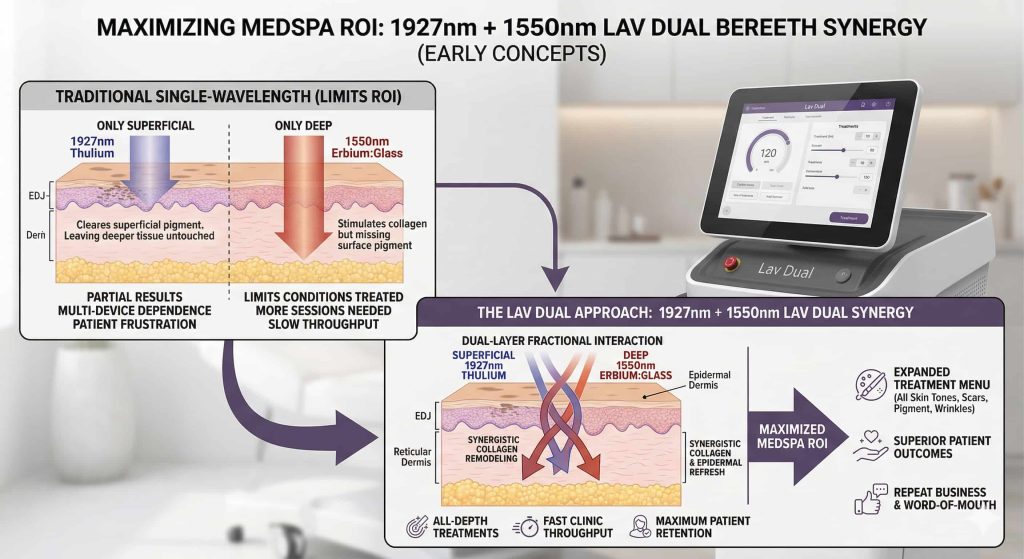
- The Limitation of Single Wavelengths: A standalone 1550nm laser is exceptional for deep wrinkles and acne scars but lacks the absorption characteristics to efficiently clear superficial sun damage. Conversely, a standalone 1927nm laser brilliantly erases epidermal pigment but cannot penetrate deeply enough to stimulate profound collagen synthesis for structural skin issues.
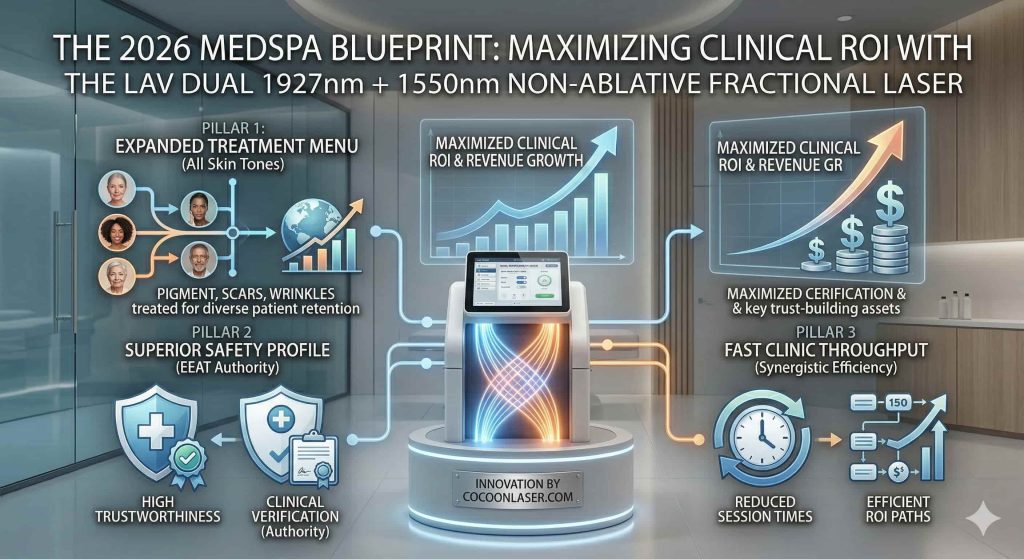
- The Dual Advantage: The Lav Dual eliminates this compromise. By housing both wavelengths in a single platform, it allows practitioners to execute a 3D, multi-layered approach to skin resurfacing in a single session. This dual-action capability dramatically increases the clinic’s treatment menu, accelerates patient throughput, and significantly boosts Return on Investment (ROI) while minimizing overhead and taking up less physical space in the treatment room.
III. What is the Lav Dual 1927nm + 1550nm System?
The Lav Dual is an advanced, medical-grade non-ablative fractional laser workstation. To maintain strict clinical accuracy, it is important to note that it combines two distinct laser mediums:
- 1927nm Thulium Laser: Engineered for superficial targeting.
- 1550nm Erbium-Doped Glass (Erbium:Glass) Laser: Engineered for deep dermal penetration.
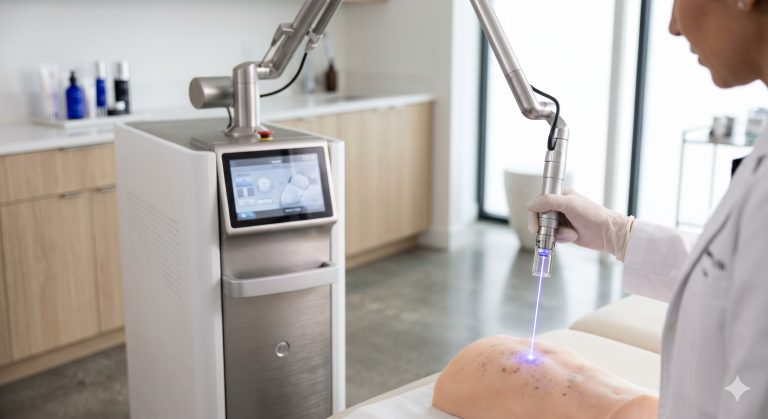
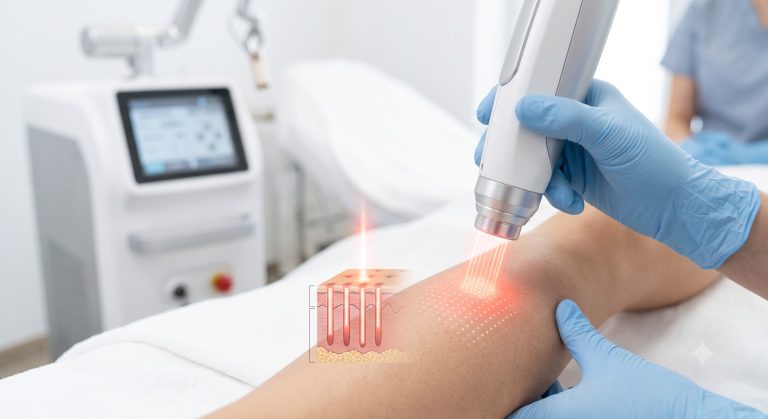
Instead of vaporizing tissue (ablation), the Lav Dual utilizes Fractional Photothermolysis. It creates thousands of Microscopic Thermal Zones (MTZs)—tiny columns of coagulated tissue—while leaving the surrounding skin entirely intact. This intact tissue acts as a biological reservoir, initiating a rapid, natural wound-healing cascade that replaces damaged cells with fresh, healthy tissue with minimal social downtime.
IV. The Science of Penetration: How the Lav Dual Works
The exceptional efficacy of the Lav Dual lies in the physics of its specific wavelengths and their interaction with the skin’s primary chromophore in non-ablative resurfacing: water.
- The 1550nm Action (Deep Remodeling): The 1550nm wavelength has a moderate absorption coefficient for water. This allows the laser energy to bypass the epidermis and penetrate deep into the reticular dermis (up to 1.4mm). The thermal injury here triggers the body’s fibroblasts to produce new collagen and elastin. This is the gold standard for treating:
- Atrophic acne scarring
- Deep rhytides (wrinkles)
- Surgical scars and striae (stretch marks)
- The 1927nm Action (Superficial Resurfacing): The 1927nm Thulium wavelength has a much higher absorption coefficient for water than the 1550nm. Because the energy is absorbed more rapidly, it does not penetrate as deeply. Instead, it focuses its thermal energy precisely at the epidermal-dermal junction (EDJ), typically penetrating only 200-300 microns. This makes it devastatingly effective at shedding pigmented cells, treating:
- Melasma and stubborn hyperpigmentation
- Actinic keratoses and sun spots
- Uneven skin tone and enlarged pores
V. Clinical Parameter Comparison: Lav Dual vs. Market Alternatives
Understanding the technological positioning of the Lav Dual requires a direct comparison against other standard clinical options.
| Feature / Metric | Lav Dual (1927nm + 1550nm) | Standalone 1927nm Thulium | Standalone 1550nm Erbium:Glass | Ablative CO2 (10600nm) |
| Ablation Profile | Strictly Non-Ablative | Non-Ablative | Non-Ablative | Highly Ablative |
| Treatment Depth | Customizable (Superficial to Deep) | Superficial Only | Deep Only | Variable (vaporizes tissue) |
| Pigment Efficacy | Excellent (via 1927nm) | Excellent | Poor to Moderate | Good (but high PIH risk) |
| Scar/Wrinkle Efficacy | Excellent (via 1550nm) | Poor | Excellent | Exceptional |
| Patient Downtime | 1 – 4 Days (Redness/Bronzing) | 12 – 24 Hours | 3 – 5 Days | 7 – 14 Days (Oozing/Crusting) |
| Fitzpatrick Safety | High (Types I – VI) | High | High | Low to Moderate (High risk for dark skin) |
VI. Frequently Asked Questions (FAQs) for Clinic Owners
- Q: Can both wavelengths be used in the same treatment session?A: Yes. This is often referred to as a “Dual Treatment.” The practitioner typically passes the 1550nm wavelength first to address deep textural issues, immediately followed by the 1927nm wavelength to clear superficial pigment and polish the stratum corneum.
- Q: Is the Lav Dual suitable for Laser-Assisted Drug Delivery (LADD)?A: Absolutely. The MTZs created by the Lav Dual temporarily compromise the skin’s barrier function. Applying topical active ingredients (like Tranexamic Acid for melasma, or Exosomes for rapid healing and anti-aging) immediately post-treatment increases topical absorption exponentially.
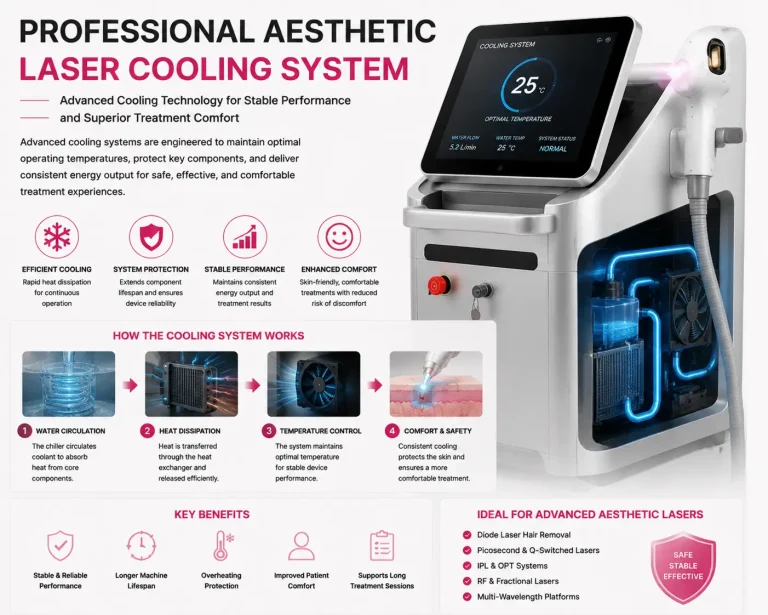
- Q: Is the treatment painful for the patient?A: The treatment is highly tolerable. A standard protocol involves applying a topical anesthetic (e.g., 20% Benzocaine, 6% Lidocaine, 4% Tetracaine) 45 minutes prior to the procedure. The system also utilizes integrated air cooling to enhance patient comfort during the laser passes.
VII. Conclusion
For the modern medical aesthetics practice, relying on single-modality equipment limits clinical outcomes and caps revenue potential. The non-ablative fractional category remains the most lucrative segment for patients seeking significant results without surgical downtime. By integrating the deep collagen-stimulating power of the 1550nm Erbium:Glass laser with the precise pigment-clearing capabilities of the 1927nm Thulium laser, the Lav Dual stands as a remarkably versatile, high-ROI workstation.
To explore the advanced engineering, review clinical whitepapers, and discover how the Lav Dual 1927nm + 1550nm system can elevate your clinic’s therapeutic offerings, connect with the primary manufacturer at https://www.cocoonlaser.com/.
If you need more information, please click “Contact Us”.
If you want to obtain more information, please follow our official website and Facebook.