Nd:YAG Laser Tattoo Removal: The Ultimate Clinic Guide to High-Fluence, Low-Pulse Width Technology & ROI
Introduction: Overcoming Clinic Bottlenecks in Tattoo Removal
For aesthetic clinic owners, legacy tattoo removal technologies often present a triad of frustrations: slow fading protocols requiring 10+ sessions, severe patient discomfort leading to treatment abandonment, and the constant risk of dyspigmentation on darker skin types. The clinical mandate is clear: a technology that maximizes photothermolysis efficiency while minimizing thermal diffusion to adjacent tissue. The solution lies in advanced Nd:YAG laser tattoo removal systems operating at 1064nm and 532nm. Unlike Q-switched predecessors alone, modern variable-pulse-width Nd:YAG platforms with spot sizes up to 8mm and fluence rates exceeding 10 J/cm² offer superior fragmentation of professional-grade inks across all Fitzpatrick skin types (I-VI). This guide delivers a clinical deep-dive into the physics, specifications, and business case for upgrading your clinic’s capabilitiy.
Core Technology & Clinical Efficacy: Selective Photothermolysis with Nd:YAG
Wavelength Specificity & Ink Particle Fragmentation
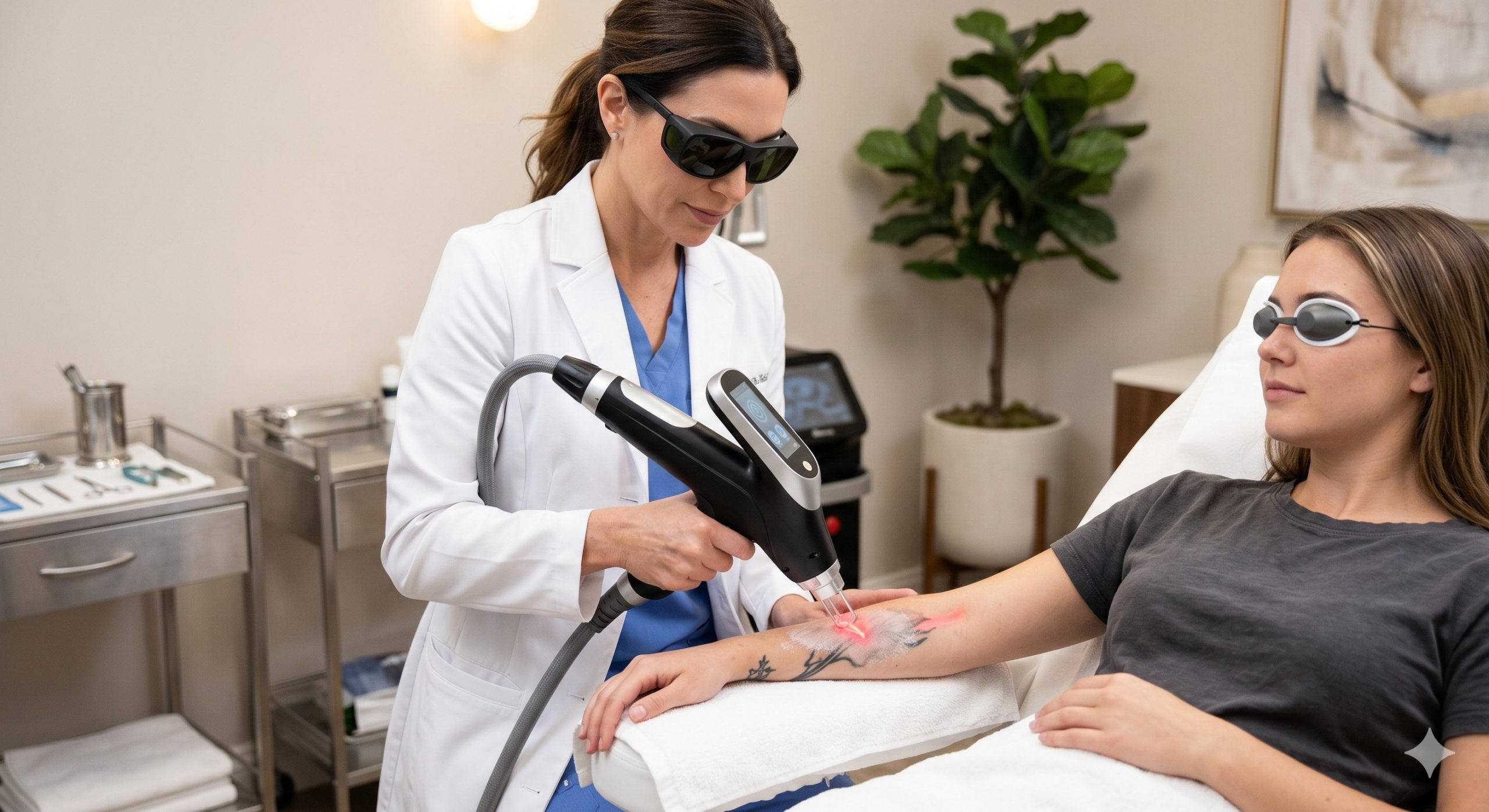
The cornerstone of effective Nd:YAG laser tattoo removal is selective photothermolysis. The 1064nm wavelength penetrates deep into the dermis (up to 4-6mm) and is preferentially absorbed by dark ink chromophores (black, dark blue, deep green). For red, orange, and yellow tattoos, frequency-doubling achieves a 532nm wavelength, targeting superficial epidermal chromophores. Critically, modern systems employ pulse durations in the nanosecond (Q-switched) or picosecond (Pico Nd:YAG) range. Shorter pulse widths (≤10 ns) generate photoacoustic shockwaves that shatter ink particles into sub-micron debris, which lymphatic clearance then removes over 4-8 weeks. The combination of high fluence (2–15 J/cm²) and large spot size (3–8 mm) ensures uniform energy delivery, reducing the risk of ‘skip areas’ and epidermal injury.
Advanced Cooling: The Epidermal Guardian
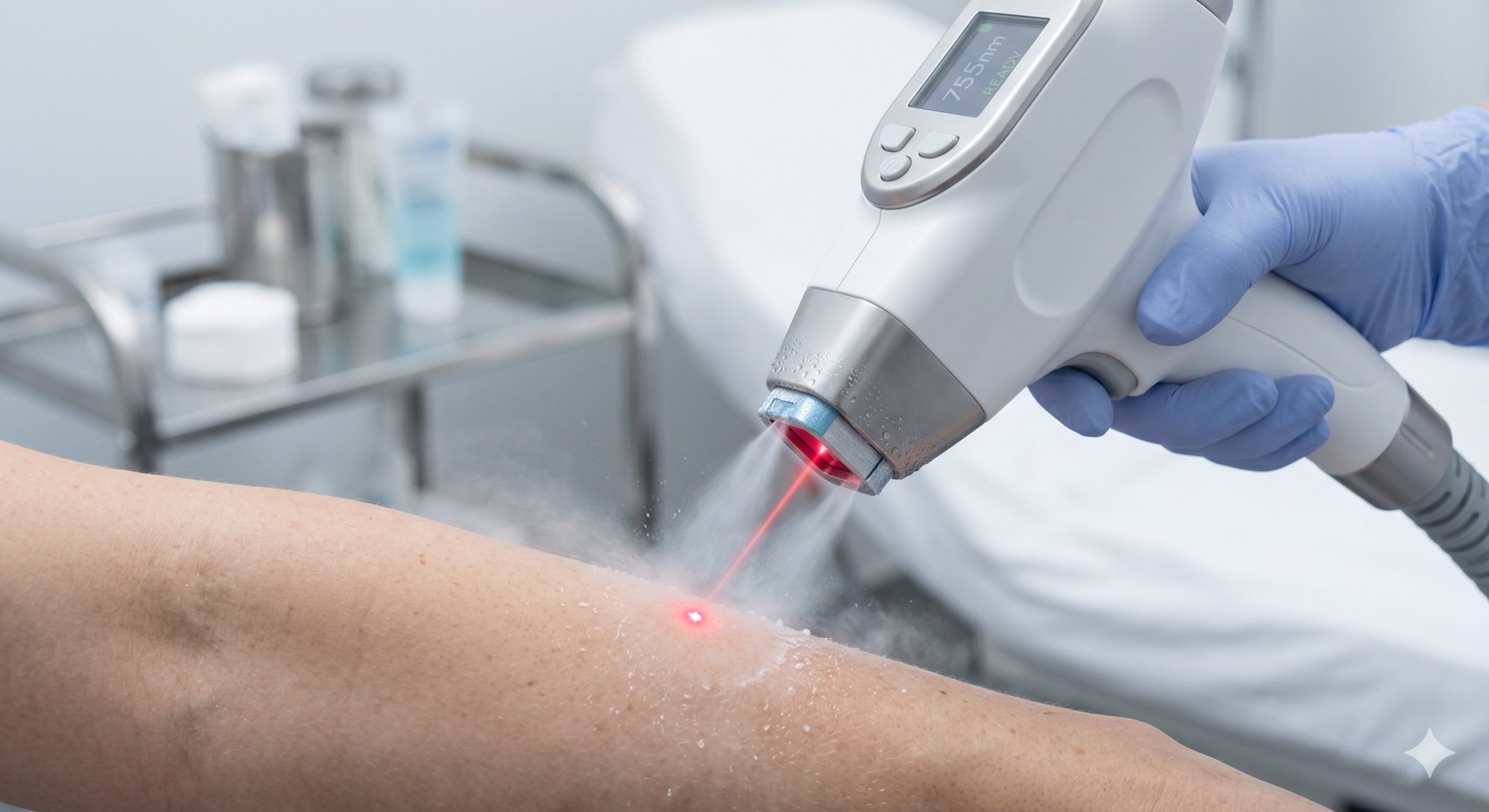
High-fluence Nd:YAG treatments inevitably generate heat in melanin-rich basal layers. To protect the epidermis and enable aggressive treatment of multi-colored tattoos, clinical-grade platforms integrate sapphire contact cooling (typically -5°C to +4°C) or advanced thermoelectric coolers (TEC). These systems create a temperature gradient that lowers the epidermal basal layer temperature by 15-20°C, allowing safe delivery of therapeutic fluence without blistering or hypopigmentation—a critical advantage for Fitzpatrick skin types IV-VI.
Technical Specifications: Key Metrics for Clinical Decision-Making
When evaluating Nd:YAG laser tattoo removal equipment for your clinic, adherence to Medical CE, FDA 510(k) clearance, and ISO 13485 certification is non-negotiable. Below are the technical parameters that correlate directly with clinical outcomes.
| Key Parameter | Technical Specification |
|---|---|
| Wavelength / Laser Type | 1064nm (deep) & 532nm (superficial) – Solid-State Nd:YAG |
| Pulse Width | Nanosecond (2-10 ns) or Picosecond (300-750 ps) modes |
| Fluence (Energy Density) | 2 – 15 J/cm² (adjustable in 0.5 J/cm² increments) |
| Spot Size | 1.5mm, 3mm, 5mm, 6mm, 8mm (zoomable handpiece) |
| Repetition Rate | Up to 10 Hz (single-shot to continuous pulse train) |
| Cooling System | Sapphire contact cooling (–5°C to +4°C) + TEC active feedback |
| FDA / CE Status | FDA 510(k) cleared, Medical CE (Class IIb), ISO 13485:2023 |
| Handpiece Design | Ergonomic multi-wavelength with interchangeable light guides |
Treatment Areas & Indications: Versatility Across Patient Demographics
The clinical utility of Nd:YAG laser tattoo removal extends beyond amateur tattoos. It is the gold standard for:
- Professional multi-color tattoos (using sequential 1064nm and 532nm passes).
- Traumatic tattoos (road rash, graphite) where ink is embedded at variable depths.
- Dermatological indications: benign hyperpigmentation (lentigines, café-au-lait macules), and vascular lesions (telangiectasias, spider veins) leveraging the 1064nm hemoglobin absorption peak.
- All Fitzpatrick skin types (I-VI): The longer 1064nm wavelength has minimal melanin competition, making it the safest choice for darker ethnic skin.
Moreover, modern Nd:YAG platforms with R20 method (multiple passes in a single session with 20-min intervals) have been shown to reduce total treatment visits by 40-60% compared to single-pass Q-switched systems. Contraindications include active tanning, pregnancy, and known photosensitivity disorders (e.g., lupus).
Clinic ROI & Competitive Advantage: Why Nd:YAG Beats Legacy Alternatives
From a business consultancy perspective, upgrading to a high-performance Nd:YAG laser tattoo removal device delivers measurable return on investment through three mechanisms:
- Reduced consumable costs: Unlike alexandrite (755nm) or diode (808nm) systems, Nd:YAG uses no consumable flashlamps in solid-state architecture; only simple optical cleaning and distilled water cooling maintenance. Typical cost-per-shot is under $0.002, maximizing profit per session.
- Treatment speed: With a 10 Hz repetition rate and 8mm spot size, a 5cm x 5cm tattoo can be treated in under 90 seconds, enabling 20+ patient sessions per day. Average clinic revenue per full tattoo removal package ranges from $1,200 to $4,500, with a break-even point typically achieved in 3-6 months at moderate volume (15-20 sessions/week).
- Patient retention: Superior cooling and shorter pulse widths reduce post-treatment purpura, edema, and pain (rated <2/10 on VAS). Satisfied patients generate recurring revenue through package upgrades (e.g., adding spot removal or skin rejuvenation).
Competitively, Nd:YAG outperforms pure Q-switched ruby (694nm) which is contraindicated in darker skin, and CO2 ablative lasers which carry high scarring risk. For clinics seeking a single-platform solution that addresses tattoo removal + pigmentation + vascular lesions, the Nd:YAG is the undisputed clinical and financial choice.
Conclusion: Future-Proof Your Aesthetic Practice with Nd:YAG Technology
The shift from ‘generic tattoo removal’ to precision dermal photothermolysis is already reshaping patient expectations. Clinics investing in medical-grade Nd:YAG laser systems with variable pulse widths, integrated sapphire cooling, and dual-wavelength capability will dominate local markets. As regulatory standards tighten (CE MDR Class IIb), owning an ISO 13485-certified device also signals clinical excellence and liability protection. For clinic owners ready to eliminate treatment bottlenecks and maximize per-procedure margins, the evidence is unequivocal: adopt a high-fluence, low-pulse-width Nd:YAG platform today.