Best Diode Laser Hair Removal Machine for Clinics (2026)
Professional Clinic Buying Guide
The best diode laser hair removal machine for a clinic should provide more than impressive power numbers or a long list of wavelengths. For professional use, clinics need to consider wavelength configuration, cooling, treatment speed, spot size, handpiece design, reliability, warranty, and long-term service support.
This guide compares the most practical diode laser configurations for professional clinics in 2026 and explains what to look for before investing in a new hair removal system.
Quick Answer: What Is the Best Diode Laser Hair Removal Machine?
For most professional clinics, the best diode laser hair removal machine is a well-engineered 755nm + 808/810nm + 1064nm multi-wavelength system with effective contact cooling, practical spot sizes, adjustable treatment parameters, a comfortable handpiece, and dependable after-sales support.
A high-quality 808nm diode laser machine is also an excellent choice for clinics that want a simpler, dedicated hair removal platform. More wavelengths or higher advertised wattage do not automatically mean better performance.
For clinics comparing equipment in 2026, our recommendation is to prioritize overall system quality, cooling, usability, reliability, and service support rather than selecting a machine based on one specification.
Best Diode Laser Hair Removal Machines by Clinic Need
There is no single machine configuration that is ideal for every clinic. The right choice depends on treatment volume, budget, patient population, workflow, and whether the equipment will be used primarily for hair removal or as part of a broader aesthetic business.
| Category | Recommended Configuration | Best For |
|---|---|---|
| Best Overall | 755nm + 808/810nm + 1064nm | Clinics wanting a versatile professional diode laser platform |
| Best Dedicated System | 808nm diode laser | Clinics focused primarily on professional hair removal |
| Best for High-Volume Clinics | High-output system with strong cooling and larger spot sizes | Busy clinics performing repeated treatments throughout the day |
| Best for Small Clinics | 808nm or compact multi-wavelength system | Clinics balancing professional capability with equipment investment |
| Best for OEM / Distributors | Configurable multi-wavelength platform | Distributors and private-label aesthetic equipment brands |
| Cocoon Laser Pick | COOLICE Professional Diode Laser | Clinics and B2B buyers seeking a manufacturer-direct professional system |

What Makes a Good Professional Diode Laser Hair Removal Machine?
When comparing professional diode laser machines, it is easy to focus on specifications such as 2000W, 3000W, triple wavelength, or four wavelength. These numbers can be useful, but none of them should determine the purchase on its own.
A professional system should be evaluated as a complete platform. The following factors matter most.
1. Wavelength Configuration
808nm or 810nm is widely used in professional diode laser hair removal systems. Clinics looking for a focused hair removal platform can therefore consider a well-designed single-wavelength 808nm system.
Multi-wavelength machines commonly combine approximately 755nm, 808/810nm, and 1064nm. This configuration provides greater wavelength flexibility within one professional platform and can be attractive to clinics serving a varied patient population.
Some systems add another wavelength such as 940nm, but four wavelengths should not automatically be considered superior to three. The quality of the complete laser architecture remains more important than wavelength count alone.
2. Cooling Performance
Cooling is one of the most important practical features of a diode laser hair removal machine. Professional systems commonly use a cooled sapphire contact surface together with internal thermal management to control heat during operation.
Clinics should look beyond marketing terms such as “ice cooling” and ask how the cooling system actually works, particularly during repeated treatments.
3. Spot Size and Treatment Speed
Larger treatment windows can improve workflow on areas such as the legs, back, or chest, while smaller spot options can provide greater precision on localized areas.
Spot size should be considered together with fluence, repetition rate, pulse width, laser output, and cooling rather than evaluated independently.
4. Handpiece Design
The handpiece is used continuously by the operator, so ergonomics matter. Weight, balance, grip, cable flexibility, treatment-window visibility, and cooling can all influence daily usability.
Buyers should also ask about handpiece warranty, expected service life, repair options, and replacement cost.
5. Reliability and After-Sales Support
For a professional clinic, equipment downtime can mean cancelled appointments and lost revenue. Warranty coverage, spare-parts availability, technical support, and repair procedures should therefore be considered part of the machine rather than optional extras.
What Matters Most?
Do not choose a professional diode laser machine because it has the highest wattage or the most wavelengths. Compare the complete system: wavelengths + laser source + treatment parameters + cooling + spot size + handpiece + reliability + support.
808nm vs 755nm + 808nm + 1064nm: Which Is Better?
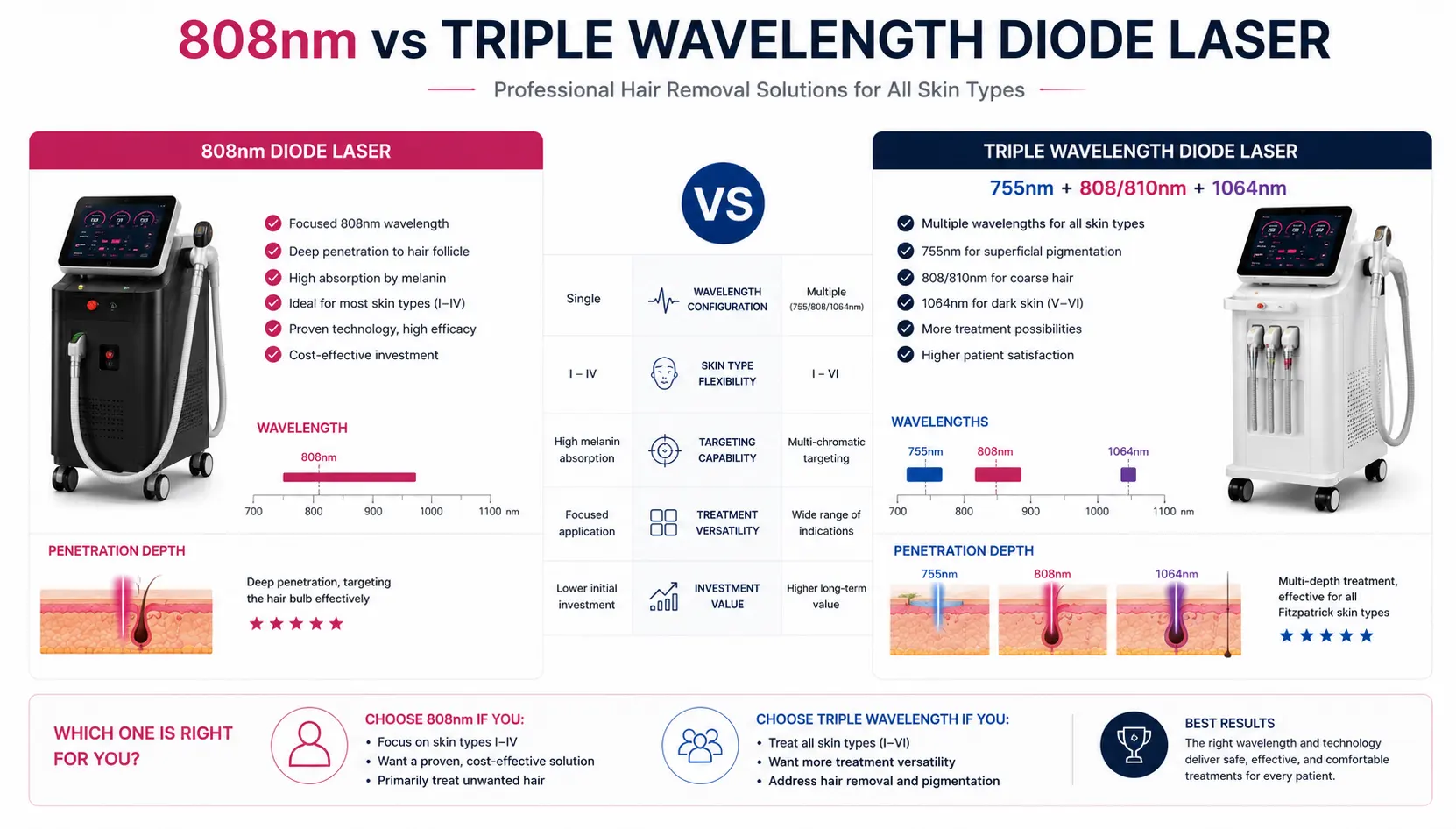
One of the most common decisions when buying a professional diode laser hair removal machine is whether to choose a dedicated 808nm system or a 755nm + 808/810nm + 1064nm multi-wavelength system.
| Feature | 808nm Diode Laser | 755 + 808 + 1064nm |
|---|---|---|
| Wavelength Configuration | Single primary wavelength | Multi-wavelength |
| Main Advantage | Focused and straightforward configuration | Greater wavelength flexibility |
| Best For | Dedicated hair removal clinics | Clinics seeking a versatile professional platform |
| System Complexity | Potentially simpler | More complex laser-source configuration |
| Price | Can be lower depending on configuration | Can cost more depending on components and specification |
| Our Verdict | Excellent focused choice | Best overall configuration for many clinics |
For a clinic that wants one versatile professional platform, 755nm + 808/810nm + 1064nm is our preferred starting point for comparison. It provides broader wavelength flexibility without requiring multiple separate diode systems.
However, this does not mean every triple-wavelength machine is better than every 808nm machine. A high-quality 808nm system with effective cooling, useful treatment controls, a reliable laser source, and strong technical support can be a better purchase than a poorly engineered multi-wavelength system.
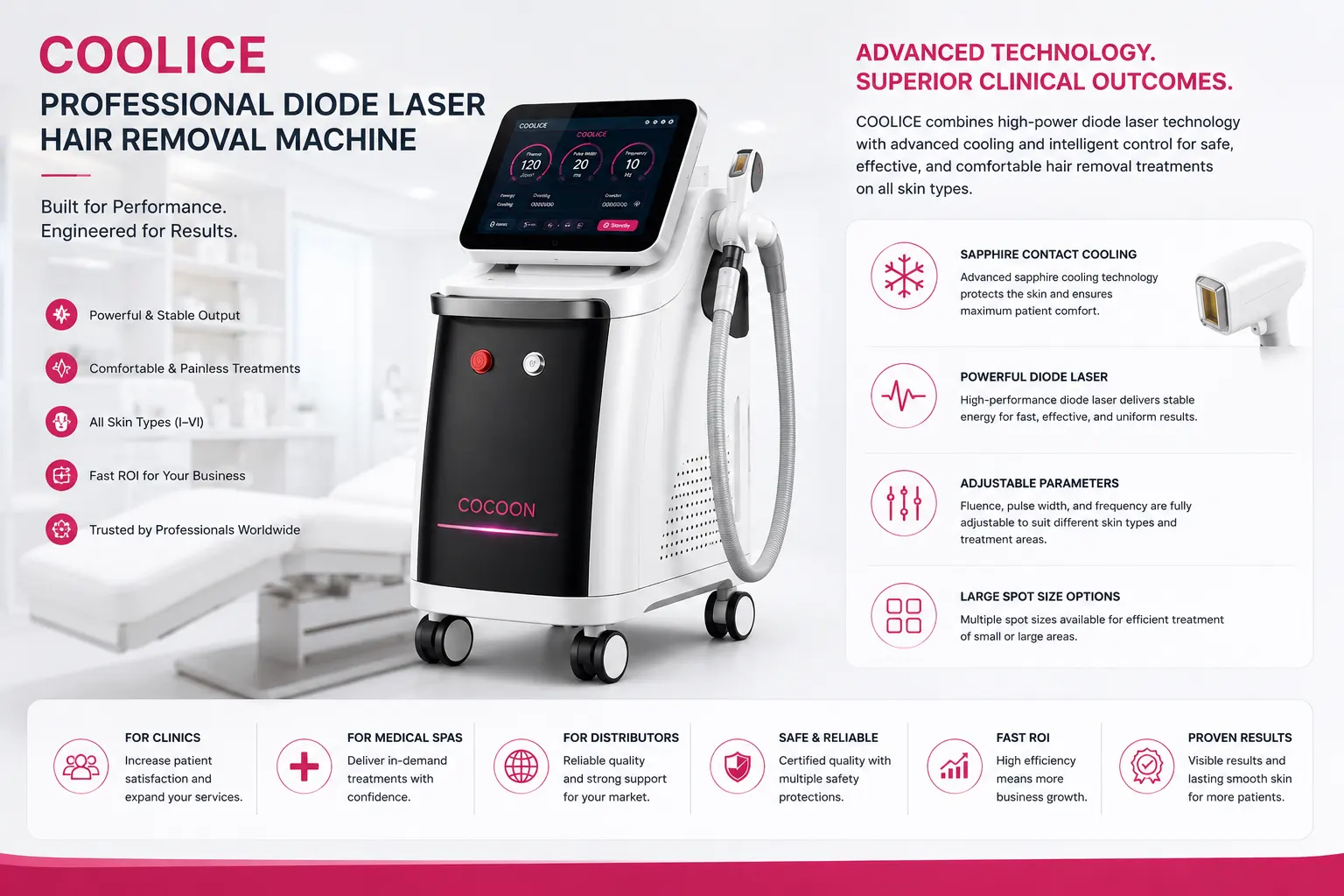
Our Professional Pick: COOLICE Diode Laser Hair Removal Machine
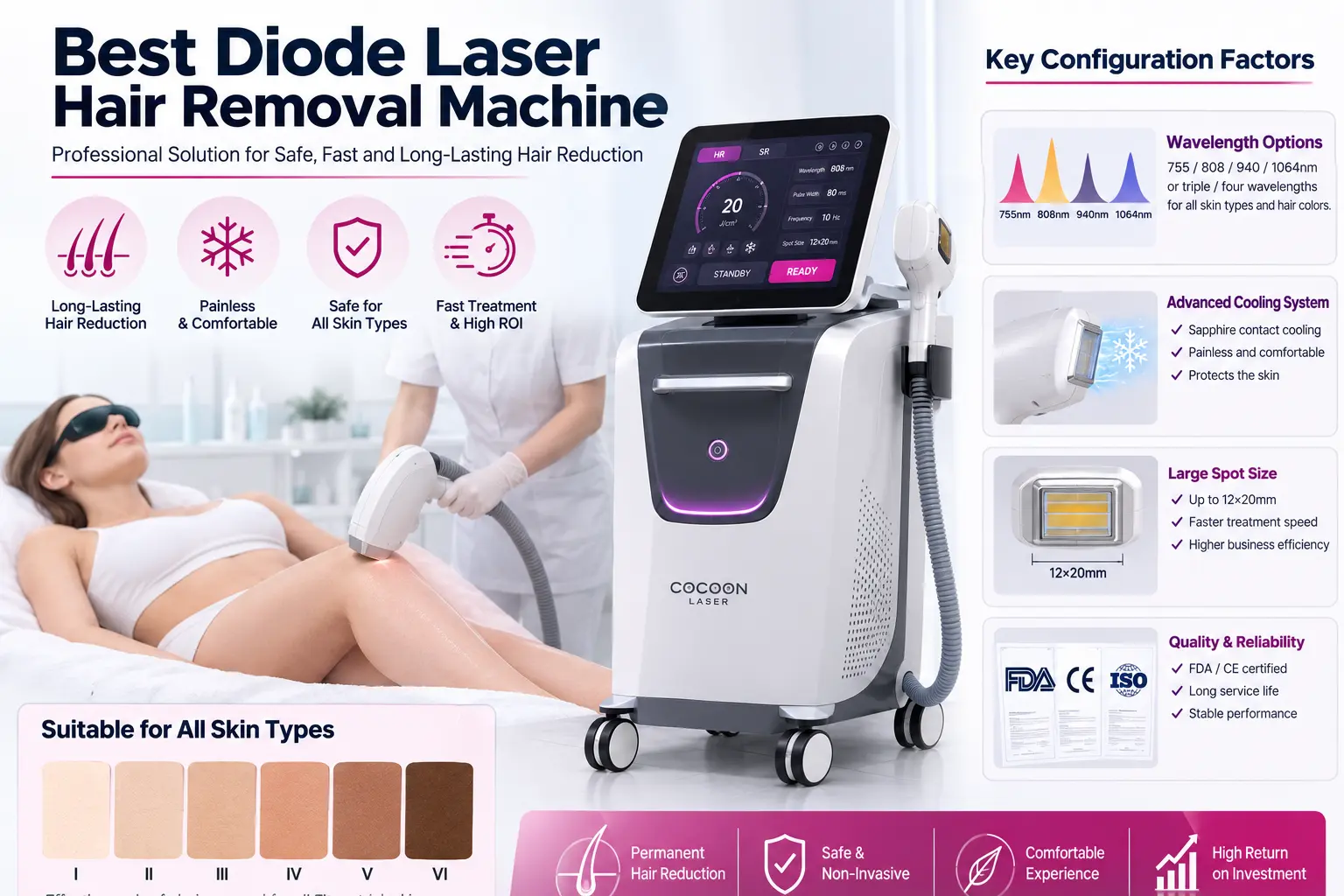
For clinics and B2B buyers looking for a professional diode laser platform, COOLICE from Cocoon Laser is one option worth considering. It is designed for professional aesthetic hair removal applications and can be configured according to different clinic and distributor requirements.
Rather than evaluating COOLICE simply by power or wavelength count, we recommend comparing it using the same criteria discussed throughout this guide: wavelength configuration, laser output, treatment parameters, cooling, spot size, handpiece design, reliability, warranty, and after-sales support.
Cocoon Laser Professional Pick
COOLICE Professional Diode Laser
Why Consider COOLICE?
- Professional diode laser platform for aesthetic clinics
- Multiple wavelength configuration options
- Adjustable professional treatment parameters
- Contact cooling at the treatment handpiece
- Configurations suitable for different clinic requirements
- Manufacturer-direct B2B purchasing
- OEM and private-label options for distributors
- Technical and after-sales support
Best For
Aesthetic clinics, medical spas, professional hair removal businesses, distributors, importers, and private-label aesthetic equipment brands.
What to Check Before Ordering
Request the exact configuration available for your market. Wavelengths, laser output, handpiece, spot sizes, accessories, documentation, and other specifications should be confirmed before comparing quotations.
How Much Should You Spend on a Professional Diode Laser Machine?
Price should not determine which machine is “best,” but it remains an important part of the purchasing decision.
As a general market reference, a professional diode laser hair removal machine may cost approximately $2,000 to $15,000+. Entry-level factory-direct systems can fall near the lower end, while higher-specification professional and premium branded systems can cost considerably more.
| Approximate Price | Typical Position |
|---|---|
| $2,000–$4,000 | Entry-level professional / factory-direct systems |
| $4,000–$8,000 | Mid-range professional clinic systems |
| $8,000–$15,000+ | Higher-specification professional systems |
| $15,000+ | Premium branded or higher-cost locally supported platforms |
These are approximate market ranges rather than fixed quotations. Actual prices depend on wavelength configuration, laser source, power, cooling, handpiece, spot sizes, manufacturer, warranty, shipping, and included services.
For a complete breakdown, see our Diode Laser Machine Price Guide.
Professional Diode Laser Machine Buying Checklist
Before requesting a final quotation, compare machines using the same criteria. This prevents one attractive specification or a low headline price from dominating the decision.
- Wavelengths: Which wavelengths are actually included?
- Laser source: What laser-source configuration does the machine use?
- Power: What exactly does the advertised wattage represent?
- Parameters: What fluence, pulse-width, and repetition-rate ranges are available?
- Spot size: Which treatment-window sizes are included or optional?
- Cooling: How does contact and internal system cooling work?
- Handpiece: What is its warranty, expected service life, and replacement cost?
- Warranty: Which components are covered and for how long?
- Service: How are technical problems, repairs, and spare parts handled?
- Documentation: What documentation is available for your target market?
- Training: Is operator or technical training included?
- Total price: Does the quotation include accessories, customization, and shipping?
If you are a distributor, also ask about MOQ, OEM branding, interface customization, packaging, repeat-order consistency, and long-term spare-parts supply.
Common Mistakes When Choosing a Diode Laser Machine
Choosing by Wattage Alone
Higher advertised wattage does not automatically mean a better machine. Power must be interpreted together with laser-source architecture, fluence, pulse width, repetition rate, spot size, and cooling.
Assuming More Wavelengths Are Always Better
Multi-wavelength systems can provide useful flexibility, but wavelength count is not a complete measure of quality. A well-engineered 808nm machine may outperform a poorly designed multi-wavelength platform in practical clinic use.
Buying the Cheapest Machine
Low acquisition cost can be attractive, but clinics should also consider handpiece replacement, maintenance, spare parts, warranty, technical support, and equipment downtime.
Ignoring Cooling and Handpiece Ergonomics
These factors become increasingly important when operators perform multiple treatments every day. A machine that looks impressive on a specification sheet still needs to work efficiently in a real clinic environment.
Not Checking After-Sales Support
Before buying, confirm who handles technical problems, whether spare parts are available, and how quickly replacement components can be supplied.
Best Diode Laser Hair Removal Machine FAQ
What is the best diode laser hair removal machine for a clinic?
For many clinics, a well-engineered 755nm + 808/810nm + 1064nm professional diode laser machine provides a strong balance of wavelength flexibility and professional capability. Cooling, spot size, handpiece design, reliability, and after-sales support should also be considered.
Is 808nm diode laser good for professional hair removal?
Yes. 808nm is widely used in professional diode laser hair removal equipment. A high-quality 808nm system remains a strong option for clinics that want a dedicated professional hair removal platform.
Is triple-wavelength diode laser better than 808nm?
A 755nm + 808/810nm + 1064nm system provides greater wavelength flexibility, but it is not automatically better. Overall engineering, cooling, laser source, treatment controls, handpiece design, and support remain critical.
How much does a professional diode laser hair removal machine cost?
Professional systems broadly range from approximately $2,000 to $15,000+. The final cost depends on configuration, manufacturer, components, warranty, service, shipping, and market.
Does higher power mean a better diode laser machine?
No. Higher advertised wattage should not be treated as proof of better equipment. Compare the complete laser platform, including usable treatment parameters, spot size, cooling, handpiece, reliability, and support.
What should a clinic check before buying a diode laser machine?
Compare wavelength configuration, laser source, treatment parameters, cooling, spot sizes, handpiece design, warranty, replacement costs, spare parts, technical support, documentation, and total cost of ownership.
Final Verdict: Which Diode Laser Hair Removal Machine Is Best?
For most professional clinics in 2026, our preferred starting point is a 755nm + 808/810nm + 1064nm multi-wavelength diode laser machine. It provides a versatile wavelength configuration within one professional hair removal platform.
Clinics that prefer a simpler dedicated system should not overlook 808nm diode laser machines. A high-quality 808nm platform with effective cooling, practical treatment controls, a comfortable handpiece, and dependable technical support can be an excellent professional choice.
| Our Pick | Recommendation |
|---|---|
| Best Overall Configuration | 755nm + 808/810nm + 1064nm |
| Best Dedicated Configuration | High-quality 808nm diode laser |
| Cocoon Laser Professional Pick | COOLICE Professional Diode Laser |
Ultimately, the best diode laser hair removal machine is not the one with the largest wattage number or the longest specification sheet. It is the machine that combines the right technical configuration with reliable cooling, practical clinic workflow, serviceability, and long-term manufacturer support.
Professional Diode Laser Equipment
Find the Right Diode Laser Machine for Your Clinic
Tell Cocoon Laser your country, clinic type, preferred wavelength configuration, expected treatment volume, and purchasing requirements. Our team can provide available configurations, technical specifications, OEM options, and current pricing.
Request Specifications & Quote