Post-Pregnancy Recovery: Partnering with a Vaginal Rejuvenation Laser Device Supplier
Executive Summary
For medical spa investors and gynecological clinic directors, integrating a vaginal rejuvenation laser device is a highly lucrative strategic expansion into the postpartum intimate wellness market. By utilizing non-surgical fractional CO2 laser technology, practitioners can effectively treat Stress Urinary Incontinence (SUI) and vaginal laxity with virtually zero downtime. Unlike aesthetic platforms that rely on the photoacoustic effect for pigment shattering, vaginal CO2 lasers employ controlled thermal coagulation for deep mucosal remodeling. Selecting a premium aesthetic laser supplier like Cocoon Laser ensures you acquire FDA 510(k) and Medical CE certified equipment featuring RF-excited metal tubes. This advanced hardware maximizes the effective shots count, ensures uniform energy delivery, and guarantees patient safety. This clinical upgrade not only serves patients safely without the heavy TEC Cooling infrastructure required by hair removal systems but also drives predictable recurring revenue and exponential clinic ROI through high-throughput, consumable-free treatments.
The Untapped Market of Postpartum Intimate Wellness
In the rapidly evolving landscape of professional medical aesthetics, the definition of comprehensive patient care has expanded far beyond facial rejuvenation and body contouring. For decades, the physiological aftermath of childbirth was largely dismissed as an inevitable consequence of aging and motherhood. Today, however, the intersection of advanced laser technology and heightened female health awareness has created a surging demand for postpartum intimate wellness. For B2B stakeholders, this represents a vast, relatively untapped market with exceptional profit margins.
The Silent Epidemic: SUI, Vaginal Laxity, and GSM
The trauma sustained by the pelvic floor and vaginal canal during a vaginal delivery—and even the hormonal shifts associated with cesarean sections—precipitates a cascade of physiological challenges. Postpartum women frequently face three core issues:
- Stress Urinary Incontinence (SUI): The involuntary leakage of urine during physical exertion, sneezing, or coughing, caused by the weakening of the sub-urethral support structures.
- Vaginal Laxity: The overstretching of the vaginal introitus and internal canal, leading to a loss of friction and a significant decrease in sexual satisfaction for both partners.
- Genitourinary Syndrome of Menopause (GSM) & Postpartum Dryness: Induced by sudden drops in estrogen levels, leading to mucosal thinning, burning, itching, and dyspareunia (painful intercourse).
Historically, women suffered in silence. However, modern, highly educated demographics prioritize their Quality of Life (QoL) and sexual wellness. They are actively seeking clinical interventions that are effective, discreet, and non-disruptive to their demanding schedules as new mothers.
The Paradigm Shift: Non-Surgical vs. Surgical Interventions
The traditional medical response to severe vaginal laxity and SUI has been surgical intervention, such as anterior colporrhaphy or vaginoplasty. From a clinical and commercial standpoint, surgery presents massive barriers to entry:
- Surgical Limitations: Vaginoplasty requires general anesthesia, carries a high risk of scarring and infection, and mandates a grueling six-to-eight-week recovery period. Most new mothers simply cannot afford this extended incapacitation.
- The Laser Alternative: Non-invasive laser therapy represents a monumental paradigm shift. Utilizing a vaginal rejuvenation laser device, practitioners can deliver profound structural improvements via a “Lunchtime Procedure.” The treatment is entirely outpatient, requires no anesthesia, and allows the patient to return to normal daily activities immediately. This low-risk, high-reward profile is the primary driver behind the exponential growth of the global intimate wellness market.
Clinical Efficacy: How Vaginal CO2 Lasers Restore Tissue
To market these services effectively and justify the capital expenditure to your board of directors, you must understand the underlying physics of the technology. Partnering with a leading professional medical laser equipment manufacturer ensures you are delivering proven histological changes, not just superficial results.
The Physics of Fractional Photothermolysis in the Vaginal Mucosa
The gold standard for vaginal tissue restoration is the 10,600nm wavelength emitted by a fractional CO2 laser. This specific wavelength is highly absorbed by intracellular water, which constitutes over 70% of the vaginal mucosa.
Unlike Q-switched lasers that utilize the photoacoustic effect to mechanically shatter pigment, the CO2 laser operates purely on the principle of Fractional Photothermolysis.
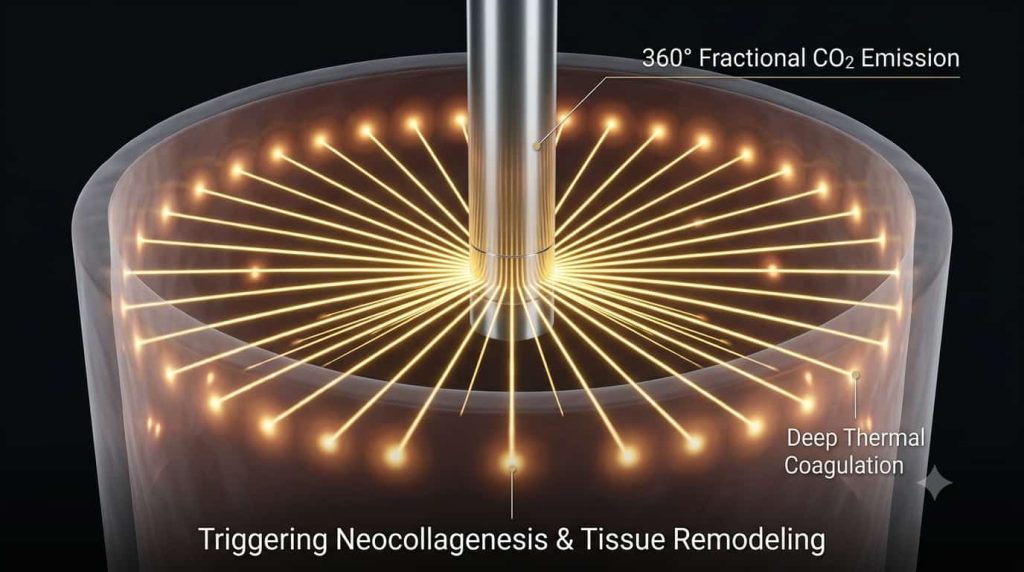
- Ablation vs. Coagulation: When the laser fires through a specialized vaginal handpiece, it splits the beam into hundreds of microscopic columns. These beams vaporize tiny channels in the epithelium (Ablation) while simultaneously transferring deep heat into the surrounding lamina propria (Thermal Coagulation).
- Preserving Tissue Integrity: By leaving healthy, untreated “bridges” of tissue between the microscopic thermal zones (MTZs), the vaginal wall’s structural integrity remains fully intact. This fractional delivery dictates the rapid healing response, ensuring absolute patient safety and preventing the formation of fibrotic scar tissue.
Triggering Neocollagenesis and Angiogenesis
The clinical magic of the CO2 laser occurs in the days and weeks following the procedure. The precisely controlled thermal injury (typically reaching 60°C to 65°C in the sub-mucosal layers) triggers an acute heat-shock protein response.
- Neocollagenesis: The thermal trauma aggressively stimulates dormant fibroblasts. These cells begin synthesizing new, tightly woven Type I and Type III collagen fibers, alongside fresh elastin. This fundamentally thickens the vaginal wall, restores elasticity, and tightens the canal, directly addressing vaginal laxity.
- Angiogenesis: The healing cascade also promotes the formation of new capillary networks (angiogenesis). Increased blood flow rejuvenates the mucosal lining, restores natural glycogen production, and rebalances the vaginal flora (pH). This effectively cures postpartum dryness and prevents recurrent urogenital infections.
- SUI Resolution: By targeting the anterior vaginal wall specifically, the newly synthesized collagen provides robust mechanical support to the mid-urethra, significantly reducing or entirely eliminating the symptoms of mild to moderate Stress Urinary Incontinence.
Strategic Procurement: What to Look for in a B2B Laser Supplier
The aesthetic market is flooded with low-cost, white-label devices that claim to offer vaginal rejuvenation. For a professional medical spa or gynecology practice, deploying subpar hardware is a catastrophic liability. Selecting the right aesthetic laser supplier is your primary defense against adverse clinical events and financial loss.
Specialized Intimate Handpieces: 360° and 90° Emission
The efficacy of a vaginal laser is entirely dependent on how the energy is delivered inside the canal. A premium platform must include specialized, medical-grade optical handpieces:
- The 360° Handpiece: Engineered with a conical gold-plated or specialized quartz reflector, this probe emits the fractional CO2 beam in a complete 360-degree radius simultaneously. As the practitioner slowly withdraws the probe, it ensures uniform, overlapping energy distribution across the entire vaginal cylinder, eliminating “missed spots” and standardizing the tightening effect.
- The 90° Handpiece: This targeted emission probe is critical for treating SUI. It allows the physician to direct 100% of the fractional energy exclusively upward into the anterior vaginal wall (directly beneath the urethra) without unnecessarily ablating the posterior wall. This targeted approach thickens the specific fascial tissue responsible for urinary continence.
Hardware Stability: RF-Excited Tubes vs. Glass Tubes
The core engine of a CO2 laser is its resonator tube. This is the single most critical differentiator between a professional clinical device and a dangerous imitation.
Technical Comparison: CO2 Laser Resonator Architecture
| Specification | RF-Excited Metal Tube (Premium Standard) | DC-Excited Glass Tube (Budget/Legacy) |
| Excitation Method | Radio Frequency (RF) | Direct Current (DC) high voltage |
| Beam Quality | Excellent (TEM00, highly uniform spot) | Poor (Irregular spot, uneven energy distribution) |
| Pulse Duration | Ultra-short (Microseconds) | Long and sluggish (Milliseconds) |
| Tissue Interaction | Precise ablation, minimal collateral heat | High risk of uncontrolled thermal burns |
| Lifespan / Shots Count | Up to 10+ years (Extremely high shots count) | 1 to 2 years (Fragile, rapid gas degradation) |
| Clinical Suitability | Safe for delicate vaginal mucosa | UNSAFE for internal gynecological use |
Partnering with an industry leader like Cocoon Laser (https://www.cocoonlaser.com/) guarantees that your platform is powered by an imported RF-excited metal tube. The ability to generate ultra-short pulses ensures that the laser energy beats the Thermal Relaxation Time (TRT) of the vaginal tissue, absolutely preventing the deep mucosal burns associated with cheap glass tubes.
Regulatory Compliance and Clinical Protocols
Procuring capital medical equipment requires rigorous legal and regulatory due diligence.
- Certifications: Your chosen platform must carry legitimate FDA 510(k) clearance and Medical CE certification. These are non-negotiable indicators that the device has undergone stringent clinical safety trials and meets international manufacturing standards.
- Clinical Support: A true B2B partner does more than ship a wooden crate. They provide comprehensive, physician-led clinical training protocols. Operating inside the vaginal canal requires a deep understanding of fluences, dwell times, and patient selection. Relying on a supplier that provides ongoing clinical education ensures your staff operates with confidence and minimizes the risk of malpractice.
Maximizing Clinic ROI with Postpartum Laser Treatments
Beyond the profound clinical benefits to the patient, integrating a vaginal rejuvenation module into your existing aesthetic practice fundamentally transforms your clinic’s financial trajectory.
High Patient Throughput with Zero Downtime
When evaluating the Return on Investment (ROI) of a new device, time and operational overhead are the primary metrics.
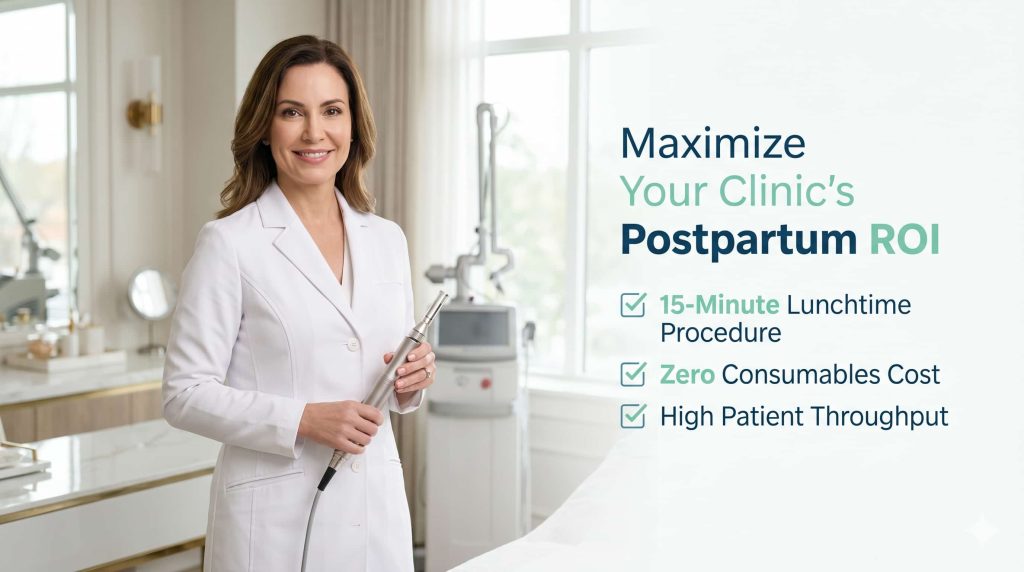
- Speed of Execution: A standard vaginal rejuvenation session takes approximately 15 to 20 minutes from start to finish. It requires no topical numbing cream for the internal canal (as the mucosa lacks somatic pain receptors for this type of heat), and patients experience zero downtime.
- Operational Efficiency: Because the procedure is so rapid, a single treatment room can comfortably process 15 to 20 patients per day. Furthermore, unlike RF microneedling or specific surgical procedures, fractional CO2 vaginal treatments typically require no single-use consumable tips (provided the clinic utilizes proper sterilization protocols for the reusable metal probes). This means that after the initial capital expenditure, your gross profit margin per treatment approaches 99%.
Packaging Solutions for the Modern Mother
To maximize revenue, savvy clinic directors do not sell “vaginal rejuvenation” in isolation; they sell comprehensive postpartum restoration.
- The “Mommy Makeover” Synergy: Combine internal vaginal tightening with external treatments. For example, while the CO2 laser handles internal laxity, practitioners can utilize the standard fractional scanner handpiece to treat external vulvar hyperpigmentation (carefully adjusting settings according to the patient’s Fitzpatrick Scale skin type to prevent PIH) and abdominal striae (stretch marks).
- By bundling these services, a clinic elevates a standard $1,000 laser session into a premium $3,500 to $5,000 comprehensive postpartum rehabilitation package.
Recurring Revenue through Maintenance Sessions
Unlike surgical interventions which are “one and done” (but highly invasive), laser tissue remodeling requires a protocol-driven approach.
- The Initial Protocol: The clinical standard of care requires a series of three sessions, spaced four to six weeks apart, to achieve optimal collagen synthesis and SUI resolution.
- The Maintenance Phase: Because the natural aging process and collagen degradation continue, patients are highly incentivized to return for a single “touch-up” maintenance session every 12 to 18 months to preserve their results.
This creates a highly predictable, recurring revenue stream. A patient acquired today for postpartum recovery remains a dedicated, paying client for the next decade, significantly increasing their Lifetime Value (LTV) to your practice.
Conclusion: Build a Profitable Postpartum Practice with Cocoon Laser
The postpartum intimate wellness market is no longer a niche specialty; it is a fundamental pillar of modern aesthetic and gynecological medicine. Women are actively demanding safe, non-surgical solutions to restore their bodies and their confidence after childbirth.
Evaluating Your Current Aesthetic Portfolio
Take a moment to evaluate your clinic’s current service menu. If you are exclusively offering facial resurfacing, neurotoxins, and body contouring, you are entirely ignoring the profound physiological needs of the postpartum demographic. By expanding your portfolio to include vaginal rejuvenation, you instantly differentiate your practice from standard medspas, elevating your brand to a comprehensive women’s health destination.
Partner with Cocoon Laser Today
The success of this expansion relies entirely on the quality, safety, and reliability of your hardware. As a premier professional medical laser equipment manufacturer, Cocoon Laser engineers fractional CO2 platforms specifically designed to deliver unparalleled gynecological outcomes. Our RF-excited technology, specialized 360° handpieces, and uncompromising commitment to international safety standards provide the ultimate foundation for your business growth.
Do not allow subpar equipment to compromise your clinical reputation. We invite medical directors, gynecologists, and aesthetic investors to explore the technical superiority of our platforms. Visit the official Cocoon Laser website today to download our comprehensive Clinical Whitepaper on vaginal tissue remodeling, utilize our proprietary B2B clinic ROI calculator, or contact our global sales team to schedule a detailed Virtual Demo of our industry-leading CO2 laser workstations.
If you need more information, please click “Contact Us”.
If you want to obtain more information, please follow our official website and Facebook.