Pico Laser Machine: Professional Buying Guide
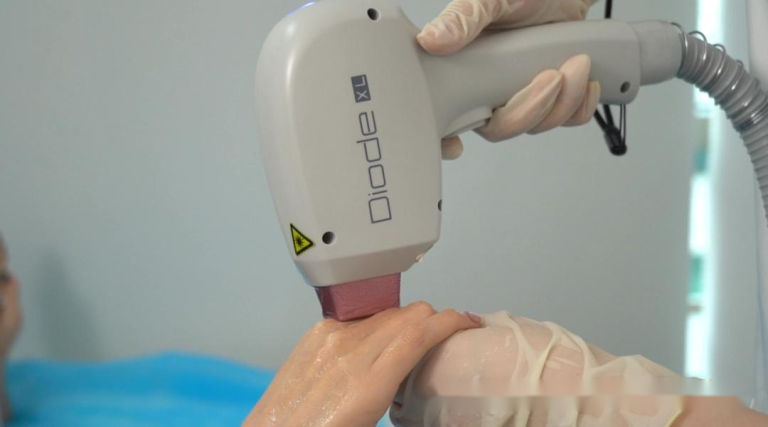
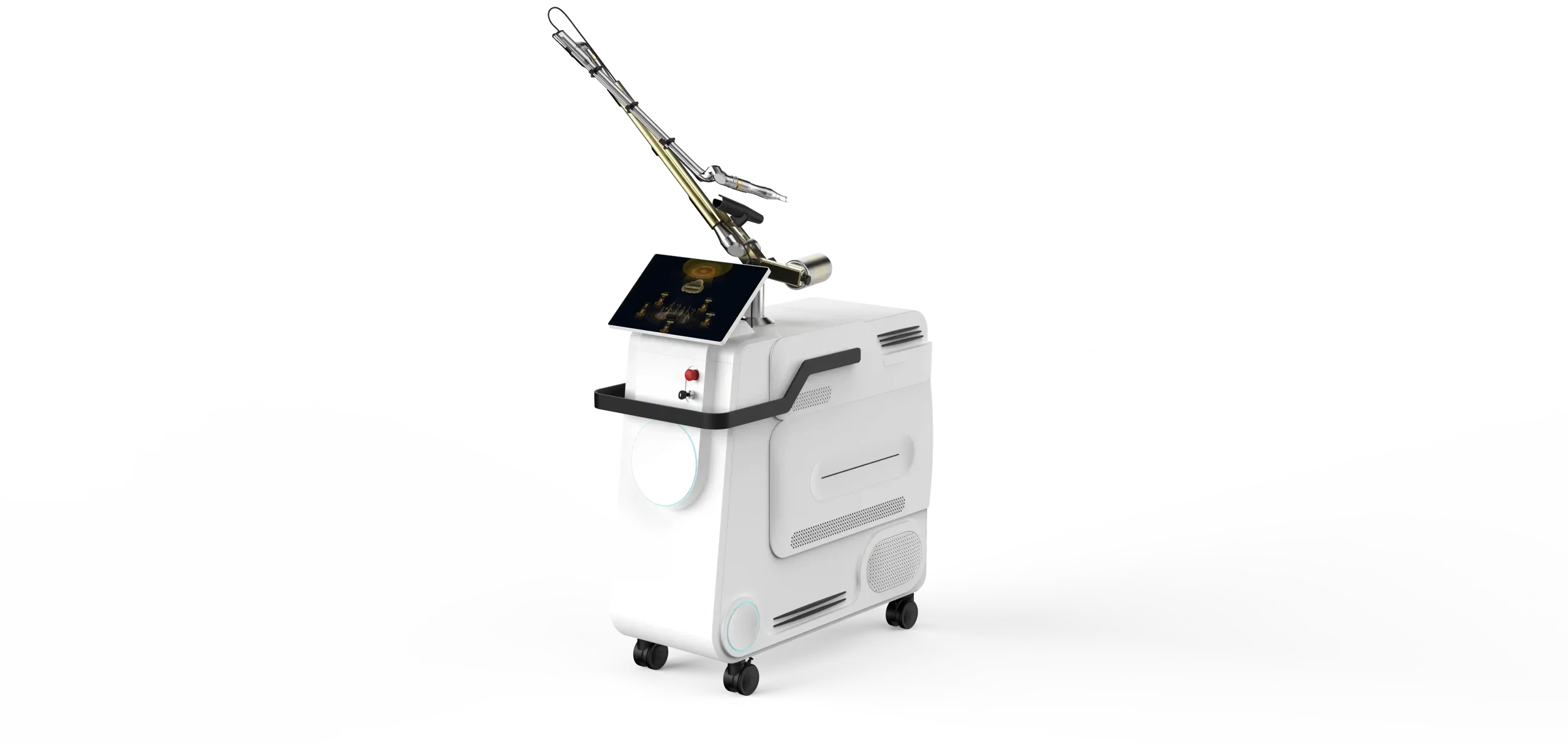
A pico laser machine is a professional aesthetic laser system designed to deliver ultra-short laser pulses measured in picoseconds. These systems are widely used in professional dermatology and medical aesthetic practices for selected pigmentation treatments, tattoo removal, and skin rejuvenation applications.
For clinics and medical equipment distributors, choosing the right pico laser machine involves more than comparing advertised pulse durations or maximum energy output. Wavelength options, treatment technologies, energy stability, applicator design, operating requirements, and manufacturer support all influence the overall value of an equipment investment.
The professional picosecond laser market includes different system configurations, ranging from single-wavelength platforms to multi-wavelength machines with integrated treatment modes. Understanding these differences helps buyers identify equipment that matches their clinical requirements and business objectives.
This guide explains how pico laser machines work, compares important technical specifications, and outlines what clinics and distributors should evaluate before purchasing a professional picosecond laser system.
Quick Answer: What Is a Pico Laser Machine?
A pico laser machine is a professional laser device that delivers ultra-short pulses of energy in picoseconds (trillionths of a second) for selected pigmentation, tattoo removal, and aesthetic skin treatment applications.
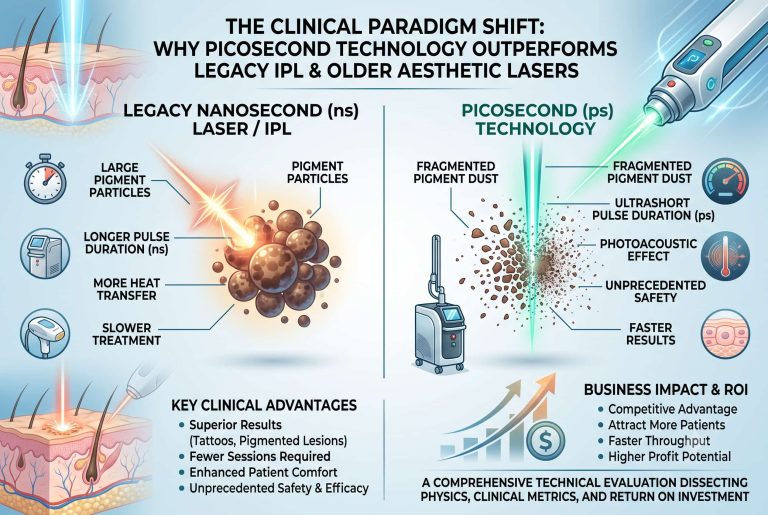
Compared with conventional nanosecond Q-switched laser systems, picosecond lasers use shorter pulse durations to generate rapid energy deposition and photoacoustic effects in suitable pigment targets.
When selecting a professional pico laser machine, buyers should evaluate:
- Available laser wavelengths.
- Pulse duration and energy output.
- Energy stability and beam quality.
- Available treatment technologies and modes.
- Handpiece and applicator configurations.
- Cooling system and maintenance requirements.
- Manufacturer qualifications and technical support.
- Warranty, training, and regulatory documentation.
The best equipment configuration depends on the clinic’s treatment requirements, operating environment, and budget.
What Is a Pico Laser Machine?
A pico laser machine is an aesthetic laser platform that generates laser pulses with durations measured in picoseconds. One picosecond equals one trillionth of a second (10-12 seconds).
This extremely short pulse duration allows the laser to deliver energy rapidly to selected targets. In pigment treatments, the interaction can generate photoacoustic effects that contribute to the fragmentation of pigment particles.
Unlike a conventional single-purpose laser, some professional pico laser machines combine multiple wavelengths, treatment modes, and applicators within one equipment platform.
How Is a Picosecond Laser Different from a Nanosecond Laser?
The main technical distinction is pulse duration. Conventional Q-switched Nd:YAG systems commonly operate in the nanosecond range, while picosecond laser systems deliver shorter pulses.
Shorter pulse durations can produce different interactions between laser energy and pigment targets. The relative contribution of photoacoustic and thermal effects depends on the laser parameters and treatment configuration.
| Feature | Picosecond Laser | Q-Switched Laser |
|---|---|---|
| Pulse Duration | Picosecond range | Nanosecond range |
| Energy Delivery | Ultra-short pulse delivery | Longer pulse delivery |
| Primary Tissue Interaction | Strong photoacoustic effects under suitable conditions | Photothermal and photoacoustic effects |
| Common Applications | Selected pigmentation and tattoo treatments | Selected pigmentation and tattoo treatments |
| Equipment Configuration | Single or multiple wavelengths | Single or multiple wavelengths |
| Purchasing Considerations | Pulse characteristics, energy stability, wavelengths, and applicators | Pulse characteristics, energy stability, wavelengths, and applicators |
A shorter pulse duration does not automatically mean better clinical performance. Buyers should evaluate the complete system configuration rather than relying on one specification.
Learn more about the underlying technology in our Picosecond Laser Technology Guide .
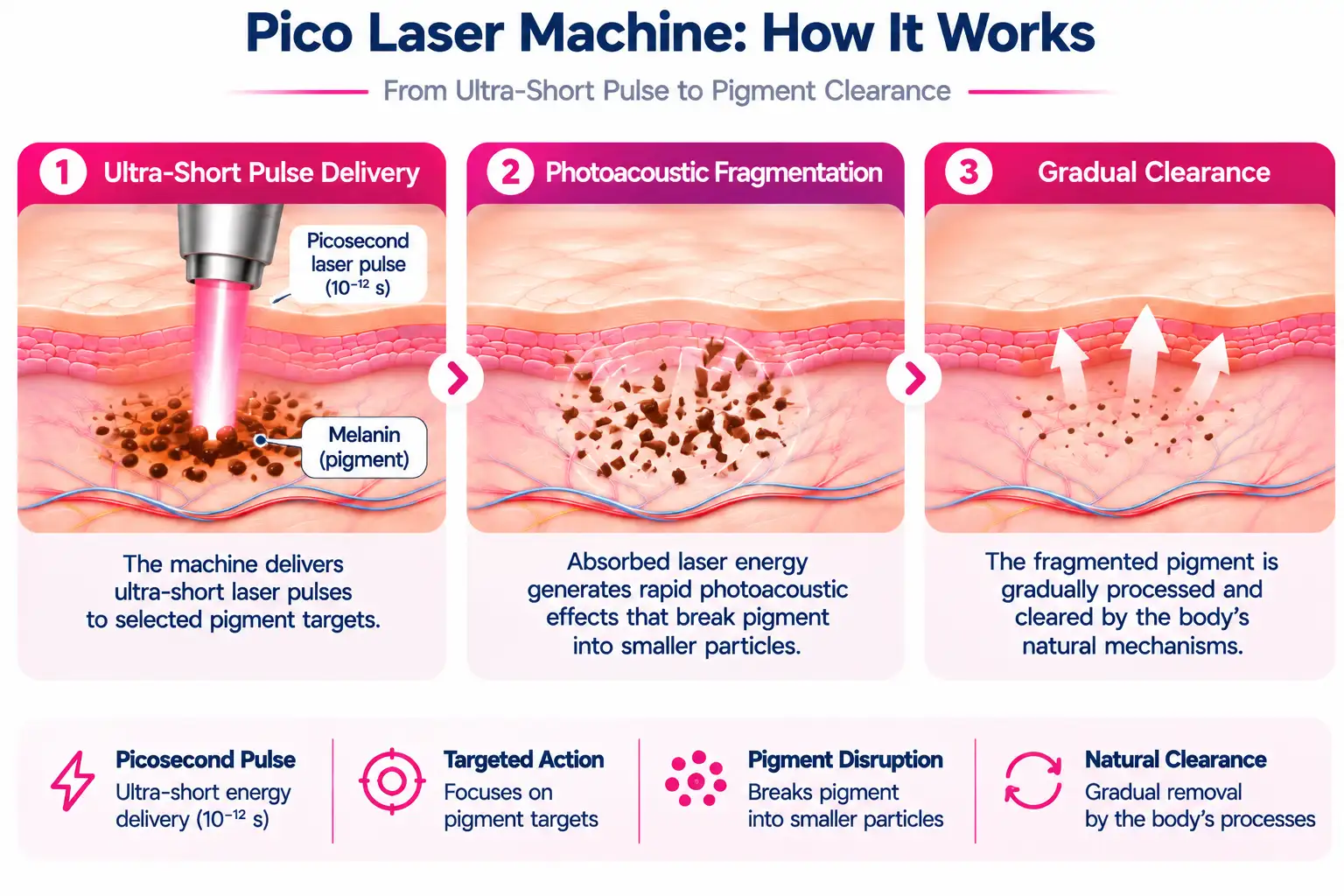
How Does a Pico Laser Machine Work?
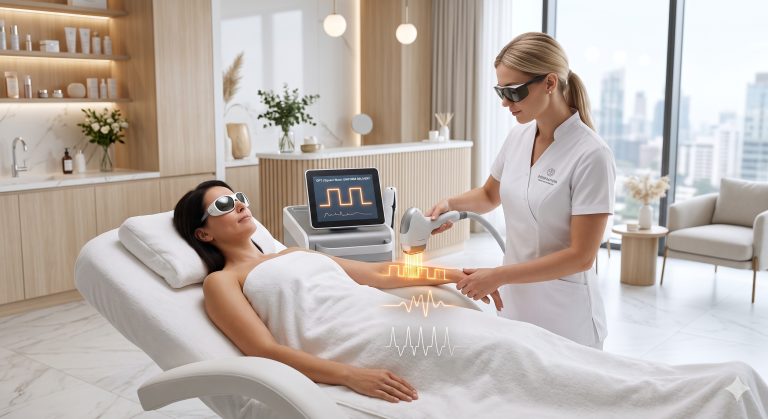
A pico laser machine generates short laser pulses and delivers them to selected tissue targets through a treatment handpiece or applicator.
In pigment-targeting procedures, the process involves laser absorption, rapid energy deposition, and photoacoustic interactions.
1. Laser Pulse Generation
The laser source generates an optical pulse with a duration measured in picoseconds.
The pulse characteristics depend on the laser source, system design, and selected operating configuration.
2. Wavelength Selection and Energy Delivery
The selected wavelength determines how the laser interacts with different tissue chromophores. Wavelengths such as 1064nm, 755nm, and 532nm are commonly found in professional picosecond laser systems.
Different wavelengths have different absorption characteristics and penetration profiles. Treatment selection must consider the target, surrounding tissue, and patient characteristics.
3. Photoacoustic Interaction
When suitable pigment targets absorb laser energy, rapid energy deposition can generate mechanical stress and photoacoustic effects.
These interactions can contribute to the disruption of pigment particles into smaller fragments.
4. Biological Pigment Clearance
Following pigment fragmentation, the body gradually processes and clears the disrupted material through biological mechanisms.
The visible response develops over time and depends on the pigment type, treatment parameters, and individual biological response.
Why Does Equipment Configuration Matter?
The actual treatment performance of a picosecond laser depends on more than its nominal pulse duration.
Important system characteristics include:
- Laser source and pulse generation technology.
- Available wavelengths.
- Energy output and adjustment range.
- Pulse consistency and energy stability.
- Beam profile and transmission characteristics.
- Handpiece and applicator design.
- Cooling and operating system configuration.
These specifications should be evaluated together when comparing professional picosecond laser equipment.
What Are Pico Laser Machines Used For?
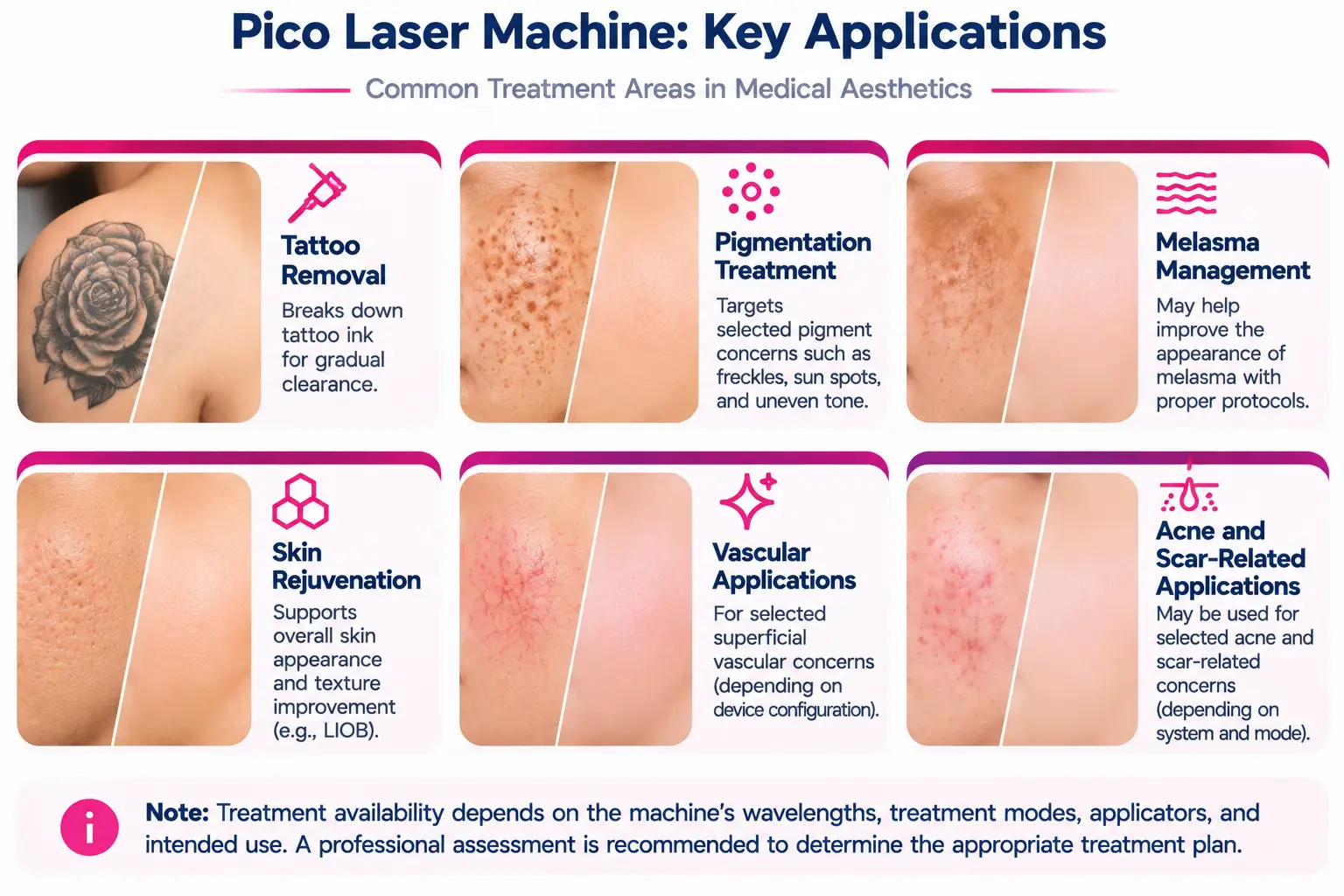
Professional pico laser machines are used in several medical aesthetic applications. The available treatment options depend on the equipment’s wavelengths, treatment technologies, applicators, and authorized intended use.
1. Tattoo Removal
Tattoo removal is one of the major applications associated with picosecond laser technology.
Laser energy interacts with selected tattoo ink particles, generating photoacoustic effects that can contribute to pigment fragmentation.
Different tattoo colors may respond differently depending on ink composition, wavelength, pigment depth, and other treatment factors.
Professional equipment buyers should therefore evaluate the available wavelengths and verify which tattoo-related applications are supported by the specific machine.
2. Pigmentation Treatment
Picosecond laser systems may be used for selected benign pigmented lesions and pigmentation-related procedures.
Potential applications include:
- Freckles.
- Selected solar lentigines.
- Benign pigmented lesions.
- Selected forms of hyperpigmentation.
- Other pigment-related conditions following professional assessment.
Conditions such as melasma require particular caution because recurrence and treatment-related pigmentary complications are possible.
3. Skin Rejuvenation
Certain picosecond laser platforms support fractional treatment technologies for selected skin rejuvenation applications.
Depending on the system, these technologies may involve microscopic treatment zones and tissue remodeling mechanisms.
For example, Laser-Induced Optical Breakdown (LIOB) is used in certain fractional picosecond applications.
4. Vascular Applications
Some multi-technology aesthetic laser platforms integrate additional long-pulse technologies for selected vascular applications.
These capabilities should be distinguished from the core picosecond mode. A machine should not be assumed to support vascular treatment simply because it is marketed as a pico laser.
5. Acne and Scar-Related Applications
Certain multi-mode laser systems include treatment configurations intended for selected acne and scar-related applications.
The relevant technology, treatment mechanism, and clinical evidence should be reviewed separately for each application.
6. Additional Aesthetic Applications
Some integrated platforms combine picosecond technology with other laser technologies, including long-pulse modes.
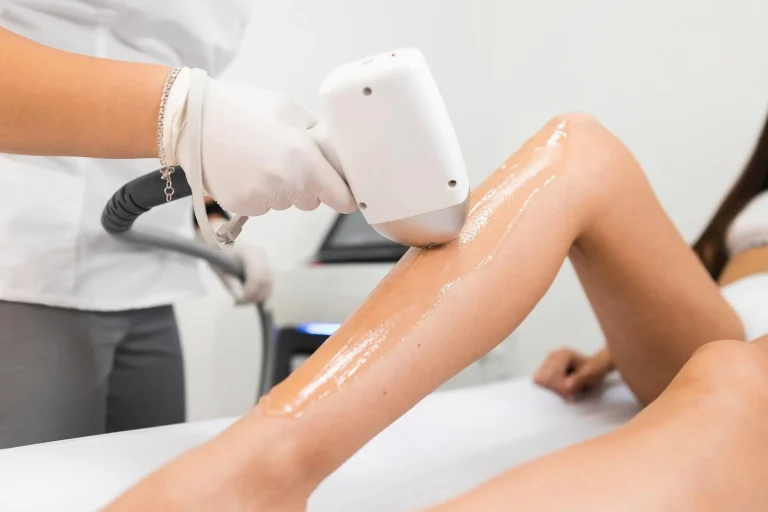
Depending on the actual configuration, these systems may offer additional applications such as hair reduction and skin rejuvenation.
Buyers should verify the specifications and intended use of each mode rather than treating all applications as functions of the picosecond laser itself.
Different Types of Pico Laser Machines
Pico laser equipment is available in different configurations. Understanding these differences helps clinics and distributors compare machines according to their operational needs.
Single-Wavelength Pico Laser Machines
A single-wavelength pico laser machine operates with one primary laser wavelength.
These systems may be suitable for buyers who have a clearly defined treatment focus and do not require several wavelength options.
Potential advantages include:
- A more focused equipment configuration.
- Potentially simpler treatment workflows.
- Fewer wavelength options to evaluate.
- Equipment selection based on a specific clinical requirement.
Multi-Wavelength Pico Laser Machines
A multi-wavelength pico laser machine integrates multiple wavelengths into one equipment platform.
Different wavelengths offer different optical absorption characteristics, providing flexibility for selected pigment-related treatment applications.
Potential advantages include:
- Multiple wavelength configurations.
- Greater flexibility for different pigment targets.
- Broader treatment planning options.
- Potentially improved equipment utilization across different services.
Multi-Technology Pico Laser Platforms
Some advanced systems integrate picosecond laser technology with additional treatment technologies within one platform.
Depending on the device, these technologies may include dual-pulse delivery, multi-pulse modes, long-pulse modes, and fractional applicators.
This configuration may be relevant to clinics that want to support multiple treatment categories using one integrated system.
However, additional modes also require buyers to evaluate operating complexity, maintenance, training, and the actual clinical applications supported.
| Machine Type | Configuration | Suitable Buyer Profile |
|---|---|---|
| Single-Wavelength | One primary wavelength | Clinics with focused treatment requirements |
| Multi-Wavelength | Multiple laser wavelengths | Clinics requiring broader pigment-targeting flexibility |
| Multi-Technology | Multiple wavelengths and treatment technologies | Multi-service aesthetic centers and distributors |
No single configuration is ideal for every buyer. The appropriate choice depends on treatment demand, budget, operator experience, equipment utilization, and long-term business planning.
Pico Laser Machine Wavelengths Explained
Wavelength is one of the most important specifications when selecting a professional pico laser machine. Different wavelengths have different optical absorption characteristics and penetration profiles, influencing how laser energy interacts with selected pigment targets and surrounding tissue.
Professional picosecond laser systems commonly offer wavelengths such as 1064nm, 755nm, and 532nm. Some multi-wavelength platforms also incorporate 585nm and 650nm options.
1064nm Pico Laser
The 1064nm wavelength is widely used in professional Nd:YAG picosecond laser systems. Its relatively deeper penetration profile makes it an important option for selected dermal pigment and tattoo-related applications.
Common applications may include:
- Selected dark tattoo pigments.
- Professional pigmentation procedures.
- Selected dermal pigment targets.
- Low-fluence laser toning applications under appropriate protocols.
The actual treatment suitability depends on pigment characteristics, skin phototype, treatment parameters, and professional assessment.
755nm Pico Laser
The 755nm wavelength is commonly associated with alexandrite-based picosecond laser technology. It has particular absorption characteristics that make it relevant to selected pigment-targeting applications.
Potential applications include:
- Selected blue and green tattoo pigments.
- Selected epidermal pigmentation concerns.
- Professional aesthetic pigment treatments.
A 755nm wavelength should not be considered universally suitable for every tattoo color or pigmentation condition. Treatment selection requires consideration of the target pigment and surrounding tissue.
532nm Pico Laser
The 532nm wavelength is commonly used for selected superficial pigment targets because of its absorption characteristics.
Potential applications include:
- Selected red and orange tattoo pigments.
- Selected superficial pigmented lesions.
- Professional pigmentation procedures.
Because shorter wavelengths may interact more strongly with epidermal melanin, treatment parameters and patient skin phototype require careful consideration.
585nm and 650nm Pico Laser Wavelengths
Certain advanced multi-wavelength picosecond laser machines offer additional wavelengths, including 585nm and 650nm.
These wavelengths can expand the available optical configurations for selected pigment-targeting applications. Their practical value depends on the machine design, available handpieces, energy specifications, and supported treatment protocols.
Buyers should request detailed technical documentation to understand the actual capabilities of each wavelength rather than assuming that additional wavelengths automatically provide better results.
Comparison of Common Pico Laser Wavelengths
| Wavelength | Common Laser Technology | Potential Applications |
|---|---|---|
| 1064nm | Nd:YAG | Selected dermal pigmentation and dark tattoo pigments |
| 755nm | Alexandrite | Selected pigmentation and blue or green tattoo pigments |
| 650nm | System-dependent | Additional selected pigment-targeting applications |
| 585nm | System-dependent | Additional selected pigment-targeting applications |
| 532nm | Frequency-doubled Nd:YAG | Selected superficial pigmentation and red or orange tattoo pigments |
For clinics that provide multiple aesthetic services, a multi-wavelength pico laser machine may offer greater treatment flexibility than a single-wavelength configuration.
Why Does Pulse Duration Matter in a Pico Laser Machine?
Pulse duration describes how long a laser pulse lasts during energy delivery. It is one of the defining characteristics of picosecond laser technology.
One picosecond equals 10-12 seconds, or one trillionth of a second. Professional picosecond laser systems are designed to deliver energy within this extremely short time range.
Picosecond vs. Nanosecond Pulse Duration
Conventional Q-switched laser systems generally operate in the nanosecond range, while picosecond systems deliver shorter pulses.
Shorter pulse durations can produce more rapid energy deposition and stronger photoacoustic interactions under suitable treatment conditions. This is particularly relevant when targeting selected pigment particles.
However, pulse duration should not be evaluated independently of wavelength, fluence, spot size, and beam characteristics.
What Is the Difference Between 350ps and 450ps?
Both 350ps and 450ps fall within the picosecond range. A system operating at 350ps delivers a shorter pulse than one operating at 450ps.
Nevertheless, pulse duration alone cannot determine which machine offers better treatment performance.
Professional buyers should also evaluate:
- Actual pulse duration under different operating conditions.
- Energy output at each wavelength.
- Energy stability and pulse consistency.
- Beam profile and spot size.
- Available fluence adjustment range.
- Handpiece and optical delivery design.
A machine with a shorter advertised pulse duration is not necessarily the best choice if its energy delivery, operating stability, or overall configuration does not meet the clinic’s requirements.
Why Should Buyers Check Pulse Stability?
Consistent energy delivery is important for professional laser equipment. Significant variations in pulse energy may affect treatment consistency and operating predictability.
Buyers should ask manufacturers for technical documentation explaining pulse characteristics, energy tolerances, and system performance under normal operating conditions.
Pico Laser Machine Specifications Explained
Comparing pico laser machine specifications is an essential part of equipment purchasing. However, technical specifications can be difficult to interpret without understanding what each parameter represents.
The following specifications are particularly important when evaluating professional picosecond laser equipment.
1. Maximum Pulse Energy
Pulse energy refers to the amount of optical energy delivered in an individual laser pulse, usually measured in millijoules (mJ).
Maximum pulse energy is an important specification, but higher energy does not automatically indicate better treatment performance.
The usable energy depends on the selected wavelength, spot size, treatment mode, and available fluence range.
2. Fluence
Fluence describes the amount of laser energy delivered per unit area and is commonly expressed in J/cm².
It is an important parameter in laser treatment because it relates the delivered energy to the treatment spot area.
Buyers should check the available fluence adjustment range for each wavelength and applicator rather than relying exclusively on the maximum pulse energy figure.
3. Repetition Rate
Repetition rate indicates how many laser pulses a machine can deliver per second. It is usually measured in Hertz (Hz).
For example, a repetition rate of 5Hz means the system can deliver five pulses per second under the specified operating conditions.
A higher repetition rate may support faster treatment workflows, depending on the treatment area, energy setting, and operator technique.
4. Spot Size
Spot size refers to the diameter of the laser beam delivered to the treatment area.
Different spot sizes may influence energy distribution, treatment coverage, and penetration characteristics. Professional systems may offer adjustable spot sizes to support different treatment configurations.
5. Beam Quality and Beam Profile
Beam quality describes the optical characteristics of the laser beam. Beam profile refers to how energy is distributed across the beam area.
A more uniform energy distribution can be an important design consideration for professional laser applications.
Buyers should request information about beam profile, divergence, optical alignment, and the consistency of energy delivery.
6. Cooling System
The cooling system helps manage heat generated during equipment operation.
Different pico laser machines may use air cooling, water cooling, or integrated air-to-water cooling configurations.
When comparing equipment, buyers should consider cooling efficiency, maintenance requirements, operating environment, and long-term reliability.
7. Laser Source and Optical Delivery System
The laser source and optical delivery system are important components influencing overall equipment design.
Buyers should understand the laser source configuration, optical components, handpiece design, and articulated arm specifications.
These details can help evaluate the equipment’s construction and suitability for the intended operating environment.
How to Read a Pico Laser Machine Specification Sheet
When comparing professional pico laser equipment, it is useful to organize technical specifications into several categories rather than focusing on one headline parameter.
| Specification | Unit | What Buyers Should Check |
|---|---|---|
| Wavelength | nm | Available wavelengths and corresponding applications |
| Pulse Duration | ps / ns | Actual pulse width and consistency |
| Pulse Energy | mJ | Maximum and usable energy at each wavelength |
| Fluence | J/cm² | Available adjustment range |
| Repetition Rate | Hz | Operating frequency and energy consistency |
| Spot Size | mm | Available spot sizes and adjustment options |
| Beam Divergence | mrad | Optical beam characteristics |
| Cooling System | Configuration | Cooling performance and maintenance requirements |
| Power Supply | V / Hz | Compatibility with the destination market |
| Dimensions | mm | Installation and transportation requirements |
Not all manufacturers publish specifications in the same format. When comparing two pico laser machines, make sure the technical figures refer to equivalent operating conditions and configurations.
Questions to Ask Before Purchasing
- Are the stated energy values available at every wavelength?
- Is the maximum energy measured at a specific spot size?
- Does the stated pulse duration remain consistent across operating settings?
- Are all advertised treatment modes included in the quotation?
- Which handpieces and applicators are supplied?
- What are the recommended maintenance intervals?
- Are technical manuals and training materials available?
- Can the manufacturer provide supporting test documentation?
A detailed specification sheet, together with supporting technical documentation, provides a more reliable basis for purchasing decisions than promotional descriptions alone.
How to Choose a Professional Pico Laser Machine
Choosing a professional pico laser machine requires evaluating technical performance, treatment flexibility, equipment reliability, and long-term operating costs. For dermatology clinics, medical aesthetic centers, and equipment distributors, the purchasing decision should be based on actual business requirements rather than promotional specifications alone.
The following factors can help buyers compare different picosecond laser systems.
1. Define Your Treatment Requirements
Before comparing machines, identify the treatments your clinic intends to provide.
Consider the following questions:
- Will the machine primarily be used for tattoo removal?
- Does your clinic provide pigmentation treatments?
- Are skin rejuvenation applications important?
- Do you require multiple wavelengths?
- Would additional treatment technologies be useful?
A clinic focusing primarily on tattoo removal may have different equipment requirements from a multi-service medical aesthetic center.
2. Compare Wavelength Configurations
Wavelength availability is an important consideration when purchasing a pico laser machine.
Single-wavelength systems may be sufficient for clinics with focused treatment requirements. Multi-wavelength systems can provide additional flexibility for selected pigment-targeting applications.
Compare the actual energy specifications and available treatment configurations for each wavelength.
3. Evaluate Pulse Duration and Energy Output
Pulse duration and pulse energy are two important technical specifications. However, neither should be considered independently of the overall optical system.
Ask the manufacturer to provide information about pulse width, energy adjustment ranges, energy stability, and performance under different operating conditions.
4. Check Treatment Modes and Applicators
Some professional pico laser machines integrate multiple treatment technologies and specialized applicators.
These features may expand the available treatment configurations, but buyers should verify which technologies are included in the standard machine and which require additional accessories.
5. Evaluate Equipment Reliability
A professional aesthetic laser machine is a long-term equipment investment. Reliability and maintenance requirements can influence operating costs and business continuity.
Evaluate the following components:
- Laser source and optical components.
- Cooling system.
- Articulated arm and handpiece.
- Electrical and control systems.
- Consumable and replacement component availability.
- Technical troubleshooting support.
6. Review Training and Technical Support
Professional laser equipment requires appropriate operator training and technical support.
Before purchasing, ask whether the supplier provides:
- Equipment operating manuals.
- Technical documentation.
- Operator training materials.
- Installation and commissioning guidance.
- Remote technical assistance.
- Warranty and maintenance information.
7. Verify Regulatory Documentation
Regulatory requirements vary by country and intended device classification. Buyers should verify applicable registration, certification, labeling, and import requirements before placing an order.
Do not assume that a machine has FDA clearance, CE conformity, or other market-specific authorization simply because these terms appear in promotional materials.
Request the relevant documentation and independently verify its validity for your destination market.
8. Compare Total Ownership Costs
The initial purchase price is only one part of the overall investment.
Buyers should also consider transportation, installation, training, maintenance, replacement parts, and potential downtime.
A well-supported machine with suitable specifications may provide better long-term value than equipment selected solely because of a lower initial price.
Pico Laser Machine Price: What Affects the Cost?
The price of a professional pico laser machine varies depending on its technical configuration, laser source, available wavelengths, treatment technologies, manufacturing quality, and after-sales services.
There is no single standard price for all picosecond laser equipment. Buyers should compare machines with similar specifications and included accessories before evaluating their quotations.
1. Number of Available Wavelengths
Single-wavelength and multi-wavelength systems may have different equipment configurations and manufacturing costs.
Machines offering additional wavelengths may require more complex optical configurations and components.
2. Laser Source and Technical Specifications
The laser source, pulse duration, energy output, optical components, and system design can all influence the manufacturing cost.
Buyers should compare the actual technical specifications instead of evaluating equipment based on pulse duration alone.
3. Treatment Technologies and Accessories
Additional treatment modes and specialized applicators may affect the final quotation.
For example, an integrated platform offering picosecond, PTP, Multi Pulse, and Long Pulse technologies may have a different configuration and price from a basic picosecond laser system.
4. Customization and OEM Requirements
Some distributors and equipment importers require private-label branding or customized machine configurations.
Customization requirements may include:
- Company logo and machine branding.
- Customized exterior appearance.
- Packaging design.
- User manual and documentation.
- Accessory configurations.
The final price depends on the customization scope and order requirements.
5. Warranty and After-Sales Support
Warranty coverage, technical support, spare parts, and maintenance services should also be considered when comparing supplier quotations.
What Should Be Included in a Pico Laser Quotation?
To make an accurate comparison, ask suppliers to provide a detailed quotation covering:
- Complete machine configuration.
- Laser wavelengths and technical specifications.
- Standard and optional handpieces.
- Included treatment modes.
- Warranty terms.
- Training and technical support.
- Packaging and shipping arrangements.
- Delivery lead time.
- Payment terms.
Comparing quotations using the same configuration makes it easier to identify the actual differences between professional pico laser machines.
Pico Laser Machine Manufacturer vs. Supplier: What Should Buyers Know?
When searching for a pico laser machine, buyers may encounter equipment manufacturers, OEM suppliers, trading companies, and international distributors.
Understanding these business models helps clinics and importers evaluate their purchasing options.
Pico Laser Machine Manufacturer
A manufacturer is generally responsible for producing or assembling equipment and managing relevant production processes.
Depending on the business model, manufacturers may also provide product development, technical documentation, quality control, and OEM or ODM services.
Pico Laser Machine Supplier
A supplier provides equipment to clinics, distributors, importers, and other commercial buyers.
Suppliers may work directly with manufacturers or coordinate equipment sourcing through established production partners.
A reliable supplier should be able to explain product specifications, provide accurate quotations, coordinate delivery, and arrange appropriate technical support.
What Should International Buyers Verify?
Whether purchasing directly from a manufacturer or through a supplier, international buyers should check:
- Business identity and company background.
- Product specifications and configuration.
- Production or sourcing arrangements.
- Quality inspection procedures.
- Applicable regulatory documentation.
- Warranty and technical support.
- Export experience and shipping arrangements.
Direct purchasing from a manufacturer does not automatically guarantee better equipment or lower prices. The quality of the equipment, reliability of the business, and availability of technical support are equally important.
Ultra PicoMax: A Multi-Wavelength Professional Pico Laser Machine
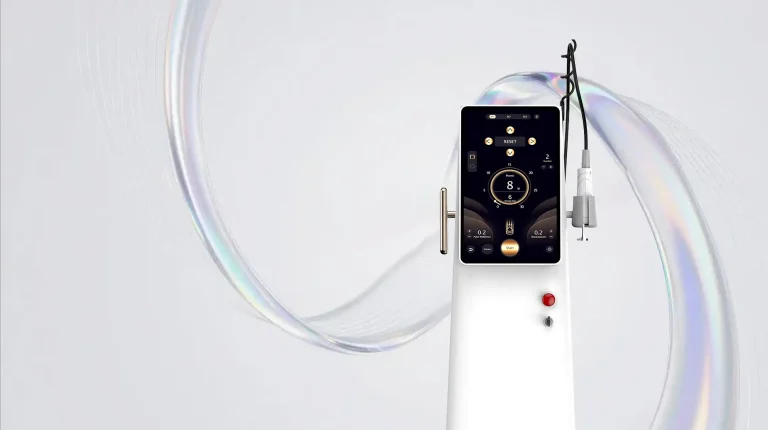
For clinics and distributors looking for a multi-wavelength professional pico laser machine, Ultra PicoMax offers an integrated platform combining picosecond laser technology with additional treatment modes.
The system is designed for professional medical aesthetic environments requiring multiple wavelength configurations and treatment options.
Five Laser Wavelengths
Ultra PicoMax supports five wavelength configurations:
- 1064nm
- 755nm
- 650nm
- 585nm
- 532nm
These wavelength options provide different optical configurations for selected pigment-targeting and aesthetic applications.
Five Integrated Treatment Technologies
Ultra PicoMax integrates five treatment technologies:
- Picosecond: Ultra-short pulse technology for selected pigmentation and tattoo-related applications.
- PTP: Photoacoustic Twin Pulse technology.
- Multi Pulse: Multiple-pulse delivery technology.
- Long Pulse: Additional long-pulse treatment technology.
- Long Pulse Pro: An additional treatment configuration within the platform.
Optional Honeycomb HP Applicator
The optional Honeycomb HP applicator provides a fractional treatment configuration based on Laser-Induced Optical Breakdown (LIOB) technology.
This technology is associated with selected skin rejuvenation applications and microscopic treatment zone formation.
Ultra PicoMax Technical Specifications
| Specification | Ultra PicoMax |
|---|---|
| Laser Type | Picosecond Laser |
| Wavelengths | 1064 / 755 / 650 / 585 / 532nm |
| Pulse Width | 350ps |
| Repetition Rate | 1–10Hz |
| Single Pulse Energy at 1064nm | 1200mJ |
| Single Pulse Energy at 532nm | 600mJ |
| Long Pulse Energy | 3000mJ |
| Beam Divergence | ≤1mrad |
| Beam Profile | Homogeneous |
| Cooling System | Air-to-Water Cooling |
| Articulated Arm | Korean Seven-Joint Articulated Arm |
| Optional Applicator | Honeycomb HP |
Who Is Ultra PicoMax Suitable For?
Ultra PicoMax is intended for professional equipment buyers and medical aesthetic businesses, including:
- Dermatology clinics.
- Medical aesthetic centers.
- Plastic surgery hospitals.
- Professional medical spas.
- Medical equipment distributors.
- International equipment importers.
OEM and ODM Cooperation
Cocoon Laser supports professional equipment buyers interested in customized product and branding arrangements.
Cooperation requirements may include:
- Private-label branding.
- Logo customization.
- Machine appearance customization.
- Packaging and documentation customization.
- Accessory configuration.
- Distributor cooperation.
Clinics and distributors interested in Ultra PicoMax can contact Cocoon Laser to request detailed specifications, available configurations, and a quotation.
Contact Cocoon Laser for Ultra PicoMax Information
Actual equipment specifications, accessories, and available configurations should be confirmed before ordering.
Frequently Asked Questions About Pico Laser Machines
1. What is a pico laser machine?
A pico laser machine is a professional laser system that delivers ultra-short pulses measured in picoseconds. It is used for selected pigmentation, tattoo removal, and aesthetic skin treatment applications.
2. What is the difference between a pico laser and a Q-switched laser?
The main difference is pulse duration. Picosecond lasers deliver shorter pulses than conventional nanosecond Q-switched systems. Their tissue interactions and treatment characteristics can therefore differ.
3. Which wavelength is best for a pico laser machine?
There is no universally best wavelength. Common options include 1064nm, 755nm, and 532nm, each with different optical characteristics. The appropriate wavelength depends on the treatment target and professional assessment.
4. How many wavelengths should a professional pico laser have?
The required number depends on the clinic’s treatment services. Single-wavelength systems may suit focused applications, while multi-wavelength systems provide additional treatment flexibility.
5. What pulse duration should buyers look for?
Professional pico laser systems commonly operate in the picosecond range. Buyers should evaluate the actual pulse duration together with energy output, stability, wavelength, and beam characteristics.
6. How much does a professional pico laser machine cost?
Prices vary according to laser source, wavelengths, energy specifications, treatment modes, accessories, customization, and after-sales support. Buyers should request quotations based on a clearly defined equipment configuration.
7. Can one pico laser machine support tattoo removal and pigmentation treatments?
Some multi-wavelength picosecond laser systems support both tattoo-related and selected pigmentation applications. Actual capabilities depend on the wavelengths, energy specifications, and authorized intended use.
8. What should I check before buying a pico laser machine?
Check wavelengths, pulse duration, energy output, fluence, repetition rate, beam characteristics, cooling configuration, accessories, warranty, technical support, and applicable regulatory documentation.
9. Is a multi-wavelength pico laser machine better?
Not necessarily. Multi-wavelength machines offer additional treatment flexibility, but the best configuration depends on clinical requirements, operating costs, and equipment utilization.
10. How do I find a reliable pico laser machine supplier?
Evaluate the supplier’s business background, product documentation, equipment specifications, quality control arrangements, warranty, technical support, and export experience. Request detailed quotations and verify relevant regulatory documentation.
11. What is the difference between a pico laser manufacturer and supplier?
A manufacturer is responsible for producing or assembling equipment, while a supplier provides equipment to buyers. Some suppliers work directly with manufacturing partners and coordinate sourcing, customization, and delivery.
12. Can I purchase a pico laser machine with my own brand?
Some professional equipment suppliers offer OEM and ODM cooperation, including logo, packaging, and selected appearance customization. Buyers should confirm the available customization options and minimum order requirements.
13. What is the Ultra PicoMax pico laser machine?
Ultra PicoMax is a professional multi-wavelength picosecond laser platform offering five wavelengths, five integrated treatment technologies, and an optional Honeycomb HP fractional applicator.
Final Verdict: Choosing the Right Pico Laser Machine
Choosing a professional pico laser machine requires a comprehensive evaluation of technical specifications, treatment flexibility, equipment reliability, and supplier support.
Wavelengths, pulse duration, energy output, beam quality, and available treatment technologies all contribute to the overall equipment configuration.
For clinics with focused treatment requirements, a single-wavelength system may be sufficient. For multi-service aesthetic centers and distributors, a multi-wavelength platform may provide greater operational flexibility.
Buyers should also consider warranty coverage, maintenance, technical documentation, regulatory requirements, and long-term operating costs before making a purchasing decision.
Ultra PicoMax combines five wavelengths and five treatment technologies in one professional picosecond laser platform, with optional Honeycomb HP fractional technology.
If you are comparing professional pico laser equipment for your clinic or distribution business, contact Cocoon Laser to discuss your requirements and request detailed product information.
About This Guide
Publisher: Cocoon Laser Editorial Team
Topic: Professional pico laser machines, picosecond laser technology, and medical aesthetic equipment selection.
Last Updated: November 2026
Editorial Approach: This guide explains the technical characteristics, equipment configurations, and purchasing considerations associated with professional picosecond laser systems. Product-specific specifications are based on Ultra PicoMax product documentation.
Medical and Technical Disclaimer: This article is intended for educational and equipment purchasing purposes. It does not replace professional medical advice or device-specific operating instructions. Laser procedures should be performed by appropriately qualified professionals in accordance with applicable regulations and manufacturer instructions.
Product Information: Specifications and available configurations may change. Buyers should confirm the latest technical documentation with the supplier before ordering.
References
- Picosecond Laser Technology: Clinical Applications and Technical Considerations. Relevant peer-reviewed literature on picosecond laser applications and pigment-targeting mechanisms. Explore PubMed research .
- Picosecond Laser Treatment for Pigmentation Disorders: Clinical Efficacy and Safety. Explore PubMed research .
- U.S. Food and Drug Administration: Medical Lasers. Read FDA information .
- Ultra PicoMax Product Documentation. Manufacturer-provided product specifications and available equipment configurations.