The Ultimate Clinic Guide to Buy Medical Aesthetic Devices: Efficacy, Wavelengths, and ROI
Executive Summary: The High-Stakes Decision of Acquiring Aesthetic Lasers
For clinic owners and medical directors, the decision to buy medical aesthetic devices represents a significant capital investment with direct implications for patient outcomes, operational throughput, and long-term profitability. Unlike consumer-grade or entry-level IPL systems, professional medical devices must deliver consistent clinical efficacy, absolute safety across diverse Fitzpatrick skin types, and a demonstrable return on investment (ROI). This guide provides a data-driven framework for evaluating diode laser systems, focusing on critical performance metrics, regulatory compliance (Medical CE, FDA cleared, ISO 13485), and total cost of ownership (TCO).
Core Physics: Selective Photothermolysis & Wavelength Synergy
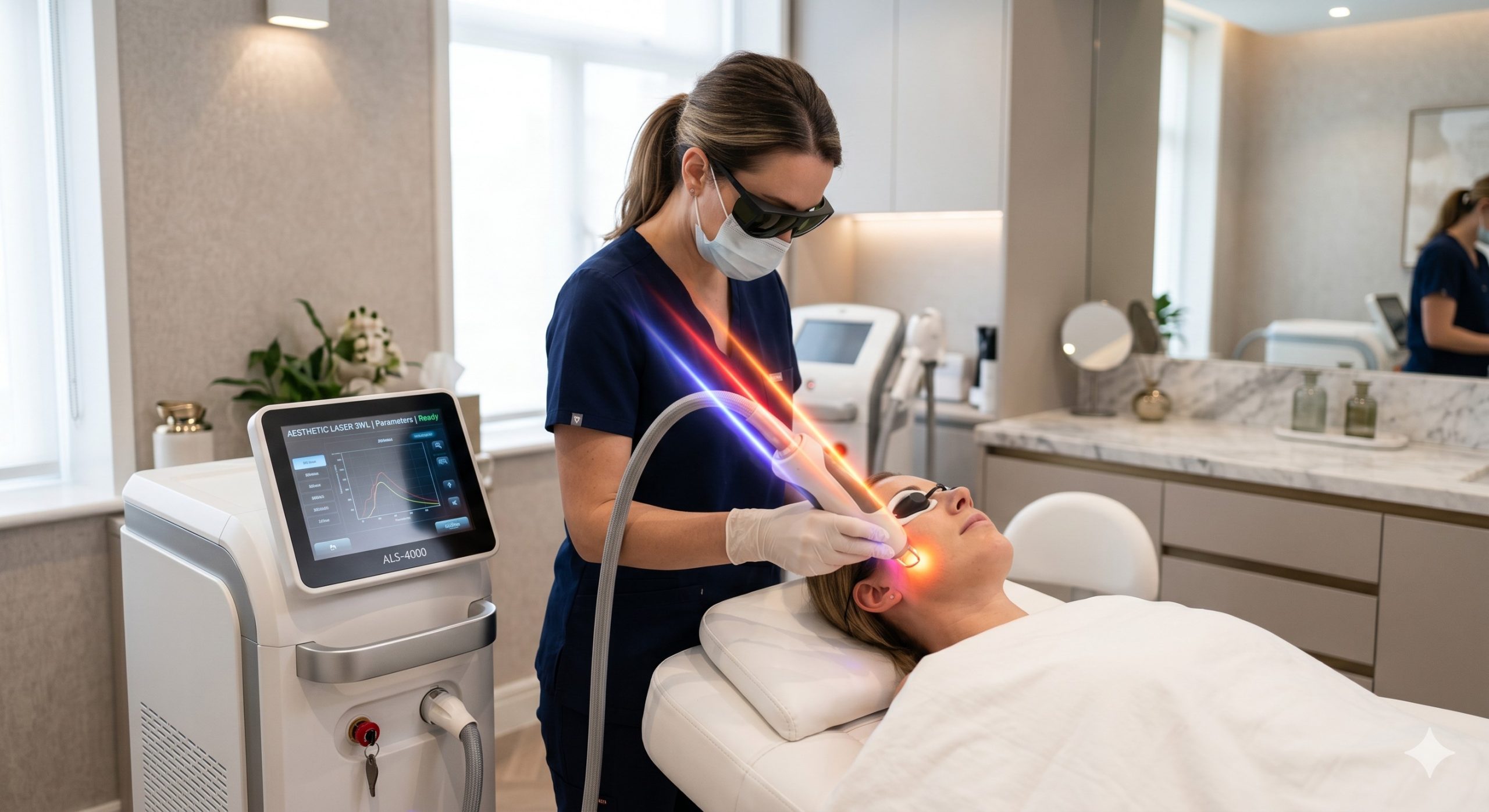
The clinical foundation of modern hair removal and pigmentation treatment lies in selective photothermolysis. This principle requires matching a specific light wavelength to an intended chromophore (melanin in hair follicles or pigmented lesions) while minimizing damage to surrounding tissue. When you buy medical aesthetic devices, the wavelength configuration is the single most important technical specification.
Triple-Wavelength Superiority (755nm / 808nm / 1064nm)
While legacy systems often rely on a single diode wavelength (e.g., 808nm alone), high-performance platforms utilize a tri-wavelength handpiece. The 755nm wavelength is ideal for fine, light-colored hairs and superficial pigmentation but has shallow penetration. The 808nm is the workhorse for deep follicular destruction across most skin types. The 1064nm wavelength penetrates deepest and safely treats darker Fitzpatrick skin types IV-VI by bypassing epidermal melanin. A device that allows simultaneous or sequential pulsing of these wavelengths provides superior clinical clearance rates (typically 85-95% reduction after 6 sessions) versus single-wavelength systems.
Engineering Excellence: Epidermal Protection & Energy Delivery
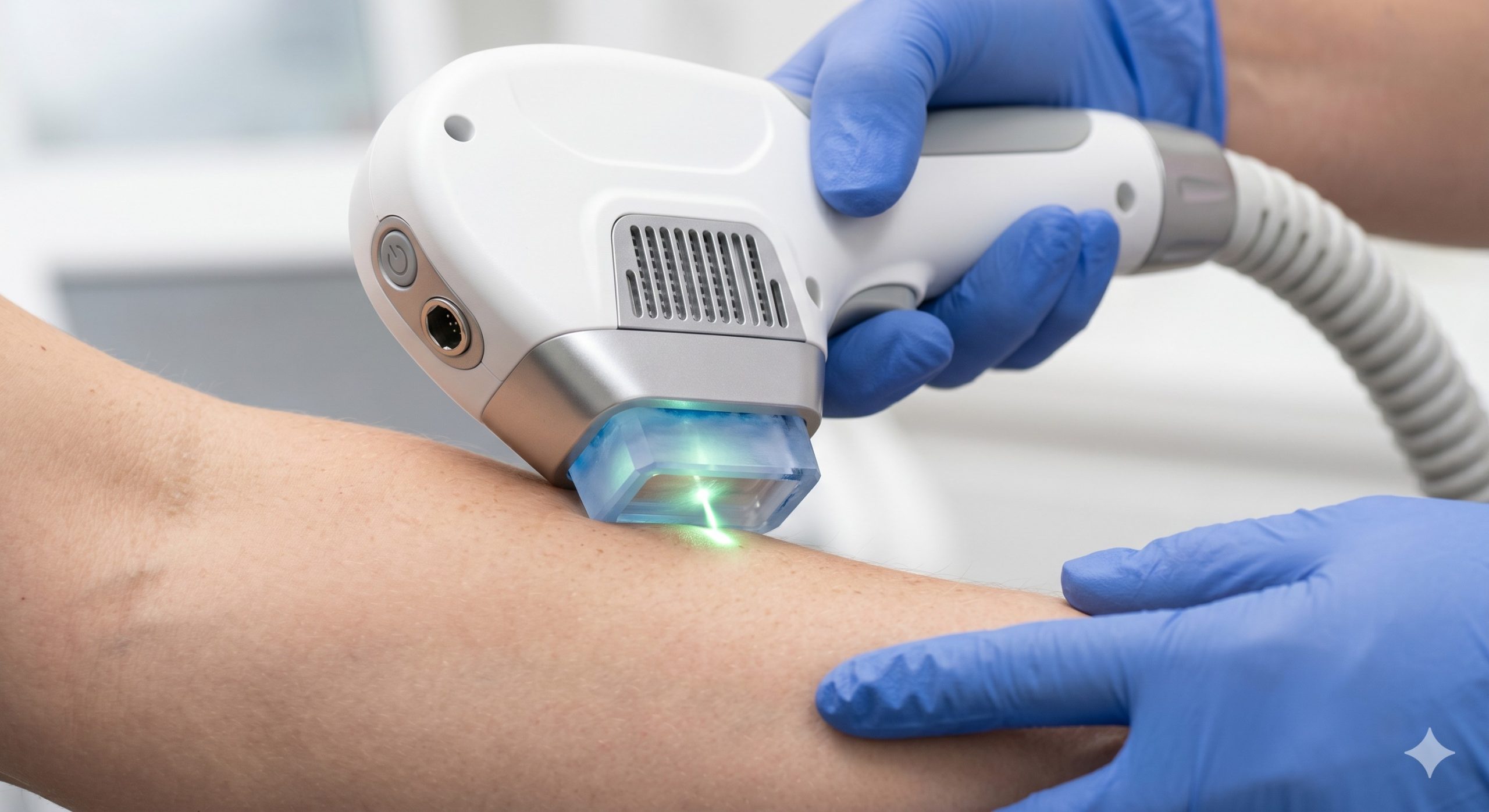
Patient comfort and safety are non-negotiable. Advanced systems integrate Sapphire Contact Cooling (often thermoelectric cooling or TEC) which pre-cools the epidermis to -5°C to +5°C before the laser pulse. This protects the skin from thermal injury, reduces pain, and allows the use of higher, more effective fluence (energy density measured in J/cm²).
Key Performance Metrics to Evaluate
Clinical efficacy directly correlates with peak power and spot size. A large spot size (e.g., 12x12mm or 15x15mm) reduces treatment time by increasing photon density and depth of penetration. Look for devices delivering fluence up to 120 J/cm² and pulse widths adjustable from 5ms to 400ms. Higher rep rate (up to 10Hz) enables rapid, uniform stacking of pulses. These specifications are meaningless without stable power delivery, which is why imported laser bars (e.g., from Jenoptik or Hamamatsu) are hallmarks of quality.
| Key Parameter | Technical Specification & Clinical Rationale |
|---|---|
| Wavelengths | 755nm (superficial/fine hair) / 808nm (deep follicular) / 1064nm (Fitzpatrick IV-VI) |
| Fluence (Energy Density) | Up to 120 J/cm² (higher fluence = stronger follicle destruction) |
| Spot Size | 12x12mm to 15x15mm (larger spot = deeper penetration & faster treatment) |
| Cooling System | Sapphire Contact Cooling (TEC) -5°C to +5°C (epidermal protection) |
| Pulse Width | 5ms – 400ms adjustable (allows targeting different hair diameters) |
| Repetition Rate | Up to 10Hz (continuous stacking for uniform heating) |
| Handpiece Shot Lifespan | 1-2 million shots (critical for consumable TCO) |
| Regulatory Status | Medical CE (Class IIb) / FDA cleared / ISO 13485 manufacturer |
Clinical Workflow & Operator Safety
Intelligent Skin Sensors & Contact Detection
To prevent accidental firing or treatment of unintended areas, premium devices feature real-time skin contact sensors and motion detection. Some advanced platforms include a Fitzpatrick skin type meter that automatically adjusts recommended fluence, reducing operator error. This is crucial for high-throughput clinics where multiple aestheticians may use the same device.
Total Cost of Ownership (TCO) & ROI Analysis
The purchase price is only the initial CapEx. A strategic evaluation of buy medical aesthetic devices requires analyzing OpEx. The most significant variable is handpiece longevity. Quality diode handpieces are rated for 1-2 million shots. Below this, you face costly consumable replacements. Calculate consumables per patient: a system with a 15x15mm spot size treats an area roughly 2.25x faster than a 10x10mm system, directly increasing daily patient volume. A single high-end aesthetic laser can generate $8,000-$15,000 monthly revenue at typical per-session pricing ($150-$300 for large areas). Break-even on a $35,000-$60,000 device is often achieved within 6-9 months in a busy med spa.
Regulatory & Compliance Audit
Never deploy a device lacking Medical CE (Class IIb or higher) or appropriate FDA clearance for your jurisdiction. ISO 13485 certification for the manufacturer ensures quality management systems in design and production. Using non-compliant devices invalidates your clinic’s malpractice insurance and poses severe patient safety risks.
Conclusion: Data-Driven Procurement Strategy
When preparing to buy medical aesthetic devices, prioritize triple-wavelength diode platforms with validated sapphire cooling, large spot sizes (≥12x12mm), and high fluence (≥100 J/cm²). Demand documentation of handpiece shot longevity and regulatory certifications. The right device is not an expense—it is a clinical asset that increases patient satisfaction, accelerates treatment throughput, and directly enhances med spa profitability. Avoid legacy IPL systems and underpowered diodes; invest in clinically validated hardware that serves the full spectrum of Fitzpatrick skin types with safety and speed.