1927nm vs 1550nm Laser: What’s the Difference?
The 1927nm and 1550nm fractional laser wavelengths are both used in professional aesthetic skin treatments, but they are not interchangeable. Their different interactions with water influence where laser energy is deposited in tissue and, consequently, the types of treatment objectives for which each wavelength may be considered.
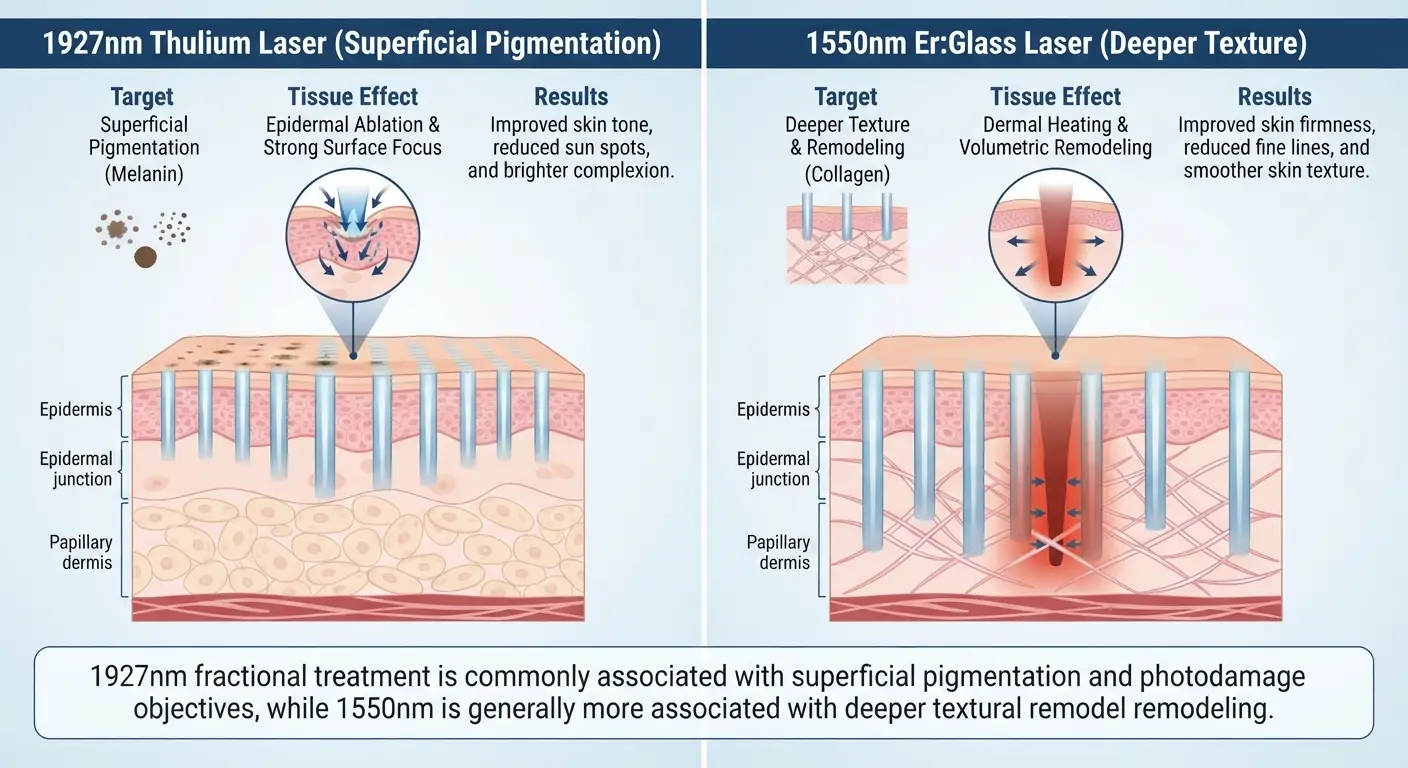
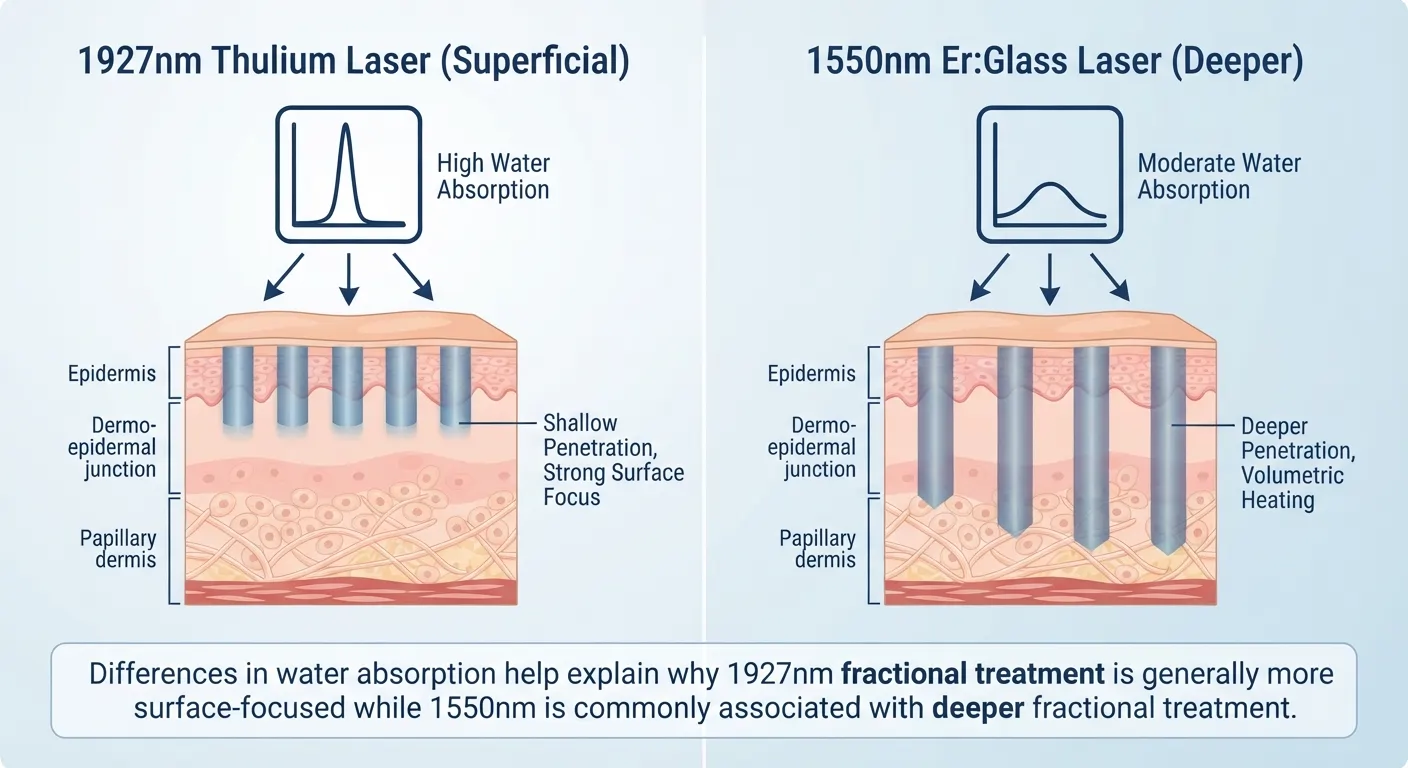
In general, approximately 1927nm is associated with stronger water absorption and a relatively superficial treatment profile, making it particularly relevant to selected pigmentation, photodamage, and superficial skin-quality concerns. Approximately 1550nm is less strongly absorbed by water and is commonly used for deeper fractional treatment strategies involving dermal remodeling and selected textural concerns.
However, wavelength alone does not determine treatment depth, results, downtime, or safety. Energy, fractional density, spot characteristics, pulse delivery, scanning architecture, number of passes, device design, and patient characteristics can all influence the clinical response.
This guide compares 1927nm vs 1550nm laser technology from a professional equipment and treatment perspective, including water absorption, treatment depth, fractional delivery, applications, pigmentation, skin resurfacing, recovery, and how clinics may evaluate single- and dual-wavelength systems.
Quick Answer
What is the main difference between 1927nm and 1550nm lasers? The key difference is how strongly each wavelength interacts with water in skin tissue. Approximately 1927nm is more strongly absorbed by water than 1550nm and is therefore generally associated with a more superficial treatment profile. This makes 1927nm particularly relevant to selected superficial pigmentation, photodamage, and skin-tone concerns.
Approximately 1550nm has lower water absorption than 1927nm and is commonly associated with deeper non-ablative fractional treatment strategies. It may therefore be selected when the treatment objective places greater emphasis on dermal remodeling and selected textural concerns.
Neither wavelength is universally better. 1927nm is generally more surface-focused, while 1550nm is generally more depth-focused. The appropriate wavelength depends on the treatment objective, patient characteristics, device design, and treatment parameters.
1927nm vs 1550nm Laser at a Glance
| Feature | 1927nm Laser | 1550nm Laser |
|---|---|---|
| Water Absorption | Higher | Lower than 1927nm |
| General Treatment Profile | Relatively superficial | Generally deeper |
| Common Fractional Approach | Superficial fractional treatment | Deeper non-ablative fractional treatment |
| Common Treatment Focus | Pigmentation, photodamage, uneven-looking tone and superficial skin quality | Texture, selected scars, fine lines and dermal remodeling |
| Pigmentation Focus | Often more directly relevant to superficial pigment concerns | May be used where deeper remodeling is part of the treatment objective |
| Skin Remodeling | Possible within its treatment profile | Generally more associated with deeper fractional remodeling |
| Fractional Delivery | Common | Common |
| Best Choice | Depends on treatment objective, device design, patient characteristics, and treatment parameters | |
This comparison describes general wavelength behavior rather than a universal protocol. Two devices operating at the same nominal wavelength may still produce different treatment experiences because their energy delivery, fractional architecture, pulse characteristics, and software differ.
What Is a 1927nm Laser?
In aesthetic medicine, approximately 1927nm is strongly associated with thulium laser technology and fractional skin treatment.
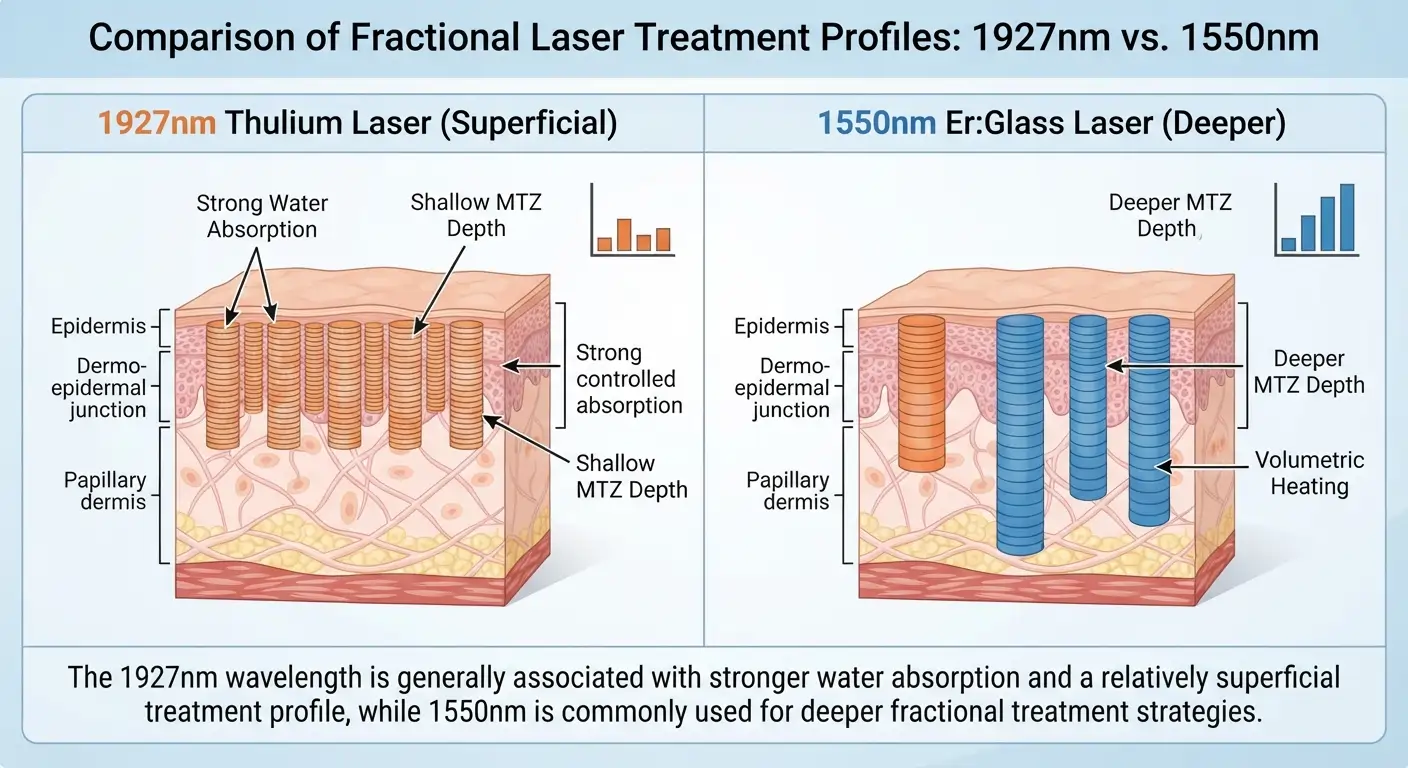
Water is an important chromophore for this wavelength. The relatively strong interaction between 1927nm energy and tissue water contributes to energy deposition closer to the skin surface compared with wavelengths that are less strongly absorbed by water.
This characteristic has made 1927nm technology relevant to treatment strategies involving:
- Selected superficial pigmentation
- Visible photodamage
- Uneven-looking skin tone
- Selected dyschromia concerns
- Superficial skin-quality improvement
- Fractional rejuvenation strategies
Many professional 1927nm aesthetic systems deliver energy fractionally rather than uniformly treating the entire surface.
For a complete explanation of this wavelength, see our 1927nm Thulium Laser guide.
What Is a 1550nm Laser?
Approximately 1550nm is widely associated with non-ablative fractional laser technology used for deeper treatment within the skin compared with more superficially focused wavelengths such as 1927nm.
Water also acts as an important chromophore around 1550nm, but its absorption characteristics differ from those at 1927nm. Because absorption is lower, energy can generally be delivered into deeper tissue before being absorbed to the same extent.
As a result, 1550nm fractional systems are commonly associated with treatment strategies involving:
- Skin texture
- Selected acne-scar concerns
- Selected traumatic or surgical scar concerns
- Fine lines
- Dermal remodeling
- Broader fractional rejuvenation strategies
This does not mean that 1550nm treats every deeper skin concern or that treatment depth is determined by wavelength alone. Device-specific energy delivery and treatment parameters remain important.
Why Does Wavelength Matter in Fractional Laser Treatment?
Laser wavelength affects how light interacts with biological tissue. Different wavelengths are absorbed differently by chromophores such as water, melanin, and hemoglobin.
For both 1927nm and 1550nm fractional technologies, interaction with water is central to understanding their treatment behavior.
When a wavelength is more strongly absorbed by water, its energy tends to be deposited over a shorter optical path in water-rich tissue. When water absorption is lower, energy can generally travel farther before being absorbed to the same degree.
This helps explain the broad distinction:
- 1927nm: stronger water absorption → relatively superficial treatment profile
- 1550nm: lower water absorption than 1927nm → generally deeper treatment profile
This relationship is one of the most important technical differences between the two wavelengths.
1927nm vs 1550nm: Which Laser Penetrates Deeper?
In general, 1550nm fractional laser treatment is associated with deeper tissue treatment than 1927nm fractional laser treatment.
This is primarily related to their different water-absorption characteristics. Approximately 1927nm is more strongly absorbed by water, causing energy to be deposited relatively superficially. Approximately 1550nm has lower water absorption and can generally support deeper fractional treatment.
However, it is important not to convert this general principle into one fixed penetration depth for every device.
Actual treatment depth can be influenced by:
- Energy delivered per microscopic treatment zone
- Pulse characteristics
- Fractional spot design
- Beam profile
- Device architecture
- Number of passes
- Scanning method
- Tissue characteristics
For this reason, claims such as “every 1927nm laser reaches exactly X millimeters” or “every 1550nm system reaches exactly Y millimeters” should be treated cautiously unless they are supported by data for the specific device and treatment parameters.
1927nm vs 1550nm Fractional Laser: How Fractional Delivery Changes Treatment
Wavelength and fractional delivery describe two different aspects of a laser treatment.
Wavelength influences optical interaction with tissue. Fractional delivery describes how the treatment energy is spatially distributed across the skin.
Fractional systems create microscopic treatment zones rather than uniformly exposing the entire treatment surface. Intervening areas remain between these zones.
Depending on the device, practitioners may be able to adjust:
- Energy
- Fractional density
- Coverage
- Scanning pattern
- Number of passes
- Treatment speed
Therefore, two fractional procedures can differ substantially even when they use the same wavelength.
For a deeper explanation of fractional treatment architecture, see Fractional Thulium Laser: How 1927nm Fractional Technology Works.
1927nm vs 1550nm for Pigmentation
When the primary concern is relatively superficial pigmentation or visible photodamage, 1927nm is often particularly relevant because of its relatively superficial treatment profile.
Potential treatment objectives may include improving the appearance of selected:
- Superficial pigmentation
- Sun-related discoloration
- Uneven-looking tone
- Photodamage
- Other superficial dyschromia concerns where appropriate
The 1550nm wavelength is generally more associated with deeper fractional remodeling than with being primarily selected for superficial pigment-focused treatment.
This does not mean that every pigmentation concern should be treated with 1927nm. Pigmentation has different causes and depths, and some conditions require particular caution.
For example, melasma is a complex and recurrent pigmentary condition. A more superficial wavelength does not automatically make treatment risk-free or permanently effective. See our Thulium Laser for Melasma guide for a more detailed discussion.
1927nm vs 1550nm for Skin Texture
If treatment objectives place greater emphasis on deeper textural remodeling, 1550nm fractional technology may be more relevant because of its generally deeper treatment profile.
Selected applications may include concerns involving:
- Visible skin texture
- Selected acne scars
- Fine lines
- Selected scar remodeling
- Dermal rejuvenation
A 1927nm fractional laser may still contribute to improvements in the visible quality of the skin, but its relatively superficial profile means it should not automatically be expected to produce the same type of deeper remodeling as a 1550nm fractional treatment.
This is why clinics should begin with the treatment objective rather than asking which wavelength is “stronger.”
1927nm vs 1550nm for Acne Scars
Acne scars vary considerably in morphology and depth. Rolling, boxcar, ice-pick, and pigment-related post-acne concerns do not necessarily respond to the same treatment strategy.
When the primary objective involves deeper fractional remodeling of selected atrophic scar characteristics, approximately 1550nm may be more relevant than a more superficially focused 1927nm treatment.
However, a patient may also have post-acne pigmentation or uneven tone in addition to textural scarring. In these situations, the treatment strategy may need to distinguish between:
- Surface pigmentation
- Uneven tone
- Scar texture
- Scar depth
- Overall skin-quality objectives
This is one reason dual-wavelength or multimodal treatment strategies can be clinically interesting: different concerns may exist at different tissue levels.
1927nm vs 1550nm for Fine Lines and Skin Rejuvenation
Both wavelengths may appear in broader skin-rejuvenation strategies, but they approach the treatment objective from different depth profiles.
A 1927nm fractional treatment may be selected when superficial photodamage, pigmentation, and visible skin-quality concerns are important components of the treatment plan.
A 1550nm fractional treatment may be selected when greater emphasis is placed on deeper fractional remodeling, texture, and selected fine-line concerns.
In practice, patients often present with more than one concern. For example, the same patient may have:
- Superficial sun-related pigmentation
- Uneven skin tone
- Fine lines
- Textural irregularities
This creates an important clinical question: should the treatment focus primarily on the superficial concern, the deeper concern, or use a strategy capable of addressing different treatment depths?
1927nm vs 1550nm: Which Is Better?
Neither 1927nm nor 1550nm is universally better. The more appropriate wavelength depends on what the practitioner is trying to achieve.
| If the Primary Treatment Goal Is… | Technology More Commonly Associated with That Goal |
|---|---|
| Superficial pigmentation | 1927nm |
| Visible photodamage | 1927nm |
| Uneven-looking superficial skin tone | 1927nm |
| Deeper fractional remodeling | 1550nm |
| Selected deeper textural concerns | 1550nm |
| Selected acne-scar remodeling | Often 1550nm, depending on scar characteristics |
| Both superficial and deeper concerns | A dual-wavelength or individualized multimodal strategy may be considered |
This distinction is more useful than describing one wavelength as more advanced or more powerful than the other. Their value comes from their different tissue interactions and treatment roles.
1927nm vs 1550nm Laser Results
The expected results of 1927nm and 1550nm fractional laser treatments differ because the two wavelengths are commonly used with different treatment depths and objectives.
With 1927nm fractional laser treatment, visible improvement may be evaluated primarily through changes in superficial pigmentation, photodamage, uneven-looking tone, and overall skin quality.
With 1550nm fractional laser treatment, evaluation may place greater emphasis on texture, selected scars, fine lines, and other concerns where deeper fractional remodeling is part of the treatment objective.
| Result Category | 1927nm | 1550nm |
|---|---|---|
| Superficial Pigmentation | Common treatment focus | Not usually the primary reason for selecting the wavelength |
| Photodamage | Common treatment focus | May be part of a broader rejuvenation strategy |
| Uneven-Looking Tone | Common treatment focus | May improve as part of broader treatment |
| Skin Texture | May improve within a superficial treatment strategy | More commonly associated with deeper remodeling |
| Selected Acne Scars | Not generally the primary strength for deeper scar remodeling | More commonly considered for selected textural scars |
| Fine Lines | May contribute to overall skin-quality improvement | Often more relevant when deeper remodeling is desired |
These are general treatment associations rather than guaranteed outcomes. The actual result depends on the device, parameters, patient characteristics, treatment plan, operator technique, and healing response.
1927nm vs 1550nm Before and After: What Should You Expect?
Before-and-after photographs should be interpreted according to the original treatment objective rather than simply asking which wavelength produces the more dramatic visual change.
A successful 1927nm result may show:
- Less visible superficial pigmentation
- A more even-looking complexion
- Reduced appearance of selected sun-related discoloration
- Improvement in visible photodamage
- Changes in overall skin quality
A successful 1550nm result may place greater emphasis on:
- Improvement in visible texture
- Selected acne-scar characteristics
- Fine-line appearance
- Skin remodeling
- Overall textural rejuvenation
This is an important distinction. A treatment producing a stronger visible change in one category is not automatically superior if the patient’s primary concern belongs to another category.
For more information about evaluating 1927nm treatment outcomes, see our Thulium Laser Before and After guide.

1927nm vs 1550nm Laser Downtime and Recovery
It is tempting to assume that a more superficially focused wavelength always means less downtime, but wavelength alone cannot reliably predict the recovery experience.
Downtime is influenced by:
- Energy delivered
- Fractional density
- Treatment coverage
- Number of passes
- Pulse characteristics
- Treatment area
- Device architecture
- Patient skin characteristics
- Individual healing response
1927nm Recovery
Following fractional 1927nm treatment, temporary responses may include redness, warmth, mild swelling, dryness, roughness, sensitivity, and temporary darkening of selected pigmented areas.
As early recovery progresses, these temporary surface changes may settle before the treatment result becomes easier to evaluate.
1550nm Recovery
Fractional 1550nm treatment can also produce redness, swelling, warmth, dryness, sensitivity, and temporary changes in skin texture.
Because 1550nm is commonly used for deeper fractional treatment strategies, the treatment experience may differ from a relatively superficial 1927nm procedure. However, this does not mean every 1550nm treatment necessarily produces more downtime than every 1927nm treatment.
A conservative 1550nm protocol and an intensive 1927nm protocol cannot be accurately compared using wavelength alone.
1927nm vs 1550nm Laser Side Effects and Risks
Both wavelengths create controlled thermal effects and therefore require appropriate patient selection, parameter selection, professional operation, and aftercare.
Possible temporary treatment responses can include:
- Redness
- Swelling
- Warmth
- Skin sensitivity
- Dryness
- Temporary texture changes
Depending on the patient and treatment, unwanted reactions may also include pigmentary changes, prolonged irritation, or other device- and patient-specific adverse effects.
Post-Inflammatory Hyperpigmentation
Post-inflammatory hyperpigmentation, or PIH, is particularly relevant when treating patients who are prone to pigmentary responses.
Neither wavelength should be described as universally free from PIH risk. Inflammatory response, treatment intensity, patient characteristics, recent sun exposure, and aftercare can all influence pigmentary outcomes.
Appropriate professional assessment is therefore more useful than choosing a wavelength solely because it is perceived as “safer.”
1927nm vs 1550nm for Different Skin Types
Skin phototype is an important consideration in fractional laser treatment, but it should not be treated as the only factor determining suitability.
Professional assessment may also consider:
- Baseline pigmentation
- History of post-inflammatory hyperpigmentation
- Current skin condition
- Recent tanning or significant sun exposure
- Previous response to laser procedures
- Treatment indication
- Desired treatment intensity
- Ability to follow aftercare instructions
Device parameters should be selected for the individual patient and intended treatment rather than assuming one protocol is appropriate for everyone within a particular skin type.
1927nm vs 1550nm for Melasma
Melasma is a particularly important example of why wavelength selection should not be reduced to a simple “which laser is better?” comparison.
Because 1927nm has a relatively superficial treatment profile, it may be considered within selected treatment strategies involving superficial pigmentary components. However, melasma is complex, can involve pigment at different levels, and is influenced by factors beyond the visible pigmentation itself.
Treatment-related inflammation can also contribute to unwanted pigmentary responses in susceptible patients.
Therefore:
- 1927nm should not be described as a universal cure for melasma
- 1550nm should not automatically be considered better because it treats more deeply
- More aggressive treatment does not necessarily produce better long-term control
- Recurrence remains possible after visible improvement
- Photoprotection and long-term management remain important
Read our Thulium Laser for Melasma guide for a dedicated discussion of this condition.
Why Combine 1927nm and 1550nm Wavelengths?
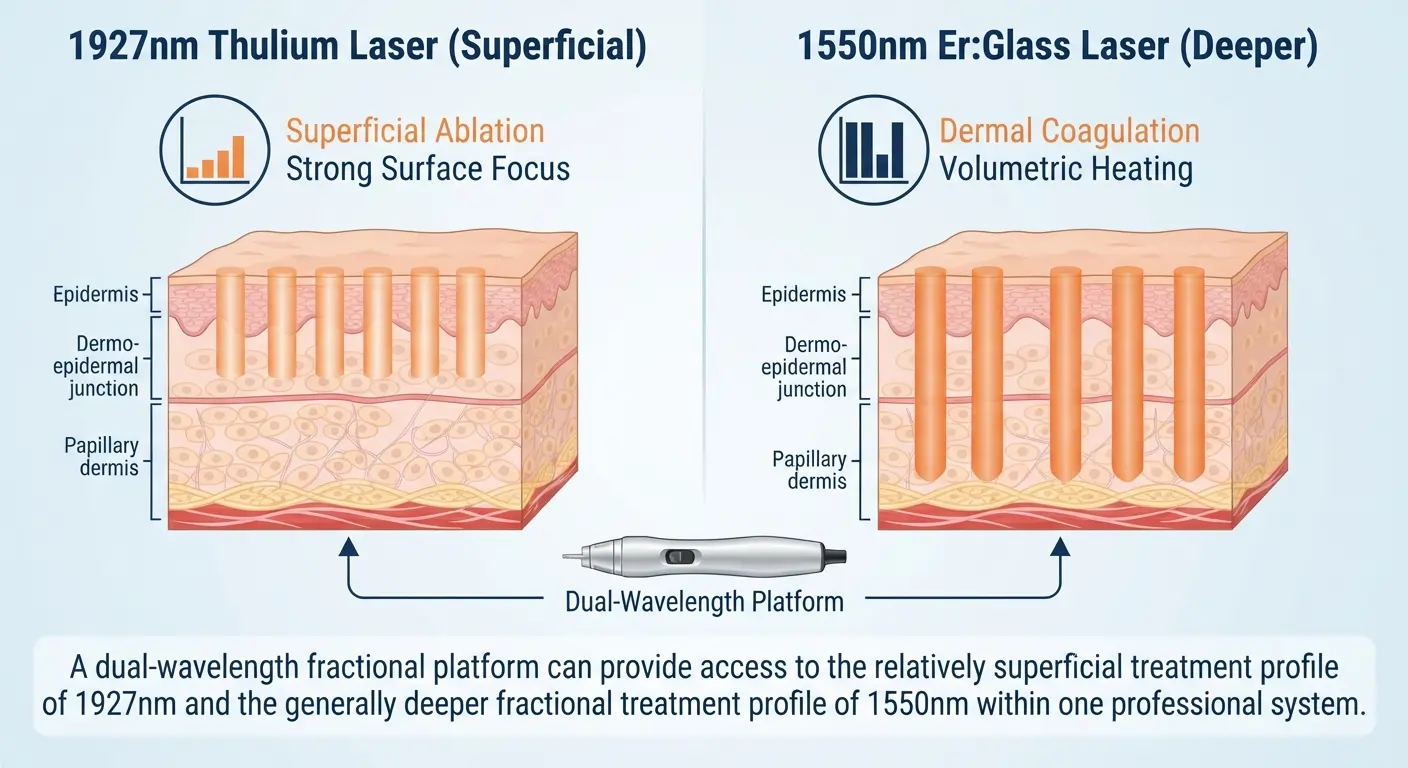
The complementary treatment profiles of 1927nm and 1550nm explain why some professional fractional laser platforms incorporate both wavelengths.
The basic concept is straightforward:
- 1927nm provides a relatively superficial treatment profile that may be relevant to pigmentation, photodamage, uneven-looking tone, and superficial skin-quality concerns.
- 1550nm provides a generally deeper fractional treatment profile that may be relevant to texture, selected scars, fine lines, and dermal remodeling.
Combining access to both wavelengths can therefore give a clinic greater flexibility when patients present with concerns at different tissue levels.
For example, a patient may simultaneously present with:
- Visible superficial pigmentation
- Sun-related photodamage
- Uneven-looking tone
- Fine lines
- Textural irregularities
A platform offering both wavelength options may allow the practitioner to build a treatment strategy around the dominant concern or, where supported by the specific device and protocol, address complementary treatment objectives.
However, the presence of two wavelengths does not automatically mean they should always be used together. Treatment sequencing, parameters, combination protocols, and patient suitability remain device- and practitioner-specific.
What Is a 1927nm + 1550nm Dual-Wavelength Fractional Laser?
A 1927nm + 1550nm dual-wavelength fractional laser is a professional aesthetic platform designed to provide two different fractional wavelength options within one treatment system.
Rather than requiring the clinic to select only a superficial or deeper fractional technology, a dual-wavelength platform can expand the range of treatment strategies available from the same equipment platform.
Potential advantages for a professional clinic may include:
- Broader treatment versatility
- Access to superficial and deeper fractional treatment profiles
- Greater flexibility for different patient concerns
- Ability to build individualized treatment strategies
- Reduced need for separate single-wavelength platforms in some clinic configurations
- Expanded treatment menu potential
These advantages depend on the actual capabilities of the device. Clinics should verify whether both wavelengths are independently adjustable, how fractional density is controlled, what handpieces or scanning modes are available, and whether combination protocols are supported by the manufacturer.
Single-Wavelength vs Dual-Wavelength Fractional Laser Systems
Clinics purchasing fractional laser equipment may need to choose between a dedicated single-wavelength system and a platform offering both 1927nm and 1550nm.
| Consideration | Single-Wavelength System | 1927nm + 1550nm Dual-Wavelength System |
|---|---|---|
| Treatment Focus | More specialized around one wavelength profile | Broader superficial and deeper fractional capabilities |
| Clinic Treatment Menu | Depends on the selected wavelength | Potentially broader |
| Protocol Flexibility | Focused on one wavelength | More options for different treatment objectives |
| Equipment Complexity | Potentially simpler | May require additional training and protocol understanding |
| Best Fit | Clinics with a clearly defined treatment focus | Clinics seeking broader fractional treatment versatility |
A dual-wavelength platform is not automatically the better purchase. A clinic that primarily performs one type of procedure may prefer a specialized system, while a clinic treating a wider range of pigmentation and textural concerns may place greater value on wavelength flexibility.
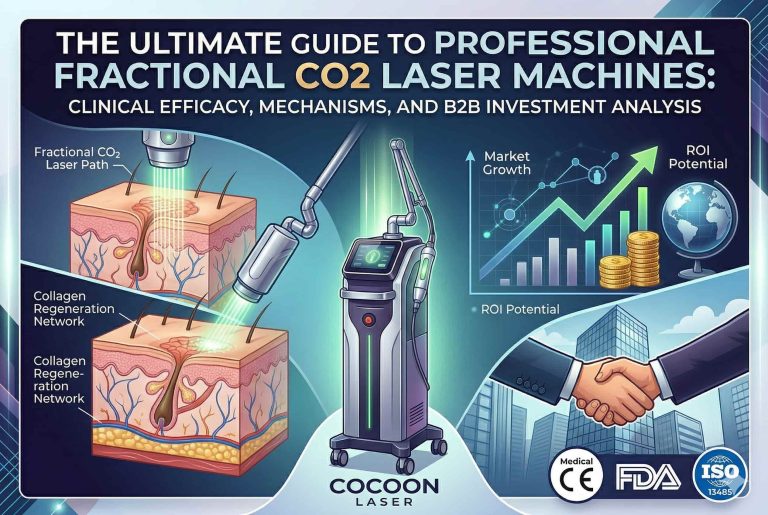
1927nm vs 1550nm vs Fractional CO2 Laser
Clinics comparing fractional technologies may also consider a 10,600nm fractional CO2 laser.
Fractional CO2 technology should not simply be treated as a stronger version of 1927nm or 1550nm. CO2 lasers have different tissue interactions and can create ablative fractional effects.
| Technology | General Treatment Profile | Common Treatment Focus |
|---|---|---|
| 1927nm | Relatively superficial fractional treatment | Pigmentation, photodamage and superficial skin-quality concerns |
| 1550nm | Deeper non-ablative fractional treatment | Texture, selected scars, fine lines and dermal remodeling |
| 10,600nm CO2 | Ablative fractional resurfacing capability | Resurfacing, wrinkles, texture and selected scar applications |
Treatment intensity, downtime, and expected results vary substantially by device and protocol. The correct technology should be selected according to the treatment objective rather than simply choosing the wavelength perceived as most powerful.
How Should Clinics Choose Between 1927nm and 1550nm?
For clinics evaluating professional fractional laser equipment, wavelength is only one part of the purchasing decision.
A useful evaluation starts with the intended treatment portfolio.
Choose a 1927nm-Focused Platform When…
A 1927nm-focused system may be particularly relevant when the clinic intends to build services around selected superficial pigmentation, photodamage, uneven-looking tone, and superficial fractional skin treatments.
Choose a 1550nm-Focused Platform When…
A 1550nm-focused system may be more relevant when the clinic places greater emphasis on deeper fractional remodeling, selected scars, texture, and fine-line concerns.
Consider a 1927nm + 1550nm Platform When…
A dual-wavelength system may be worth considering when a clinic wants broader fractional capabilities and regularly treats patients presenting with both superficial and deeper skin concerns.
What Should Clinics Compare When Buying a Fractional Laser?
Two machines with the same wavelength specifications can perform differently in clinical workflow. Clinics and distributors should therefore evaluate the complete system rather than purchasing according to wavelength alone.
Important factors can include:
- Available wavelengths
- Laser source technology
- Energy adjustment range
- Fractional density control
- Beam and fractional delivery architecture
- Scanning patterns
- Treatment-area options
- Handpiece design
- Parameter control
- User interface
- Treatment speed and workflow
- System reliability
- Maintenance requirements
- Operator training
- Clinical protocol support
- Technical support
- Warranty
- Consumables, if applicable
- Device documentation
- Applicable regulatory status
- OEM/ODM support for distributors where required
For a B2B purchaser, the best fractional laser is therefore not simply the machine with the longest specification list. The equipment needs to fit the clinic’s treatment portfolio, operator workflow, service expectations, and local regulatory requirements.
Frequently Asked Questions About 1927nm vs 1550nm Lasers
What is the difference between 1927nm and 1550nm lasers?
The main difference is their interaction with water and resulting general treatment profile. Approximately 1927nm is more strongly absorbed by water and is associated with relatively superficial fractional treatment. Approximately 1550nm has lower water absorption than 1927nm and is commonly used for deeper non-ablative fractional treatment strategies.
Is 1927nm or 1550nm better for pigmentation?
For selected superficial pigmentation and photodamage concerns, 1927nm is generally more directly associated with the treatment objective. However, pigmentation type, depth, patient characteristics, and risk of unwanted pigmentary changes must be professionally assessed.
Is 1927nm or 1550nm better for acne scars?
For selected acne scars where deeper fractional remodeling is required, 1550nm may be more relevant. Acne scars vary in type and depth, however, and some patients also have pigmentation concerns that require a different or combined strategy.
Which penetrates deeper, 1927nm or 1550nm?
In general, 1550nm is associated with deeper fractional treatment than 1927nm because 1927nm is more strongly absorbed by water. Actual treatment depth still depends on the specific device and parameters.
Does 1927nm have less downtime than 1550nm?
Not necessarily. Wavelength influences treatment behavior, but downtime also depends on energy, fractional density, coverage, number of passes, device design, treatment area, and individual skin response.
Can 1927nm and 1550nm lasers be used together?
Some professional systems provide both wavelengths, allowing access to relatively superficial and deeper fractional treatment profiles. Whether they are used separately, sequentially, or within a combined treatment strategy depends on the device, protocol, treatment objective, and patient assessment.
Why do some fractional laser machines have both 1927nm and 1550nm?
The wavelengths provide complementary treatment profiles. 1927nm is commonly associated with superficial pigmentation and photodamage, while 1550nm is more associated with deeper fractional remodeling. A dual-wavelength platform can therefore increase treatment flexibility for professional clinics.
Is 1927nm a thulium laser?
Approximately 1927nm is strongly associated with thulium-based aesthetic laser systems. However, “thulium laser” describes a broader laser family and should not automatically be treated as a synonym for every possible thulium wavelength or device.
Is 1550nm a thulium laser?
Not necessarily. A 1550nm aesthetic fractional laser should be identified according to its actual laser source and device architecture rather than being described as thulium simply because it appears alongside a 1927nm thulium wavelength in a dual-wavelength platform.
Final Verdict: 1927nm or 1550nm?
The main difference between 1927nm and 1550nm fractional lasers is not that one is universally better, but that they provide different treatment profiles.
Approximately 1927nm is more strongly absorbed by water and is generally associated with relatively superficial fractional treatment. This makes it particularly relevant to selected superficial pigmentation, photodamage, uneven-looking tone, and skin-quality concerns.
Approximately 1550nm has lower water absorption than 1927nm and is generally associated with deeper non-ablative fractional treatment. This can make it more relevant when treatment objectives involve texture, selected scars, fine lines, and deeper fractional remodeling.
For clinics treating a broad range of patients, access to both wavelengths may provide additional flexibility because superficial and deeper concerns frequently occur in the same patient.
However, wavelength should never be evaluated in isolation. Fractional delivery architecture, energy control, density, scanning system, handpiece design, software, training, service support, and device-specific intended use all influence the practical value of a professional fractional laser system.
Ultimately, the appropriate choice between 1927nm, 1550nm, or a dual-wavelength platform should be based on the clinic’s treatment objectives, patient population, desired treatment depth, workflow, and equipment requirements.
Editorial & Technical Review: This article was prepared for the Cocoon Laser professional aesthetic technology knowledge center for educational and equipment-research purposes. It does not replace individual medical assessment. Treatment suitability, parameters, expected results, recovery, contraindications, and adverse-event risks vary by patient and device. Qualified professionals should follow the instructions, intended use, training requirements, and applicable regulations for the specific laser system.