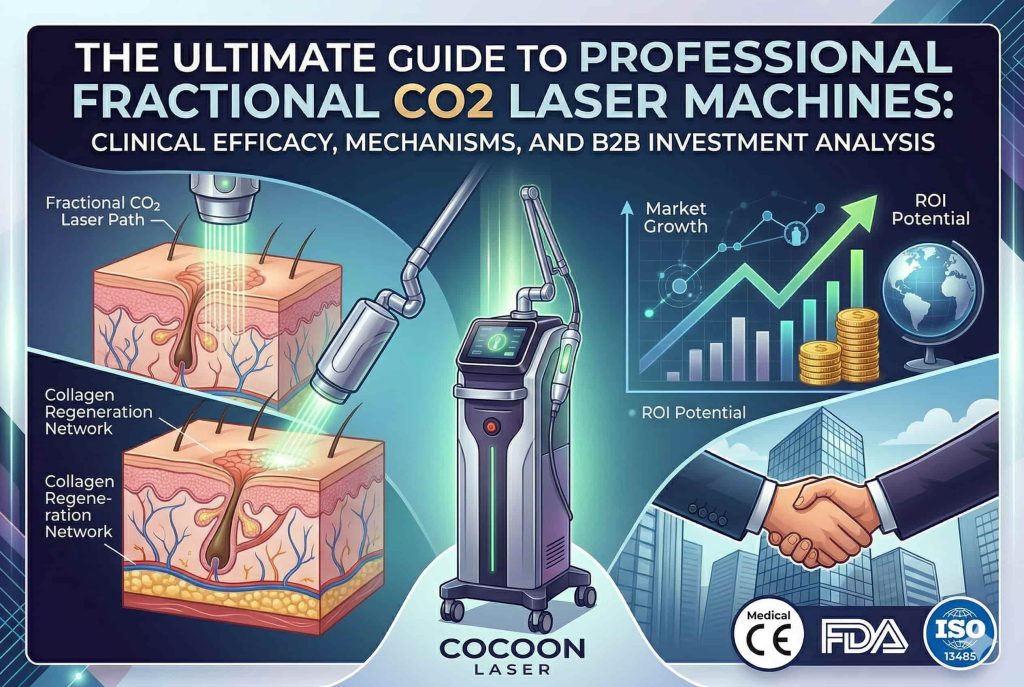
The Ultimate Guide to Professional Fractional CO2 Laser Machines: Clinical Efficacy, Mechanisms, and B2B Investment Analysis
Executive Summary
In the rapidly evolving landscape of medical aesthetics, the professional fractional CO2 laser machine remains the gold standard for dramatic skin resurfacing, scar revision, and advanced anti-aging treatments. Operating at a wavelength of 10,600 nm, this technology bridges the gap between the aggressive ablation of traditional continuous-wave CO2 lasers and the subtler, slower results of non-ablative modalities. By generating Microscopic Treatment Zones (MTZs), fractional CO2 lasers deliver precise thermal damage to stimulate neocollagenesis while leaving surrounding tissue intact for rapid re-epithelialization.
For dermatology clinics, medical spas, and aesthetic practitioners, investing in a high-quality fractional CO2 system is not merely a clinical upgrade; it is a strategic business decision that drives high patient satisfaction, expansive treatment indications, and robust Return on Investment (ROI). This comprehensive guide delves into the what, why, and how of professional fractional CO2 lasers, providing a rigorous technical framework for B2B buyers evaluating their next capital equipment acquisition.
What is a Professional Fractional CO2 Laser Machine?
At its core, a professional fractional CO2 laser is an advanced gas laser system that utilizes carbon dioxide as the active lasing medium to emit a highly focused beam of infrared light at a wavelength of 10,600 nanometers (nm). The critical distinction of a fractional system lies in its delivery method, which is rooted in the principle of Fractional Photothermolysis.
The Principle of Fractional Photothermolysis
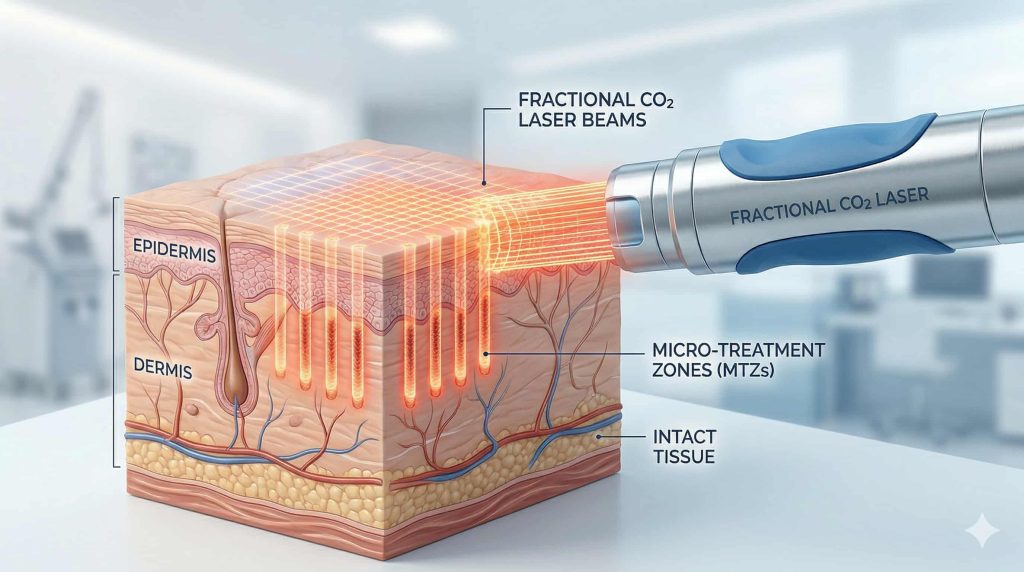
Pioneered in the early 2000s, fractional photothermolysis revolutionized ablative lasers. Instead of vaporizing the entire epidermis in a solid block (which historically led to prolonged downtime, severe erythema, and high risks of hyperpigmentation), a fractional CO2 laser machine utilizes a sophisticated computerized scanner. This scanner fractures the primary laser beam into hundreds of microscopic beams.
When these micro-beams strike the skin, they create tiny columns of thermal ablation known as Microscopic Treatment Zones (MTZs). Crucially, the healthy, untreated skin surrounding each MTZ acts as a reservoir of viable stem cells, accelerating the healing process.
RF Metal Tube vs. Glass Tube Technology
From a B2B engineering perspective, what separates a professional clinical-grade machine from an entry-level salon device is the laser excitation method. Professional systems predominantly utilize RF (Radio Frequency) Excited Metal Tubes rather than traditional DC-excited glass tubes.
- RF Metal Tubes: Provide continuous, highly stable energy output, a significantly longer lifespan (often exceeding 20,000 hours), and an incredibly fine spot size (often as small as 0.05 mm to 0.12 mm). This allows for deep penetration with minimal collateral thermal damage.
- Glass Tubes: Generally cheaper to manufacture but produce a larger, less precise spot size and possess a shorter operational lifespan, making them less suited for high-volume clinical environments.
Why Invest in a Fractional CO2 Laser? (Clinical & Business Perspective)
For clinic owners and aesthetic equipment distributors, the justification for integrating a professional fractional CO2 laser machine into an operational portfolio is twofold: unparalleled clinical efficacy and compelling business economics.
1. Unmatched Clinical Efficacy and Versatility
The 10,600 nm wavelength is highly absorbed by tissue water, making it exceptionally efficient at vaporizing targeted skin layers. A professional unit is incredibly versatile, FDA-cleared and CE-marked for a vast array of dermatological indications:
- Severe Acne Scarring: Including ice-pick, boxcar, and rolling scars. The deep thermal heating breaks down fibrotic tissue and triggers massive collagen remodeling.
- Rhytides and Fine Lines: Superior reduction of periorbital and perioral wrinkles compared to non-ablative lasers or chemical peels.
- Skin Laxity: The thermal coagulation effect causes immediate tissue contraction, resulting in a visible lifting effect.
- Dyschromia and Photoaging: Effective removal of epidermal pigmentation, solar lentigines, and actinic keratosis.
- Surgical Applications: Many professional systems come with a surgical cutting handpiece (continuous wave mode) for excising benign lesions, warts, and skin tags, essentially offering two machines in one.
2. High Return on Investment (ROI) and Patient Retention
Despite the higher initial capital expenditure compared to IPL or microneedling devices, the revenue-generating potential of a fractional CO2 laser is immense. Patients seeking fractional CO2 treatments are typically highly motivated individuals looking for transformative results. Because the clinical outcomes are often dramatic after just one to three sessions, patient satisfaction is exceptionally high, leading to strong word-of-mouth referrals. Furthermore, the consumable costs associated with CO2 lasers are generally low compared to systems that require proprietary single-use tips.
3. Minimized Risk and Downtime
Compared to fully ablative resurfacing of the 1990s, modern fractional technology reduces patient downtime from weeks to a mere 5–7 days. Features like “randomized scanning patterns” on premium machines ensure that adjacent tissue is not treated sequentially, allowing the skin to adhere to its Thermal Relaxation Time (TRT) and drastically reducing the risk of Post-Inflammatory Hyperpigmentation (PIH), a crucial factor when treating Fitzpatrick Skin Types III and IV.
How Does Fractional CO2 Technology Work? (The Biological Mechanism)
To fully understand the power of this equipment, one must look at the laser-tissue interaction at a histological level. When the 10600 nm energy is delivered into the dermis via an articulated arm and a focusing lens, a complex biological sequence is initiated.
Step 1: Immediate Tissue Vaporization (The Ablation Zone)
Water within the targeted epidermal and dermal cells absorbs the laser’s photon energy, rapidly heating up. Once the intracellular water reaches the boiling point, it vaporizes instantly. This process physically removes the damaged superficial layers of the skin, carrying away hyperpigmented cells and smoothing out superficial textural irregularities.
Step 2: Thermal Coagulation (The Coagulation Zone)
Immediately surrounding the vaporized column (MTZ) is a zone of thermal coagulation. Here, the heat is not high enough to vaporize the tissue, but it is sufficient to denature existing, cross-linked collagen fibers. This controlled thermal damage causes the collagen to shrink and contract by up to 30%, providing the immediate “tightening” effect observed by practitioners immediately post-treatment.
Step 3: Neocollagenesis and Dermal Remodeling
The most profound benefits of the fractional CO2 laser occur in the weeks and months following the procedure. The controlled micro-injuries trigger the body’s natural wound-healing cascade. Fibroblasts migrate to the thermal zones, proliferating and synthesizing massive amounts of new Type I and Type III collagen, as well as elastin. This remodeling phase continues for 3 to 6 months post-treatment, progressively improving skin texture, filling in atrophic acne scars, and increasing skin dermal density.
Key Technical Parameters: What to Look For
When procuring medical aesthetic equipment, analyzing the technical specifications is vital. Below is a comparative breakdown of parameters distinguishing standard clinical lasers from premium professional systems.
| Technical Parameter | Standard Entry-Level CO2 Laser | Professional Fractional CO2 Laser Machine | Impact on Clinical Outcomes |
| Laser Tube Type | DC Excited Glass Tube | RF Excited Metal Tube | RF tubes provide ultra-stable energy, ensuring uniform tissue ablation and drastically longer equipment lifespan. |
| Beam Delivery | 5 or 6-joint articulated arm | 7-joint articulated arm (e.g., imported from Korea) | 7-joint arms minimize energy loss during transmission and offer maximum flexibility for the practitioner without fatigue. |
| Spot Size | 0.20 mm – 0.30 mm | 0.05 mm – 0.12 mm | Smaller spot sizes penetrate deeper (for severe scars) with less surface damage, reducing pain and downtime. |
| Scanning Modes | Sequential only | Sequential, Random, Maximum Distance | Random scanning prevents heat accumulation in one localized area, heavily mitigating the risk of burns and PIH. |
| Pulse Energy | Up to 100 mJ | Up to 300 mJ (Highly Adjustable) | Higher peak power allows for clean vaporization without excessive thermal charring of surrounding tissues. |
| Pulse Duration | Fixed or limited adjustment | Ultra-short pulse durations (Microsecond level) | Shorter pulses allow the energy to enter and exit before heat spreads, optimizing the Thermal Relaxation Time (TRT). |
How to Choose the Right Manufacturer and Supplier
Sourcing B2B medical aesthetic devices requires strict due diligence. Clinics and distributors must look beyond the specification sheet and evaluate the manufacturer’s engineering pedigree, quality control, and post-sales support infrastructure.
When searching for a system that balances cutting-edge RF tube technology with intuitive clinical interfaces, partnering with an authoritative brand is essential. For example, evaluating a highly specified professional fractional CO2 laser machine provides insight into the exact standards required for modern clinical practice. A premium system must offer customizable scanning shapes (squares, circles, hexagons, and custom drawings) to perfectly match the treatment area, alongside precise depth and density controls.
Furthermore, engaging with an established global manufacturer like Cocoon Laser ensures that the equipment comes with robust clinical protocols, necessary CE certifications for regulatory compliance, and a reliable supply chain for spare parts (such as focusing lenses and articulated arm balancing weights) to guarantee zero clinical downtime.
Frequently Asked Questions (FAQs)
Q1: What is the expected downtime for a patient undergoing a fractional CO2 laser treatment?
A: Downtime is directly proportional to the energy density and ablation depth selected by the practitioner. For a light “lunchtime” peel targeting fine lines, downtime may be 3-4 days of mild redness and flaking. For deep acne scar revision requiring high energy (e.g., 50-70 mJ per dot), patients should expect 5-8 days of significant erythema, swelling, and micro-crusting.
Q2: Is the fractional CO2 laser safe for all skin types?
A: Fractional CO2 is considered the gold standard for Fitzpatrick Skin Types I-III. For Fitzpatrick Types IV-VI (darker skin tones), there is a statistically higher risk of Post-Inflammatory Hyperpigmentation (PIH). However, a professional-grade machine with ultra-short pulse durations, low density settings, and randomized scanning patterns allows skilled practitioners to treat darker skin types safely, often accompanied by pre- and post-treatment tyrosinase inhibitors.
Q3: How does the maintenance of an RF metal tube compare to a glass tube?
A: RF metal tubes are virtually maintenance-free and do not require the constant water-cooling management that high-voltage glass tubes demand. While an RF tube represents a higher initial B2B investment, it typically yields over 5 to 7 years of heavy clinical use before requiring a gas recharge, offering a much lower Total Cost of Ownership (TCO) in the long run.
Q4: Can a fractional CO2 machine be used for vaginal rejuvenation?
A: Yes. Many professional fractional CO2 platforms are modular. By switching the dermal scanner for a specialized 360-degree or 90-degree vaginal probe, the exact same 10600nm technology can be utilized for treating Vulvovaginal Atrophy (VVA), Stress Urinary Incontinence (SUI), and promoting vaginal mucosal tightening through collagen stimulation.
Q5: What are the primary consumable costs for the clinic?
A: Unlike many diode or RF microneedling devices that require expensive, single-use disposable tips for every patient, fractional CO2 lasers have negligible consumable costs. The primary expenses are routine maintenance (annual alignment of the articulated arm), replacement of the protective lens cover, and standard clinical consumables (gauze, numbing cream, cooling masks).
Conclusion
The evolution of laser dermatology has brought many technologies to the forefront, but none have completely unseated the professional fractional CO2 laser machine regarding profound, transformative tissue remodeling. Its unique mechanism of fractional photothermolysis combined with the powerful 10,600 nm wavelength provides unparalleled results for acne scarring, deep rhytides, and comprehensive skin rejuvenation.
For B2B buyers—whether setting up a new premium dermatology clinic or upgrading a medical spa’s technological arsenal—investing in an RF-excited, highly adjustable fractional CO2 system is a foundational move. By choosing equipment that adheres to the highest engineering standards, practitioners can ensure maximum clinical efficacy, unparalleled patient safety, and a highly lucrative return on investment that will serve as the cornerstone of their aesthetic practice for years to come. Ensure you partner with verified, reputable manufacturers that align with your clinical goals and regulatory requirements to future-proof your aesthetic enterprise.
If you need more information, please click “Contact Us”.
If you want to obtain more information, please follow our official website and Facebook.