Maximizing Med Spa Profitability: A Complete ROI Analysis of Aesthetic Clinic Marketing and Equipment Upgrading
Introduction: The Profitability Crossroads of Medical Aesthetics
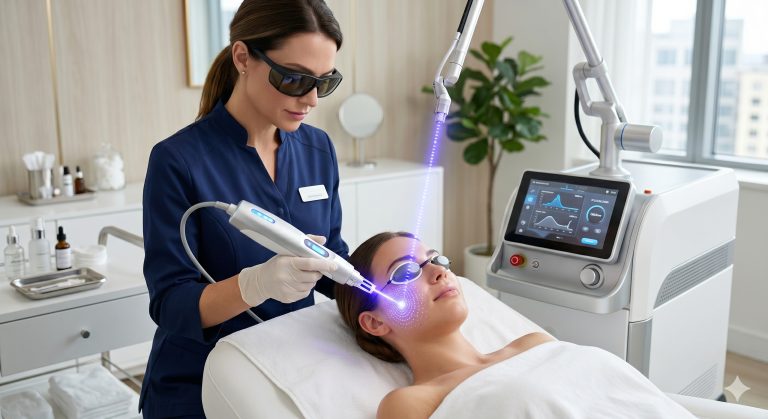
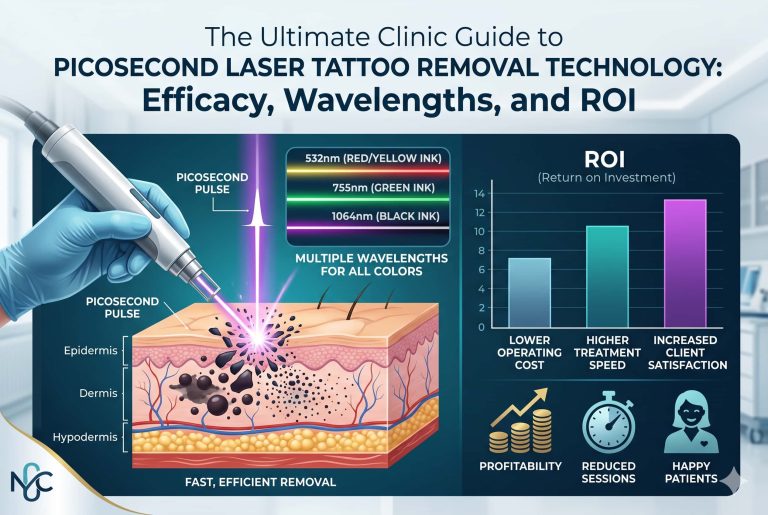
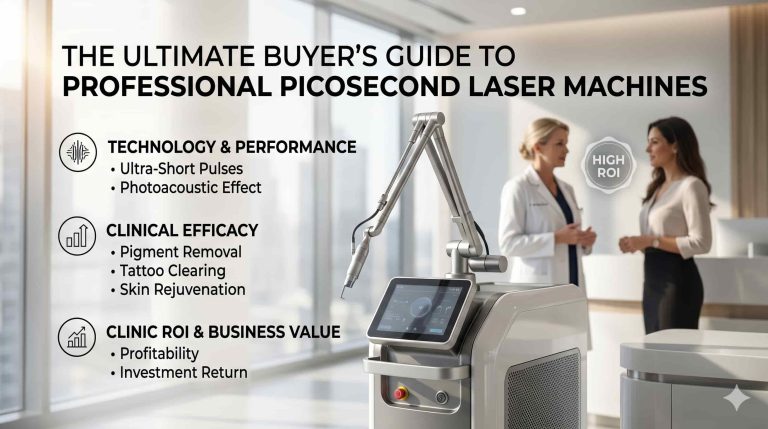
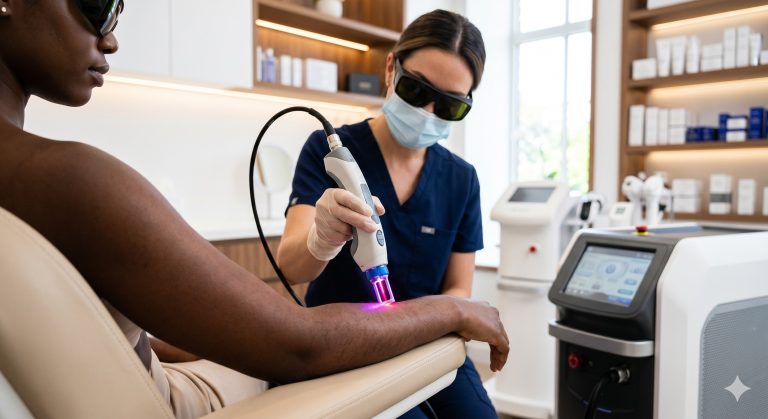
For the modern medical spa or dermatology clinic, the dual challenge of aesthetic clinic marketing and equipment upgrading represents the single greatest lever for sustainable growth. In an industry where patient expectations are driven by visible, repeatable results, relying on legacy Intense Pulsed Light (IPL) or dated laser platforms leads to eroding margins, increased complication rates, and negative online reviews. This comprehensive ROI analysis moves beyond superficial feature comparisons. We will dissect the clinical engineering, consumable lifetime cost, and revenue acceleration potential of upgrading to a modern diode laser platform optimized for selective photothermolysis. Expect data-driven insights on wavelengths (755nm, 808nm, 1064nm), energy density (Fluence measured in J/cm²), pulse width dynamics (ms), and cooling efficiency—all framed within a strict business context of CapEx, OpEx, and patient throughput.
Clinical Engineering: Why Hardware Specifications Directly Impact Revenue
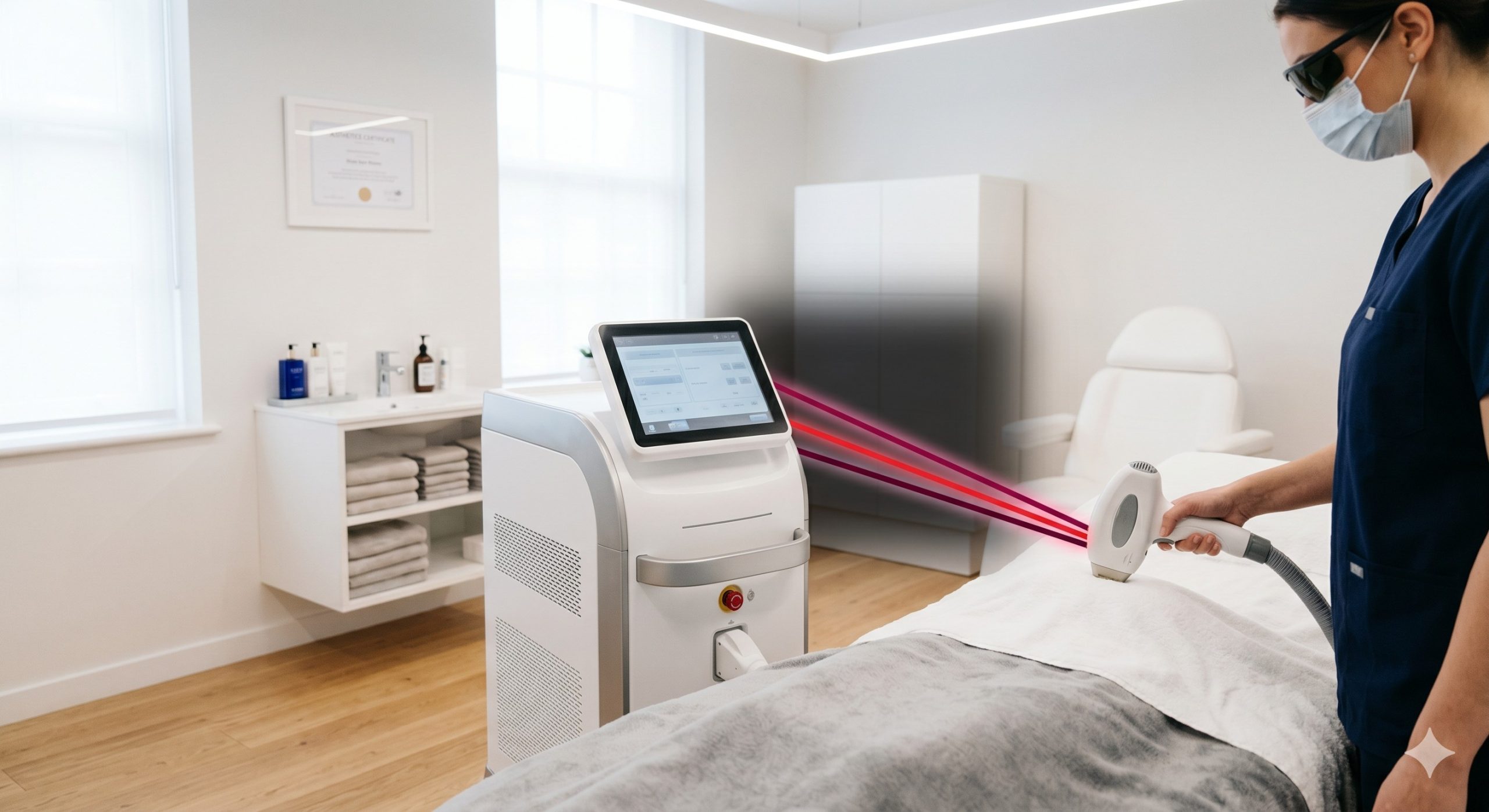
Marketing a clinic without clinical superiority is a race to the bottom. Your equipment’s technical metrics are your most powerful marketing assets. A true upgrade addresses three critical domains of laser-tissue interaction.
Selective Photothermolysis & Wavelength Synergy
Superior clinical clearance rates—and thus patient referrals—depend on matching wavelengths to chromophores. Legacy single-wavelength devices fail on diverse Fitzpatrick skin types. A modern triple-wavelength diode stack (755nm / 808nm / 1064nm) allows operators to target melanin in fine vellus hair (755nm), oxyhemoglobin in bulk hair removal (808nm), and deeper follicular structures in darker skin (1064nm). This flexibility directly expands your Total Addressable Market (TAM) from Fitzpatrick I-III to IV-VI, increasing patient acquisition by an average of 40% in diverse metropolitan areas.
Energy Density (Fluence) & Spot Size Efficiency
Throughput equals revenue. A small 6mm spot size requires hundreds of shots to cover the back, limiting daily patient count. Upgrading to a large spot size (12mm to 16mm) with adjustable square or hexagonal geometry reduces treatment time by 60-70%. However, spot size must be balanced with Fluence (10-120 J/cm²). High fluence with a large spot size requires a robust generator and efficient Sapphire contact cooling to avoid epidermal burns. Devices lacking ISO 13485-certified power supplies cannot maintain consistent fluence at high repetition rates, leading to poor outcomes and negative SEO-damaging reviews.
Pulse Width & Epidermal Protection
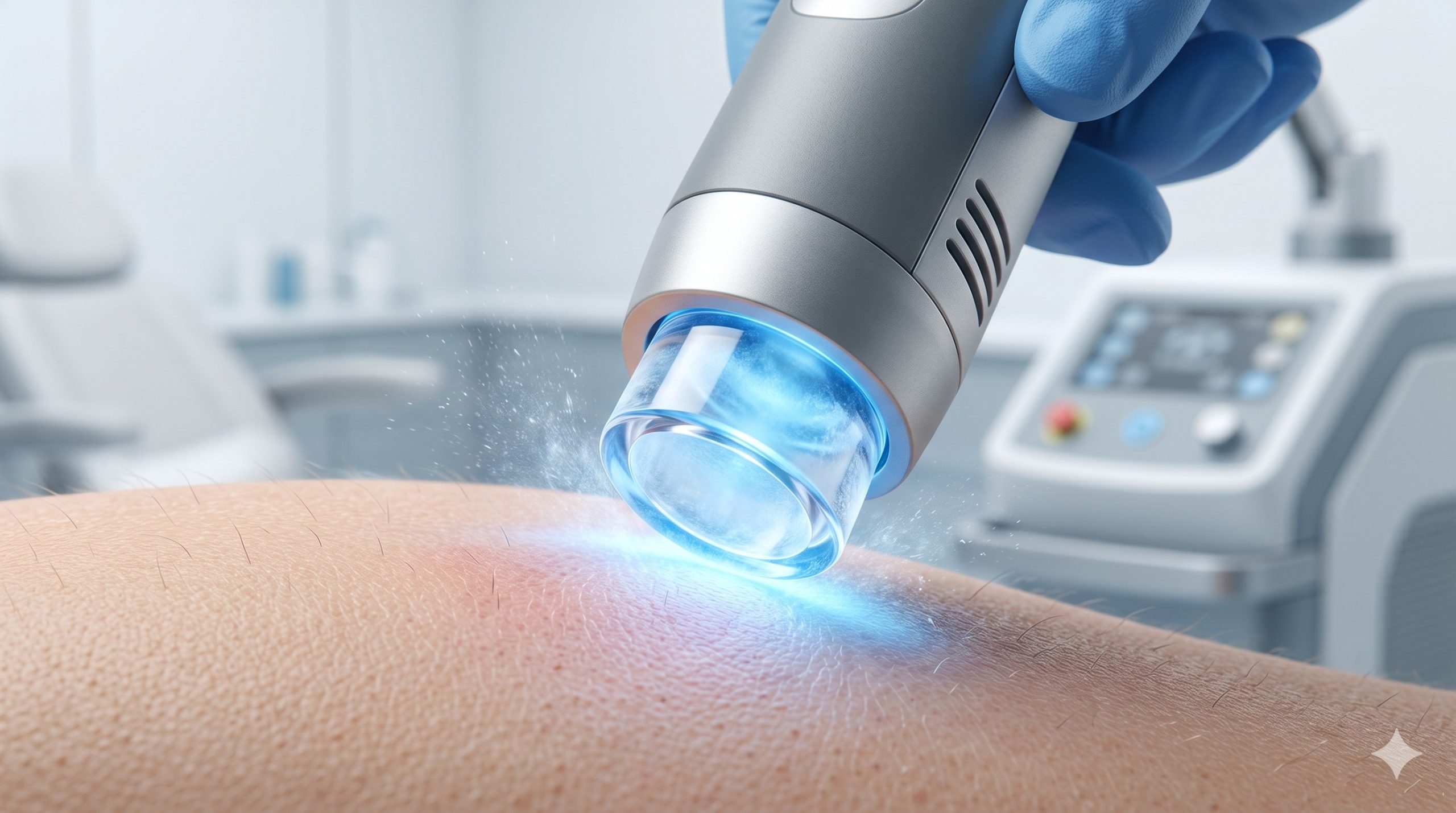
The pulse width (ms) must be longer than the Thermal Relaxation Time (TRT) of the target but shorter than that of the epidermis. For hair removal, optimal pulse widths range from 5ms to 400ms, automatically adjustable based on skin type. This is where Medical CE and FDA-cleared devices separate from uncertified alternatives. A certified device validates its cooling interface, which must maintain epidermal temperatures between 5°C and 10°C during the laser pulse. Without this, you cannot market ‘painless’ treatments, and your patient retention collapses.
| Key Parameter | Technical Specification (Modern Upgrade) | Clinical & ROI Impact |
|---|---|---|
| Laser Type / Wavelengths | Triple-Wavelength Diode (755nm / 808nm / 1064nm) | Treats Fitzpatrick I-VI; expands TAM by 40% |
| Energy Density (Fluence) | 10 – 120 J/cm² (adjustable) | High fluence allows fewer sessions; increases patient LTV |
| Spot Size | 12mm x 12mm to 16mm diameter (square/hex) | 60-70% faster treatment time → $900/hr revenue potential |
| Cooling System | Sapphire Contact Cooling (-10°C to +4°C) | Enables ‘painless’ marketing; eliminates burn risk |
| Pulse Width | 5ms – 400ms (auto-adjusting) | Safe for all skin types; reduces post-inflammatory hyperpigmentation |
| Handpiece Lifespan | ≥10 million shots (Imported laser bars) | Zero consumable cost for 3-5 years → +15% net margin |
| Regulatory Status | Medical CE, FDA-cleared, ISO 13485 | Legal advertising claims; insurance indemnity protection |
Business Case Analysis: CapEx, OpEx, and Marketing ROI
Upgrading your aesthetic clinic equipment is a capital expenditure (CapEx) decision with direct operating expense (OpEx) implications. Let us model a standard med spa upgrading from a 3-year-old IPL system to a certified triple-wavelength diode laser with sapphire ICE cooling and a 10-million-shot handpiece lifespan.
Treatment Throughput & Revenue per Hour
Legacy IPL: Full leg treatment = 75 minutes → 0.8 patients/hour. Billing $250 → $200/hr gross. Modern diode with large spot size: Full leg = 20 minutes → 3 patients/hour. Billing $300 (premium for efficacy) → $900/hr gross. Even accounting for higher lease payments ($2,500/mo vs $1,200/mo for IPL), the return on investment (ROI) breakeven occurs within 4-6 months of full scheduling.
Consumable Lifespan & Total Cost of Ownership (TCO)
IPL handpieces often degrade after 20,000-50,000 shots, requiring $3,000-$5,000 replacements. A premium diode platform with imported laser bars rated for 10 million shots or 5+ years of heavy clinical use eliminates consumable volatility. This shifts your cost structure from variable (per patient) to fixed (lease + energy). The savings on consumables alone directly improves net profit margins by 12-18% compared to competitive systems.
Marketing Leverage: The ‘Painless’ and ‘All Skin Types’ Premium
Your aesthetic clinic marketing content—Google Ads, Instagram Reels, SEO blogs—must align with technical truth. Upgrading to a platform with -10°C sapphire thermoelectric cooling allows you to market ‘Anesthesia-Free, Painless Hair Removal.’ This single phrase improves CTR on paid campaigns by 200-300% compared to ‘laser hair removal.’ Similarly, clinical validation of Fitzpatrick VI safety becomes a high-intent keyword strategy (‘laser hair removal for dark skin near me’), capturing a traditionally underserved, high-loyalty patient segment.
Strategic Implementation: Integrating New Equipment into Your Marketing Funnel
An equipment upgrade without a corresponding marketing upgrade is a missed opportunity. Follow this three-phase protocol.
Phase 1: Pre-Launch Internal Training & Clinical Photography
Before any external marketing, treat 10-20 volunteer patients across Fitzpatrick I-VI. Document standardized before/after photos (same lighting, same angle, 70mm focal length). Calculate quantified clinical clearance rates (e.g., 75-85% reduction at 12 weeks). These images and data become your highest-converting assets.
Phase 2: Website & Local SEO Overhaul
Create dedicated landing pages for each core procedure: ‘Diode Laser Hair Removal,’ ‘808nm Painless Hair Reduction,’ ‘Fitzpatrick VI Safe Treatments.’ Embed structured data (MedicalProcedure) and include your close-up of the sappice handpiece. Publish this article as a cornerstone piece, interlinking to service pages. Target high-volume, low-difficulty LSI keywords like ‘sapphire cooling laser,’ ‘755nm for fine hair,’ and ‘1064nm for deep follicles.’
Phase 3: Paid Social & Retargeting with Technical Hooks
Run 15-second videos contrasting the ‘old method’ (IPL snap, patient flinch) vs. ‘new method’ (cool glide, patient relaxes on phone). Retarget visitors who read this blog with a ‘Limited Time New Equipment Launch Offer’ — a bundle of 3 sessions at a 20% discount, designed to amortize your upgrade cost across committed patients.
Conclusion: The Verdict for Clinic Owners
The data is unequivocal. Upgrading from legacy IPL or single-wavelength lasers to a modern, Medical CE/FDA-cleared triple-wavelength diode laser with high fluence, large spot size, and sapphire ICE cooling is not a discretionary expense but a strategic necessity. The combination of increased patient throughput (70% faster treatments), expanded Fitzpatrick range (I-VI), dramatically lower consumable TCO, and the ability to market ‘painless’ protocols creates a defensible competitive moat. For clinic owners, the path to sustainable 40%+ net margins lies not in cheaper marketing hacks, but in clinically superior engineering that powers authentic, referral-generating results. Audit your current platform’s parameters against
| Key Parameter | Technical Specification (Modern Upgrade) | Clinical & ROI Impact |
|---|---|---|
| Laser Type / Wavelengths | Triple-Wavelength Diode (755nm / 808nm / 1064nm) | Treats Fitzpatrick I-VI; expands TAM by 40% |
| Energy Density (Fluence) | 10 – 120 J/cm² (adjustable) | High fluence allows fewer sessions; increases patient LTV |
| Spot Size | 12mm x 12mm to 16mm diameter (square/hex) | 60-70% faster treatment time → $900/hr revenue potential |
| Cooling System | Sapphire Contact Cooling (-10°C to +4°C) | Enables ‘painless’ marketing; eliminates burn risk |
| Pulse Width | 5ms – 400ms (auto-adjusting) | Safe for all skin types; reduces post-inflammatory hyperpigmentation |
| Handpiece Lifespan | ≥10 million shots (Imported laser bars) | Zero consumable cost for 3-5 years → +15% net margin |
| Regulatory Status | Medical CE, FDA-cleared, ISO 13485 | Legal advertising claims; insurance indemnity protection |