Selective Photothermolysis Clinical Deep Dive: Selective Photothermolysis & Parameter Optimization
Introduction: Beyond Basic Hair Removal – Why Selective Photothermolysis is the Clinical Gold Standard
For two decades, the term selective photothermolysis has been the cornerstone of modern laser aesthetics. Yet, many clinics still operate with a superficial understanding of this principle, leading to suboptimal clearance rates, increased patient discomfort, and higher risks of dyschromia. As an elite medical device consultant, I assert that mastering selective photothermolysis is not an academic exercise; it is the single most important lever for improving clinical outcomes and maximizing the ROI of your aesthetic laser investment. This deep-dive technical guide will deconstruct the physics, optimize your parameter protocols, and provide a clinically relevant roadmap for treating diverse skin phototypes with precision.
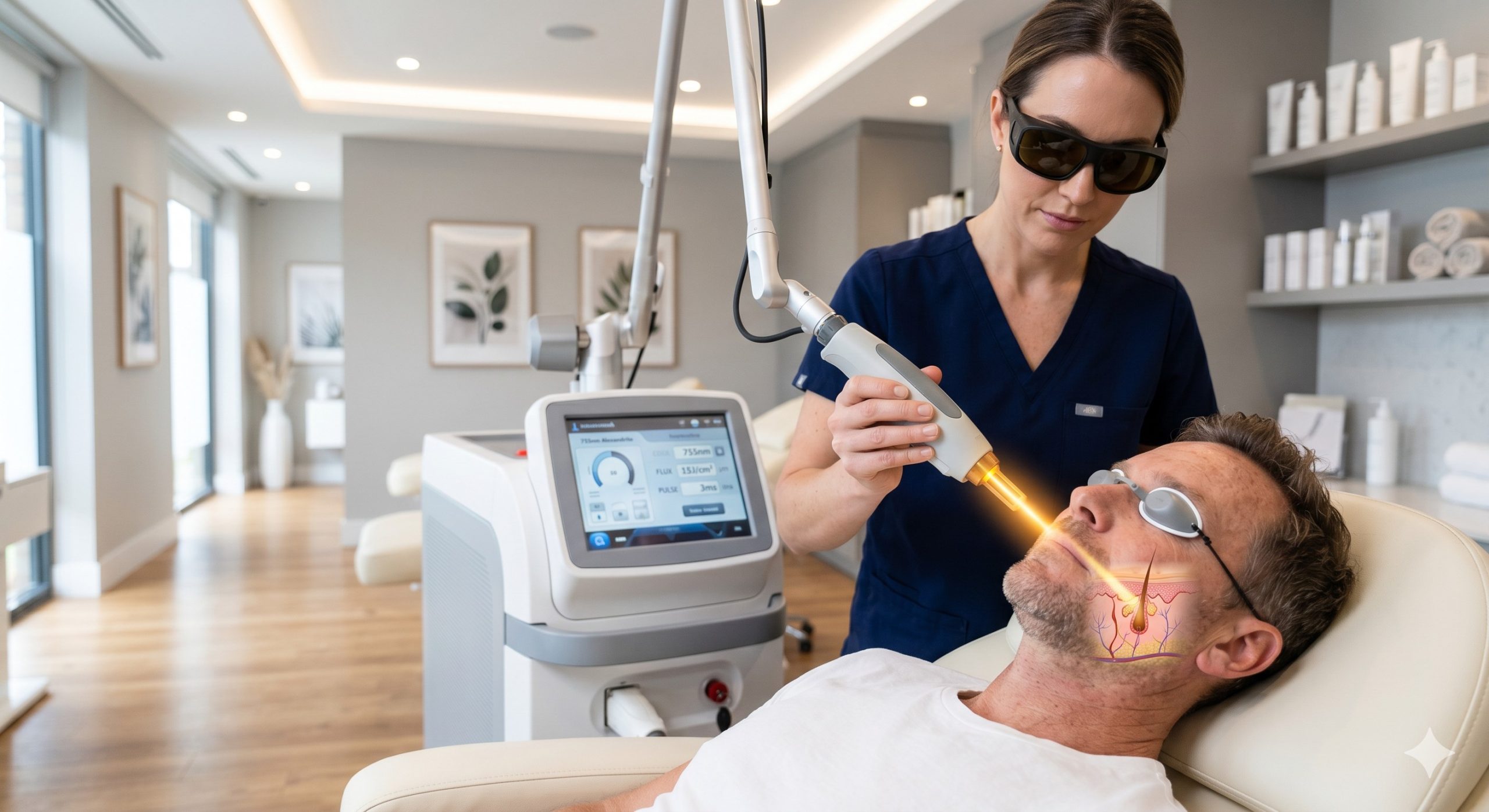
Physics of Precision: Wavelength, Pulse Width, and Fluence in Harmony
The principle of selective photothermolysis dictates that to destroy a target chromophore (e.g., melanin in a hair follicle or hemoglobin in a vessel) without damaging surrounding tissue, you must match three critical variables: a wavelength preferentially absorbed by the target, a pulse width shorter than or equal to the target’s thermal relaxation time (TRT), and sufficient fluence (energy density) to achieve irreversible thermal damage. For hair removal, the ideal targets are follicular stem cells and bulb melanin. The TRT of a terminal hair follicle ranges from 10-50 milliseconds, while smaller vessels for vascular lesions have a TRT of just 1-10 milliseconds.
The Wavelength Imperative: 755nm, 808nm, and 1064nm
No single wavelength satisfies all clinical needs. A true selective photothermolysis platform must offer multi-wavelength synergy. The 755nm alexandrite wavelength offers the highest melanin absorption, making it highly effective for Fitzpatrick Skin Types I-III but risky for darker skins. The 808nm diode wavelength provides a balance of deep penetration (2-3mm) and sufficient melanin absorption, serving as the workhorse for most ethnic skin types (Fitzpatrick III-V). For deep follicular destruction or darker skin types (Fitzpatrick V-VI), the 1064nm Nd:YAG wavelength is essential due to its reduced epidermal melanin competition and deeper penetration (4-6mm). Leveraging a triple-wavelength platform (755nm/808nm/1064nm) allows the clinician to ‘dial-in’ the precise absorption coefficient needed for each patient’s unique biology.
Pulse Width & Fluence: The Safety and Efficacy Knobs
Pulse width (measured in milliseconds) directly dictates heat confinement. For effective photothermolysis of a hair follicle, a pulse width of 20-50ms is optimal. Shorter pulses (e.g., 5ms) generate explosive photoacoustic effects beneficial for shattered tattoos but cause epidermal burning in hair removal. Longer pulses (>100ms) merely ‘cook’ tissue, leading to pain and non-specific thermal injury. Fluence (J/cm²) is the energy delivered per unit area. A clinically effective range for hair removal is 10-40 J/cm², depending on wavelength and skin type. Darker skin requires lower fluence (10-20 J/cm²) but longer pulse widths to safely heat the deep follicle while allowing epidermal cooling time.
| Key Parameter | Technical Specification (Clinical-Grade Diode Laser) |
|---|---|
| Wavelength / Laser Type | Triple-Wavelength Diode: 755nm / 808nm / 1064nm (Independently Selectable) |
| Fluence (Energy Density) | 1 – 50 J/cm² (Adjustable in 0.5 J/cm² increments) |
| Pulse Width | 5ms – 400ms (True Square Pulse Technology) |
| Spot Size | 10mm x 10mm up to 15mm x 20mm (Variable, Geometric) |
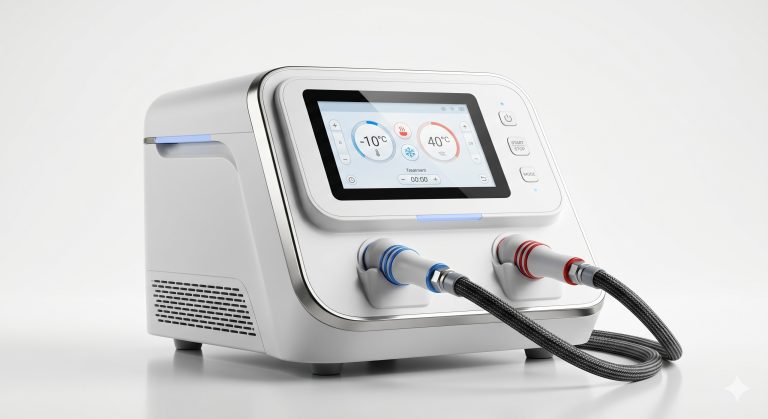
| Cooling System | Sapphire Contact Cooling with TEC (Temperature range: -5°C to +15°C) |
| Repetition Rate | Up to 10 Hz (High-Throughput Mode) |
| Laser Classification | Medical CE (MDR 2017/745) & FDA 510(k) Cleared, ISO 13485 Certified |
Epidermal Preservation: The Critical Role of Advanced Cooling Systems
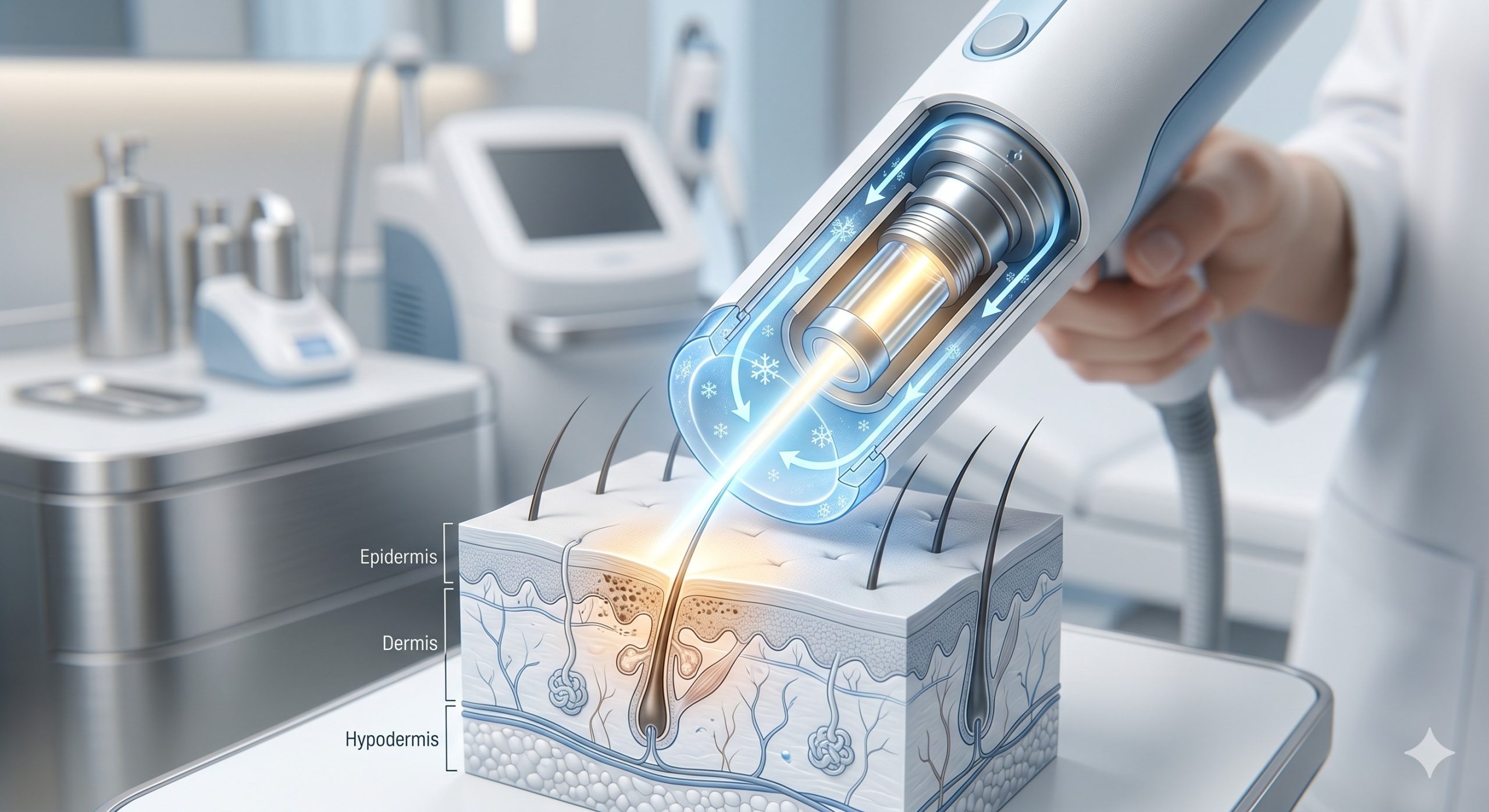
Without protection, selective photothermolysis is impossible because the epidermis absorbs laser energy faster than the dermal target. Modern medical CE and FDA cleared devices integrate dynamic cooling methods. The current industry benchmark is Sapphire contact cooling with thermoelectric cooling (TEC) modules. These systems maintain a skin-contact surface temperature of -5°C to +4°C, creating a protective ‘ice layer’ on the stratum corneum without vaporizing. This contrasts sharply with older cryogen spray cooling (CSC), which is non-uniform and poses asphyxiation risks in unventilated rooms. A high-end ISO 13485 certified system will offer real-time skin impedance monitoring, automatically adjusting cooling parameters if skin temperature rises above a safety threshold (e.g., 42°C). This closed-loop feedback is the difference between a comfortable, high-fluence treatment and a lawsuit.
Parameter Optimization Matrix: The Clinic’s Protocol Bible
Treating Fitzpatrick Skin Types I-VI Safely
A fixed protocol is a recipe for disaster. The table below provides a starting framework, but real-time tissue response is your ultimate guide.
For Fitzpatrick I-II (Celtic/Nordic): Use 755nm or 808nm, Fluence 12-18 J/cm², Pulse Width 15-25ms, Large Spot Size (12-15mm). The endpoint is mild perifollicular edema and erythema. For Fitzpatrick III-IV (Mediterranean/Asian): Use 808nm as primary, Fluence 10-14 J/cm², Pulse Width 30-40ms. Observe for delayed erythema. For Fitzpatrick V-VI (African/Caribbean): Use 1064nm exclusively, Fluence 9-12 J/cm², Long Pulse Width 40-60ms, and test spot mandatory. The endpoint is no visible epidermal whitening (frosting) – only a slight warmth and mild redness 15 minutes post-treatment.
Beyond Hair Removal: Expanding Your Service Menu with Selective Photothermolysis
The same photothermolysis principles apply to vascular and pigmented lesions. For telangiectasia and facial veins, target oxyhemoglobin using 532nm (green light) for superficial vessels or 1064nm for deep reticular veins. Pulse widths must be short (1-10ms) to match the small TRT of vessels. For solar lentigines and ephelides, utilize a 532nm or 755nm with a short pulse width (2-10ms) and low fluence (6-10 J/cm²) to achieve ‘shattering’ of the pigmented lesion without purpura. Clinics that train staff on multi-indication protocols can increase daily patient throughput by 40%, converting single-service clients into package-based treatment plans.
Business Calculus: How Precision Impacts Your Bottom Line
Investing in a high-spec, selective photothermolysis-optimized laser (such as a 2000W diode laser with triple wavelengths and sapphire ICE cooling) commands a premium CapEx of $25,000-$80,000. However, its OpEx is remarkably low. High-efficiency diode bars (rated for 5-10 million shots) eliminate the recurring cost of flashlamps found in IPL or alexandrite systems. With consumable costs near zero, the Breakeven Point (BEP) at a $250/session average fee is approximately 200-300 treatments. More importantly, superior clinical outcomes driven by correct parameter selection lead to a higher Net Promoter Score (NPS) and 3x higher patient lifetime value (LTV) through referrals and cross-selling. The clinic that understands the science of spot size (large spots penetrate deeper and treat faster), pulse stacking, and dynamic cooling will dominate its local market. Conclusion: Selective photothermolysis is not just a scientific principle; it is your clinic’s most profitable and defensible competitive advantage. Audit your current protocols against the data presented here, and upgrade your hardware to a medical CE certified multi-wavelength platform if you cannot achieve safe clearance on all Fitzpatrick types.