
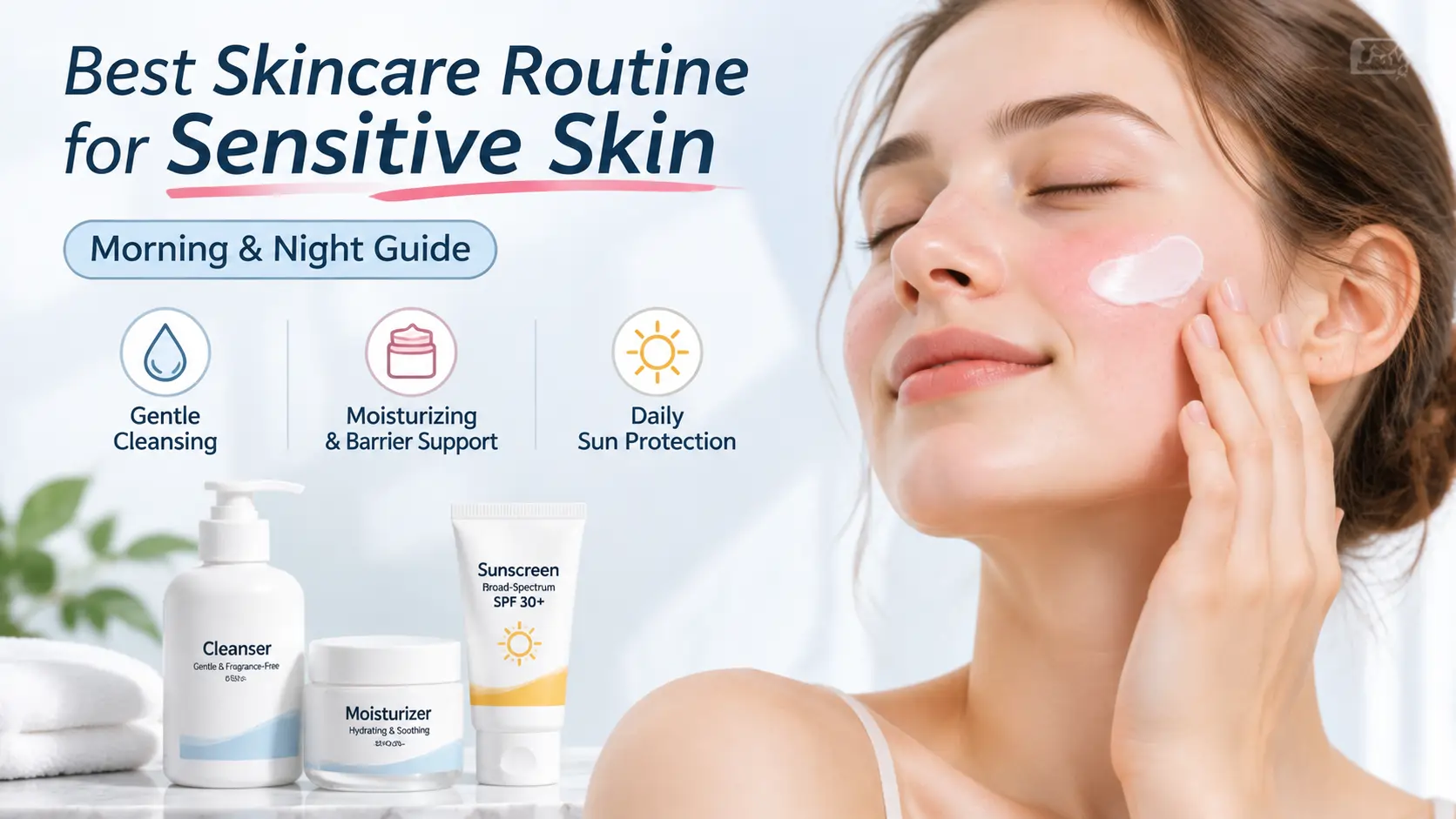
Best Skincare Routine for Sensitive Skin
Finding the right skincare routine for sensitive skin can be challenging. Products that work well for other people may cause redness, dryness, itching, burning, or uncomfortable tightness when applied to reactive skin. Even simple steps such as cleansing or moisturizing can sometimes trigger irritation.
The key to caring for sensitive skin is not using more products. Instead, a consistent routine built around gentle cleansing, adequate hydration, and daily sun protection can help maintain the skin barrier and reduce exposure to common irritants.
Whether your skin is naturally sensitive, frequently irritated, or temporarily reactive after using strong skincare products, understanding how to build an appropriate morning and nighttime routine can make daily skincare easier.
Quick Answer: What Is the Best Skincare Routine for Sensitive Skin?
The best skincare routine for sensitive skin is generally a simple, consistent routine that focuses on cleansing, moisturizing, and sun protection.
- Morning: Gently cleanse if needed, apply a fragrance-free moisturizer, and finish with broad-spectrum SPF 30 or higher sunscreen.
- Evening: Remove makeup and sunscreen, cleanse with a mild facial cleanser, and apply a moisturizer to support skin hydration.
- Product selection: Choose fragrance-free products with relatively simple formulations and ingredients that your skin tolerates.
- New products: Introduce one product at a time and test it on a small area before applying it to your entire face.
- During irritation: Temporarily simplify your routine and avoid unnecessary exfoliation or potentially irritating active ingredients.
There is no universal skincare formula for everyone with sensitive skin. The most suitable routine depends on individual skin characteristics, triggers, and whether an underlying condition such as eczema, rosacea, or contact dermatitis is present.
1. Understanding What Sensitive Skin Needs
Before choosing skincare products, it is important to understand why sensitive skin may react differently to certain ingredients and environmental conditions.
Sensitive skin is commonly associated with unpleasant sensations such as stinging, burning, itching, tightness, and redness. These reactions may occur after using skincare products, washing the face, exposure to temperature changes, or contact with environmental irritants.
In some people, impaired skin barrier function contributes to increased moisture loss and greater susceptibility to external irritants. However, sensitive skin does not always indicate a damaged skin barrier, and the term itself does not describe one specific medical diagnosis.
Common Characteristics of Sensitive Skin
People with sensitive skin may experience several of the following symptoms:
- Redness: The cheeks, nose, forehead, or other areas may become red after exposure to certain products or environmental conditions.
- Stinging and burning: Some cleansers, moisturizers, and cosmetic products may cause uncomfortable sensations shortly after application.
- Dryness and tightness: Skin may feel uncomfortable after washing, particularly when exposed to harsh cleansers or hot water.
- Itching: Irritated areas may feel itchy, especially when the skin is dry or inflamed.
- Flaking: Some individuals experience visible dryness, rough texture, or peeling.
- Frequent product reactions: Products containing fragrance, certain preservatives, or other individual triggers may cause irritation.
Not everyone with sensitive skin experiences all these symptoms. Persistent redness, swelling, severe itching, or recurring rashes may indicate an underlying dermatological condition that requires professional assessment.
Why a Simple Skincare Routine Matters
Using too many skincare products can make it difficult to identify which ingredient or formulation is causing irritation. Combining multiple exfoliating products, introducing several active ingredients at once, or frequently changing products may also increase the likelihood of unwanted reactions.
A simplified routine makes it easier to identify individual triggers and maintain consistent skin care.
For most people with sensitive skin, three basic product categories provide a practical starting point:
- A gentle facial cleanser to remove dirt, excess oil, sunscreen, and makeup.
- A suitable moisturizer to maintain hydration and support the skin barrier.
- A broad-spectrum sunscreen to protect the skin from ultraviolet radiation.
Additional products should be introduced only when there is a clear reason to use them and the skin can tolerate them.
2. Morning Skincare Routine for Sensitive Skin
A morning skincare routine for sensitive skin should focus on maintaining hydration and protecting the skin throughout the day. It does not need to involve multiple serums, toners, or complicated treatment steps.
A practical morning routine can be organized into three main steps.
Step 1: Cleanse Gently
Start by deciding whether your skin actually needs a cleanser in the morning.
Some people with sensitive or dry skin may find that rinsing with lukewarm water is sufficient in the morning, particularly if they cleansed properly before going to bed. Others may prefer a gentle facial cleanser to remove overnight oil and skincare residue.
When selecting a cleanser for sensitive skin, look for:
- Fragrance-free formulations.
- Mild cleansing agents.
- Products designed for sensitive or easily irritated skin.
- Non-abrasive textures without physical exfoliating particles.
- Formulations that leave the skin feeling comfortable rather than tight or stripped.
Avoid aggressive scrubbing, cleansing brushes, rough washcloths, and excessively hot water. These practices may increase irritation.
Use your fingertips to gently distribute the cleanser, rinse thoroughly, and pat your face dry with a clean, soft towel.
Step 2: Apply a Moisturizer for Sensitive Skin
Moisturizing is an important part of a sensitive skin routine because it helps reduce water loss and maintain the skin’s protective surface.
Apply moisturizer while the skin is slightly damp after cleansing. Choose a formulation that feels comfortable and does not cause persistent stinging, itching, or redness.
Some commonly used moisturizing and barrier-supporting ingredients include:
- Glycerin: A humectant that helps attract and retain water in the outer layers of the skin.
- Ceramides: Lipids naturally found in the skin barrier that help maintain its structure.
- Hyaluronic acid: A humectant that helps bind water and improve skin hydration.
- Petrolatum: An occlusive ingredient that reduces water loss by forming a protective layer on the skin.
- Dimethicone: A skin-conditioning ingredient that helps reduce moisture loss and improve the feel of a formulation.
These ingredients are not guaranteed to suit everyone. The overall formulation and individual tolerance matter just as much as the ingredient list.
If your skin is particularly dry, a richer cream may be more comfortable than a lightweight gel or lotion. People with oily or combination skin may prefer a lighter formulation.
Step 3: Apply Sunscreen Every Morning
Daily sun protection is essential, including for people with sensitive skin.
Ultraviolet radiation can contribute to premature skin aging, pigmentation changes, and skin damage. Sun exposure may also aggravate certain inflammatory skin conditions.
Choose a broad-spectrum sunscreen with SPF 30 or higher. Broad-spectrum protection helps protect against both UVA and UVB radiation.
If conventional sunscreen products cause irritation, consider testing a fragrance-free mineral sunscreen containing zinc oxide, titanium dioxide, or both.
When selecting sunscreen for sensitive skin, consider the following:
- Choose a broad-spectrum SPF 30 or higher product.
- Look for fragrance-free formulations.
- Consider mineral sunscreen if other formulations cause irritation.
- Select a texture that is comfortable enough for daily use.
- Reapply according to the product directions, especially after swimming, sweating, or prolonged outdoor exposure.
Sunscreen should be applied as the final step of your morning skincare routine, before makeup.
Remember that sunscreen is only one part of sun protection. Seeking shade, wearing protective clothing, and avoiding excessive midday sun exposure can also help protect sensitive skin.
3. Nighttime Skincare Routine for Sensitive Skin
Your nighttime skincare routine for sensitive skin should focus on removing the day’s buildup and maintaining skin hydration.
Unlike the morning routine, which emphasizes sun protection, evening care provides an opportunity to cleanse the skin and apply moisturizing products without adding unnecessary steps.
Step 1: Remove Makeup and Sunscreen
If you wear makeup or water-resistant sunscreen, remove these products before your regular cleansing step.
Choose a gentle makeup remover or cleansing product that does not require aggressive rubbing. Avoid repeatedly wiping the same area with cotton pads or using harsh cleansing wipes that leave your skin feeling uncomfortable.
For sensitive skin, the removal process should be as gentle as the cleanser itself.
Step 2: Use a Mild Facial Cleanser
After removing makeup and sunscreen, cleanse your face with a mild facial cleanser.
Use lukewarm water and gently massage the cleanser over your skin with your fingertips. Pay attention to areas where makeup, sunscreen, and excess oil tend to accumulate.
Avoid:
- Harsh soaps that leave the skin feeling tight.
- Physical facial scrubs and exfoliating brushes.
- Excessive washing or prolonged cleansing.
- Very hot water.
- Strongly fragranced cleansing products.
If your skin feels unusually dry or irritated after cleansing, reconsider whether the cleanser is suitable for your skin.
Step 3: Apply a Nourishing Night Moisturizer
After cleansing, apply a moisturizer that helps maintain hydration overnight.
People with dry or easily irritated skin may prefer a cream-based moisturizer containing ingredients such as glycerin, ceramides, or petrolatum. Those with oily or combination skin may prefer a lighter cream or lotion.
Apply an even layer without rubbing aggressively. If certain areas are particularly dry, a suitable occlusive product may help reduce moisture loss in those areas.
There is no need to apply several layers of serum, toner, and treatment products simply because it is nighttime. A comfortable moisturizer may be sufficient.
Should You Use Retinol or Exfoliating Acids at Night?
Not necessarily.
Retinoids, alpha hydroxy acids (AHAs), beta hydroxy acids (BHAs), and other active ingredients can be useful for particular skin concerns. However, they may also cause dryness, peeling, stinging, or irritation, especially when introduced too quickly or used too frequently.
If your skin is already irritated, simplify your routine before considering additional active ingredients.
Once your skin is comfortable and stable, a suitable active ingredient may be introduced gradually when there is a clear skincare objective. People with persistent sensitivity or underlying skin conditions should seek advice from a dermatologist before starting potentially irritating treatments.
4. How to Choose the Best Skincare Products for Sensitive Skin
Choosing the best skincare for sensitive skin is not simply about purchasing products labeled “for sensitive skin.” Product formulations, individual ingredients, and personal skin tolerance all influence how the skin responds.
A good starting point is to choose products with relatively simple formulations, avoid unnecessary fragrance, and introduce new products gradually.
Choose Fragrance-Free Products
Fragrance is a common source of irritation and allergic contact dermatitis. Both synthetic fragrances and certain natural essential oils may trigger reactions in susceptible individuals.
Look for products specifically labeled fragrance-free rather than assuming that unscented products are always free of fragrance-related ingredients.
Look for Moisturizing and Barrier-Supporting Ingredients
Some ingredients are particularly useful when the goal is to maintain hydration and support the skin barrier.
| Ingredient | Primary Function | Common Product Types |
|---|---|---|
| Glycerin | Helps attract and retain moisture | Moisturizers and hydrating cleansers |
| Ceramides | Help maintain the skin barrier | Barrier-supporting creams |
| Hyaluronic Acid | Helps bind water in the skin | Hydrating serums and moisturizers |
| Petrolatum | Reduces transepidermal water loss | Protective ointments and balms |
| Dimethicone | Provides skin conditioning and protective properties | Moisturizers and barrier creams |
No ingredient is universally suitable for every sensitive skin type. A product containing several beneficial ingredients may still cause a reaction because of another component in its formulation.
Choose Products According to Your Skin Type
Sensitive skin can also be dry, oily, or combination skin. Your moisturizer and cleanser should therefore match both your skin sensitivity and your underlying skin type.
- Dry sensitive skin: Consider cream-based moisturizers with ceramides, glycerin, or petrolatum.
- Oily sensitive skin: Consider lightweight, fragrance-free lotions or creams that feel comfortable without excessive greasiness.
- Combination sensitive skin: Use a balanced moisturizer and adjust the amount applied to different facial areas.
- Acne-prone sensitive skin: Look for suitable non-comedogenic formulations and avoid aggressive acne treatments that may increase irritation.
Product labels can help narrow your choices, but individual tolerance should always guide the final decision.
5. Skincare Ingredients to Avoid or Use With Caution
Some skincare ingredients and product categories are more likely to cause irritation in people with sensitive skin. However, reactions are individual, and an ingredient that causes problems for one person may be tolerated by another.
The following table highlights ingredients and formulations worth reviewing when building a gentle skincare routine.
| Ingredient or Product | Potential Concern | Practical Approach |
|---|---|---|
| Fragrance and Perfume | May trigger irritation or allergic reactions | Prefer fragrance-free products |
| Essential Oils | May cause irritation or contact allergy | Use caution with fragranced botanical products |
| Alcohol-Based Toners | Some formulations may increase dryness and irritation | Avoid products that leave skin feeling tight or uncomfortable |
| Strong Exfoliating Acids | May cause stinging, peeling, and irritation | Reduce frequency or avoid during irritation |
| Physical Facial Scrubs | Friction may aggravate already irritated skin | Choose gentle cleansing instead |
| High-Strength Retinoids | May cause dryness, redness, and peeling | Introduce only when appropriate and gradually |
| Harsh Cleansers | May strip skin lipids and increase discomfort | Choose mild cleansing formulations |
It is important not to treat every active ingredient as automatically harmful. Ingredients such as retinoids, glycolic acid, salicylic acid, and vitamin C can have useful skincare applications. Their suitability depends on the formulation, concentration, frequency of use, and individual skin condition.
If a product repeatedly causes burning, swelling, itching, or redness, discontinue it rather than trying to push through the reaction.
6. Weekly Skincare Routine for Sensitive Skin
A weekly skincare routine for sensitive skin does not need to be complicated. The goal is to maintain consistency rather than introduce a different treatment every day.
The following schedule provides a simple framework. It is not a requirement to use exfoliants or treatment products every week.
| Day | Morning Routine | Evening Routine |
|---|---|---|
| Monday | Gentle cleansing, moisturizer, sunscreen | Gentle cleansing, moisturizer |
| Tuesday | Gentle cleansing, moisturizer, sunscreen | Gentle cleansing, moisturizer |
| Wednesday | Gentle cleansing, moisturizer, sunscreen | Gentle cleansing, moisturizer |
| Thursday | Gentle cleansing, moisturizer, sunscreen | Gentle cleansing, moisturizer |
| Friday | Gentle cleansing, moisturizer, sunscreen | Gentle cleansing, moisturizer |
| Saturday | Gentle cleansing, moisturizer, sunscreen | Gentle cleansing, moisturizer |
| Sunday | Gentle cleansing, moisturizer, sunscreen | Gentle cleansing, moisturizer |
If your skin is stable and you have a specific reason to introduce an additional treatment, discuss its suitability with a dermatologist and introduce only one new product at a time.
Do Sensitive Skin Types Need Weekly Exfoliation?
No. Exfoliation is not an essential requirement for maintaining healthy skin.
Some people with sensitive skin can tolerate carefully selected chemical exfoliants, while others experience persistent irritation even with relatively mild products.
If your skin is already red, dry, peeling, or uncomfortable, avoid exfoliation until the irritation has resolved. If you have eczema, rosacea, or another inflammatory skin condition, seek professional advice before adding exfoliating treatments.
7. Common Sensitive Skin Care Mistakes
Even people who choose suitable skincare products may experience irritation because of how they use them. Avoiding a few common mistakes can make a sensitive skin routine easier to maintain.
Using Too Many Products at Once
Adding several new products simultaneously makes it difficult to identify the cause of a reaction.
Introduce new products individually and allow enough time to assess your skin’s response before adding another product.
Over-Cleansing the Face
Washing your face repeatedly throughout the day may increase dryness and irritation, especially when using strong cleansers.
Use a gentle cleansing routine and avoid unnecessary washing.
Exfoliating Too Frequently
Frequent use of scrubs, exfoliating acids, and cleansing tools may aggravate sensitive skin.
Exfoliation should never be treated as a mandatory daily skincare step.
Ignoring Sunscreen
Skipping sunscreen leaves the skin exposed to ultraviolet radiation. Sun protection is important even when your skincare routine is otherwise simple.
Changing Products Too Frequently
Constantly switching between cleansers, moisturizers, and serums can make it harder to understand which products your skin tolerates.
Once you find a comfortable routine, maintain it consistently unless there is a clear reason to make a change.
Assuming Natural Products Are Always Gentle
Natural ingredients and botanical extracts can still cause irritation or allergic contact dermatitis.
Plant-derived ingredients, essential oils, and herbal extracts should not automatically be considered safer than synthetic ingredients.
8. How to Introduce New Skincare Products Safely
Introducing new products gradually is particularly important when you have sensitive skin or a history of skincare reactions.
Before applying a new product to your entire face, consider performing a repeated open application test on a small area of skin.
- Read the ingredient list: Check for ingredients that have previously caused problems for your skin.
- Choose a small test area: Apply the product to a small area of skin, following the product instructions.
- Repeat the test: The American Academy of Dermatology recommends testing a new skincare product on a small area twice daily for 7 to 10 days.
- Observe your skin: Watch for redness, itching, swelling, burning, or other signs of irritation.
- Introduce one product at a time: Avoid changing several parts of your routine simultaneously.
A home product test can help identify some unwanted reactions, but it cannot guarantee that a product will never cause irritation or an allergic reaction. It also does not replace formal patch testing performed by a dermatologist when allergic contact dermatitis is suspected.
9. When Should You See a Dermatologist?
Although a simple skincare routine can help many people manage everyday sensitivity, persistent or severe symptoms should not automatically be treated as an ordinary skincare problem.
Consider consulting a dermatologist if you experience:
- Persistent facial redness that does not improve.
- Recurring itching, burning, or stinging.
- Repeated rashes after using different skincare products.
- Swelling, blistering, or painful skin reactions.
- Severe dryness, cracking, or peeling.
- Symptoms that interfere with daily activities or sleep.
- Skin irritation that continues despite simplifying your routine.
Conditions such as eczema, rosacea, and allergic or irritant contact dermatitis can produce symptoms that resemble sensitive skin. A dermatologist can help identify the underlying cause and recommend appropriate treatment.
For persistent suspected allergic contact dermatitis, formal patch testing may help identify specific allergens.
Seek urgent medical attention if a skin reaction is accompanied by difficulty breathing, throat or tongue swelling, or other signs of a serious allergic reaction.
10. Frequently Asked Questions About Skincare for Sensitive Skin
What Is the Best Daily Skincare Routine for Sensitive Skin?
A simple daily routine usually includes gentle cleansing, a suitable moisturizer, and broad-spectrum SPF 30 or higher sunscreen in the morning. At night, remove makeup and sunscreen, cleanse gently, and apply moisturizer. Additional products are optional.
Should I Wash My Face in the Morning if I Have Sensitive Skin?
It depends on your skin type and personal preference. Some people with dry or sensitive skin prefer rinsing with lukewarm water, while others benefit from a mild facial cleanser. Avoid excessive washing and harsh cleansing products.
What Is the Best Moisturizer for Sensitive Skin?
The best moisturizer is one that provides sufficient hydration without causing irritation. Fragrance-free formulations containing ingredients such as glycerin, ceramides, dimethicone, or petrolatum may be suitable starting points.
Is Vitamin C Good for Sensitive Skin?
Vitamin C can provide antioxidant benefits, but some formulations, particularly those containing high concentrations of L-ascorbic acid, may cause stinging or irritation. If you want to try vitamin C, introduce an appropriate formulation gradually and discontinue it if irritation occurs.
Can People with Sensitive Skin Use Retinol?
Some people with sensitive skin can tolerate retinoids, but these ingredients may cause dryness, peeling, and irritation. Start only when the skin is stable, use an appropriate formulation, and seek professional advice if you have an underlying inflammatory skin condition.
Should Sensitive Skin Use Mineral or Chemical Sunscreen?
Both mineral and organic-filter sunscreens can provide effective sun protection when properly formulated and used. If your skin reacts to certain sunscreen products, a fragrance-free mineral sunscreen containing zinc oxide or titanium dioxide may be worth testing.
How Long Does It Take for a Sensitive Skin Routine to Work?
There is no universal timeline. Some people notice improved comfort after simplifying their routine, while others need more time or treatment for an underlying skin condition. Persistent or worsening symptoms should be evaluated by a dermatologist.
Can Sensitive Skin Use Toner?
Toner is not an essential step in a sensitive skin routine. If you choose to use one, select a gentle, fragrance-free formulation that your skin tolerates. Avoid products that cause burning, tightness, or persistent redness.
Is a Minimalist Skincare Routine Better for Sensitive Skin?
A minimalist routine is often a practical starting point because it reduces unnecessary product exposure and makes potential triggers easier to identify. Gentle cleansing, moisturizing, and sun protection are the main priorities.
Can Sensitive Skin Become Less Reactive Over Time?
It depends on the underlying cause. Reducing exposure to individual triggers and managing conditions that contribute to irritation may improve symptoms. However, some people continue to experience sensitivity and need long-term skincare adjustments.
Conclusion: Keep Your Sensitive Skin Routine Simple and Consistent
The best skincare routine for sensitive skin does not need to be expensive or complicated. A gentle cleanser, a suitable moisturizer, and daily sun protection provide a practical foundation for most people.
Pay attention to how your skin responds to different products, avoid unnecessary irritation, and introduce new ingredients gradually. Rather than following every skincare trend, focus on finding a routine that your skin can tolerate consistently.
If redness, burning, itching, or other symptoms persist, consult a qualified dermatologist to determine whether an underlying skin condition requires specific treatment.