Diode Laser Machine Price: Professional Cost Guide 2026
Professional diode laser machine prices vary widely because not every system uses the same laser source, wavelength configuration, power, handpiece, cooling technology, spot sizes, software, or service package. For clinics, medical spas, laser hair removal businesses, and distributors, understanding these differences is essential before comparing quotations.
Quick Answer: How Much Does a Diode Laser Machine Cost?
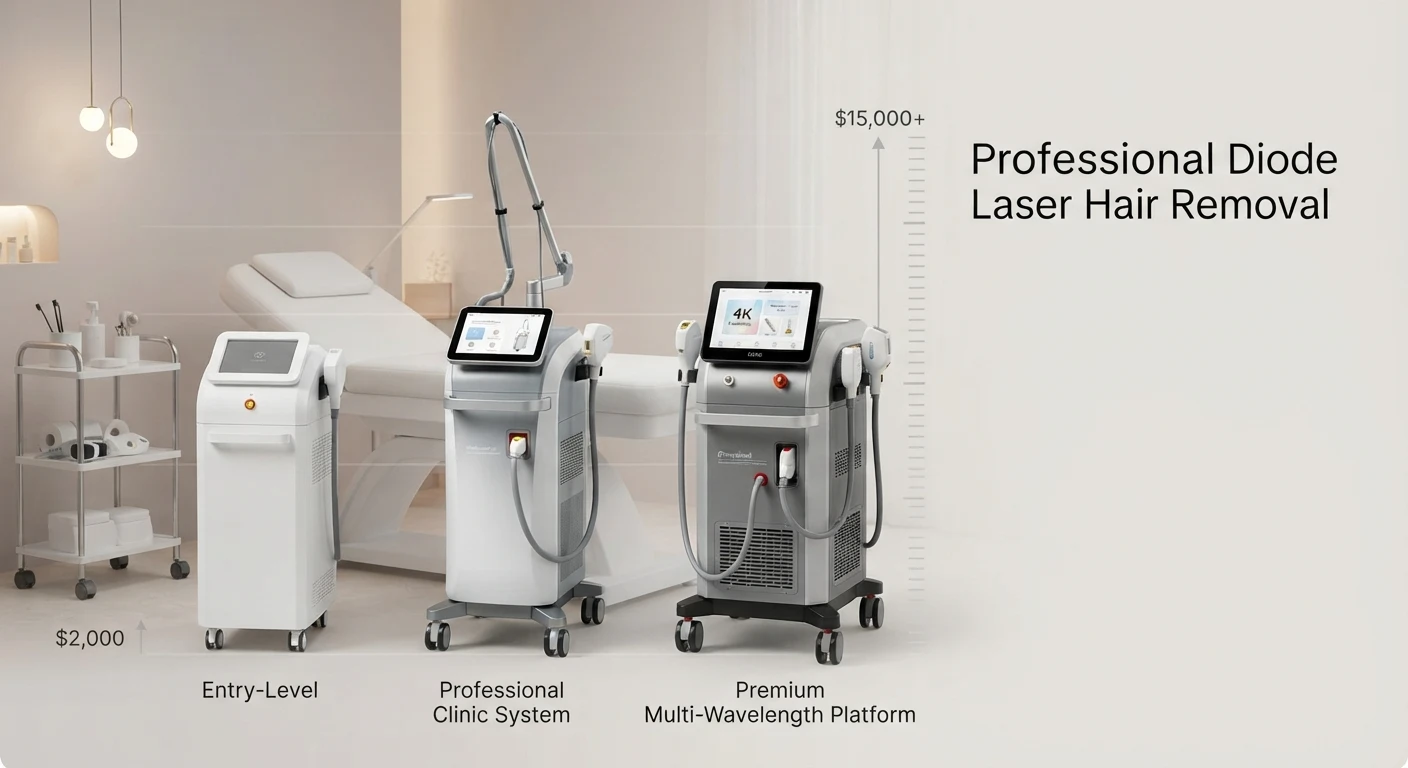
A professional diode laser machine typically costs about $2,000 to $15,000+, depending on the manufacturer, laser configuration, power, wavelengths, handpiece, cooling system, spot sizes, software, warranty, and after-sales support. Entry-level factory-direct systems may be available near the lower end of this range, while higher-specification professional systems and established premium brands can cost considerably more.
As a general purchasing reference, basic professional systems may fall around $2,000–$4,000, mid-range clinic systems around $4,000–$8,000, and higher-specification systems around $8,000–$15,000+. These are approximate market ranges rather than fixed quotations, and actual prices can vary significantly by supplier, country, configuration, and included services.
Clinics should compare more than the initial diode laser machine price. Handpiece replacement, laser source life, spare parts, shipping, maintenance, warranty, training, and equipment downtime can all influence the real total cost of ownership.
Professional Diode Laser Machine Price Range
There is no universal price that applies to every professional diode laser hair removal machine. However, dividing the market into broad equipment tiers can make initial budgeting easier.
| Machine Category | Approximate Price Range | Typical Characteristics | Potential Buyer |
|---|---|---|---|
| Entry-Level Professional | $2,000–$4,000 | Simpler configuration, fewer customization options, standard handpiece and basic professional features | Small clinics and lower-volume businesses |
| Mid-Range Professional | $4,000–$8,000 | Improved cooling, higher-specification components, multiple wavelengths or spot-size options, broader support | Established clinics and medical spas |
| Higher-Specification Professional | $8,000–$15,000+ | Advanced hardware configuration, higher-output platforms, sophisticated cooling, customization and more comprehensive support | High-volume clinics, distributors and professional operators |
| Premium Branded Platforms | Can exceed $15,000 | Pricing may reflect brand positioning, local distribution, service infrastructure, training and market-specific support | Clinics prioritizing established brand and local support ecosystems |
These figures should be used as a general budgeting reference rather than a supplier quotation. A specific machine may fall outside these ranges depending on its technical configuration, brand, regulatory market, accessories, warranty, shipping, and service package.
What Is Included in a Professional Diode Laser Machine Price?
When buyers search for a diode laser hair removal machine price, comparing only the headline number can be misleading. Two machines advertised as professional diode laser systems may have very different internal components, treatment capabilities, cooling architectures, warranties, and support packages.
A professional equipment quotation may include some or all of the following:
- Main diode laser console
- Laser treatment handpiece
- Single- or multi-wavelength laser configuration
- Contact cooling system
- Interchangeable treatment spot sizes or tips
- Touchscreen and treatment software
- Standard accessories
- Operator documentation
- Training and technical guidance
- Warranty coverage
- Spare-parts support
- OEM or private-label customization
- Packaging and shipping arrangements
Before deciding that one supplier is cheaper than another, confirm that both quotations include comparable equipment and services.
What Factors Affect Diode Laser Machine Price?
The cost of professional laser hair removal equipment is determined by a combination of hardware, engineering, manufacturing, customization, and service factors.
| Price Factor | What to Compare | Why It Matters |
|---|---|---|
| Wavelengths | Single wavelength vs multi-wavelength configuration | Changes system architecture and treatment versatility |
| Laser Source | Laser bars, output configuration and component quality | One of the core components of a diode laser platform |
| Power | Rated output and actual operating parameters | Can influence equipment configuration and workflow |
| Cooling | Contact cooling and internal thermal management | Important for system stability and treatment comfort |
| Spot Size | Treatment-window dimensions and interchangeable tips | Influences workflow across different treatment areas |
| Handpiece | Ergonomics, laser source, cooling and serviceability | A heavily used component with long-term cost implications |
| Software | Interface, languages, presets and parameter controls | Affects operator workflow and usability |
| OEM / ODM | Logo, interface, housing and packaging customization | Important for distributors and private-label projects |
| Warranty & Support | Warranty, training, spare parts and technical assistance | Can significantly influence total ownership cost |
1. Wavelength Configuration
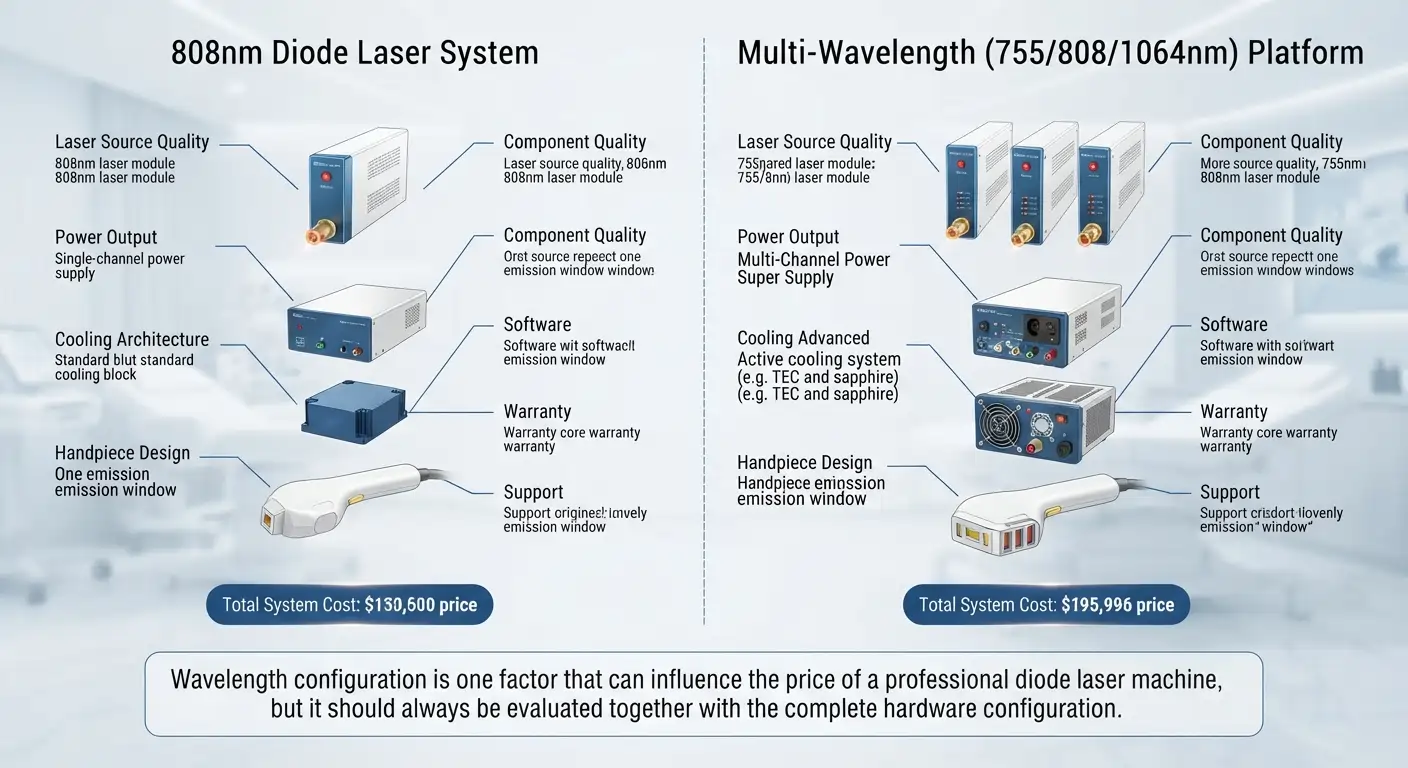
Wavelength configuration is one of the first differences buyers encounter when comparing professional diode laser machines. Some systems use a single wavelength, while others integrate multiple wavelengths within the same platform.
808nm Diode Laser Machine
808nm is widely associated with professional diode laser hair removal technology. Consequently, 808nm diode laser machine price is a common purchasing query among clinics and aesthetic equipment distributors.
However, wavelength alone does not determine price or equipment quality. Two 808nm machines can differ substantially in laser source, output, cooling, treatment window, handpiece construction, software, warranty, and technical support.
Multi-Wavelength Diode Laser Machine
Multi-wavelength platforms combine several wavelengths within one professional system. Depending on the equipment architecture, configurations can include wavelengths such as 755nm, 808nm, 940nm, and 1064nm.
Because multi-wavelength systems can involve more complex laser-source and handpiece configurations, they may cost more than simpler platforms. However, more wavelengths do not automatically make one machine better than another.
Buyers should evaluate wavelength architecture together with laser output, cooling, treatment parameters, spot sizes, handpiece design, and overall system quality.
2. Laser Power and Laser Source
Power is frequently emphasized in professional diode laser equipment marketing. Buyers may encounter increasingly large wattage figures, but the highest advertised number should not automatically determine which machine to purchase.
A useful comparison considers how the laser source, handpiece, energy delivery, cooling architecture, treatment parameters, and spot size operate together as a complete system.
Buyer Tip
Ask the supplier to explain exactly what the advertised power figure represents. Compare the complete laser source and handpiece configuration instead of choosing a machine solely because it advertises a larger wattage number.
Clinics should also ask about expected component life, warranty coverage, replacement procedures, and spare-parts availability.
3. Cooling System
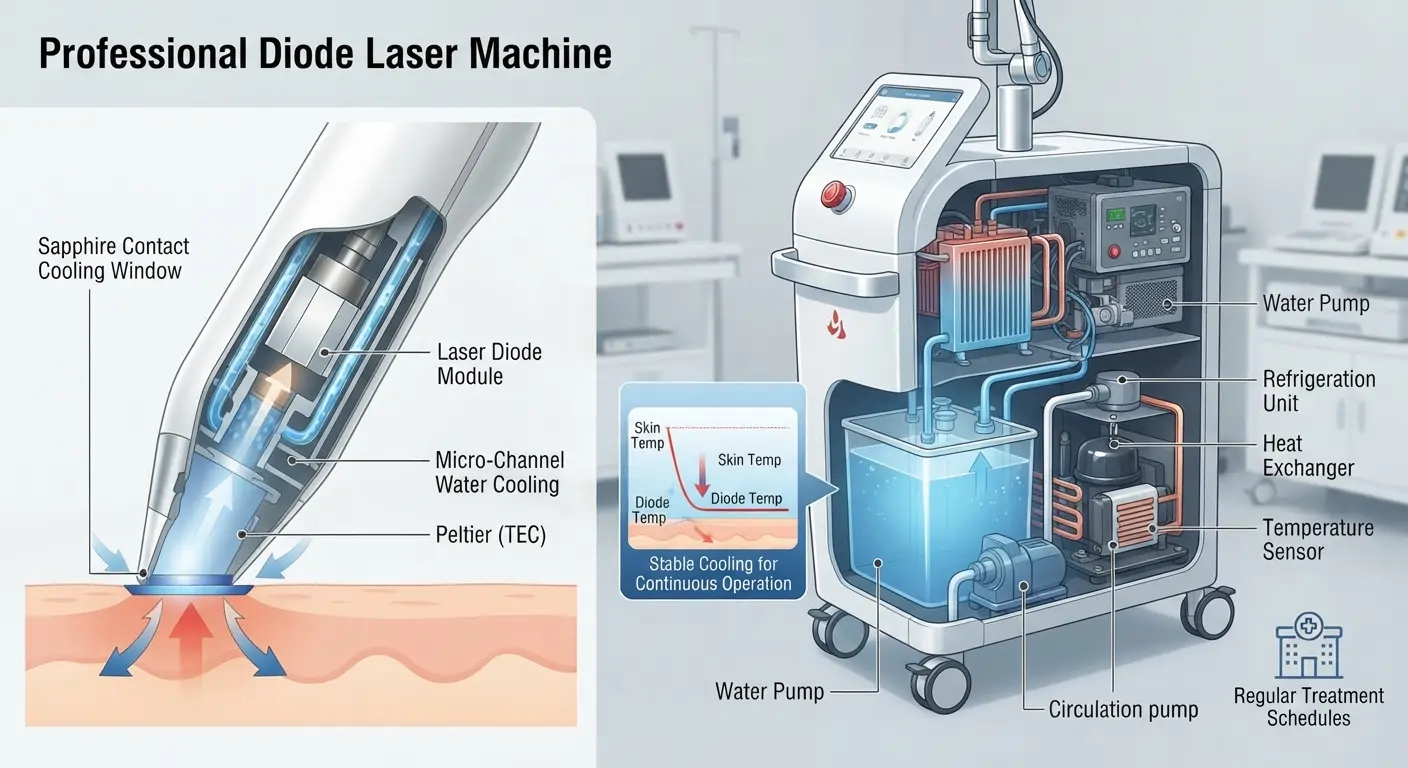
Cooling technology can influence both purchase price and practical equipment value. Professional diode laser platforms require thermal management for internal components as well as cooling at the treatment-contact interface.
Depending on system design, cooling may incorporate:
- Water circulation cooling
- Air cooling
- Thermoelectric or semiconductor cooling
- Sapphire contact cooling
- Additional handpiece thermal-management components
More sophisticated cooling architecture can increase equipment complexity and manufacturing cost. Buyers should therefore compare documented cooling specifications rather than relying only on marketing terms such as “ice cooling.”
4. Spot Size and Treatment Handpiece
Spot size affects how efficiently a system can be used across different treatment areas. Larger treatment windows can support coverage of larger anatomical areas, while smaller tips provide precision for localized areas.
When comparing a diode laser machine for sale, check whether the quoted configuration includes one treatment window, interchangeable spot sizes, or multiple handpiece options.
The treatment handpiece should also be evaluated for:
- Weight and ergonomics
- Treatment-window size
- Contact cooling design
- Cable flexibility
- Laser-source configuration
- Expected service life
- Replacement cost
- Repair and parts availability
A machine with a lower purchase price can become more expensive over time if the handpiece is costly to replace or difficult to service.
5. Software, Interface and Treatment Controls
Software can be overlooked during price comparisons, but it directly affects daily operator workflow. Professional buyers should evaluate interface design, treatment controls, parameter adjustment, available languages, presets, and software support.
For distributors and private-label projects, customized startup screens, languages, branding, or other interface modifications may also affect the final quotation.
6. OEM and Private-Label Customization
Distributors and aesthetic equipment brands often require more than a standard factory configuration. OEM or ODM projects can include customization of logos, interfaces, exterior appearance, packaging, documentation, or other commercial elements.
These requirements may increase the final diode laser machine cost or affect minimum order quantities.
Before requesting OEM pricing, specify:
- Target market
- Expected order quantity
- Logo requirements
- Interface language
- Packaging requirements
- Required documentation
- Preferred equipment configuration
Why Do Diode Laser Machine Prices Vary So Much?
Buyers can encounter large price differences between machines that appear similar externally. One supplier may advertise an 808nm diode laser machine at a relatively low price while another professional system costs substantially more.
The difference often comes from what is actually inside the equipment and what is included with the purchase.
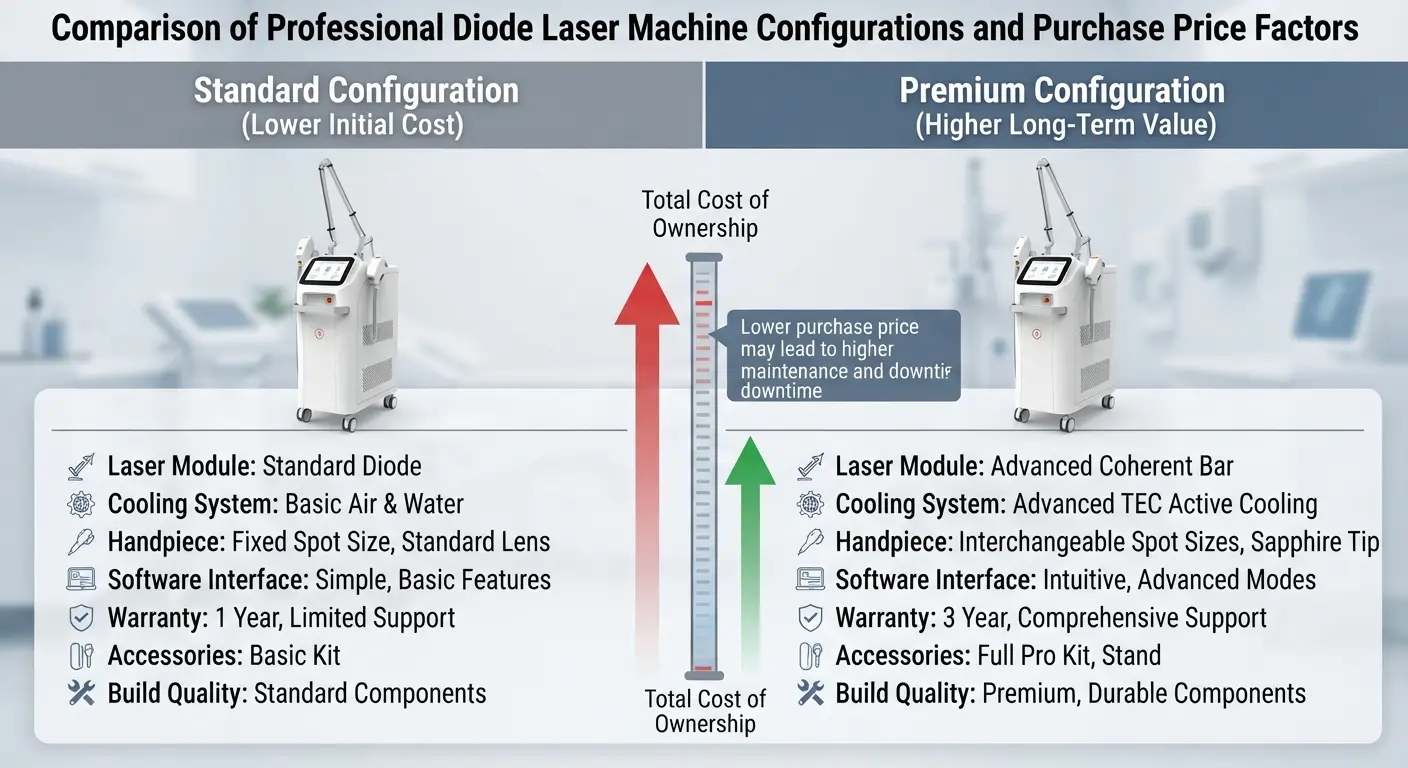
| Comparison Area | Basic Configuration | Higher-Specification Configuration |
|---|---|---|
| Wavelengths | Single-wavelength system | Multi-wavelength platform |
| Laser Source | Basic laser-source configuration | Higher-specification laser architecture |
| Cooling | Basic thermal management | More comprehensive system and contact cooling |
| Spot Sizes | Single treatment window | Multiple or interchangeable treatment sizes |
| Software | Standard interface | Additional controls, languages or customization |
| OEM | Standard factory configuration | Branding, interface and packaging customization |
| After-Sales | Basic support | More comprehensive warranty, parts and technical support |
Low-Cost vs Professional Diode Laser Machine
Searching for the cheapest diode laser machine for sale can be tempting, particularly for a new clinic controlling startup costs. However, equipment should be selected according to expected workload and business requirements rather than price alone.
A Lower-Cost System May Be Suitable When:
- The clinic expects relatively limited treatment volume.
- A simpler wavelength configuration meets the intended requirements.
- Advanced OEM customization is unnecessary.
- Reliable technical support is available.
- The machine has a clearly defined professional role.
A Higher-Specification System May Be Worth Considering When:
- The clinic expects frequent or high-volume operation.
- Multiple treatment areas require different spot sizes.
- Cooling performance is a major purchasing criterion.
- The buyer wants a multi-wavelength platform.
- The equipment will support a dedicated hair removal business.
- A distributor requires OEM or private-label customization.
- Long-term spare-parts and technical support are priorities.
Manufacturer vs Distributor: Does the Supplier Affect Price?
Clinics can purchase equipment through local distributors, aesthetic equipment brands, or directly from manufacturers. Each route provides a different combination of price, localization, service, customization, and convenience.
| Buying Route | Potential Advantages | What to Check |
|---|---|---|
| Local Distributor | Local communication, logistics and potentially local service | Included warranty, service and training |
| Equipment Brand | Established ecosystem and standardized commercial support | Exactly what the system price includes |
| Direct Manufacturer | Potential factory pricing, configuration flexibility and OEM options | Shipping, warranty, parts and international support |
Direct factory purchasing may reduce some distribution costs, but buyers must still account for freight, import requirements, compliance, service, training, and local support.
Purchase Price vs Total Cost of Ownership
The initial purchase price is only one part of the financial decision. Clinics should also consider the total cost of ownership (TCO).
Total cost of ownership can include:
- Initial equipment purchase
- Shipping
- Import duties and taxes where applicable
- Installation or commissioning
- Operator training
- Routine maintenance
- Replacement handpieces or laser components
- Maintenance items
- Spare parts
- Technical service
- Equipment downtime
- Out-of-warranty repairs
A $3,000 machine is not necessarily cheaper than a $6,000 machine over several years if the lower-priced system requires substantially more maintenance, replacement components, or downtime. Conversely, a higher purchase price only creates value when the additional cost corresponds to useful equipment or service advantages.
Hidden Costs to Check Before Buying
Shipping and Import Costs
Confirm whether the quotation is EXW, FOB, CIF, DDP, or another shipping arrangement. Freight, customs, taxes, insurance, and clearance responsibilities can materially change the final landed cost.
Replacement Handpiece Cost
Ask how long the handpiece is expected to remain serviceable, whether it is covered by warranty, and how much replacement or repair costs after the warranty period.
Spare Parts
Confirm which components require periodic replacement, whether common parts are stocked, and how quickly replacements can be supplied to your country.
Technical Service
Determine how troubleshooting is performed, what support is included during warranty, and how repairs are handled after warranty expiration.
Training
Some suppliers include equipment-operation guidance, while others may charge separately for additional or on-site training.
OEM Customization
Logo printing, customized interfaces, packaging, documentation, housing changes, or private-label requirements may involve additional costs or minimum order quantities.
How to Compare Diode Laser Machine Quotations
If Supplier A offers a lower price than Supplier B, standardize both quotations before deciding which provides better value.
| Specification | Supplier A | Supplier B |
|---|---|---|
| Machine Price | Confirm | Confirm |
| Wavelengths | Confirm | Confirm |
| Laser Source | Confirm | Confirm |
| Power Specification | Confirm | Confirm |
| Spot Sizes | Confirm | Confirm |
| Cooling System | Confirm | Confirm |
| Handpiece Warranty | Confirm | Confirm |
| Main Unit Warranty | Confirm | Confirm |
| Training | Included / Extra | Included / Extra |
| Spare Parts | Confirm | Confirm |
| OEM | Included / Extra | Included / Extra |
| Shipping | Included / Extra | Included / Extra |
| After-Sales Support | Confirm scope | Confirm scope |
What Should You Ask Before Buying a Diode Laser Machine?
Before you buy a diode laser hair removal machine, send suppliers a structured list of questions rather than asking only for the lowest price.
Diode Laser Machine Buyer Checklist
- What wavelengths are included?
- What does the advertised laser power specification represent?
- What laser-source configuration is used?
- Which spot sizes are included?
- How does the contact cooling system work?
- What internal cooling architecture is used?
- What treatment parameters can operators adjust?
- Which interface languages are available?
- What is the main-unit warranty?
- What warranty applies to the handpiece?
- What is the expected service life of key components?
- How much does a replacement handpiece cost?
- Which spare parts are stocked?
- How is technical support provided?
- Is equipment training included?
- What OEM or private-label options are available?
- What is the MOQ for customization?
- Which shipping terms are available?
- What documentation is supplied?
- What regulatory documentation is available for your target market?
How to Request an Accurate Diode Laser Machine Price
A supplier can provide a more useful quotation when the buyer clearly explains the intended configuration and business requirements.
Include:
- Your country or target market
- Whether you are a clinic, medical spa, distributor, importer, or equipment brand
- Preferred wavelength configuration
- Expected treatment volume
- Required spot sizes
- Order quantity
- OEM or private-label requirements
- Required documentation
- Shipping destination
This allows manufacturers to provide a configuration-specific quotation rather than an entry-level promotional price that may not match your requirements.
Should You Buy the Cheapest Diode Laser Machine?
Not necessarily. The lowest-priced option can be appropriate for some businesses, but price alone should not determine a professional equipment purchase.
Compare wavelength configuration, laser source, cooling, handpiece design, spot sizes, warranty, replacement parts, technical support, shipping, and expected ownership costs.
A higher initial investment may offer better value when it provides meaningful improvements in equipment configuration, support, serviceability, or expected operating costs. At the same time, buyers should not pay more solely for marketing claims that are unsupported by useful specifications or services.
How to Choose the Right Diode Laser Machine for Your Clinic
The right diode laser machine is not necessarily the one with the highest power, the largest number of wavelengths, or the lowest price. It is the machine whose configuration best matches the clinic’s intended workflow and business requirements.
Consider Treatment Volume
High-volume businesses may place greater importance on cooling stability, handpiece ergonomics, treatment speed, component service life, and spare-parts availability.
Consider Treatment Areas
Larger treatment windows may improve workflow for larger body areas, while smaller treatment tips can provide greater precision for localized areas.
Consider Wavelength Requirements
Choose wavelength architecture according to intended professional applications rather than simply selecting the machine with the largest number of wavelengths.
Consider Service and Technical Support
Equipment downtime can affect clinic operations and revenue. Confirm how troubleshooting, replacement parts, repairs, and technical assistance are handled.
Consider Future Expansion
Clinics planning additional locations and distributors developing private-label equipment businesses may place greater value on scalable configurations, OEM services, training, and long-term supply support.
Diode Laser Machine Price FAQ
How much does a professional diode laser machine cost?
As a general market reference, professional diode laser machines can cost approximately $2,000 to $15,000+. Basic factory-direct systems may fall toward the lower end, while higher-specification professional and premium branded systems can cost more. Actual pricing depends on configuration, supplier, market, warranty, and included services.
How much does a diode laser hair removal machine for a clinic cost?
Many professional clinic systems fall broadly within the $4,000–$8,000 mid-range, although simpler equipment may cost less and higher-specification systems may exceed $8,000–$15,000. Buyers should request a quotation for the exact configuration they require.
What affects diode laser hair removal machine price the most?
Major factors include wavelength configuration, laser source, power, cooling architecture, handpiece design, spot sizes, component quality, software, warranty, technical support, accessories, and OEM requirements.
Is an 808nm diode laser machine cheaper?
Not always. An 808nm-only configuration can be simpler than some multi-wavelength platforms, but laser source quality, power, cooling, handpiece design, warranty, and manufacturer can have a greater influence on final price.
Why are some diode laser machines much cheaper than others?
Machines that appear similar externally may use different laser sources, cooling systems, handpieces, components, software, quality-control processes, warranties, and support packages. These differences can affect both purchase price and long-term ownership cost.
Should I buy a diode laser machine directly from a manufacturer?
Direct manufacturer purchasing can provide access to factory pricing, configuration options, and OEM services. Buyers should also evaluate shipping, import requirements, warranty, technical support, spare parts, training, and local regulatory obligations.
Does OEM customization increase diode laser machine cost?
It can. Customized logos, interfaces, packaging, housing, documentation, and other private-label requirements may affect price or minimum order quantity depending on the project.
What should I ask for in a diode laser machine quotation?
Request the complete configuration, including wavelengths, laser source, power, cooling, spot sizes, accessories, warranty, handpiece coverage, replacement costs, training, OEM fees, shipping terms, spare parts, and after-sales support.
What is the total cost of ownership of a diode laser machine?
Total cost of ownership includes the original purchase price plus shipping, import costs, maintenance, replacement parts, handpiece replacement, technical service, training, downtime, and out-of-warranty repairs over the equipment’s service life.
How can I get an accurate diode laser machine price?
Provide the supplier with your country, business type, preferred wavelengths, treatment requirements, spot sizes, quantity, OEM requirements, required documentation, and shipping destination. The supplier can then prepare a configuration-specific quotation.
Final Verdict: Compare Value, Not Just Diode Laser Machine Price
A realistic starting point for budgeting is approximately $2,000 to $15,000+ for a professional diode laser machine, with the final price depending heavily on configuration, manufacturer, service, and market.
For many clinics, comparing machines in the $4,000–$8,000 range may reveal professional configurations with a balance of equipment capability and investment, while higher-specification platforms can move beyond $8,000–$15,000. These ranges should still be treated as market estimates rather than fixed supplier prices.
The most important purchasing decision is therefore not simply finding the cheapest machine. Buyers should compare wavelength configuration, laser source, cooling, handpiece, spot sizes, software, warranty, spare parts, shipping, technical support, and total ownership cost.
If you are purchasing for a clinic, medical spa, laser hair removal business, distribution company, or private-label project, request a detailed configuration-specific quotation before making the final comparison.