The Ultimate Clinic Guide to 808nm vs 755nm vs 1064nm: Efficacy, Wavelengths, and ROI
Executive Summary: Why Wavelength Selection Dictates Your Clinical ROI
In the competitive landscape of medical aesthetics, the choice between 755nm, 808nm, and 1064nm diode laser systems is not merely a technical specification—it is the single most critical factor determining treatment efficacy, patient safety across Fitzpatrick skin types, and your clinic’s long-term return on investment (ROI). While legacy IPL devices offer broad-spectrum uncertainty, modern diode lasers leverage selective photothermolysis to target specific chromophores. This guide provides a clinically-driven, data-rich comparison to empower your purchasing and treatment protocols.
Physical Mechanisms: Penetration Depth & Chromophore Affinity
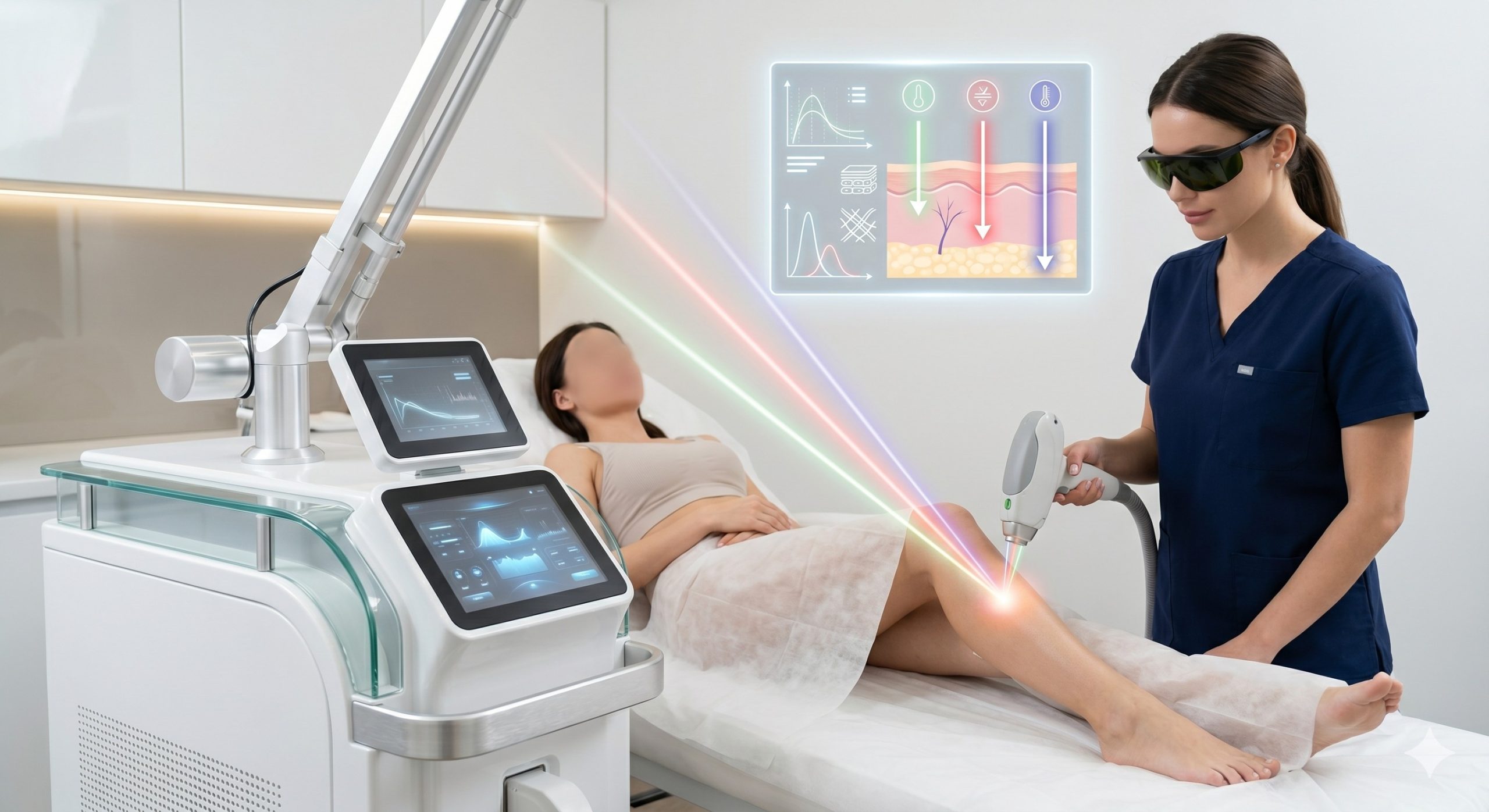
The principle of selective photothermolysis dictates that a wavelength must be optimally absorbed by the target (melanin for hair, oxyhemoglobin for vessels) while sparing surrounding tissue. Penetration depth increases with wavelength, but absorption decreases.
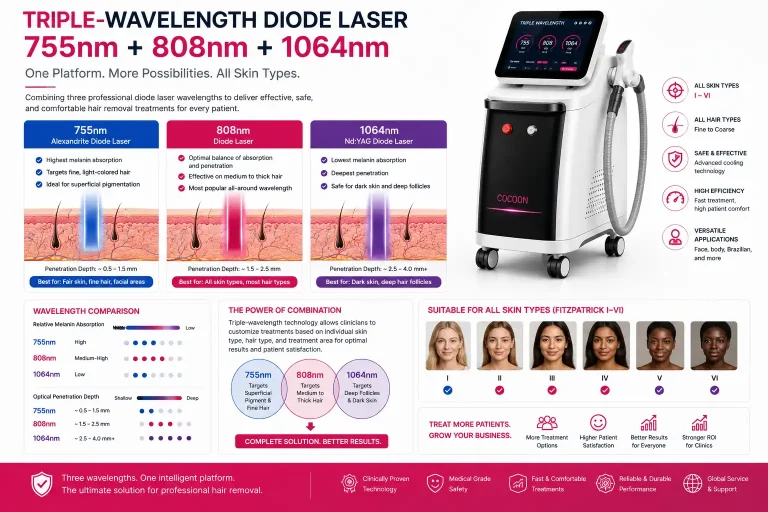
755nm (Alexandrite-equivalent Diode)
Exhibits the highest melanin absorption coefficient. This makes it exceptionally potent for fine, light-colored hair and superficial pigmented lesions. However, with a penetration depth of approximately 1.5-2.5mm, it carries a significant risk of epidermal burning in Fitzpatrick Skin Types IV-VI due to competitive absorption by basal layer melanin. Requires aggressive epidermal cooling (e.g., -5°C to 0°C sapphire plate temperature) and longer pulse widths (>30ms) for safety in darker skin.
808nm (Diode Gold Standard)
Widely regarded as the clinical gold standard for permanent hair reduction. The 808nm wavelength strikes the ideal balance: deep penetration (3-5mm) reaching the dermal papilla and hair bulb, with relatively low absorption by epidermal melanin. This creates the widest therapeutic window, enabling safe and effective treatment across Fitzpatrick II-V. Modern devices utilize high-fluence (up to 120 J/cm²) combined with large spot sizes (12x12mm up to 15x15mm) to accelerate treatment throughput.
1064nm (Nd:YAG-equivalent Diode)
The longest wavelength, penetrating 5-7mm deep. It has the lowest melanin absorption, rendering it the safest option for Fitzpatrick V and VI skin and for targeting deep vascular lesions, leg veins, and inflammatory acne. However, due to low absorption, significantly higher fluence (up to 200+ J/cm²) is required to achieve thermal coagulation of the follicle, potentially leading to higher patient discomfort if not paired with superior Sapphire ICE cooling.
Technical Specifications: The Engine of Clinical Performance
Commercially available medical CE and FDA-cleared multi-wavelength systems (e.g., 755/808/1064nm tri-wavelength diode lasers) allow clinics to adapt to any patient demographic. Below are the critical metrics for evaluation, referencing ISO 13485 manufacturing standards.
| Key Parameter | 755nm (Diode/Alex) | 808nm (Diode Gold Std) | 1064nm (Diode/Nd:YAG) |
|---|---|---|---|
| Primary Chromophore | Melanin (Superficial) | Melanin (Deep Bulb) | Oxyhemoglobin / Deep Mel |
| Penetration Depth | 1.5 – 2.5 mm | 3.0 – 5.0 mm | 5.0 – 7.0 mm |
| Optimal Fluence Range | 20 – 40 J/cm² | 40 – 120 J/cm² | 80 – 200+ J/cm² |
| Pulse Width (Typical) | 20 – 60 ms | 10 – 400 ms | 30 – 400 ms |
| Fitzpatrick Suitability | I – III (IV w/ caution) | II – V | IV – VI |
| FDA / CE Status | 510(k) / CE Class IV | 510(k) / CE Class IV | 510(k) / CE Class IV |
Clinical Protocols: Parameter Optimization per Indication
Using a tri-wavelength platform, the strategy is to blend or sequentially fire wavelengths. For hair removal on Fitzpatrick III, a protocol of 755nm (25 J/cm², 30ms) for superficial hairs followed by 808nm (60 J/cm², 30ms) for deep bulbs yields >90% clearance after 6 sessions. For darker skin (Fitzpatrick V), pure 1064nm (140 J/cm², 35ms) with spot size 15x15mm ensures the fluence reaches the follicle while the large spot minimizes light scattering and deepens penetration. Always validate your device’s pulse width range (10ms to 400ms); longer pulse widths are safer for darker phototypes.
Hardware Integrity: Cooling Systems & Laser Bar Origin
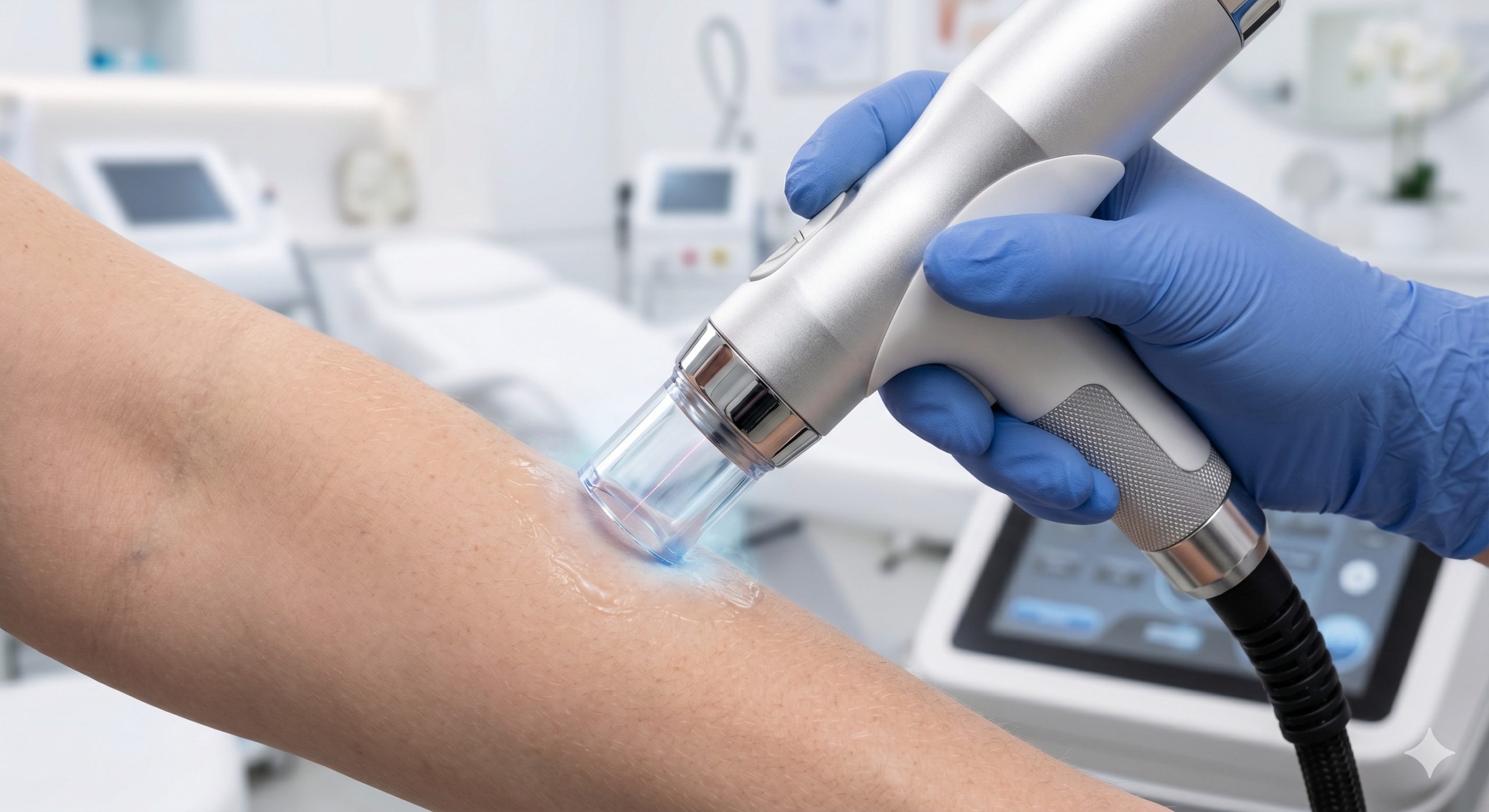
Clinical outcomes depend on hardware stability. High-end systems use imported laser bars (e.g., from Jenoptik or Hamamatsu) providing consistent output across 20+ million shots. The non-negotiable safety component is the Sapphire ICE contact cooling system which cools the epidermis to 0°C to -5°C before, during, and after the laser pulse. Without this, high-fluence 1064nm treatments become painful and risky. Verify medical CE (MDR 2017/745) or FDA 510(k) clearance to ensure the device has passed rigorous electrical and thermal safety tests.
Clinic ROI & Strategic Verdict
Investing in a multi-wavelength (755/808/1064nm) diode laser rather than a single-wavelength 808nm device increases your upfront CapEx but drastically expands your addressable patient base (100% of Fitzpatrick I-VI vs. ~70%). The average treatment session price for full legs ranges from $350 to $600. With consumable costs (electricity, negligible water cooling maintenance, and no disposables) at less than $2 per session, the ROI breakpoint is typically under 4-6 months for a clinic performing 20-30 sessions weekly. For high-throughput clinics, prioritize large spot sizes (≥15mm) and repetition rates (≥2Hz) to reduce session time to 15 minutes for underarms, maximizing daily patient turnover. Choose ISO 13485 certified manufacturers offering at least a 2-year warranty on the laser handpiece.
Conclusion
No single wavelength is superior across all indications. The 808nm remains the highest-efficacy workhorse for general hair removal. The 755nm is your tool for fair, thin hair and pigment. The 1064nm is essential for dark skin and deep vascular targets. A tri-wavelength platform with high-power diode bars, Sapphire ICE cooling, and medical CE/FDA clearance represents the definitive upgrade for any serious medical aesthetic practice focused on safety, patient outcomes, and profitability.