755nm vs 808nm vs 1064nm Diode Laser: Key Differences
Diode Laser Technology Guide
755nm, 808nm, and 1064nm are three wavelengths commonly discussed when comparing professional diode laser hair removal machines. They differ primarily in melanin absorption, optical penetration, and how manufacturers use them within single- or multi-wavelength laser platforms.
Understanding these differences can help clinics compare an 808nm diode laser with 755nm + 808nm + 1064nm multi-wavelength systems and decide which configuration better fits their professional equipment requirements.
Quick Answer: 755nm vs 808nm vs 1064nm Diode Laser
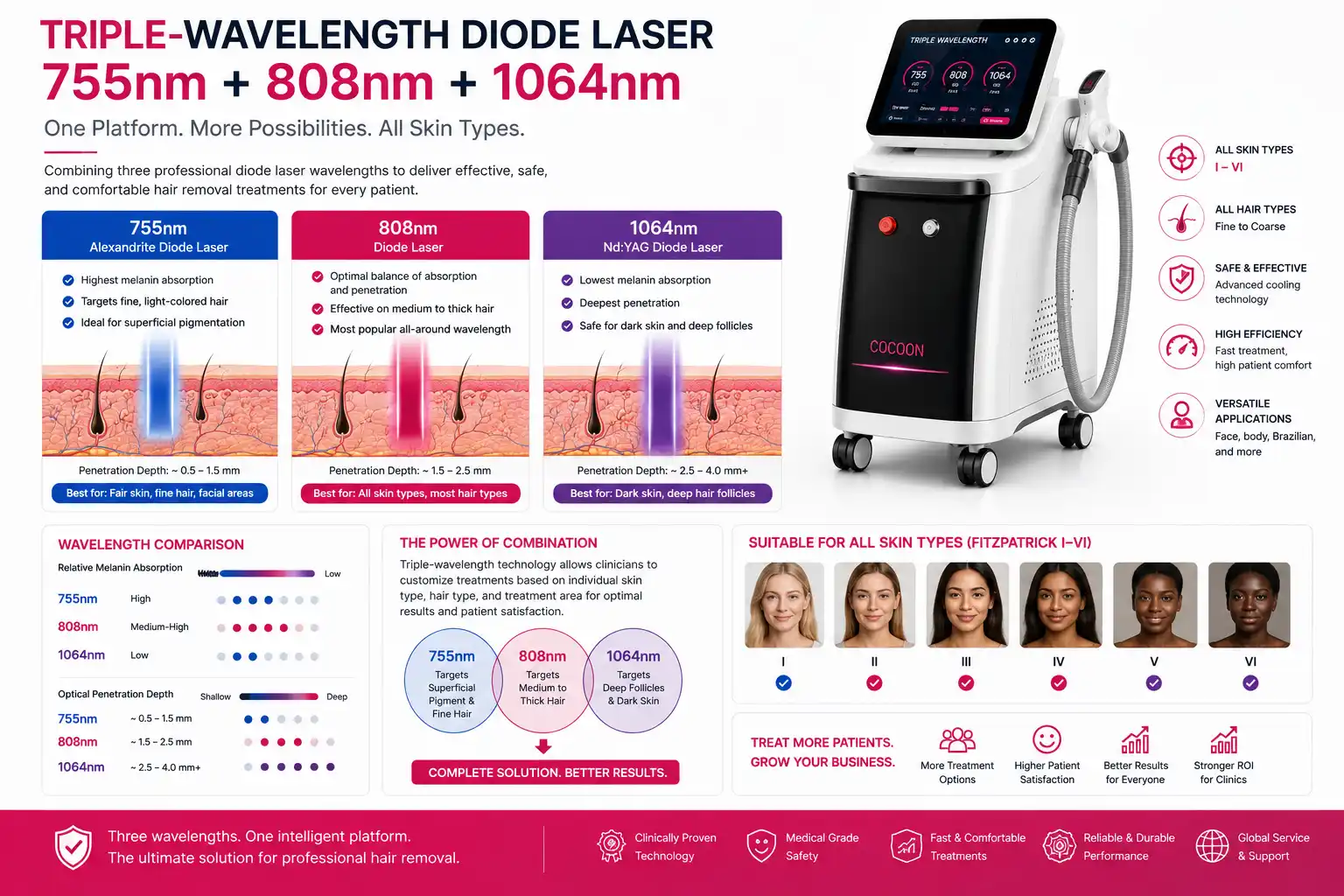
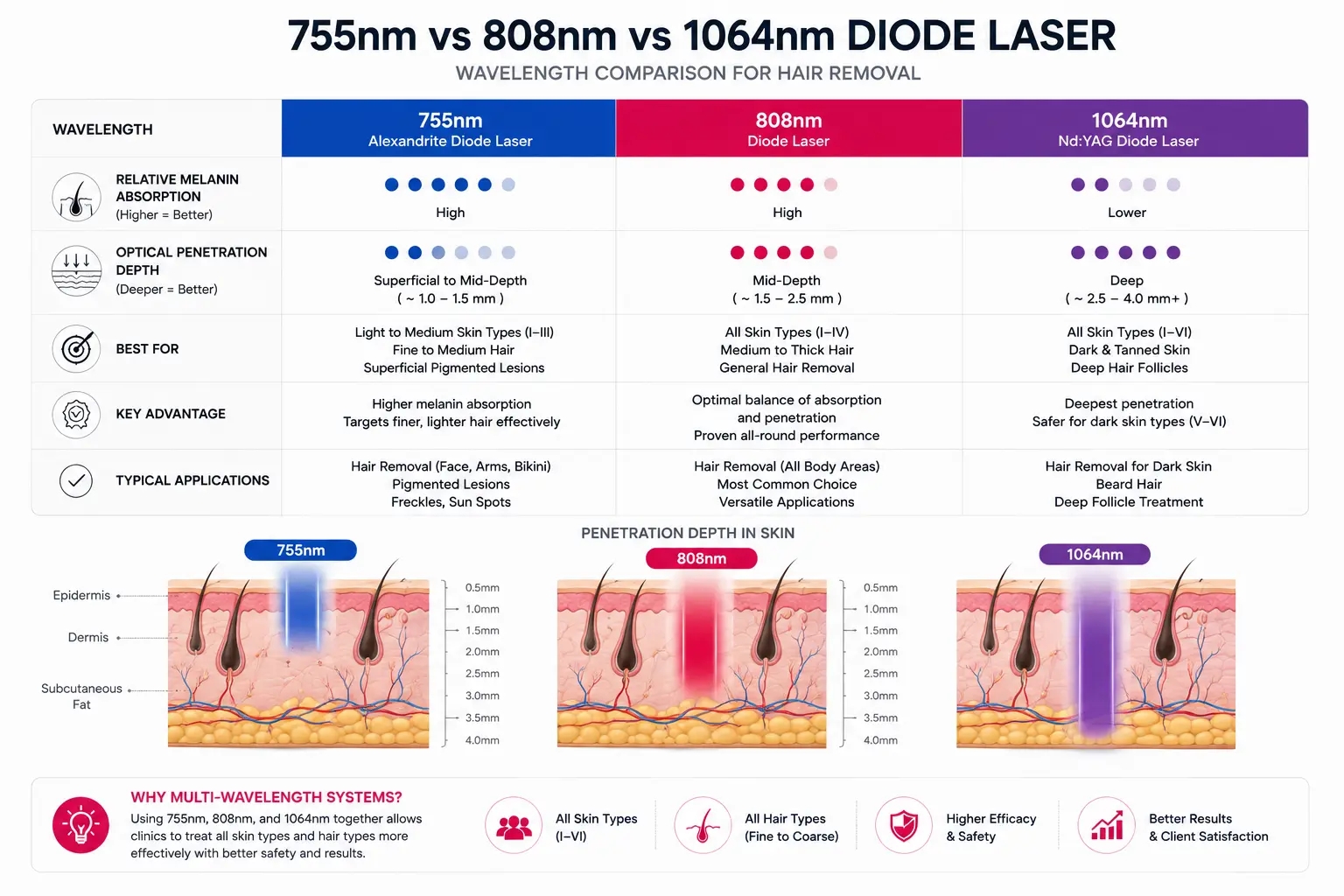
The main difference between 755nm, 808nm, and 1064nm diode laser wavelengths is their relative interaction with melanin and their optical penetration into tissue.
- 755nm: has relatively higher melanin absorption among these three wavelengths and is commonly included in multi-wavelength systems to complement the longer wavelengths.
- 808nm: provides a practical balance between melanin absorption and penetration and is one of the most widely used wavelengths in professional diode laser hair removal machines.
- 1064nm: has lower relative melanin absorption and greater optical penetration than the shorter wavelengths, making it an important component of many multi-wavelength systems.
For a dedicated professional hair removal machine, 808nm remains a strong standalone configuration. For clinics seeking broader wavelength flexibility, 755nm + 808nm + 1064nm is a popular multi-wavelength configuration.
However, wavelength alone does not determine treatment suitability or equipment quality. Fluence, pulse duration, spot size, cooling, hair characteristics, skin characteristics, device design, and professional parameter selection also matter.
755nm vs 808nm vs 1064nm at a Glance
| Feature | 755nm | 808nm | 1064nm |
|---|---|---|---|
| Relative Melanin Absorption | Higher | Moderate | Lower |
| Relative Penetration | Shallower | Intermediate | Deeper |
| Role in Diode Systems | Usually part of multi-wavelength platforms | Standalone or multi-wavelength | Usually part of multi-wavelength platforms |
| Main Advantage | Stronger relative interaction with melanin | Balanced professional hair removal wavelength | Lower relative melanin absorption and deeper penetration |
| Common Configuration | 755 + 808 + 1064nm | 808nm or 755 + 808 + 1064nm | 755 + 808 + 1064nm |
| Best Purchasing Context | Multi-wavelength flexibility | Dedicated or versatile professional systems | Multi-wavelength flexibility |
These differences explain why many professional diode laser manufacturers combine the three wavelengths rather than positioning them simply as competing technologies.
Why Does Wavelength Matter in Laser Hair Removal?
Laser hair removal is based on the principle of selective photothermolysis. Light energy is absorbed by chromophores in tissue and converted into heat. In hair removal, melanin within the hair is an important optical target.
Wavelength matters because melanin does not absorb all wavelengths equally. Changing the wavelength changes the balance between absorption and penetration.
In simplified terms:
- Shorter wavelengths in this comparison have relatively greater melanin absorption.
- Longer wavelengths generally provide deeper optical penetration.
- 808nm sits between 755nm and 1064nm and provides a useful balance of these characteristics.
This is also why wavelength should never be evaluated alone. The actual thermal effect depends on additional parameters including fluence, pulse duration, spot size, repetition rate, cooling, and the characteristics of the treatment area.
For a deeper explanation of the underlying principle, see our Selective Photothermolysis Guide.
What Is a 755nm Diode Laser?
755nm is the shortest of the three wavelengths compared in this guide. At this wavelength, melanin absorption is relatively higher than at 808nm and 1064nm.
The 755nm region is also strongly associated with Alexandrite laser technology. However, a 755nm diode laser system is not the same thing as a traditional 755nm Alexandrite laser. The wavelength may be similar, but the laser source and overall device architecture are different.
In professional diode equipment, 755nm is frequently incorporated as one component of a multi-wavelength laser stack alongside 808nm and 1064nm.
Advantages of 755nm
- Higher relative melanin absorption than 808nm and 1064nm
- Useful complementary wavelength in multi-wavelength diode platforms
- Allows manufacturers to broaden the optical characteristics of a diode laser handpiece
Considerations
Greater melanin interaction also means that treatment parameters and cooling require appropriate professional consideration. A 755nm specification alone should not be interpreted as evidence that a machine is automatically more effective or appropriate for a particular patient.
What Is an 808nm Diode Laser?
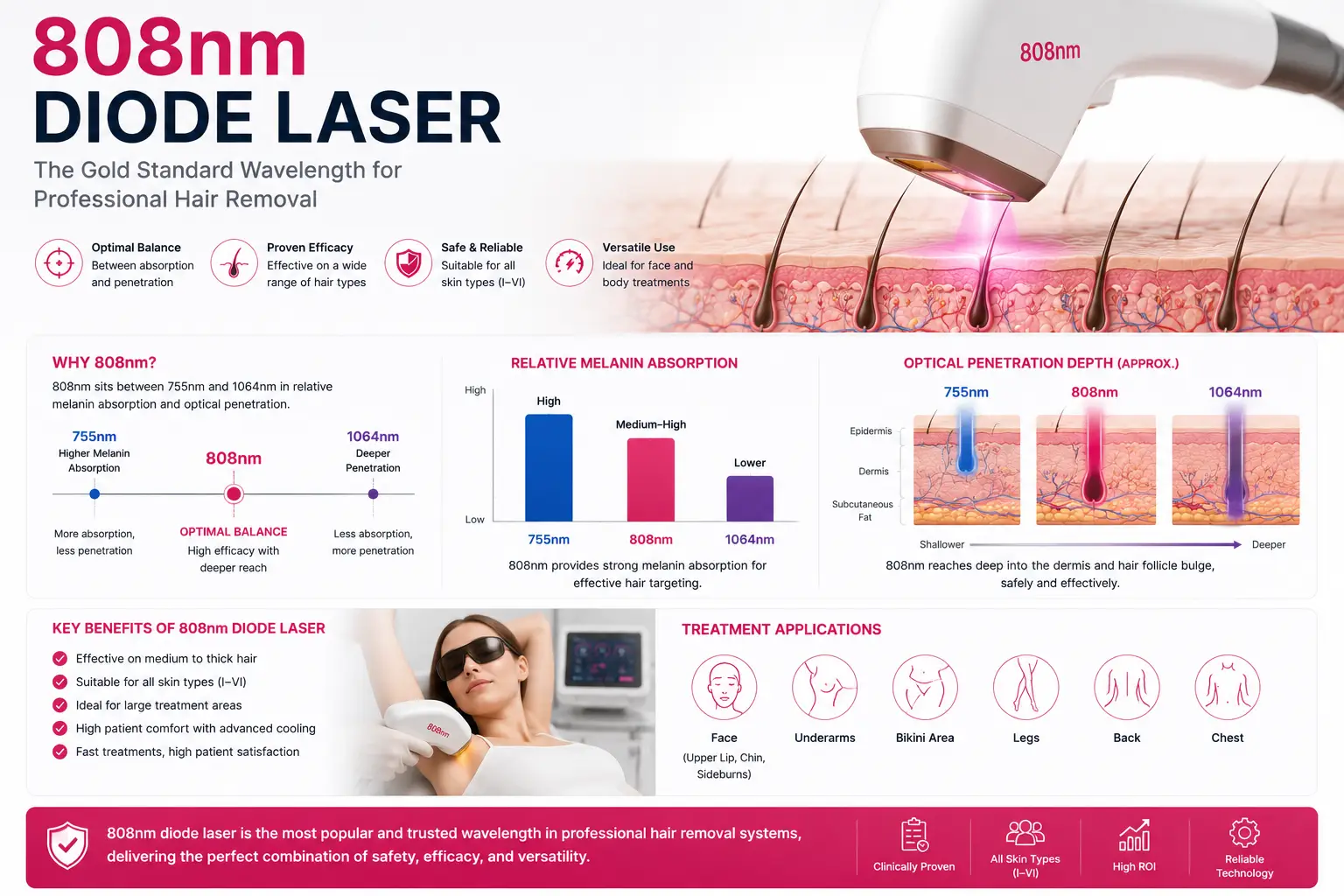
808nm diode laser technology is one of the most established configurations used in professional diode laser hair removal equipment.
Compared with 755nm, 808nm has lower relative melanin absorption and greater penetration. Compared with 1064nm, it retains greater relative melanin absorption while having less penetration. This intermediate position gives 808nm its characteristic balance.
For this reason, 808nm can function either as a standalone professional hair removal wavelength or as the central wavelength in a 755nm + 808nm + 1064nm platform.
Advantages of 808nm
- Widely used in professional diode laser hair removal
- Balances melanin interaction and optical penetration
- Can be used as a dedicated single-wavelength configuration
- Commonly forms the core of triple-wavelength diode systems
- Available across a wide range of professional machine configurations
Clinics that primarily want a dedicated hair removal platform should therefore not assume that they need three or four wavelengths. A well-designed 808nm machine remains a legitimate professional option.
Learn more in our 808nm Diode Laser Guide.
What Is a 1064nm Diode Laser?
1064nm is the longest wavelength in this comparison. Relative to 755nm and 808nm, it has lower melanin absorption and greater optical penetration.
The 1064nm wavelength is also strongly associated with Nd:YAG laser systems. As with 755nm, however, wavelength should not be confused with laser-source technology: a 1064nm diode laser configuration is not the same device architecture as a traditional 1064nm Nd:YAG laser.
Within diode laser hair removal machines, 1064nm is commonly combined with 755nm and 808nm to broaden the wavelength profile of a multi-wavelength platform.
Advantages of 1064nm
- Lower relative melanin absorption than 755nm and 808nm
- Greater optical penetration among the three wavelengths
- Complements shorter wavelengths in multi-wavelength diode systems
- Expands the technical flexibility of a professional diode laser platform
Its presence should still be evaluated as part of the complete machine. Laser-source quality, output, pulse parameters, cooling, spot size, and professional parameter selection remain essential.
755nm vs 808nm: What’s the Difference?
The simplest difference is that 755nm has relatively higher melanin absorption, while 808nm provides greater penetration and a more intermediate balance.
This does not mean 755nm is simply “stronger” or 808nm is “weaker.” They represent different optical characteristics, and the actual treatment effect depends on the complete set of laser parameters and device design.
808nm vs 1064nm: What’s the Difference?
Compared with 808nm, 1064nm has lower relative melanin absorption and greater penetration. The 808nm wavelength occupies a more intermediate position and remains widely used as a standalone professional diode hair removal wavelength.
This complementary relationship is one reason manufacturers frequently combine both wavelengths within triple-wavelength systems.
How Does a 755nm + 808nm + 1064nm Triple-Wavelength Diode Laser Work?
A triple-wavelength diode laser combines approximately 755nm, 808nm, and 1064nm wavelengths within one professional hair removal platform. Instead of requiring a clinic to purchase separate machines for each wavelength, the system integrates different wavelength characteristics into a single handpiece and treatment platform.
The reason for combining these wavelengths is straightforward: each occupies a different position in terms of relative melanin absorption and optical penetration.
- 755nm contributes relatively higher melanin absorption.
- 808nm provides an intermediate balance of melanin interaction and penetration.
- 1064nm contributes lower relative melanin absorption and deeper penetration.
Together, these wavelengths give manufacturers a way to build a more versatile diode laser platform. However, simply listing three wavelengths on a specification sheet does not establish the quality of the machine.
Buyers should also evaluate the laser-source architecture, wavelength distribution, fluence, pulse duration, repetition rate, spot size, cooling, handpiece design, and overall system reliability.

808nm vs Triple-Wavelength Diode Laser: Which Is Better?
For clinics purchasing a new machine, this is usually more useful than asking which individual wavelength is “best.”
A dedicated 808nm diode laser provides a focused professional configuration, while a 755nm + 808nm + 1064nm diode laser provides broader wavelength flexibility within the same platform.
| Feature | 808nm Diode Laser | 755 + 808 + 1064nm |
|---|---|---|
| Configuration | Single primary wavelength | Triple wavelength |
| Main Strength | Focused, established diode configuration | Broader wavelength flexibility |
| System Design | Potentially simpler | More complex laser-source architecture |
| Clinic Positioning | Dedicated hair removal platform | Versatile professional platform |
| Cost | Can be lower depending on specification | Can cost more depending on configuration |
| Best For | Clinics wanting a straightforward professional system | Clinics prioritizing wavelength flexibility |
Neither configuration automatically wins. A high-quality 808nm machine can be a better investment than a poorly engineered triple-wavelength machine.
If the machines are otherwise comparable in laser-source quality, cooling, treatment controls, handpiece design, reliability, and manufacturer support, the triple-wavelength configuration provides additional wavelength flexibility.
Which Diode Laser Wavelength Is Best for a Professional Clinic?
For a clinic choosing equipment rather than selecting an individual treatment parameter, the answer depends on the purpose of the machine.
| Clinic Requirement | Configuration to Consider |
|---|---|
| Dedicated professional hair removal | 808nm |
| Broader wavelength flexibility | 755 + 808 + 1064nm |
| Small clinic prioritizing simplicity | 808nm |
| Multi-service or higher-volume aesthetic clinic | 755 + 808 + 1064nm |
| Distributor / private-label product | Multi-wavelength configuration can provide stronger product-positioning flexibility |
For many clinics purchasing a versatile new professional system, 755nm + 808nm + 1064nm is a practical configuration to use as the starting benchmark.
Clinics that want a simpler dedicated platform should continue to consider 808nm. The decision should ultimately be based on the complete machine rather than wavelength count alone.
For a broader equipment comparison, see our Best Diode Laser Hair Removal Machine for Clinics.
Does Triple Wavelength Mean Better Hair Removal?
Not necessarily.
Triple wavelength describes the optical configuration of the laser source. It does not guarantee treatment outcomes or prove that one machine is better engineered than another.
When comparing professional machines, wavelength should be considered alongside:
- Laser-source quality
- Fluence range
- Pulse-duration control
- Repetition rate
- Spot size
- Contact cooling
- Internal thermal management
- Handpiece ergonomics
- System reliability
- Warranty and technical support
This is particularly important when comparing machines from different manufacturers because two systems advertised as “755 + 808 + 1064nm” may have very different hardware configurations.
What About 940nm Four-Wavelength Diode Lasers?
Some newer diode laser machines are marketed with four wavelengths, commonly adding 940nm to a 755nm + 808nm + 1064nm configuration.
The additional wavelength changes the optical profile of the laser source, but clinics should not assume that four wavelengths automatically make the machine superior to a well-designed triple-wavelength or 808nm system.
The same purchasing rule applies: compare the complete laser architecture and usable treatment specifications rather than simply counting wavelengths.
755nm, 808nm and 1064nm Diode Laser FAQ
What is the main difference between 755nm, 808nm and 1064nm?
The main difference is their relative melanin absorption and optical penetration. Among these three wavelengths, 755nm has relatively higher melanin absorption, 808nm provides an intermediate balance, and 1064nm has lower relative melanin absorption with greater penetration.
Why is 808nm commonly used for diode laser hair removal?
808nm provides a useful balance between melanin interaction and optical penetration and is widely used in professional diode laser hair removal systems. It can function as either a standalone wavelength or part of a multi-wavelength platform.
Is 755nm diode laser the same as Alexandrite laser?
No. Both may operate around 755nm, but wavelength and laser-source technology are different concepts. A 755nm diode laser and a traditional Alexandrite laser use different laser architectures.
Is 1064nm diode laser the same as Nd:YAG?
No. A diode laser producing approximately 1064nm and a traditional 1064nm Nd:YAG laser may operate at similar wavelengths, but their laser sources and device architectures are different.
Is triple-wavelength diode laser better than 808nm?
Triple-wavelength systems provide greater wavelength flexibility, while 808nm provides a simpler dedicated configuration. Machine quality, cooling, treatment controls, reliability, and support are more important than wavelength count alone.
Which diode laser wavelength should a clinic choose?
Clinics seeking a dedicated professional hair removal system can consider 808nm. Clinics wanting broader wavelength flexibility can consider a 755nm + 808nm + 1064nm multi-wavelength platform.
Final Verdict: 755nm vs 808nm vs 1064nm
The difference between 755nm, 808nm, and 1064nm diode laser wavelengths is primarily their relative melanin absorption and optical penetration.
- 755nm: provides relatively higher melanin absorption and is commonly used as part of a multi-wavelength diode platform.
- 808nm: provides a balanced combination of melanin interaction and penetration and remains one of the most important standalone wavelengths for professional diode laser hair removal.
- 1064nm: provides lower relative melanin absorption and greater penetration, complementing the shorter wavelengths in multi-wavelength systems.
These wavelengths should therefore not always be viewed as three competing choices. In a 755nm + 808nm + 1064nm diode laser machine, they are designed to provide complementary optical characteristics within one professional platform.
For clinics that want a straightforward dedicated system, 808nm remains a strong professional choice. For clinics that prioritize wavelength flexibility, 755nm + 808nm + 1064nm is the configuration we would use as the starting point for comparison.
In either case, wavelength is only one part of the purchasing decision. Laser-source quality, treatment parameters, cooling, spot size, handpiece design, reliability, warranty, and after-sales support should determine which machine is ultimately the better investment.
Professional Diode Laser Systems
Compare 808nm and Multi-Wavelength Diode Laser Machines
Tell Cocoon Laser your country, clinic type, preferred wavelength configuration, and purchasing requirements. Our team can provide available 808nm and multi-wavelength diode laser configurations, technical specifications, OEM options, and current pricing.
Request Specifications & Quote