Intimate Wellness: Breaking the Stigma with a Vaginal Rejuvenation Laser Device Supplier
Executive Summary
The landscape of women’s intimate health is experiencing a paradigm shift, transitioning from invasive surgical interventions to advanced photonics. For patients suffering from Genitourinary Syndrome of Menopause (GSM) or Stress Urinary Incontinence (SUI), vaginal rejuvenation laser devices offer a scientifically validated, non-surgical pathway to restore mucosal integrity and pelvic floor function. This comprehensive guide dissects the underlying laser physics—specifically Fractional Technology and the mechanisms of neocollagenesis—empowering patients to understand their biological responses. Furthermore, it demystifies the critical hardware components engineered by top-tier aesthetic laser suppliers, such as 360-degree precision probes and specific wavelength modalities (CO2 vs. Erbium). By understanding the technical benchmarks, including FDA 510(k) clearances and Medical CE certifications, consumers can confidently navigate treatment options, ensuring they select clinics equipped with professional, clinical-grade Cocoon Laser technologies for optimal safety and efficacy.
Beyond the Stigma: Addressing the Biological Realities of Women’s Intimate Health
For decades, the physical changes occurring within the female reproductive system due to aging and childbirth were shrouded in silence. Millions of women have silently endured discomfort, assuming it to be an inevitable consequence of life stages. However, modern gynecology and dermatological science treat these changes not as personal failings or inevitable declines, but as well-documented physiological conditions requiring precise medical intervention. Elevating the conversation from emotional distress to objective biology is the first step in reclaiming intimate wellness.
The Hidden Impact of Childbirth and Menopause (GSM & SUI)
The female intimate anatomy is highly dynamic and profoundly influenced by hormonal fluctuations and mechanical stress. The two most prevalent conditions driving the demand for advanced therapeutic interventions are Genitourinary Syndrome of Menopause (GSM) and Stress Urinary Incontinence (SUI).
During the perimenopausal and menopausal phases, the systemic decline in estrogen levels drastically alters the vaginal mucosa. Estrogen is the primary hormone responsible for maintaining the thickness, elasticity, and lubrication of the vaginal walls. Without sufficient estrogen, the non-keratinized stratified squamous epithelium undergoes significant atrophy. The tissue thins, loses its rugae (the natural folds that allow for expansion), and experiences a sharp decrease in glycogen production. This reduction in glycogen disrupts the local microbiome, leading to a decline in protective lactobacilli and an increase in vaginal pH, which manifests as severe dryness, irritation, burning, and dyspareunia (painful intercourse).
Simultaneously, the mechanical trauma of vaginal childbirth, combined with natural aging, frequently compromises the structural integrity of the pelvic floor muscles and the endopelvic fascia. This degradation of support structures often leads to SUI—the involuntary leakage of urine during activities that increase intra-abdominal pressure, such as coughing, laughing, or exercising. These are objective, structural, and histological breakdowns of tissue; they require a modality capable of structurally remodeling the affected anatomy at a cellular level.
Why Non-Invasive Solutions Are Replacing Traditional Surgery
Historically, the medical response to severe vaginal laxity and structural degradation was surgical intervention, primarily Vaginoplasty (anterior or posterior colporrhaphy). While surgery remains necessary for severe pelvic organ prolapse, it presents significant drawbacks for the average patient seeking functional restoration.
Traditional surgical procedures are inherently ablative and invasive. They require general anesthesia, involve the mechanical excision of excess mucosa, and are followed by a prolonged, painful recovery period often extending beyond six weeks. Furthermore, surgery carries substantial risks, including infection, scarring, nerve damage, and potentially permanent dyspareunia if the tissue is over-tightened. Crucially, surgery only addresses the mechanical dimension of laxity; it does absolutely nothing to improve mucosal health, restore lubrication, or reverse the histological thinning caused by estrogen depletion.
This clinical gap is precisely where non-invasive laser equipment has revolutionized gynecological care. By utilizing targeted photonic energy rather than scalpels, modern medical lasers induce a regenerative healing cascade within the tissue itself. They offer a “no downtime” alternative that not only tightens the tissue through collagen contraction but actively rejuvenates the mucosal lining, restoring its youthful histological architecture without the profound risks associated with surgical trauma.
The Science of Restoration: How Vaginal Rejuvenation Lasers Actually Work
To dispel the misconception that non-invasive treatments are merely superficial or placebo-driven, one must examine the precise photobiological interactions occurring beneath the mucosal surface. The efficacy of a professional medical laser device relies on highly controlled thermal physics, designed to trigger the body’s innate regenerative mechanisms.
Fractional Technology Explained: Micro-Ablation without the Burn
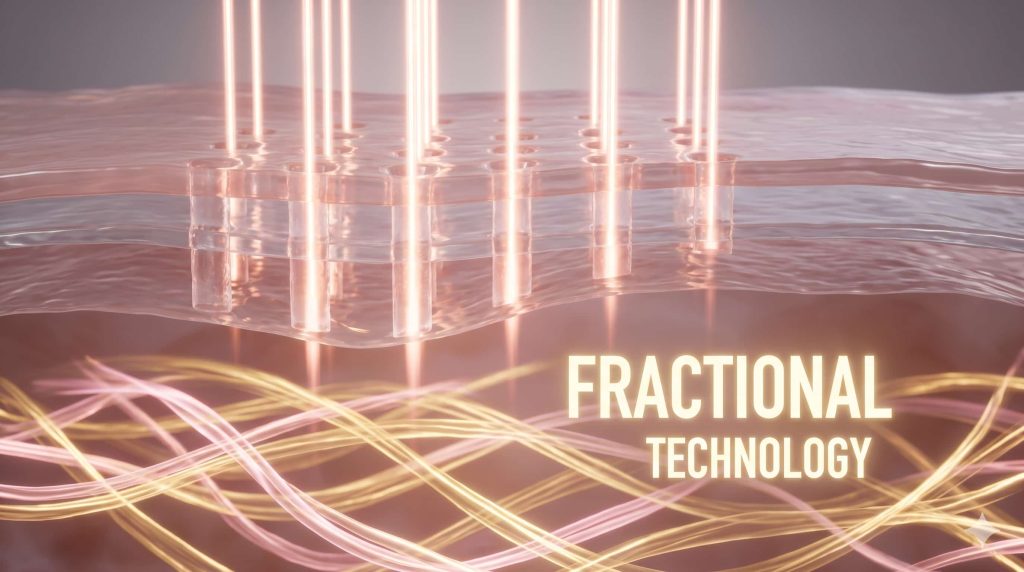
The cornerstone of modern vaginal laser therapy is Fractional Technology. Unlike older, fully ablative lasers that vaporized the entire top layer of tissue (resulting in massive trauma and high infection risk), fractional lasers split the main laser beam into dozens or hundreds of microscopic thermal beams.
When these fractionated beams strike the vaginal wall, they create distinct, columnar Microscopic Thermal Zones (MTZs). These MTZs penetrate deep into the lamina propria (the connective tissue layer beneath the epithelium). The genius of fractional delivery lies in what it leaves behind: intact, completely healthy, and undamaged tissue surrounding each microscopic thermal column.
These intact “mucosal bridges” serve as a vast reservoir of healthy stem cells and fibroblasts. Because the overall thermal damage is mathematically calculated and restricted to a fraction of the total surface area (usually between 5% and 20%), the intact tissue rapidly initiates a healing response, rushing growth factors to the adjacent MTZs. This results in extraordinarily fast healing times—often within 48 to 72 hours—while still delivering enough deep thermal energy to force the tissue to remodel. It is controlled, micro-ablation engineered for maximum biological stimulation with minimal clinical downtime.
Triggering Neocollagenesis and Angiogenesis in Vaginal Mucosa
The ultimate goal of the laser energy is not merely to heat the tissue, but to reach a specific thermal threshold (typically between 60°C and 65°C in the submucosa) that triggers two critical biological phenomena: Neocollagenesis and Angiogenesis.
Neocollagenesis: As the thermal energy penetrates the lamina propria, it causes the immediate denaturation (shrinkage) of existing, age-degraded collagen fibers. This provides the immediate, albeit temporary, sensation of tightening. More importantly, the controlled thermal trauma acts as an acute stressor that aggressively stimulates local fibroblasts. Over the ensuing weeks, these activated fibroblasts synthesize massive amounts of new Type I and Type III collagen, along with fresh elastin fibers. This newly formed extracellular matrix fundamentally rebuilds the structural support of the vaginal canal, restoring its elasticity, tensile strength, and natural rugae.
Angiogenesis: Concurrently, the thermal stimulation triggers the release of Vascular Endothelial Growth Factor (VEGF), leading to angiogenesis—the formation of new microscopic blood vessels. A revitalized vascular network dramatically increases local blood flow, oxygenation, and nutrient delivery to the mucosa. This re-vascularization is the primary mechanism that reverses vaginal dryness. The healthier, well-perfused tissue resumes robust glycogen production, which normalizes the vaginal pH and restores the natural, protective mucosal transudate, effectively reversing the debilitating symptoms of GSM.
The Safety Matrix: Why the Laser Machine Behind Your Treatment Matters Most
Understanding the biology is only half the equation; understanding the hardware is equally critical. The aesthetic market is flooded with devices of varying quality. The safety, comfort, and ultimate clinical outcome of a procedure are entirely dependent on the specific engineering and proprietary technologies embedded within the vaginal rejuvenation laser machine.
CO2 vs. Erbium (Er:YAG) Lasers: Navigating Wavelengths
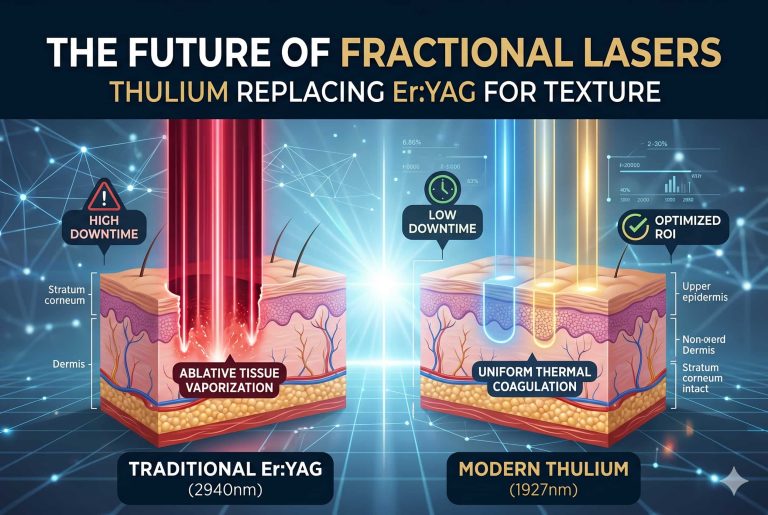
When evaluating clinical options, patients will primarily encounter two distinct laser wavelengths: the Carbon Dioxide (CO2) Laser operating at 10600nm, and the Erbium-doped Yttrium Aluminum Garnet (Er:YAG) Laser operating at 2940nm. Both are highly absorbed by intracellular water, but their vastly different absorption coefficients dictate entirely different clinical behaviors.
| Technical Parameter | CO2 Laser (10,600nm Wavelength) | Erbium:YAG Laser (2,940nm Wavelength) |
| Water Absorption Coefficient | High | Extremely High (approx. 10-15x higher than CO2) |
| Primary Tissue Interaction | Moderate ablation with a wide, deep zone of residual thermal coagulation (heating). | Precise, superficial ablation with very minimal residual thermal damage. |
| Clinical Mechanism | Deep heat penetrates the lamina propria, maximizing long-term collagen remodeling. | “Cold ablation” vaporizes superficial layers efficiently, ideal for surface mucosal resurfacing. |
| Ideal Patient Indication | Patients with severe laxity, advanced GSM, or structural SUI requiring deep tissue tightening. | Patients primarily suffering from superficial dryness or mild GSM seeking a completely painless option. |
| Recovery & Downtime | 3 to 7 days of mild discharge and pelvic rest. | 1 to 3 days of minimal discharge; exceptionally fast epithelialization. |
A reputable clinic utilizing technology from a premier aesthetic laser supplier will clearly explain which wavelength their device utilizes and justify why it is the correct biophysical match for your specific anatomical severity.
The Critical Role of 360-Degree Probes and Uniform Energy Delivery
The vaginal canal is a complex, cylindrical, and collapsible muscular tube. Delivering therapeutic light to this topography safely requires highly specialized delivery systems. Handpieces and probe design are where premium manufacturers drastically separate themselves from inferior replicas.
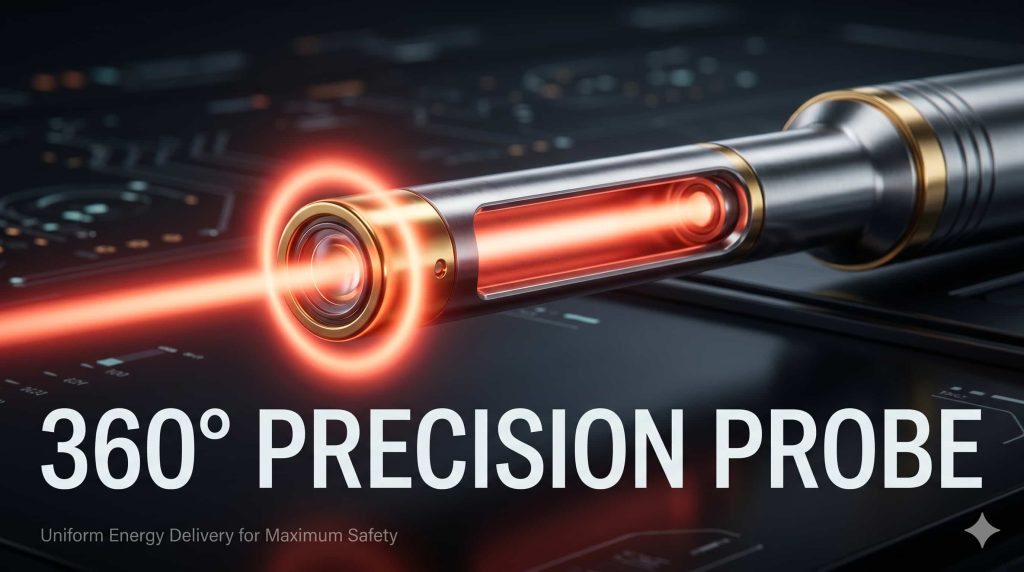
High-end systems utilize precisely engineered 360-degree intravaginal probes. These probes feature gold-plated conical reflectors or advanced optical lenses positioned at the tip, which fracture and refract the laser beam in a perfect 360-degree halo.
Furthermore, premium devices integrate automated stepping motors within the handpiece. Instead of relying on the practitioner’s manual speed to withdraw the probe, the internal motor automatically retracts the optical lens in exact millimeter increments. This automation guarantees Uniform Energy Delivery. If a probe is withdrawn too slowly by a human hand, thermal stacking occurs, risking localized burns and tissue necrosis. If withdrawn too quickly, there are untreated gaps, leading to sub-optimal results. Automated, 360-degree emission ensures that every square millimeter of the vaginal wall receives the exact predetermined fluency, maximizing both the safety profile and the uniformity of the neocollagenesis.
The Real Patient Journey: What to Expect from a “Lunchtime” Procedure
Medical anxiety is a significant barrier for women seeking intimate wellness treatments. Demystifying the actual clinical experience—separating fact from internet fiction—is essential for informed consent. These treatments are routinely referred to as “lunchtime procedures” because their operational footprint is remarkably minimal.
Pain Management: Is Vaginal Laser Treatment Uncomfortable?
The most pervasive fear among prospective patients is the anticipation of severe pain. However, this fear fundamentally misunderstands the neuroanatomy of the internal female reproductive tract.
Unlike the external vulva and introitus, which are densely packed with somatic pain receptors, the upper two-thirds of the internal vaginal canal possesses very limited somatic innervation. It primarily relies on autonomic visceral nerves, which are sensitive to stretch and pressure, but relatively insensitive to temperature and sharp pain.
Consequently, when the fractionated laser energy is delivered deep within the canal, the vast majority of patients report feeling absolutely no pain. Instead, the sensation is universally described as a mild, entirely tolerable internal warmth or a slight vibration as the probe rotates. For the treatment of the external introitus or labia (where pain receptors are abundant), clinics will routinely apply a high-strength topical anesthetic cream 20 to 30 minutes prior to the procedure, ensuring the entire experience remains entirely comfortable and devoid of acute distress.
Post-Treatment Care and Realistic Timelines for Results
Proper expectation management regarding the healing timeline is crucial for patient satisfaction. While the laser interaction occurs in minutes, biological remodeling takes months.
Immediate Post-Treatment (Days 1-7):
Patients can typically drive themselves home immediately. The protocol mandates strict pelvic rest for 5 to 7 days—meaning no sexual intercourse, no tampon use, and avoiding heavy lifting or rigorous cardiovascular exercise. Mild to moderate watery discharge, very light spotting, and a sensation of localized warmth or mild cramping (similar to a light menstrual cycle) are normal and expected inflammatory responses indicating that the healing cascade has successfully begun.
The Timeline of Results (Weeks 4-12):
To achieve optimal, lasting structural changes, a standard protocol generally requires a series of 3 sessions, spaced 4 to 6 weeks apart.
- Early indicators (improved lubrication and minor tone enhancement) may be noticed after the first session due to initial tissue contraction and acute inflammation.
- True clinical results (significant reduction in SUI symptoms, robust restoration of mucosal thickness, and normalized pH) are dependent on the maturation of new collagen fibers. Because the human body requires 30 to 90 days to synthesize and cross-link new collagen, the peak therapeutic outcome will not be fully realized until 3 to 4 months following the final treatment session.
Patient Checklist: How to Vet Your Clinic’s Technology and Provider
The democratization of aesthetic technology means that highly powerful medical devices are no longer confined exclusively to major hospitals. While accessibility is positive, it places the burden of due diligence squarely on the patient. To ensure you are receiving a safe, effective treatment rather than an expensive, ineffective light show, you must interrogate the clinic’s technological infrastructure.
Inquiring About FDA Clearances and Medical CE Marks
Regulatory clearance is the absolute baseline for medical safety. You must explicitly ask the clinic if their specific machine holds an FDA 510(k) clearance (if in the US) or a Medical CE mark (if in Europe or global markets) specifically for gynecological indications.
An FDA clearance means the manufacturer has submitted extensive clinical data proving the device is structurally safe, emits the exact wavelengths and energy levels it claims to, and presents no unreasonable risk to the patient. Beware of “med-spas” utilizing generic, unbranded, or cheap imported machines that lack these rigorous regulatory benchmarks. An uncertified machine may suffer from unstable power supplies, leading to sudden, unexpected energy spikes that can cause severe internal mucosal burns and permanent scarring.
Questions to Ask About the Device Manufacturer’s Credentials
Beyond basic certifications, the pedigree of the equipment matters. A premium clinic is entirely transparent about the aesthetic laser supplier they partner with.
When evaluating a clinic, ask: “Which manufacturer makes this device, and what is their background in medical photonics?”
Top-tier suppliers like Cocoon Laser dedicate years to clinical research and development. They do not merely assemble parts; they engineer the core laser cavities, develop proprietary software algorithms for precise pulse control, and mandate rigorous, ongoing training protocols for the practitioners purchasing their machines. A clinic that proudly advertises the brand of their medical equipment is demonstrating a commitment to clinical excellence. By demanding high-quality, reputable technology, you not only safeguard your own intimate health but also drive the entire aesthetic industry toward higher standards of safety, efficacy, and uncompromised biological integrity.
If you need more information, please click “Contact Us”.
If you want to obtain more information, please follow our official website and Facebook.