Erasing the Past: Real Results from an Acne Scar Removal Laser Manufacturer
Executive Summary
Effectively treating atrophic acne scarring requires moving beyond superficial skincare and addressing the structural deficit within the dermis. This clinical guide explores the advanced photonics behind actual skin resurfacing, highlighting how technologies governed by Selective Photothermolysis and the Photoacoustic effect are utilized to trigger neocollagenesis. By understanding the biophysical differences between a fractional CO2 laser machine and a picosecond laser device, patients can align their specific scar morphology with the correct modality. Furthermore, navigating clinical treatments demands an understanding of hardware quality. Recognizing critical safety benchmarks—such as FDA 510(k) clearances, Medical CE marks, uniform beam profiles, and rigorous device calibration from a reputable acne scar removal laser manufacturer like Cocoon Laser—empowers patients to mitigate risks like Post-Inflammatory Hyperpigmentation (PIH) and achieve predictable, medically sound outcomes with manageable downtime.
The Anatomy of Acne Scars: Why Topical Creams Always Fall Short
The aesthetic industry is saturated with over-the-counter serums and creams promising to “erase” acne scars. However, clinical dermatology presents a different reality. True acne scarring is not merely a surface discoloration; it is a profound structural alteration caused by severe tissue inflammation and subsequent collagen destruction.
Decoding Your Scars: Ice Pick, Boxcar, and Rolling Scars
To understand why advanced medical interventions are necessary, one must first classify the morphological structure of atrophic (depressed) scars. Severe cystic acne triggers an intense inflammatory cascade that destroys the extracellular matrix. When the body attempts to heal this void, it often produces disorganized collagen or fails to produce enough, resulting in permanent depressions.
- Ice Pick Scars: These are narrow (usually less than 2mm), sharply demarcated tracts that extend deep into the dermis or subcutaneous tissue. They visually resemble puncture marks from a miniature ice pick and are notoriously resistant to superficial treatments due to their depth.
- Boxcar Scars: Characterized by wider, sharply defined vertical edges, boxcar scars resemble the scars left by chickenpox. They can be shallow or deep, presenting a significant textural irregularity across the cheeks and temples.
- Rolling Scars: These scars create a wave-like, undulating appearance on the skin’s surface. They occur when fibrous bands of tissue develop between the skin and the subcutaneous tissue below, physically tethering the epidermis downward.
The Dermis Barrier: The Limitation of Skincare Products
The fundamental limitation of topical skincare lies in human anatomy. The skin’s outermost layer, the stratum corneum (part of the Epidermis), is an exceptionally effective biological shield designed to keep foreign molecules out.
Active ingredients in topical creams—such as peptides or hyaluronic acid—are generally too large (exceeding the 500 Dalton rule for skin penetration) to reach the Dermis, where the actual scar tissue resides. Even if a fraction of an active ingredient penetrates, it lacks the physical kinetic energy required to break down rigid fibrous tethering or stimulate the massive fibroblast activity necessary to fill a dermal void. Skincare is vital for maintaining epidermal barrier health, but treating atrophic scars requires high-energy physical modalities capable of precise dermal remodeling.
The Science of Resurfacing: How Advanced Lasers Rebuild Your Skin
Modern aesthetic medicine relies on directed energy to transform scar tissue. Medical lasers do not simply “burn” the skin away; they utilize specific wavelengths of light to create controlled thermal or acoustic injuries that force the body’s immune system to rebuild the targeted area with fresh, organized collagen.
Fractional CO2 Lasers: The Gold Standard for Deep Textural Remodeling
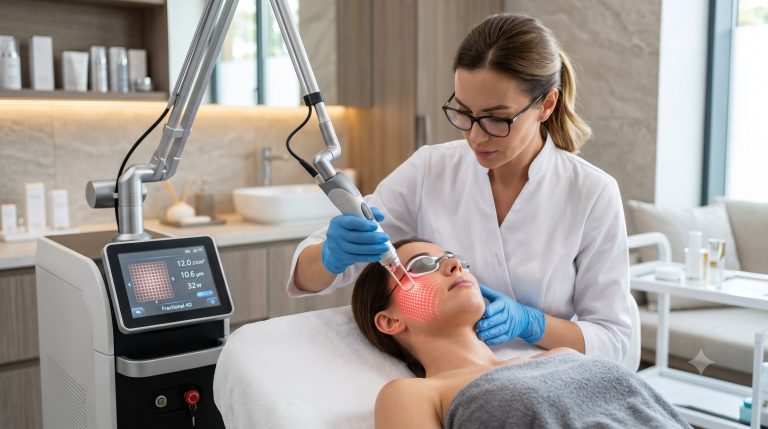
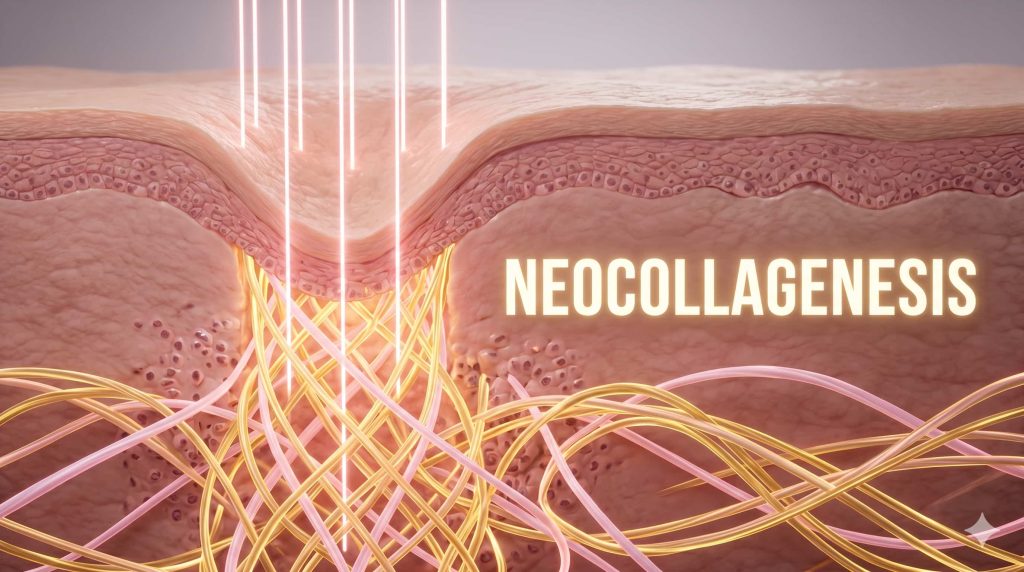
For moderate to severe atrophic scarring, the fractional CO2 laser machine remains the undisputed clinical gold standard. Operating at a wavelength of 10,600nm, the CO2 laser is highly absorbed by the water inside human tissue.
Instead of ablating the entire skin surface, fractional technology splits the laser beam into thousands of microscopic columns known as Microscopic Thermal Zones (MTZs). These columns precisely vaporize the targeted scar tissue deep into the dermis while leaving the surrounding tissue entirely intact.
This mechanism achieves two critical endpoints:
- Immediate Tissue Contraction: The thermal energy causes existing, disorganized collagen fibers to instantly denature and contract, physically shrinking the scar.
- Fibroblast Activation: The intact tissue surrounding each MTZ acts as a reservoir for rapid healing, aggressively deploying fibroblasts to the injury site to synthesize new collagen. Because the thermal effect is profound, the resulting neocollagenesis is robust enough to elevate deep boxcar and rolling scars over time.
Picosecond Lasers with MLA: Tackling Pigmentation and Shallow Scars
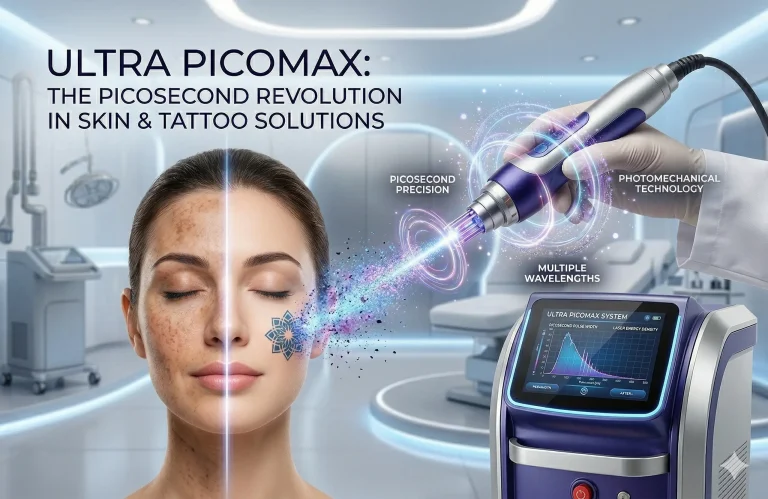
For patients with shallower scars, significant Post-Inflammatory Erythema (PIE), or those who cannot afford the downtime associated with ablative lasers, the picosecond laser device equipped with a Micro Lens Array (MLA) offers a revolutionary alternative.
Operating in trillionths of a second, picosecond lasers generate energy so rapidly that they bypass thermal heating and create a purely mechanical impact known as the Photoacoustic effect. When passed through an MLA, the laser beam is fractionated and concentrated into high-intensity micro-spots beneath the surface of the skin.
This intense acoustic pressure leads to Laser-Induced Optical Breakdown (LIOB). LIOB creates microscopic intra-epidermal and dermal vacuoles (bubbles) without physically breaking the outermost layer of the skin. This non-ablative process stimulates collagen production from within, significantly improving skin texture and shattering residual melanin (pigmentation), all with minimal to zero epidermal downtime.
| Clinical Parameter | Fractional CO2 Laser (Ablative) | Picosecond Laser with MLA (Non-Ablative) |
| Wavelength | 10,600nm | Typically 1064nm, 755nm, or 532nm |
| Primary Mechanism | Photothermal (Vaporization & Heating) | Photoacoustic (Mechanical LIOB) |
| Target Scar Type | Severe, deep Boxcar and Rolling scars | Shallow scars, enlarged pores, severe PIH |
| Epidermal Barrier | Partially compromised (Micro-wounds) | Remains completely intact |
| Expected Downtime | 5 to 10 days (Crusting, swelling) | 1 to 3 days (Mild redness, petechiae) |
Beyond the Beam: Why the Machine’s Manufacturer Dictates Your Safety
Understanding the biological mechanism is only half the battle. The actual clinical outcome is heavily dictated by the hardware delivering the energy. As a premier aesthetic laser supplier, we recognize that the engineering tolerances of the machine are what separate a transformative treatment from a dangerous adverse event.
Precision Beam Quality and Thermal Control
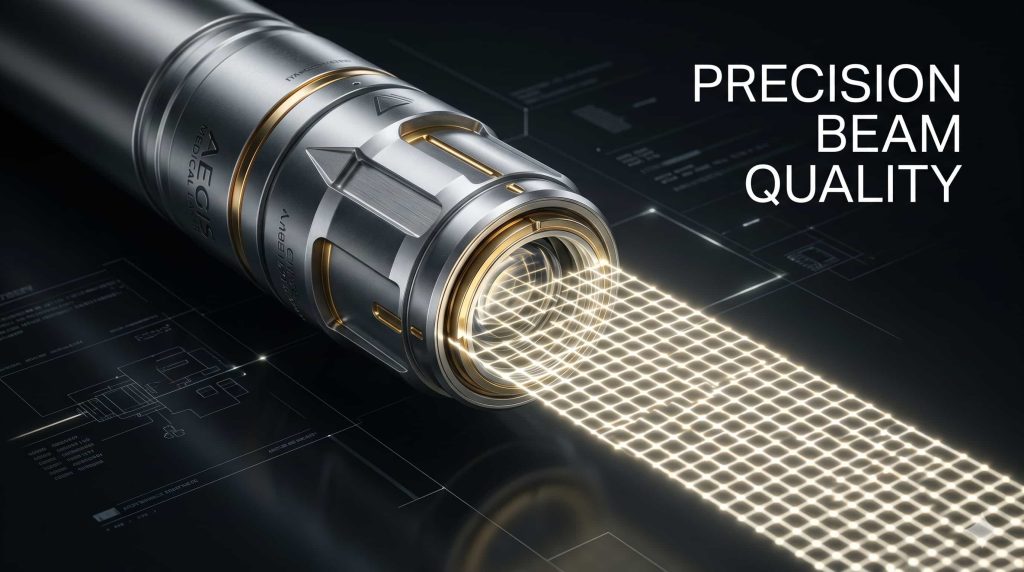
Not all laser beams are created equal. Inferior, poorly manufactured devices often produce a “Gaussian” beam profile with intense, uncontrolled “hot spots” in the center and weak edges. When treating delicate facial tissue, these hot spots cause unpredictable Residual Thermal Damage (RTD), drastically increasing the risk of severe burns, blistering, and prolonged erythema.
A top-tier acne scar removal laser manufacturer engineers their optical cavities to produce a “Top-Hat” beam profile. This ensures that the energy is distributed perfectly evenly across the entire targeted area. Furthermore, premium devices integrate highly advanced TEC Cooling (Thermoelectric Cooling) systems into their handpieces, actively extracting heat from the epidermis while the deep dermis is treated, maintaining an uncompromising safety margin.
Mitigating PIH (Post-Inflammatory Hyperpigmentation) in Darker Skin Tones
One of the most significant complications in laser dermatology is Post-Inflammatory Hyperpigmentation (PIH), particularly for patients with darker skin tones (Fitzpatrick Scale Types IV-VI). Melanin-rich skin is highly reactive to thermal trauma.
Substandard machines lack the micro-processing power to precisely control pulse durations. If a laser pulse lingers on the skin for even a fraction of a millisecond too long, the excess heat will trigger melanocytes to overproduce pigment, leaving the patient with dark patches that are often worse than the original scar. High-end devices manufactured by industry leaders like Cocoon Laser feature ultra-precise pulse control and energy calibration. By delivering exact, consistent energy parameters, the practitioner can bypass epidermal melanin and target the dermal scarring without triggering the inflammatory hyperpigmentation cascade.
The Journey to Clear Skin: Setting Realistic Timelines and Expectations
Patients seeking real results must abandon the marketing myth of the “overnight cure.” Structural skin remodeling is a biological process bound by the laws of human cellular regeneration. Setting medically accurate expectations is crucial for a successful patient journey.
The 90-Day Rule of Neocollagenesis
When laser energy strikes the dermis, it initiates a complex wound-healing cascade. The initial tightening observed immediately post-treatment is simply tissue dehydration and collagen denaturation—it is not the final result.
True structural improvement is governed by the timeline of neocollagenesis:
- Inflammatory Phase (Days 1-5): The immune system clears out the vaporized cellular debris.
- Proliferative Phase (Days 5-21): Fibroblasts begin migrating to the treatment zones, laying down preliminary Type III collagen.
- Remodeling Phase (Days 21-90+): The temporary Type III collagen is gradually replaced by stronger, highly organized Type I collagen.
Because of this biological imperative, the ultimate, finalized results of an acne scar laser session will not be visible until 3 to 6 months post-treatment. It is a journey of incremental, cumulative improvement.
Navigating the Recovery: Downtime, Redness, and Aftercare
Downtime is not a complication; it is a necessary physiological response to ablative or high-energy treatments.
- What to Expect: Following a fractional CO2 treatment, the skin will exhibit significant erythema (redness) and edema (swelling) for 48 hours. By day 3, microscopic crusts (resembling a grid pattern) will form. These must be allowed to slough off naturally by day 5 to 7.
- Critical Aftercare: During this window, the epidermal barrier is vulnerable. Strict adherence to a sterile protocol is mandatory. Patients must use medical-grade barrier repair ointments, avoid all active chemical exfoliants (like Retinol or AHAs), and apply rigorous, broad-spectrum UV protection to prevent UV-induced PIH on the freshly healing tissue.
The Patient’s Checklist: How to Vet Your Clinic’s Acne Scar Technology
As an educated consumer, you hold the power to dictate the quality of your care. Before consenting to any laser procedure, you must look beyond the clinic’s marketing materials and evaluate the actual hardware they are utilizing.
Verifying FDA Clearances and Medical CE Certifications
Regulatory clearance is the absolute baseline of medical safety. You must explicitly verify that the clinic’s laser holds an FDA 510(k) clearance (for the US market) or a Medical CE mark (for the European market) specifically indicated for acne scar revision.
These certifications indicate that the device manufacturer has submitted exhaustive clinical data proving the machine emits the exact energy levels it claims to, without presenting unreasonable risks to human tissue. Generic, unbranded, or unregulated devices sourced from unreliable vendors present an unacceptable risk to your safety.
Asking the Right Questions About Device Maintenance and Calibrations
A laser is only as safe as its last calibration. Medical lasers utilize flashlamps, RF tubes, and complex optical lenses that degrade over time.
When consulting with a clinic, ask them about their maintenance protocols:
- “How frequently is your machine calibrated?” A professional clinic ensures their device outputs the exact energy displayed on the screen.
- “Do you monitor the shots count?” Consumable parts like flashlamps have a strict lifespan. Operating a machine beyond its recommended shots count leads to unstable energy output.
A clinic that invests in hardware from a leading B2B supplier like Cocoon Laser benefits from continuous clinical training, strict maintenance schedules, and robust engineering support. By demanding transparency about the technology used on your skin, you actively protect yourself from substandard care while ensuring that your path to scar-free skin is paved with authentic, medically validated science.
If you need more information, please click “Contact Us”.
If you want to obtain more information, please follow our official website and Facebook.