Medical Aesthetic Laser Technology Glossary: Complete Guide
Medical aesthetic laser technology includes a wide range of energy-based systems used for skin rejuvenation, hair reduction, pigmentation treatment, resurfacing, and body contouring applications.
As laser technology continues to evolve, understanding key terms such as diode laser, picosecond laser, CO2 laser, wavelength, pulse duration, and energy delivery is essential for aesthetic clinics and medical professionals evaluating professional equipment.
Quick Answer
A medical aesthetic laser technology glossary explains the essential terms, technologies, wavelengths, and treatment concepts used in professional aesthetic laser systems.
Common technologies include diode lasers for hair reduction, CO2 lasers for skin resurfacing, picosecond lasers for pigmentation and tattoo removal, thulium 1927nm lasers for fractional resurfacing, and IPL systems for broad-spectrum light treatments.

What Is Medical Aesthetic Laser Technology?
Medical aesthetic laser technology refers to professional laser and light-based systems designed for cosmetic and dermatological applications.
Unlike general light sources, medical aesthetic lasers use controlled wavelengths and energy parameters to interact with specific targets in the skin.
Depending on the technology, the target may include:
- Hair follicles
- Melanin pigments
- Tattoo ink particles
- Water molecules in skin tissue
- Collagen-related structures
Key Laser Technology Terms
Laser Wavelength
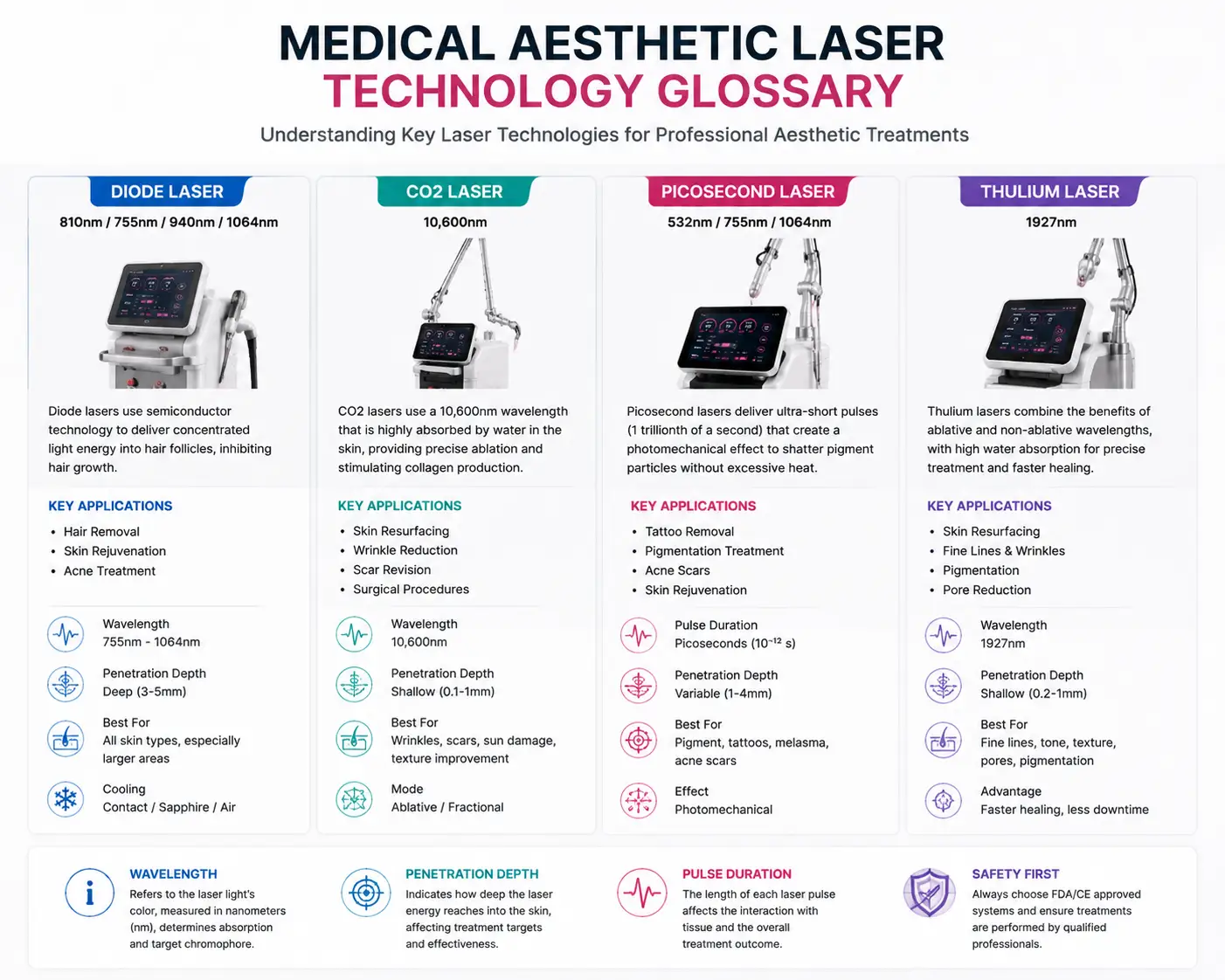
A laser wavelength refers to the specific measurement of light energy produced by a laser system.
Different wavelengths penetrate the skin at different depths and are absorbed by different targets.
| Wavelength | Common Technology | Main Applications |
|---|---|---|
| 755nm | Alexandrite Laser | Hair reduction and pigmentation |
| 808nm | Diode Laser | Professional hair reduction |
| 1064nm | Nd:YAG Laser | Deep pigment and vascular applications |
| 1927nm | Thulium Laser | Fractional skin resurfacing |
Pulse Duration
Pulse duration describes how long laser energy is delivered during each pulse.
Different pulse durations create different interactions with tissue.
- Nanosecond pulses are commonly associated with traditional Q-switched laser systems.
- Picosecond pulses deliver energy within trillionths of a second for advanced pigment treatments.
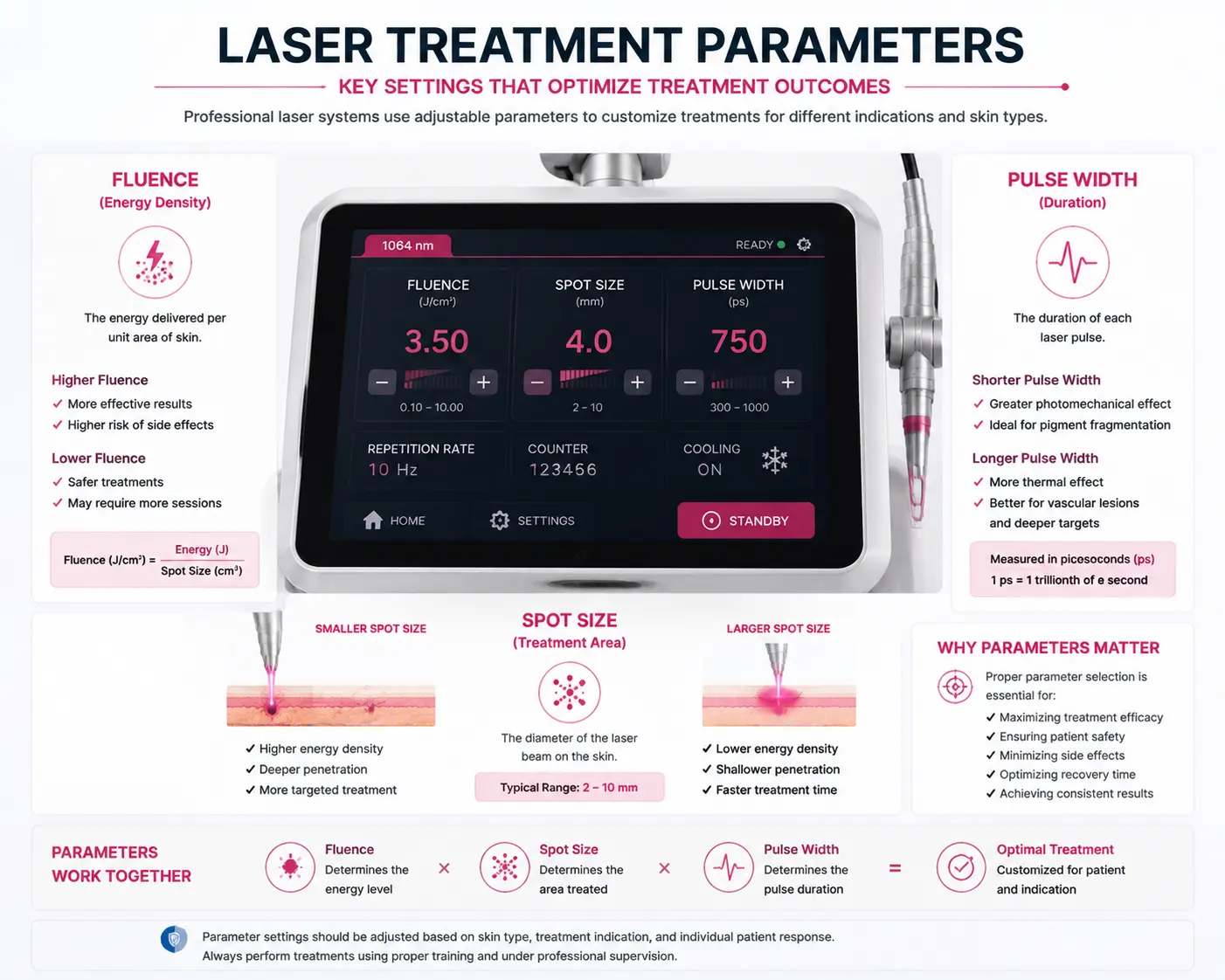
Energy Density (Fluence)
Energy density, also called fluence, refers to the amount of laser energy delivered over a specific area.
Professional systems allow practitioners to adjust energy parameters according to treatment goals and patient conditions.
Spot Size
Spot size refers to the diameter of the laser treatment area delivered by the handpiece.
A larger spot size can improve treatment efficiency for larger areas, while smaller spot sizes may provide more precision.
Major Medical Aesthetic Laser Technologies
Diode Laser Technology
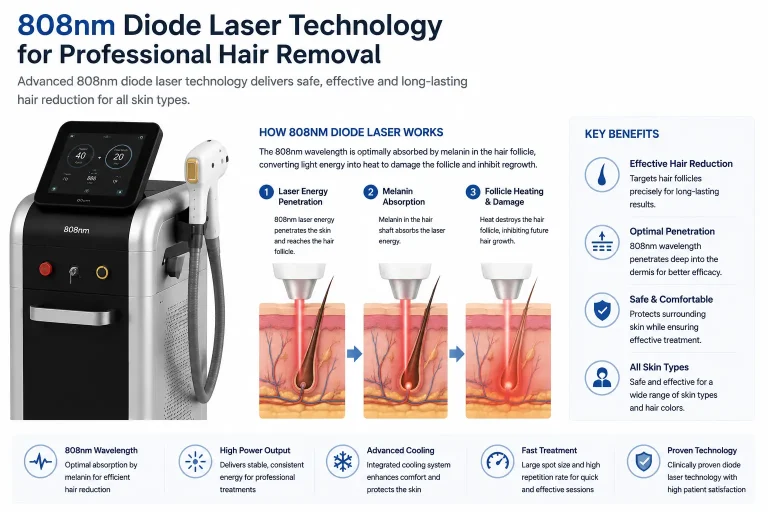
Diode laser technology is one of the most widely used platforms for professional hair reduction treatments.
Common diode laser wavelengths include 755nm, 808nm, 810nm, 940nm, and 1064nm.
The technology works through selective photothermolysis, where laser energy is absorbed by melanin in hair follicles.
CO2 Laser Technology
CO2 laser technology is an ablative laser platform commonly used for advanced skin resurfacing.
Fractional CO2 lasers create controlled microthermal zones in the skin, supporting skin renewal and collagen remodeling processes.
Picosecond Laser Technology
Picosecond laser technology uses ultra-short pulses measured in trillionths of a second.
The rapid energy delivery creates a photomechanical effect that helps break pigment particles into smaller fragments.
Common applications include:
- Tattoo removal
- Pigmentation treatment
- Skin rejuvenation
Thulium 1927nm Laser Technology
Thulium 1927nm laser technology is a fractional resurfacing platform designed to target water absorption in skin tissue.
It is commonly used for:
- Skin texture improvement
- Pigmentation management
- Skin rejuvenation treatments
Light-Based Aesthetic Technologies
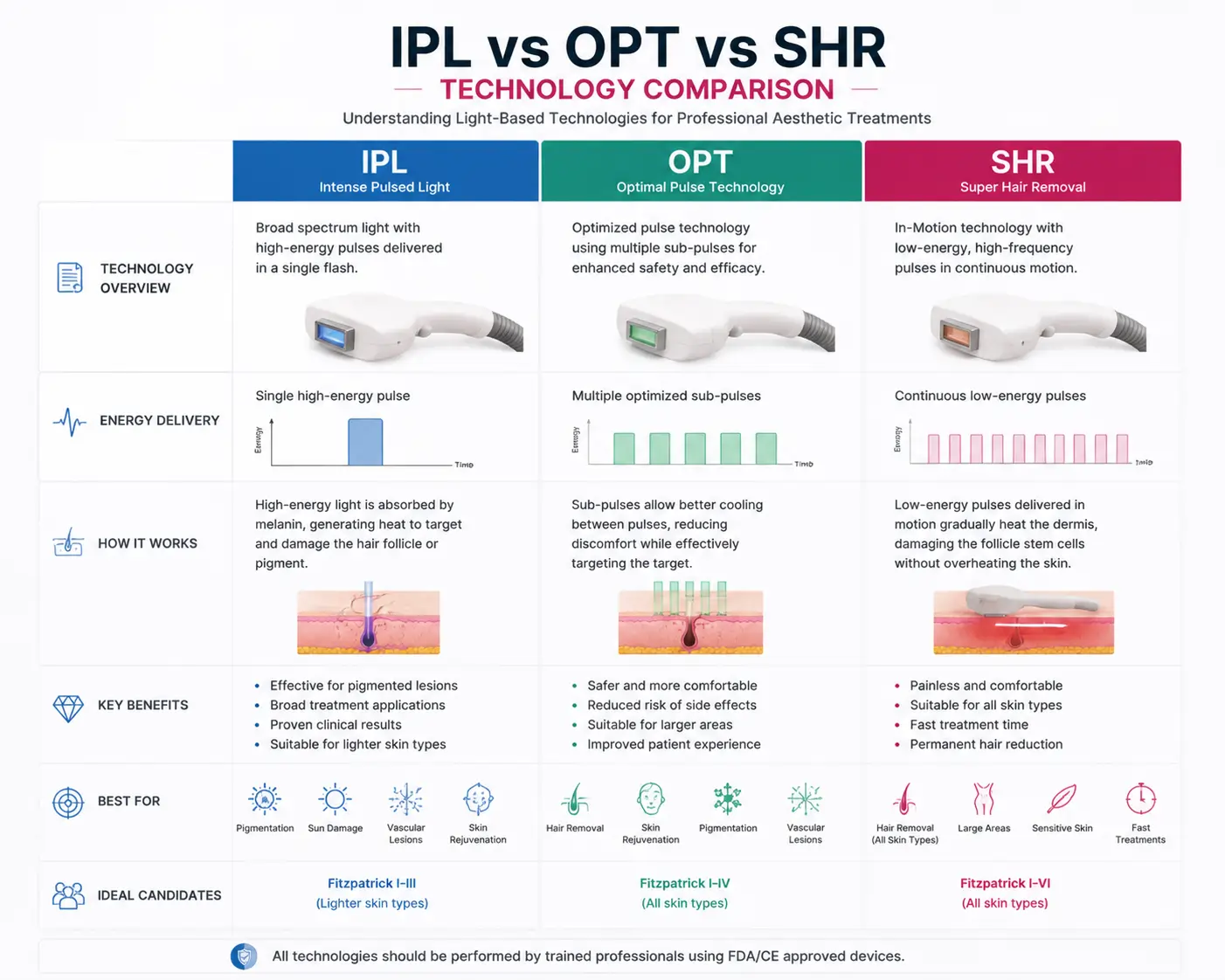
In addition to laser systems, modern aesthetic clinics also use various light-based technologies for hair reduction, pigmentation treatment, skin rejuvenation, and body contouring.
Understanding the differences between these technologies helps clinics select suitable platforms based on treatment goals and patient requirements.
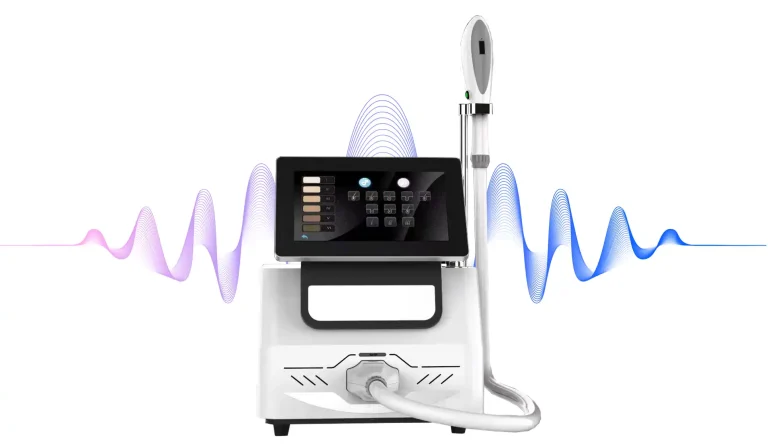
IPL (Intense Pulsed Light) Technology
IPL, or Intense Pulsed Light, is a light-based aesthetic technology that uses a broad spectrum of wavelengths rather than a single laser wavelength.
Unlike laser systems that deliver specific wavelength energy, IPL emits multiple wavelengths that can be filtered for different applications.
Common IPL applications include:
- Hair reduction
- Pigmentation treatment
- Skin rejuvenation
- Vascular appearance improvement
OPT Technology (Optimal Pulse Technology)
OPT Technology is an advanced IPL energy delivery method designed to improve pulse consistency and treatment control.
Traditional IPL systems may experience energy fluctuation during pulse delivery. OPT technology focuses on maintaining more balanced energy distribution throughout the pulse.
Potential advantages include:
- More consistent energy output
- Improved treatment flexibility
- Enhanced parameter control
SHR Technology (Super Hair Removal)
SHR, or Super Hair Removal, is a hair reduction technology that uses repeated low-fluence energy delivery at high repetition rates.
Instead of delivering high energy in a single pulse, SHR gradually accumulates heat within the hair follicle.
SHR technology is commonly associated with:
- Fast treatment speed
- Large treatment areas
- Improved patient comfort
Energy-Based Skin Rejuvenation Technologies
HIFU Technology (High-Intensity Focused Ultrasound)
HIFU, or High-Intensity Focused Ultrasound, is a non-invasive aesthetic technology that uses focused ultrasound energy to create thermal effects at specific depths beneath the skin.
Unlike laser technologies that use light energy, HIFU uses acoustic energy to target deeper tissue layers.
Common HIFU applications include:
- Skin tightening
- Facial contouring
- Non-invasive lifting treatments
RF Technology (Radio Frequency)
Radio Frequency (RF) technology uses electromagnetic energy to generate controlled thermal effects in tissue.
RF systems are commonly used in aesthetic treatments focused on:
- Skin tightening
- Collagen stimulation
- Body contouring
Ultrasound Aesthetic Technology
Ultrasound-based aesthetic systems use acoustic waves to deliver energy into targeted tissue layers.
Compared with light-based technologies, ultrasound systems provide a different approach to non-invasive aesthetic treatments.
Body Contouring Technologies
Non-Surgical Body Contouring
Non-surgical body contouring refers to aesthetic treatments designed to improve body appearance without traditional surgery.
Common technologies include:
- HIFU body contouring
- Radio frequency systems
- Cryolipolysis
- Ultrasound-based platforms
Cryolipolysis Technology
Cryolipolysis is a body contouring technology that uses controlled cooling to target fat cells.
Unlike laser and light-based systems, cryolipolysis works through temperature-based energy control.
Laser Treatment Concepts
Selective Photothermolysis
Selective photothermolysis is one of the fundamental concepts behind many aesthetic laser treatments.
The principle describes how specific wavelengths of light can selectively target certain structures while minimizing effects on surrounding tissue.
The three key factors include:
- Wavelength selection
- Pulse duration
- Energy level
Chromophore
A chromophore is a target substance that absorbs laser or light energy.
Common chromophores in aesthetic treatments include:
- Melanin
- Hemoglobin
- Water
Thermal Relaxation Time
Thermal relaxation time refers to the time required for a target structure to lose a significant amount of absorbed heat.
Matching pulse duration with thermal relaxation time helps achieve more controlled treatment effects.
Laser Safety and Clinical Terms
Professional medical aesthetic laser systems require a strong understanding of safety principles, skin characteristics, and treatment parameters.
These clinical terms help practitioners understand how laser energy interacts with different skin types and how treatment settings are selected.
Fitzpatrick Skin Types
The Fitzpatrick Skin Type Classification is a commonly used system that categorizes skin based on its response to ultraviolet exposure and melanin characteristics.
In aesthetic laser treatments, understanding skin type helps professionals select appropriate wavelengths and energy parameters.
| Skin Type | Characteristics |
|---|---|
| Type I | Very light skin, usually burns easily |
| Type II | Light skin with limited tanning ability |
| Type III | Medium skin with moderate tanning response |
| Type IV | Olive or light brown skin |
| Type V | Brown skin with higher melanin content |
| Type VI | Deeply pigmented skin |
Modern laser platforms often include adjustable parameters and multiple wavelength options to support different skin types and treatment applications.
Melanin Absorption
Melanin is one of the most important chromophores in aesthetic laser treatments.
Laser hair reduction technologies such as diode lasers work by targeting melanin inside hair follicles.
The wavelength selection affects how strongly laser energy is absorbed by melanin and how deeply the energy penetrates into tissue.
Water Absorption
Water is another important chromophore in aesthetic laser technology.
Some laser systems, including CO2 lasers and thulium 1927nm lasers, interact primarily with water contained in skin tissue.
This interaction allows controlled treatment of skin surfaces and supports resurfacing applications.
Laser Treatment Parameters
Fluence
Fluence refers to the amount of laser energy delivered per unit area, usually measured in joules per square centimeter (J/cm²).
Adjusting fluence allows practitioners to control treatment intensity according to the application and patient characteristics.
Repetition Rate
Repetition rate refers to how frequently a laser system delivers pulses, usually measured in Hertz (Hz).
A higher repetition rate can improve treatment speed, especially when treating larger areas.
Spot Size
Spot size refers to the diameter of the laser beam delivered through the treatment handpiece.
Different spot sizes provide different advantages:
- Large spot sizes can improve efficiency for larger treatment areas.
- Smaller spot sizes allow more precise energy delivery.
Pulse Width
Pulse width describes the duration of each laser pulse.
The relationship between pulse width and tissue response is an important factor in professional laser treatment design.
Examples include:
- Picosecond pulses for advanced pigment fragmentation.
- Longer pulses for specific thermal treatment applications.
Laser Cooling Systems
Skin Cooling Technology
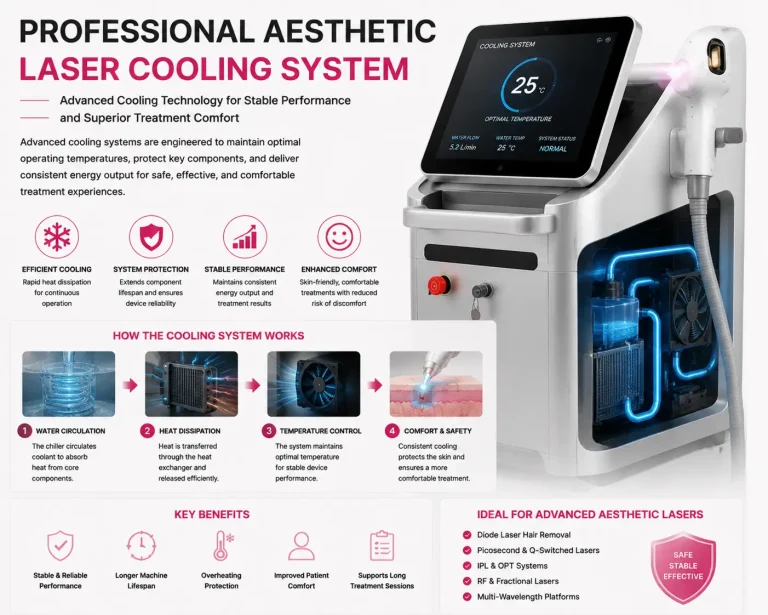
Cooling technology is an essential component of modern aesthetic laser systems.
Cooling systems help improve patient comfort and protect surrounding skin during energy delivery.
Common cooling technologies include:
- Sapphire contact cooling
- Water cooling systems
- Air cooling systems
- Integrated handpiece cooling
Sapphire Cooling
Sapphire cooling is commonly used in diode laser hair reduction systems.
A sapphire window in the handpiece helps transfer cooling directly to the skin surface during treatment.
Benefits may include:
- Improved patient comfort
- Reduced surface temperature
- Better treatment experience
Ablative vs Non-Ablative Laser Technology
Ablative Laser
Ablative lasers remove controlled layers of skin tissue to stimulate skin renewal.
Common examples include:
- Fractional CO2 Laser
- Er:YAG Laser
Non-Ablative Laser
Non-ablative lasers heat targeted structures beneath or within the skin without removing the surface layer.
Examples include:
- Diode Laser
- Picosecond Laser
- Nd:YAG Laser
Fractional Laser Technology
Fractional laser technology delivers energy into microscopic treatment zones while leaving surrounding tissue untreated.
This approach allows controlled skin remodeling with potentially shorter recovery compared with traditional full-field ablative treatments.
Fractional technology is used in several aesthetic laser platforms, including:
- Fractional CO2 Laser
- Fractional Thulium 1927nm Laser
Professional Aesthetic Laser Equipment Terms
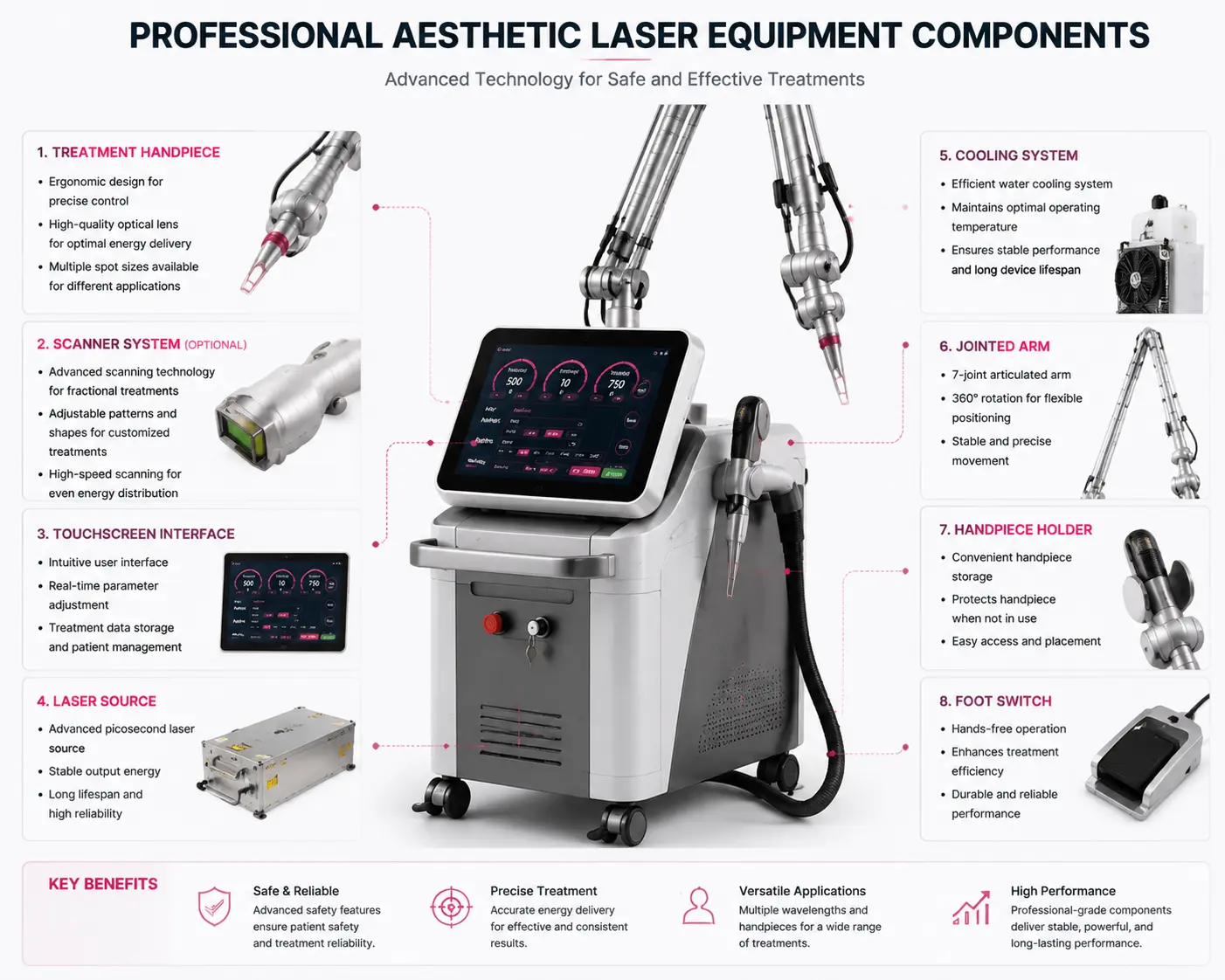
When evaluating professional aesthetic laser equipment, clinics and distributors often consider not only the laser technology itself but also system components, manufacturing standards, certifications, and supplier capabilities.
Understanding these equipment-related terms helps buyers make informed decisions when selecting medical aesthetic laser systems.
Laser Handpiece
A laser handpiece is the treatment component that delivers laser energy from the main system to the target area.
Different aesthetic laser platforms use specialized handpieces depending on the treatment application.
Examples include:
- Diode laser hair reduction handpieces
- Fractional CO2 laser scanning handpieces
- Picosecond laser treatment handpieces
- IPL light treatment applicators
Laser Scanner
A laser scanner is a component used in some fractional laser systems to distribute laser energy across the treatment area.
Instead of delivering energy to a single point, scanning systems can create controlled treatment patterns.
Laser scanners are commonly used in:
- Fractional CO2 laser systems
- Fractional resurfacing platforms
Fractional Mode
Fractional mode refers to a treatment method where laser energy is delivered into microscopic treatment zones rather than covering the entire skin surface.
The untreated surrounding tissue helps support the skin recovery process.
Fractional technology is commonly used for:
- Skin resurfacing
- Texture improvement
- Collagen remodeling applications
Laser Cartridge
A laser cartridge refers to a replaceable component used in certain aesthetic devices.
Depending on the system design, cartridges may contain treatment modules, energy delivery components, or consumable parts.
Laser Generator
The laser generator is the core component responsible for producing laser energy.
The quality and stability of the laser source directly influence system performance and treatment consistency.
Types of Professional Aesthetic Laser Systems
Alexandrite Laser
Alexandrite lasers commonly operate at a wavelength of 755nm.
The wavelength has strong melanin absorption characteristics and is widely associated with hair reduction and pigmentation-related applications.
Nd:YAG Laser
Nd:YAG lasers commonly use a 1064nm wavelength.
Because of its deeper penetration and lower melanin absorption compared with shorter wavelengths, Nd:YAG technology is often considered for specific skin types and applications.
Q-Switched Laser
Q-switched laser technology produces high-energy pulses with very short pulse durations.
Traditional Q-switched systems are commonly associated with:
- Tattoo removal
- Pigmentation treatment
- Melanin-related applications
Picosecond Laser System
A picosecond laser system delivers energy in extremely short pulses measured in trillionths of a second.
Compared with traditional nanosecond systems, picosecond technology creates a stronger photomechanical effect for certain pigment applications.
Diode Laser System
A diode laser system uses semiconductor laser technology to generate specific wavelengths commonly used in professional hair reduction treatments.
Popular diode laser wavelengths include:
- 755nm
- 808nm
- 810nm
- 940nm
- 1064nm
Laser Manufacturing Terms
Medical Aesthetic Laser Manufacturer
A medical aesthetic laser manufacturer designs, develops, and produces professional laser systems for clinics, medical professionals, and distributors.
Manufacturers are typically responsible for:
- Laser system development
- Quality control
- Product testing
- Technical support
OEM (Original Equipment Manufacturer)
OEM refers to manufacturing products according to another company’s specifications or branding requirements.
In the aesthetic equipment industry, OEM services may include:
- Custom branding
- Logo customization
- Product appearance modifications
- Packaging customization
ODM (Original Design Manufacturer)
ODM refers to a manufacturer that provides both product design and manufacturing capabilities.
Companies working with ODM suppliers may select existing technologies while customizing product features or configurations.
Laser Equipment Supplier
A laser equipment supplier provides professional aesthetic devices, technical support, training resources, and after-sales services for clinics and distributors.
Medical Device Certifications and Quality Standards
CE Certification
CE marking indicates that a product complies with applicable European Union requirements.
For medical aesthetic equipment sold in European markets, CE compliance is an important consideration for distributors and professional buyers.
ISO 13485
ISO 13485 is an international quality management standard specifically designed for medical device manufacturers.
The standard focuses on:
- Quality management systems
- Manufacturing processes
- Risk management
- Product consistency
Medical Device Quality Control
Professional aesthetic laser manufacturers implement quality control procedures to ensure system reliability, safety, and consistent performance.
How to Choose a Professional Aesthetic Laser Supplier
When selecting an aesthetic laser supplier, clinics and distributors should evaluate several factors:
- Technology capability
- Product certifications
- Manufacturing experience
- Technical support
- Warranty and after-sales service
- OEM/ODM capabilities
A reliable supplier should provide not only equipment but also technical knowledge and long-term support for professional aesthetic businesses.