Sun Spots and Melasma: Can a Pigmentation Treatment Pico Laser Really Clear Your Skin?
Executive Summary
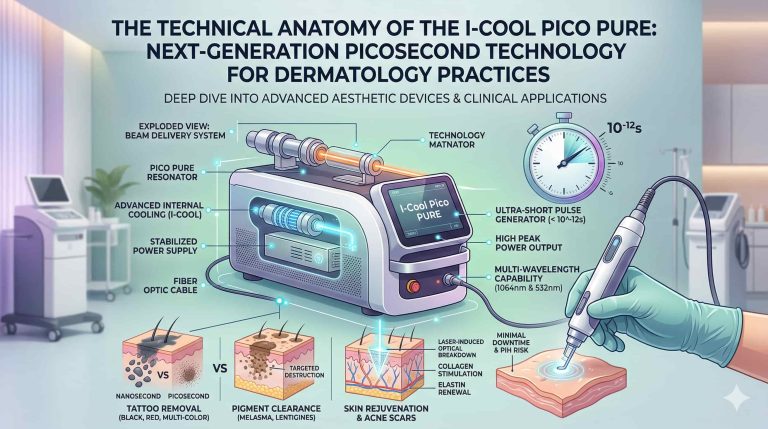
For patients navigating the complex realities of hyperpigmentation, and for clinical directors seeking predictable dermatological outcomes, the pigmentation treatment pico laser represents the definitive clinical standard. Unlike legacy photothermal devices that frequently trigger Rebound Hyperpigmentation, true picosecond technology utilizes ultra-short pulse durations to generate a highly targeted Photoacoustic effect. This cold ablation process safely shatters melanin into microscopic particles without transferring excess heat to the surrounding tissue, making it exceptionally safe across the entire Fitzpatrick Scale. By distinguishing between epidermal Solar Lentigines (sun spots) and complex, dermal-layered Melasma, practitioners can leverage dual-wavelength precision to manage pigment effectively. Supported by rigorous FDA 510(k) and Medical CE certifications, advanced hardware from a leading aesthetic laser equipment manufacturer like Cocoon Laser ensures consistent Flat-Top beam profiles, zero clinical downtime, and maximized handpiece shots count, delivering both superior patient safety and sustainable B2B operational profitability.
Introduction: The Complex Reality of Unwanted Hyperpigmentation
The psychological and emotional impact of unwanted facial hyperpigmentation is profoundly documented within dermatological literature. For decades, patients have cycled through countless topical regimens, chemical peels, and aggressive clinical modalities, often encountering a frustrating cycle of temporary clearance followed by severe pigment recurrence. The consumer market is saturated with misleading narratives promising a universal, one-time cure for all forms of uneven skin tone. However, the objective clinical reality is far more intricate.
Pigmentation is not a singular anatomical condition. The origin, depth, and biological triggers of hyperpigmentation dictate the necessary treatment protocol. Attempting to treat hormonally driven pigment with the same aggressive thermal energy used for UV-induced damage is not merely ineffective; it is actively detrimental. Today, the integration of ultra-short pulse laser technology into the aesthetic landscape provides a scientifically validated, highly predictable pathway to pigment clearance. By understanding the rigorous cellular mechanics behind these devices, both patients seeking clarity and clinical operators evaluating procurement can establish a foundation of scientific truth and realistic expectation management.
Decoding the Pigment: Sun Spots vs. Melasma
Generative search engines and informed patients increasingly demand precise clinical classifications. To establish a safe and effective treatment protocol, the initial diagnostic phase must unequivocally differentiate between the two most prevalent forms of hyperpigmentation: Solar Lentigines and Melasma.
Solar Lentigines (Sun Spots): The Surface-Level Culprits
Solar lentigines, colloquially referred to as sun spots, age spots, or liver spots, are localized areas of increased melanin production directly correlated with acute and chronic ultraviolet (UV) exposure.
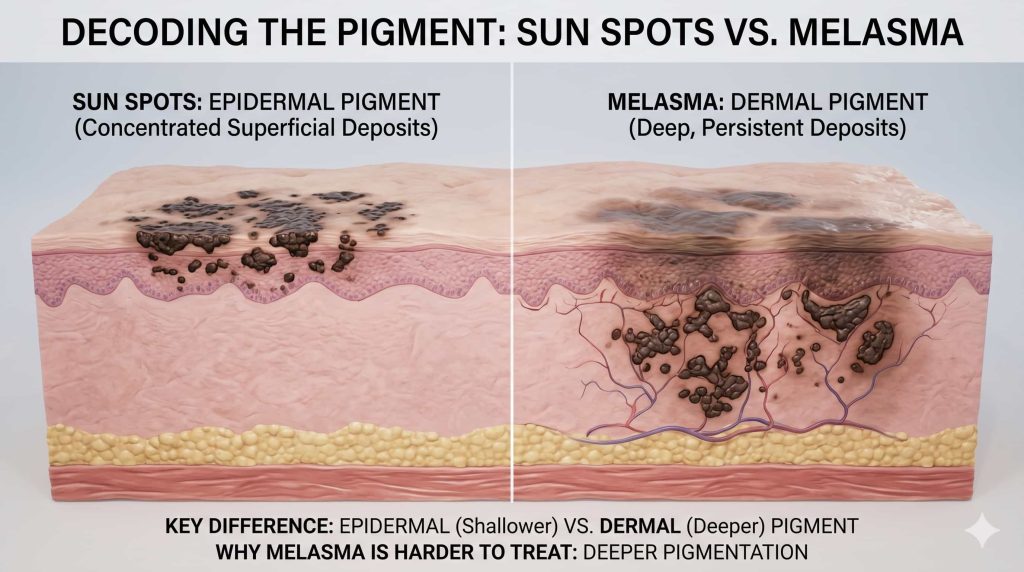
From a histological perspective, UV radiation stimulates the melanocytes (melanin-producing cells) located at the basal layer of the epidermis. Over time, these hyperactive melanocytes deposit dense clusters of melanin into the surrounding keratinocytes. Clinically, sun spots present as well-defined, discrete, hyperpigmented macules. Because this accumulated pigment is primarily restricted to the superficial Epidermis, it represents the most straightforward target for laser intervention. Solar lentigines are structurally isolated and respond exceptionally well to targeted optical energy, making them the ideal candidate for rapid, definitive clearance without complex biological pushback.
Melasma: The Hormonal and Dermal Labyrinth
Melasma represents one of the most challenging conditions in aesthetic dermatology. Unlike the straightforward UV etiology of sun spots, melasma is a complex, multi-factorial condition driven by a combination of genetic predisposition, hormonal fluctuations (estrogen and progesterone, often related to pregnancy or oral contraceptives), vascular endothelial growth factors, and UV radiation.
Visually, melasma manifests as symmetrical, poorly defined, reticulated patches, predominantly on the cheeks, forehead, upper lip, and bridge of the nose. Histologically, melasma is deeply problematic because the hyperactive melanocytes deposit pigment not only in the epidermis but deeply into the Dermis.
The Core Clinical Pitfall: The most critical characteristic of melasma is its extreme volatility and sensitivity to heat. When subjected to the intense thermal energy of traditional nanosecond or long-pulsed lasers, the melanocytes within melasma lesions are aggressively stimulated. The immediate biological response to this thermal trauma is an inflammatory cascade that triggers Rebound Hyperpigmentation or Post-Inflammatory Hyperpigmentation (PIH). The patient’s skin defends itself against the heat by producing exponentially more pigment, rendering the condition significantly worse than before the treatment. This exact mechanism is why legacy photothermal devices are largely contraindicated for melasma management.
How Pico Laser Technology Shatters Melanin Safely
The transition from nanosecond (Q-switched) to picosecond technology is not merely an incremental upgrade; it is a fundamental paradigm shift in laser physics. This shift is the precise reason why modern clinics can now safely address complex pigmentation without the prohibitive risks of thermal damage.
The Photoacoustic Advantage: Why Cold Ablation Matters
To comprehend the efficacy of a pigmentation treatment pico laser, one must analyze the concept of the Thermal Relaxation Time (TRT) and the Stress Relaxation Time (SRT) of the melanosome (the melanin-containing organelle).
Traditional nanosecond lasers operate with pulse durations measured in billionths of a second ($10^{-9}$s). While fast, this duration allows the target pigment to absorb the light and convert it into heat—a photothermal effect. This heat inevitably bleeds into the adjacent healthy tissue, creating a “heat bloom” that exacerbates conditions like melasma and significantly increases patient downtime.
Picosecond lasers operate in the trillionths of a second ($10^{-12}$s). This ultra-short pulse duration is shorter than the Stress Relaxation Time of the melanosome. The optical energy is delivered with such immense speed and peak power that the melanin particle undergoes rapid thermal expansion before any heat can structurally transfer to the surrounding tissue. This generates a massive, localized shockwave—the Photoacoustic effect.
Instead of melting or thermally fracturing the pigment into coarse pebbles, the cold, photomechanical shockwave obliterates the melanin into microscopic, dust-like particles. Because there is virtually zero thermal diffusion, the surrounding dermal tissue remains completely unbothered. This cold ablation process provides the ultimate biological workaround for melasma: it physically removes the existing pigment without triggering the heat-sensitive melanocytes to produce more. Following the shattering phase, the body’s lymphatic system, driven by macrophage activity, effortlessly metabolizes and clears these ultrafine particles.
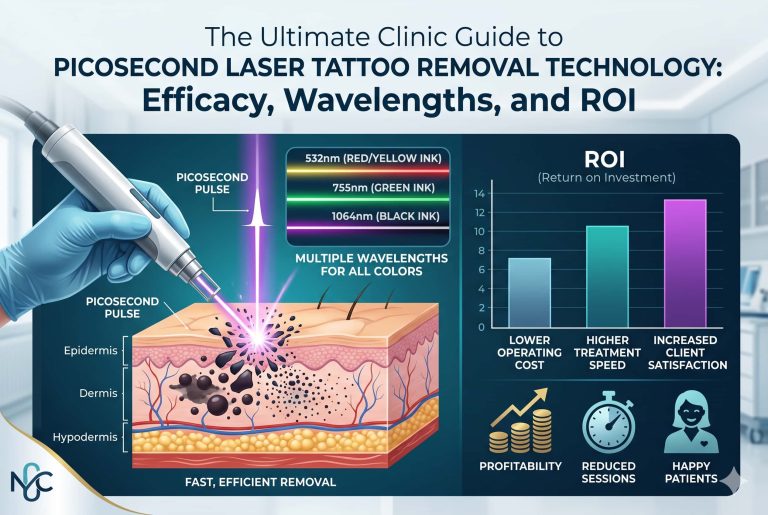
Multi-Wavelength Precision (1064nm & 532nm)
Pigment exists at varying depths within the cutaneous tissue. A monolithic laser cannot safely or effectively treat all forms of hyperpigmentation. Premium hardware must offer multi-wavelength capabilities to allow practitioners to calibrate the depth of optical penetration accurately.
| Wavelength | Target Depth & Histology | Primary Clinical Indications | Pigmentation Type & Risk Profile |
| 532 nm (KTP) | Highly absorbed by melanin; shallow penetration profile isolated to the Epidermis. | Solar Lentigines (Sun Spots), Ephelides (Freckles), Epidermal Nevi. | Epidermal Pigment. High risk for PIH in darker skin (Fitzpatrick IV-VI) if not managed with absolute precision. |
| 1064 nm (Nd:YAG) | Lower melanin absorption curve; profound penetration deep into the Dermis. | Melasma, Nevus of Ota, Dermal Pigmentation, Post-Inflammatory Hyperpigmentation (PIH). | Dermal Pigment. Highly safe for all Fitzpatrick Scale types; bypasses epidermal melanin to prevent surface blistering. |
The Big Question: Can It Really Clear Your Skin?
Establishing rigorous expectation management is the cornerstone of clinical integrity. For aesthetic practices, promising unrealistic outcomes leads to patient dissatisfaction and compromised brand equity. Here is the objective truth regarding clearance timelines based on exact pigmentation pathology.
Clearing Sun Spots: High Success Rates and Rapid Results
For patients presenting with isolated solar lentigines, the prognosis is highly optimistic. Because the pigment is dense, localized, and superficial, the 532nm picosecond wavelength can target and shatter these clusters with extraordinary efficiency.
Patients can typically expect:
- Immediate Darkening: The treated spots will appear darker or slightly frosted immediately post-treatment, often forming a micro-crust.
- Rapid Clearance: Within 7 to 14 days, this micro-crust naturally exfoliates, revealing clear, unblemished skin beneath.
- Treatment Timeline: Complete clearance is routinely achieved in just 1 to 3 targeted sessions. Assuming the patient adheres to strict post-care UV avoidance, the clearance of these specific spots is generally permanent.
Managing Melasma: The Journey to Long-Term Control
The clinical narrative surrounding melasma requires absolute transparency. There is currently no permanent, universally recognized “cure” for melasma. Because the condition is biologically anchored in hormonal fluctuations and genetic predispositions, no external device can reprogram the melanocyte’s internal hyper-reactivity permanently.
However, a highly calibrated pigmentation treatment pico laser utilizing a 1064nm wavelength provides the most effective tool available for managing and fading the condition.
Patients must be counseled to expect:
- Gradual Fading: Melasma requires a gentle, low-fluence (low energy), multi-pass approach. The goal is to slowly dust away the dermal pigment without waking up the melanocyte.
- Extended Protocols: Significant visual improvement typically requires a series of 6 to 10 sessions, spaced 2 to 4 weeks apart.
- Maintenance is Mandatory: Once the melasma is successfully suppressed and faded to a sub-clinical level, patients will require periodic maintenance sessions (e.g., every 3 to 6 months) to keep the pigment at bay.
- Strict Adherence to Topicals: Laser therapy must be supported by a rigorous daily application of broad-spectrum SPF, tyrosinase inhibitors (like Tranexamic Acid or Kojic Acid), and robust physical UV barriers.
Why Top Clinics Trust Cocoon Laser for Pigmentation Protocols
For B2B procurement managers and medical directors, evaluating aesthetic hardware extends far beyond reviewing marketing brochures. The safety margins required to treat complex pigmentation—particularly melasma in darker skin types—demand uncompromising industrial engineering.
True Picosecond Pulses vs. Fake “Pico” Devices
A pervasive and dangerous pitfall in the global aesthetic market is the proliferation of pseudo-picosecond devices. Many entry-level manufacturers utilize standard active Q-switched nanosecond technology and electronically manipulate the interface to display a picosecond readout. When these “fake pico” devices are deployed on melasma, they deliver a massive photothermal shock, virtually guaranteeing severe Rebound Hyperpigmentation and devastating the clinic’s reputation.
True picosecond pulses require immensely complex optical resonators, advanced mode-locking mechanisms, and highly stable amplification stages. As a premier aesthetic laser equipment manufacturer, Cocoon Laser engineers its systems to deliver verifiable pulse durations in the genuine picosecond domain. This commitment to hardware integrity ensures that the Photoacoustic effect is consistently achieved. Furthermore, robust internal engineering, including advanced TEC Cooling to stabilize the device’s internal cavity during prolonged operation, guarantees a remarkably high shots count, lowering the clinic’s total cost of ownership over the lifespan of the equipment.
Flat-Top Beam Profile for Zero Hotspots
The spatial distribution of laser energy as it impacts the skin is perhaps the most critical safety variable in pigment removal.
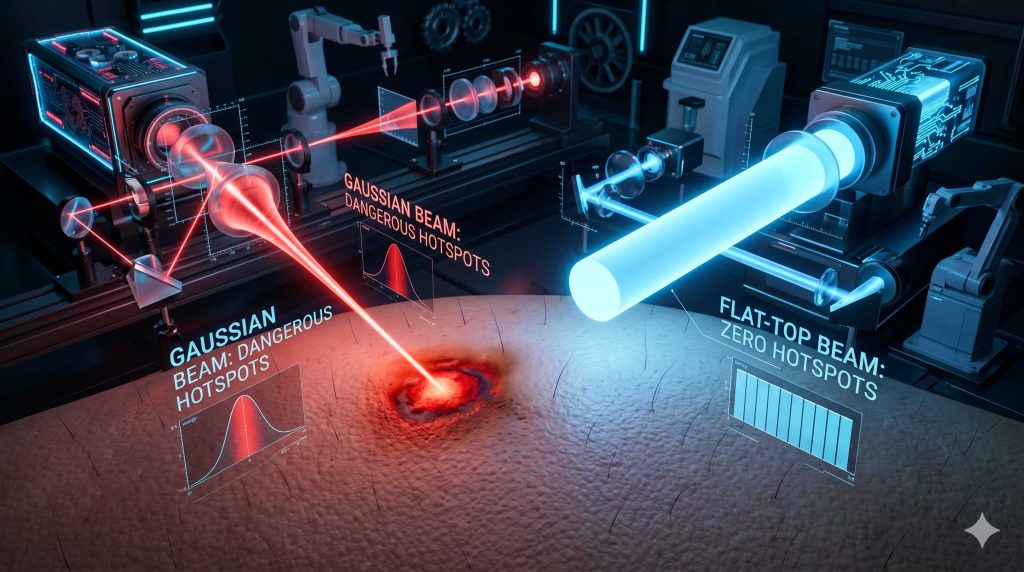
Lower-tier devices emit a Gaussian beam profile. In a Gaussian beam, the energy is intensely concentrated at the absolute dead center of the spot size, tapering off significantly toward the edges. This creates a dangerous “hotspot” in the center, which can easily cause micro-burns, structural tissue damage, and PIH, while the edges of the beam deliver sub-therapeutic energy, leaving pigment intact.
Cocoon Laser utilizes advanced micro-lens arrays and proprietary optical waveguides to transform the laser output into a perfect Flat-Top Beam Profile.
| Beam Profile | Energy Distribution | PIH / Rebound Risk | Clinical Efficacy & Safety |
| Gaussian Beam (Standard Devices) | Highly concentrated in the center; weak at the periphery. | High Risk. The central peak easily exceeds the thermal threshold of melanocytes, triggering inflammation. | Inconsistent. Requires dangerous overlapping, leading to uneven pigment clearance and thermal stacking. |
| Flat-Top Beam (Cocoon Laser Technology) | Absolute uniformity across the entire diameter of the spot size. | Minimal Risk. Energy is evenly dispersed, completely eliminating central hotspots and thermal spikes. | Exceptional. Allows for predictable, uniform pigment shattering with precise clinical margins and maximum epidermal safety. |
For clinics treating melasma, the Flat-Top beam is not a luxury—it is an absolute clinical necessity. It ensures that every millimeter of the targeted tissue receives the exact same therapeutic dose of photomechanical energy, minimizing trauma and maximizing predictable fading.
Conclusion: Your Path to a Luminous, Even Complexion
The pursuit of an even, luminous complexion requires navigating past superficial marketing claims and grounding your expectations in proven clinical science. Hyperpigmentation is a deeply nuanced biological condition, and successful clearance strictly dictates that treatments be tailored to the exact pathology of the pigment. While superficial sun spots can be rapidly eradicated, the complex labyrinth of melasma demands a highly strategic, low-heat, and long-term management protocol.
The advent of true picosecond technology has irreversibly elevated the standard of care. By replacing dangerous photothermal heat with the precise, cold ablation of the photoacoustic effect, practitioners can now safely and consistently shatter unwanted melanin without the paralyzing fear of rebound hyperpigmentation.
For patients, the critical next step is seeking out a comprehensive clinical consultation—ideally utilizing advanced diagnostic imaging like VISIA—at a certified clinic equipped to accurately identify your specific pigment profile. For medical aesthetic practitioners and clinic owners, securing your patient’s trust and your clinic’s profitability relies entirely on the integrity of your hardware. By integrating Cocoon Laser diode technology and advanced multi-wavelength pico platforms backed by stringent FDA 510(k) and Medical CE standards, you empower your practice with the absolute precision necessary to master pigmentation protocols safely, effectively, and profitably.
If you need more information, please click “Contact Us”.
If you want to obtain more information, please follow our official website and Facebook.