Deep Atrophic Scars: How Modern Laser Technology Restores Skin Texture
Executive Summary
Deep atrophic scars are clinical manifestations of permanent dermal collagen loss, necessitating professional intervention to achieve visible structural restoration. Standard topical treatments are biologically incapable of penetrating the epidermal barrier to reach the dermis, where scar tissue is anchored. Fractional laser therapy, utilizing advanced modalities such as CO2 ablative resurfacing and 1927nm Thulium systems, remains the gold standard for inducing neocollagenesis through fractional photothermolysis. Cocoon Laser emphasizes that clinical success is contingent upon precise energy delivery, strict adherence to the Fitzpatrick Scale for patient assessment, and the utilization of high-precision, medical-grade hardware to ensure aesthetic laser safety and mitigate risks such as hyperpigmentation.
Understanding Deep Atrophic Scars: Why Topical Treatments Fall Short
The persistence of atrophic acne scars is not merely a superficial issue; it is a structural deficiency. Understanding the biological limitations of non-invasive home care is the first step in effective scar revision.
The Anatomy of Atrophic Scars
Atrophic scars occur when inflammatory acne processes destroy the collagen and elastin fibers within the dermis, leaving behind a depressed area of skin. Clinically, these are classified by their morphology:
- Icepick Scars: Narrow, deep, and penetrating into the deep dermis or even the subcutis. These present the greatest challenge for non-invasive modalities.
- Boxcar Scars: Round or oval depressions with sharply defined vertical edges. These result from a more significant loss of dermal tissue.
- Rolling Scars: Characterized by a wavelike appearance of the skin surface, caused by fibrous bands anchoring the epidermis to the deeper dermis.
The Epidermis vs. Dermis Barrier
Many patients attempt to treat these scars with topical serums, retinoids, or over-the-counter exfoliants. While these may improve skin texture and tone (pigmentation), they cannot address the underlying structural void. The Stratum Corneum—the outermost layer of the skin—serves as a highly effective barrier designed to keep substances out. Topical agents cannot physically penetrate this barrier to stimulate fibroblast activity or break down fibrous bands within the deep dermis. Effective revision requires a modality capable of reaching the reticular dermis to trigger the body’s natural wound-healing response.
The Gold Standard in Scar Revision: Fractional Laser Technology
When topicals fail, medical-grade laser intervention is indicated. The mechanism of action for modern scar revision is Fractional Photothermolysis.
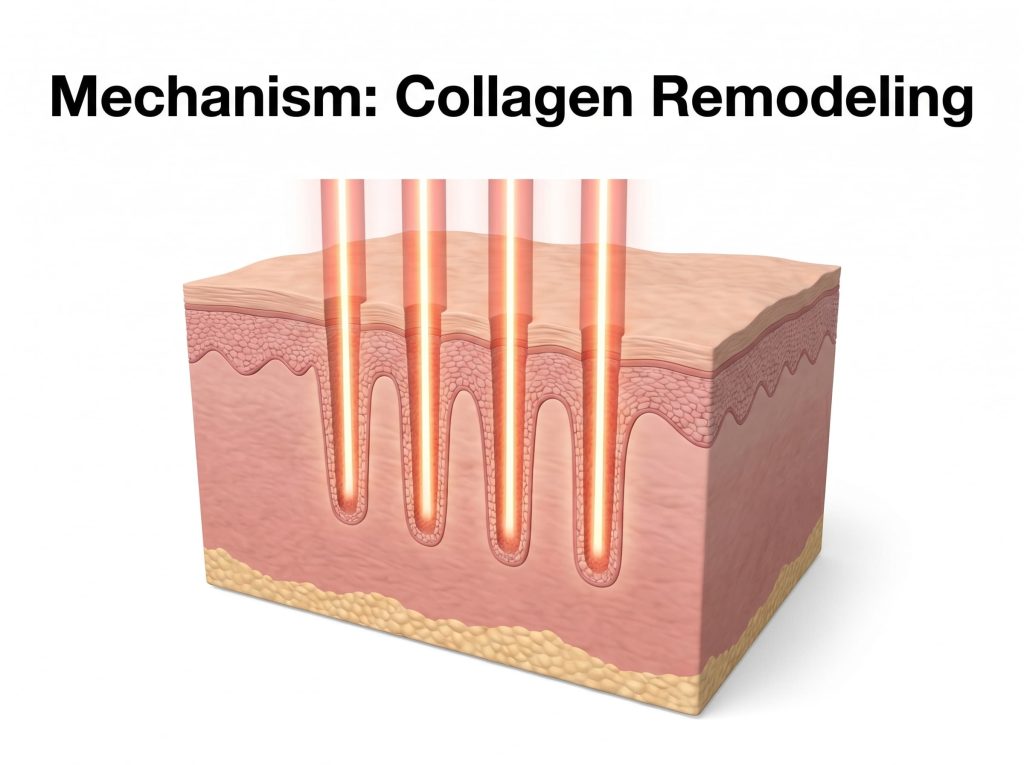
How Laser Energy Remodels Collagen
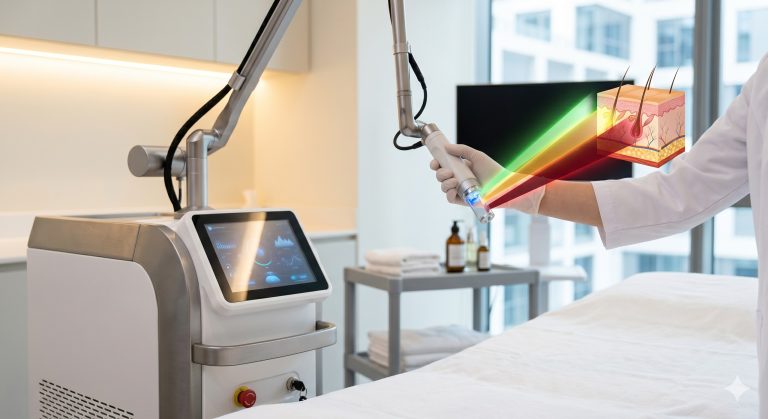
Unlike older, non-fractionated “full-field” lasers that ablated the entire skin surface (resulting in prolonged downtime and high risk), fractional technology delivers laser energy in a grid pattern. This creates thousands of microscopic treatment zones (MTZs) while leaving the surrounding tissue intact. This healthy “reservoir” of tissue promotes rapid re-epithelialization and initiates neocollagenesis—the production of new, organized collagen.
Fractional CO2 vs. Thulium: Choosing the Right Tool for Your Scar Type
Selecting the appropriate laser platform depends on the scar depth, skin phototype, and acceptable downtime. The following table provides a professional comparison of these two primary technologies:
| Feature | Fractional CO2 Laser (10,600nm) | Thulium Laser (1927nm) |
| Primary Action | Ablative (vaporizes tissue) | Sub-ablative (coagulative) |
| Penetration Depth | Deep (reaches reticular dermis) | Moderate (epidermal/dermal junction) |
| Ideal For | Severe boxcar/rolling scars | Pigmentation, texture, mild scarring |
| Downtime | 5–10 days (erythema/crusting) | 2–4 days (mild redness/flaking) |
| Thermal Effect | High (triggers collagen contraction) | Moderate (triggers remodeling) |
| Safety Profile | Higher risk for darker skin (Fitzpatrick IV-VI) | Lower risk for darker skin types |
Expert Note: One size does not fit all. Patients with deeper, more complex scar architecture (like deep boxcar scars) typically require the ablative power of CO2, while those prioritizing a shorter recovery or treating early-stage scarring may benefit from the Thulium platform.
What to Expect: A Realistic Treatment Journey
Patient safety and satisfaction depend on a structured, professional approach. A high-quality device is only as effective as the protocol applied to it.
The Consultative Approach: Initial Assessment
Every clinical engagement must begin with a proper assessment using the Fitzpatrick Scale. This classification (ranging from I to VI) dictates the laser settings. Treating an individual with high melanin content (Fitzpatrick IV-VI) requires caution to avoid Post-Inflammatory Hyperpigmentation (PIH). Professional providers will use this assessment to calibrate pulse duration and energy density to ensure the treatment is effective without compromising aesthetic laser safety.
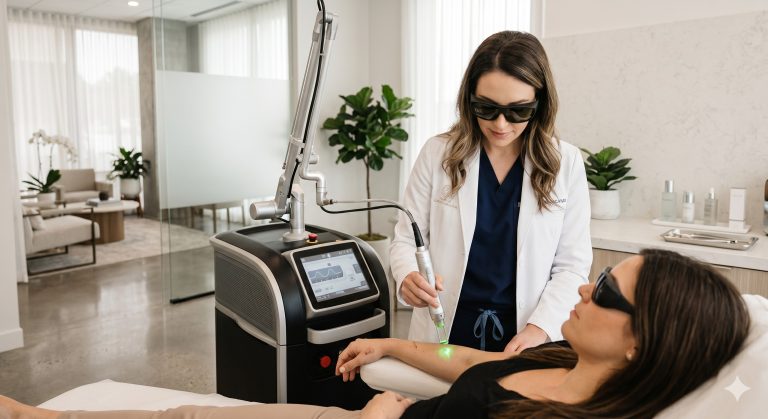
During the Procedure: Comfort and Safety Protocols
Modern medical-grade devices, such as those engineered by Cocoon Laser, integrate advanced hardware to improve the clinical experience:
- TEC Cooling Systems: Thermoelectric cooling integrated into the handpiece protects the epidermis from thermal damage, ensuring only the target dermal structures receive the necessary energy.
- Pulse Duration Control: Precise control of pulse width prevents the buildup of collateral thermal damage, which is a common cause of adverse events.
Post-Procedure Recovery: The Healing Phase
Patients must be prepared for the biological healing process. Immediately post-treatment, erythema (redness) is the expected clinical endpoint. Depending on the intensity:
- Days 1–3: Inflammation and swelling are common. Use of occlusive dressings or medical-grade recovery balms is advised.
- Days 4–7: Micro-crusting (where the treated MTZs are expelled) occurs. Sun protection is mandatory during this phase to prevent permanent pigmentary changes.
Why Equipment Manufacturing Standards Matter for Your Results
As a manufacturer, Cocoon Laser understands that the physics of the laser beam is the most critical determinant of clinical success. Inferior equipment often leads to unpredictable outcomes.
Precision Matters: Pulse Control and Beam Profile
Clinical safety hinges on the beam profile. High-quality optics ensure a “top-hat” or uniform Gaussian beam distribution. In contrast, low-quality lasers often suffer from “hot spots”—areas where energy density is significantly higher than the average. These hot spots can cause unintended deep burns, scarring, or localized depigmentation. Our engineering focus is on ensuring consistent energy delivery across every pulse, ensuring that the clinical effect is uniform, predictable, and safe.
Choosing a Clinic with High-Tier Equipment
When seeking treatment, patients are encouraged to ask the following questions of their provider:
- Is the device FDA 510(k) cleared or Medical CE certified? These certifications ensure the device has passed rigorous safety and efficacy testing.
- What is the pulse duration variability? The ability to adjust pulse duration allows the clinician to tailor the treatment to the specific depth of the scar.
- Does the clinic maintain a regular maintenance schedule for their laser systems? Regular calibration is essential to maintain the integrity of the laser output.
Frequently Asked Questions (FAQ)
Are laser treatments for deep scars permanent?
Yes, the collagen remodeling induced by fractional lasers is structural and permanent. However, the skin will continue to age naturally. Maintenance sessions or a healthy skincare regimen are recommended to preserve results.
How many sessions are typically required?
For significant improvement in deep atrophic scars, a series of 3 to 5 sessions, spaced 4 to 6 weeks apart, is the clinical standard. This allows for the full cycle of collagen induction therapy (CIT) to occur between sessions.
Can I combine laser treatment with subcision or microneedling?
In many clinical cases, a combination approach is superior. For deep, tethered “rolling” scars, subcision (the physical release of the fibrous band) is often performed alongside fractional laser therapy to achieve optimal results. Always consult a dermatologist to design a customized treatment plan.
Start Your Journey to Smoother Skin
Professional scar revision is a scientific endeavor, not a cosmetic shortcut. By utilizing advanced fractional laser technology, it is possible to achieve significant, measurable improvements in skin texture and scar depth. The transition from an atrophic scar surface to a smoother, more uniform appearance requires patience, proper clinical assessment, and, most importantly, the use of high-standard medical equipment.
We encourage all patients to seek out local dermatologists or medical aesthetic clinics that utilize certified, professional-grade platforms. Understanding the technology behind your treatment is the best way to ensure your safety and satisfaction. Consult our expert team at Cocoon Laser to learn more about the engineering standards that drive successful clinical outcomes in aesthetic laser systems.
If you need more information, please click “Contact Us”.
If you want to obtain more information, please follow our official website and Facebook.