755nm, 808nm, 1064nm Explained by a Triple Wavelength Diode Laser Manufacturer
Executive Summary
For modern aesthetic clinics and medical spas, transitioning to a triple wavelength diode laser is a critical operational upgrade. Legacy single-wavelength systems severely limit a clinic’s demographic reach, struggling with fine hair or posing significant burn risks to darker skin tones. By concurrently emitting 755nm, 808nm, and 1064nm wavelengths in a single pulse, advanced platforms achieve true volumetric heating across the entire hair follicle anatomy—targeting the bulge, bulb, and deep papilla simultaneously. This synergistic approach guarantees maximum efficacy across the entire Fitzpatrick Scale (I-VI) with virtually zero downtime. Powered by premium laser bars for an exceptional shots count and stabilized by advanced TEC Cooling, Cocoon Laser systems provide medical-grade reliability. Compliant with Medical CE and FDA 510(k) standards, investing in this technology ensures higher patient throughput, superior pain management, and a maximized Return on Investment (ROI) for professional medical aesthetic devices.
The Shift from Single to Triple Wavelength: Why Clinics Must Adapt
In the highly competitive landscape of aesthetic medicine, the hardware you deploy directly dictates your clinical reputation and operational profitability. For years, the industry relied on single-wavelength systems—primarily the 808nm diode or the 755nm Alexandrite—as the standard of care for hair reduction. However, as patient demographics diversify and clinical expectations rise, the limitations of single-wavelength architecture have become a significant liability.
The Limitations of Single Wavelength Systems
A single-wavelength laser hair removal machine operates on a fixed optical parameter, which inherently restricts its clinical versatility.
- The 808nm Limitation: While the 808nm diode is a robust all-rounder, it frequently struggles to eradicate fine, vellus hair with low melanin concentration, often leaving residual hair after multiple sessions.
- The 755nm Limitation: Conversely, pure 755nm systems possess an aggressive melanin absorption coefficient. While excellent for pale skin, applying a 755nm laser to Fitzpatrick Scale IV-VI skin types creates a severe risk of epidermal thermal injury, blistering, and Post-Inflammatory Hyperpigmentation (PIH).
From a business perspective, operating a single-wavelength device means your clinic is actively turning away patients. If you cannot safely treat melanin-rich skin or effectively clear fine facial hair, you are leaking potential revenue to competitors equipped with more advanced technology.
The Anatomy of the Hair Follicle: A Multi-Depth Target
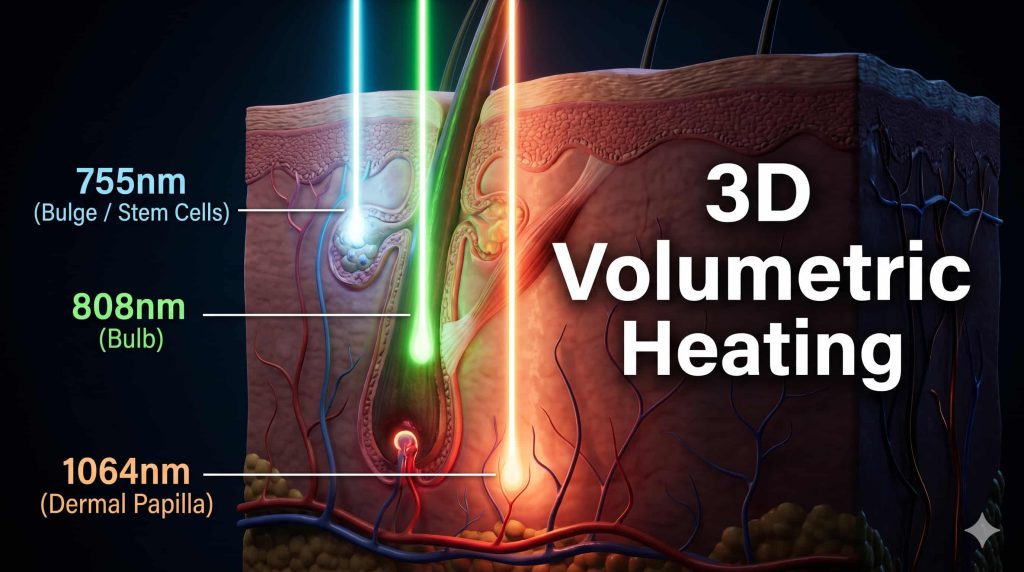
To understand why a single wavelength falls short, we must examine the anatomical reality of human hair. The hair follicle is not a two-dimensional target; it is a complex, three-dimensional structure situated at varying depths within the dermis. Effective, permanent hair reduction requires the destruction of three distinct anatomical zones:
- The Bulge: Located superficially, housing the epithelial stem cells responsible for follicular regeneration.
- The Bulb: Situated in the mid-dermis, the active growth center during the anagen phase.
- The Papilla: The deepest vascular network that supplies blood and nutrients to the follicle.
Because varying wavelengths of light penetrate human tissue to different depths, a single wavelength mathematically cannot deliver optimal thermal energy to the bulge, bulb, and papilla simultaneously. This anatomical fact birthed the engineering necessity of the triple wavelength diode laser.
Decoding the Wavelengths: The Physics of Laser Hair Removal
Unlike the photoacoustic effect utilized in Q-switched lasers for tattoo removal, laser hair reduction relies strictly on Selective Photothermolysis. The goal is to heat the target chromophore (melanin within the hair shaft) to a necrotic temperature without damaging the surrounding epidermal tissue.
As a leading aesthetic laser supplier, Cocoon Laser engineers devices that blend three specific optical wavelengths. Here is the technical breakdown of how each wavelength functions within the tissue.
755nm (Alexandrite Equivalency): Precision for Fine and Light Hair
The 755nm wavelength occupies a unique position on the optical absorption spectrum.
- Physical Characteristics: It exhibits extremely high absorption by melanin chromophores but has a relatively shallow penetration depth.
- Clinical Targeting: Because of its shallow reach and high melanin affinity, the 755nm wavelength perfectly targets the superficial Bulge of the hair follicle.
- Ideal Patient Profile: It is the undisputed champion for treating light-colored, fine, and vellus hair that other lasers miss. Clinically, it is highly effective for superficial hair on areas like the upper lip and eyebrows, specifically on patients with Fitzpatrick Scale types I to III.
808nm/810nm (The Golden Standard): Speed and Versatility
The 808nm (or 810nm) wavelength remains the workhorse of the laser hair removal industry.
- Physical Characteristics: It offers a balanced, moderate melanin absorption rate paired with a deeper dermal penetration capability than the 755nm.
- Clinical Targeting: This wavelength drives energy directly into the mid-dermis, efficiently destroying the Bulb and the surrounding follicular structure.
- Ideal Patient Profile: It is highly versatile, safe for most skin types (I-IV), and ideal for rapidly clearing thick, terminal hair across large anatomical areas such as the back, chest, and legs.
1064nm (Nd:YAG Equivalency): Maximum Safety for Dark Skin
The addition of the 1064nm wavelength is what elevates a standard diode into a comprehensive medical workstation.
- Physical Characteristics: The 1064nm wavelength has the lowest melanin absorption rate but the deepest tissue penetration, reaching deep into the subcutaneous layer.
- Clinical Targeting: It bypasses the epidermal melanin almost entirely, delivering thermal energy deep into the vascular Papilla to cut off the blood supply to the hair.
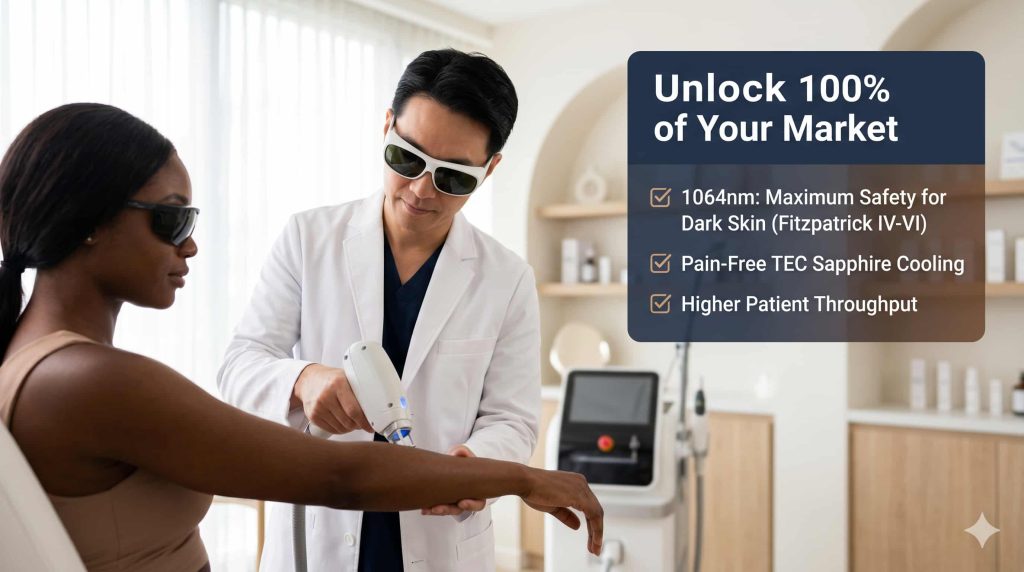
- Ideal Patient Profile: This is the only scientifically safe wavelength for treating Fitzpatrick Scale types V and VI. It allows clinics to confidently perform laser hair removal on deeply pigmented skin without the risk of epidermal burns. Furthermore, its deep penetration makes it highly effective for deeply rooted hair in areas like the axilla (underarms) and bikini line.
Technical Comparison: The Triple Wavelength Spectrum
| Wavelength Parameter | Melanin Absorption | Penetration Depth | Primary Anatomical Target | Optimal Fitzpatrick Types | Clinical Advantage |
| 755nm | Very High | Superficial | Bulge (Stem Cells) | Types I – III | Eradicates fine, light, residual hair. |
| 808nm / 810nm | Moderate | Medium | Bulb | Types I – IV | Fast, efficient clearance for large body areas. |
| 1064nm | Low | Deep | Dermal Papilla | Types IV – VI | Maximum safety for dark skin; targets deep roots. |
The Power of Synergy: How Concurrent Emission Elevates Clinical Outcomes
The defining technological breakthrough of the modern triple wavelength diode laser is not merely having three wavelengths available, but firing them concurrently.
Volumetric Heating vs. Superficial Damage
In legacy systems, practitioners had to switch handpieces or manually toggle wavelengths, treating the patient in isolated optical passes. A true synergistic platform emits 755nm, 808nm, and 1064nm simultaneously within a single microscopic pulse.
This concurrent emission generates Volumetric Heating. Instead of attacking the follicle at one specific depth, the laser energy blankets the entire follicular anatomy in a 3D thermal profile. The 755nm destroys the superficial stem cells, the 808nm vaporizes the bulb, and the 1064nm coagulates the deep vascular papilla. This comprehensive destruction ensures the follicle cannot regenerate, resulting in statistically significant improvements in long-term clearance rates compared to single-wavelength treatments.
Minimizing the Risk of Paradoxical Hypertrichosis
Paradoxical Hypertrichosis is a highly distressing clinical adverse event where sub-lethal laser energy actually stimulates dormant hair follicles, causing more hair to grow in the treated area. This typically occurs when a laser lacks the necessary penetration depth or fluence to fully destroy the follicle, effectively acting as a thermal stimulant.
By utilizing the deep-penetrating 1064nm wavelength concurrently with the 808nm and 755nm, the laser ensures that even the deepest, most resilient follicles receive a lethal dose of thermal energy. This multi-depth coverage drastically minimizes the clinical risk of Paradoxical Hypertrichosis, protecting your clinic from negative patient reviews and clinical liabilities.
Strategic Business Value: What Triple Wavelength Means for Your Clinic’s ROI
For B2B stakeholders, medical directors, and clinic investors, clinical physics must ultimately translate into business economics. Procuring a synergistic diode system is a highly strategic financial decision that directly impacts gross revenue and operational efficiency.
Capturing 100% of the Patient Demographic
The most immediate ROI of a triple-wavelength system is market expansion. With a single-wavelength device, treating diverse populations is an operational gamble. By integrating a platform that legally and safely accommodates Fitzpatrick Scale types I through VI, your clinic instantly captures 100% of the demographic market. You transition from a niche provider to a universal aesthetic destination, maximizing the ROI on your marketing and patient acquisition spend.
Faster Throughput and Higher Patient Satisfaction
In an aesthetic practice, time is your most valuable commodity. Advanced triple wavelength diode laser handpieces are engineered with exceptionally large spot sizes (e.g., $15mm \times 25mm$ or larger).
When a large spot size is combined with high-frequency “In-Motion” continuous sweeping technology (often up to 10Hz), practitioners can treat full backs or full legs in a fraction of the time required by legacy stamping methods.
- Business Impact: Reducing a 60-minute appointment to 25 minutes doubles your daily patient throughput. This allows clinics to maximize the revenue generated per treatment room, per hour, without increasing overhead costs.
Pain Management as a Retention Strategy
Patient retention in laser hair removal is heavily dependent on comfort. Traditional high-fluence lasers are notoriously painful, leading to high drop-out rates before the 6-session protocol is completed.
Modern synergistic platforms address this by distributing the thermal load across different depths, preventing extreme heat accumulation at the epidermal surface. When coupled with advanced contact cooling, the treatment becomes virtually painless. This elevates the patient experience from a “medical ordeal” to a premium spa service, virtually guaranteeing protocol completion and encouraging highly lucrative word-of-mouth referrals.
Behind the Hardware: Why the Manufacturer Matters
The B2B aesthetic market is currently flooded with low-cost, white-label laser devices that claim “triple wavelength” capabilities. However, a laser is only as good as its internal optical architecture. As a professional aesthetic laser supplier, Cocoon Laser urges clinics to rigorously evaluate the internal components before committing capital.
Premium Laser Bars (Coherent USA)
The engine of any diode laser is the semiconductor laser bar stack. Low-tier manufacturers utilize generic bars that suffer from severe power degradation (attenuation) after only a few months of use. This results in “empty flashes”—the machine emits light, but lacks the fluence to destroy hair, leading to clinical failure and angry patients.
To ensure uncompromised reliability, high-end platforms must utilize premium optical components. Devices manufactured by Cocoon Laser are driven by imported Coherent (USA) laser bars. These top-tier components ensure absolute power stability and guarantee a massive shots count (often exceeding 20 to 50 million pulses). This longevity drastically reduces the Total Cost of Ownership (TCO) by eliminating the need for frequent, expensive handpiece replacements.
Advanced TEC Cooling Systems
A laser generating intense thermal energy requires an equally powerful thermal management system. If a laser overheats, the software will throttle the output, or worse, the sapphire tip will heat up and burn the patient.
- TEC Cooling Integration: Industrial-grade Thermo-Electric Cooling (TEC Cooling) coupled with a high-capacity internal water loop is non-negotiable for high-volume clinics.
- Sapphire Contact Cooling: The tip of the handpiece must feature genuine Sapphire Contact Cooling, maintaining a consistent temperature of $0^\circ C$ to $-5^\circ C$ at the epidermal junction. This active cooling chills the skin moments before, during, and after the optical pulse. It is the definitive factor that ensures the procedure features zero downtime and maximum patient safety.
Conclusion: Upgrade Your Practice with Cocoon Laser
The evolution of hair reduction technology has reached a definitive milestone. The integration of 755nm, 808nm, and 1064nm wavelengths into a single, cohesive pulse has rendered older, single-wavelength devices clinically obsolete.
Future-Proofing Your Aesthetic Business
By investing in a triple wavelength diode laser, you are future-proofing your aesthetic business. You gain the clinical agility to treat the finest blond hair and the deepest roots on melanin-rich skin, all with unparalleled speed and safety. You mitigate the risks of burns and paradoxical hair growth while dramatically boosting your daily revenue capacity.
When selecting your hardware, demand transparency regarding internal components, cooling architecture, and international safety certifications such as Medical CE and FDA 510(k).
Do not compromise your clinical reputation with sub-standard equipment. Partner with a proven manufacturer dedicated to engineering excellence. Visit the Cocoon Laser official website today to download our comprehensive hardware specification sheets, utilize our clinic ROI calculator, or schedule an exclusive B2B virtual demonstration to see the power of synergistic wavelength technology in action.
If you need more information, please click “Contact Us”.
If you want to obtain more information, please follow our official website and Facebook.