1927nm Thulium Laser: How It Works
1927nm Laser Technology Guide
The 1927nm thulium laser is a near-infrared laser technology widely associated with fractional aesthetic skin treatments. Its wavelength is strongly absorbed by water in skin tissue, contributing to a relatively superficial treatment profile that makes it particularly relevant to pigmentation, photodamage, uneven tone, texture, and skin rejuvenation applications.
This guide explains why the 1927nm wavelength matters, how it interacts with skin, how fractional 1927nm systems work, their common aesthetic applications, and how this wavelength differs from other fractional laser technologies.
Quick Answer: What Is a 1927nm Thulium Laser?
A 1927nm thulium laser is a laser system that generates near-infrared light at approximately 1927 nanometers. In aesthetic medicine, this wavelength is commonly delivered fractionally to create microscopic treatment zones in the skin.
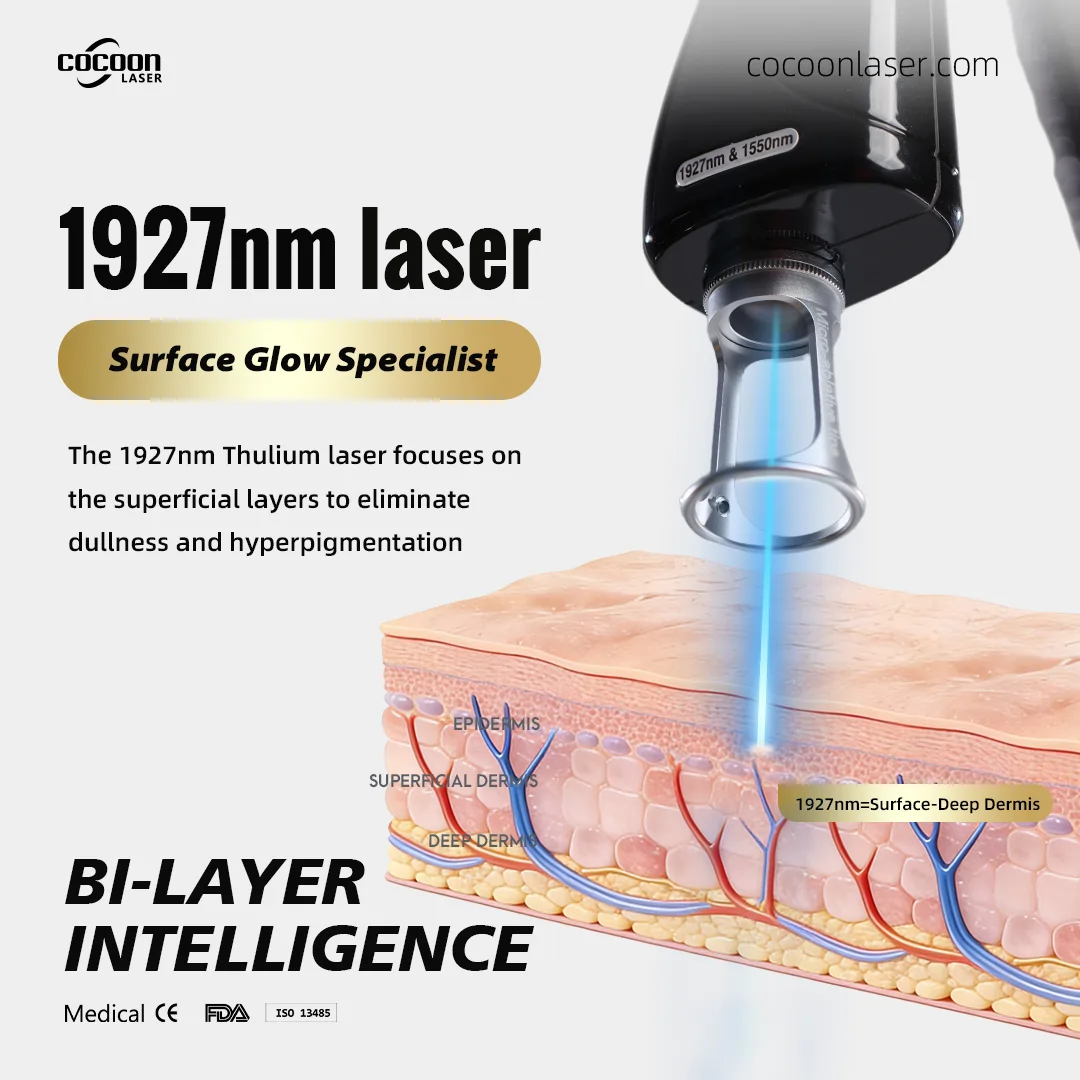
The key characteristic of 1927nm is its strong absorption by water. Because water is abundant in skin tissue, 1927nm energy is absorbed relatively superficially compared with wavelengths such as approximately 1550nm.
This makes fractional 1927nm technology particularly relevant to professional treatments targeting superficial pigmentation, sun damage, uneven skin tone, texture, and overall skin rejuvenation. Treatment depth, intensity, downtime, and results still depend on the specific device and treatment parameters.
What Does 1927nm Mean?
The term 1927nm refers to the wavelength of the laser light. A nanometer is a unit used to measure wavelength, and 1927nm lies within the near-infrared region of the electromagnetic spectrum.
Wavelength matters because different wavelengths are absorbed differently by chromophores within tissue.
Important chromophores encountered in aesthetic laser treatments include:
- Water
- Melanin
- Hemoglobin
- Exogenous tattoo pigments
The absorption characteristics of a wavelength help determine how deeply energy penetrates, which tissue components absorb it, and what type of thermal or optical effect can be produced.
For the 1927nm wavelength, water is the dominant chromophore relevant to its aesthetic tissue interaction.

Why Is 1927nm Associated with Thulium Lasers?
Thulium is a rare-earth element used in certain laser gain media. Depending on the host material and laser architecture, thulium-based systems can generate wavelengths within the near-infrared region.
In aesthetic medicine, approximately 1927nm has become one of the best-known wavelengths associated with fractional thulium laser technology.
However, thulium laser and 1927nm are not interchangeable terms. Thulium-based laser systems can operate at other wavelengths and can be designed for applications outside aesthetic dermatology.
1927nm vs Thulium: The Difference
Thulium describes the laser technology or active laser medium, while 1927nm describes the wavelength of the emitted laser light.
When people refer to a “1927nm thulium laser” in aesthetics, they are generally describing a thulium-based system designed to deliver approximately 1927nm laser energy for professional skin treatments.
For a broader introduction to the technology, see our What Is a Thulium Laser? Guide.
How Does a 1927nm Thulium Laser Work?
The mechanism of a 1927nm aesthetic laser can be understood through the relationship between wavelength, water absorption, heat generation, and fractional delivery.
1. The Laser Generates 1927nm Energy
The laser source generates light at approximately 1927nm and delivers it through the optical system and treatment handpiece.
2. The Energy Enters the Skin
When 1927nm laser energy reaches the treatment area, it penetrates into the skin. The distribution of that energy depends on wavelength as well as the characteristics of the device and treatment settings.
3. Water Absorbs the Energy
Water-containing tissue absorbs the laser energy and converts it into heat. Because water absorption is relatively strong at 1927nm, the energy is deposited relatively superficially compared with some wavelengths that interact less strongly with water.
4. Controlled Thermal Effects Are Created
The absorbed energy produces controlled thermal effects within the targeted tissue. In fractional systems, these effects are concentrated into microscopic treatment zones.
5. A Healing and Renewal Response Follows
After treatment, the skin enters a recovery process. Temporary redness, warmth, dryness, roughness, or mild swelling can occur depending on treatment intensity.
Changes in pigmentation, tone, texture, and overall skin appearance generally develop progressively rather than being determined immediately after treatment.

Why Does Water Absorption Matter at 1927nm?
Water absorption is one of the most important concepts for understanding the 1927nm wavelength.
When a wavelength is strongly absorbed by a chromophore, more of its energy is deposited over a shorter optical penetration distance. In the case of 1927nm, the relevant chromophore is water.
This contributes to a treatment profile that is generally more superficial than fractional wavelengths with lower water absorption, such as approximately 1550nm.
This does not mean that 1927nm simply treats the outermost surface of the skin. The actual distribution of thermal effect depends on multiple variables, including:
- Delivered energy
- Fractional density
- Spot or microbeam characteristics
- Pulse characteristics
- Number of passes
- Scanning method
- Device architecture
Therefore, wavelength provides the foundation for tissue interaction, but it does not independently define the complete treatment effect.
What Is a Fractional 1927nm Thulium Laser?
Most discussions of 1927nm aesthetic treatment involve fractional laser delivery.
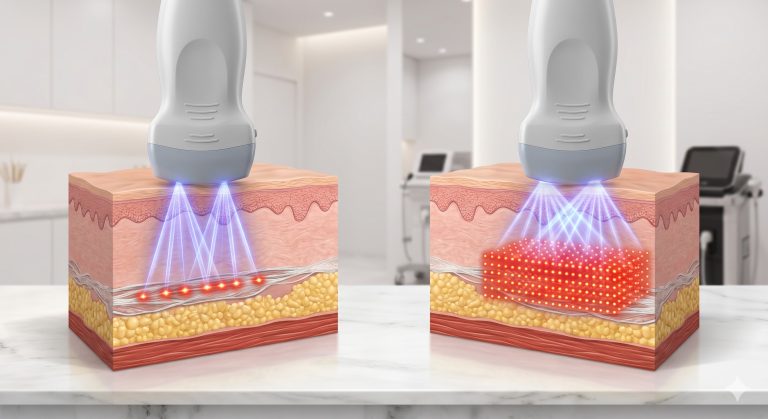
Fractional technology divides the treatment area into microscopic treated and untreated regions instead of applying an identical thermal effect continuously across the entire surface.
This produces many microscopic treatment zones surrounded by tissue that has not received the same direct treatment.
Depending on the system, practitioners may be able to adjust parameters that influence:
- Energy delivered to each treatment zone
- Fractional treatment density
- Treatment coverage
- Number of passes
- Treatment speed
Fractional delivery is therefore separate from wavelength. A device can use a 1927nm wavelength and also use fractional technology, but the two terms describe different characteristics of the system.
This distinction is explored further in our Fractional Thulium Laser Guide.
What Is a 1927nm Laser Used For?
In professional aesthetic practice, fractional 1927nm laser technology is primarily associated with skin concerns where relatively superficial treatment is desirable.
| Aesthetic Application | Why 1927nm Is Relevant |
|---|---|
| Superficial Pigmentation | Its relatively superficial thermal profile makes 1927nm relevant to selected pigment-related treatment strategies. |
| Photodamage | Frequently associated with treatment of visible sun-related pigmentation and changes in skin appearance. |
| Uneven Skin Tone | Fractional treatment can be distributed over broader areas where overall visible tone is a treatment concern. |
| Skin Texture | Microscopic thermal treatment zones are followed by a controlled recovery and renewal response. |
| Skin Rejuvenation | May be incorporated into professional protocols focused on overall tone, texture, clarity, and skin appearance. |
| Selected Pigmentary Conditions | May be considered within professionally assessed treatment plans depending on the condition and patient characteristics. |
1927nm Thulium Laser for Pigmentation
Pigmentation is one of the most important aesthetic applications associated with 1927nm fractional laser technology.
However, it is important to understand that “pigmentation” describes a broad group of visible skin changes rather than one single condition.
Sun-related pigment changes, post-inflammatory pigmentation, melasma, and other pigmentary concerns can differ in their causes, depth, recurrence patterns, and response to treatment.
The relatively superficial profile of 1927nm technology makes it relevant to selected pigmentation strategies, but the wavelength should not be assumed to be appropriate for every pigmentary condition or every patient.
We cover this application separately in our Thulium Laser for Pigmentation Guide.
1927nm Thulium Laser for the Face
Facial skin is another major application area for aesthetic 1927nm systems. Depending on the device and treatment plan, professional facial treatments may focus on superficial pigmentation, photodamage, uneven tone, texture, or general skin rejuvenation.
Because the face can contain multiple concerns at the same time, treatment selection should be based on professional assessment rather than simply applying the same 1927nm protocol to every patient.
For results, downtime, recovery, and facial applications, see our dedicated Thulium Laser for Face Guide.
Can 1927nm Thulium Laser Be Used for Melasma?
1927nm thulium laser technology may be considered in selected professional treatment strategies for melasma, but melasma requires more careful assessment than many forms of superficial sun-related pigmentation.
Melasma is a complex and often recurrent pigmentary condition. Its appearance can be influenced by factors such as ultraviolet exposure, visible light, hormonal influences, skin characteristics, inflammation, and individual pigmentation tendency.
Because of this complexity, the presence of superficial pigmentation does not mean that every patient with melasma is automatically an appropriate candidate for the same 1927nm treatment protocol.
Treatment intensity, patient selection, previous treatment history, sun protection, and post-treatment management can all influence outcomes and the risk of unwanted pigment changes.
For a dedicated discussion of this application, see our Thulium Laser for Melasma Guide.
1927nm vs 1550nm Laser: What Is the Difference?
Both 1927nm and approximately 1550nm wavelengths are used in fractional aesthetic laser systems and both interact with water in skin tissue. However, their absorption and general treatment profiles differ.
Water absorption is stronger at 1927nm than around 1550nm. As a result, 1927nm energy is generally deposited more superficially, while approximately 1550nm fractional systems are commonly associated with relatively deeper treatment.
| Feature | 1927nm | ~1550nm |
|---|---|---|
| Important Chromophore | Water | Water |
| Relative Water Absorption | Higher | Lower than 1927nm |
| General Treatment Profile | Relatively superficial | Relatively deeper |
| Common Aesthetic Focus | Pigmentation, photodamage, tone, and superficial rejuvenation | Texture, selected scars, and deeper fractional remodeling |
These are general technical differences rather than fixed treatment rules. Actual treatment depth and tissue response depend on the specific device and parameters.
For a detailed comparison, see our 1927nm vs 1550nm Laser Guide.
1927nm Thulium Laser vs CO2 Laser
A 1927nm thulium laser and a CO2 laser both interact strongly with water, but their wavelengths and typical resurfacing approaches are substantially different.
CO2 lasers operate at approximately 10,600nm and are commonly associated with ablative or fractional ablative resurfacing. They can produce vaporization of water-containing tissue along with surrounding thermal effects.
Many aesthetic 1927nm systems instead use a fractional non-ablative or minimally disruptive approach with a relatively superficial thermal treatment profile.
As a result, these technologies may occupy different positions within a clinic’s treatment portfolio rather than functioning as direct substitutes.
See our Thulium Laser vs CO2 Laser Guide for a dedicated comparison.
What Are the Benefits of 1927nm Thulium Laser Technology?
The advantages of 1927nm technology are closely related to its wavelength characteristics and the way modern aesthetic systems deliver laser energy.
Relatively Superficial Energy Deposition
Strong water absorption contributes to relatively superficial energy deposition, making the wavelength particularly relevant when the treatment objective involves concerns closer to the skin surface.
Strong Relevance to Pigment and Photodamage Applications
Fractional 1927nm technology is commonly associated with professional treatment strategies for superficial pigmentation, visible photodamage, and uneven skin tone.
Fractional Treatment Delivery
Fractional systems create microscopic treatment zones separated by untreated tissue. Depending on the device, treatment density and energy can be adjusted to support different treatment strategies.
Broad Skin Rejuvenation Applications
In addition to pigment-related concerns, professional 1927nm systems may be used in protocols focused on texture, tone, clarity, and overall skin appearance.
Complementary to Other Laser Technologies
A clinic may use 1927nm alongside other technologies such as 1550nm fractional, CO2, picosecond, or vascular lasers because each wavelength and delivery system has different optical characteristics and treatment objectives.
What Results Can 1927nm Laser Treatment Produce?
Results from fractional 1927nm treatment generally develop progressively rather than immediately.
Depending on the indication, device, treatment parameters, and individual response, visible changes may include improvement in the appearance of:
- Superficial pigment irregularities
- Sun-related discoloration
- Uneven skin tone
- Rough or irregular texture
- Overall skin clarity and appearance
Some changes may become noticeable after the initial recovery period, while additional improvement may develop over the following weeks.
Results vary between individuals and cannot be guaranteed. Treatment intensity, number of sessions, underlying skin condition, post-treatment care, and ongoing sun exposure can all influence the outcome.
How Much Downtime Does a 1927nm Thulium Laser Have?
Recovery is commonly measured in days, but there is no universal downtime for every 1927nm treatment.
Temporary post-treatment effects may include redness, warmth, mild swelling, dryness, tightness, sensitivity, or a rough sandpaper-like texture.
| General Timeline | Possible Skin Response |
|---|---|
| Immediately After | Redness, warmth, sensitivity, or mild swelling may occur. |
| Days 1–2 | Skin may remain mildly red and begin to feel dry or tight. |
| Days 2–5 | Dryness or a fine rough texture may become more noticeable during recovery. |
| Around Days 5–7 | Many temporary surface effects may have substantially improved, depending on treatment intensity. |
| Following Weeks | Visible changes in tone, pigmentation, and texture may continue to develop. |
More intensive protocols can result in more noticeable post-treatment effects. For a detailed recovery discussion, see our Thulium Laser Treatment Guide.

What Should Clinics Look for in a 1927nm Thulium Laser Machine?
For clinics, distributors, and professional equipment buyers, wavelength should be treated as the starting point rather than the complete specification of a thulium laser machine.
Two systems that both advertise 1927nm can differ considerably in treatment delivery, parameter control, workflow, reliability, and manufacturer support.
| Factor | What to Evaluate |
|---|---|
| Laser Source | Confirm the actual wavelength, laser architecture, and technical specifications. |
| Fractional Delivery | Understand how microscopic treatment zones are generated and distributed. |
| Energy Control | Review the available energy settings and adjustment range. |
| Treatment Density | Determine how fractional coverage can be adjusted for different protocols. |
| Handpiece & Workflow | Consider ergonomics, treatment speed, scanning method, and practical daily use. |
| Training | Evaluate the operational and professional training supplied with the system. |
| Service & Warranty | Compare technical support, warranty terms, maintenance, and parts availability. |
| Regulatory Documentation | Verify the documentation and intended use required for the target market. |
Buyers should therefore avoid selecting a professional system solely because “1927nm” appears on the specification sheet.
1927nm Thulium Laser FAQ
What is a 1927nm laser?
A 1927nm laser generates near-infrared light at approximately 1927 nanometers. In aesthetic medicine, this wavelength is commonly associated with fractional thulium laser systems and strong interaction with water in relatively superficial skin tissue.
What is a 1927nm thulium laser used for?
Fractional 1927nm thulium systems are commonly associated with professional treatments for superficial pigmentation, photodamage, uneven tone, texture, and general skin rejuvenation.
How deep does a 1927nm laser penetrate?
1927nm has relatively strong water absorption and therefore a comparatively superficial treatment profile. However, actual treatment depth cannot be defined by wavelength alone and depends on the device, energy, delivery method, and other treatment parameters.
Is a 1927nm laser fractional?
1927nm describes wavelength, while fractional describes the energy delivery pattern. Many aesthetic 1927nm thulium systems use fractional delivery, but the two terms do not mean the same thing.
Is 1927nm laser ablative?
Many aesthetic 1927nm thulium systems are designed around fractional non-ablative or minimally disruptive treatment approaches. Device architecture varies, so the mechanism of the specific system should be verified.
What is the difference between 1927nm and 1550nm?
Both wavelengths interact with water, but water absorption is stronger at 1927nm. This generally gives 1927nm a more superficial treatment profile, while approximately 1550nm fractional systems are commonly associated with relatively deeper treatment.
Can 1927nm laser treat pigmentation?
Fractional 1927nm technology is commonly associated with selected professional treatment strategies for superficial pigmentation and photodamage. Suitability depends on the type of pigmentation, skin characteristics, device, and professional assessment.
How long is recovery after a 1927nm laser?
Recovery varies with treatment intensity. Temporary redness, warmth, dryness, mild swelling, or roughness may occur during the first several days, while visible changes may continue to develop afterward.
Final Verdict: Why Is 1927nm Important in Aesthetic Laser Technology?
The 1927nm thulium laser occupies a distinct position within fractional aesthetic laser technology because of its strong interaction with water and relatively superficial treatment profile.
These characteristics make it particularly relevant to professional applications involving superficial pigmentation, photodamage, uneven tone, texture, and general skin rejuvenation.
However, 1927nm should not be evaluated as a wavelength in isolation. Fractional delivery, energy control, treatment density, scanning technology, handpiece design, treatment protocols, and operator technique all influence the actual tissue response.
For professional buyers, the same principle applies to equipment selection. A 1927nm specification alone does not determine the quality or capabilities of a thulium laser machine. The complete system, training, service, regulatory documentation, and manufacturer support should also be considered.
Professional 1927nm Laser Technology
Explore Professional 1927nm Thulium Laser Systems
Cocoon Laser provides professional aesthetic laser equipment for clinics, medical spas, distributors, and OEM partners. Contact our team to discuss available 1927nm thulium laser configurations, technical specifications, treatment applications, customization options, and pricing.
Request Specifications & Quote