IPL Hair Removal Side Effects: Is IPL Safe?
Intense pulsed light (IPL) is widely used for hair reduction, both in professional aesthetic settings and through consumer at-home devices. For many appropriately selected users, treatment may cause only temporary skin reactions such as redness, warmth, or mild swelling. However, IPL is not risk-free.
Incorrect device selection, unsuitable treatment parameters, recent tanning, excessive light exposure, inadequate skin assessment, or using a device on an incompatible skin tone can increase the risk of adverse effects. More significant complications can include burns, blistering, and changes in skin pigmentation.
This guide explains the common and less common IPL hair removal side effects, what can increase the risk of complications, how professional and at-home IPL differ from a safety perspective, and when a skin reaction deserves further attention.
Quick Answer: Is IPL Hair Removal Safe?
IPL can be used safely for appropriately selected users when a suitable device, treatment parameters, skin assessment, eye protection where required, and the manufacturer’s or professional treatment protocol are followed. However, IPL can cause side effects and is not suitable for every person or every skin condition.
Temporary redness, warmth, mild tenderness, or localized swelling can occur after treatment. More significant adverse effects such as burns, blistering, prolonged irritation, or changes in pigmentation are possible, particularly when treatment conditions are inappropriate.
Safety therefore depends not simply on whether a device is called “IPL,” but on the specific system, its intended use, treatment parameters, skin and hair characteristics, operator or user technique, and adherence to safety instructions.
What Are the Most Common IPL Hair Removal Side Effects?
IPL delivers optical energy to the treatment area, so some temporary skin response can occur even when treatment is performed appropriately. The exact response varies between individuals and devices.
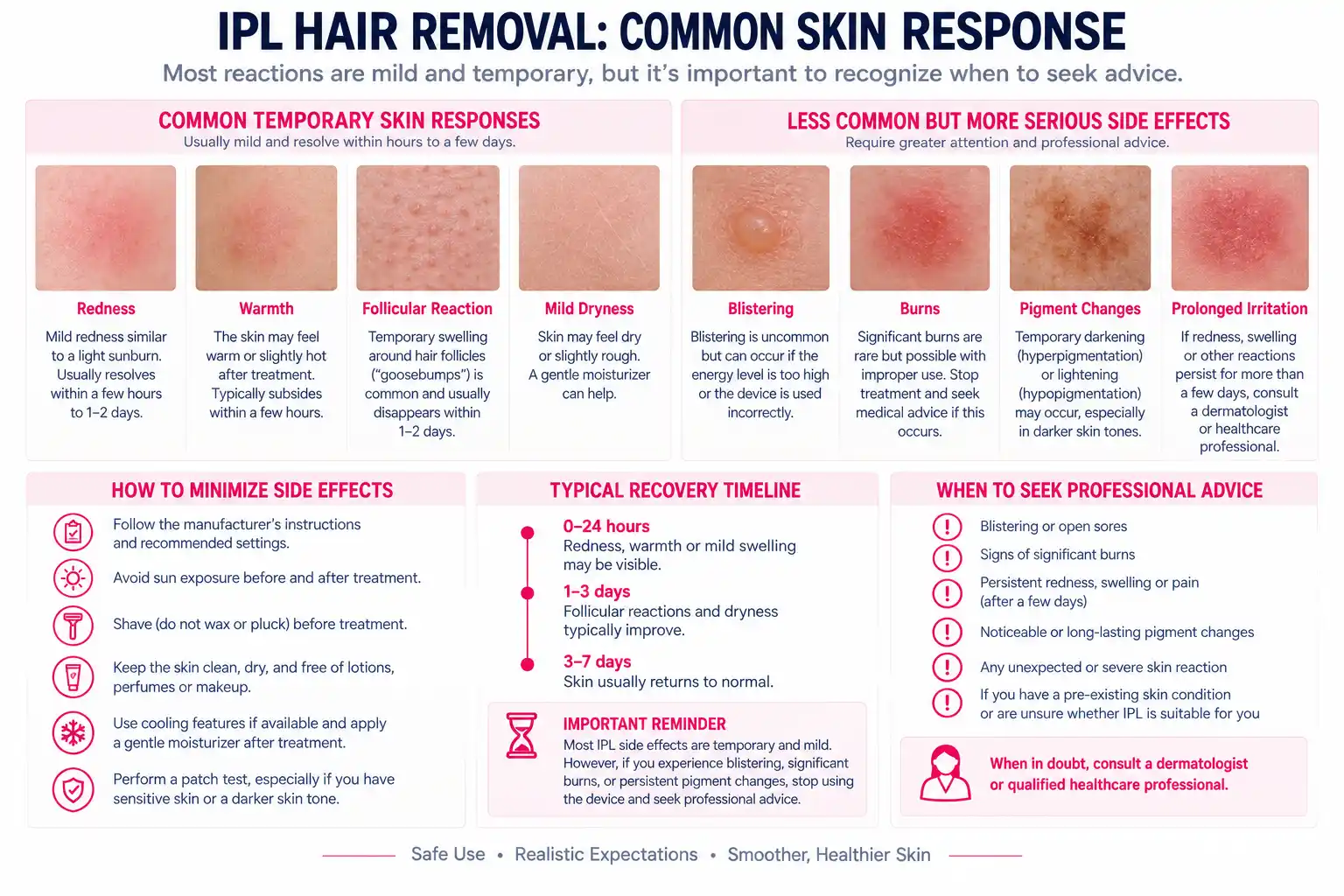
Common short-term reactions can include:
- Temporary redness
- A sensation of warmth
- Mild tenderness or sensitivity
- Temporary swelling around treated follicles
- Mild skin irritation
- Temporary dryness or sensitivity in the treated area
These reactions are different from more concerning complications such as significant blistering, severe or persistent pain, extensive burns, or pronounced changes in skin color.
| Possible Reaction | Typical Concern Level | What to Watch For |
|---|---|---|
| Temporary redness | Common short-term response | Whether it settles rather than becoming increasingly severe |
| Mild warmth or tenderness | Can occur after treatment | Persistent or worsening pain is more concerning |
| Localized follicular swelling | Can occur temporarily | Monitor for unusual or prolonged inflammation |
| Burning or blistering | More significant adverse effect | Stop further treatment and seek appropriate advice |
| Darkening or lightening of skin | Potential pigmentary complication | Persistent or pronounced changes deserve attention |
| Eye exposure | Potentially serious safety issue | Follow device-specific eye-safety requirements |
Why Does IPL Cause Redness After Hair Removal?
Temporary redness is one of the more commonly reported skin responses associated with light-based hair reduction.
IPL works by delivering pulses of light that can be absorbed by melanin associated with pigmented hair. The absorbed optical energy is converted into heat, which is used to affect follicular structures involved in hair growth.
Because thermal energy is involved in the process, the surrounding treatment area can temporarily appear red or feel warm.
Mild short-lived redness is therefore not the same thing as a burn. The important distinction is how intense the reaction is, whether it is improving, and whether additional symptoms such as blistering or significant pain appear.
For a deeper explanation of how the technology works, see What Is IPL? How Intense Pulsed Light Works.
Can IPL Hair Removal Burn Your Skin?
Yes. Burns are a possible complication of IPL treatment. IPL should therefore never be described as completely risk-free.
The risk can increase when excessive optical energy is absorbed by the skin rather than being sufficiently selective for the intended target. Several factors can contribute to this.
- Inappropriate treatment parameters
- Using a device on an incompatible skin tone
- Recent tanning or substantial sun exposure
- Repeated treatment of the same area outside the intended protocol
- Incorrect device use
- Failure to follow manufacturer instructions
- Inadequate professional assessment
- Device- or procedure-specific cooling issues
A significant burn should not be treated as a normal sign that the IPL treatment is “working better.” Increasing energy beyond appropriate parameters does not automatically improve hair-reduction results.
Can IPL Cause Blisters?
Blistering can occur as a more significant adverse skin reaction and should be distinguished from mild temporary redness or warmth.
If blistering, marked swelling, severe pain, open skin, or a substantial burn develops, further IPL exposure to the affected area should be avoided until the situation has been appropriately evaluated.
Significant or worsening reactions may warrant assessment by an appropriate healthcare professional.
Can IPL Cause Hyperpigmentation or Hypopigmentation?
Changes in skin pigmentation are another potential IPL side effect.
Two terms are particularly important:
- Hyperpigmentation — an area becomes darker than the surrounding skin.
- Hypopigmentation — an area becomes lighter than the surrounding skin.
IPL interacts with melanin, and melanin is present not only in hair but also in the epidermis. This is one reason skin pigmentation must be considered when selecting a device and treatment parameters.
Recent tanning can further alter the amount of epidermal melanin available to absorb light, potentially changing the safety profile of treatment.
Pigment changes may be temporary in some cases, but persistent discoloration is possible. Pronounced or persistent changes should not simply be ignored or repeatedly treated with additional IPL.
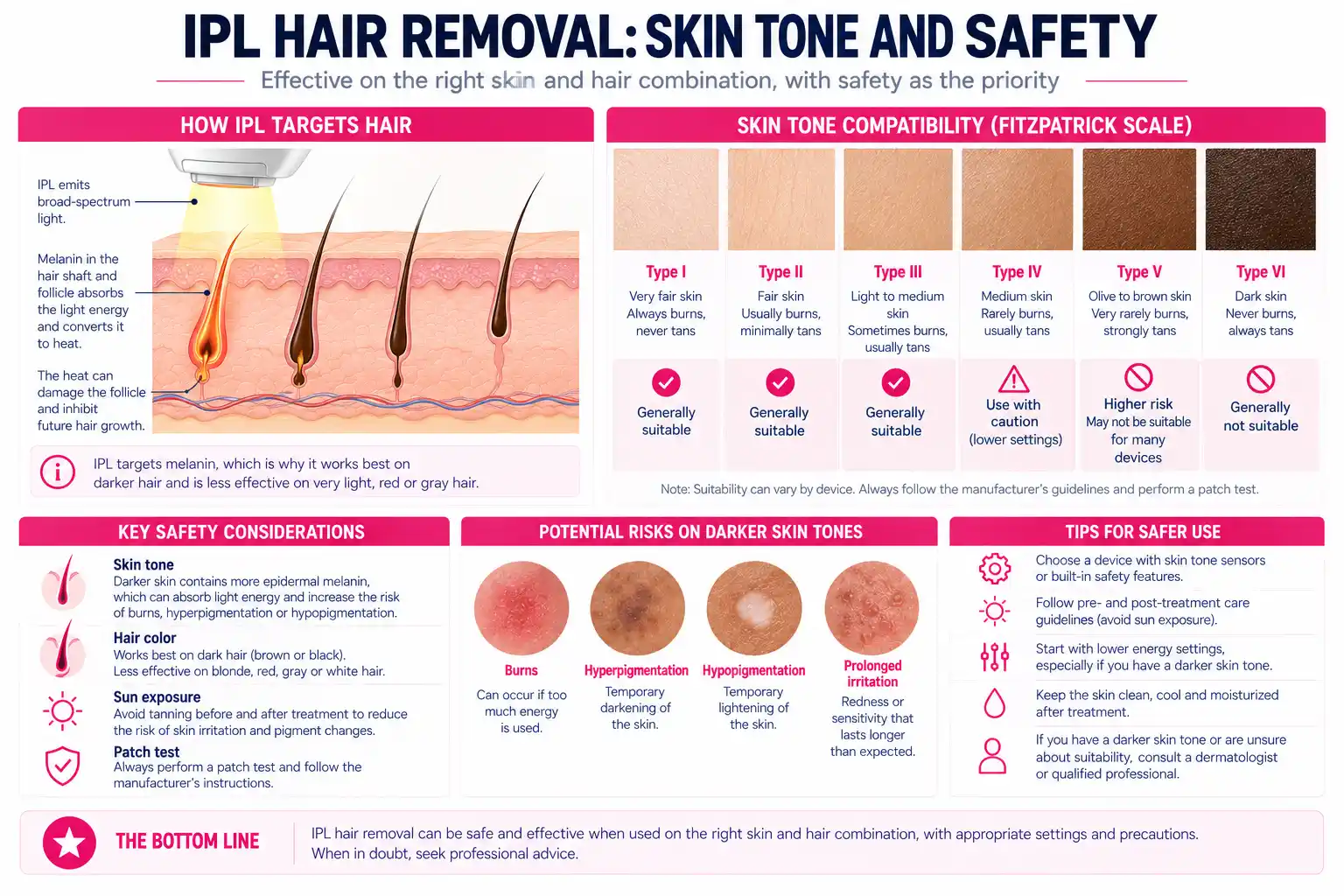
Is IPL Hair Removal Safe for Dark Skin?
IPL safety for darker skin requires particular attention because conventional IPL hair reduction relies substantially on melanin as an optical target.
The challenge is that melanin exists in both the hair and the skin. When epidermal melanin absorbs more of the delivered optical energy, unwanted heating of the skin can become a greater concern.
This does not mean that every person with darker skin must automatically be excluded from every IPL system. It means that suitability depends heavily on the specific device, its approved or intended skin-tone range, treatment parameters, cooling, and professional assessment where applicable.
A consumer should never assume that an IPL device is suitable for all skin tones simply because it is sold for home use. The manufacturer’s skin-tone compatibility guidance and contraindications should be checked before treatment.
Can IPL Damage Your Skin?
IPL can cause skin injury when treatment conditions are inappropriate. Potential adverse effects range from temporary irritation to burns and pigmentary changes.
However, the existence of these risks does not mean that skin damage is an expected outcome of every IPL treatment. The objective of appropriate treatment is to achieve the intended optical and thermal effect while limiting unnecessary exposure to surrounding tissue.
Important safety factors include:
- Correct patient or user selection
- Skin-tone compatibility
- Appropriate treatment parameters
- Correct treatment technique
- Suitable cooling where applicable
- Following the recommended treatment interval
- Observing device-specific contraindications
- Avoiding inappropriate treatment after tanning or significant sun exposure
Does IPL Hair Removal Hurt?
Sensation varies by device, treatment parameters, body area, cooling method, and individual sensitivity.
Some users describe brief warmth, snapping, stinging, or tingling during light-based hair reduction. However, significant or escalating pain should not automatically be considered a normal indication of an effective treatment.
Professional IPL systems may incorporate cooling technologies intended to manage skin temperature and treatment comfort. Consumer systems may use different contact-cooling, sensing, or energy-control strategies depending on the device.
The presence of cooling does not remove the need for correct treatment parameters and appropriate user selection.
Can IPL Damage Your Eyes?
IPL produces intense pulses of optical radiation, so eye safety must be taken seriously.
Users and operators should follow the eye-protection requirements specified for the particular device and treatment procedure. Professional systems may require appropriate protective eyewear for the operator, patient, or others present in the treatment area, according to the device instructions and applicable safety procedures.
Consumer devices may incorporate contact sensors or other design features, but these should not be treated as permission to ignore the manufacturer’s eye-safety instructions.
IPL should not be deliberately flashed toward the eyes, and treatment close to the eye requires particular caution and strict adherence to device-specific guidance.
What Increases the Risk of IPL Hair Removal Side Effects?
IPL complications are not determined by a single factor. Risk can increase when several unfavorable conditions occur together.
| Risk Factor | Why It Matters |
|---|---|
| Recent tanning | Increased epidermal pigmentation can alter light absorption in the skin. |
| Incompatible skin tone | The device may not be designed for the user’s pigmentation range. |
| Excessive treatment settings | Greater energy is not automatically safer or more effective. |
| Repeated overlapping exposure | Can increase unintended thermal exposure to the same area. |
| Ignoring contraindications | Device-specific medical and skin-related restrictions exist for a reason. |
| Incorrect treatment frequency | Treating more often than recommended does not guarantee faster results. |
| Inappropriate technique | Professional systems require trained operation and correct parameter use. |
Treatment frequency is another area where “more” should not automatically be interpreted as “better.” See our How Often Should You Use IPL Hair Removal? guide for a more detailed explanation.
Are IPL Side Effects Permanent?
Many mild treatment reactions are temporary, but it would be inaccurate to say that every IPL side effect is always temporary.
More significant thermal injury can potentially result in prolonged skin changes, and pigmentary alterations may persist in some cases. The severity and duration depend on the nature of the reaction and individual response.
This is why prevention matters more than assuming that any adverse reaction will simply disappear on its own.
Mild short-term redness and a significant burn should not be placed in the same category. Users and professionals should recognize the difference between an expected transient response and a potentially important complication.
At-Home IPL vs Professional IPL: Which Is Safer?
It is not accurate to say that at-home IPL is always safer than professional IPL, or that professional IPL is automatically safer simply because it is used in a clinic. The two categories are designed for different users and operating environments.
Consumer IPL devices typically use simplified controls and may include features such as skin-contact detection, skin-tone sensing, preset energy levels, or other safeguards intended for self-use. Professional IPL systems may provide a wider range of adjustable parameters and treatment options, but they are intended to be operated by appropriately trained professionals.
| Safety Consideration | At-Home IPL | Professional IPL |
|---|---|---|
| Intended operator | Consumer | Trained professional |
| Parameter selection | Usually simplified or partially automated | May provide broader adjustable controls |
| Skin assessment | Relies heavily on instructions and device eligibility guidance | Can include professional assessment before treatment |
| Safety features | Device-dependent consumer safeguards | Device-dependent professional controls and protocols |
| Cooling | Varies by device | May include integrated professional cooling systems |
| Misuse risk | Incorrect self-use or ignoring instructions | Incorrect assessment, parameters, or technique |
The safest option therefore depends on appropriate device selection and correct use rather than simply whether the system is labeled “home” or “professional.”
Consumers comparing home-use technologies can also read our Best At-Home Laser Hair Removal Device: IPL vs Diode Explained guide.
Who Should Avoid IPL Hair Removal?
IPL is not appropriate for every person, treatment area, or situation. Contraindications vary between devices, so the instructions for use of the specific IPL system should always take priority over generalized online advice.
Situations that may require avoiding treatment, delaying treatment, or obtaining professional advice can include:
- Skin tones outside the compatibility range specified for the device
- Recent tanning or significant sun exposure
- Active irritation, wounds, infection, or other skin problems in the treatment area
- Use of medications associated with photosensitivity
- Medical conditions associated with increased photosensitivity
- Areas or conditions specifically excluded by the device manufacturer
- Any circumstance in which the user cannot safely follow the device instructions
Professional systems may have additional contraindications and precautions based on their intended use. Operators should follow the manufacturer’s instructions, applicable training, and local professional requirements.
IPL and Photosensitizing Medications
Medications are an important part of IPL safety screening because some drugs can increase sensitivity to light or alter the skin’s response to treatment.
It would be unsafe to create one universal online list and assume it applies to every patient and every IPL system. Medication status, dose, timing, treatment indication, and the specific device can all matter.
If a medication carries a photosensitivity warning, or if there is uncertainty about its compatibility with IPL, the treatment should not simply proceed based on an internet checklist. The device instructions and advice from an appropriate healthcare professional should be followed.
Can You Use IPL Over Tattoos?
Hair-removal IPL should generally not be treated as though tattooed skin behaves the same as untreated skin.
Tattoo pigments can absorb optical energy, potentially creating unintended heating or other skin reactions. Consumer IPL instructions commonly identify tattoos or darkly pigmented areas as locations requiring avoidance or specific precautions.
Follow the instructions for the particular device and do not deliberately flash a hair-removal IPL system directly over a tattoo unless that use is specifically supported by the system’s instructions and appropriate professional protocol.
Can You Use IPL Over Moles or Dark Spots?
Darkly pigmented lesions can absorb more optical energy than the surrounding skin. They should therefore not automatically be treated like ordinary skin during IPL hair removal.
Device instructions may specify that certain dark spots, moles, birthmarks, or other pigmented areas should be avoided. If a skin lesion is new, changing, unusual, or otherwise concerning, it should be appropriately assessed rather than covered up simply so IPL treatment can continue around it.
How to Reduce the Risk of IPL Hair Removal Side Effects
No procedure can be made completely risk-free, but many avoidable IPL problems relate to inappropriate treatment conditions or failure to follow device-specific instructions.
1. Check Whether the Device Is Suitable for Your Skin Tone
Do not assume that every IPL device is suitable for every skin tone. Check the manufacturer’s compatibility information before treatment.
2. Avoid Treating Recently Tanned Skin When Contraindicated
Tanning changes epidermal pigmentation and can affect optical absorption. Follow the waiting periods and sun-exposure precautions specified for the particular device.
3. Follow the Recommended Energy Settings
Higher settings do not automatically produce better or more permanent hair reduction. Energy selection should remain within the device’s intended operating protocol.
4. Do Not Treat More Frequently Than Recommended
Hair-growth biology is one reason IPL treatment is performed as a series. Repeatedly treating the same area more often than recommended does not force follicles to move through their growth cycles faster.
5. Follow Eye-Safety Instructions
Never deliberately expose the eyes to IPL flashes. Follow all device-specific requirements for protective eyewear, treatment zones, and operator or bystander protection.
6. Do Not Ignore Contraindications
Review medication, photosensitivity, skin condition, tanning, treatment-area, and other contraindication information before beginning treatment.
7. Stop if an Unexpected Significant Reaction Develops
Continuing to repeatedly expose skin that is blistering, severely painful, burned, or developing another significant reaction may worsen the problem.
Normal IPL Reaction vs Warning Signs
One of the most useful safety distinctions is knowing the difference between a mild, temporary treatment response and a reaction that should not simply be dismissed as normal.
| Possible Short-Term Response | More Concerning Warning Sign |
|---|---|
| Mild temporary redness | Severe or worsening redness with significant pain |
| Temporary warmth | Intense or persistent burning sensation |
| Mild localized follicular swelling | Marked or progressive swelling |
| Brief sensitivity | Severe or persistent pain |
| Mild transient irritation | Blistering, open skin, or significant burn |
| Temporary mild color change | Pronounced or persistent pigmentation change |
The exact threshold for concern depends on the reaction and individual circumstances. Significant burns, blistering, eye exposure, severe pain, or worsening skin injury warrant greater attention and may require professional medical assessment.
Is IPL Safer Than Laser Hair Removal?
IPL should not automatically be described as safer or more dangerous than laser hair removal simply because the technologies use different light sources.
IPL uses broadband pulsed light, while laser hair removal systems use laser light within a comparatively narrow wavelength range. Both technologies can produce unwanted thermal effects when used inappropriately.
Safety depends on factors such as:
- Device design
- Wavelength or spectral range
- Treatment parameters
- Skin pigmentation
- Hair characteristics
- Cooling
- Treatment technique
- Operator training
- Adherence to contraindications and safety procedures
A more useful comparison is therefore whether a specific technology and device are appropriate for a particular user and treatment objective.
See our full IPL vs Laser: What’s the Difference? guide for a broader technology comparison.
Does At-Home IPL Cause Long-Term Skin Damage?
Long-term skin damage should not be considered an expected outcome of correctly used consumer IPL. However, incorrect use can cause adverse effects, and more significant thermal injury or pigment changes may persist.
The fact that a device is designed for home use does not mean its instructions, contraindications, treatment intervals, or skin-tone limitations can be ignored.
Users experiencing a significant or persistent adverse reaction should stop treating the affected area and seek appropriate professional advice rather than repeatedly testing the device on injured skin.
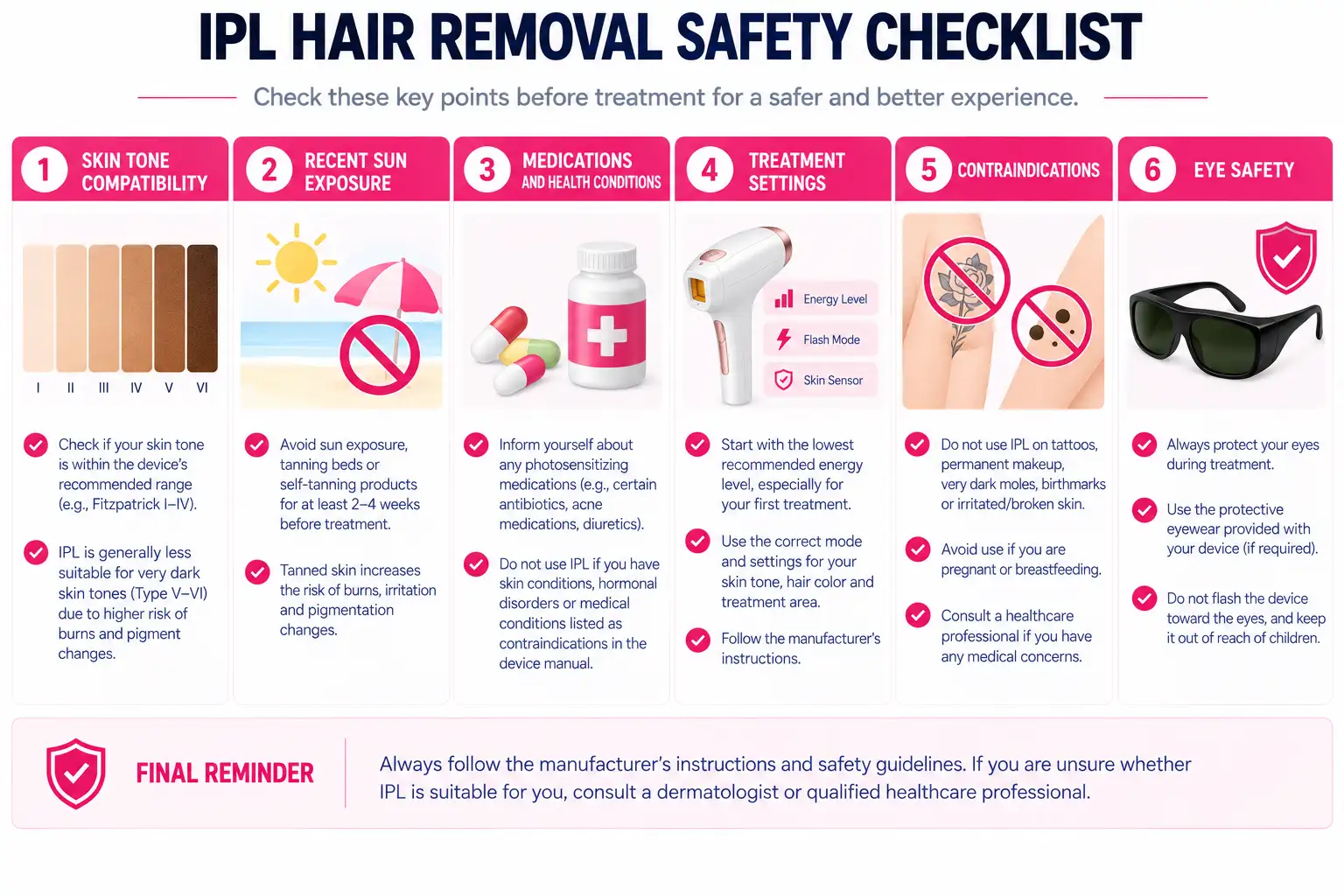
IPL Hair Removal Safety Checklist
Before using an IPL hair-removal system, consider the following basic safety questions:
- Is my skin tone within the device’s stated compatibility range?
- Have I read the contraindications and warnings?
- Have I recently tanned or had substantial sun exposure?
- Am I taking medication that may affect photosensitivity?
- Is the treatment area free from conditions excluded by the device instructions?
- Am I using an appropriate treatment setting?
- Am I following the recommended treatment interval?
- Am I following the device’s eye-safety requirements?
- Do I know when to stop treatment if an unexpected reaction occurs?
This checklist is not a substitute for the instructions supplied with a specific device or for professional medical advice where appropriate.
常见问题
Is IPL hair removal dangerous?
IPL is not inherently risk-free. Temporary skin reactions can occur, and inappropriate use can result in burns, blistering, pigment changes, or other adverse effects. Appropriate device selection, treatment parameters, safety procedures, and adherence to the manufacturer’s instructions help reduce avoidable risks.
Can IPL permanently damage your skin?
Significant thermal injury can potentially lead to prolonged or persistent skin changes, including pigmentary changes. Permanent injury is not an expected outcome of correctly performed treatment, but significant adverse reactions should be taken seriously.
Is redness normal after IPL hair removal?
Mild temporary redness can occur after IPL treatment. Severe, worsening, or persistent redness accompanied by significant pain, blistering, or other signs of injury is more concerning.
Can IPL cause hyperpigmentation?
Yes. Hyperpigmentation is a possible adverse effect, particularly when unwanted optical energy is absorbed by epidermal melanin. Skin pigmentation, recent tanning, treatment parameters, and device selection can influence risk.
Can IPL cause hypopigmentation?
Hypopigmentation is also a possible pigmentary complication. Persistent lightening of the skin after treatment should not automatically be treated with additional IPL without appropriate assessment.
Can IPL burn dark skin?
Burns are possible when excessive optical energy is absorbed by the skin. Because epidermal melanin influences light absorption, skin-tone compatibility is particularly important. The specific device’s stated skin-tone range and treatment guidance should be followed.
Is at-home IPL safe?
Home IPL devices are designed for consumer use, but they still have contraindications, skin-tone limitations, treatment instructions, and safety requirements. Safe use depends on following the instructions for the specific device.
Can IPL damage your eyes?
Intense optical exposure can present an eye-safety risk. Do not deliberately flash IPL toward the eyes, and follow all protective measures and treatment-area restrictions specified for the device.
Should IPL hair removal hurt?
Brief warmth, tingling, stinging, or similar sensations can occur depending on the system and treatment. Severe or escalating pain should not be interpreted as evidence that the treatment is simply working more effectively.
Final Verdict: Is IPL Hair Removal Safe?
IPL can be used safely for appropriately selected users when the device, treatment parameters, skin characteristics, treatment technique, and safety procedures are appropriately matched. However, IPL is not completely risk-free.
Mild temporary redness, warmth, sensitivity, or localized swelling can occur after treatment. More significant complications can include burns, blistering, pigmentation changes, and injury associated with inappropriate optical exposure.
Skin tone, tanning, medications, photosensitivity, treatment frequency, energy settings, eye safety, and device-specific contraindications all deserve attention. Professional systems also require appropriate assessment, training, and treatment protocols.
Most importantly, greater discomfort, higher energy, or more frequent treatment should never automatically be interpreted as better IPL treatment. The goal is an appropriate optical treatment with unnecessary exposure to surrounding tissue kept as low as reasonably achievable within the intended procedure.
If you are researching IPL before treatment, continue with our What Is IPL?, How Often Should You Use IPL?, and Is IPL Hair Removal Permanent? guides.