Is IPL Hair Removal Permanent?
IPL hair removal can produce significant, long-lasting hair reduction, but calling it completely permanent can be misleading. Some treated hairs may remain absent for long periods, while others can gradually return as finer, lighter, or less noticeable growth. Maintenance treatments may also be needed over time.
The reason is that IPL does not affect every hair follicle equally at every treatment. Hair-growth cycles, hair color, skin tone, treatment area, device characteristics, treatment consistency, and individual biological factors can all influence how much reduction occurs and how long the results last.
This guide explains what “permanent” really means for IPL hair removal, whether hair can grow back, why multiple sessions are needed, and what you can realistically expect from long-term IPL hair reduction.
Quick Answer: Is IPL Hair Removal Permanent?
IPL is better described as a method for long-term hair reduction rather than a guarantee that every treated hair will be permanently removed forever.
IPL uses pulses of broad-spectrum light that can be absorbed by melanin in pigmented hair. This optical energy is converted into heat and can affect follicular structures involved in future hair growth. After an effective treatment series, users may experience fewer visible hairs, slower regrowth, reduced density, and finer hair.
However, some hair can return over time. Results vary according to hair and skin characteristics, treatment area, device and treatment parameters, hair-growth cycles, and individual biological factors. Periodic maintenance treatments may therefore be appropriate for some users.
What Does “Permanent Hair Removal” Actually Mean?
Much of the confusion around IPL begins with the word permanent.
Consumers may interpret permanent hair removal as meaning that every treated follicle is completely eliminated and that hair can never grow in the area again. That is not a useful expectation for IPL.
A successful IPL treatment course may substantially reduce visible hair growth for an extended period, but the amount and duration of reduction can vary between individuals. Some hairs may remain absent, while others may eventually become visible again.
| Term | What It Means |
|---|---|
| Permanent hair removal | Commonly understood by consumers as complete and irreversible elimination of hair from the treated area. |
| Long-term hair reduction | A sustained reduction in the amount, density, or visibility of hair after completing an appropriate treatment series. |
| Maintenance treatment | Additional treatment performed after the initial series when noticeable regrowth occurs or according to the recommended treatment protocol. |
For someone considering IPL, the more useful questions are therefore: How much hair reduction can I achieve? How long might it last? Will the hair grow back? And will I need maintenance?
How Does IPL Reduce Hair Growth?
IPL stands for Intense Pulsed Light. Unlike a laser, which emits light within a comparatively narrow wavelength range, IPL systems produce broadband pulsed light that can be filtered for particular applications.
During hair reduction treatment, suitable wavelengths can be absorbed by melanin associated with pigmented hair. The absorbed optical energy is converted into heat, which can affect structures within or around the hair follicle that contribute to future hair growth.
This process is related to the principle of selective photothermolysis: using an appropriate combination of wavelength, pulse characteristics, and energy so that the intended chromophore absorbs optical energy while unnecessary thermal exposure to surrounding tissue is limited.
This is also why IPL results depend on more than simply how powerful a flash appears. Spectral output, filters, pulse duration, delivered energy, skin pigmentation, hair pigmentation, cooling, and treatment technique can all influence the interaction between light and tissue.
For a more detailed explanation of the technology, read our What Is IPL? How Intense Pulsed Light Works guide.
Why Does IPL Hair Removal Require Multiple Sessions?
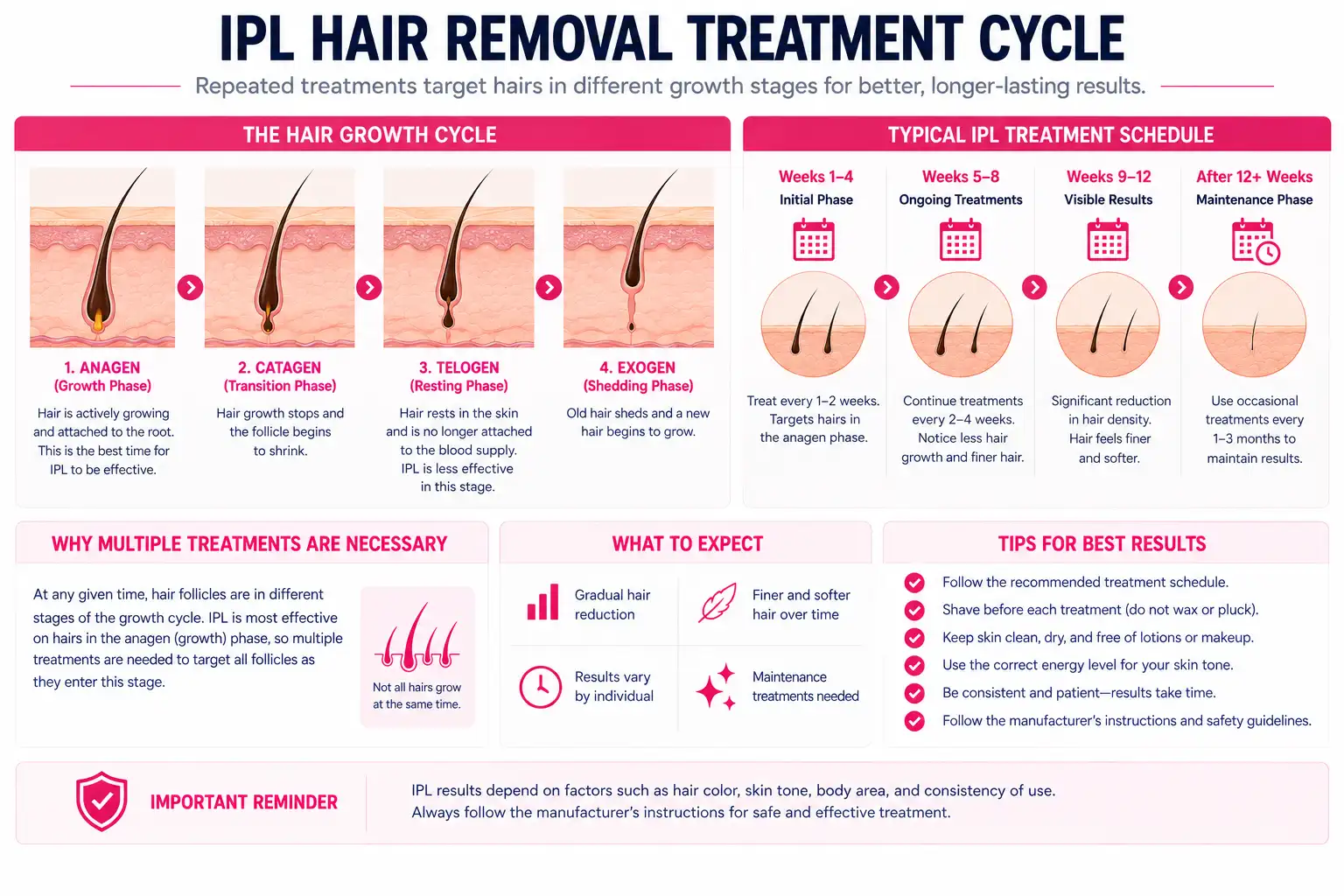
One IPL session cannot effectively address every hair in a treatment area because individual follicles are not synchronized.
Hair moves through different stages of a growth cycle, commonly described as:
- Anagen: the active growth phase.
- Catagen: a transitional phase.
- Telogen: a resting phase before the cycle begins again.
Light-based hair reduction generally works best when the optical and biological conditions allow energy absorbed by pigmented hair to affect the relevant follicular structures. Because only part of the hair population is in the appropriate stage at a given time, repeated sessions are used to treat additional hairs as they progress through their cycles.
This is one of the main reasons claims suggesting that a single IPL session can permanently eliminate all unwanted hair should be treated cautiously.
Does Hair Grow Back After IPL?
Yes, some hair can grow back after IPL. However, regrowth does not necessarily mean that the treatment failed.
Following an effective treatment series, hair that becomes visible again may differ from the original growth. Depending on the individual response, you may notice:
- Fewer visible hairs
- Reduced overall hair density
- Slower regrowth
- Finer or less noticeable hairs
- Patchier growth
- Longer intervals before noticeable regrowth
The amount of regrowth can also differ between treatment areas. Results on the legs, face, underarms, bikini area, or other body areas should not automatically be expected to behave identically.
The important distinction is that hair growing back after IPL does not necessarily mean that the treated area has returned to its original hair density, thickness, or growth rate.
How Long Does IPL Hair Removal Last?
There is no universal number of months or years that IPL results will last for every person. Some users experience extended periods of noticeably reduced hair growth after completing an initial treatment series, while others see gradual regrowth sooner.
How long IPL hair removal results last can be influenced by:
- Hair color and melanin content
- Hair thickness and density
- Skin pigmentation
- The area being treated
- The IPL system being used
- Treatment parameters
- Consistency during the initial treatment course
- Individual hair-growth cycles
- Age and biological variation
- Hormonal influences
- Whether maintenance treatments are performed
For this reason, statements such as “IPL lasts exactly six months” or “IPL permanently removes hair after a fixed number of sessions” are too simplistic.
Why Do Some People Need IPL Maintenance Treatments?
Maintenance treatments are common with long-term light-based hair reduction because hair growth is biologically dynamic. Previously less responsive follicles may produce visible hair later, and changes in the body can influence future growth.
A maintenance treatment is therefore not necessarily evidence that the initial treatment series was unsuccessful. Instead, it can be part of maintaining the degree of hair reduction already achieved.
There is no single maintenance schedule that is appropriate for everyone. Professional IPL systems and consumer IPL devices can also have very different treatment protocols.
Home users should follow the instructions provided for their specific device rather than automatically increasing treatment frequency whenever they notice regrowth.
For a detailed discussion of treatment intervals, see How Often Should You Use IPL Hair Removal? .
What Determines How Long IPL Results Last?
IPL outcomes are influenced by the interaction between the user, the hair, the treatment area, the device, and the treatment protocol. This explains why two people can follow similar schedules but experience different degrees of long-term reduction.
Hair Color
Melanin is an important optical target in conventional IPL hair reduction. Dark pigmented hair generally provides a stronger optical target than hair containing very little melanin.
Very light blonde, white, gray, and some red hair may therefore respond poorly to conventional melanin-targeting IPL systems.
Skin Tone
Melanin is also present in the skin, so skin pigmentation influences how optical energy is absorbed in the treatment area. Device suitability and appropriate treatment parameters therefore matter.
Users should follow the skin-tone compatibility guidance for their specific device rather than assuming that every IPL system is suitable for every skin tone.
Treatment Area
Hair thickness, density, growth rate, and hormonal influence vary by body area. Facial hair, leg hair, underarm hair, and bikini-area hair can therefore respond differently and may not require identical maintenance strategies.
Treatment Consistency
Repeated sessions are intended to address hairs as they move through different growth stages. Frequently skipping scheduled treatments during the initial course may reduce the opportunity to treat those hairs under favorable conditions.
Consistency is generally more important than attempting to compensate by using IPL more frequently than recommended.
Device and Treatment Parameters
Not every IPL system is identical. Devices can differ in spectral output, optical filtering, pulse characteristics, delivered fluence, treatment-window size, cooling, and other engineering characteristics.
Professional IPL platforms and consumer home devices can also be designed around very different operating environments. The word IPL alone therefore does not tell you how a particular system will perform.
Hormonal and Biological Factors
Hair growth can change over time as a result of age, hormonal influences, and other biological factors. New or increased hair growth may therefore become noticeable even in an area that previously responded well to treatment.
If there is an unexpected or substantial change in hair growth that raises a health concern, appropriate medical evaluation may be more useful than simply increasing IPL treatment frequency.
At-Home IPL vs Professional IPL: Are the Results the Same?
At-home IPL and professional IPL are based on related light-based principles, but they should not be assumed to deliver identical treatment experiences or results.
Consumer IPL devices are designed for self-use and generally prioritize ease of operation, built-in safety controls, portability, and simplified treatment settings. Professional IPL platforms are designed for trained operators and may provide broader control over treatment parameters, larger treatment areas, different filtering options, more substantial cooling systems, and workflows intended for repeated clinical use.
| Feature | At-Home IPL | Professional IPL |
|---|---|---|
| Intended user | Consumer | Trained professional |
| Primary design priority | Convenience and self-use | Professional treatment workflow |
| Parameter control | Usually simplified | May offer broader device-dependent control |
| Cooling | Device-dependent | May use more substantial integrated cooling systems |
| Treatment planning | User follows manufacturer instructions | Professional assessment and device-specific protocol |
| Maintenance | Often incorporated into continued home use | Scheduled according to response and professional assessment |
This does not mean that every professional IPL system will outperform every consumer device in every situation. Device design, treatment parameters, user characteristics, treatment consistency, and operator technique all matter.
The important point is that “IPL” describes a technology category rather than one standardized treatment system.

IPL vs Laser Hair Removal: Which Gives Longer-Lasting Results?
Both IPL and laser technologies can be used for long-term hair reduction, but they deliver light differently.
IPL uses broadband pulsed light that is filtered for the intended application. Laser hair removal systems use a laser source operating within a comparatively narrow wavelength range. Professional hair removal platforms may use technologies such as diode, alexandrite, or Nd:YAG lasers depending on system design.
It is tempting to ask whether laser is simply “more permanent” than IPL, but the comparison is not that straightforward.
Long-term results can depend on:
- The specific IPL or laser system
- Wavelength or spectral range
- Delivered fluence
- Pulse characteristics
- Hair pigmentation and thickness
- Skin pigmentation
- Treatment area
- Cooling and treatment technique
- Number and timing of sessions
- Individual biological response
Therefore, it is more accurate to compare specific technologies and treatment protocols than to assume that every laser treatment produces longer-lasting results than every IPL treatment.
For a full technology comparison, read IPL vs Laser: What’s the Difference?.
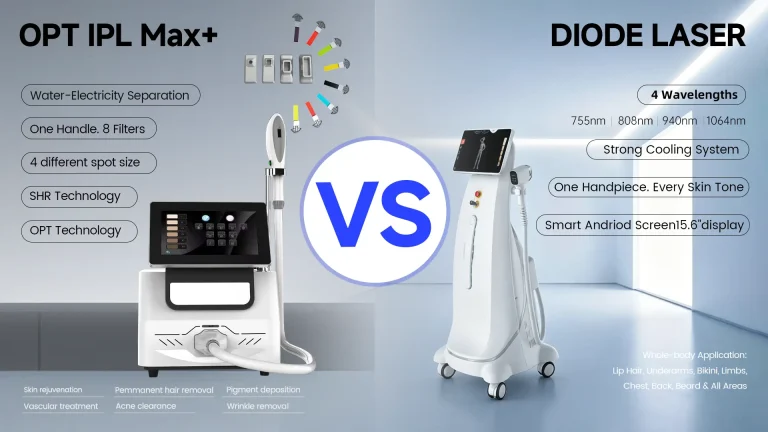
IPL vs Diode Laser Hair Removal
Diode laser and IPL are particularly important to distinguish because both are widely associated with professional hair reduction, yet they are different optical technologies.
A diode laser produces laser light within a defined wavelength range according to the system design. Professional diode platforms are commonly built around wavelengths in the approximate 800–810 nm region, while multi-wavelength platforms may combine additional wavelengths.
IPL instead produces broadband pulsed light that is filtered to deliver a selected range of wavelengths.
| Characteristic | IPL | Diode Laser |
|---|---|---|
| Light source | Broad-spectrum pulsed light | Laser diode |
| Spectral output | Filtered wavelength range | Comparatively narrow wavelength range |
| Hair reduction | Yes, when appropriately applied | Yes, when appropriately applied |
| Multiple sessions required | Yes | Yes |
| Maintenance may be needed | Yes | Yes |
| Professional systems available | Yes | Yes |
Neither technology should be described as a universal solution for every person. Device design, treatment parameters, hair characteristics, skin type, and professional assessment remain important.
If you are comparing consumer devices rather than professional platforms, see our Best At-Home Laser Hair Removal Device: IPL vs Diode Explained guide.
Is IPL More Permanent Than Electrolysis?
IPL and electrolysis should not be treated as interchangeable technologies.
IPL is a light-based method that can treat multiple hairs across a treatment area during a session. Electrolysis works on individual follicles using a fine probe and electrical energy.
For users researching the word permanent, this distinction matters. IPL is more appropriately discussed in terms of long-term hair reduction, whereas electrolysis is a different follicle-by-follicle approach.
Which option is appropriate depends on factors such as hair characteristics, treatment area, treatment goals, time commitment, skin characteristics, and professional assessment.
This article focuses specifically on IPL, so a detailed IPL-versus-electrolysis comparison is better treated as a separate topic rather than compressing two very different technologies into a simple “which is better” answer.
How Can You Help IPL Results Last Longer?
There is no method that can guarantee permanent IPL results, but following an appropriate treatment protocol can help avoid preventable reasons for poor or inconsistent results.
Follow the Recommended Initial Treatment Schedule
IPL treatment schedules are designed around repeated exposure across changing hair-growth cycles. Skipping much of the initial course may reduce treatment consistency.
Do Not Treat More Often Than Recommended
More frequent treatment does not automatically produce faster or more permanent results. Follow the instructions for the specific consumer device or the protocol established by the treating professional.
Use Appropriate Device Settings
Treatment settings should be appropriate for the device, treatment area, skin characteristics, and user. Higher energy should not automatically be interpreted as better treatment.
Follow Device-Specific Skin Preparation Instructions
Preparation requirements can differ between devices and treatment settings. Follow the manufacturer’s instructions or professional guidance rather than applying a universal preparation routine to every IPL system.
Use Maintenance Treatments When Appropriate
If visible hair gradually returns after the initial treatment course, maintenance treatments may help preserve the degree of reduction achieved.
Common Misconceptions About Permanent IPL Hair Removal
“IPL Permanently Removes 100% of Hair”
This is not a realistic universal expectation. Treatment response varies, and some hair may eventually become visible again.
“If Hair Grows Back, IPL Didn’t Work”
Regrowth alone does not demonstrate treatment failure. A treated area may still have much lower density, finer hair, or slower growth than before treatment.
“More IPL Sessions Always Mean Better Results”
Treatment frequency and total number of sessions should follow an appropriate protocol. Excessive treatment does not guarantee better results and may increase unnecessary skin exposure.
“Every IPL Device Produces the Same Results”
IPL devices differ in optical design, filtering, pulse characteristics, energy delivery, cooling, treatment-window size, safety controls, and intended use.
“IPL Works Equally Well on Every Hair Color”
Conventional IPL hair reduction relies substantially on melanin as an optical target. Hair with very little melanin can therefore be more difficult to treat effectively.
Who Is a Good Candidate for IPL Hair Reduction?
Suitability depends on the specific IPL device and individual characteristics rather than a single rule that applies to everyone.
Factors commonly considered include:
- Hair pigmentation
- Skin pigmentation
- Hair thickness
- Treatment area
- Recent sun exposure or tanning
- Medications or conditions that may affect light sensitivity
- The intended IPL system and its instructions for use
Consumer IPL users should carefully follow the device manufacturer’s contraindications, skin-tone guidance, treatment instructions, and safety information.
Professional treatment should involve appropriate assessment before parameters are selected.
When Should You Not Use IPL?
IPL is not appropriate for every person or every situation. Contraindications and precautions vary by device, so the instructions for the specific system take priority.
Particular caution may be required where there is recent tanning, significant photosensitivity, certain medications, active skin problems in the treatment area, or other conditions identified by the device manufacturer or healthcare professional.
Do not attempt to compensate for poor results by repeatedly increasing treatment frequency or energy outside the recommended operating instructions.
IPL Hair Removal: Permanent Removal or Long-Term Reduction?
The most useful way to think about IPL is not as a promise that every hair follicle will disappear forever, but as a technology capable of producing meaningful long-term reduction in visible hair growth when the user, device, treatment parameters, and protocol are appropriately matched.
| Question | Short Answer |
|---|---|
| Is IPL hair removal permanent? | It is better described as long-term hair reduction rather than guaranteed permanent elimination of every hair. |
| Can hair grow back after IPL? | Yes. Some regrowth can occur, although it may be finer, slower, or less dense. |
| How long do IPL results last? | Duration varies by individual, treatment area, device, protocol, and biological factors. |
| Do you need maintenance IPL? | Some users may benefit from periodic maintenance treatments. |
| Does one IPL session work permanently? | No. Hair-growth cycles are one reason a treatment series is normally required. |
常见问题
Does IPL hair removal last forever?
IPL should not be expected to guarantee that no hair will ever grow in the treated area again. It can provide long-lasting hair reduction, but some regrowth may occur and maintenance treatments may be needed.
Does hair grow back thicker after IPL?
Successful IPL treatment is intended to reduce visible hair growth rather than make hair thicker. However, individual responses vary, and changes in hair growth can also be influenced by biological and hormonal factors unrelated to the treatment itself.
How many IPL sessions are needed for permanent hair removal?
There is no universal number of IPL sessions that guarantees permanent removal. Multiple treatments are generally required because hairs are in different growth stages, and the appropriate schedule depends on the device, treatment area, and individual response.
Do I have to keep using IPL forever?
Not necessarily on the same schedule as the initial treatment course. After achieving a satisfactory reduction, some users transition to less frequent maintenance treatments when needed or according to device-specific guidance.
What happens if you stop using IPL?
Hair growth may gradually become more noticeable over time. The degree of regrowth varies between individuals and does not necessarily mean the treated area will immediately return to its original hair density.
Is professional IPL more permanent than at-home IPL?
Professional systems and consumer devices differ in design, operating parameters, cooling, controls, and intended use. However, it is not accurate to say that every professional IPL treatment is automatically permanent or that all home IPL devices produce the same level of reduction.
Is laser hair removal more permanent than IPL?
Both technologies can provide long-term hair reduction. Results depend on the specific technology, device, treatment parameters, hair and skin characteristics, treatment schedule, and individual response. The word “laser” alone does not guarantee permanent removal.
Can IPL permanently remove facial hair?
IPL may reduce suitable pigmented facial hair, but permanent elimination of every facial hair should not be guaranteed. Facial hair growth can also be strongly influenced by biological and hormonal factors.
Final Verdict: Is IPL Hair Removal Really Permanent?
IPL can provide substantial and long-lasting hair reduction, but it should not be presented as a guarantee that every treated hair will disappear permanently.
Effective treatment can leave fewer visible hairs, slower regrowth, reduced density, and finer hair for extended periods. However, some follicles may produce visible hair again, and maintenance treatments may be appropriate over time.
The durability of IPL results depends on multiple factors, including hair pigmentation, skin characteristics, treatment area, hair-growth cycles, device design, treatment parameters, treatment consistency, and individual biology.
For users comparing hair reduction technologies, the more useful question is therefore not simply “Is IPL permanent?” but “Which technology and treatment approach is appropriate for my hair, skin, treatment area, and long-term goals?”
To continue comparing the available options, read our IPL vs Laser guide or explore our Best At-Home Laser Hair Removal Device: IPL vs Diode Explained comparison.