How Often Should You Use IPL Hair Removal?
If you are considering IPL hair removal, one of the most common questions is: how often should IPL treatments be performed?
More frequent treatment does not necessarily produce faster or better hair reduction. IPL works partly because treatments are repeated over time to address hairs as they progress through different stages of the hair growth cycle.
The appropriate interval depends on the treatment area, hair-growth pattern, device, treatment parameters, individual response, and whether you are talking about a professional IPL system or an at-home IPL device.
This guide explains how often IPL hair removal is typically performed, why treatment intervals matter, how schedules can differ by body area, what happens if IPL is used too frequently, and when maintenance treatments may be considered.
Quick Answer
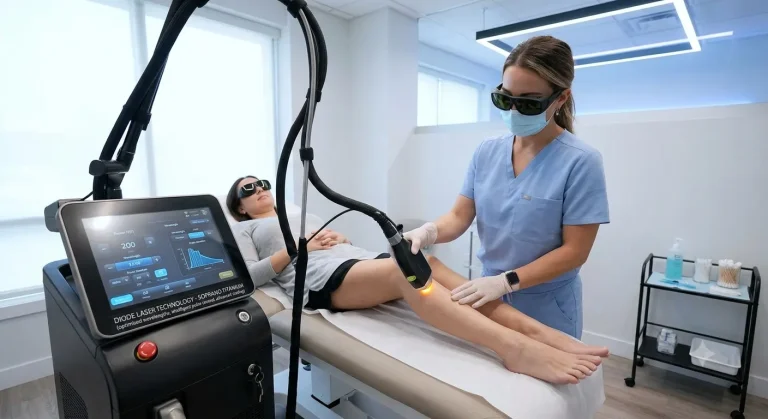
Professional IPL hair removal is generally performed as a series of treatments separated by several weeks rather than being used every day or every few days.
The exact interval varies according to the treatment area, hair-growth cycle, individual response, device, and professional treatment protocol. Areas with relatively faster hair-growth cycles may be treated at different intervals from areas where hair cycles more slowly.
At-home IPL devices may recommend more frequent use during an initial treatment phase, sometimes on a weekly or biweekly schedule depending on the device. These instructions should not be applied directly to professional IPL equipment.
Always follow the treatment schedule specified for the particular IPL system rather than increasing treatment frequency in an attempt to accelerate results.
How Often Should You Use IPL Hair Removal?
There is no single IPL treatment interval that applies to every person, body area, and device.
For professional hair reduction, treatments are commonly spaced over a period of weeks so that subsequent sessions can address hairs entering a more treatment-responsive stage of the growth cycle.
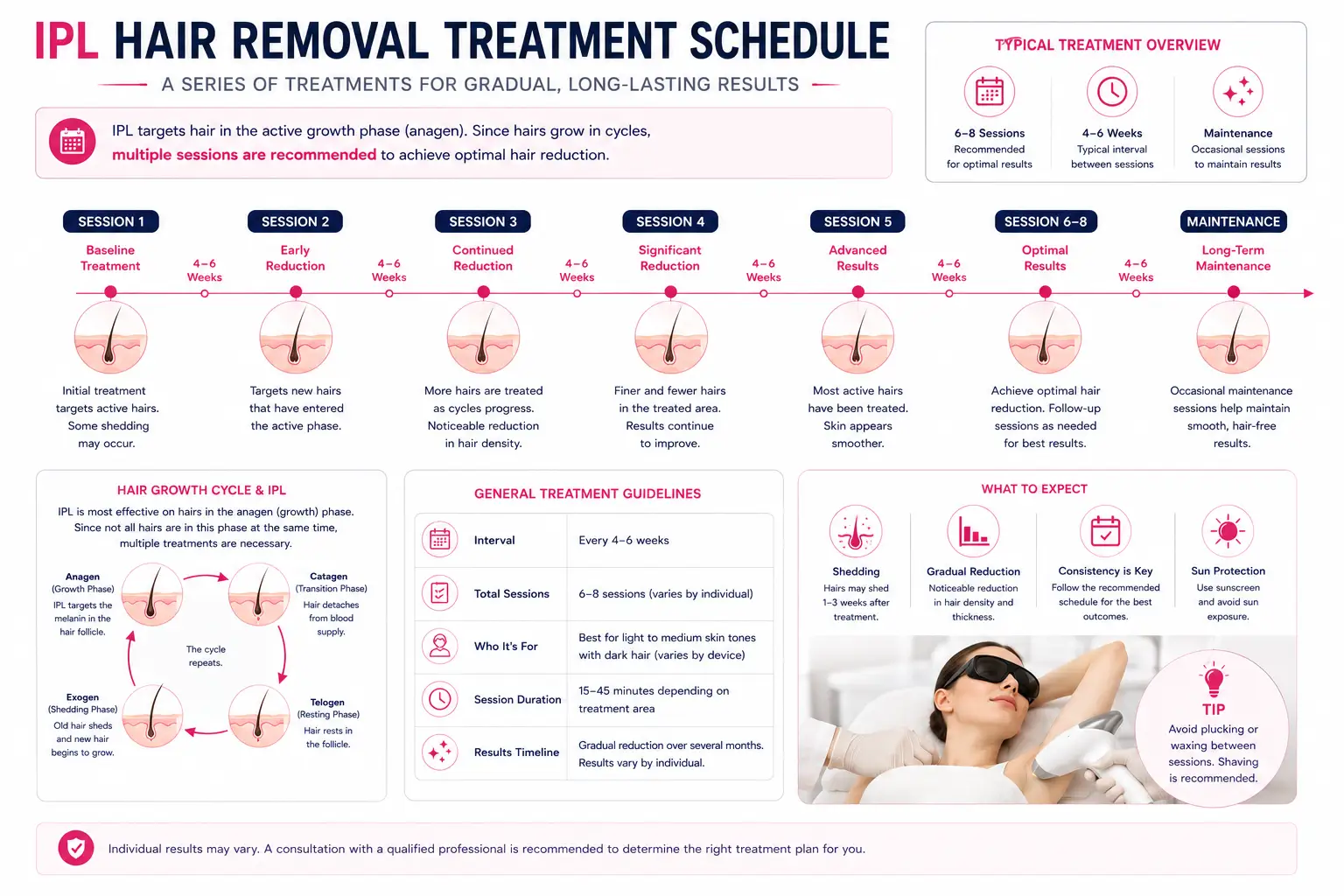
A simplified professional treatment pattern may look like this:
| Treatment Stage | General Approach | Main Objective |
|---|---|---|
| Initial Treatment | Professional assessment and first IPL session | Begin the treatment series using appropriate parameters |
| Early Treatment Series | Sessions generally separated by several weeks | Address additional hairs as growth cycles progress |
| Later Treatment Series | Intervals may be adjusted according to regrowth and response | Continue reducing visible regrowth |
| Maintenance | Performed when clinically appropriate based on later regrowth | Address residual or returning hair over time |
This is a general framework rather than a universal treatment prescription.
The instructions and protocol for the specific professional IPL system should determine the actual treatment interval.
Why Do You Have to Wait Between IPL Sessions?
The need for repeated IPL treatments is closely related to the biology of hair growth.
Hair follicles do not all grow at the same time.
At any given moment, hairs within the same treatment area can be at different stages of the hair-growth cycle.
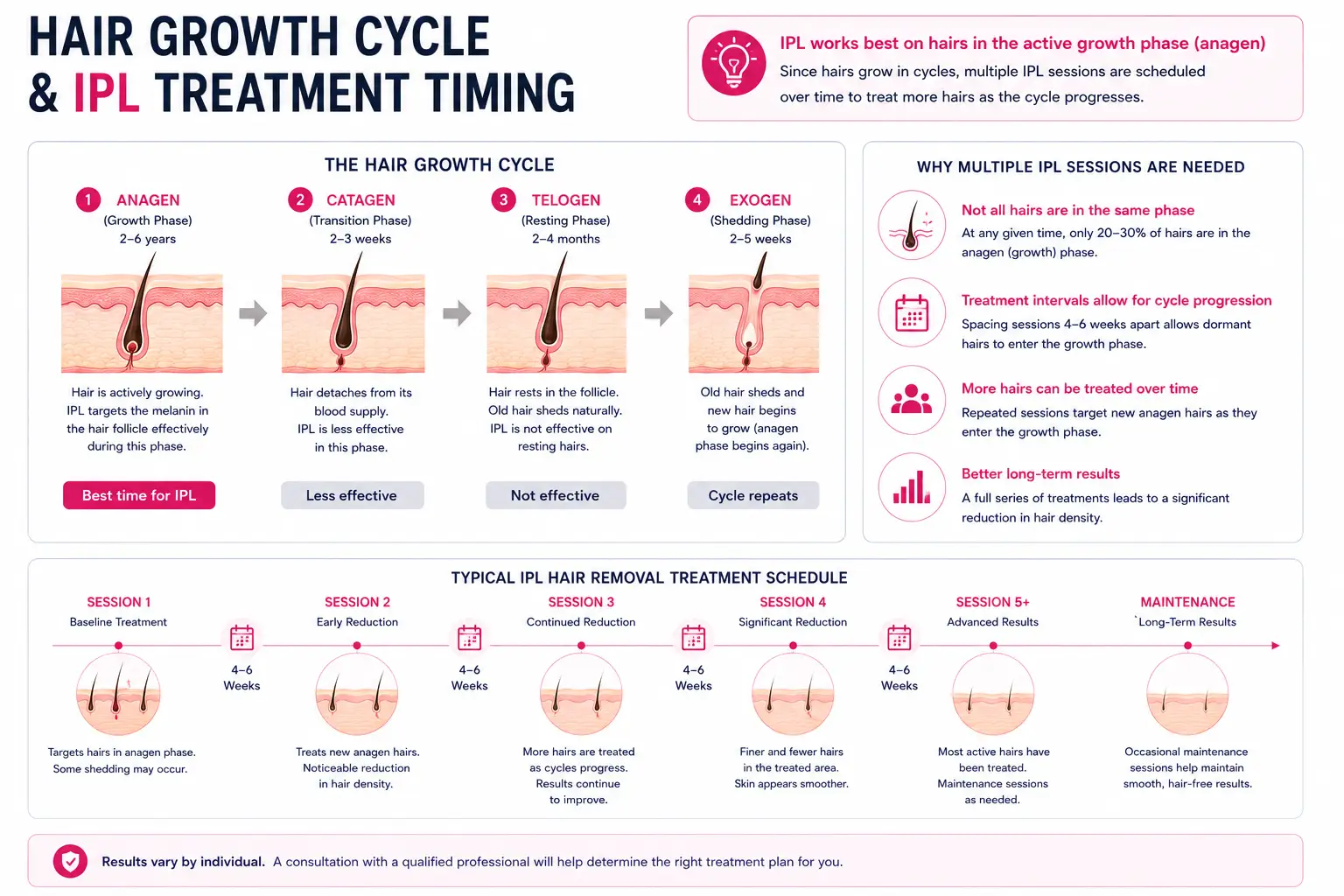
The major stages are commonly described as:
- Anagen — active growth
- Catagen — transitional phase
- Telogen — resting phase
There is also a shedding stage sometimes described separately as exogen.
Light-based hair reduction is generally most dependent on hairs that provide an appropriate optical and biological target during the treatment period.
Because only a proportion of hairs are in the same stage at one time, repeating treatments over an appropriate schedule helps address additional hairs as the growth cycle progresses.
How the Hair Growth Cycle Affects IPL Treatment Frequency
The hair-growth cycle is one of the main reasons IPL is not simply repeated as often as possible.
Performing another treatment immediately after the previous session does not suddenly move resting follicles into active growth.
This means that shortening the interval beyond the protocol recommended for the device may add unnecessary skin exposure without proportionally increasing the number of useful hair targets.
Treatment scheduling therefore attempts to balance:
- Hair-growth biology
- Visible regrowth
- Skin recovery
- Treatment response
- Body area
- Device-specific protocol
This is also why a complete hair-reduction program is normally planned as a series of sessions rather than one intensive treatment.
How Long Should You Wait Between IPL Hair Removal Sessions?
For professional IPL, treatment intervals are commonly measured in weeks rather than days.
Depending on the body area and professional protocol, initial intervals may often fall within a broad range of approximately several weeks between sessions.
Some protocols may use shorter intervals for areas where visible hair returns more quickly and longer intervals for slower-cycling body areas.
Rather than applying one fixed number to every patient, professionals may consider:
- Where the hair is located
- How quickly visible regrowth occurs
- Hair density
- Hair thickness
- Hair color
- Skin phototype
- Response to previous treatment
- Skin response after the previous session
- Device instructions and protocol
As treatment progresses and regrowth becomes slower or less dense, the timing of later sessions may also change.
IPL Hair Removal Schedule by Body Area
Hair-growth behavior differs across the body, which is one reason treatment intervals are not necessarily identical for the face, underarms, bikini area, legs, and back.
The following table should be understood as a general scheduling concept rather than a treatment prescription. The specific device protocol and professional assessment should take priority.
| Body Area | General Scheduling Consideration | Why Timing May Differ |
|---|---|---|
| Face | May require relatively closer monitoring of regrowth | Facial hair can show different growth behavior and may be influenced by hormonal factors |
| Underarms | Sessions are generally spaced over multiple weeks | Dense, pigmented hair can provide a strong optical target in suitable candidates |
| Bikini Area | Generally treated as a multi-session series | Hair density and thickness influence treatment planning |
| Legs | Intervals may become longer as regrowth slows | Large treatment area and different hair-cycle behavior |
| Back | Timing should follow visible regrowth and protocol | Hair density, area size, and individual growth patterns vary substantially |
| Arms | Generally treated over a series of sessions | Hair density and pigmentation vary considerably between individuals |
This is why a clinic should not automatically schedule every IPL hair-removal patient at exactly the same interval regardless of treatment area.
How Often Can You Use IPL on Your Face?
Facial hair should not simply be treated as frequently as possible.
Professional IPL treatment frequency should follow the specific device protocol and account for visible regrowth, skin response, hair characteristics, and the reason for unwanted facial hair.
Facial hair can also be influenced by hormonal factors, which may affect treatment response and long-term regrowth.
Increasing treatment frequency does not resolve an underlying hormonal driver and may unnecessarily increase repeated skin exposure.
Professional assessment is particularly important when facial hair growth changes unexpectedly or is associated with other clinical concerns.
How Often Can You Use IPL on Your Underarms?
Underarm hair is commonly treated through a multi-session IPL program with sessions separated according to the device protocol and hair-regrowth pattern.
Because underarm hair can be relatively coarse and pigmented, it may provide a useful optical target in appropriately selected patients.
However, the next session should still be based on the planned treatment schedule rather than performed immediately when the first new hairs become visible.
How Often Can You Use IPL on the Bikini Area?
IPL treatment of the bikini area is also generally performed as a series rather than through very frequent repeated exposures.
Treatment planning should consider:
- Hair density
- Hair thickness
- Skin pigmentation
- Recent sun exposure
- Previous treatment response
- Skin sensitivity
- Device-specific parameters and instructions
Appropriate treatment boundaries and device-specific safety instructions are also important for sensitive anatomical areas.
How Often Can You Use IPL on Your Legs?
Legs cover a relatively large treatment area and can have different hair-growth timing from facial areas.
Professional treatment sessions are generally scheduled over multiple weeks, with later intervals potentially adjusted as hair density and visible regrowth change.
Large-area treatment also makes equipment factors such as spot size, repetition rate, cooling, and treatment workflow particularly relevant.
Can You Use IPL Every Week?
You should not assume that professional IPL hair removal should be performed every week.
Professional systems can differ substantially from consumer at-home devices in optical output, treatment parameters, treatment-window design, and intended use.
A professional protocol may call for longer intervals between sessions.
Using professional IPL more frequently than recommended does not necessarily improve hair-reduction results and may increase unnecessary skin exposure.
If you are using an at-home IPL device whose manufacturer specifically recommends a weekly initial schedule, follow the instructions for that particular device rather than applying a professional clinic schedule to it.
Can You Use IPL Twice a Week?
For professional IPL hair reduction, twice-weekly treatment should not be treated as a general recommendation.
Hair-growth biology means that repeating treatment after only a few days does not necessarily provide a meaningful new population of target hairs.
More frequent treatment can also increase cumulative skin exposure.
Consumer devices may have very different output levels and manufacturer schedules, so their instructions must be evaluated separately.
Can You Use IPL Every Day?
Daily professional IPL hair removal is not an appropriate general treatment schedule.
IPL is not more effective simply because it is used more often.
The skin needs to be monitored after treatment, and hair follicles require time to progress through their growth cycle.
Repeating professional IPL every day may add unnecessary optical and thermal exposure without creating a corresponding improvement in hair-reduction efficiency.
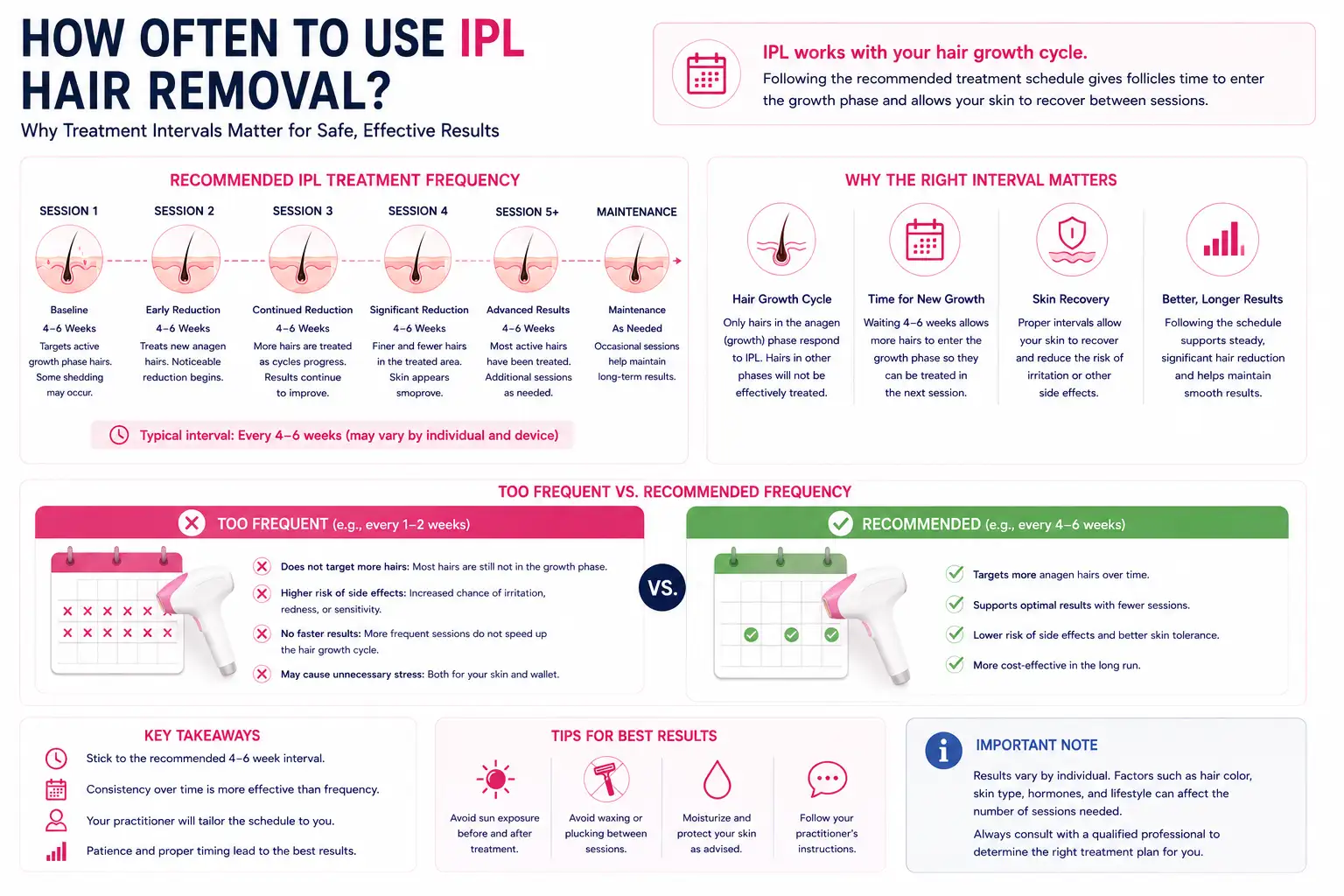
What Happens If You Use IPL Too Often?
Using IPL more frequently than recommended may increase unnecessary cumulative exposure without improving the biological timing of hair reduction.
Depending on the device, parameters, skin characteristics, and treatment technique, excessive or inappropriate exposure may increase the risk of:
- Prolonged redness
- Skin irritation
- Excessive warmth or discomfort
- Burns or blistering
- Post-inflammatory hyperpigmentation
- Hypopigmentation
- Other unwanted skin responses
More treatment is therefore not automatically better treatment.
Appropriate intervals, parameters, cooling, and patient selection are all part of a professional hair-reduction protocol.
Professional IPL vs At-Home IPL: Why the Schedule Is Different
One of the biggest problems with online advice about how often to use IPL hair removal is that professional and consumer devices are often discussed as though they were identical.
They are not.
| Factor | Professional IPL | At-Home IPL |
|---|---|---|
| Intended User | Trained professional according to device requirements | Consumer |
| Device Design | Professional treatment platform | Consumer-use device |
| Available Parameters | May provide broader professional adjustment depending on system | Generally more limited or automated |
| Initial Treatment Frequency | Commonly spaced over multiple weeks according to protocol | Some devices recommend weekly or biweekly initial use |
| Scheduling Authority | Device protocol and qualified professional assessment | Manufacturer instructions for the specific consumer device |
A schedule printed in the manual of an at-home IPL device should therefore not be copied directly into a professional clinic treatment protocol.
Likewise, consumers should not ignore the instructions for their own device simply because they have read about a different schedule used in a professional clinic.
Does SHR Hair Removal Use the Same Treatment Schedule as IPL?
Not necessarily.
SHR commonly describes a repeated, often in-motion hair-reduction delivery strategy. Many SHR systems are based on IPL technology, but their treatment protocols can differ from conventional IPL modes.
Treatment frequency should therefore follow the specific SHR system and protocol rather than assuming that all IPL and SHR machines use identical intervals.
To understand the technology difference, see IPL vs SHR Hair Removal: What’s the Difference?.
How Many IPL Hair Removal Sessions Are Needed?
IPL hair reduction generally requires multiple sessions rather than a single treatment.
This is primarily because only a proportion of hairs within a treatment area are in the same growth stage at any given time.
A treatment series allows additional hairs to become suitable targets as their growth cycles progress.
The total number of IPL sessions can vary according to:
- Treatment area
- Hair density
- Hair thickness
- Hair color
- Skin pigmentation
- Individual hair-growth cycle
- Hormonal influences
- Device characteristics
- Treatment parameters
- Consistency of the treatment schedule
- Individual response
Rather than promising that everyone needs a fixed number of sessions, treatment progress should be evaluated throughout the series.
When Do You Start Seeing Results From IPL Hair Removal?
IPL hair reduction should be evaluated progressively rather than immediately after the first treatment.
Treated hairs do not necessarily disappear at the moment a pulse is delivered. Changes may become more apparent as treated hairs shed and subsequent regrowth develops.
Over a treatment series, successful response may appear as:
- Reduced visible hair density
- Slower regrowth
- Finer regrowing hair
- Patchier regrowth
- Longer periods between visible regrowth
The timing and degree of these changes vary between individuals and treatment areas.
This is another reason why performing IPL more frequently than recommended should not be used as a shortcut to faster results.
Why Does Hair Grow Back Between IPL Sessions?
Seeing new hair between IPL sessions does not necessarily mean that the previous treatment failed.
Hair follicles within the same area are not synchronized.
Some visible hairs may have been appropriate targets during the previous session, while other follicles may have been in different stages of the growth cycle.
As time passes, additional hairs can become visible.
This is exactly why hair reduction is normally performed as a treatment series.
Professionals may evaluate:
- How much hair has returned
- Whether regrowth is becoming finer
- Whether density has decreased
- How quickly regrowth is occurring
- How the skin responded to the previous session
These observations can help determine whether the planned schedule remains appropriate.
Should You Wait Until Hair Grows Back Before the Next IPL Session?
Treatment timing should not be based solely on waiting until all visible hair has returned.
At the same time, performing another professional IPL session only a few days after the previous one simply because a few hairs are visible is generally not an appropriate scheduling strategy.
The next treatment should follow the protocol for the specific device while considering hair-growth timing, treatment area, previous response, and skin recovery.
As the treatment series progresses, slower and less dense regrowth may justify changes to later treatment intervals.
What Happens to the IPL Schedule as Hair Reduction Progresses?
The treatment schedule does not necessarily remain identical from the first session to the last.
Early in the treatment series, visible regrowth may occur relatively predictably. Later, successful hair reduction may result in:
- Less visible hair
- Slower regrowth
- Finer remaining hair
- Longer hair-free intervals
When this happens, repeating treatment according to the original early-stage frequency may no longer be necessary.
Later sessions can instead be planned according to the specific treatment protocol and observed regrowth.
How Often Is Maintenance IPL Hair Removal Needed?
After completing an initial IPL hair-reduction series, some people may later experience residual or returning hair.
Maintenance treatments may be considered when clinically appropriate rather than automatically continuing IPL at the same frequency indefinitely.
The need for maintenance varies according to:
- Treatment area
- Original hair density
- Hair characteristics
- Individual response
- Hormonal influences
- Age-related changes
- Device and treatment protocol
Some people may experience relatively little regrowth for an extended period, while others may require occasional additional treatments.
For this reason, maintenance is better based on actual regrowth and professional assessment than on a universal monthly or annual schedule.
Do You Need IPL Hair Removal Forever?
IPL should not automatically be scheduled continuously at short intervals forever.
The goal of a professional hair-reduction program is generally to achieve a meaningful reduction in unwanted hair over a treatment series and then reassess the need for additional treatment.
Long-term regrowth can occur because of biological and hormonal factors, and treatment response varies among individuals.
It is therefore more accurate to discuss long-term hair reduction rather than guaranteeing that every treated hair will be permanently eliminated.
What If You Miss an IPL Hair Removal Session?
Missing one planned IPL session does not usually mean that the entire treatment series must be restarted from the beginning.
However, repeatedly inconsistent scheduling may make treatment progress less predictable.
If a professional appointment is missed, the next session should generally be rescheduled according to the clinic’s assessment and the protocol for the specific device.
Trying to compensate by performing multiple sessions unusually close together is not an appropriate substitute for the missed treatment.
Can You Shave Between IPL Sessions?
Shaving is commonly compatible with light-based hair-reduction programs because it removes hair above the skin without intentionally removing the follicular hair structure below the surface.
By contrast, methods that remove hair from the root can affect the target available for subsequent melanin-based light treatment.
Clinics may therefore instruct patients to avoid methods such as:
- Waxing
- Plucking
- Tweezing
- Some forms of mechanical epilation
Exact pre-treatment hair preparation should follow the instructions for the specific IPL system and treatment provider.
Should You Shave Before IPL Hair Removal?
Professional IPL protocols commonly require appropriate preparation of visible hair before treatment.
Excessively long hair above the skin can absorb optical energy at the surface rather than allowing treatment to be focused as intended.
However, shaving timing and preparation instructions can differ between systems and treatment protocols.
Patients should therefore follow the clinic’s instructions rather than applying one universal shaving schedule to every IPL treatment.
When Should You Delay an IPL Hair Removal Session?
A scheduled treatment should not automatically proceed simply because the appointment date has arrived.
Depending on the device and circumstances, treatment may need to be reassessed or delayed when there is:
- Recent tanning or significant sun exposure
- Sunburn
- Active skin irritation in the treatment area
- Unexpected skin reaction from the previous session
- Open wounds or compromised skin in the treatment area
- A relevant change in medications or medical history
- Another device-specific contraindication
These situations are particularly important because changes in skin condition or pigmentation can alter how optical energy interacts with the treatment area.
A qualified professional should follow the contraindications and instructions provided for the specific IPL system.
Example of an IPL Hair Removal Treatment Schedule
The following example illustrates the logic of a professional IPL treatment program. It is not a universal prescription and should not replace the protocol for a specific device.
| Stage | What Happens | Scheduling Principle |
|---|---|---|
| Consultation | Assess skin, hair, treatment area, history, suitability and device protocol | Before beginning the treatment series |
| Session 1 | Initial professional IPL treatment | Establish baseline response |
| Early Sessions | Repeat treatments as additional hair cycles progress | Generally separated by several weeks according to area and protocol |
| Mid-Series Review | Evaluate density, thickness, regrowth speed and skin response | Adjust later scheduling if appropriate |
| Later Sessions | Treat remaining appropriate hair targets | Intervals may change as regrowth slows |
| Maintenance | Address meaningful later regrowth when appropriate | Based on actual need rather than a fixed indefinite schedule |
The important principle is that IPL scheduling should follow hair biology + treatment response + device protocol, not simply the shortest possible interval.
How to Know Whether Your IPL Treatment Schedule Is Working
Treatment progress should be evaluated across several sessions rather than judged only by whether hair is visible on a particular day.
Useful indicators may include:
- Reduced overall hair density
- Slower visible regrowth
- Finer regrowing hair
- Longer intervals before noticeable regrowth
- Progressive reduction across the treatment series
If little or no change is occurring after an appropriate treatment period, simply increasing frequency may not solve the problem.
Other factors may need to be reviewed, including hair color, skin type, treatment parameters, device performance, treatment technique, or biological influences.
Common IPL Scheduling Mistakes
Several common mistakes can make an IPL hair-reduction program less effective or unnecessarily increase treatment risk.
Using IPL More Often to Try to Get Faster Results
Hair-growth stages cannot simply be accelerated by adding more treatments.
Using the Same Schedule for Every Body Area
Hair-growth behavior differs across the face, underarms, bikini area, legs, back, and other treatment areas.
Copying an At-Home IPL Schedule for Professional Equipment
Consumer and professional devices can have very different specifications, output, and intended-use instructions.
Ignoring Skin Response
The next session should not proceed without considering how the skin responded to the previous treatment.
Continuing the Initial Schedule Indefinitely
As hair density and regrowth change, later treatment timing may need to change as well.
Waxing or Plucking Between Sessions
Removing hair from the root may interfere with the target required for subsequent melanin-based light treatment.
Frequently Asked Questions
How often should you use IPL hair removal?
Professional IPL hair removal is generally performed as a series of treatments separated by several weeks. The exact interval depends on the treatment area, hair-growth cycle, device, treatment protocol, and individual response.
How often can you use IPL at home?
At-home IPL schedules vary by device. Some manufacturers recommend relatively frequent use during an initial phase, such as weekly or biweekly treatment. Follow the instructions for the specific consumer device rather than applying a professional IPL schedule.
Can I use IPL every week?
Weekly treatment may be specified for some at-home IPL devices, but it should not be assumed to be appropriate for professional IPL systems. Professional treatment frequency should follow the device protocol and qualified assessment.
Can I use IPL twice a week?
Twice-weekly professional IPL hair removal is not a general recommendation. Increasing treatment frequency does not necessarily improve hair reduction and may increase unnecessary skin exposure.
Can I use IPL every day?
Daily professional IPL hair removal is not an appropriate general schedule. Hair follicles require time to progress through their growth cycle, and repeated daily exposure does not necessarily produce faster hair reduction.
How long should I wait between IPL sessions?
Professional IPL sessions are commonly separated by a period measured in weeks rather than days. The actual interval depends on body area, regrowth, treatment response, device, and professional protocol.
Why do you have to wait between IPL sessions?
Hair follicles are at different stages of the growth cycle. Waiting between sessions allows additional hairs to progress into stages where they may provide appropriate treatment targets while also allowing skin response to be assessed.
What happens if I use IPL too often?
Excessive treatment frequency may increase cumulative skin exposure without producing proportionally better hair reduction. Depending on the device and parameters, unwanted responses can include irritation, prolonged redness, burns, blistering, or pigmentary changes.
How many IPL sessions do you need for hair removal?
There is no universal number. Multiple sessions are commonly required, and the total depends on the treatment area, hair characteristics, skin type, device, protocol, and individual response.
Why is my hair growing back after IPL?
Hair follicles do not all grow simultaneously. Hair appearing between sessions may represent follicles progressing through different growth stages rather than proof that the previous treatment had no effect.
Do IPL sessions get further apart?
They can. As visible hair density decreases and regrowth becomes slower, later treatment intervals may be adjusted according to the specific protocol and individual response.
Do you need maintenance IPL treatments?
Some people may benefit from occasional maintenance treatments if meaningful regrowth occurs after the initial series. Maintenance frequency varies and should be based on actual need rather than an automatic fixed schedule.
Can you shave between IPL sessions?
Shaving is commonly compatible with IPL hair-reduction programs because it does not intentionally remove the hair from the root. Follow the preparation instructions provided for the specific IPL system.
Can you wax between IPL treatments?
Waxing and other methods that remove hair from the root are commonly avoided during light-based hair-reduction programs because they can remove the pigment-containing hair structure that would otherwise serve as an optical target.
Should I use IPL if my skin is sunburned?
Treatment should be reassessed when the treatment area is sunburned or has experienced significant recent sun exposure. Follow the contraindications and instructions for the specific device and seek professional assessment when appropriate.
Does SHR need the same interval as IPL?
Not necessarily. Although many SHR systems are IPL-based, SHR protocols can use different pulse-delivery strategies. Treatment frequency should follow the instructions for the specific system.
Final Verdict: How Often Should You Use IPL Hair Removal?
IPL hair removal should be scheduled according to hair-growth biology, treatment response, body area, and the protocol of the specific device — not simply performed as often as possible.
Professional IPL hair reduction is generally performed as a treatment series with sessions separated by a period measured in weeks. The exact interval can vary between the face, underarms, bikini area, legs, and other treatment areas.
The reason for waiting is important: hair follicles are not all in the same growth stage at the same time. Performing another treatment immediately does not force resting follicles into a more responsive growth phase.
As treatment progresses, visible hair density may decrease and regrowth may become slower, allowing later intervals to be adjusted when appropriate.
At-home IPL devices are a separate category. Some consumer systems recommend weekly or biweekly initial use, but those instructions should not be transferred directly to professional IPL equipment.
Ultimately, the best answer to how often to use IPL hair removal is to follow the schedule designed for the specific device and treatment situation. More frequent IPL does not automatically mean faster or better hair reduction.
Editorial & Technical Review: This article was prepared for the Cocoon Laser professional aesthetic technology knowledge center for educational purposes. It does not provide an individualized treatment prescription or replace professional medical assessment. IPL devices vary in optical output, filters, pulse characteristics, intended use, treatment protocols, and regulatory status. Treatment intervals, suitability, contraindications, expected outcomes, and risks should be determined according to the specific device instructions and appropriate professional assessment.