Inside the Tech: Why a Professional Ice Cooling Hair Removal Device Protects the Skin
Executive Summary
For medical spa directors and dermatologists evaluating aesthetic devices, understanding the thermal dynamics of a professional ice cooling hair removal device is paramount. Achieving permanent hair reduction relies on selective photothermolysis, a process that inherently generates extreme heat. Without robust thermal management, this energy risks severe epidermal burns and prolonged downtime. Advanced platforms engineered by top-tier suppliers like Cocoon Laser utilize Thermo-Electric Cooling (TEC Cooling) paired with genuine Sapphire contact cooling to freeze the epidermis while the dermal target is obliterated. This continuous, tri-phase protection enables practitioners to safely deploy higher fluences across the entire Fitzpatrick Scale, including melanin-rich skin. By guaranteeing a pain-free experience, these medical-grade systems eliminate patient dropout, maximize clinic ROI, and protect the hardware investment by exponentially extending the laser’s shots count. Certified devices compliant with FDA 510(k) and Medical CE standards ensure high patient throughput and uncompromised clinical safety.
The Clinical Paradox: Heating the Follicle While Freezing the Epidermis
The foundation of modern aesthetic laser technology is built upon a delicate biological balancing act. Clinic owners and aesthetic practitioners are constantly navigating the clinical paradox of laser hair reduction: to achieve permanent destruction of the hair follicle, the targeted tissue must be heated to extreme, necrotic temperatures, yet the highly sensitive surface of the skin must remain entirely unharmed. Understanding how to bridge this gap separates standard aesthetic clinics from industry-leading medical spas.
The Mechanics of Selective Photothermolysis
Unlike the photoacoustic effect utilized by Q-switched lasers to mechanically shatter tattoo ink, laser hair removal relies entirely on the principle of Selective Photothermolysis.
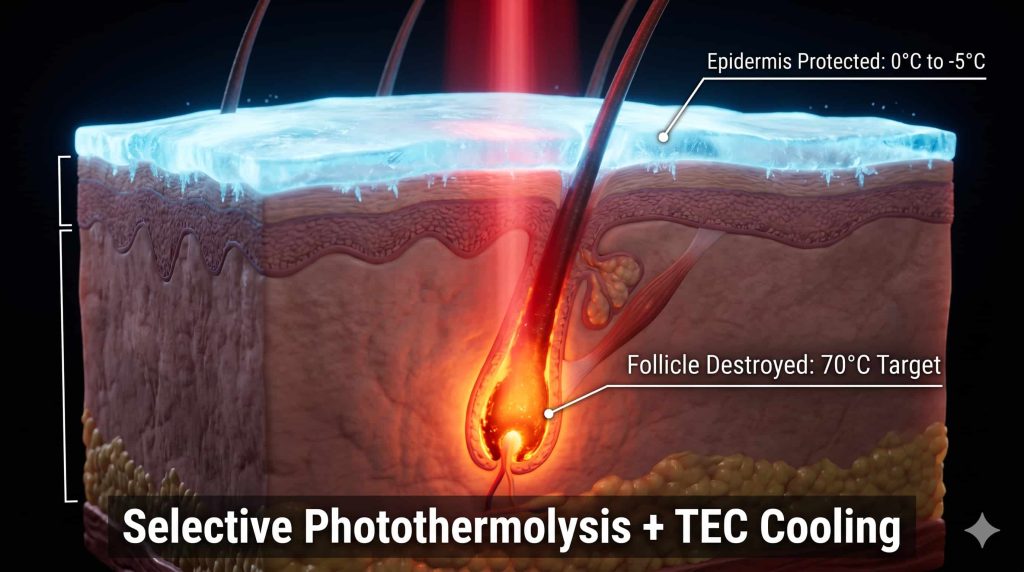
When a professional commercial diode laser fires—most commonly at the 808nm or 810nm wavelength—the emitted photons penetrate the dermis and seek out a specific chromophore. In this application, the target chromophore is the melanin concentrated within the hair shaft. As the melanin absorbs the optical energy, it instantaneously converts it into thermal energy. For the treatment to be successful, this heat must rapidly transfer down the hair shaft to obliterate the surrounding stem cells in the Bulge and the vascular supply in the deep dermal Papilla.
To achieve irreversible protein denaturation and permanent follicular destruction, the internal temperature of the bulb must reach between 60°C and 70°C. Delivering this level of thermal trauma is relatively straightforward from an engineering standpoint; however, doing so safely is where the technological complexity arises.
The Vulnerability of the Epidermal Barrier
The primary obstacle in delivering 70°C of thermal energy into the dermis is the epidermal barrier. The epidermis contains its own basal layer of melanin—Epidermal Melanin—which acts as a competing chromophore.
As the laser pulse passes through the surface of the skin, the epidermal melanin inevitably absorbs a portion of the optical energy, converting it to heat at the surface level. If this surface heat is not immediately neutralized, the thermal accumulation will exceed the tissue’s Thermal Relaxation Time (TRT). The resulting collateral thermal damage manifests as severe epidermal burns, blistering, and debilitating Post-Inflammatory Hyperpigmentation (PIH). Therefore, a mechanism to instantly extract this heat from the epidermis is an absolute clinical necessity, not merely an optional comfort feature.
Decoding “Ice Cooling”: How Professional Sapphire TEC Systems Work
The term “ice cooling” is frequently utilized in consumer marketing, but in the B2B sector of professional medical laser equipment, it refers to a highly specific, advanced thermodynamic architecture. The efficiency of a cooling system dictates the clinical ceiling of the entire laser platform.
Sapphire Contact Cooling: The Gold Standard of Thermal Conductivity
The physical interface between the medical device and the patient’s skin is the handpiece tip. Lower-tier devices often utilize standard glass or quartz tips to reduce manufacturing costs. However, premium platforms engineered by a reputable aesthetic laser supplier exclusively utilize genuine synthetic Sapphire.
- Thermal Conductivity: Sapphire possesses one of the highest thermal conductivity ratings of any transparent optical material. It is exponentially more efficient at transferring heat than quartz.
- Clinical Application: When the chilled Sapphire tip makes contact with the skin, it acts as a thermal vacuum. It instantly draws the accumulated heat out of the epidermis, dissipating it into the internal cooling engine of the handpiece. Furthermore, Sapphire is incredibly durable and highly resistant to scratching, ensuring the optical purity of the laser beam remains uncompromised over millions of pulses.
Thermo-Electric Cooling (TEC) Architecture Explained
Sapphire alone cannot maintain freezing temperatures; it requires an active cooling engine. This is achieved through Thermo-Electric Cooling (TEC Cooling), which operates on the Peltier Effect.
- The Peltier Effect: By passing a direct electrical current through a circuit of alternating P-type and N-type semiconductor materials, heat is actively transferred from one side of the component to the other.
- Medical-Grade Implementation: Inside a Cocoon Laser hair removal device, the TEC module actively pulls heat away from the Sapphire tip and dumps it into an internal water-cooling loop. Unlike passive air-cooling or basic water-circulation systems that eventually succumb to ambient room temperatures, an active TEC system forces the handpiece tip to remain at a constant, stable temperature ranging from 0°C to -5°C, even during continuous, hours-long operation in a warm clinical environment.
The Tri-Phase Protection: Pre, Parallel, and Post-Cooling
A professional TEC Sapphire system provides continuous, dynamic thermal management that protects the patient in three distinct chronological phases:
- Pre-cooling (Preparation): As the practitioner glides the handpiece over the treatment area, the frozen Sapphire tip touches the skin fractions of a second before the laser fires. This preemptively drops the epidermal temperature and constricts superficial capillaries, providing a thermal buffer.
- Parallel-cooling (Active Protection): During the exact millisecond the laser pulse is emitted and the epidermal melanin heats up, the Sapphire tip is simultaneously extracting that heat. This parallel action effectively neutralizes the surface thermal load while allowing the deep dermal follicle to reach the critical 70°C threshold.
- Post-cooling (Recovery): As the handpiece continues its sweeping motion, the trailing edge of the chilled tip soothes the freshly treated tissue. This immediate post-pulse cooling drastically minimizes the inflammatory cascade, reducing transient erythema (redness) and edema (swelling), thereby ensuring a true zero downtime procedure for the patient.
The Direct Link Between Advanced Cooling and Clinic ROI
For clinic owners and investors, technical specifications must translate directly into commercial viability. The procurement of an advanced ice cooling laser is not just a clinical safety measure; it is a profound driver of Return on Investment (ROI) and business growth.
Pain Management Equals Patient Retention
In the highly competitive aesthetic industry, patient retention is the primary metric of a profitable clinic. The leading cause of patient dropout in laser hair removal is intolerable pain. Legacy systems that rely on bursts of cryogen gas or weak chillers often subject patients to a sensation akin to snapping rubber bands against the skin.
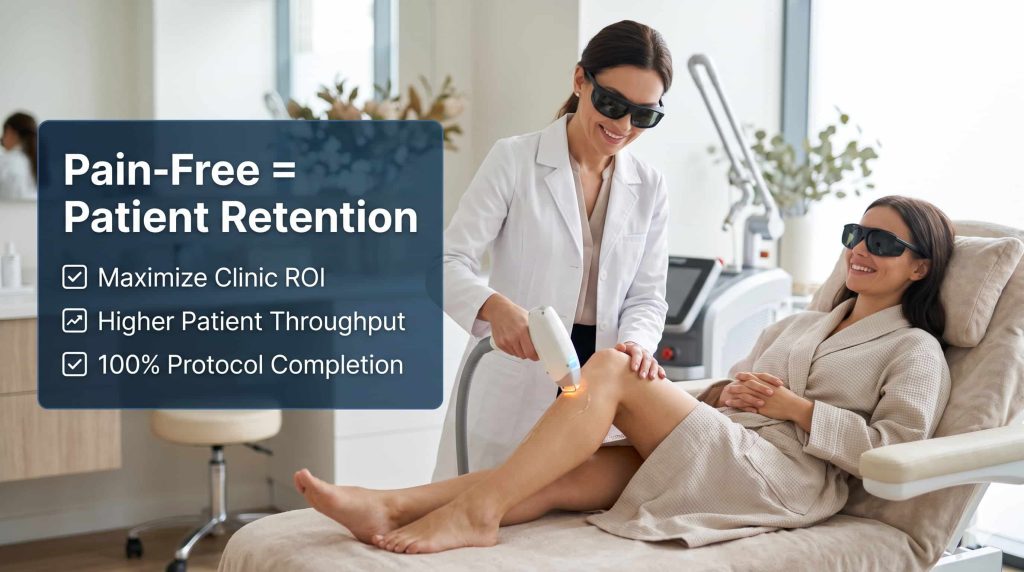
A medical-grade TEC cooling system fundamentally alters this dynamic. By maintaining a sub-zero temperature on the skin’s surface, the cold physically numbs the local nociceptors (pain receptors), effectively blocking the transmission of pain signals to the brain. This transforms what was once an agonizing medical procedure into a comfortable, relaxing spa-like experience. When a patient experiences zero pain, they complete their entire six-to-eight session protocol, drastically reducing revenue leakage. Furthermore, this positive experience becomes your clinic’s strongest marketing asset, driving high-converting word-of-mouth referrals.
Unlocking Higher Fluences for Stubborn Hair
Every practitioner inevitably encounters patients with fine, light, or incredibly stubborn residual hair. Treating these follicles requires deploying significantly higher fluences (energy density measured in Joules/cm²).
If a clinic utilizes a laser with an inferior cooling system, the practitioner is forced to keep the fluence low to avoid burning the patient. Consequently, the stubborn hair is not destroyed, leading to endless, ineffective follow-up sessions and frustrated clients.
Conversely, the robust thermal protection of a professional ice cooling system acts as a safety shield. It grants the physician the confidence to aggressively increase the fluence, delivering the massive energy required to permanently eradicate even the most resilient vellus hairs, thereby elevating your clinic’s clinical success rate.
Safely Treating Melanin-Rich Skin (Fitzpatrick IV-VI)
Expanding your clinic’s demographic reach is the fastest pathway to increased revenue. Historically, treating patients with Fitzpatrick Scale skin types IV, V, and VI was considered high-risk due to the dense concentration of epidermal melanin.
Advanced TEC cooling is the great equalizer. By fiercely protecting the epidermis from thermal injury, a high-end diode laser can safely bypass the surface melanin and target the deep follicular root in darker skin types. This capability allows your clinic to safely and legally market your services to a broader, highly lucrative demographic, ensuring no patient is turned away due to technological limitations.
Consumer-Grade vs. Medical-Grade Cooling: Avoiding Costly Procurement Mistakes
The global market is saturated with low-cost, imported devices that deceptively advertise “ice cooling” technology. B2B buyers must exercise extreme due diligence to separate consumer-grade imitations from genuine medical-grade hardware.
The Danger of Insufficient Thermal Management
Budget devices often rely on simple water-pump circulation paired with radiator fans, lacking a true active Peltier (TEC) module. While these handpieces might feel cool when first turned on, they suffer from rapid thermal degradation.
Technical Comparison: Aesthetic Laser Cooling Architectures
| Parameter | Premium Medical-Grade (TEC + Sapphire) | Consumer/Budget-Grade (Water + Glass) |
| Cooling Element | Thermo-Electric Peltier Module | Standard Water Pump & Fan |
| Skin Interface | Genuine Synthetic Sapphire | Standard Glass or Quartz |
| Temperature Stability | Constant 0°C to -5°C | Rises to room temperature quickly |
| Continuous Operation Time | 12 to 24 Hours (Non-stop) | 1 to 2 Hours (Requires cool-down breaks) |
| Pain Level | Virtually Pain-Free | Moderate to Severe discomfort |
| Clinical Burn Risk | Exceptionally Low | High (Increases as machine runs longer) |
If a clinic operates a budget-grade machine for more than an hour, the internal water temperature rises. The handpiece tip loses its cooling capability, and the risk of inflicting a severe third-degree burn on a patient skyrockets. A single medical malpractice lawsuit resulting from an epidermal burn will cost a clinic exponentially more than the initial savings of buying a cheap device.
Protecting Your Laser Bar Investment (Continuous Operation)
The internal cooling system does not merely protect the patient; it protects the core engine of the device. The most expensive components within a diode laser are the semiconductor laser bars (often imported from top manufacturers like Coherent USA).
Laser bars generate immense internal heat when firing. If the thermal management system is inadequate, this heat will rapidly degrade the semiconductor material, leading to a catastrophic drop in optical power.
By integrating a massive internal TEC water-chilling loop, a Cocoon Laser platform ensures that the laser bars are maintained at an optimal operating temperature. This rigorous thermal regulation protects your capital investment, ensuring a remarkably high shots count (often exceeding 20 to 50 million pulses) without any degradation in output power. Furthermore, this allows high-volume clinics to schedule back-to-back appointments for 12 hours straight without the machine overheating, maximizing daily patient throughput and overall profitability.
Conclusion: Elevating Patient Safety with Cocoon Laser
The technological sophistication of a laser’s cooling system is the ultimate determining factor in both clinical efficacy and commercial success. Masterful thermal management is what allows practitioners to push the boundaries of selective photothermolysis, safely treating all skin types while guaranteeing patient comfort.
Evaluating Your Next Laser Procurement
As a medical director or clinic owner, when you allocate capital for your next aesthetic platform, the engineering of the cooling system must carry as much weight in your decision-making process as the wavelength or the peak wattage. A laser is only as powerful as its ability to cool the skin. Procuring equipment that holds rigorous international certifications, such as Medical CE and FDA 510(k), ensures that the thermal management systems have been clinically validated for absolute safety.
Discover the Cocoon Laser Difference
To position your clinic at the forefront of the medical aesthetic industry, partner with an equipment manufacturer that refuses to compromise on internal hardware. Cocoon Laser integrates industry-leading TEC active cooling and genuine Sapphire optics into every hair removal platform we build, ensuring maximum ROI, zero patient downtime, and unparalleled clinical outcomes.
We invite B2B buyers, medical spa directors, and dermatologists to explore our rigorous engineering standards. Visit the official website today to download our comprehensive hardware Spec Sheet, or contact our global B2B team to schedule an exclusive 1-on-1 Virtual Demo. Discover firsthand why upgrading to a professional ice cooling laser is the most lucrative investment your clinic can make.
If you need more information, please click “Contact Us”.
If you want to obtain more information, please follow our official website and Facebook.