Tattoo Regret? What to Expect from a Pico Laser Tattoo Removal Equipment Session
Executive Summary:
For patients facing tattoo regret and clinical directors seeking to elevate their treatment portfolios, pico laser tattoo removal equipment represents the undisputed clinical gold standard. Unlike legacy modalities that rely heavily on photothermal tissue damage, picosecond technology utilizes ultra-short pulse durations to generate a profound photoacoustic effect, shattering ink into easily metabolized microscopic particles. This comprehensive guide details the entire clinical workflow—from the initial Fitzpatrick Scale diagnostic assessment and TEC Cooling protocols for optimal pain management, to the physiological realities of the macrophage response and lymphatic clearance. By leveraging technologies compliant with FDA 510(k) and Medical CE standards, such as those engineered by an industry-leading aesthetic laser equipment manufacturer, modern clinics can significantly reduce patient downtime, mitigate collateral thermal injury risks, and establish highly predictable, multi-session clinical outcomes.
Introduction: Turning the Page on Unwanted Ink
Tattoos are frequently acquired as permanent markers of temporary phases, leading to a clinically significant and globally recognized rise in tattoo regret. Historically, patients seeking dermal ink clearance faced grueling procedures characterized by unpredictable results, high scarring risks, and severe physical discomfort. Today, the aesthetic medical landscape has fundamentally shifted. The deployment of advanced picosecond laser technology has unequivocally established a new gold standard in pigment clearance.
For patients, the prospect of laser treatments can understandably evoke anxiety, largely stemming from a lack of scientific understanding regarding the procedure and the biological mechanisms at play. For clinical operators and procurement managers currently evaluating a professional laser tattoo removal machine, managing these patient expectations is intrinsically linked to the underlying capabilities of the hardware. This comprehensive clinical guide is explicitly designed to dismantle the myths surrounding the removal process, offering a scientifically grounded look at what patients can expect, and explaining exactly why the specific physics of picosecond lasers translate to safer, faster, and more efficient clinical outcomes.
The Science of Picosecond Technology: Why It Outperforms Q-Switched Lasers
Photomechanical vs. Photothermal Effects
To truly understand the paradigm shift in dermal pigment clearance, one must examine the fundamental physics of laser-tissue interaction. Traditional Q-switched Nd:YAG laser systems operate primarily in the nanosecond domain. While effective to a certain degree, these older generation systems rely predominantly on a photothermal effect. The laser energy actively heats the targeted ink particles, and this thermal energy inevitably diffuses into the surrounding healthy dermal tissue. This heat transfer significantly increases the risk of collateral thermal damage, localized blistering, post-inflammatory hyperpigmentation (PIH), and prolonged clinical downtime.
In stark contrast, modern picosecond technology operates at pulse durations measuring $10^{-12}$ seconds. This ultra-short pulse is delivered so rapidly that the target chromophore (the tattoo ink) undergoes massive thermal expansion before any significant heat can dissipate into the adjacent tissue. This rapid expansion creates an intense localized shockwave—a photomechanical or photoacoustic effect. Instead of merely breaking the ink into smaller, thermally fractured pebbles, the sheer physical force of the picosecond pulse shatters the pigment into ultra-fine, dust-like particles.
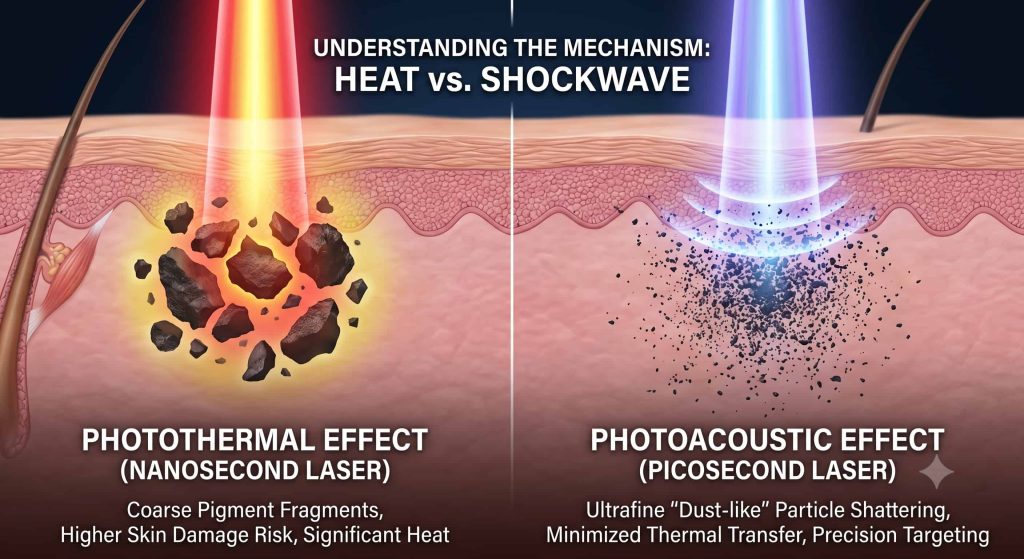
(Visual Concept: A highly detailed 3D clinical rendering illustrating a cross-section of the dermis. The left hemisphere depicts nanosecond thermal fracturing resulting in coarse pigment fragments. The right hemisphere highlights the picosecond photoacoustic shockwave, rendering the pigment into microscopic, dust-like particulate matter ready for biological clearance.)
Precision Targeting Across the Color Spectrum
Ink clearance is not a monolithic challenge; it is highly dependent on optical absorption and the specific chemical composition of the ink. A premier pico laser system must be capable of emitting multiple, highly calibrated wavelengths to target specific pigment formulations without compromising the surrounding tissue.
| Wavelength | Target Chromophore (Ink Color) | Absorption Characteristics & Clinical Application |
| 1064 nm | Black, Dark Blue, Dark Brown | Exhibits the deepest dermal penetration profile; structurally the safest option for higher Fitzpatrick Scale skin types (IV-VI) due to lower epidermal melanin absorption. |
| 532 nm | Red, Orange, Yellow | Features a shallower dermal penetration profile; demonstrates extremely high absorption by red pigments, but requires strict clinical caution to avoid targeting epidermal melanin. |
| 755 nm / 730 nm | Green, Light Blue | Serves as the definitive solution for notoriously recalcitrant blue and green inks, effectively bridging the therapeutic gap found in the standard nanosecond spectrum. |
Step-by-Step: Your Pico Laser Tattoo Removal Walkthrough
1. The Initial Clinical Assessment
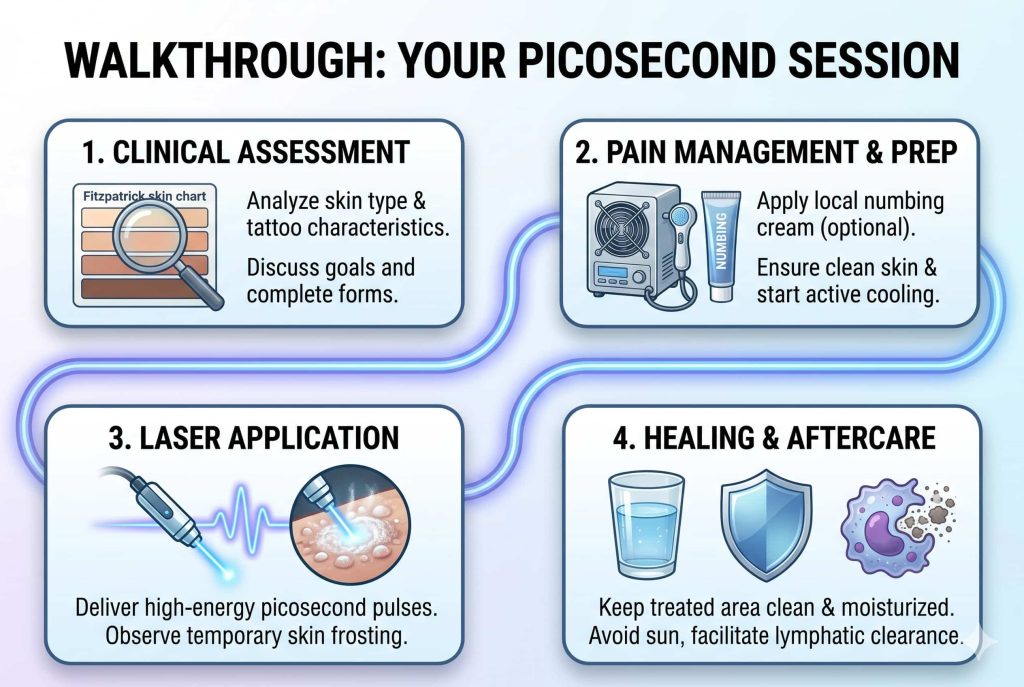
A successful and safe clinical outcome begins long before the laser is ever fired. The initial consultation is a rigorous diagnostic process. Practitioners must first evaluate the patient’s Fitzpatrick Scale skin type to determine safe energy thresholds (Fluence) and select the appropriate optical wavelength. The clinician will meticulously assess the tattoo’s anatomical location, ink depth, structural density, and whether the application was amateur or professional. Amateur tattoos typically feature uneven, superficial ink distribution and carbon-based particles, whereas professional tattoos utilize dense, complex metallic compounds that demand highly advanced photoacoustic disruption.
2. Pain Management and Preparation
A universal barrier to entry for patients is the anticipation of pain. Objectively, the physical sensation of picosecond laser delivery is often likened to a heavy rubber band snapping against the skin in rapid succession. To mitigate this discomfort and ensure a highly controlled clinical environment, top-tier aesthetic practices deploy comprehensive pain management protocols.
- Topical Anesthetics: The application of pharmaceutical-grade numbing creams (typically a Lidocaine and Prilocaine compound) approximately 30 to 45 minutes prior to the session.
- TEC Cooling Systems: Advanced continuous contact cooling or specialized forced cold-air epidermal cooling devices (often operating at sub-zero temperatures) are utilized synchronously with the laser pulse. This not only numbs the epidermis neurologically but serves as a critical thermal protectant, safeguarding healthy tissue from any residual thermal buildup.
3. The Laser Application and The “Frosting” Phenomenon
During the active treatment phase, the laser handpiece is passed systematically over the targeted ink. Almost instantaneously, patients and practitioners will witness a distinct clinical endpoint known as “laser frosting.”
This optical phenomenon often alarms uninformed patients who mistake it for an immediate thermal burn. In reality, frosting is a localized, transient physiological reaction. As the intense laser energy rapidly shatters the ink, the resulting photoacoustic shockwave creates microscopic vacuoles of gas (primarily steam and carbon dioxide) within the upper layers of the skin. This gas physically reflects ambient light, creating a stark, white, frosted appearance on the surface. It is a highly positive clinical indicator, definitively confirming that the photomechanical effect has successfully engaged and disrupted the target pigment. This frosting reaction typically subsides entirely within 15 to 30 minutes post-treatment.
Healing and Aftercare: Maximizing the Macrophage Response
Immediate Post-Session Care (24-48 Hours)
Once the clinical session concludes, the treated area enters an acute inflammatory phase. Erythema (redness), localized edema (swelling), and occasional pinpoint bleeding are standard, expected clinical responses. Mild blistering is also a natural biological byproduct of the immune system rapidly mobilizing fluid to the site of the disrupted pigment.
Post-care protocols must be strictly adhered to, actively minimizing complications and protecting the temporarily compromised epidermal barrier:
- Maintain strict hygiene: Keep the treated area meticulously clean and dry to prevent bacterial infection.
- Apply clinical occlusives: Utilize prescribed medical barrier ointments to prevent transepidermal water loss and support cellular regeneration.
- Absolute UV avoidance: Direct ultraviolet sun exposure on treated skin risks severe hyperpigmentation or hypopigmentation, potentially ruining the cosmetic outcome.
The Role of Your Lymphatic System
A fundamental consumer misconception is that the laser device “burns the ink away.” In clinical truth, the laser merely functions as a sophisticated demolition tool; the actual removal of the ink is entirely facilitated by the human body’s intrinsic biological processes.
Following the photoacoustic shattering of the ink, the immune system deploys specialized scavenger cells known as macrophages. These white blood cells actively engulf the microscopic ink dust created by the laser. Once absorbed, the macrophages transport the pigment through the lymphatic system, where it is ultimately filtered by the liver and excreted from the body. To optimize this biological clearance phase, patients are strongly advised to exponentially increase their hydration levels, maintain a highly active cardiovascular routine to promote blood flow, and completely abstain from smoking—as nicotine-induced peripheral vasoconstriction significantly impedes lymphatic drainage and delays clearance.
Setting Realistic Expectations: The “One-and-Done” Myth
Variables That Determine Your Timeline
In the high-end aesthetic medical industry, operational transparency is paramount. The notion that any complex tattoo can be completely eradicated in a single session is a physiological impossibility. Establishing a realistic clearance timeline requires understanding the complex interplay of several clinical variables:
- Anatomical Placement: Tattoos located closer to the heart (e.g., chest, neck, upper back) benefit from robust vascular and lymphatic flow, exponentially expediting macrophage clearance. Conversely, distal appendages (hands, feet, ankles) exhibit much slower circulatory rates, mathematically requiring more sessions.
- Ink Volume and Stratification: Cover-up designs or heavily layered professional tattoos harbor immense volumes of densely packed pigment. The laser must systematically dismantle these physical layers over multiple sessions, addressing the superficial ink before deeper dermal deposits can be accessed by the laser energy.
- Age of the Tattoo: Older tattoos have often undergone a degree of natural phagocytosis and UV degradation over the years, making them structurally weaker and generally easier to clear than fresh, heavily saturated, modern ink.
Why 6-8 Week Intervals Are Non-Negotiable
Patience is the foundation of effective and safe tattoo clearance. Rigid clinical protocols dictate mandatory intervals of 6 to 8 weeks—and sometimes extending up to 12 weeks for distal extremities—between individual sessions.
Attempting to aggressively accelerate this timeline by scheduling premature sessions is both counterproductive and clinically dangerous. Firstly, the epidermis and dermal structures require adequate biological time to structurally regenerate and fully resolve the localized acute inflammation. Firing high-energy lasers into actively inflamed tissue drastically escalates the risk of irreversible dermal scarring. Secondly, the macrophage-mediated clearance is a inherently protracted biological process. Treating the area before the lymphatic system has fully evacuated the previously shattered ink simply wastes the device’s shots count and the patient’s capital on debris that is already queued for biological removal.
Why Clinics Trust Cocoon Laser’s Pico Technology for Patient Safety
For clinical directors and procurement officers, evaluating hardware goes far beyond reviewing a marketing spec sheet; it is fundamentally about ensuring consistent, defensible, and highly profitable clinical outcomes. As a premier global aesthetic laser equipment manufacturer, Cocoon Laser distinctly engineers its systems to address the precise operational vulnerabilities of older generation technologies.
Consistent Peak Power and Uniform Beam Profiles
The overarching clinical efficacy of picosecond technology is entirely reliant on the absolute stability of its peak power output. Inconsistent energy delivery or fluctuating pulse durations result in localized optical hotspots, which immediately translate to unintended thermal tissue damage and unpredictable clearance rates.
Cocoon Laser’s proprietary systems utilize advanced optical resonators and superior beam delivery articulated arms to project a perfectly uniform Top-Hat beam profile. Unlike standard Gaussian beams that concentrate dangerous levels of energy directly in the center of the pulse, a top-hat profile ensures absolute energy equilibrium across the entire spot size. This precise optical engineering guarantees that the photomechanical effect is evenly distributed, maximizing ink shattering efficacy while rigorously protecting the structural integrity of the surrounding healthy dermis.
(Visual Concept: An industrial-grade, ultra-high-resolution 3D rendering of the articulated laser arm and treatment handpiece. The metallic finish, precision optics, and graphical user interface should evoke cutting-edge biomedical engineering, robust durability, and uncompromising safety.)
Minimized Downtime for Better Patient Retention
From a B2B operational standpoint, hardware selection directly influences clinic profitability, long-term ROI, and crucial patient retention rates. While clinics routinely diversify their portfolios with devices for diode laser hair removal or fractional skin resurfacing, tattoo removal patients represent a highly lucrative, long-term, multi-session commitment.
If a patient experiences severe blistering, agonizing recovery periods, or noticeable scarring due to inferior, poorly calibrated equipment, the statistical likelihood of them abandoning the treatment protocol skyrockets. By investing in and utilizing high-fidelity pico laser technology from a vetted and reliable supplier like Cocoon Laser, clinics drastically minimize the patient’s post-treatment downtime. The drastic reduction in collateral thermal damage translates to a remarkably smooth and tolerable recovery process. This fosters deep patient trust, ensures high compliance with the long-term treatment schedule, and ultimately solidifies the clinic’s regional reputation for clinical excellence.
Conclusion: Ready to Erase the Past?
The clinical journey to clearing unwanted dermal ink is no longer dictated by the crude, heavily scarring methodologies of the past. Driven by the extraordinary physics of the photoacoustic effect and ultra-short pulse durations, modern picosecond systems have successfully transformed what was once an agonizing ordeal into a highly predictable, biologically safe, and sophisticated clinical procedure.
Whether you are a patient ready to reclaim your skin canvas with scientifically grounded and realistic expectations, or a medical aesthetic practitioner looking to integrate world-class pico laser tattoo removal equipment into your advanced clinical offerings, the hardware you choose unequivocally defines the ultimate outcome. Precision optical engineering, stabilized peak power, and a relentless commitment to clinical safety are strictly non-negotiable. Explore how elite, medically certified technologies are actively redefining dermal pigment clearance and continuously setting new benchmarks for patient satisfaction and clinic profitability worldwide.
If you need more information, please click “Contact Us”.
If you want to obtain more information, please follow our official website and Facebook.