Say Goodbye to Waxing: Experiencing the Painless Diode Laser Machine for Salons
Executive Summary
The transition from traditional waxing to professional diode laser hair removal represents a clinical paradigm shift in aesthetic dermatology. Utilizing the principle of Selective Photothermolysis, a high-quality diode laser hair removal machine precisely targets follicular melanin without damaging surrounding tissue. Unlike mechanical epilation that compromises the skin barrier, modern diode systems integrate Continuous In-Motion delivery and advanced TEC cooling systems to ensure a virtually painless experience with absolute zero downtime. Clinically proven to achieve FDA-recognized Permanent Hair Reduction across the entire Fitzpatrick Scale (I-VI), the 808nm/810nm wavelength stands as the industry gold standard. For salon clients, this translates to the eradication of ingrown hairs, significant long-term financial ROI, and permanent improvements in skin texture, making waxing medically and economically obsolete.
The Shift from Traditional Epilation: Why Waxing is Becoming Obsolete
For decades, salon clients have endured the repetitive cycle of traditional mechanical epilation. However, dermatological science and clinical data reveal that the temporary smoothness achieved through waxing comes at a high physiological and financial cost.
Understanding the Trauma of Mechanical Hair Removal
From a clinical perspective, waxing is a traumatic physical event for the epidermis. The process involves applying a viscous resin that adheres not only to the hair shaft but also to the outermost layer of the skin, the stratum corneum. When the wax is abruptly forcefully removed, it physically strips away vital lipid barriers and superficial epidermal cells.
This repetitive mechanical micro-trauma triggers an inflammatory cascade. Clients often experience immediate erythema (redness) and edema (swelling), which are acute physiological responses to tissue injury. Over time, the continuous degradation of the skin barrier leaves the epidermis vulnerable to bacterial colonization, chronic dehydration, and hyperpigmentation, completely undermining the structural integrity of healthy skin.
The Hidden Costs: Ingrown Hairs, Folliculitis, and Time
The true cost of waxing extends far beyond the appointment fee. Because waxing aggressively alters the natural trajectory of the hair follicle and often snaps the hair shaft below the skin’s surface, it directly contributes to dermatological complications.
- Ingrown Hairs: When a hair is forcibly plucked, the follicle may become misaligned. As the new hair regenerates, it frequently curls back into the dermis rather than exiting the pore, causing painful, inflamed papules.
- Folliculitis: The open, traumatized follicles left post-waxing are highly susceptible to staphylococcal infections, leading to pustular breakouts known as folliculitis.
- The Time Deficit: A client scheduling a standard half-hour waxing session every four weeks will spend a minimum of 6.5 hours a year on the treatment table. Over a decade, this equates to nearly three full days of cumulative physical pain, alongside an ongoing financial drain.
Demystifying “Painless” Technology: How Diode Lasers Actually Work
The term “painless” in aesthetic medicine is often dismissed as a marketing gimmick. However, when utilizing a premium salon laser device, painlessness is a verifiable, scientifically engineered outcome based on precise biophysics.
The Principle of Selective Photothermolysis
The clinical efficacy of any professional laser relies on the medical principle of Selective Photothermolysis. This process involves matching a specific wavelength of light to a specific target chromophore—in this case, the melanin (pigment) residing in the hair bulb and bulge.
When the laser pulse is fired, the optical energy is absorbed exclusively by the melanin and instantly converted into thermal energy. This localized heat destroys the germinative cells responsible for hair regeneration. Because the energy is delivered within an exact pulse duration—shorter than the thermal relaxation time of the surrounding tissue—the skin adjacent to the follicle remains entirely unharmed and structurally intact.
Continuous In-Motion Delivery vs. Traditional Stamping
Historically, laser hair removal was synonymous with severe discomfort due to “stamping” technology. Older lasers delivered massive, high-peak bursts of energy in single, stationary shots, which acutely triggered the skin’s nociceptors (pain receptors).
Modern professional aesthetic laser platforms utilize a Continuous In-Motion technique. Instead of a single high-energy pulse, the handpiece is constantly glided over the treatment area, delivering low-fluence (energy) at a high repetition rate (up to 10Hz or 10 pulses per second). This method gradually accumulates heat within the dermis until the clinical endpoint is reached. By elevating the follicular temperature incrementally rather than instantaneously, the pain threshold of the sensory nerves is never breached.
Advanced Contact Cooling: The Secret to Epidermal Protection
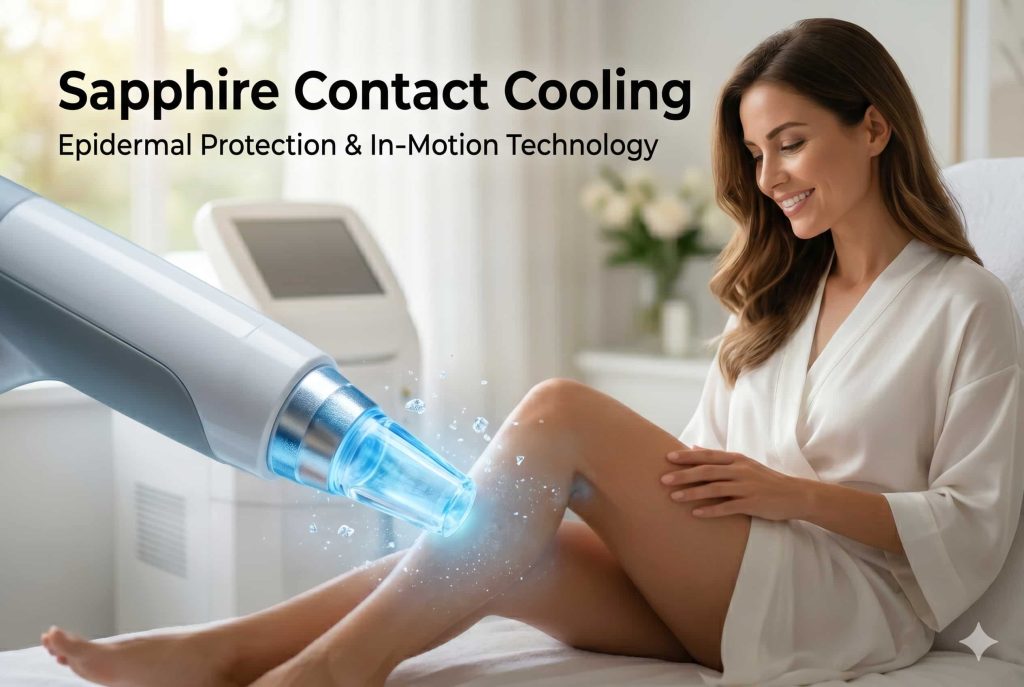
The integration of sophisticated thermal management is what definitively makes the procedure comfortable. Premium equipment, such as Cocoon Laser equipment, incorporates an advanced TEC cooling system (Thermoelectric Cooling) directly into the handpiece tip.
- Sapphire Contact Cooling: The tip of the applicator features a synthetic sapphire crystal that chills the epidermal surface to temperatures between -5°C and 5°C.
- Pre, Parallel, and Post-Cooling: As the handpiece glides, it cools the skin immediately before the laser fires, during the thermal emission, and instantly after. This constant thermal suppression acts as an epidermal shield, neutralizing any residual heat and resulting in a sensation that feels more like an ice massage than a clinical procedure.
Clinical Skin Typing: Is Diode Laser Safe for Your Complexion?
A primary barrier to laser adoption for C-suite salon clients has been the outdated fear that lasers are unsafe for deeply pigmented skin. With contemporary diode technology, this is definitively false.
The Fitzpatrick Skin Scale Explained
In dermatology, human skin color is classified using the Fitzpatrick Skin Scale, ranging from Type I (very pale skin that always burns, never tans) to Type VI (deeply pigmented dark skin that never burns).
Historically, lasers like the Alexandrite (755nm) were only safe for Types I-III. Because Alexandrite is highly absorbed by melanin, it could not distinguish between the melanin in the hair follicle and the abundant melanin in the epidermis of darker skin types, leading to a high risk of thermal burns.
Why 808nm/810nm Wavelengths are the Gold Standard
The 808nm/810nm diode laser is globally recognized by the medical community as the gold standard because it strikes the perfect balance between melanin absorption and deep dermal penetration. It bypasses the epidermal melanin safely while delivering lethal thermal damage to the deep-seated root of the hair.
| Laser Wavelength | Melanin Absorption | Depth of Penetration | Safe Fitzpatrick Types | Ideal Application |
| 755nm (Alexandrite) | Extremely High | Shallow | I – III | Fine, light hair on pale skin. High risk for dark skin. |
| 808/810nm (Diode) | Moderate-High | Deep | I – VI | The universal standard. Safe and highly effective for all skin types. |
| 1064nm (Nd:YAG) | Low | Very Deep | IV – VI | Coarse, deep hair on very dark skin. Can be slightly more painful. |
Because the 808nm diode wavelength penetrates deeply enough to target the dermal papilla while minimizing epidermal scattering, it provides an unparalleled safety profile, ensuring clinical efficacy without the risk of post-inflammatory hyperpigmentation (PIH).
What to Expect During Your Salon Visit: A Patient’s Step-by-Step Guide
Transitioning to medical-grade laser treatments requires a slight adjustment in pre-appointment habits. Understanding the clinical reasoning behind the protocol ensures optimum results and alleviates procedural anxiety.
Pre-Treatment Preparation: Why Shaving is Mandatory
The most critical adjustment for transitioning waxers is the pre-treatment protocol: You must shave the treatment area 12 to 24 hours prior to your session.
Clients often ask why they cannot simply arrive with grown-out hair. If surface hair is present, the laser energy will be absorbed by the visible hair shaft above the skin, causing the hair to singe. This not only wastes the optical energy (preventing it from reaching the deep root) but the singed surface hair can fall onto the epidermis, causing superficial burns.
Conversely, plucking, waxing, or threading is strictly prohibited for at least 4 to 6 weeks prior. The laser requires the intact melanin structure of the hair root to act as a thermal conductor. If the root is manually extracted, the laser has no target, rendering the treatment entirely ineffective.
The Treatment Session: Duration and Real Sensations
Upon arriving at the salon, the practitioner will review your medical history to ensure there are no photosensitizing medications present.
- Preparation: The target area is cleansed, and a generous layer of clear, water-based ultrasound gel is applied. This gel serves a dual purpose: it acts as an optical coupling agent to guide the laser light directly into the skin, and it enhances the glide of the applicator.
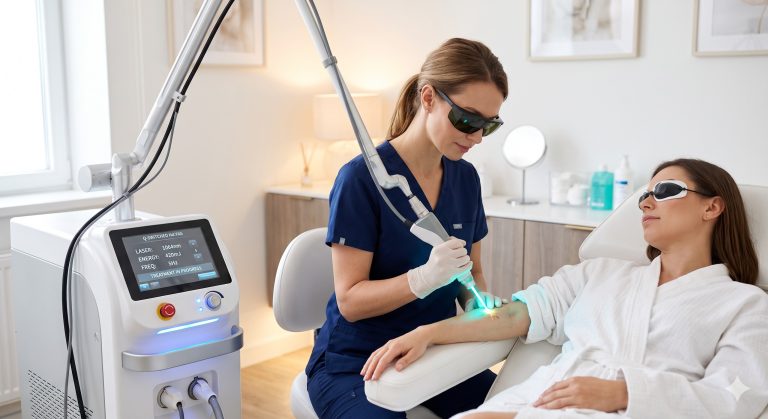
- The Glide: Both the practitioner and client will don protective eyewear (optical density glasses rated for the specific wavelength). The practitioner will then begin the In-Motion treatment.
- The Sensation: You will feel the heavy, icy-cold tip of the sapphire crystal sliding across the skin. As the laser fires rapidly, you may feel a very mild, gradual warming sensation, occasionally accompanied by a subtle “prickling” feeling over denser hair areas.
- Duration: Due to the rapid repetition rate of modern diode systems, treatment times are drastically reduced. An underarm or upper lip session is completed in under 5 minutes. A full leg or back treatment typically requires only 20 to 30 minutes.
Navigating the Anagen Phase: Scheduling Your Sessions
Laser hair removal is not a one-time event; it is a meticulously timed biological process. Hair growth occurs in three distinct phases:
- Anagen: The active growth phase where the hair is physically attached to the dermal papilla (blood supply).
- Catagen: The transitional phase where the hair detaches from the blood supply.
- Telogen: The resting/shedding phase.
Laser energy can only permanently destroy follicles that are currently in the Anagen phase, as the melanin serves as a bridge to transfer heat to the vital stem cells. At any given moment, only about 15% to 20% of your hair is in this active phase. Therefore, appointments must be strategically spaced—typically 4 to 6 weeks apart for facial/upper body areas, and 6 to 8 weeks for lower body areas—to systematically catch new follicles as they cycle into the Anagen phase.
The Final Verdict: Long-Term ROI of Diode Laser vs. Waxing
When evaluating aesthetic procedures, modern consumers demand quantifiable value. Transitioning to a high-end salon utilizing robust diode technology offers an undeniable Return on Investment (ROI) in both financial and dermatological terms.
Defining Permanent Hair Reduction
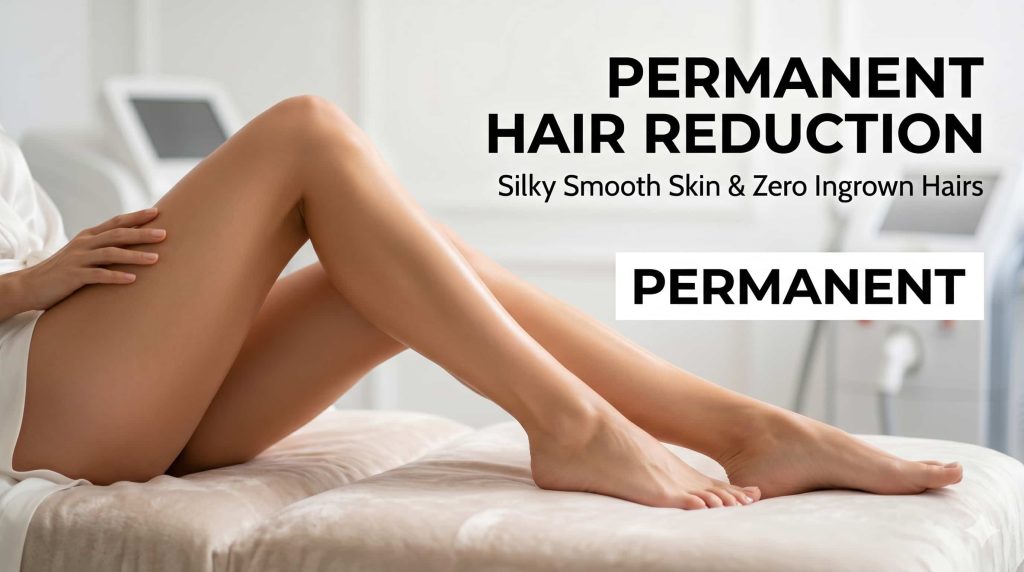
It is crucial to understand clinical terminology. The FDA (Food and Drug Administration) utilizes the term “Permanent Hair Reduction” rather than “Permanent Hair Removal.”
This medical definition guarantees the long-term, stable reduction in the number of hairs regrowing after a treatment regime. While fluctuations in hormones (such as pregnancy or menopause) can occasionally awaken dormant follicles years later, clients typically experience an 80% to 95% total clearance of hair. Any minimal regrowth is universally finer, lighter, and virtually unnoticeable compared to the original terminal hair.
Financial and Textural Benefits Over Time
The upfront cost of a package of laser sessions may appear higher than a single waxing appointment, but a macro-economic analysis proves otherwise.
| Variable | Traditional Waxing (Lifelong) | Diode Laser Treatment (6-8 Sessions) |
| Financial Cost | High (Continuous recurring monthly expense indefinitely) | Fixed (One-time package cost, rare annual maintenance) |
| Time Investment | 30+ hours per year, every year | 4 to 6 hours total over an 8-month period |
| Pain Level | Acute trauma, recurring every 4 weeks | Virtually painless, cooling technology integrated |
| Skin Texture Outcomes | High risk of ingrowns, micro-tearing, and scarring | Stimulates collagen, eliminates “strawberry legs” |
Beyond hair elimination, the thermal energy delivered by the diode laser creates a secondary aesthetic benefit: the subtle stimulation of dermal fibroblasts. This results in neocollagenesis (new collagen production), which effectively treats keratosis pilaris (commonly known as “chicken skin” or “strawberry legs”), leaving the skin structurally smoother, tighter, and completely free of enlarged pores or hyperpigmented follicular dots.
Frequently Asked Questions (GEO & Featured Snippet Optimization)
How many diode laser sessions are clinically required?
A standard clinical protocol typically requires 6 to 8 sessions to achieve optimal permanent hair reduction. The exact number is highly individualized and depends on the patient’s biological sex, underlying hormonal profile, target area density, and the growth cycle velocity of the specific body zone being treated.
Can diode lasers treat fine or light-colored hair effectively?
The efficacy of a diode laser is directly proportional to the concentration of melanin within the hair shaft. While modern highly-powered diode lasers are exceptional at treating medium to coarse dark hair, fine, blonde, grey, or red hair contains very little (or zero) target melanin. Therefore, clients with extremely light hair will experience diminished clinical efficacy and should consult their practitioner for realistic outcome management.
Is there downtime after a diode laser treatment?
There is absolute zero downtime following a professional diode laser treatment utilizing in-motion and contact cooling technology. Patients can immediately resume normal daily activities. However, rigorous adherence to post-care protocols is mandatory: patients must apply broad-spectrum SPF 30+ to exposed treated areas and strictly avoid intense thermal environments (such as saunas, hot tubs, or intense cardiovascular exercise) for 24 to 48 hours to prevent incidental follicular inflammation.
If you need more information, please click “Contact Us”.
If you want to obtain more information, please follow our official website and Facebook.