What Is IPL Hair Removal? How It Works & What to Expect
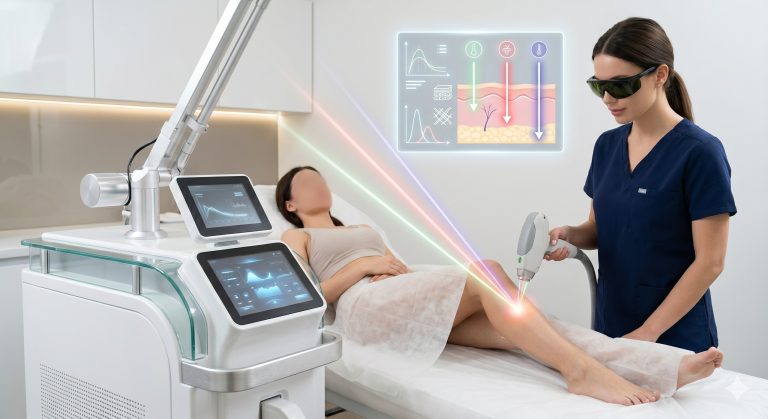
IPL hair removal is a light-based method used to reduce unwanted hair on areas such as the legs, underarms, bikini area, back, chest, arms, and face.
Although IPL is frequently grouped together with laser hair removal, the two technologies are not identical. IPL stands for Intense Pulsed Light. Instead of producing a single laser wavelength, an IPL system generates broad-spectrum pulsed light that can be filtered and configured for different treatment applications.
For hair reduction, selected light reaches pigment within the hair and follicular structures, where absorbed optical energy is converted into heat. The objective is to create sufficient thermal effects in appropriate hair targets while limiting unwanted heating of surrounding skin.
Understanding how IPL hair removal works also explains why multiple sessions are usually needed, why dark and coarse hair may respond differently from light hair, and why skin type, wavelength range, filters, pulse characteristics, cooling, and treatment parameters all matter.
Quick Answer
IPL hair removal uses filtered pulses of broad-spectrum light to target melanin in unwanted hair and produce controlled thermal effects within hair-bearing structures.
It is more accurately described as a method of long-term hair reduction rather than a guarantee that every treated hair will be permanently removed.
Because hairs are at different stages of the growth cycle at any given time, IPL hair removal normally requires multiple treatment sessions. Results vary according to hair color and thickness, skin pigmentation, body area, treatment parameters, device characteristics, and individual biological response.
IPL is also not the same as laser hair removal. IPL uses filtered broad-spectrum light, while laser systems generally produce much narrower, wavelength-specific optical output.
What Is IPL Hair Removal?
IPL hair removal is a non-surgical light-based treatment designed to reduce unwanted hair by delivering pulses of optical energy to hair-bearing skin.
IPL stands for Intense Pulsed Light.
Unlike a laser, which is generally designed around a specific wavelength or relatively narrow wavelength band, an IPL system begins with a broader spectrum of light. Optical filters are then used to select portions of that spectrum for particular treatment applications.
In hair-reduction treatments, melanin within the hair acts as an important chromophore. It absorbs part of the delivered optical energy and converts it into heat.
When the optical spectrum, pulse characteristics, energy, and other parameters are appropriately selected, this thermal effect can contribute to reducing the ability of targeted follicles to produce visible hair.
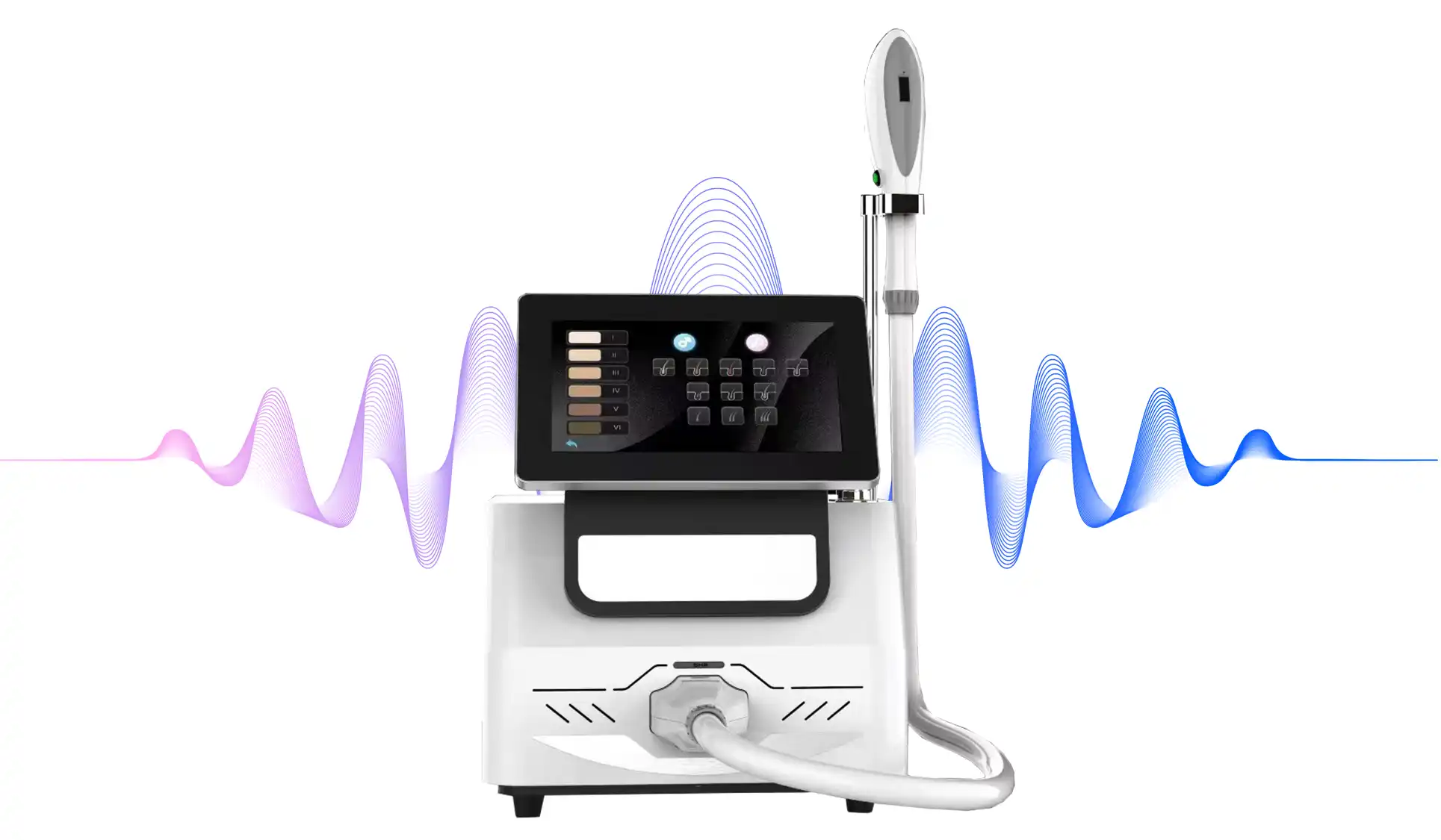
IPL technology is not limited to hair reduction. Depending on the professional system, filters, intended use, and regulatory status, IPL platforms may also be designed for applications involving pigmentation, vascular appearance, and photorejuvenation.
For a broader explanation of the underlying technology, see What Is IPL? How Intense Pulsed Light Works.
How Does IPL Hair Removal Work?
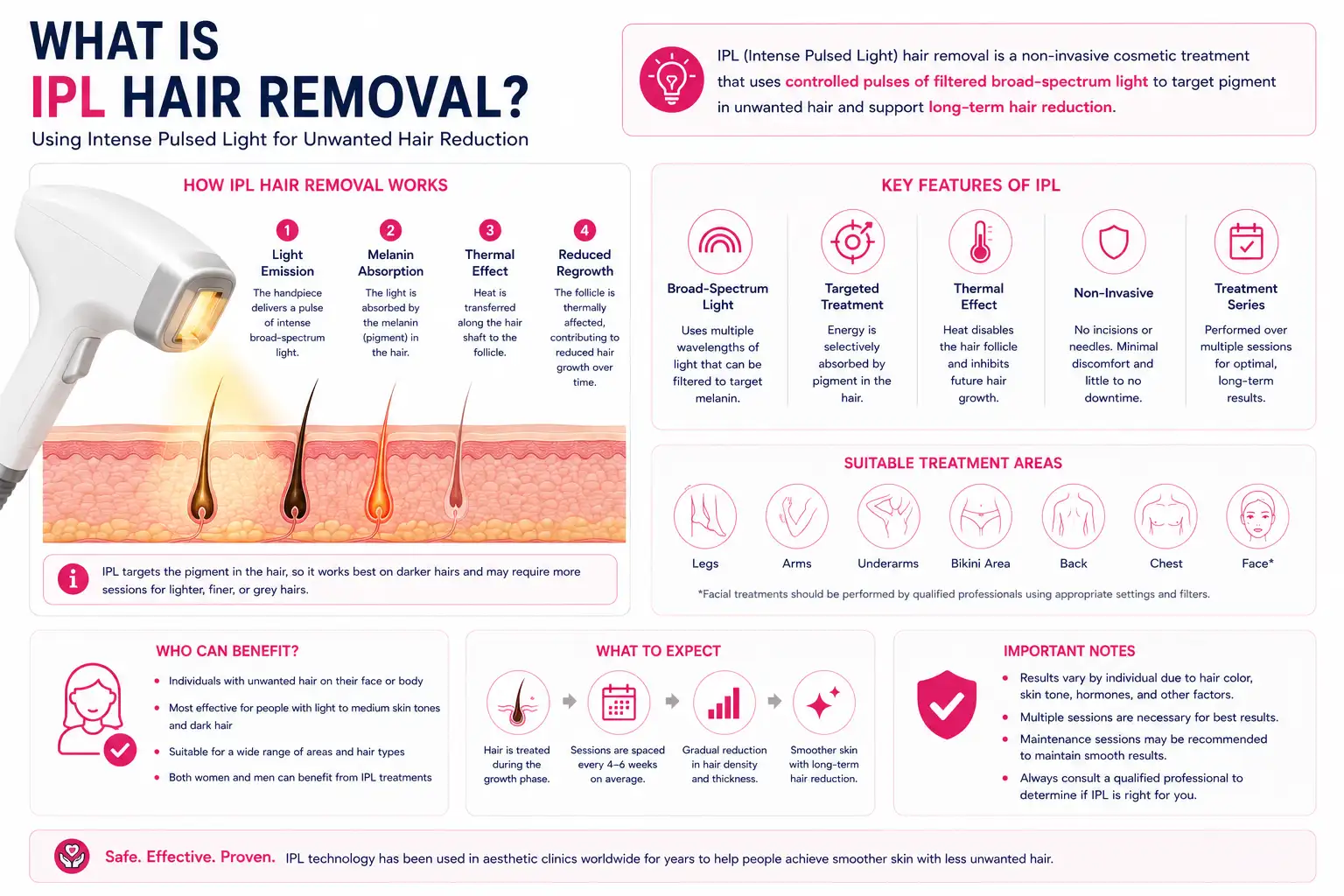
The basic mechanism behind IPL hair removal is based on the interaction between light and chromophores within tissue.
For hair reduction, the primary optical target is melanin, the pigment found in hair and also present in the skin.
The process can be simplified into five stages:
- The IPL system generates a pulse of broad-spectrum light.
- An optical filter helps define the spectral range delivered to the skin.
- Light enters the treatment area and is absorbed to different degrees by melanin.
- Absorbed optical energy is converted into heat.
- Appropriate thermal exposure can affect hair-producing structures and contribute to reduced future hair growth.
This process is related to the principle of selective photothermolysis: optical parameters are selected to produce useful heating of a target chromophore while attempting to limit unwanted thermal effects in surrounding tissue.
However, the process is not perfectly selective. Melanin is also present in the epidermis, which is one reason skin pigmentation must be considered when choosing treatment parameters.
What Does IPL Target During Hair Removal?
The key target in IPL hair reduction is melanin associated with the hair.
This creates an important relationship between:
- Hair color
- Hair thickness
- Skin pigmentation
- Selected spectral range
- Pulse duration and structure
- Delivered fluence
- Cooling
Ideally, the hair provides enough optical contrast relative to the surrounding skin to allow useful targeting.
This helps explain why coarse, darkly pigmented hair can often provide a stronger optical target than very light, gray, white, or some red hair.
It also explains why darker or recently tanned skin requires particular care: increased epidermal melanin can compete for some of the delivered optical energy.
Does IPL Hair Removal Actually Work?
IPL can produce meaningful long-term hair reduction in appropriately selected candidates when suitable equipment and treatment parameters are used.
However, “does IPL work?” is not a simple yes-or-no question because treatment response depends on several variables.
Important factors include:
- Hair color and melanin content
- Hair diameter
- Skin phototype
- Treatment area
- Hair-growth stage
- Hormonal influences
- IPL spectral output and filters
- Pulse characteristics
- Energy delivery
- Cooling performance
- Treatment technique
- Consistency across multiple sessions
A well-designed IPL treatment plan therefore involves more than simply flashing light over unwanted hair.
Appropriate candidate selection, device settings, treatment intervals, and evaluation of skin response are all important.
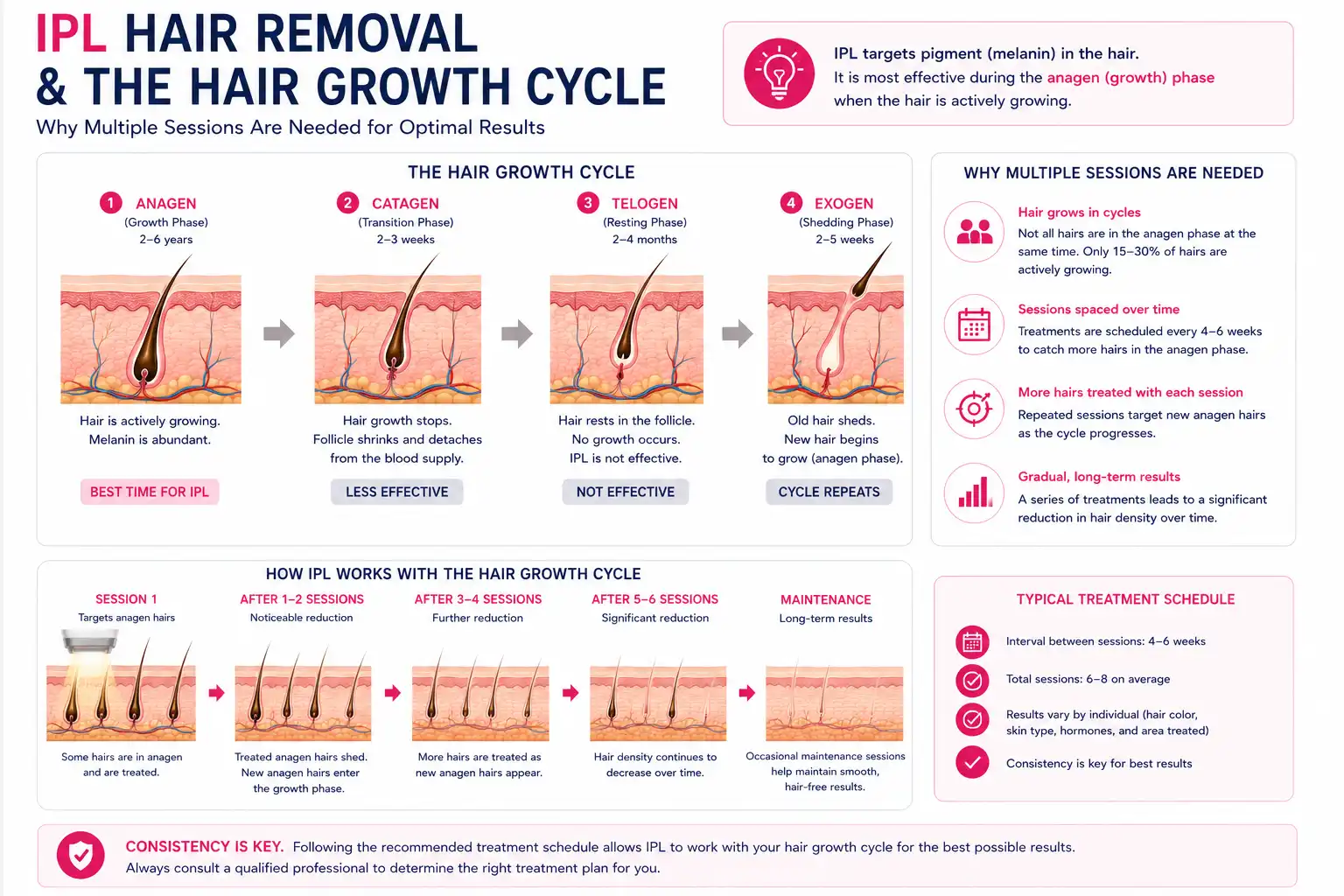
Why Does IPL Hair Removal Require Multiple Sessions?
One of the most important concepts in light-based hair reduction is that not every hair is in the same stage of growth at the same time.
Hair progresses through several stages commonly described as:
- Anagen — active growth
- Catagen — transition
- Telogen — resting phase
- Exogen — shedding, sometimes described separately
Light-based hair reduction depends on having an appropriate pigmented target and biological relationship between the hair and follicular structures.
Because only a proportion of hairs are suitable targets during any individual treatment session, repeated treatments allow additional hairs to be addressed as their growth cycles progress.
This is why IPL hair removal is normally planned as a series of treatments rather than a one-time procedure.
For a detailed explanation of treatment intervals, see How Often Should You Use IPL Hair Removal?.
Is IPL Hair Removal Permanent?
IPL is better described as a technology for long-term hair reduction rather than a guarantee of permanent removal of every treated hair.
Following a successful treatment series, people may experience:
- Lower visible hair density
- Slower regrowth
- Finer regrowing hair
- Patchier hair distribution
- Longer periods with less visible hair
Some hair can remain or return over time.
Long-term regrowth can be influenced by treatment response, body area, age, hormonal factors, and other biological changes.
Maintenance treatments may therefore be appropriate for some people.
Because this question has a distinct search intent, see our detailed guide: Is IPL Hair Removal Permanent? How Long Results Last.
What Hair Colors Respond Best to IPL?
IPL hair reduction depends substantially on melanin as an optical target.
As a general principle, darker pigmented hair can provide stronger optical absorption than hair containing very little melanin.
| Hair Characteristic | General IPL Consideration |
|---|---|
| Dark, coarse hair | Often provides a relatively strong melanin target |
| Dark, fine hair | May respond differently because less total pigment and smaller hair diameter can affect heating |
| Blonde hair | Response may be limited when melanin content is low |
| Red hair | Response can be limited because pigment composition differs |
| Gray or white hair | Generally a poor target for melanin-dependent light-based hair reduction |
These are general principles rather than guarantees for individual treatment response.
Can IPL Hair Removal Be Used on Dark Skin?
Skin pigmentation is an important consideration because melanin is present not only in hair but also in the epidermis.
As epidermal melanin increases, some of the delivered optical energy can also be absorbed by the skin. This can reduce the treatment window between useful follicular heating and unwanted epidermal heating.
Suitability therefore depends on more than whether a machine is marketed as “IPL.”
Professionals need to consider:
- Skin phototype
- Recent tanning and sun exposure
- Spectral output
- Selected filter
- Fluence
- Pulse duration and pulse structure
- Cooling
- Hair characteristics
- Manufacturer protocol
It is therefore inaccurate to claim that every IPL device is automatically suitable for every skin tone.
What Areas Can IPL Hair Removal Treat?
Depending on the device’s intended use, professional assessment, and treatment protocol, IPL hair reduction may be used on a variety of body areas.
Common areas include:
- Underarms
- Legs
- Arms
- Bikini area
- Back
- Chest
- Abdomen
- Selected facial areas
Treatment parameters and practical considerations may differ significantly between a small facial area and a large treatment area such as the legs or back.
Sensitive anatomical areas also require appropriate treatment boundaries and device-specific safety precautions.
What Does IPL Hair Removal Feel Like?
Treatment sensation varies according to the device, treatment area, energy settings, cooling system, hair density, and individual sensitivity.
Patients may describe sensations such as brief warmth, heat, or a snapping sensation during pulse delivery.
Cooling can be an important part of professional IPL treatment because it may help manage epidermal heat and patient comfort.
However, IPL should not universally be described as “painless.” Comfort varies between individuals and treatment conditions.
IPL Hair Removal vs Laser Hair Removal: What Is the Difference?
IPL and laser hair removal can both use optical energy for hair reduction, but their light sources are fundamentally different.
| Feature | IPL Hair Removal | Laser Hair Removal |
|---|---|---|
| Light Source | Broad-spectrum pulsed light | Laser emission |
| Spectrum | Selected portions of a broad spectrum using filters | Generally much narrower and wavelength-specific |
| Hair Target | Primarily melanin | Primarily melanin for common hair-removal lasers |
| Platform Versatility | Some systems support multiple aesthetic applications through filters and modes | Depends on laser wavelength and platform design |
| Examples | Professional IPL, OPT and some SHR platforms | Alexandrite, diode and Nd:YAG hair-removal systems |
Neither category is automatically better in every situation.
A meaningful comparison should consider the actual IPL system or laser wavelength, patient characteristics, treatment objective, parameters, cooling, and operator technique.
For a detailed technology comparison, see IPL vs Laser: What’s the Difference?.
IPL Hair Removal vs SHR: What Is the Difference?
IPL and SHR are often presented as competing hair-removal technologies, but the relationship is more nuanced.
IPL describes the underlying intense pulsed light technology, while SHR commonly describes a particular treatment-delivery approach that may be implemented on an IPL-based platform.
Conventional IPL hair-removal modes may use individual pulses delivered to adjacent treatment areas. SHR modes commonly use repeated pulses, relatively high repetition rates, and an in-motion technique to build thermal effects progressively across the treatment area.
This means an IPL platform may offer both conventional IPL and SHR treatment modes without containing two completely different light sources.
SHR should also not automatically be described as a laser. The actual light source depends on the specific device.
For a detailed comparison, see IPL vs SHR Hair Removal: What’s the Difference?.
How Should You Prepare for IPL Hair Removal?
Appropriate preparation can influence both treatment safety and the availability of a useful optical hair target.
Instructions vary by device and provider, but professional treatment preparation may include evaluating:
- Recent sun exposure or tanning
- Skin condition in the treatment area
- Hair-removal methods used before treatment
- Relevant medications
- Previous reactions to light-based procedures
- Hair and skin characteristics
- Device-specific contraindications
Patients are commonly instructed to avoid removing the hair from the root with methods such as waxing or plucking during a light-based hair-reduction program.
Shaving may instead be used according to the provider’s preparation instructions because it removes hair above the skin while leaving the follicular hair target below the surface.
Recent tanning is particularly relevant because increased epidermal melanin can change the way optical energy is absorbed by the skin.
What Happens During an IPL Hair Removal Treatment?
The exact clinical workflow varies between systems, but a professional IPL hair-removal session generally involves several stages.
1. Consultation and Assessment
The treatment provider evaluates the treatment area, hair characteristics, skin pigmentation, recent sun exposure, relevant history, and other factors that may affect treatment suitability.
2. Treatment Preparation
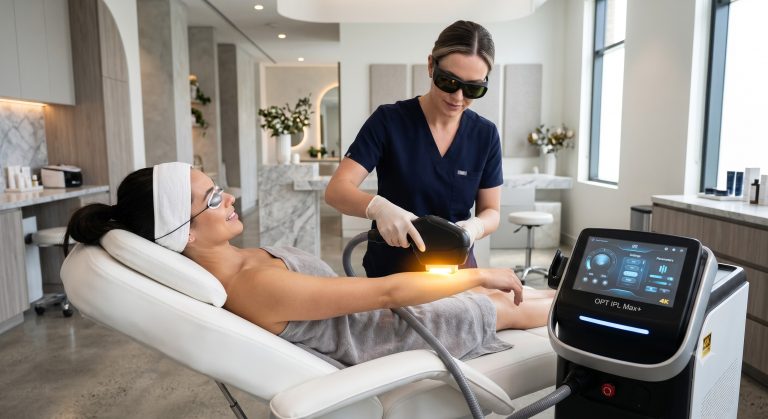
The treatment area is prepared according to the protocol of the specific IPL system. Appropriate eye protection is required according to device instructions and applicable safety procedures.
3. Parameter Selection
The operator selects appropriate treatment parameters according to factors such as the patient’s skin and hair characteristics, treatment area, device capabilities, and manufacturer protocol.
4. Light Delivery
The IPL handpiece is positioned over the treatment area and pulses of filtered light are delivered using the technique intended for the selected treatment mode.
5. Cooling and Skin Monitoring
Depending on the device, cooling may be integrated into the treatment window or used through another approved method. Skin response is monitored throughout treatment.
6. Post-Treatment Assessment
After treatment, the area is evaluated and appropriate aftercare instructions are provided.
How Many IPL Hair Removal Sessions Do You Need?
There is no universal number of IPL sessions that guarantees the same result for every person.
Multiple treatments are generally required because hair follicles are at different stages of the growth cycle.
The number of sessions required can be influenced by:
- Body area
- Hair color
- Hair thickness
- Hair density
- Skin phototype
- Hair-growth pattern
- Hormonal influences
- IPL device and filter selection
- Treatment parameters
- Treatment interval
- Individual biological response
Instead of promising a fixed session count, treatment progress should be evaluated across the series.
Useful signs of response may include slower regrowth, lower hair density, finer regrowing hairs, and longer periods before visible hair returns.
How Often Should You Have IPL Hair Removal?
Professional IPL hair-removal sessions are generally separated by a period measured in weeks rather than being performed every day or every few days.
However, one fixed interval should not be applied universally to every body area, patient, and IPL device.
Treatment frequency depends on hair-growth behavior, visible regrowth, treatment area, skin response, device instructions, and the professional protocol being followed.
At-home IPL devices may recommend a different initial schedule, including more frequent use for some consumer systems. These instructions should not be transferred directly to professional IPL equipment.
We explain this search intent in detail in How Often Should You Use IPL Hair Removal?.
What Results Can You Expect From IPL Hair Removal?
IPL results usually develop progressively across a treatment series rather than appearing as complete hair removal immediately after the first session.
With an appropriate response, changes may include:
- Reduced visible hair density
- Slower hair regrowth
- Finer regrowing hairs
- Patchier regrowth
- Longer intervals before noticeable hair returns
Results vary significantly among individuals.
Dark, coarse hair can often provide a more favorable melanin target than very lightly pigmented hair, while hormonal influences and treatment area can also affect the long-term response.
Some people may eventually benefit from maintenance treatments if meaningful regrowth develops.

How Long Does It Take to See IPL Hair Removal Results?
IPL hair removal should not be judged only by what the treatment area looks like immediately after a session.
Treated hairs may remain visible for a period before shedding, and other follicles may subsequently produce visible hairs as they progress through different growth stages.
The more useful question is whether the pattern of regrowth changes across multiple sessions.
Over time, a responsive treatment area may show progressively less hair, slower regrowth, or finer remaining hairs.
Does IPL Hair Removal Have Downtime?
IPL hair removal is generally performed without the type of recovery period associated with ablative skin-resurfacing procedures.
However, that does not mean every treatment produces zero visible skin response.
Temporary effects can include:
- Redness
- Warmth
- Mild sensitivity
- Temporary perifollicular changes around treated hairs
The degree and duration of these effects depend on the device, parameters, treatment area, skin characteristics, and individual response.
Unexpected, severe, or persistent reactions should be assessed appropriately rather than treated as a normal consequence of every IPL session.
What Are the Side Effects of IPL Hair Removal?
Like other energy-based aesthetic treatments, IPL hair removal has potential side effects and risks.
Temporary expected responses may include redness, warmth, or mild discomfort.
Less desirable reactions can include:
- Excessive erythema
- Prolonged irritation
- Burns
- Blistering
- Post-inflammatory hyperpigmentation
- Hypopigmentation
- Crusting or other unwanted skin reactions
Risk is influenced by patient selection, skin pigmentation, recent tanning, device characteristics, spectral range, filter selection, fluence, pulse characteristics, cooling, and operator technique.
Is IPL Hair Removal Safe?
IPL hair removal can be used within professional aesthetic practice when the patient is appropriately selected and the device is operated according to its intended use, instructions, and applicable professional requirements.
However, no light-based procedure should be described as universally risk-free.
Important safety considerations include:
- Correct skin and hair assessment
- Appropriate filter selection
- Appropriate treatment parameters
- Cooling
- Eye protection
- Recent sun exposure
- Relevant medications and medical history
- Device-specific contraindications
- Operator training
Professional IPL systems also differ substantially in design and performance, so safety cannot be inferred from the term “IPL” alone.
Who May Be a Good Candidate for IPL Hair Removal?
IPL hair reduction may be considered when there is sufficient pigment in the unwanted hair to provide a useful optical target and the person’s skin characteristics allow an appropriate treatment window.
Candidate assessment should consider:
- Hair color
- Hair thickness
- Hair density
- Skin phototype
- Treatment area
- Sun exposure and tanning
- Previous treatment response
- Relevant health and medication history
Suitability cannot be determined solely by looking at hair color in isolation.
Who May Not Be Suitable for IPL Hair Removal?
IPL may not be appropriate in every situation, and contraindications vary between devices.
Treatment may need to be avoided, delayed, or professionally reassessed when there is:
- Recent significant tanning or sunburn
- Active skin irritation or compromised skin in the treatment area
- Certain photosensitizing medications or relevant medical factors
- A previous significant adverse reaction to light-based treatment
- Very low hair pigmentation that provides an inadequate optical target
- Another contraindication specified by the device manufacturer
This list is not exhaustive. The instructions and contraindications for the particular IPL system should take priority.
Professional IPL vs At-Home IPL Hair Removal
Professional and at-home IPL devices use related light-based principles, but they should not be treated as interchangeable equipment.
| Factor | Professional IPL | At-Home IPL |
|---|---|---|
| Intended User | Professional operator according to applicable requirements | Consumer |
| Platform Design | Designed for professional aesthetic treatment workflows | Designed for consumer self-use |
| Parameter Control | May provide broader professional adjustment depending on the system | Usually more limited or automated |
| Treatment Modes | May include multiple filters, pulse modes, OPT or SHR depending on platform | Usually focused on simplified hair-reduction operation |
| Treatment Schedule | Based on professional protocol and device instructions | Based on the specific consumer manufacturer’s instructions |
| Clinical Assessment | Can incorporate professional evaluation before and during a treatment series | Relies more heavily on consumer screening and device safeguards |
This distinction is particularly important when reading online advice about treatment frequency. A weekly schedule recommended for one home-use device should not automatically be applied to professional IPL equipment.
IPL, OPT and SHR: How Are They Related?
IPL, OPT, and SHR are frequently presented as three separate technologies, but that can be misleading.
IPL describes the broad-spectrum pulsed light platform.
OPT generally refers to an optimized pulse-delivery approach used with IPL technology. The exact implementation and terminology can vary between manufacturers.
SHR commonly refers to a hair-reduction delivery strategy involving repeated light pulses and often an in-motion technique designed to create progressive thermal accumulation.
A professional platform may therefore provide IPL, OPT, and SHR functions while using the same underlying light-generation architecture.
For more detail, see OPT vs IPL: What’s the Difference? and What Is SHR Hair Removal? How SHR Technology Works.
Is IPL Better Than Laser Hair Removal?
Neither IPL nor laser should be described as universally better for every patient, clinic, or treatment objective.
Professional IPL can offer flexibility because one platform may support multiple filters and aesthetic applications.
Dedicated hair-removal lasers, such as diode, Alexandrite, or Nd:YAG systems, use more wavelength-specific optical output and may offer advantages for particular patient populations or treatment objectives.
A meaningful decision should therefore compare the actual systems rather than assuming that all IPL machines or all lasers perform identically.
Factors to compare include:
- Wavelength or spectral range
- Skin phototype
- Hair characteristics
- Pulse control
- Fluence
- Spot size
- Repetition rate
- Cooling
- Treatment speed
- Operator experience
- Device indications and regulatory status
Frequently Asked Questions About IPL Hair Removal
What is IPL hair removal?
IPL hair removal is a light-based method that uses filtered broad-spectrum intense pulsed light to target pigment in unwanted hair. Absorbed optical energy is converted into heat, contributing to long-term reduction in visible hair growth.
What does IPL stand for in hair removal?
IPL stands for Intense Pulsed Light. It is not a single-wavelength laser. IPL systems generate a broader spectrum of pulsed light and use filters to select portions of that spectrum for different applications.
How does IPL hair removal work?
Melanin within the hair absorbs part of the delivered optical energy. This energy is converted into heat, creating controlled thermal effects in hair-bearing structures that can contribute to reduced future hair growth.
Does IPL hair removal really work?
IPL can produce meaningful long-term hair reduction in appropriately selected candidates. Results depend on hair and skin characteristics, device performance, treatment parameters, treatment consistency, and individual response.
Is IPL hair removal permanent?
IPL is more accurately described as providing long-term hair reduction rather than guaranteeing permanent elimination of every treated hair. Some people may experience later regrowth and may benefit from maintenance treatment.
How many IPL sessions are needed?
Multiple sessions are generally required because hair follicles are not all in the same growth stage at the same time. There is no universal session count that applies to every person or treatment area.
How often should IPL hair removal be performed?
Professional IPL sessions are generally separated by intervals measured in weeks, but the appropriate schedule depends on the body area, hair-growth pattern, device, treatment response, and professional protocol.
Does IPL work on blonde hair?
IPL relies substantially on melanin as an optical target, so very lightly pigmented hair may respond less effectively than darker hair. Response varies with the amount and type of pigment present.
Does IPL work on gray or white hair?
Gray or white hair generally provides a poor target for melanin-dependent IPL hair reduction because it contains little or no useful melanin for optical absorption.
Can IPL be used on dark skin?
Suitability depends on the actual device, spectral range, filter, pulse parameters, cooling, skin phototype, tanning status, and professional assessment. The term “IPL” alone does not establish suitability for every skin tone.
Is IPL the same as laser hair removal?
No. IPL uses filtered broad-spectrum pulsed light, while laser hair-removal systems generally use much narrower, wavelength-specific optical emission.
Is SHR the same as IPL?
SHR commonly describes a treatment-delivery strategy rather than a completely separate light source. Many SHR systems are based on IPL technology, although implementations vary between manufacturers.
Does IPL hair removal hurt?
Sensation varies. Some people describe brief warmth or a snapping sensation. Device settings, cooling, treatment area, hair density, and individual sensitivity all affect comfort, so IPL should not universally be described as painless.
Can you shave between IPL treatments?
Shaving is commonly compatible with IPL treatment programs because it removes visible hair above the skin without intentionally removing the follicular hair from the root. Follow the preparation instructions for the specific device and provider.
Is professional IPL the same as home IPL?
No. Professional and consumer IPL devices can differ substantially in design, available parameters, treatment protocols, intended users, and safeguards. Advice for one category should not automatically be transferred to the other.
Final Verdict: What Is IPL Hair Removal?
IPL hair removal is a light-based method for reducing unwanted hair using filtered pulses of broad-spectrum intense pulsed light.
The treatment relies primarily on melanin within the hair as an optical target. Absorbed light is converted into heat, producing controlled thermal effects that can contribute to a long-term reduction in visible hair growth.
IPL is not the same as a laser. It uses a broader spectrum of light, while common hair-removal lasers produce narrower wavelength-specific output.
Multiple sessions are usually needed because hair follicles progress through different growth stages at different times. Treatment response also depends on hair color, thickness, skin pigmentation, treatment area, device characteristics, parameters, and individual biology.
For suitable candidates, professional IPL can be an effective option for long-term hair reduction. However, it should not be marketed as universally permanent, completely painless, suitable for every hair and skin type, or interchangeable with every laser hair-removal system.
Understanding these distinctions helps patients set realistic expectations and helps professional clinics evaluate IPL technology based on actual optical performance, treatment protocols, and patient suitability rather than marketing terminology alone.
Editorial & Technical Review: This article was prepared for the Cocoon Laser professional aesthetic technology knowledge center for educational purposes. It does not provide an individualized treatment recommendation or replace appropriate professional assessment. IPL systems vary in spectral output, filters, pulse characteristics, energy delivery, cooling, intended use, treatment protocols, and regulatory status. Treatment suitability, parameters, contraindications, expected outcomes, and risks should be evaluated according to the specific device instructions and applicable professional requirements.