IPL vs Laser: What’s the Difference?
IPL and laser are both light-based technologies used in professional aesthetic treatments, but they are not the same.
The main difference is that IPL uses broad-spectrum pulsed light, while a laser typically delivers light centered around a much more specific wavelength or wavelength range.
This difference affects how each technology interacts with tissue, which treatment targets it may be suited for, how devices are configured, and how clinics should compare equipment.
This guide explains the difference between IPL vs laser, including wavelength, chromophores, hair reduction, pigmentation, vascular applications, skin rejuvenation, downtime, risks, and professional equipment selection.
Quick Answer
IPL and laser differ mainly in how they produce and deliver light. IPL uses a broad spectrum of non-coherent pulsed light that can be modified with optical filters, while a laser generally emits light centered around a specific wavelength or narrow wavelength range.
IPL offers versatility because one platform may support hair reduction, pigmentation, vascular, and photorejuvenation applications depending on its filters and pulse controls.
Lasers are generally more wavelength-specific. For example, diode lasers are commonly used for hair reduction, picosecond lasers for selected tattoo and pigmentation applications, 1927nm thulium lasers for relatively superficial fractional treatment, and 10,600nm CO2 lasers for ablative resurfacing.
Neither IPL nor laser is universally better. The right technology depends on the treatment target, skin characteristics, desired tissue effect, downtime, device design, and professional clinical assessment.
What Is IPL?
IPL stands for Intense Pulsed Light.
IPL systems generate broad-spectrum, non-coherent pulses of light rather than one fixed laser wavelength.
Optical filters can be used to remove portions of the spectrum and shape the light delivered to the treatment area.
Depending on the device, IPL may be used for selected applications such as:
- Hair reduction
- Superficial pigmentation
- Photodamage
- Selected vascular concerns
- Photorejuvenation
- Uneven-looking skin tone
For a detailed introduction, see What Is IPL? How Intense Pulsed Light Works.
What Is a Laser?
A laser is a light source that produces optical energy with much greater wavelength specificity than IPL.
Different aesthetic lasers are designed around different wavelengths and pulse characteristics.
Examples include:
- Approximately 755nm alexandrite lasers
- Approximately 808 or 810nm diode lasers
- Approximately 1064nm Nd:YAG lasers
- Picosecond laser systems using wavelengths such as 532nm and 1064nm
- Approximately 1927nm thulium lasers
- Approximately 10,600nm CO2 lasers
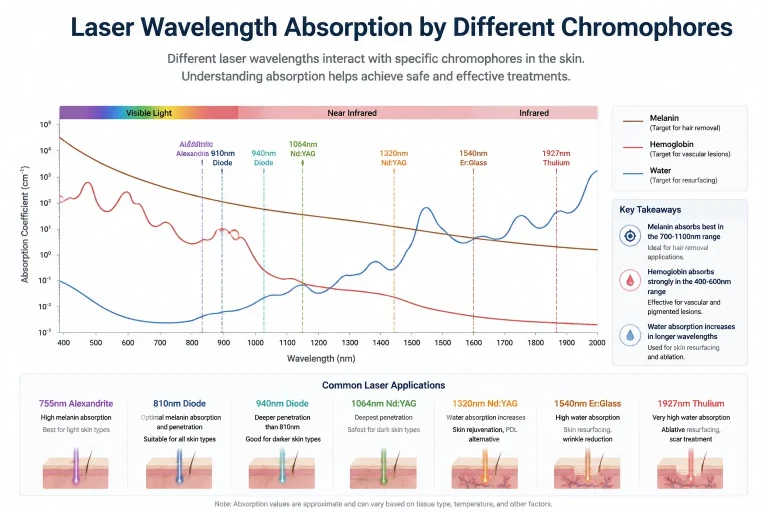
Each wavelength has different absorption characteristics in chromophores such as melanin, hemoglobin, or water.
This means the word “laser” does not describe one single treatment.
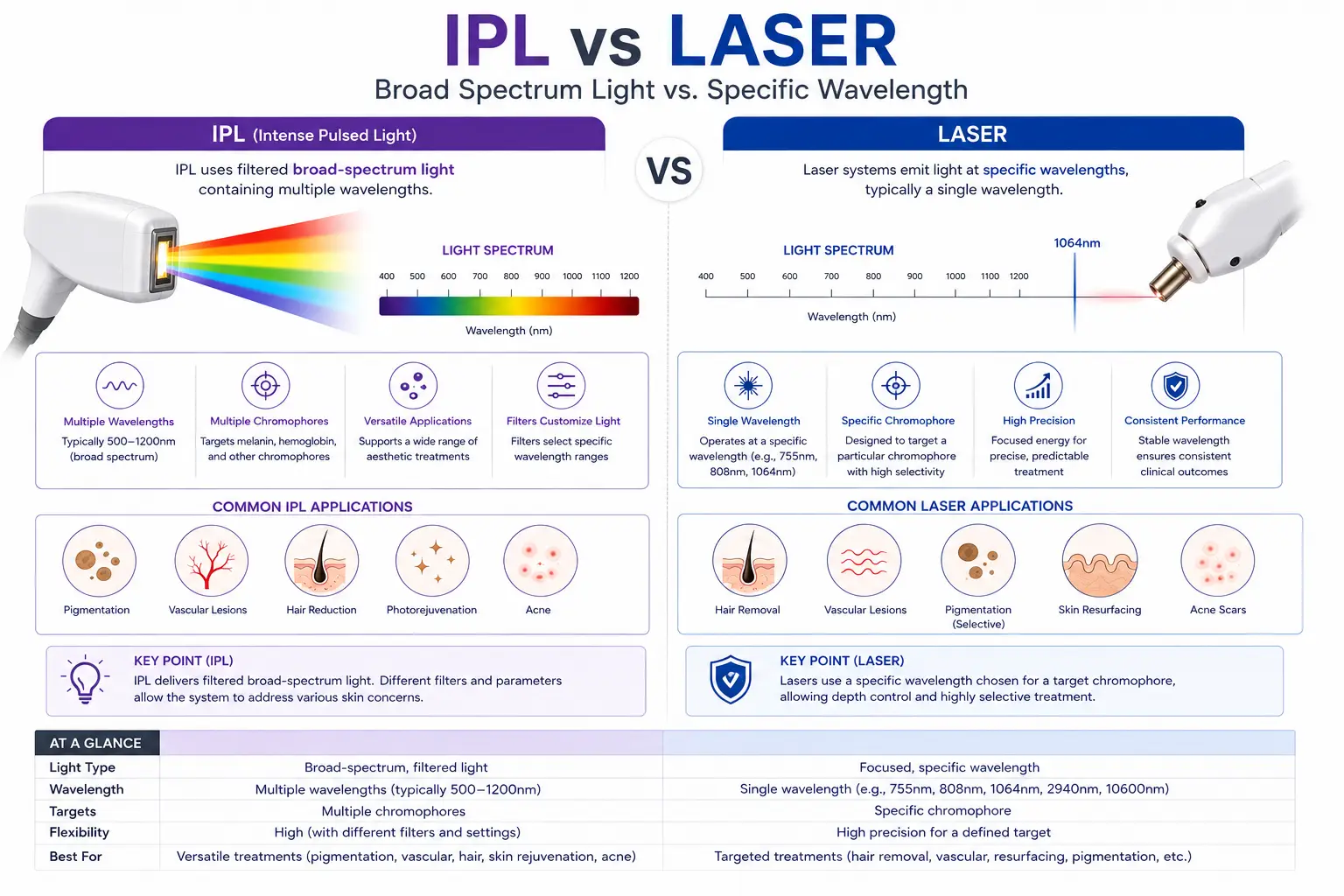
IPL vs Laser at a Glance
| Feature | IPL | Laser |
|---|---|---|
| Light Source | Broad-spectrum pulsed light | Laser-generated light |
| Wavelength | Broad range modified by filters | Usually centered around a specific wavelength or narrow range |
| Coherence | Non-coherent | Highly organized laser emission |
| Treatment Flexibility | Multiple applications may be supported with filters and parameter changes | Usually more specialized according to wavelength and device design |
| Hair Reduction | Common application | Common with diode, alexandrite, and Nd:YAG systems |
| Pigmentation | Selected superficial pigmentation | Depends strongly on laser wavelength and pulse architecture |
| Vascular Applications | Selected vascular concerns | Specific vascular lasers may offer targeted wavelength interaction |
| Resurfacing | Not equivalent to ablative resurfacing | Thulium, fractional non-ablative, and CO2 systems offer different resurfacing profiles |
IPL vs Laser Wavelength: The Biggest Technical Difference
The wavelength architecture is the most important technical distinction between IPL and laser systems.
IPL Uses a Broad Spectrum
IPL begins with a broad spectrum of light.
The machine may then use optical filters to remove selected portions of the spectrum and deliver a more useful range for a specific treatment objective.
This allows one IPL platform to potentially support several different applications.
Laser Uses a More Specific Wavelength
Laser systems are generally designed around a specific wavelength or narrow wavelength range.
For example, a professional diode hair-reduction system may operate around 808nm, while a fractional thulium system may operate around 1927nm.
These wavelengths interact differently with tissue because chromophore absorption changes across the electromagnetic spectrum.
Wavelength therefore strongly influences which tissue targets a laser system may be suited to treat.
IPL vs Laser: How Do They Target Tissue?
Both IPL and laser treatments rely on controlled interaction between light and biological tissue.
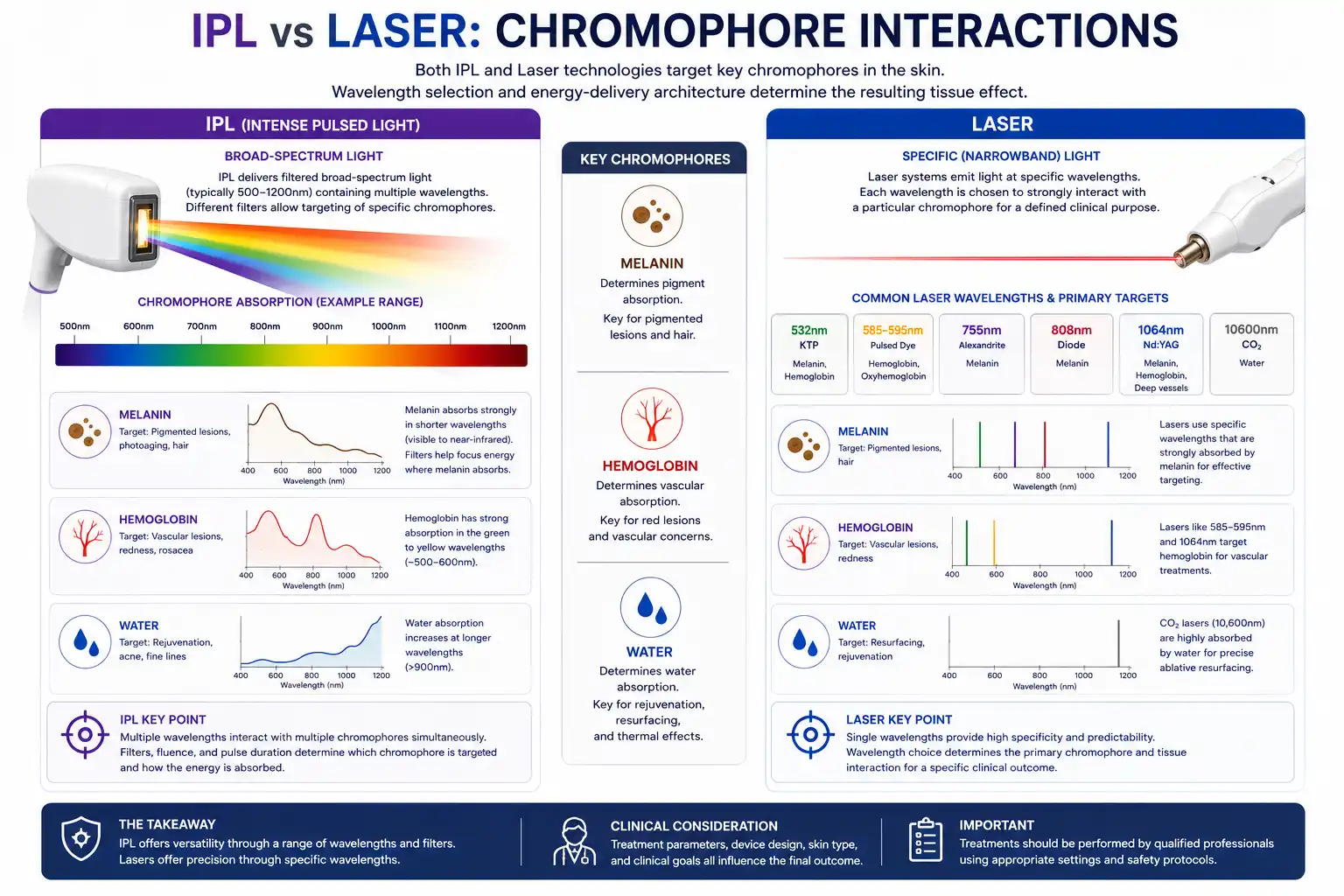
Important target chromophores include:
- Melanin
- Hemoglobin
- Water
Melanin
Melanin is important in hair reduction and many pigmentation treatments.
Both IPL and selected lasers can deliver wavelengths that are absorbed by melanin. However, their spectral profiles and energy-delivery characteristics are different.
Hemoglobin
Hemoglobin is relevant to vascular applications.
IPL can use selected spectral ranges for certain visible vascular concerns, while specific vascular lasers may use wavelength-specific absorption characteristics.
Water
Water becomes particularly important in technologies such as 1927nm thulium and 10,600nm CO2 lasers.
These laser systems create treatment effects that are fundamentally different from conventional IPL photorejuvenation.
Does IPL Use Selective Photothermolysis?
Yes. Selective photothermolysis is an important principle behind many IPL and laser treatments.
The objective is to select optical and temporal parameters that create sufficient heat within the target while limiting unwanted thermal damage to surrounding tissue.
Important variables include:
- Wavelength or spectral range
- Fluence
- Pulse duration
- Pulse structure
- Target size
- Chromophore concentration
- Cooling
IPL adds another layer of complexity because multiple wavelengths may be delivered within the filtered spectrum.
IPL vs Laser for Hair Removal
Hair reduction is one of the most common areas where consumers and clinics compare IPL with laser technology.
Both approaches can use melanin within the hair structure as an optical target, but they deliver light differently.
IPL Hair Reduction
IPL delivers a filtered range of wavelengths. Selected portions of that spectrum can be absorbed by melanin associated with the hair structure.
Laser Hair Reduction
Laser hair-reduction systems use more wavelength-specific output.
Common professional technologies include:
- Alexandrite laser around 755nm
- Diode laser around 808/810nm
- Nd:YAG laser around 1064nm
- Multi-wavelength diode platforms
These systems can provide different balances of melanin absorption, penetration, epidermal interaction, and treatment suitability.
IPL vs Laser Hair Removal: Which Is Better?
There is no universal answer because “laser hair removal” includes several different wavelength technologies.
A professional IPL platform may offer flexibility and large treatment areas, while wavelength-specific laser systems may provide more specialized optical targeting.
Important comparison factors include:
- Skin phototype
- Hair color
- Hair thickness
- Treatment area
- Wavelength or spectral range
- Pulse duration
- Spot size
- Cooling
- Treatment speed
- Operator technique
For professional clinics, the comparison is often more useful when framed as IPL vs diode laser, IPL vs alexandrite, or IPL vs Nd:YAG rather than simply IPL vs laser.
Read our dedicated IPL vs Diode Laser Hair Removal guide for a more specific comparison.
IPL vs Laser for Pigmentation
Both IPL and laser technologies can appear in pigmentation treatment strategies, but the appropriate technology depends strongly on the type and depth of pigmentation.
IPL for Pigmentation
IPL can be configured so that selected parts of its spectrum interact with melanin in superficial pigmented targets.
This makes IPL particularly relevant to selected sun-related pigmentation and visible photodamage in appropriately selected patients.
Laser for Pigmentation
Laser options vary considerably.
Examples may include:
- Picosecond lasers for selected pigmentary targets
- Q-switched lasers for selected pigmentation
- 1927nm thulium laser for relatively superficial fractional treatment
These technologies do not create identical tissue effects.
A superficial photodamage concern may require a different approach from dermal pigmentation or a recurrent condition such as melasma.
IPL vs Laser for Melasma
Melasma requires particular caution because it is a complex and often recurrent pigmentary condition.
Neither IPL nor laser should automatically be described as a permanent solution for melasma.
Treatment response can be influenced by:
- Pigment depth
- Skin phototype
- Hormonal influences
- Sun and visible-light exposure
- Previous treatment history
- Inflammatory response
- Risk of post-inflammatory hyperpigmentation
More aggressive light or laser treatment is not automatically better for melasma. Professional diagnosis and conservative treatment planning may be important.
For a wavelength-specific discussion, see Thulium Laser for Melasma.
IPL vs Laser for Vascular Concerns
IPL may be used for selected visible vascular concerns because hemoglobin absorbs portions of the IPL spectrum.
However, wavelength-specific vascular lasers may offer more targeted interaction for particular vessel types and depths.
Technology selection may depend on:
- Vessel diameter
- Vessel depth
- Vessel color
- Treatment area
- Skin phototype
- Wavelength
- Pulse duration
- Cooling
IPL therefore provides versatility, but it is not a universal substitute for every dedicated vascular laser.
IPL vs Laser for Skin Rejuvenation
The term “skin rejuvenation” covers many different treatment goals, so IPL and laser should not be considered interchangeable.
IPL photorejuvenation commonly focuses on visible photodamage, superficial pigmentation, selected redness, and uneven-looking tone.
Laser rejuvenation can include very different technologies, ranging from relatively superficial fractional treatment to deeper non-ablative remodeling and ablative resurfacing.
| Technology | General Treatment Focus |
|---|---|
| IPL | Photodamage, superficial pigmentation, selected redness, tone |
| 1927nm Thulium | Relatively superficial fractional treatment, pigmentation, photodamage |
| 1550nm Fractional Laser | Texture and deeper non-ablative remodeling |
| Fractional CO2 | Ablative resurfacing, selected scars, wrinkles, texture |
The best option therefore depends on what “rejuvenation” actually means for the individual patient.
IPL vs Laser Before and After
Before-and-after results should be evaluated according to the treatment objective rather than by assuming that IPL and all laser technologies should create the same visible change.
After IPL treatment, visible improvement may be assessed through changes in:
- Superficial pigmentation
- Photodamage
- Selected redness
- Uneven-looking skin tone
- Hair density in hair-reduction treatments
After laser treatment, the outcome depends heavily on which laser technology is used.
For example:
- Diode laser results may focus on long-term hair reduction.
- Picosecond laser results may focus on selected pigment or tattoo targets.
- 1927nm thulium results may focus on superficial pigmentation and photodamage.
- Fractional CO2 results may focus on texture, selected scars, and wrinkles.
This is why “IPL vs laser before and after” cannot be judged as one universal comparison. The specific laser technology and treatment indication must always be considered.
IPL vs Laser Results: Which Is More Effective?
Effectiveness depends on whether the selected technology matches the biological target.
IPL may offer strong versatility across several light-based treatment categories, while a wavelength-specific laser may provide a more specialized interaction with a particular chromophore or tissue depth.
For example, a clinic may prefer:
- IPL for selected photodamage and broad photorejuvenation strategies
- Diode laser for dedicated professional hair reduction
- Picosecond laser for selected tattoo and pigment applications
- 1927nm thulium laser for relatively superficial fractional treatment
- Fractional CO2 laser for more intensive resurfacing
Therefore, a laser is not automatically more effective simply because it is a laser, and IPL is not automatically more versatile in every clinical situation.
The more useful question is whether the device can deliver the appropriate optical and thermal effect for the intended target.
IPL vs Laser Downtime
Downtime varies significantly because the word “laser” includes technologies ranging from relatively low-downtime treatments to ablative resurfacing.
Many IPL procedures are associated with relatively limited recovery compared with more intensive fractional laser treatments.
| Technology | General Recovery Profile |
|---|---|
| IPL | Often limited visible downtime, depending on indication and settings |
| Diode Laser | Usually limited downtime in hair-reduction applications |
| Picosecond Laser | Varies by indication, wavelength, fluence, and treatment mode |
| 1927nm Thulium | May involve redness, dryness, roughness, and temporary pigment darkening |
| Fractional CO2 | Can involve more visible recovery, especially with stronger ablative settings |
Downtime should therefore be compared between specific treatments rather than between IPL and the entire category of laser technology.
IPL vs Laser Pain and Treatment Comfort
Treatment comfort depends on the device, settings, treatment area, cooling system, and individual sensitivity.
IPL treatment may create sensations such as:
- Warmth
- Brief snapping
- Stinging
- Temporary heat
Laser treatment sensations vary considerably according to technology.
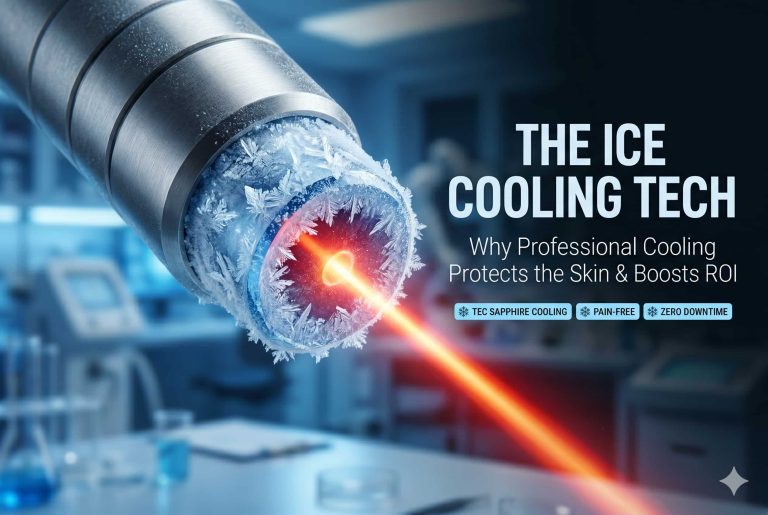
A diode hair-reduction procedure with strong sapphire cooling may feel very different from fractional CO2 resurfacing or picosecond tattoo treatment.
Professional systems may use:
- Contact cooling
- Sapphire cooling
- Air cooling
- Topical anesthesia where appropriate
- Post-treatment cooling
Greater discomfort should never be interpreted as proof of better treatment efficacy.
IPL vs Laser Side Effects and Risks
Both IPL and laser treatments can produce expected temporary responses and possible adverse effects.
Potential risks may include:
- Redness
- Swelling
- Skin sensitivity
- Temporary pigment darkening
- Post-inflammatory hyperpigmentation
- Hypopigmentation
- Blistering or burns
- Delayed healing
- Unwanted textural changes
- Eye injury if appropriate protection is not used
The actual risk profile depends on the device and treatment.
For example, an ablative CO2 laser has a different recovery and adverse-event profile from a professional IPL photorejuvenation treatment.
Device-specific training, patient selection, appropriate eye protection, parameter selection, and aftercare remain essential.
IPL vs Laser for Different Skin Types
Skin pigmentation is an important factor in both IPL and many laser treatments because epidermal melanin can absorb optical energy.
As baseline pigmentation increases, treatment planning may require greater attention to:
- Wavelength or spectral range
- Melanin absorption
- Fluence
- Pulse duration
- Cooling
- Previous pigmentary response
- Recent sun exposure
IPL should not automatically be described as safe for every skin tone simply because filters and settings can be adjusted.
Similarly, not every laser wavelength has the same relationship with epidermal melanin.
For hair reduction, for example, longer-wavelength technologies such as 1064nm Nd:YAG may offer different epidermal melanin interaction from shorter wavelengths.
Technology selection should therefore be based on the specific wavelength, treatment target, patient characteristics, and device instructions rather than a simplified “IPL vs laser” rule.
IPL vs Diode Laser
One of the most commercially important comparisons is IPL vs diode laser, especially for professional hair reduction.
IPL uses filtered broad-spectrum light, while diode laser systems use wavelength-specific semiconductor laser sources.
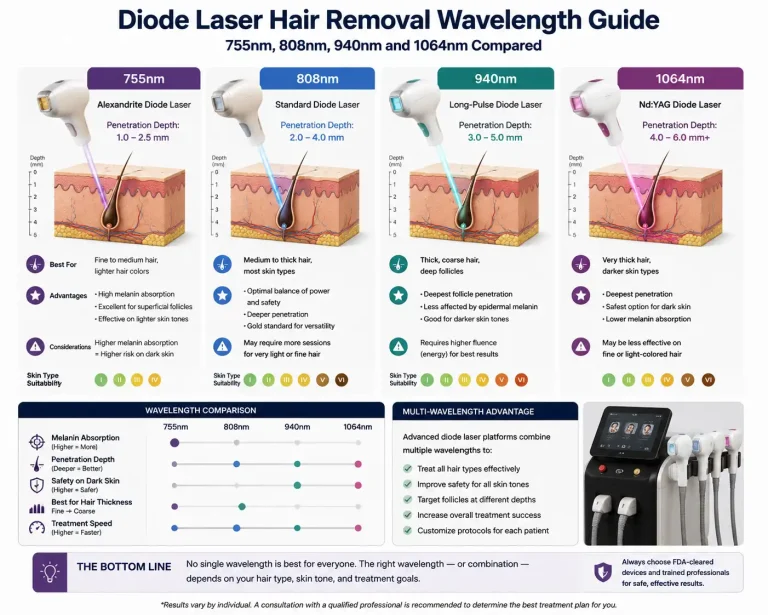
Professional diode platforms may use approximately:
- 755nm
- 808nm or 810nm
- 940nm
- 1064nm
- Multiple wavelengths in one handpiece
| Feature | IPL | Diode Laser |
|---|---|---|
| Light Output | Filtered broad spectrum | Specific diode laser wavelength or wavelength combination |
| Primary Strength | Multi-application versatility | Dedicated hair-reduction specialization |
| Hair Reduction | Common application | Major professional application |
| Pigmentation / Photorejuvenation | Can be supported by appropriate filters | Generally not the primary role of standard hair-reduction diode systems |
| Clinic Positioning | Multi-treatment light platform | Specialized hair-removal platform |
For a complete comparison, see IPL vs Diode Laser Hair Removal.
IPL vs Picosecond Laser
IPL and picosecond laser technology are sometimes compared for pigmentation, but their energy-delivery mechanisms are very different.
IPL uses broad-spectrum pulsed light and relies substantially on photothermal effects.
Picosecond lasers deliver extremely short laser pulses at specific wavelengths. Depending on the device and parameters, these pulses can create strong photoacoustic or photomechanical effects in addition to thermal interaction.
Picosecond systems are commonly associated with:
- Selected tattoo removal applications
- Selected pigmentation treatments
- Laser toning or fractional applications depending on the system
IPL may be more useful when a clinic wants one platform for photorejuvenation, superficial pigmentation, selected vascular concerns, and hair reduction.
Picosecond systems may be more specialized for pigment and tattoo-related treatment portfolios.
IPL vs 1927nm Thulium Laser
IPL and 1927nm thulium laser can both be relevant to pigmentation and photodamage, but they target tissue through different optical pathways.
IPL uses filtered broad-spectrum light, with melanin and hemoglobin serving as important chromophores in many applications.
Approximately 1927nm thulium energy interacts strongly with tissue water and is commonly delivered fractionally for relatively superficial treatment.
This means a thulium laser is not simply a more powerful version of IPL.
The technologies have different:
- Wavelength architecture
- Chromophore relationships
- Fractional treatment mechanisms
- Clinical treatment profiles
- Recovery characteristics
Learn more in our 1927nm Thulium Laser guide.
IPL vs CO2 Laser
IPL and CO2 laser are fundamentally different technologies.
IPL is commonly associated with photorejuvenation, superficial pigmentation, selected vascular concerns, and hair reduction.
A 10,600nm CO2 laser is strongly absorbed by water and can create ablative tissue effects. Fractional CO2 systems can produce microscopic treatment zones used for more intensive resurfacing.
Fractional CO2 may therefore be more directly relevant to:
- Selected acne scars
- Wrinkles
- Textural irregularities
- More intensive resurfacing strategies
IPL should not be marketed as an alternative to ablative fractional resurfacing when the clinical objective requires a fundamentally different tissue effect.
IPL vs Laser: Which Lasts Longer?
Result duration depends much more on the treatment indication than on whether the device is categorized as IPL or laser.
For hair reduction, long-term results can be influenced by:
- Hair-growth biology
- Hormonal influences
- Hair color and thickness
- Skin characteristics
- Treatment completeness
- Maintenance sessions
For pigmentation, results can be affected by:
- Sun exposure
- Underlying pigment disorder
- Hormonal factors
- Skin-care habits
- Recurrence tendency
For resurfacing, natural aging and continued environmental exposure remain relevant even after visible improvement.
Neither IPL nor laser should therefore be marketed as creating universally permanent aesthetic results.
IPL vs Laser: Which Requires More Sessions?
Session count cannot be determined from the technology category alone.
It depends on:
- Treatment indication
- Device technology
- Parameters
- Patient response
- Severity of the concern
- Treatment intensity
- Clinical protocol
A series of IPL treatments may be used for some photorejuvenation or hair-reduction protocols, while certain laser procedures may also involve multiple sessions.
More sessions do not necessarily mean a technology is inferior. Session frequency, treatment intensity, recovery, and treatment goals should be evaluated together.
IPL vs Laser Cost
The cost of IPL or laser treatment varies considerably according to location, treatment area, indication, provider, equipment, and the number of sessions required.
For clinics purchasing equipment, the comparison is even broader.
Equipment cost may be influenced by:
- Energy technology
- Number of wavelengths or filters
- Light or laser source
- Handpiece design
- Cooling system
- Pulse-control capabilities
- Treatment modes
- Consumables
- Expected service life
- Training
- Warranty
- Technical support
- Regulatory documentation
- Manufacturer and distributor model
A lower initial machine price does not necessarily mean a lower long-term operating cost. Clinics should consider maintenance, replacement parts, lamp or handpiece life, consumables, and service support.
IPL or Laser: Which Is Better for a Clinic?
For professional clinics, the decision depends on whether versatility or specialization better matches the treatment portfolio.
IPL May Be a Better Fit If…
- The clinic wants multiple applications on one platform
- Photorejuvenation is an important service category
- Superficial pigmentation is a frequent concern
- Selected vascular applications are part of the service menu
- Hair reduction is required alongside skin treatments
A Dedicated Laser May Be a Better Fit If…
- The clinic focuses heavily on one treatment category
- Hair reduction is the main business and diode specialization is preferred
- Tattoo removal or specialized pigment treatment is a major service
- Fractional resurfacing is a major clinical focus
- The clinic requires a specific wavelength-tissue interaction
A Clinic May Benefit From Both If…
- The practice has a broad aesthetic treatment menu
- Patient volume supports multiple technologies
- The clinic wants both photorejuvenation and specialized laser procedures
- Different devices serve clearly distinct treatment indications
What Should Clinics Compare Before Buying IPL or Laser Equipment?
Clinics and distributors should avoid choosing equipment based only on maximum power, treatment-mode count, or marketing terminology.
Important factors include:
- Actual light or laser technology
- Wavelength or spectral range
- Available filters
- Energy stability
- Fluence range
- Pulse-duration control
- Pulse waveform
- Spot size
- Treatment speed
- Cooling system
- Handpiece ergonomics
- Consumables
- Expected source or lamp life
- Maintenance requirements
- Treatment protocols
- Operator training
- Technical support
- Warranty
- Clinical documentation
- Applicable regulatory status
- OEM/ODM options where required
The correct purchase decision should begin with the clinic’s target procedures and patient population, followed by a technical evaluation of the device.
Frequently Asked Questions About IPL vs Laser
Is IPL the same as laser?
No. IPL uses broad-spectrum, non-coherent pulsed light, while laser systems generally produce light centered around a specific wavelength or narrow wavelength range.
Is IPL better than laser?
Not universally. IPL can provide multi-application flexibility, while a laser can provide more wavelength-specific treatment. The better option depends on the treatment objective.
Is laser stronger than IPL?
“Stronger” is not a useful universal comparison. Different IPL and laser systems create different optical and thermal effects. Treatment suitability depends on the target, wavelength, parameters, and device design.
Which is better for hair removal, IPL or laser?
Both may be used for professional hair reduction. Dedicated laser systems such as diode, alexandrite, and Nd:YAG offer wavelength-specific targeting, while IPL provides a broader filtered spectrum. The most appropriate option depends on hair, skin, device, and treatment objectives.
Which is better for pigmentation, IPL or laser?
It depends on the type and depth of pigmentation. IPL may be useful for selected superficial photodamage, while picosecond, Q-switched, or fractional thulium lasers may be considered for different pigment-related treatment strategies.
Which has less downtime, IPL or laser?
IPL often has relatively limited downtime, but laser downtime varies widely. A diode hair-reduction treatment may have minimal recovery, while fractional CO2 resurfacing can require a much more visible healing period.
Is IPL safer than laser?
Neither technology is universally safer. Safety depends on patient selection, treatment target, device design, settings, cooling, eye protection, operator training, and proper use.
Can IPL and laser be used in the same clinic?
Yes. Many professional clinics use IPL for versatile light-based applications and wavelength-specific lasers for more specialized procedures.
Is IPL a good alternative to CO2 laser resurfacing?
Not for the same treatment objective. IPL does not create the ablative fractional tissue effects associated with CO2 laser resurfacing, so the technologies should not be treated as direct substitutes.
Does IPL permanently remove hair?
IPL is generally used for long-term hair reduction. Results vary by patient, hair characteristics, biological factors, treatment parameters, and the number of sessions.
Final Verdict: IPL vs Laser
The fundamental difference between IPL and laser is the way light is generated and delivered.
IPL produces broad-spectrum pulsed light that can be modified with optical filters, making professional IPL platforms useful across several applications such as selected hair reduction, superficial pigmentation, vascular concerns, and photorejuvenation.
Laser systems typically use more specific wavelengths. This allows technologies such as diode, picosecond, thulium, and CO2 lasers to create more specialized interactions with melanin, water, tattoo pigment, or other treatment targets.
This does not make one category universally superior.
IPL is often valuable for versatility, while lasers are often valuable for wavelength-specific specialization.
For patients, the correct choice depends on the actual condition being treated, skin characteristics, treatment depth, desired outcome, acceptable recovery, and professional assessment.
For clinics purchasing equipment, the decision should be based on the treatment portfolio, patient population, wavelength or spectral architecture, pulse control, cooling, workflow, consumable costs, service support, training, and applicable regulatory requirements.
In many professional practices, IPL and laser technologies are complementary rather than mutually exclusive.
Editorial & Technical Review: This article was prepared for the Cocoon Laser professional aesthetic technology knowledge center for educational and equipment-research purposes. It does not replace individual medical assessment. Treatment suitability, contraindications, parameters, expected results, recovery, and adverse-event risks vary by patient and device. Qualified professionals should follow the intended use, device instructions, training requirements, eye-protection procedures, and applicable regulations for the specific IPL or laser platform.