Diode Laser Wavelengths: 755 vs 808 vs 940 vs 1064nm Comparison
Professional Diode Laser Technology Guide
Why do modern professional diode laser hair removal systems combine multiple wavelengths instead of relying on a single laser? The answer lies in how different wavelengths interact with melanin, penetrate the skin and target hair follicles at varying depths. This guide explains the characteristics of 755nm, 808nm, 940nm and 1064nm diode lasers, compares their advantages and limitations, and explores why multi-wavelength platforms have become the preferred choice for many aesthetic clinics.
Editorial Methodology: This guide is based on established laser physics, published clinical literature, manufacturer technical documentation and current industry practices. Rather than repeating marketing claims, we focus on explaining how each wavelength differs in penetration depth, melanin absorption and practical clinical applications.
Quick Answer
There is no universally “best” diode laser wavelength for hair removal. Each wavelength offers different characteristics that influence how laser energy interacts with hair follicles and surrounding skin. While 808nm remains the most widely adopted wavelength because of its balanced penetration and melanin absorption, professional systems increasingly combine 755nm, 808nm, 940nm and 1064nm into a single platform to increase treatment flexibility across different skin tones, hair thicknesses and anatomical areas.
Instead of asking which wavelength is strongest, practitioners should understand what each wavelength contributes and why modern multi-wavelength diode laser systems are designed to use them together.

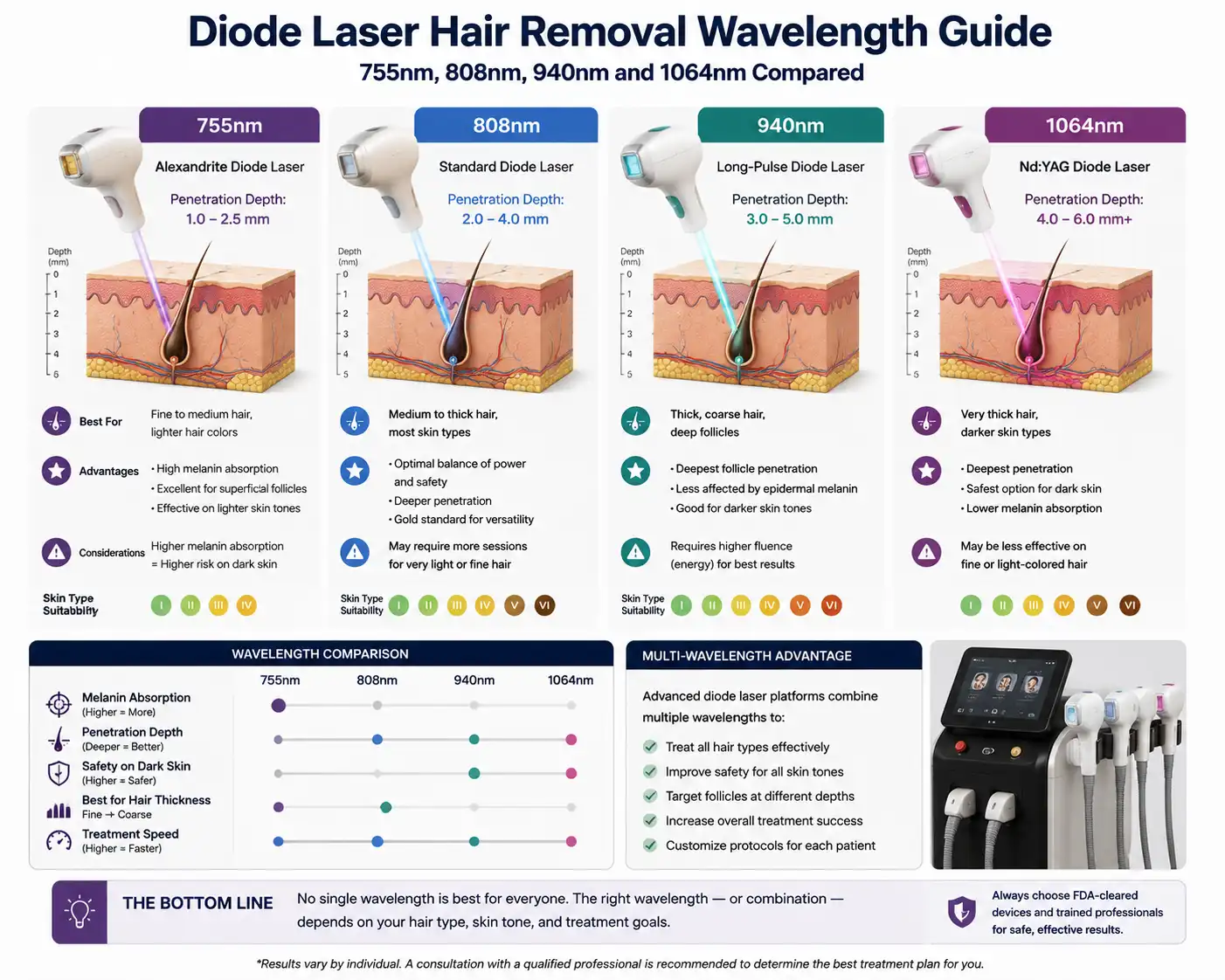
755nm vs 808nm vs 940nm vs 1064nm: Quick Comparison
| Wavelength | Penetration Depth | Melanin Absorption | Typical Characteristics | Common Role in Multi-Wavelength Systems |
|---|---|---|---|---|
| 755nm | Shallower | Higher | Often associated with finer hair and more superficial follicles. | Expands treatment versatility for selected treatment scenarios. |
| 808nm | Medium | Balanced | The most widely used wavelength in professional diode laser systems. | Acts as the primary wavelength in many diode laser platforms. |
| 940nm | Medium to Deep | Moderate | Frequently used as a complementary wavelength in advanced platforms. | Helps broaden treatment flexibility when combined with other wavelengths. |
| 1064nm | Deep | Lower | Provides deeper penetration characteristics than shorter wavelengths. | Often incorporated into multi-wavelength systems for expanded treatment options. |
Why Modern Diode Laser Systems Use Multiple Wavelengths
Human hair varies significantly from one individual to another. Hair thickness, follicle depth, skin pigmentation and treatment area all influence how laser energy is absorbed. A wavelength that performs well for one patient or body area may not always provide the same characteristics in another situation.
This is one of the primary reasons why modern professional diode laser manufacturers increasingly develop multi-wavelength platforms . Instead of relying on a single wavelength, these systems combine multiple wavelengths to provide practitioners with greater flexibility across different clinical scenarios.
Important: Multi-wavelength technology does not automatically guarantee better treatment outcomes. Clinical results depend on many factors, including patient selection, treatment parameters, operator experience and adherence to appropriate treatment protocols.
Why You Can Trust This Guide
Discussions about diode laser wavelengths are often oversimplified by marketing materials that describe one wavelength as universally superior to another. In reality, every wavelength represents a balance between penetration depth, melanin absorption and intended clinical use.
Rather than promoting a single wavelength, this guide explains the strengths and limitations of each option using established laser principles and current industry practices. Throughout this article, you’ll also learn why many modern professional platforms combine multiple wavelengths instead of relying on just one.
Understanding Each Wavelength in Detail
Now that you’ve seen how the four wavelengths compare at a high level, let’s examine each wavelength individually. We’ll explore how 755nm , 808nm , 940nm and 1064nm differ, what role each plays in modern diode laser technology and why they are commonly combined in professional multi-wavelength systems.
Understanding Each Diode Laser Wavelength
Although people often ask which diode laser wavelength is “the best,” the reality is more nuanced. Each wavelength has unique optical characteristics that influence penetration depth, melanin absorption and overall treatment flexibility. Rather than replacing one another, modern professional diode laser platforms combine multiple wavelengths to address a wider variety of clinical situations.
The following sections explain how each wavelength differs and why modern multi-wavelength systems typically integrate 755nm, 808nm, 940nm and 1064nm into a single platform.
755nm Diode Laser Hair Removal
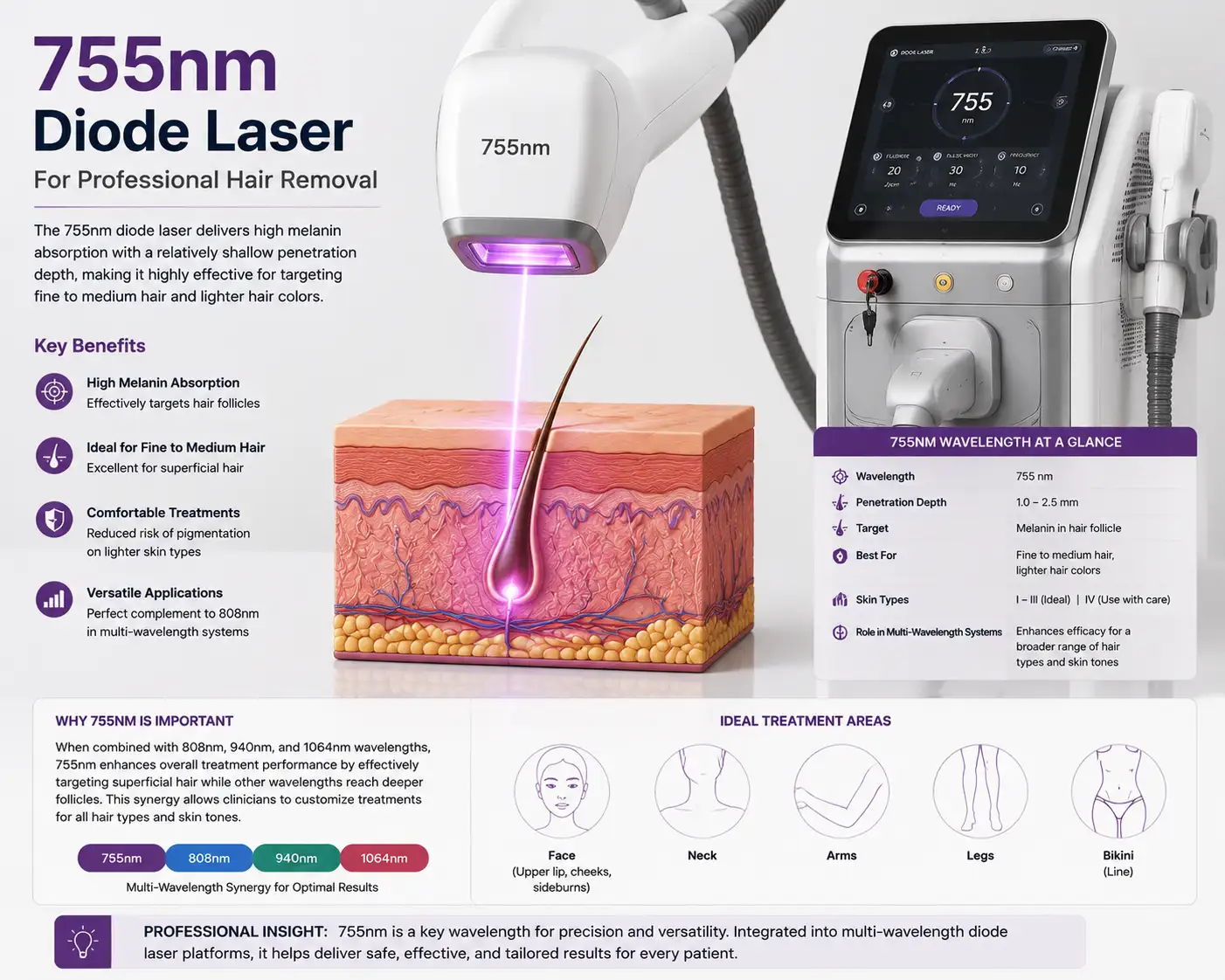
The 755nm diode laser is characterized by relatively high melanin absorption compared with longer wavelengths. Because laser energy is absorbed more readily by melanin, this wavelength is commonly associated with treating finer hair and follicles located closer to the skin surface. In modern professional platforms, 755nm is typically used alongside other wavelengths rather than as a standalone solution.
Typical Characteristics
- Higher melanin absorption than longer diode laser wavelengths.
- Relatively shallower penetration depth.
- Often selected for finer hair in appropriate clinical situations.
- Frequently combined with 808nm and 1064nm in modern systems.
Advantages
- Strong interaction with melanin.
- Suitable for expanding treatment versatility.
- Helps improve flexibility within multi-wavelength platforms.
Limitations
- Not intended to replace longer wavelengths.
- May not be the preferred option for every skin type.
- Clinical parameter selection remains essential.
Important: A 755nm diode laser should not be confused with a traditional 755nm Alexandrite laser . Although both share the same wavelength, they are different laser technologies with different laser media and system designs.
808nm Diode Laser Hair Removal
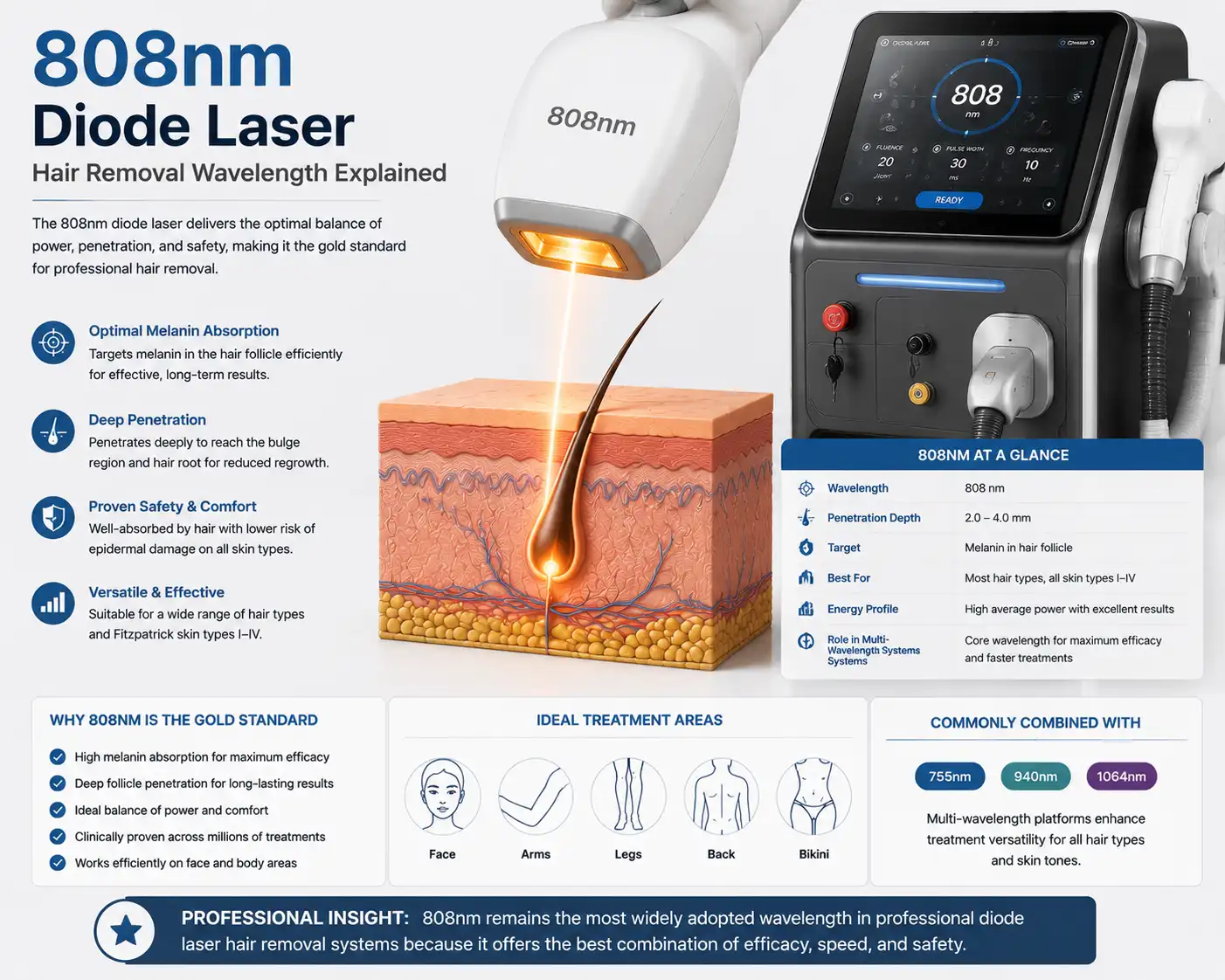
The 808nm diode laser is widely recognized as the industry’s benchmark wavelength because it provides an excellent balance between penetration depth and melanin absorption. For many years, 808nm has been the core wavelength used in professional diode laser hair removal systems worldwide.
Unlike shorter wavelengths that prioritize melanin absorption or longer wavelengths that emphasize deeper penetration, 808nm offers a balanced optical profile suitable for a broad range of treatment areas. This is one reason why many manufacturers continue to use 808nm as the primary wavelength even when additional wavelengths are incorporated into the system.
Why 808nm Became the Industry Standard
- Balanced penetration depth.
- Balanced melanin absorption.
- Suitable for a wide variety of treatment areas.
- Supported by extensive industry adoption.
- Acts as the foundation of many multi-wavelength platforms.
Advantages
- Excellent overall versatility.
- Suitable for both facial and body treatments.
- Commonly used in professional aesthetic clinics.
- Works effectively alongside additional wavelengths.
Limitations
- No single wavelength is ideal for every treatment scenario.
- Professional treatment outcomes depend on appropriate clinical parameters rather than wavelength alone.
755nm vs 808nm: What’s the Difference?
| Feature | 755nm | 808nm |
|---|---|---|
| Melanin Absorption | Higher | Balanced |
| Penetration Depth | Shallower | Medium |
| Primary Role | Complements other wavelengths | Core treatment wavelength |
| Industry Adoption | Growing in multi-wavelength systems | Most widely adopted |
While 755nm and 808nm receive most of the industry’s attention, modern diode laser platforms increasingly include additional wavelengths to further expand treatment flexibility. In the next section, we’ll examine how 940nm and 1064nm contribute to advanced multi-wavelength diode laser systems.
940nm Diode Laser Hair Removal
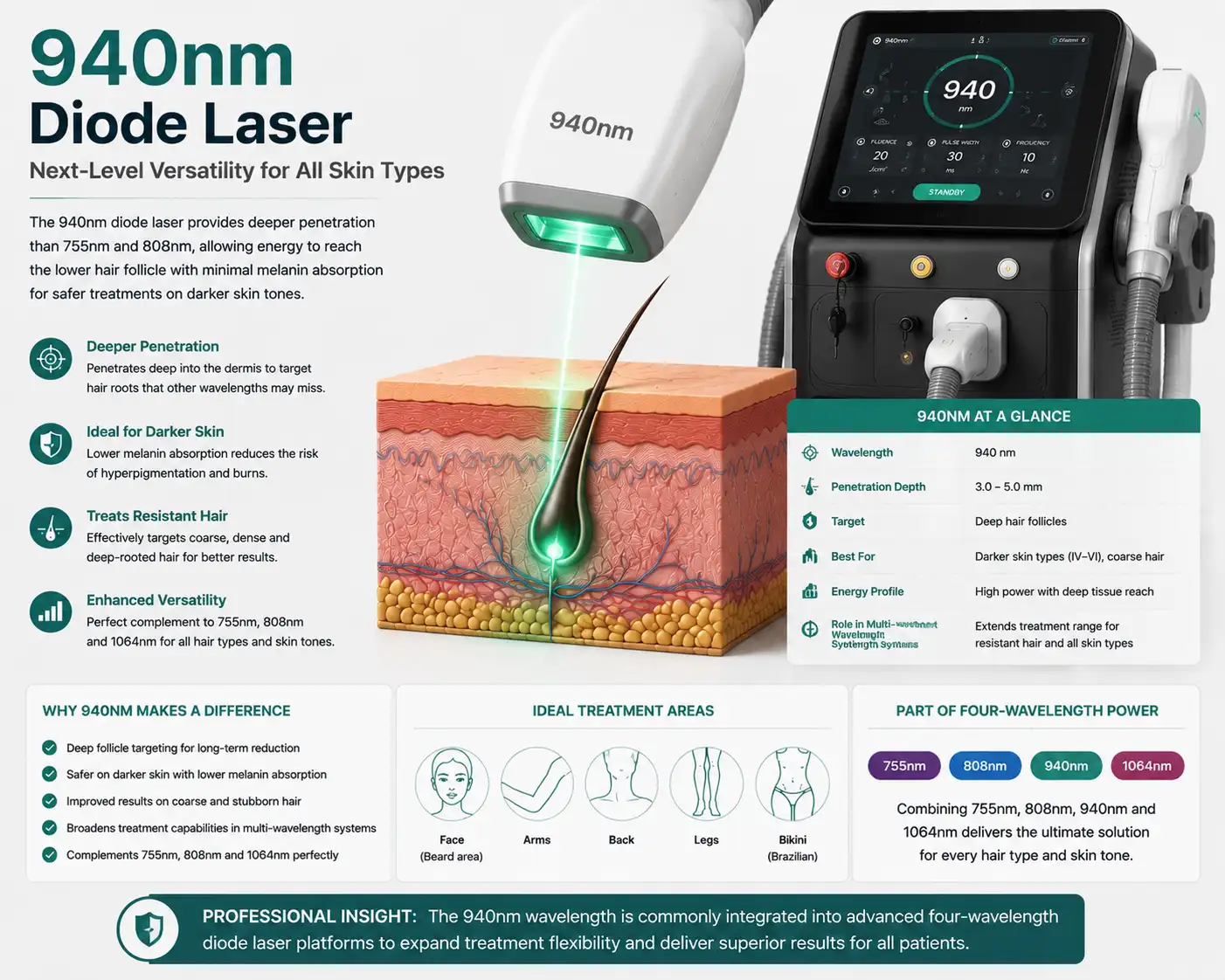
Compared with 755nm and 808nm, the 940nm diode laser is a relatively newer addition to multi-wavelength diode laser systems. Rather than replacing existing wavelengths, 940nm is typically integrated to expand treatment flexibility and improve the overall versatility of professional laser platforms.
Positioned between 808nm and 1064nm, the 940nm wavelength offers intermediate optical characteristics. It is commonly incorporated into four-wavelength diode laser systems, allowing practitioners to utilize a broader range of treatment parameters across different clinical situations.
Typical Characteristics
- Intermediate penetration characteristics.
- Designed to complement rather than replace other wavelengths.
- Increasingly adopted in professional four-wavelength systems.
- Expands treatment versatility across multiple clinical scenarios.
Advantages
- Provides additional flexibility within multi-wavelength platforms.
- Supports broader treatment customization.
- Works alongside 755nm, 808nm and 1064nm.
Limitations
- Rarely used as a standalone wavelength.
- Limited independent clinical discussion compared with 808nm.
- Primarily valued as part of a multi-wavelength system.
1064nm Diode Laser Hair Removal
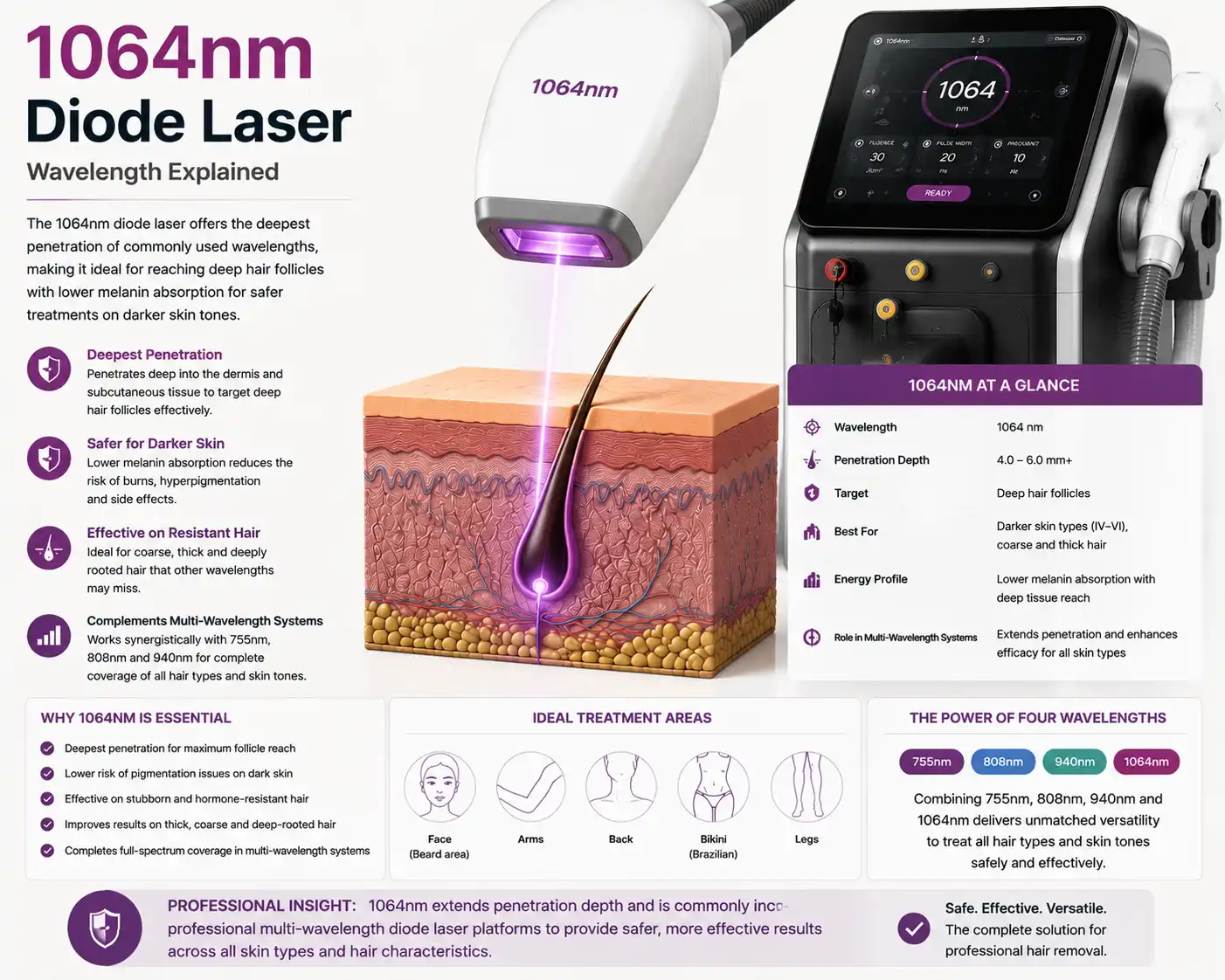
The 1064nm diode laser provides deeper penetration characteristics than shorter wavelengths because of its longer wavelength. Within modern diode laser systems, it is frequently included to broaden the range of treatment options available to practitioners.
It is important to distinguish a 1064nm diode laser from a traditional 1064nm Nd:YAG laser . Although both operate at the same wavelength, they use different laser technologies and should not be considered interchangeable.
Typical Characteristics
- Longer wavelength with deeper penetration characteristics.
- Lower melanin absorption than shorter wavelengths.
- Frequently incorporated into multi-wavelength diode laser systems.
- Expands treatment flexibility for practitioners.
Advantages
- Complements shorter wavelengths.
- Broadens the treatment capabilities of professional platforms.
- Provides additional flexibility for different treatment protocols.
Limitations
- Should not be confused with Nd:YAG laser technology.
- Treatment outcomes depend on multiple factors beyond wavelength.
Single-Wavelength vs Multi-Wavelength Diode Laser Systems
Early diode laser systems commonly relied on a single wavelength—most often 808nm—to perform the majority of hair removal treatments. As technology evolved, manufacturers introduced multi-wavelength platforms that combine multiple laser wavelengths into one handpiece, allowing practitioners to select parameters according to different treatment goals.
| Single-Wavelength System | Multi-Wavelength System |
|---|---|
| One primary wavelength | Multiple wavelengths integrated into one platform |
| Simpler system architecture | Greater treatment flexibility |
| Suitable for many standard treatments | Designed to support a wider variety of treatment scenarios |
| Limited wavelength selection | Expanded wavelength options for practitioners |
Why Are Four-Wavelength Diode Laser Systems Becoming More Popular?
Professional aesthetic clinics increasingly seek equipment capable of treating diverse patient populations with greater flexibility. Rather than relying on a single wavelength, four-wavelength diode laser systems combine 755nm, 808nm, 940nm and 1064nm into a single platform, allowing practitioners to utilize different wavelength characteristics within one treatment system.
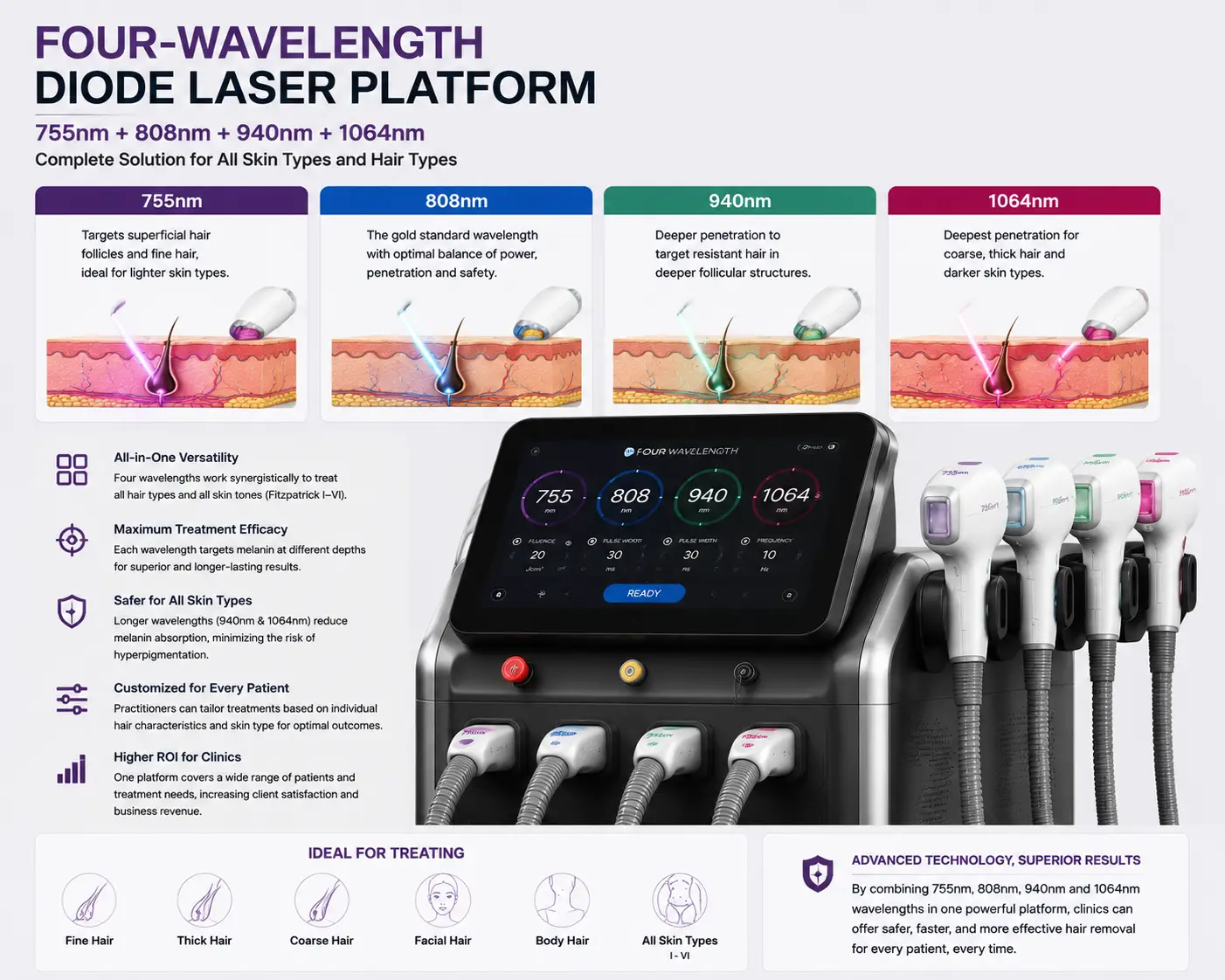
Professional Multi-Wavelength Diode Laser Platform
If you’re looking beyond basic wavelength comparisons and are evaluating professional equipment for a beauty clinic, medical spa or aesthetic practice, modern multi-wavelength systems combine the advantages of 755nm, 808nm, 940nm and 1064nm within a single treatment platform.
Explore our COOLICE Professional Medical Diode Laser Hair Removal Machine to learn how a four-wavelength diode laser platform supports professional hair removal treatments.
Frequently Asked Questions
Which diode laser wavelength is the best?
There is no universally “best” wavelength. Each wavelength has different optical characteristics, which is why many professional systems combine multiple wavelengths instead of relying on only one.
Why is 808nm considered the industry standard?
808nm offers a balanced combination of penetration depth and melanin absorption, making it one of the most widely adopted wavelengths in professional diode laser systems.
Why do manufacturers add 940nm?
The 940nm wavelength is typically included to expand treatment flexibility within multi-wavelength platforms rather than replace existing wavelengths.
Is 1064nm the same as Nd:YAG?
No. Although both use a 1064nm wavelength, a 1064nm diode laser and a 1064nm Nd:YAG laser are different laser technologies with different laser media and system designs.
Are four wavelengths always better than one?
Not necessarily. Clinical outcomes depend on appropriate patient selection, treatment parameters, operator experience and overall system design. Multiple wavelengths provide greater flexibility, but they are only one component of a professional laser platform.
Final Verdict
Modern diode laser technology has evolved beyond relying on a single wavelength. While 808nm remains the foundation of many professional systems, combining 755nm, 808nm, 940nm and 1064nm allows manufacturers to develop more versatile platforms capable of addressing a broader range of treatment scenarios.
Instead of asking which wavelength is “best,” practitioners should understand how each wavelength contributes to the overall capabilities of a professional diode laser system. This combination of complementary wavelengths is one reason why four-wavelength platforms have become increasingly popular in modern aesthetic clinics.