Unwanted Hair No More: The Client’s Guide to High-Power Laser Hair Removal Equipment
Executive Summary:
For medical spa owners, clinical dermatologists, and aesthetic institution directors, upgrading to high-power laser hair removal equipment is no longer a luxury; it is a fundamental clinical and financial imperative. This comprehensive whitepaper examines the rigorous physics of optical energy delivery, detailing exactly why legacy low-power diode platforms and BroadBand Light (IPL) systems consistently fail to provide permanent reduction for fine anagen hairs and darker skin tones. By deeply analyzing the critical interplay of fluence, pulse duration, and spot size, we establish the definitive baseline for optimal clinical efficacy. Furthermore, we dissect the absolute necessity of triple-wavelength synergy (755nm, 808nm/810nm, 1064nm) across the entire Fitzpatrick Scale, the critical role of advanced TEC Cooling in preventing thermal injury and eliminating downtime, and the structural shift toward continuous In-Motion™ technology. Ultimately, this guide provides a quantitative framework for evaluating the Total Cost of Ownership (TCO), FDA 510(k) and Medical CE compliance, demonstrating how cutting-edge infrastructure engineered by Cocoon Laser drastically accelerates both patient throughput and clinic profitability.
The Paradigm Shift in Aesthetic Dermatology: Why High Power is Non-Negotiable
The landscape of aesthetic dermatology has fundamentally shifted. Modern patients demand permanent results, absolute safety, and minimal discomfort. For clinics, delivering on these expectations requires abandoning outdated technologies and investing in systems engineered with uncompromising power output. In the realm of photothermolysis, electrical and optical power is the definitive metric that separates temporary hair shedding from permanent follicular destruction.
Overcoming the Limitations of Low-Power Diode and IPL Systems
For years, the market was saturated with low-wattage diode lasers and Intense Pulsed Light (IPL) devices. While these legacy systems present a lower initial capital expenditure, their clinical limitations severely cap a clinic’s growth potential and patient retention rates.
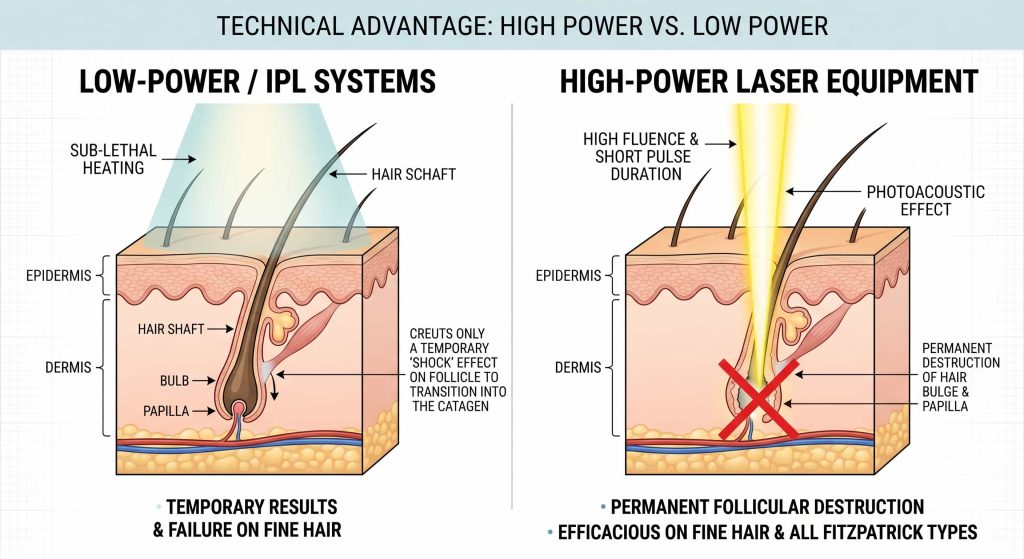
- The Trap of Sub-Lethal Heating: Low-power systems lack the wattage to generate the necessary peak energy. Instead of permanently destroying the stem cells within the hair follicle’s bulge region, these devices often induce sub-lethal heating. This trauma forces the hair follicle into a premature, temporary catagen (resting) phase, resulting in a clinical illusion: the hair sheds, but the follicle recovers and regrows months later.
- The IPL Scatter Problem: IPL utilizes a broad spectrum of light, meaning a significant percentage of the emitted energy is absorbed by competing chromophores (like hemoglobin or water) rather than the target melanin in the hair shaft. This non-coherent scattering necessitates multiple passes, drastically increasing the risk of epidermal burns while offering vastly inferior terminal hair reduction compared to coherent, monochromatic laser light.
- Failure on Fine Hair: As treatment progresses and hair becomes finer and lighter in subsequent sessions, low-power systems hit an efficacy ceiling. They simply cannot generate the concentrated thermal spike required to target the minuscule amounts of melanin present in vellus or fine terminal hairs.
The Physics of Efficacy: Pulse Duration, Fluence, and Spot Size
Achieving permanent hair reduction relies on the precise manipulation of the Extended Theory of Selective Photothermolysis. To completely denature the follicular structures without causing collateral damage to the surrounding epidermis, three physical parameters must operate in perfect synergy.
- Fluence ($J/cm^2$): This is the density of optical energy delivered to the tissue. High-power systems can sustain high fluence levels across large treatment areas. Without sufficient fluence, the core temperature of the follicle will not reach the critical $65^\circ C – 70^\circ C$ required for permanent protein denaturation.
- Pulse Duration (ms): The duration of the laser pulse must be shorter than the Thermal Relaxation Time (TRT) of the hair follicle (typically 10-100ms, depending on thickness) but longer than the TRT of the epidermis (around 3-10ms). High-power generators are uniquely capable of delivering massive fluence within an ultra-short pulse duration. This rapid delivery structurally shatters the target melanin (the photoacoustic effect) and transfers heat immediately to the follicular epithelium before the energy can dissipate into the surrounding dermal tissue.
- Spot Size ($cm^2$): A larger spot size is not merely about covering more surface area quickly; it profoundly impacts the physics of photon scattering. Deeper optical penetration is achieved with larger spot sizes because less light is scattered laterally within the dermis. However, powering a large spot size without a drop in fluence requires a massive underlying power supply—a feat impossible for low-power systems.
Decoding Wavelengths: Customizing Treatments for All Fitzpatrick Skin Types
A singular approach to hair removal is clinically obsolete. The modern demographic is diverse, and a professional clinic must possess the technological capability to safely treat the entire Fitzpatrick Scale (Types I through VI). The absorption coefficient of melanin varies drastically depending on the laser’s wavelength.
755nm Alexandrite: Unmatched Precision for Lighter Skin and Fine Hair
Operating at the shorter end of the relevant spectrum, the 755nm wavelength boasts an exceptionally high absorption rate by melanin.
- Primary Indication: Ideal for Fitzpatrick Skin Types I-III.
- Clinical Advantage: Because it targets melanin so aggressively, it is the undisputed champion for treating fine, light-colored hair that other wavelengths leave behind. It is highly effective for superficial hair structures in areas such as the upper lip or eyebrows.
808nm/810nm Diode: The Industry Gold Standard for Versatility
The 808nm or 810nm wavelength is the absolute workhorse of the aesthetic laser industry, offering the optimal balance between deep dermal penetration and melanin absorption.
- Primary Indication: Versatile enough to treat Fitzpatrick Skin Types I-IV safely and effectively.
- Clinical Advantage: It penetrates deeper into the dermis than the 755nm, directly targeting the follicle bulb and papilla. Its moderate melanin absorption makes it safer for patients with tanned skin or naturally darker baseline pigmentation, minimizing the risk of epidermal blistering.
1064nm Nd:YAG: Ensuring Safety for Darker Skin Tones (Types IV-VI)
The 1064nm Nd:YAG wavelength is the mandatory standard of care for treating darker skin tones.
- Primary Indication: Specifically engineered for Fitzpatrick Skin Types IV-VI.
- Clinical Advantage: It has a highly reduced melanin absorption rate, allowing the optical energy to bypass the heavily pigmented epidermis completely. Instead of relying solely on melanin, the 1064nm wavelength penetrates profoundly deep (up to 4-5mm) to target the vascular supply feeding the hair root, ensuring absolute safety and eliminating the risk of Post-Inflammatory Hyperpigmentation (PIH) in patients of color.
The Triple-Wavelength Synergy: A Comprehensive Clinical Solution
Rather than purchasing three separate laser platforms, elite professional laser hair removal equipment now integrates all three wavelengths into a single applicator. This concurrent emission targets multiple tissue depths and anatomical structures of the hair follicle simultaneously.
| Technical Parameter | 755nm Alexandrite Profile | 808nm Diode Profile | 1064nm Nd:YAG Profile | Triple-Wavelength Synergy |
| Melanin Absorption | Extremely High | Moderate / High | Low | Balanced multi-target |
| Depth of Penetration | Superficial | Deep | Very Deep | Multi-tiered (Bulge, Bulb, Papilla) |
| Fitzpatrick Suitability | Types I – III | Types I – IV | Types IV – VI | Types I – VI (Universal) |
| Target Hair Type | Fine, Light | Medium, Coarse | Thick, Deeply Rooted | All morphologic hair variants |
By deploying a triple-wavelength laser, practitioners eliminate the guesswork, optimize the destruction of both the superficial bulge and the deep vascular papilla, and guarantee a universal solution for any patient profile that walks through the clinic doors.
Patient-Centric Engineering: Maximizing Comfort and Safety
Clinical efficacy is only half of the commercial equation. If a treatment is excruciatingly painful or results in severe epidermal trauma requiring extended downtime, patient attrition will decimate the clinic’s ROI. High-end systems utilize advanced engineering to prioritize the patient experience.
Advanced Epidermal Cooling Systems Explained
The application of raw optical power must be heavily guarded by robust thermal management. If the epidermis is not protected, severe thermal injury will occur.
- TEC (Thermoelectric Cooler) vs. Legacy Methods: Traditional cryogen sprays or basic air cooling are wildly inconsistent and can cause cryo-burns or fail to sustain protection during long sessions.
- Active Sapphire Contact Cooling: Advanced platforms utilize active TEC Cooling integrated directly into a sapphire crystal tip. Sapphire acts as an unparalleled thermal conductor. This continuous, active system pulls heat away from the epidermis in real-time, maintaining a strict temperature window of -5°C to 5°C at the dermo-epidermal junction. This robust cooling acts as a local anesthetic, drastically reducing nociceptor activation (pain signals) and strictly preventing PIH.
In-Motion™ Technology and Frequency (Hz) for Faster Sessions
The historical “stamping” technique—delivering slow, highly concentrated pulses—is notorious for causing intense, localized pain (often described as a rubber band snapping against the skin).
- High Repetition Rates (10Hz – 20Hz): Modern high-power diode lasers utilize continuous sweeping motions across the treatment grid. By firing up to 20 micro-pulses per second, the system gradually accumulates thermal energy within the dermis until it reaches the denaturing threshold.
- The Comfort Paradigm: Because the energy is delivered incrementally while the highly cooled sapphire tip glides across the skin, the peak thermal shock to the pain receptors is entirely bypassed. This results in a virtually painless procedure that drastically increases patient compliance and encourages word-of-mouth referrals.
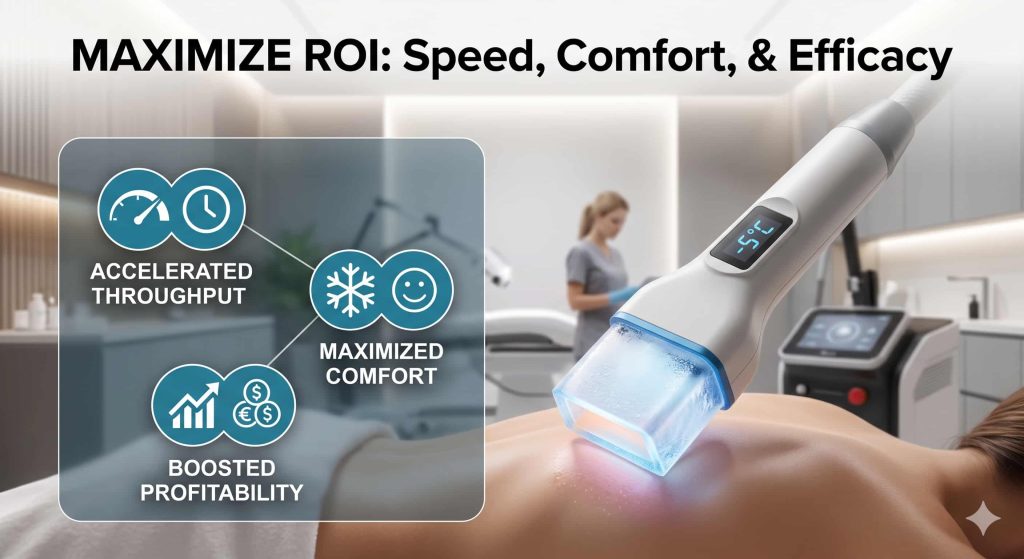
The ROI Equation: How High-Power Equipment Transforms Clinic Profitability
Procuring a medical aesthetic device is a capital expenditure that must be rigorously justified by its operational return on investment (ROI). Transitioning to premium equipment reshapes the financial architecture of a medical spa.
Reducing Treatment Times and Increasing Patient Throughput
Time is the most restrictive bottleneck in any aesthetic practice. The correlation between technical specifications and hourly revenue is direct and undeniable.
- The Math of Large Spot Sizes: Upgrading from a standard $1.0cm^2$ spot size to a $3.0cm^2$ or $4.0cm^2$ applicator dramatically reduces the number of pulses required to cover large anatomical zones like full backs or legs.
- Operational Velocity: Combining a massive spot size with a 20Hz delivery frequency means a full-back treatment that once took 45 minutes can now be completed in under 15 minutes.
- Revenue Impact: A 40% to 60% reduction in single-patient chair time mathematically equates to a doubled daily patient capacity. This throughput acceleration translates directly to exponential revenue scaling without increasing clinic operating hours.
Durability and Consumables: Evaluating the Total Cost of Ownership (TCO)
The upfront sticker price of a device is misleading. The true financial metric is the Total Cost of Ownership (TCO), which factors in maintenance, consumable replacement, and catastrophic downtime.
| ROI & Cost Vector | Low-Power / White-Label Lasers | Premium High-Power Lasers (e.g., Cocoon Laser) |
| Laser Emitter Origin | Generic, non-branded diode arrays | Coherent® USA or equivalent premium laser bars |
| Guaranteed Shots Count | Typically < 5 million shots | 20 Million to 50 Million+ shots |
| Consumable Overheads | High (frequent handpiece replacements) | Extremely Low (virtually zero consumables) |
| Cooling Architecture | Macro-channel (prone to water blockages) | Micro-channel (highly efficient, zero-burnout risk) |
| Downtime Risk | High (frequent overheating mid-session) | Negligible (built for 24/7 continuous operation) |
Investing in a high-quality diode laser hair removal machine with imported coherent bars guarantees an exponentially higher shots count lifespan, mitigating the need for costly applicator replacements and ensuring uninterrupted clinic revenue generation.
Evaluating Your Next Investment: Key Criteria for Medical Spa Owners
Selecting the right manufacturing partner requires rigorous due diligence. Medical spa owners must look beyond basic specification sheets and evaluate the overarching commercial and regulatory safety nets provided by the vendor.
Medical Certifications and Global Compliance (CE, FDA, ISO 13485)
Never compromise on regulatory compliance. A device without proper medical certification is an existential legal threat to your practice and your medical director’s license.
- Strict Baselines: Ensure the device holds a valid Medical CE mark for European jurisdictions or an FDA 510(k) clearance for the United States.
- Manufacturing Standards: Verify that the medical aesthetic laser manufacturer operates under an ISO 13485 certified quality management system, guaranteeing that clinical safety protocols are strictly enforced at the assembly level.
Manufacturer Direct Support: Training, Maintenance, and Warranty
A laser is only as effective as the practitioner operating it. B2B procurement must include a comprehensive after-sales ecosystem.
- Clinical Protocols: The manufacturer must provide extensive, certified clinical training covering the nuances of pulse duration and fluence adjustments across the Fitzpatrick scale.
- Rapid Diagnostics: Prioritize partners who offer IoT-enabled remote diagnostics, multi-year warranties, and guaranteed swift parts dispatch to eliminate costly clinical downtime.
Elevate Your Clinical Standards with Cocoon Laser Innovations
The transition from outdated modalities to high-power, multi-wavelength platforms represents a critical evolution in evidence-based aesthetic medicine. By investing in systems engineered with superior peak power, advanced TEC cooling, and synergistic wavelength emission, medical spas can guarantee unparalleled clinical efficacy, ensure absolute patient safety across all skin types, and drastically accelerate their financial throughput.
As a premier medical aesthetic laser manufacturer, Cocoon Laser is dedicated to engineering platforms that meet the most rigorous clinical demands of modern dermatology. Our professional laser hair removal equipment is meticulously designed to optimize your Total Cost of Ownership, eliminate technical bottlenecks, and position your clinic as the definitive market leader in permanent hair reduction.
Stop compromising on clinical outcomes and start maximizing your operational ROI. Upgrade your practice with the industry’s most reliable high-power diode laser systems.
Ready to transform your clinical capabilities?
- Request a Technical Demo
- Consult with Our Clinical Experts
- Download the Full Specification Sheet at Cocoon Laser to explore our flagship triple-wavelength laser innovations today.
If you need more information, please click “Contact Us”.
If you want to obtain more information, please follow our official website and Facebook.