The Ultimate Clinic Guide to 1927nm vs 1550nm Thulium Laser Differences: Efficacy, Wavelengths, and ROI
Introduction: Addressing the Clinical Dilemma of Wavelength Selection
For medical aesthetic practitioners, selecting the optimal non-ablative fractional laser platform is a critical decision impacting clinical outcomes, patient safety, and practice profitability. The choice between 1927nm thulium fiber laser and 1550nm erbium glass laser technology is not merely a technical specification debate; it represents a fundamental strategic decision about the conditions you treat and the patient demographics you serve. While often integrated into dual-platform systems like the Fraxel DUAL or REVIVO, understanding the distinct biophysical interactions, safety profiles across Fitzpatrick skin types, and return on investment (ROI) of each wavelength is paramount for the discerning clinic owner.
This comprehensive guide draws on 15 years of industry expertise and the latest clinical evidence to delineate the critical differences between 1927nm and 1550nm lasers. We will dissect their mechanisms of action, optimal indications, safety protocols, and business case, empowering you to make a data-driven investment that elevates your standard of care.
Physical Mechanism Deep Dive: Selective Photothermolysis and Water Absorption
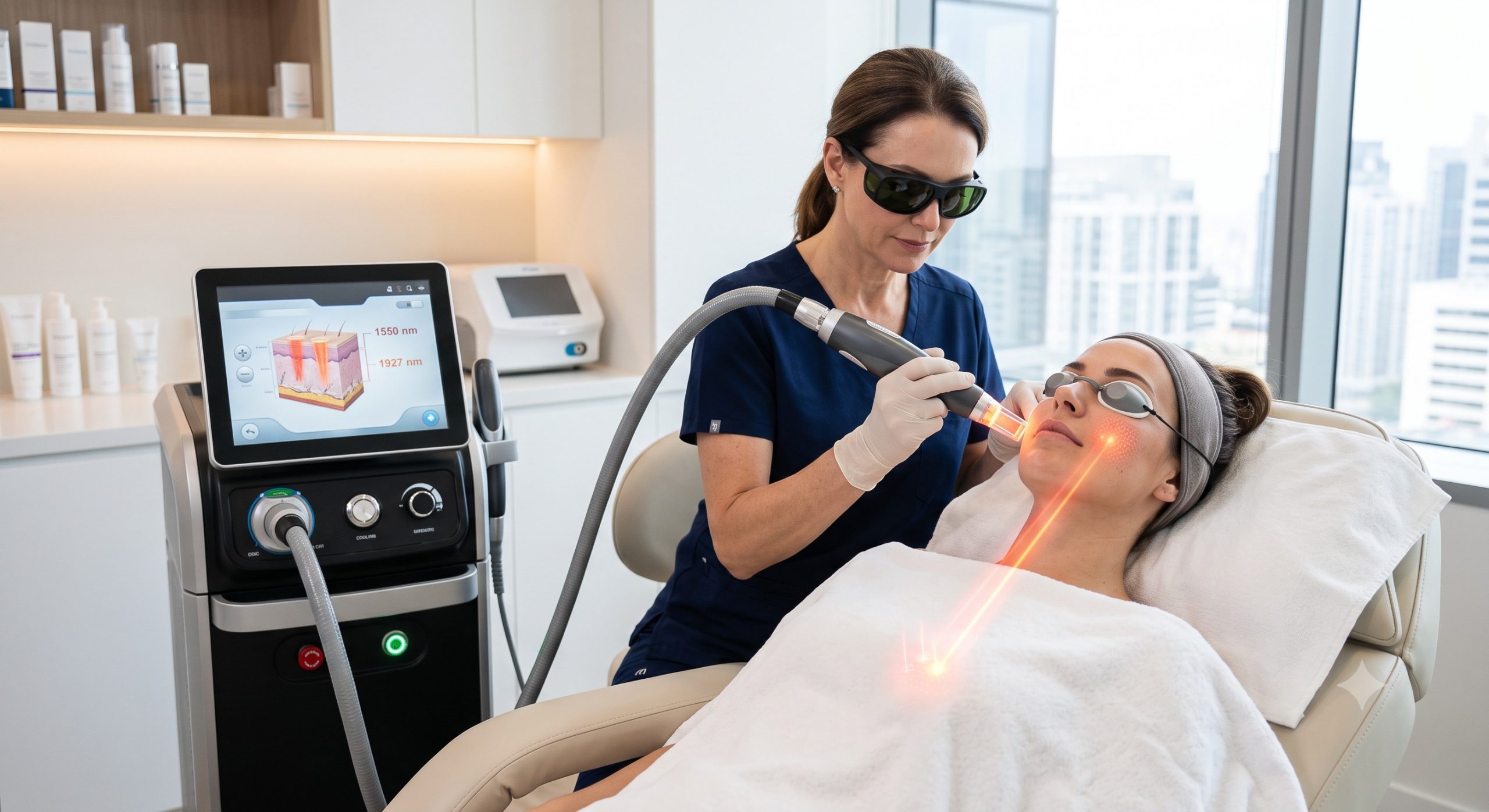
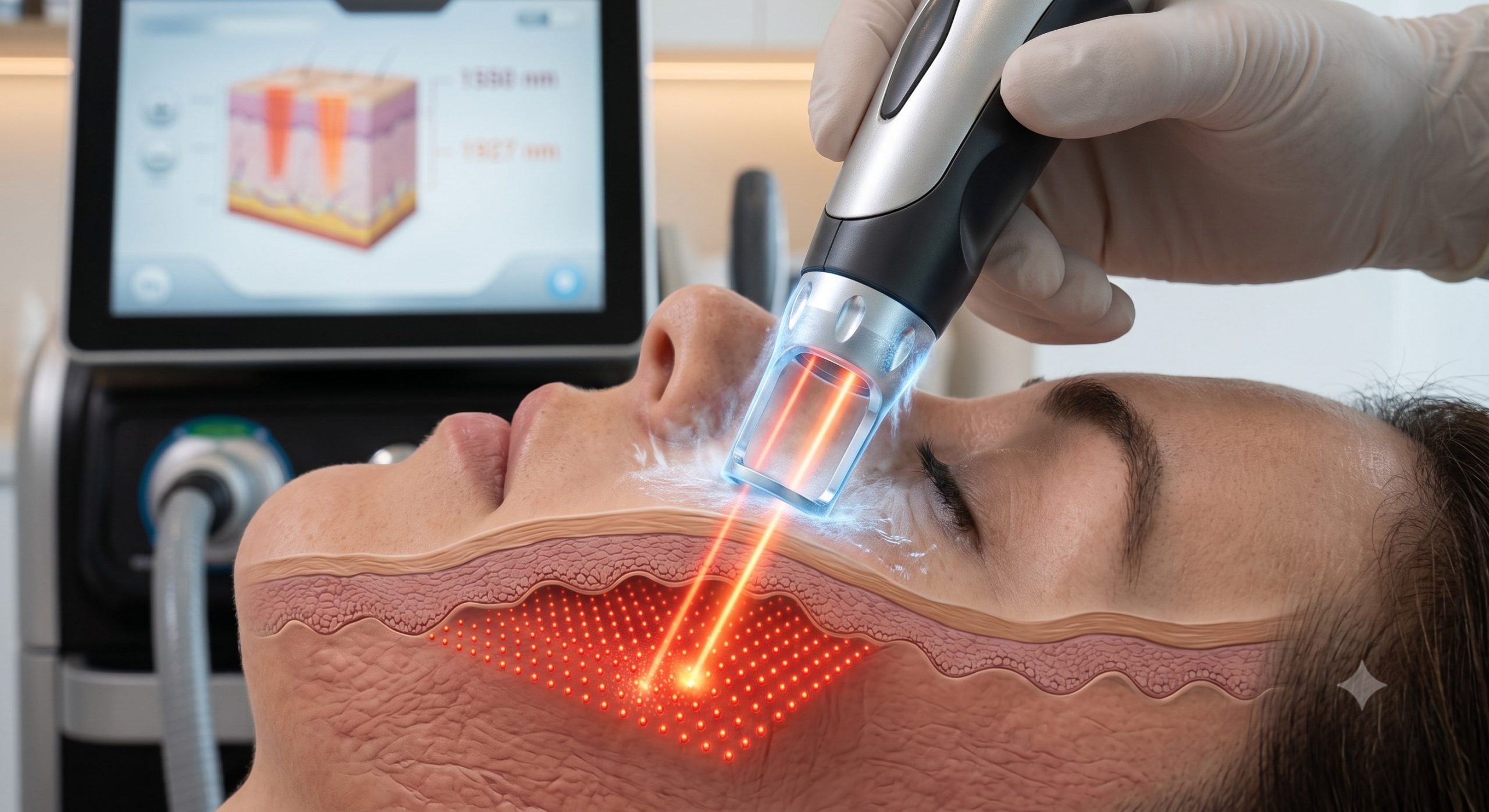
The foundation of the difference between the 1550nm and 1927nm wavelengths lies in the physics of selective photothermolysis and the absorption coefficient of water. Both wavelengths are classified as non-ablative fractional lasers, meaning they create microscopic treatment zones (MTZs) of thermal injury in the skin while leaving the surrounding tissue intact to facilitate rapid healing . However, their efficacy is dictated by their specific chromophore targets.
The 1550nm Erbium Glass Laser: The Dermal Specialist
The 1550nm wavelength possesses a relatively lower water absorption coefficient. This allows it to penetrate deeper into the dermis, typically reaching depths of 1-3 mm . This deeper penetration makes it highly effective at targeting dermal structures. The primary chromophore is water in the dermal tissue, which, upon heating, induces a controlled wound healing response. This leads to neocollagenesis and dermal remodeling. Its deep-penetrating nature makes the 1550nm laser the gold standard for treating dermal scarring, such as atrophic acne scars, and moderate-to-deep periorbital wrinkles . It effectively addresses textural irregularities and deep rhytides by stimulating a robust fibroblastic response in the deeper dermal layers.
The 1927nm Thulium Fiber Laser: The Epidermal Expert
In contrast, the 1927nm thulium wavelength has a significantly higher water absorption coefficient, approximately five times greater than that of the 1550nm wavelength. As a result, its energy is absorbed more superficially, primarily targeting the epidermis and the dermo-epidermal junction (DEJ) . This superficial action makes the 1927nm laser exceptionally potent for treating epidermal and junctional pathologies. It is the preferred wavelength for addressing dyschromia, actinic keratoses, solar lentigines (age spots), and melasma . The 1927nm laser efficiently targets melanin-rich epidermal cells without generating excessive bulk heating in the deeper dermis, which is crucial for minimizing the risk of adverse events like post-inflammatory hyperpigmentation (PIH) in darker skin types.
Ablative vs. Non-Ablative Spectrum
A groundbreaking study by Wenande et al. (2025) using advanced optical coherence tomography (OCT) and line-field confocal OCT (LC-OCT) revealed a spectrum of effects from the 1927nm thulium laser. At low pulse energies (e.g., 3 mJ), the effects are strictly non-ablative, creating subepidermal clefts. However, as pulse energy increases to 15-20 mJ, the 1927nm wavelength can produce microscopic ablation zones (MAZs) that disrupt the stratum corneum, characteristics that are typically associated with ablative lasers . This tunability is a distinct advantage, allowing clinicians to operate across a non-ablative to ablative continuum based on the patient’s presentation and desired downtime.
Clinical Efficacy and Indications: A Targeted Approach
The clinical application of each wavelength is directly correlated to its physical properties. A 2025 review in Lasers in Surgery and Medicine reinforces that both wavelengths have distinct and complementary roles in a modern aesthetic practice .
Indications for the 1550nm Wavelength
The deep dermal targeting of the 1550nm laser makes it the primary tool for structural remodeling. Its efficacy is well-documented for:
- Atrophic Acne Scars: Studies have demonstrated significant clinical improvement in acne scarring, with some studies reporting mean quartile improvement scores of 3.2 in Asian patients (Fitzpatrick Skin Types IV-V) using parameters of 12-20 mJ/MTZ and densities of 750-1500 MTZ/cm² .
- Surgical Scars: It softens and improves the appearance of surgical scars by remodeling the underlying collagen matrix .
- Periorbital Wrinkles: Its ability to heat deep dermal collagen makes it effective for treating fine lines and wrinkles around the eyes .
- Dermal Dyschromia: While primarily a dermal device, it is also approved for treating general dyschromia and melasma, though with a higher risk profile in darker skin types .
Indications for the 1927nm Wavelength
The superficial nature of the 1927nm wavelength positions it as the superior choice for treating epidermal and pigmentary concerns. Its approved and evidence-based indications include:
- Actinic Keratosis (AK): The 1927nm laser is specifically FDA-cleared for the treatment of actinic keratosis . A study by Polder et al. (2011) showed a 51-75% improvement in nonfacial photodamage, which is often a precursor to actinic damage .
- Benign Pigmented Lesions: It is highly effective for age spots, sunspots (solar lentigines), and freckles (ephelides) .
- Melasma and Hyperpigmentation: The 1927nm wavelength’s controlled superficial heating is considered a safer and more effective approach for managing melasma, especially in patients with skin of color, compared to more ablative or deeper-penetrating lasers .
- Androgenic Alopecia (Hair Loss): An emerging application supported by a 2025 clinical study from Indonesia demonstrated that the 1927nm thulium laser is safe and effective for promoting hair regrowth in patients with androgenic alopecia. Using parameters of 300 µs pulse duration and 5W power, significant clinical improvement was observed with minimal side effects .
- Skin Tone and Texture: It improves overall tone, texture, and large pores by acting on the superficial dermis and epidermis .
| Feature / Parameter | 1550nm Erbium Glass Laser | 1927nm Thulium Fiber Laser |
|---|---|---|
| Primary Target | Dermis (Water) | Epidermis (Water) & Melanin |
| Penetration Depth | ~1-3 mm | Superficial (Epidermis – Superficial Dermis) |
| Primary Indications | Atrophic scars, deep wrinkles, dermal remodeling | Pigmented lesions, actinic keratosis, melasma, hair loss |
| Water Absorption Coefficient | Lower (Deeper penetration) | Higher (Shallower, more superficial action) |
| Clinical Effects | Dermal heating, neocollagenesis, scar remodeling | Epidermal turnover, melanin clearance, superficial rejuvenation |
| Skin of Color Safety (FST IV-VI) | Requires conservative energy settings; PIH risk higher ~11.6%-33% | Often preferred for pigment issues; risk mitigated with low energy/density |
| Typical Pulse Energy | 10-50 mJ/MTZ | 3-20 mJ/MTZ |
| FDA-Cleared Indications (Example) | Skin resurfacing, dyschromia, scars, wrinkles | Actinic keratosis, age spots, sunspots, soft tissue coagulation |
Special Considerations for Fitzpatrick Skin Types (FSTs)
Treating patients with skin of color (Fitzpatrick Skin Types III-VI) presents unique challenges due to the competitive absorption of laser energy by epidermal melanin. This can lead to reduced efficacy and an elevated risk of complications, most notably post-inflammatory hyperpigmentation (PIH) . The dual 1550/1927-nm system offers a strategic advantage for this growing demographic.
Wavelength and Skin Safety
A 2026 review by Goldman et al. highlights the necessity of a nuanced approach for skin of color . While both wavelengths are safer than ablative technologies, they carry distinct risk profiles. A retrospective study of 961 sessions of 1550nm treatment found a correlation between FST and PIH occurrence, with rates climbing to 33% in patients with FST V . This is because a portion of the 1550nm energy can still be absorbed by melanin in the epidermis, leading to unintended thermal damage and subsequent PIH.
The 1927nm wavelength, with its higher water absorption, allows for a more targeted epidermal effect. However, its proximity to the melanin absorption peak (250-1200 nm) still necessitates cautious parameter selection. The literature suggests that reducing pulse energy and MTZ density is critical to mitigating PIH risks in patients with skin of color. Specifically, lowering fluence settings can help prevent unintended epidermal thermal damage and the aberrant production of melanin by labile melanocytes .
Parameter Optimization for Diverse Skin Types
The customizable settings of modern dual-wavelength systems, including the 1550/1927-nm dual-laser platform, allow clinicians to employ a data-driven, rather than subjective, approach. For darker skin types, starting with lower energy settings and lower densities is recommended. This approach helps to ensure patient safety while still achieving effective MTZ formation for clinical improvement. Integrated epidermal cooling systems, such as sapphire or solid-state contact cooling, are also non-negotiable for optimizing patient comfort and reducing epidermal heat buildup, further minimizing the risk of PIH .
Technical Specifications, Compliance, and ROI
Beyond clinical performance, the operational efficiency and financial viability of a laser platform are critical for business success.
Compliance and Safety Standards
When acquiring laser technology, regulatory compliance is non-negotiable. The 1927nm thulium laser system (e.g., models PZ-DJG75-01, PZ-DJG75-02) has received FDA 510(k) clearance (K252732) for dermatological procedures requiring soft tissue coagulation, treatment of actinic keratosis, and benign pigmented lesions . This clearance verifies the device’s safety and efficacy based on bench testing and compliance with rigorous international standards, including IEC 60601-1 (medical electrical equipment safety), IEC 60825-1 (laser safety), and ISO 10993 (biocompatibility) . Clinics should prioritize platforms that have undergone such stringent testing to ensure patient safety and protect against liability.
Hardware, Cooling Systems, and Throughput
High-throughput clinics will benefit from devices with integrated cooling and large spot sizes to accelerate treatment times. The 1927nm thulium laser, in particular, has been noted for its rapid treatment times. The Cynosure Lutronic Ultra, for example, features a large 200um microbeam and a magnetic roller tracking system to allow for treatments to be completed in just 15-20 minutes . This speed, combined with a low cost of consumables and minimal patient downtime, directly contributes to a strong ROI, with some practices reporting device payback in as little as three months .
The device specifications also play a crucial role in operational costs. A typical dual-wavelength system delivers up to 15W of power per wavelength, with pulse widths ranging from 1-20ms per dot and adjustable scan areas up to 20x20mm . Clinics should look for platforms that offer 100% shot hours without swipe cards or shot limits, as this eliminates hidden consumable costs and allows for unlimited treatments, directly improving long-term profit margins.
Conclusion: The Strategic Verdict
The debate of 1927nm vs. 1550nm thulium laser is not about which technology is superior, but rather, which technology is superior for a specific indication. Our comprehensive analysis leads to a clear clinical and business conclusion:
- For a broad-spectrum aesthetic practice that treats a high volume of patients with diverse concerns (photoaging, scars, and pigmentation) across all Fitzpatrick skin types, a dual-wavelength 1550/1927nm platform is the most strategic, versatile, and profitable investment. It offers the ability to address both epidermal and dermal concerns in a single, powerful system.
- For a practice specializing in pigment disorders, superficial lesions, or skin of color, a dedicated 1927nm thulium laser or a dual-platform with a heavy emphasis on the 1927nm wavelength is essential. Its superior safety profile for melasma and hyperpigmentation, combined with its FDA clearance for actinic keratosis, makes it an irreplaceable tool.
- For practices focusing on scar revision and profound dermal rejuvenation, the deeper-penetrating 1550nm wavelength remains the gold standard.
Ultimately, selecting a device with FDA clearance, ISO 13485 quality management certification, and customizable parameters ensures not only optimal clinical outcomes but also robust patient safety and a healthy return on investment. By adopting a dual-wavelength approach, you can cater to a wider patient demographic, offer comprehensive treatment plans, and solidify your position as a leader in medical aesthetics.