The Ultimate Clinic Guide to IPL vs OPT SHR Hair Removal Technology: Efficacy, Wavelengths, and ROI
Introduction: The Evolution of Aesthetic Light-Based Hair Removal
In the rapidly expanding field of medical aesthetics, clinic owners and dermatologists are constantly evaluating technologies that maximize patient outcomes while ensuring a strong return on investment (ROI). For over a decade, Intense Pulsed Light (IPL) has been a staple in non-invasive hair removal. However, the emergence of OPT (Optimal Pulse Technology) and SHR (Super Hair Removal) has fundamentally shifted clinical expectations. The debate regarding IPL vs OPT SHR is not merely about marketing hype; it is rooted in distinct physical mechanisms that affect safety, efficacy, treatment speed, and patient comfort .
This clinical guide provides an expert, evidence-based dissection of these technologies. We will analyze the engineering, parameter optimization, and financial implications to help you make a procurement decision that elevates your practice’s standard of care.
Physical Mechanisms: Broad Spectrum vs. Selective Heating
Understanding Traditional IPL and the Energy Spike Problem
Traditional Intense Pulsed Light (IPL) technology operates on the principle of selective photothermolysis using a broad spectrum of light, typically ranging from 420nm to 1200nm . Older IPL systems emit energy in short, high-intensity impulses lasting 2 to 300 milliseconds, delivering a massive energy density of 12 to 120 J/cm² . This approach relies heavily on melanin absorption to heat and destroy the hair follicle.
However, this ‘high energy, short burst’ method presents a clinical challenge: the energy pulse often features a sharp, unstable spike in the waveform (a ‘peak’). This peak can cause the epidermis to absorb excessive heat, leading to a higher risk of burns, swelling, and patient discomfort . Furthermore, because the absorption coefficient of melanin in the skin and red blood cells is similar to that of the hair root, the surrounding tissue is vulnerable to thermal damage .
OPT: The Advent of the Square Wave
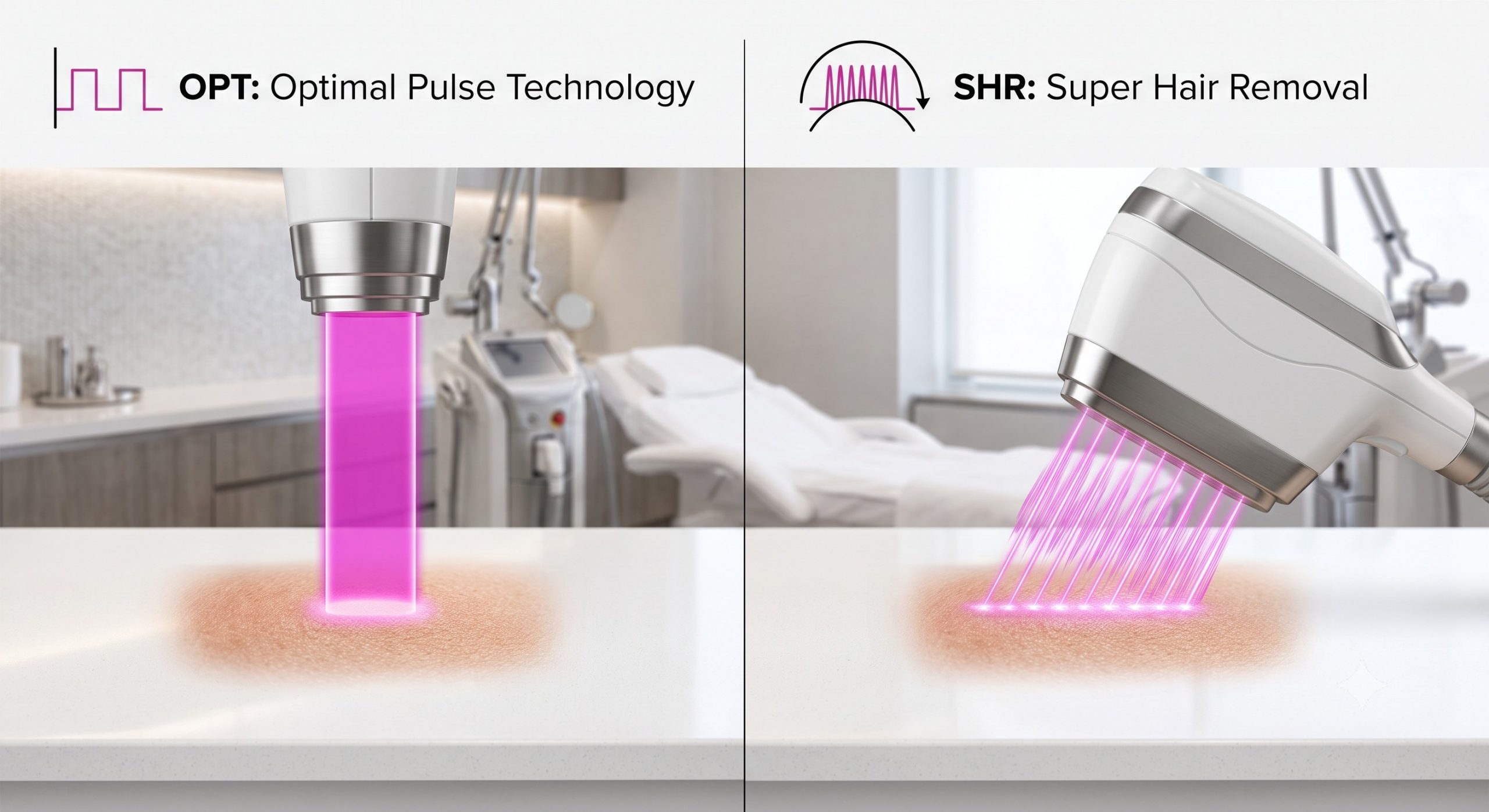
OPT (Optimal Pulse Technology) represents a critical engineering upgrade. Unlike traditional IPL’s decaying spike, OPT outputs a stable, uniform square wave . This ensures that the energy delivered to the target tissue is consistent and predictable from the start to the end of the pulse. This square-wave technology significantly enhances treatment safety and efficacy by eliminating the peak energy that causes epidermal burns, allowing for a more controlled thermal effect on the hair follicle .
SHR: The In-Motion Paradigm Shift
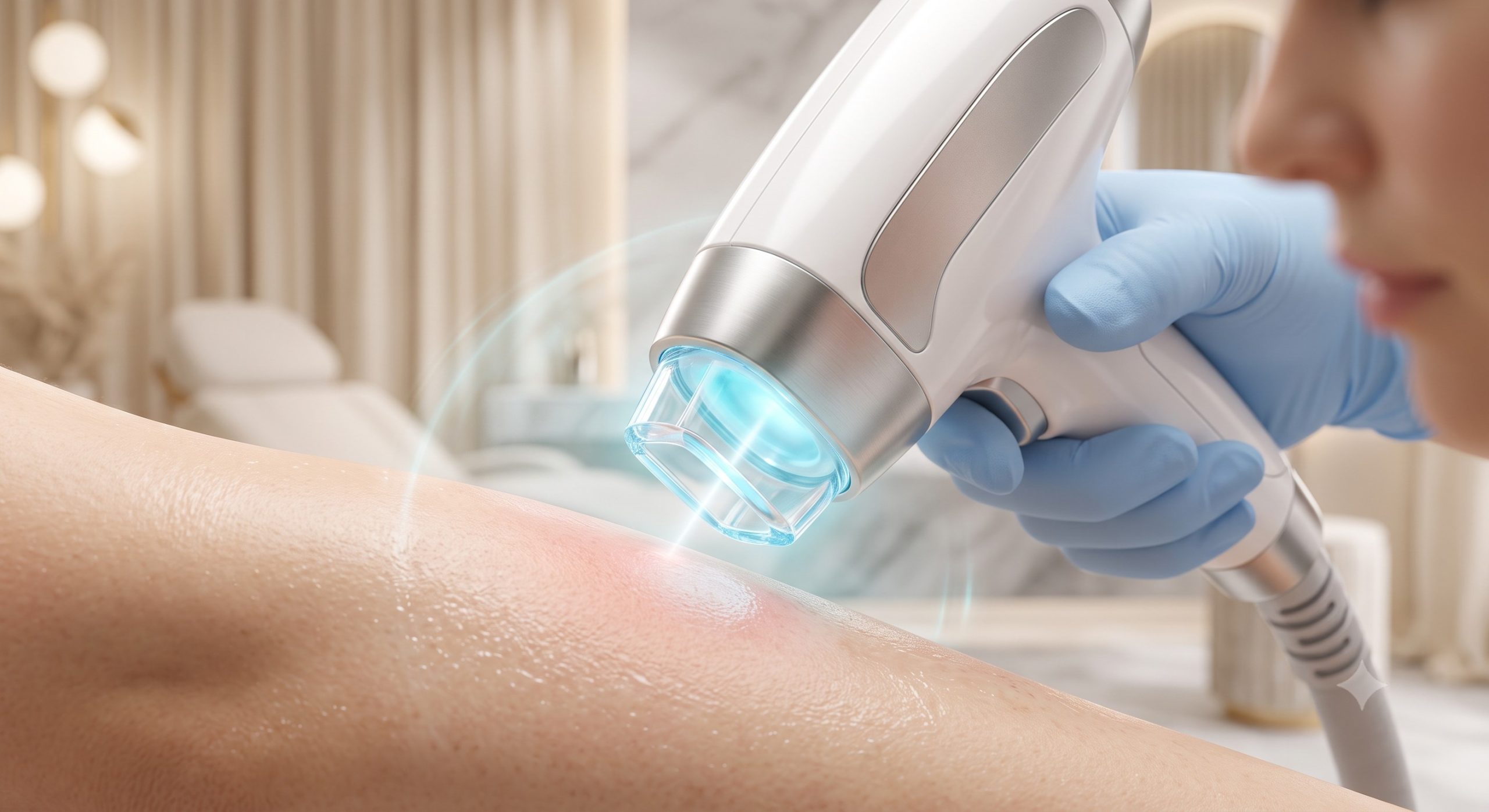
SHR (Super Hair Removal), conversely, rejects the high-energy single-shot model entirely. It employs a low fluence, high-frequency approach (up to 10Hz) . Instead of a static application, the handpiece is moved continuously over the skin (the “In-Motion” technique) . This delivers cumulative heat to the dermis, gradually raising the tissue temperature to a therapeutic 45°C rather than a harmful 65-72°C .
This methodology is designed to bypass the melanin pathway partially, allowing for the heating of the stem cells and the dermal papilla with significantly less epidermal absorption, making it exceptionally safe for darker skin types (Fitzpatrick IV-VI) .
Technical Parameter Matrix: A Comparative Deep Dive
To understand the differences in clinical application, we must compare the core specifications that drive these devices. This table illustrates the distinct identities of these technologies.
| Key Parameter | Traditional IPL | OPT (Optimal Pulse Technology) | SHR (Super Hair Removal) |
|---|---|---|---|
| Wavelength | 420 – 1200 nm (Filter Dependent) | 420 – 1200 nm (Filter Dependent) | 640 – 950 nm / 640 – 1200 nm |
| Energy Density (Fluence) | High (12 – 120 J/cm²) | Controlled (1 – 50 J/cm²) | Low Energy / High Repetition |
| Pulse Width | 2 – 300 ms | 0.1 – 20 ms | Continuous Pulses (In-Motion) |
| Frequency | 0.2 Hz (Typical) | 1 – 10 Hz | 1 – 10 Hz |
| Waveform Output | Decaying Spike (Unstable) | Stable Square Wave | Sequential Low-Energy Pulses |
| Cooling System | Contact Cooling (Basic) | Water + Air + Semiconductor | Advanced Sapphire/Water Cooling |
| Treatment Mode | Stationary (Stamping) | Stationary (Stamping) | In-Motion (Sweeping) |
Treatment Protocols and Indications
Versatility and Handpiece Optimization
When evaluating IPL vs OPT SHR, the expandability of the system is crucial. Standard IPL and OPT platforms generally offer interchangeable filters for specific indications: 530nm/590nm for vascular lesions and pigmentation, and 640nm/1200nm for hair removal .
However, SHR-specific handpieces typically employ a fixed 640-950nm wavelength, filtered specifically to eliminate infrared light that causes unwanted water absorption in the epidermis . This filtration is the reason SHR is often described as painless, as it eliminates the side-effect of the skin heating up due to water absorption .
Clinical Efficacy: Evidence-Based Outcomes
According to clinical studies comparing SHR-mode IPL against Alexandrite and Nd:YAG lasers for leg hair reduction, mean hair reductions after 6 weeks were 50% for the IPL system, 53% for Alexandrite, and 39% for Nd:YAG lasers . Six months post-treatment, hair reduction rates stabilized at 40%, 49%, and 34%, respectively . While Alexandrite remains a highly efficient benchmark for Fitzpatrick Skin Types I-III, the SHR technology demonstrated comparable efficacy with the notable advantage of a significantly improved safety profile and reduced pain for patients across a broader range of skin tones .
Clinic ROI and Business Implications
Speed, Throughput, and Patient Retention
The upgrade from IPL to OPT SHR is primarily a business efficiency decision. Standard IPL protocols require static placements, increasing the time required to cover large areas like legs or backs. SHR’s “In-Motion” technique, coupled with a large spot size (e.g., 15x50mm), allows practitioners to treat large areas 6-10 times faster, significantly increasing patient throughput .
Furthermore, the ‘painless’ marketing claim of SHR is a powerful tool for patient retention. Patient comfort directly correlates with compliance and the willingness to return for multiple sessions. A system that generates ‘soothing warm stone massage’ experiences rather than ‘painful rubber band snaps’ will undeniably boost rebooking rates and word-of-mouth referrals .
Hardware Quality and Maintenance
When considering the lifetime cost of ownership (TCO), hardware components matter. High-quality OPT SHR systems utilize imported capacitors from Japan, high-pressure water pumps, and NMB cooling fans to ensure stable power and consistent cooling . Multi-cooling systems (Semiconductor, Water, and Air) are standard to ensure the handpiece stays at operational temperatures during high-frequency use, prolonging the lifespan of the laser bars and handpiece . Investing in a unit with a robust cooling circuit reduces long-term maintenance costs and prevents downtime.
Conclusion: Making the Strategic Decision
The transition from traditional IPL to OPT SHR technology is a natural evolution in aesthetic medicine. While traditional IPL is adequate for basic hair reduction on fair skin, it poses inherent risks and inefficiencies.
- If your clinic prioritizes maximum safety for all skin types and aims to offer a virtually painless experience that encourages patient loyalty, SHR technology is the superior choice.
- If your focus is on multi-modality versatility (treating vascular and pigmented lesions) with a higher safety profile than traditional IPL, OPT technology offers the stability required.
Ultimately, the data supports that OPT and SHR are not mere gimmicks but substantive technological advancements designed to deliver superior clinical outcomes and robust profitability for the modern med spa.