
Laser treatment for vascular lesions removal FAQ: Expert Answers for Aesthetic Clinics & Dermatologists
Overview
For aesthetic clinic owners and dermatologists, investing in a laser platform for vascular lesion removal requires clinical and commercial clarity. This FAQ addresses pre-sales technical specifications, post-sales maintenance, safety across Fitzpatrick skin types, and ROI calculations. All answers are structured for evidence-based procurement decisions.
Frequently Asked Questions
Q1: Is laser treatment for vascular lesions removal safe for all Fitzpatrick skin types (I-VI)?
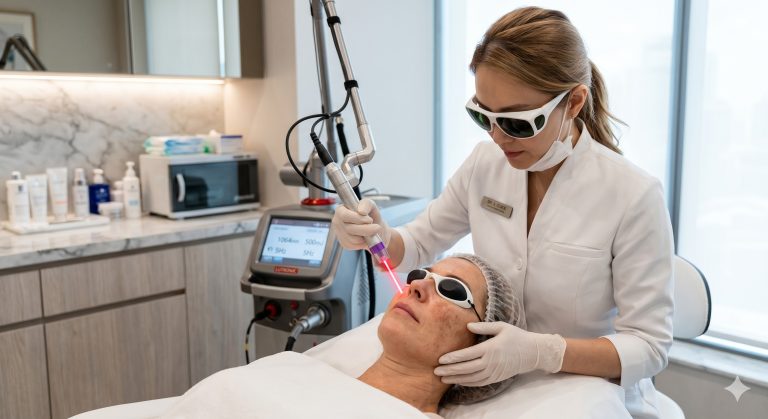
Yes, modern long-pulse 1064 nm Nd:YAG lasers are safe and effective for Fitzpatrick skin types I-VI, including dark and tan skin. The key is dual-wavelength capability (532 nm for superficial red lesions in light skin; 1064 nm for deep blue/purple lesions in all skin types) plus dynamic contact cooling. Epidermal protection via sapphire tip cooling (typically -4°C to +4°C) prevents thermal injury to melanin-rich epidermis while allowing selective photothermolysis of oxyhemoglobin.
Q2: How many treatment sessions are typically required for full clearance of a port wine stain or leg vein?
Most vascular lesions require 3 to 6 sessions spaced 4 to 8 weeks apart for 70-90% clearance. Capillary malformations (port wine stains) average 4-6 sessions; facial telangiectasias often resolve in 1-3 sessions; lower extremity reticular veins may need 3-5 sessions. Lesion diameter, depth, and vessel caliber directly influence session count. A clinical parameter starting point is 80-120 J/cm² for 1064 nm with 10-20 ms pulse duration.
Q3: What is the typical handpiece lifespan and consumable replacement schedule for a vascular laser machine?
The handpiece for a medical-grade vascular laser typically delivers 500,000 to 1,000,000 full-energy shots before diode array or flashlamp degradation reaches 20% energy drop. Replacement handpieces cost $2,500-$6,000 USD. Consumables: sapphire tip windows (replace every 10,000-20,000 shots or if scratched, $200-$400), distilled water for closed-loop cooling system (change every 6-12 months), and water filters (every 6 months). No expensive per-use disposables.
Q4: How does the cooling system in a vascular lesion laser improve patient comfort and safety?
The integrated contact cooling system (sapphire or copper tip with Peltier or thermoelectric chiller) reduces epidermal surface temperature to 0-4°C milliseconds before the laser pulse. This achieves three benefits: 1) eliminates need for topical anesthetic or cryogen spray, 2) allows higher fluence without blistering for faster results, and 3) shrinks dynamic cooling-related revenue loss (no consumable cryogen gas). Typical cooling efficiency: -30°C/sec temperature drop over 300 μm epidermis.
Q5: What ROI can a med spa expect when adding a vascular lesion laser, considering consumable costs and per-session pricing?
A clinic can achieve payback within 6-12 months averaging 8-12 vascular treatments weekly. Sample calculation: $25,000-$45,000 laser investment; per-session clinic charge $200-$450 (based on lesion size); consumables under $5/session (electricity, water, tip wear). Monthly revenue at 10 sessions/week: $8,000-$18,000. Gross margin after technician cost: 65-75%. Additional ROI from combination treatments (vascular + pigmentation, vascular + skin rejuvenation) using multi-wavelength capability increases chair utilization.
Q6: What regulatory certifications should a B2B buyer verify before purchasing a vascular lesion laser?
A compliant medical vascular laser must hold: 1) FDA 510(k) clearance for “laser treatment of benign vascular lesions” or CE Mark (Class IIb or III according to MDR 2017/745), 2) ISO 13485:2016 manufacturer certification, 3) IEC 60825-1 laser safety class 4 compliance. Request specific clearance numbers: e.g., FDA KXXXXXX. Avoid consumer-grade or “for aesthetic use only” devices lacking vascular indication. Certification ensures malpractice insurance validity and meets local health department audits.
Q7: What are the most common technical errors with vascular lasers and how are they resolved?
The most frequent post-sales issues are: 1) Energy drop >20% – resolve by cleaning handpiece optics and checking water circuit for air bubbles; 2) Cooling failure (warm tip) – prime water pump and check chiller refrigerant pressure; 3) No laser emission – inspect foot pedal connection and key switch interlock. Routine prevention: daily visual inspection of sapphire tip, weekly energy meter test using a calibrated power meter, and quarterly chiller radiator cleaning. Most certified suppliers provide remote diagnostics within 4 business hours.
Q8: Can I upgrade my existing IPL or older-generation alexandrite laser to add vascular lesion treatment capability?
Q9: What ongoing maintenance does a water-cooled vascular laser require in a busy clinic?
For closed-loop recirculating water systems (standard for >30J/cm² outputs): replace distilled water and add biocide every 6 months or 500 operating hours. Clean chiller air intake filter monthly. For air-cooled portable systems (lower fluence, shorter duty cycle): no water maintenance, but observe 10-minute cooldown after 200 shots. All systems: calibrate energy output quarterly using a pyroelectric meter; clean handpiece anti-reflection window daily with lens tissue and isopropyl alcohol.
Q10: Does the supplier include clinical training and technical support for international B2B buyers?
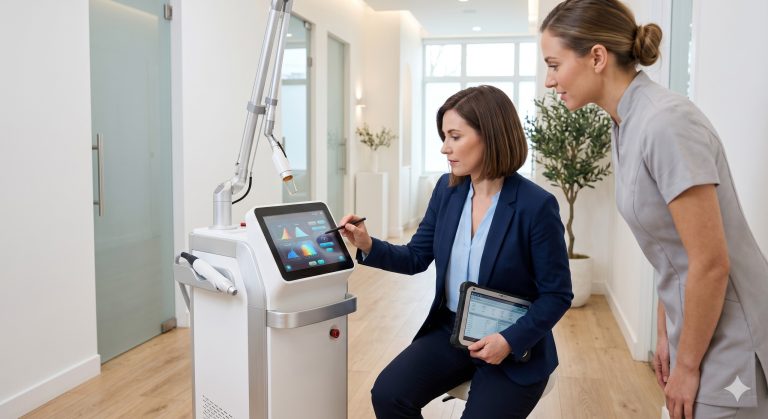
Reputable B2B suppliers include: 3-day on-site clinical training (patient selection, parameter protocols, safety) for up to 3 staff, plus remote technical support via WhatsApp/WeChat/Email with 4-hour response SLA. Some offer certification workshops (CME accredited). Verify that training covers Fitzpatrick V-VI protocols (lower fluence, longer pulse widths, active cooling verification). Warranty typically 2 years parts + 1 year labor, with optional extended service contracts (12-18% of device cost annually).
Similar Posts
Premier Medical Aesthetic Technology Manufacturer
Products
OPT IPL Max+
Lav Clear
Cocoon
Contact
E-mail: [email protected]
Address: No. 288, Keyuan 4th Road, Jiulongpo District, Chongqing, China