Picosecond Laser Clinical Deep Dive: Selective Photothermolysis & Parameter Optimization
Introduction: The Clinical Paradigm Shift in Aesthetic Laser Medicine
For years, the gold standard in pigment and tattoo removal was the Q-switched nanosecond laser. However, the advent of picosecond laser technology represents a paradigm shift, not just an incremental upgrade. This is a fundamental change in how laser energy interacts with biological tissue. As a clinic consultant, I’ve seen practices transform their service offerings and patient satisfaction scores by integrating this technology. This guide provides an objective, clinically-driven analysis of the physics and mechanisms behind picosecond lasers, designed to help medical aesthetic professionals make informed, evidence-based decisions.
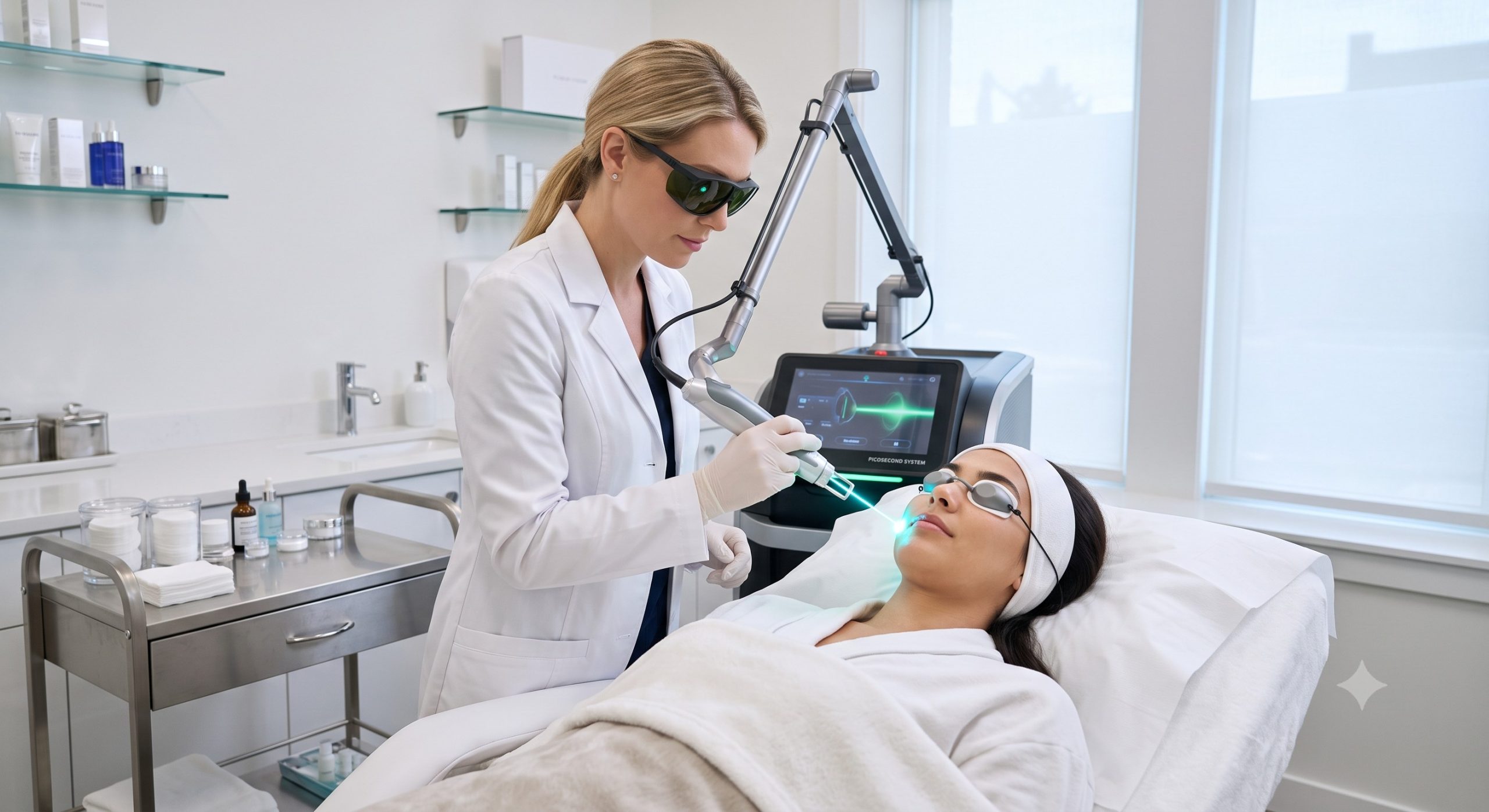
The Physics of the Picosecond: Moving Beyond Photothermal
Defining the Pulse Width
The defining characteristic of a picosecond laser is its pulse duration. While a nanosecond (ns) laser delivers energy in one billionth of a second (10⁻⁹ s), a picosecond (ps) laser delivers it in one trillionth of a second (10⁻¹² s) . This seemingly small difference has massive clinical implications. To put it in perspective, a picosecond is to a nanosecond what a nanosecond is to a second.
From Selective Photothermolysis to Photomechanical Effects
The foundational principle of laser dermatology is selective photothermolysis, which dictates that a laser pulse must be shorter than the thermal relaxation time (TRT) of the target chromophore to confine heat and prevent collateral damage . While nanosecond lasers adhere to this, they still rely primarily on a thermal (photothermal) effect to heat and break apart pigment.
Picosecond lasers, with their ultra-short pulses, achieve a pulse width that is often shorter than the stress relaxation time (SRT) of the target . This triggers a powerful photomechanical (or photoacoustic) effect . Instead of primarily heating the target, the intense, rapid energy deposition creates a mechanical shockwave that shatters the pigment or tattoo ink particles into much finer dust . This process is analogous to using a jackhammer (photomechanical) versus a blowtorch (photothermal) to break up concrete; the jackhammer is more precise and creates less collateral damage to the surrounding sidewalk.
This is supported by fundamental physics research, which describes how these ultra-short pulses generate significant optical forces and stress components within a medium . This allows for more efficient fragmentation of the target . For clinics, this translates to faster clearance in fewer sessions, particularly effective for previously stubborn tattoo inks like blues and greens that were difficult to remove with nanosecond lasers .
Core Technical Specifications and Parameters
Understanding the key metrics is crucial for optimizing treatment outcomes and ensuring patient safety. The following specifications are the foundation of a high-performance picosecond laser device. When evaluating a system, look for medical CE and FDA clearance, and ensure the manufacturer adheres to quality standards like ISO 13485.
Based on extensive clinical and meta-analysis data, the relationship between these parameters and outcomes is critical. For instance, a recent in-silico-supported meta-analysis on treating Nevus of Ota found that a specific clinical fluence threshold (an ‘Excessive Setting Index of Clinical Fluence’ or EICF ≤ 0.03) was associated with optimal efficacy and minimized complications . This emphasizes the need for precise control over these variables.
For scar revision, a clinical study utilized a 1,064nm fractional picosecond laser with a spot size of 3 mm, fluence of 1.5 to 5.5 J/cm², and a frequency of 10 Hz, demonstrating significant efficacy . Similarly, a clinical review outlines safe and effective fluence ranges for treating pigmented lesions at different wavelengths, with the 532nm wavelength requiring lower fluences (starting at 0.8 J/cm²) compared to the deeper-penetrating 1,064nm wavelength (starting at 2.0 J/cm²) .
| Key Parameter | Technical Specification & Clinical Relevance |
|---|---|
| Laser Type / Wavelength | Nd:YAG (1,064nm) / Alexandrite (755nm) |
| Pulse Width | Picosecond Domain (< 1 ns, typically 450-750ps) |
| Spot Size | Variable (e.g., 2mm – 8mm) |
| Fluence (Energy Density) | Variable (e.g., 0.8 – 5.5 J/cm², depending on indication and wavelength) |
| Cooling System | Advanced Contact Cooling (e.g., Sapphire ICE) |
| Pulse Frequency | Up to 10 Hz for high-speed treatments |
| Regulatory Status | FDA 510(k) Cleared, Medical CE, Manufactured under ISO 13485 |
Detailed Parameter Explanations:
- Pulse Width (ns/ps): The duration of the laser pulse. Shorter pulse widths (picoseconds) favor the photomechanical effect, leading to greater fragmentation and less thermal spread.
- Wavelengths (755nm, 808nm, 1064nm): Each wavelength targets different chromophores with varying skin penetration depths. 755nm (Alexandrite) is excellent for green/blue tattoo inks and epidermal melanin. 1064nm (Nd:YAG) penetrates deeper and is safer for darker skin types (Fitzpatrick IV-VI) as it bypasses competing epidermal melanin absorption.
- Fluence (J/cm²): The energy density delivered per pulse. This is a critical safety and efficacy parameter. Setting the fluence too low results in poor clearance; setting it too high increases the risk of side effects like burns and hyperpigmentation. The EICF model provides a data-driven guide for selecting appropriate fluence .
- Spot Size (mm): The diameter of the laser beam on the skin. Larger spot sizes (e.g., 6-8mm) allow for deeper energy penetration and faster treatment coverage, which is beneficial for high-throughput clinics .
- Frequency (Hz): The number of pulses delivered per second. A higher frequency (e.g., 10 Hz) enables faster treatment times, increasing patient comfort and clinic efficiency.
Clinical Applications and Fitzpatrick Scale Versatility
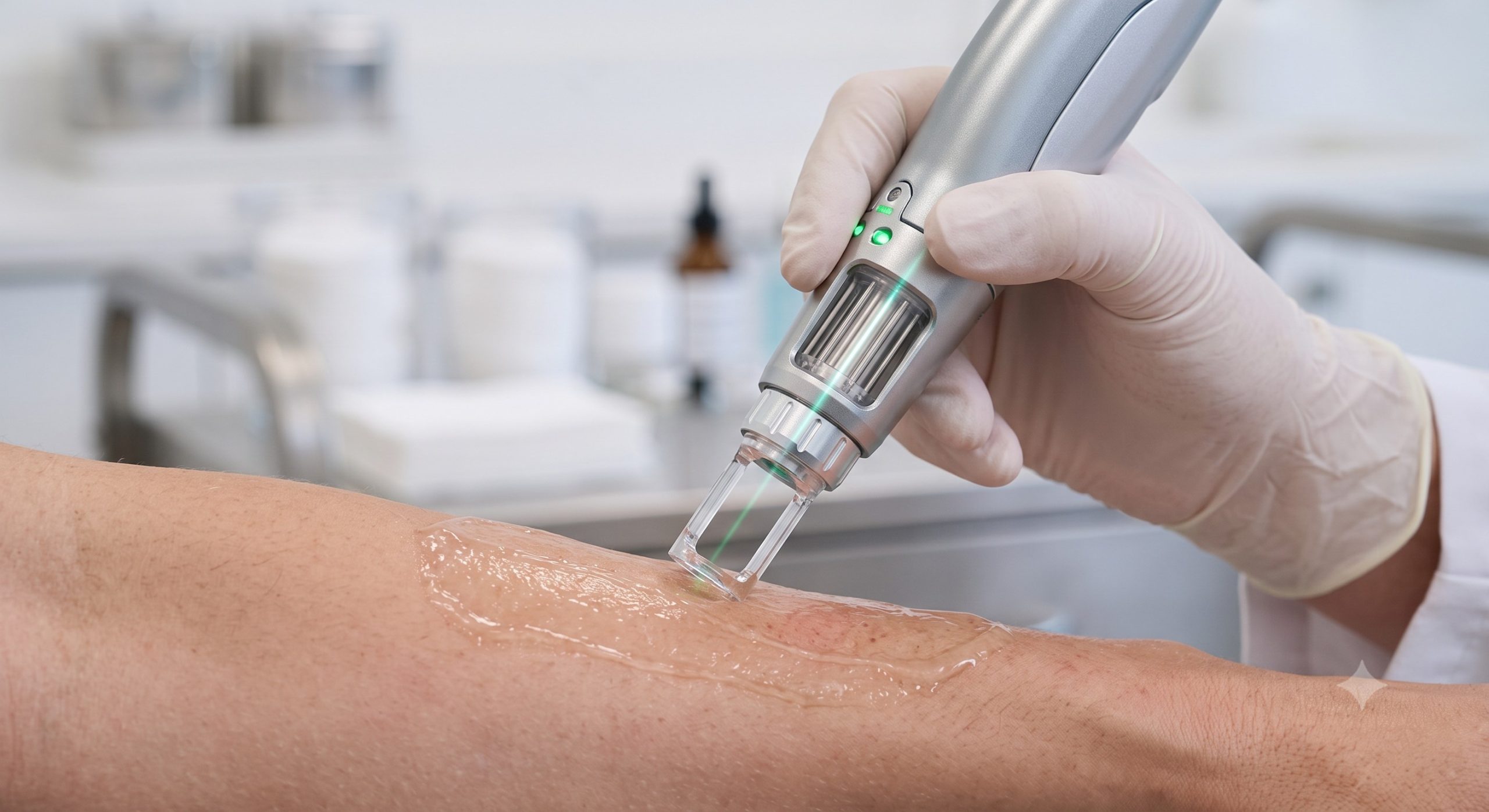
The versatility of picosecond technology, especially when combined with the right parameters and accessories, is remarkable. Its enhanced safety profile allows clinics to treat a wider range of patients and conditions.
- Tattoo Removal: This is the original and most well-established indication. Picosecond lasers are considered the gold standard, demonstrating superior efficacy in clearing multi-colored tattoos and those resistant to nanosecond lasers .
- Pigmented Lesions: From benign epidermal lesions to dermal melanocytosis like Nevus of Ota, picosecond lasers offer an efficient solution with a lower risk of post-inflammatory hyperpigmentation (PIH), a common concern in Asian and darker skin types .
- Skin Rejuvenation and Scar Revision: When equipped with a fractional diffractive lens array or microlens array, the picosecond laser can create laser-induced optical breakdown (LIOB) micro-injuries in the dermis, stimulating new collagen and elastin production without significant thermal damage to the epidermis . This allows for improvement in acne scars, fine lines, and overall skin texture, often termed a ‘lunchtime procedure’ due to minimal downtime .
- Safety Across the Fitzpatrick Scale: One of the most significant advantages is the reduced risk of thermal injury. By operating on a photomechanical principle, picosecond lasers minimize heat diffusion to the surrounding tissue, making it a safer and more effective option for treating patients with Fitzpatrick skin types IV-VI, who are historically at a higher risk for PIH .
Conclusion: The Clinical Imperative of Picosecond Technology
Integrating a picosecond laser into a medical aesthetic practice is more than just an equipment purchase; it’s a commitment to delivering state-of-the-art, evidence-based care. The physics are clear: the shift from a primarily photothermal mechanism to a dominant photomechanical one provides a decisive clinical advantage. With superior outcomes in tattoo removal, a wider safety margin for diverse skin types, and expanding applications in skin rejuvenation and scar revision, this technology is the new clinical imperative for any practice aiming for excellence. While the initial investment is a consideration, the clinical outcomes, patient satisfaction, and expanded treatment portfolio make it a powerful driver for practice growth and profitability.