The Ultimate Clinic Guide to Maintaining a Diode Laser Hair Removal Machine: Maximizing Uptime, Safety, and ROI
The $50,000 Mistake: Why Diode Laser Maintenance Dictates Your Clinic’s Bottom Line
In high-throughput medispas and dermatology clinics, a diode laser hair removal machine represents a significant capital investment (typically $15,000 to $45,000 for premium systems). However, clinical data indicates that over 60% of unscheduled downtime and up to 40% of diode laser bar degradation is directly attributable to poor routine maintenance protocols, not component failure. For the clinic owner, this translates directly into lost revenue—each day a 808nm or triple-wavelength (755/808/1064nm) system is offline represents a loss of $1,500 to $3,500 in potential treatment revenue. This guide provides a component-level, clinically-driven maintenance protocol designed to preserve ISO 13485 compliance, maintain FDA and Medical CE operational standards, and ensure your system delivers consistent fluence (J/cm²) and pulse width (ms) for years beyond the warranty period.
Physics of Failure: Understanding Your Diode Laser’s Core Components
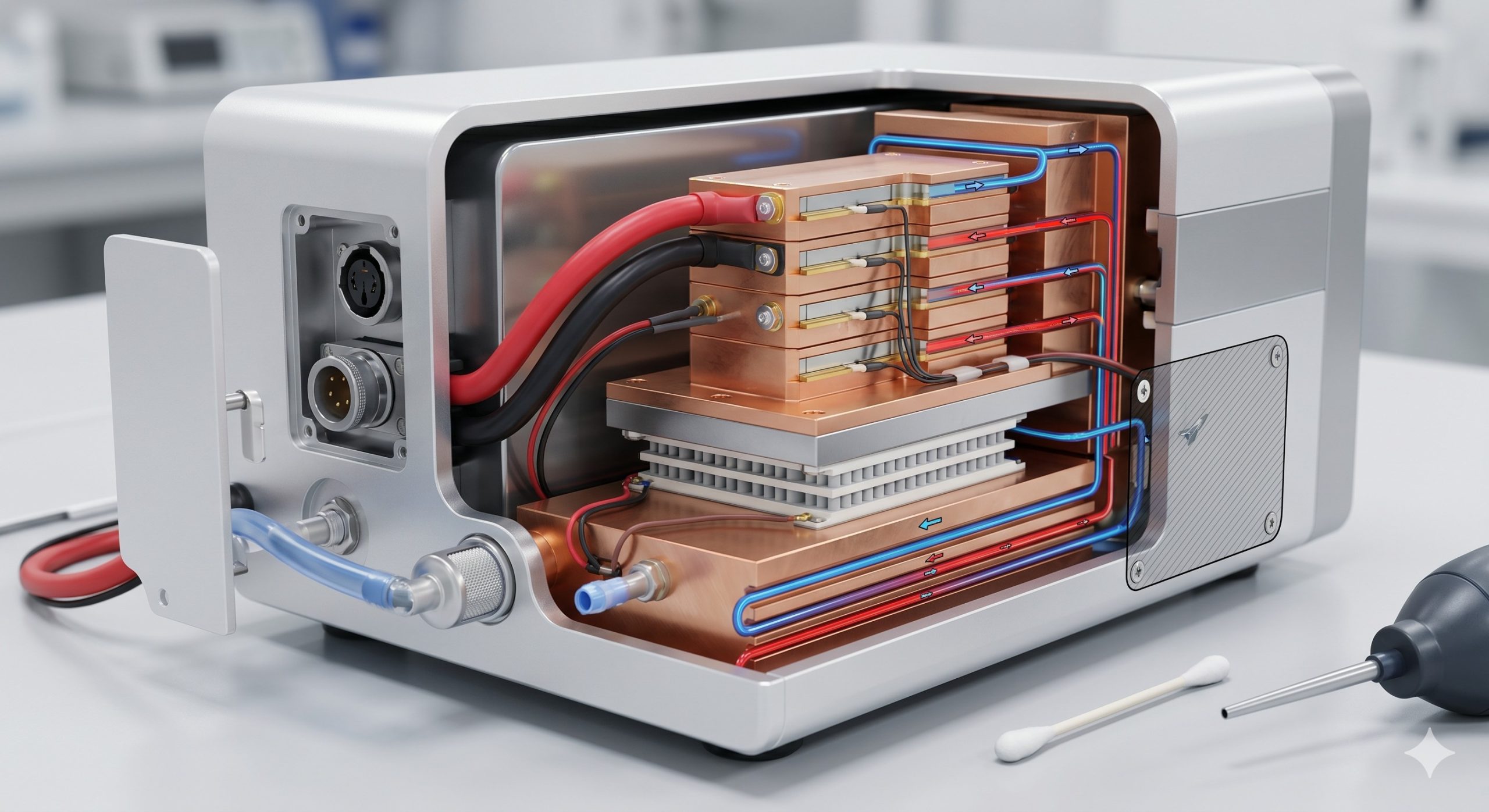
Effective maintenance begins with understanding the three most stress-vulnerable sub-systems. High-end diode laser stacks (typically emitting at 808nm, often combined with 755nm and 1064nm for alexandrite and Nd:YAG-like effects) are susceptible to thermal runaway. The laser bars are semiconductor diodes; for every 10°C increase above the optimal operating temperature (usually 15-25°C), the lifespan of the diode stack reduces by approximately 50%. The second critical component is the sapphire contact cooling tip (target temperature: -2°C to 4°C). Micro-cracks or particulate contamination on this optical surface can create hot spots, leading to epidermal burns. Thirdly, the water circulation and thermoelectric cooler (TEC) system—if the deionized water flow drops below 1.5 L/min, the laser’s duty cycle collapses, leading to automatic shutdowns mid-treatment.
Daily & Pre-Operational Protocol
Implement a mandatory 5-point checklist before the first patient. Visual Inspection: Examine the handpiece window for any carbonization or debris. Sapphire Tip Integrity: Run a gloved finger across the cooling plate to feel for any scratches or roughness. Conductivity Test: Perform a 5-shot test fire onto a calibration card (or wooden tongue depressor) to verify uniform beam profile. Emergency Stop Check: Verify the system’s skin contact sensor is functional—the laser must not fire without full cutaneous contact. Coolant Reservoir Log: Document the water level in the closed-loop system (using only medical-grade deionized water or OEM-specified coolant).
Weekly Deep-Cleaning & Calibration Workflow
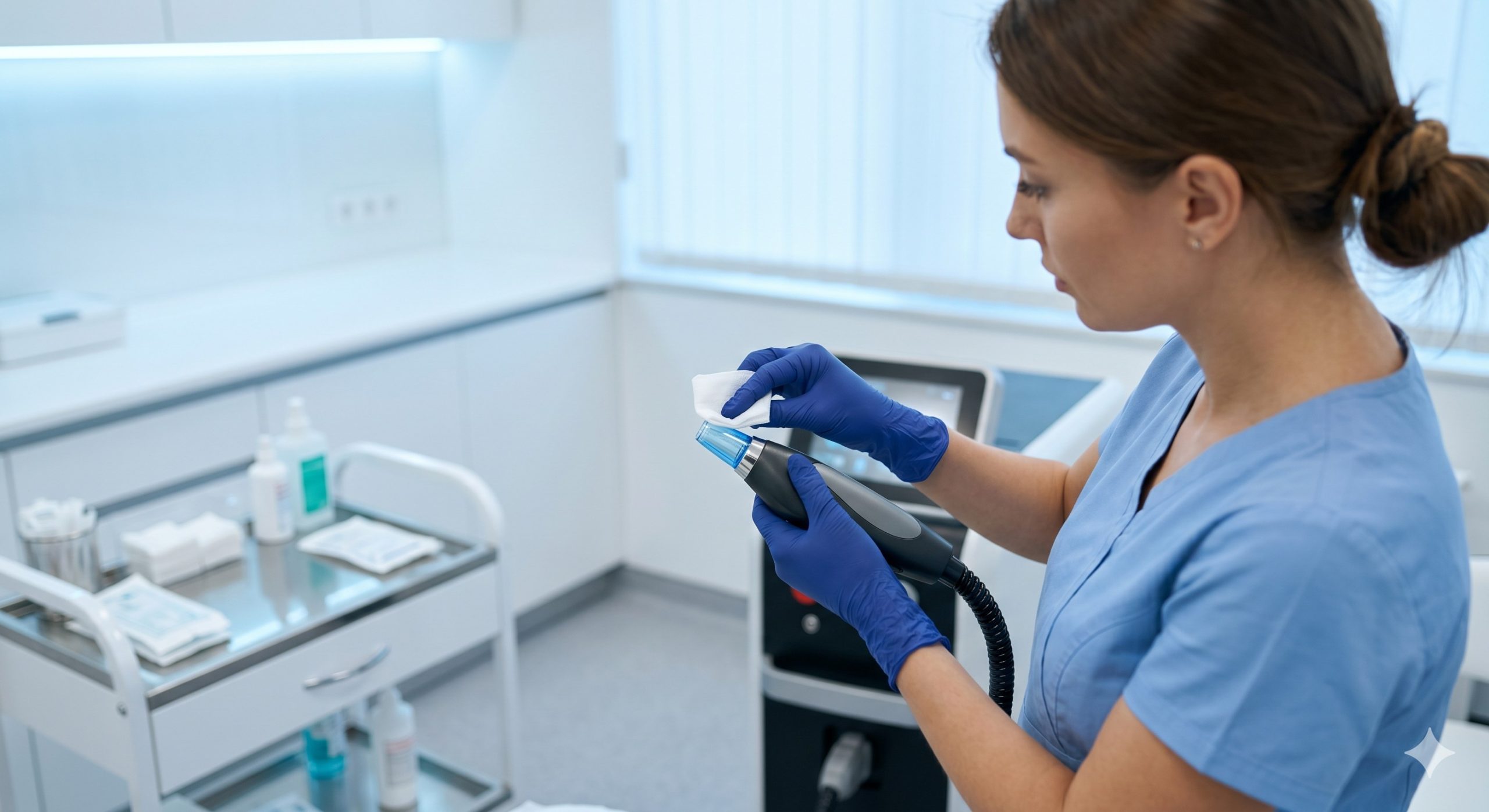
Biofilm and conductive dust are silent killers of high-voltage systems. Use a non-linting, lint-free wipe with 70% isopropyl alcohol to clean the handpiece housing and the globe (output window). Never use acetone or abrasive cleaners on the sapphire. Recalibrate the energy output (fluence) using a calibrated laser power meter (thermopile sensor). A variance exceeding ±10% from the set parameters (e.g., setting 20 J/cm² but reading <18 J/cm² or >22 J/cm²) indicates diode bar aging or Q-switch driver issues. For multi-wavelength systems, check each channel (755nm, 808nm, 1064nm) individually using the appropriate detector.
| Maintenance Task | Frequency | Clinical Metric | Action Threshold |
|---|---|---|---|
| Sapphire tip & window cleaning | Between each patient / Daily | Light transmission >95% | Visible debris or haze -> reclean |
| Energy output calibration (Power meter) | Weekly | Fluence variance <±10% | Deviation >10% -> service diode bar |
| Coolant water quality & level check | Weekly | Conductivity <5 µS/cm, full reservoir | Low level -> top up (DI water only) |
| Internal filter & radiator cleaning | Quarterly | Airflow unobstructed | Visible dust -> vacuum or compressed air |
| Diode bar lifetime assessment | Per 200k shots | Shot count < OEM spec (e.g., 1M) | >800k shots -> plan replacement |
Quarterly Preventative Maintenance: The Engineer’s Checklist
For clinics performing over 200 treatments monthly, quarterly audits are non-negotiable. Access the internal laser cavity and power supply unit (PSU)—this requires a medical physicist or OEM-trained biomedical engineer. Inspect the capacitor bank for bulging or electrolyte leakage; these store high-voltage charges (typically 800-1500V) to drive the diode bars. Test the grounding integrity (earth resistance); a reading above 0.5 ohms poses a serious electrical hazard. Flush the deionized water loop using a closed-loop flushing kit to remove algae or mineral deposits that reduce cooling efficiency. Replace the in-line water filter (0.2-micron rating) every 500 operational hours or biannually. Finally, update the system’s firmware to ensure the pulse shaping algorithms (for Square Pulse or Multi-Pulse technologies) remain optimized for Fitzpatrick skin types III-VI.
Handpiece & Component Lifespan Management
The handpiece is the most frequently replaced part. A quality diode laser handpiece with an imported laser bar (e.g., from Jenoptik or Hamamatsu) should deliver 1-2 million shots before a 20% drop in power is observed. However, poor maintenance (overheating, dropping the handpiece, liquid ingress) can reduce this to under 300,000 shots. Always store handpieces in the designated holder—never leave them hanging by the cable, as this fractures the fiber optic conduit or power leads. For systems with a detachable handpiece, clean the electrical and optical docking connectors quarterly with a contact cleaner.
Clinical Logs & Compliance Audit Trail
A medical-grade device demands a digital or physical log. Record the cumulative shot count daily. Note any error codes (e.g., E-01 for cooling flow, E-07 for diode temperature). This log serves two purposes: it triggers proactive maintenance (e.g., scheduling a diode bar replacement at 800,000 shots) and it provides legal proof of maintenance due diligence in the event of a regulatory audit (ISO 13485:2016 clause 7.5.1 requires controlled conditions for production and service provision). For leased or financed equipment, missing logs can void warranty support and maintenance contracts.
Troubleshooting Common Clinical Downtime Events
- Symptom: Laser fires but no hair reduction. Root Cause: Fluence drop >20% or wavelength shift. Action: Power meter test and diode current check.
- Symptom: Patient reports pinching pain despite cooling. Root Cause: Sapphire tip temperature >10°C. Action: Check TEC module voltage and coolant pump pressure.
- Symptom: System shuts down during a large spot area (e.g., back treatment). Root Cause: Thermal overload due to reduced water flow or clogged radiator fins. Action: Clean external air filters and check pump RPM.
- Symptom: Uneven beam pattern (center hot spot). Root Cause: Delaminated optical window or misaligned diode stack. Action: Return to service center for re-collimation.
Conclusion: The ROI of Proactive Maintenance
Data from multi-clinic operators (5+ systems) shows that implementing the above protocol reduces major component failures by 73% and extends the useful life of a diode laser hair removal machine by 4-6 years. Budget 3-5% of the original equipment cost annually for genuine OEM consumables (filters, cooling fluid, windows) and one engineering service contract. A proactive maintenance strategy not only protects your CapEx but ensures patient safety, consistent clinical efficacy (70-90% hair reduction after 6 sessions), and a strong reputation in a competitive aesthetic market. Treat your diode laser not as a purchase, but as a precision instrument requiring daily clinical discipline.