Colored Tattoos Demystified: How Advanced Pico Laser Technology Removes Complex Pigments
Executive Summary
Colored tattoo removal requires a sophisticated understanding of selective photothermolysis and the specific absorption spectra of dermal pigments. Unlike traditional nanosecond Q-switched lasers, advanced picosecond laser technology utilizes the photoacoustic effect to shatter ink particles into microscopic fragments with minimal collateral thermal damage. This article clarifies why wavelength specificity—particularly the integration of 1064nm, 532nm, and 755nm/785nm wavelengths—is critical for multi-colored ink clearance. By emphasizing high-precision beam profiles and rigorous safety protocols, such as those upheld by Cocoon Laser manufacturing standards, this guide provides clinical insights for patients and practitioners alike, ensuring that outcomes are based on physics and physiological response rather than marketing claims.
The Challenge of Colored Ink: Why “Black” Is Easier to Remove
For patients and aesthetic practitioners, the removal of colored tattoos remains one of the most complex procedures in the field of laser medicine. While black and dark blue inks respond predictably to standard laser treatments, the removal of complex, multi-colored tattoos requires a deeper dive into the physics of light-matter interaction.
The Science of Selective Photothermolysis
At the heart of laser tattoo removal is the principle of Selective Photothermolysis. This concept dictates that a laser must deliver energy at a wavelength that is preferentially absorbed by the target (the ink pigment) while sparing the surrounding tissue. The target, or chromophore, absorbs the laser energy, which is then converted into physical energy—specifically, a rapid expansion of shockwaves—to break down the ink particles. If the laser wavelength is not correctly matched to the ink’s absorption spectrum, the energy is reflected or absorbed by the skin’s natural melanin, leading to suboptimal results or, worse, thermal damage.
The Color Spectrum Barrier
The reason “black” ink is significantly easier to remove is its broad absorption spectrum; it absorbs virtually all wavelengths of light used in aesthetic laser devices. Conversely, colored inks present a significant challenge. Green, blue, red, and yellow pigments have very specific and often narrow absorption bands. If a clinic relies on a device that only offers standard 1064nm or 532nm wavelengths, they will inherently fail to effectively target “cool” colors like green or light blue. This wavelength mismatch is the primary reason why many patients experience a “plateau” in their removal journey, where the laser simply cannot “see” the remaining pigment in the dermis.
The Pico Advantage: Why Picosecond Lasers are the Gold Standard
The evolution from nanosecond (Q-switched) lasers to picosecond (Pico) technology represents a paradigm shift in how we approach dermal ink removal.
Photoacoustic vs. Photothermal Effect
Traditional nanosecond lasers operate largely on a photothermal mechanism. They heat the ink, relying on thermal diffusion to break down the particles. This method is effective but risky, as the prolonged heat can damage the surrounding dermal matrix, increasing the risk of scarring, hypopigmentation, and textural changes.
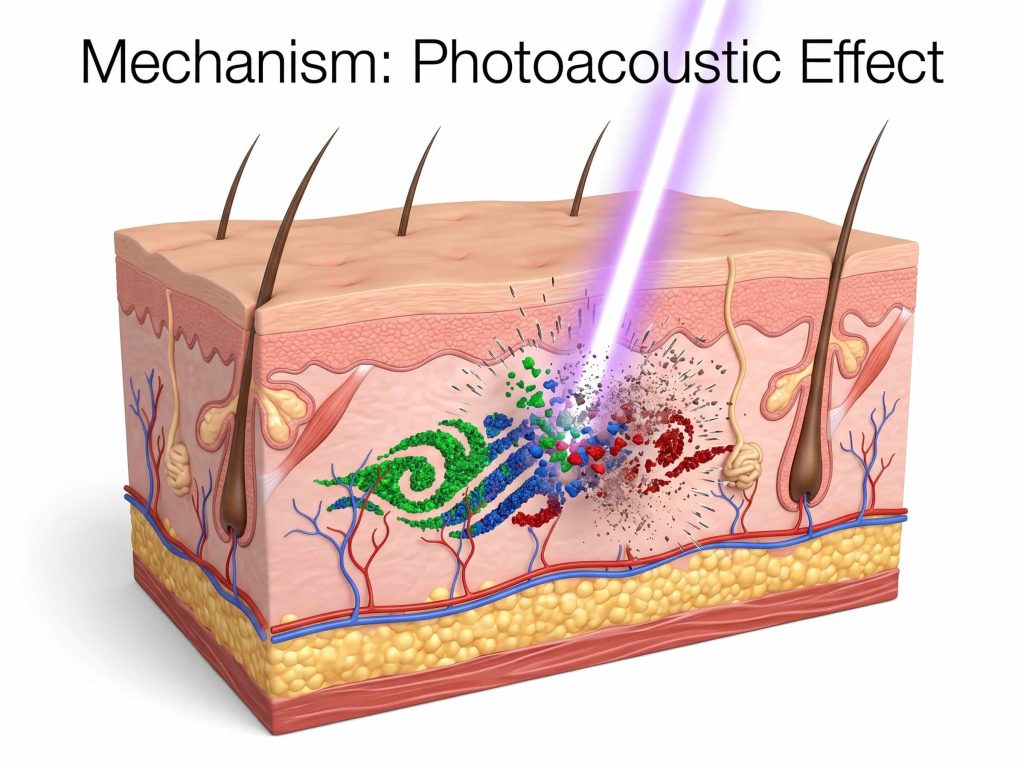
In contrast, advanced picosecond lasers operate via the photoacoustic effect (or photomechanical effect). Because the pulse duration is so brief—measured in trillionths of a second—the energy does not have time to dissipate as heat. Instead, the laser creates a massive, localized pressure wave (a shockwave) that physically shatters the ink particles into “dust.” This process is far more efficient at clearing pigment because it targets the ink at a granular level without cooking the surrounding skin tissue.
The Importance of Pulse Duration
The pulse duration is the defining variable of Pico technology. By keeping the pulse duration in the picosecond range, the device ensures that the energy is deposited faster than the “thermal relaxation time” of the skin tissue. This allows the laser to achieve higher peak power, which is necessary to shatter even the most resistant, deeply embedded ink particles. For the patient, this means fewer treatment sessions and a drastically reduced risk of post-inflammatory sequelae.
Wavelength Matching: The Key to Multi-Colored Ink Removal
Successful tattoo removal is not about power; it is about precision. Using the wrong wavelength for a specific ink color is akin to trying to open a door with the wrong key—the mechanism will not engage.
Decoding the Spectrum: Matching Lasers to Pigments
To achieve clinical success, a professional-grade laser system must be capable of multi-wavelength emission. The following table illustrates the clinical requirement for wavelength matching:
| Wavelength | Primary Target Colors | Clinical Application |
| 1064nm | Black, Dark Blue, Dark Gray | Deep dermal penetration; excellent for dark, dense ink. |
| 532nm | Red, Yellow, Orange | Superficial absorption; targets warm, vibrant tones. |
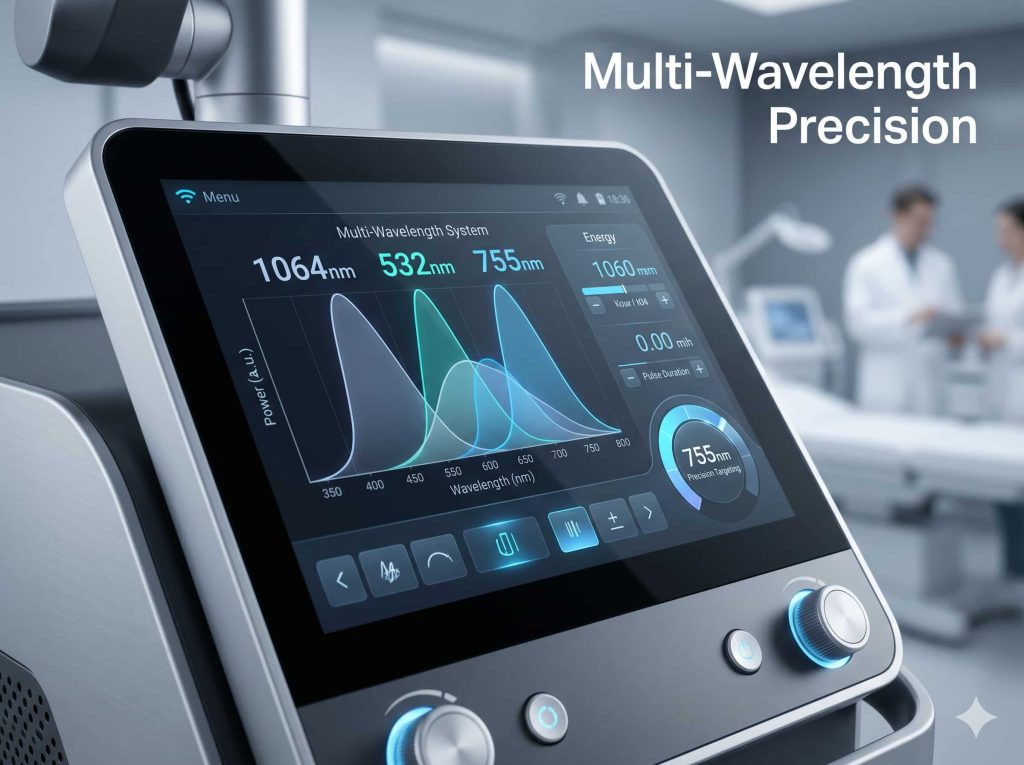
| 755nm / 785nm | Green, Light Blue, Teal | Essential for “rebellious” colors that resist 1064/532. |
Why a Single-Wavelength Device is Insufficient
Many entry-level aesthetic devices are limited to 1064nm and 532nm. While these are sufficient for monochrome black tattoos, they are clinically inadequate for modern, professional-grade tattoos that feature complex color gradients. A green tattoo, for example, reflects the 1064nm and 532nm wavelengths almost entirely. Without a 755nm or 785nm source, the green ink will persist regardless of how many sessions the patient undergoes. A professional clinic must invest in high-end, multi-wavelength Pico systems to provide a comprehensive service. Cocoon Laser emphasizes that true clinical versatility is impossible without this spectrum coverage.
Clinical Expectations: Safety, Pain, and Downtime
The medical reality of tattoo removal involves managing biological responses and ensuring patient safety throughout the course of treatment.
The Fitzpatrick Scale and Patient Assessment
Before any laser intervention, a thorough patient assessment based on the Fitzpatrick Scale is mandatory. This scale categorizes skin types from I (very fair) to VI (deeply pigmented). Patients with darker skin (Fitzpatrick IV-VI) have higher epidermal melanin levels, which absorb laser energy competitively with the tattoo ink. A professional practitioner will use this assessment to calibrate settings, potentially utilizing longer wavelengths to bypass epidermal melanin and prevent hyperpigmentation or hypopigmentation.
Managing Downtime and Healing
Patients should have a clear understanding of the immediate clinical response:
- Frosting: A white, superficial “frost” appearing on the skin immediately post-treatment is a normal indicator of the photoacoustic effect breaking down pigment.
- Erythema and Edema: Mild redness and swelling are expected for 24–48 hours.
- Downtime: While Pico technology significantly reduces thermal damage, the skin still requires time to remodel. Avoiding sun exposure is non-negotiable to protect the treated area during the inflammatory response phase.
Why Manufacturer Standards Matter for Your Results
The efficacy of a Pico laser is determined by the engineering quality within the housing. As a manufacturer of medical-grade aesthetic systems, Cocoon Laser understands that clinical outcomes are directly tied to hardware reliability and precision.
Beam Quality and Stability
In the world of high-power lasers, the beam profile—the spatial distribution of energy within the laser pulse—is everything. A high-quality laser system produces a “top-hat” or uniform Gaussian beam. This ensures that the energy density is consistent across the entire spot size. Inferior lasers often suffer from “hot spots”—unregulated spikes in energy density. Hot spots are dangerous; they can cause focalized burns, leading to permanent dermal scarring or uneven ink clearance. When selecting a laser system, consistent energy stability across the entire shots count lifespan is the hallmark of professional-grade manufacturing.
How to Choose a Clinic with High-Tier Equipment
For patients evaluating a clinic, the following checklist is recommended:
- Ask about the wavelengths: Does the clinic have a system capable of 755nm or 785nm for colored ink?
- Check the hardware certifications: Is the system backed by FDA 510(k) or Medical CE certification? These documents are not just bureaucratic; they prove the system has undergone clinical safety testing.
- Inquire about TEC Cooling: Ensure the system utilizes TEC Cooling (Thermoelectric Cooling). This technology stabilizes the laser core temperature, ensuring that the laser output remains consistent from the first shot to the last, preventing energy degradation.
Frequently Asked Questions (FAQ)
Will my tattoo be completely gone after one session?
No. Tattoo removal is a cumulative process. Even with advanced Pico technology, the body needs time to flush out the shattered ink particles through the lymphatic system. A series of 5 to 10 sessions is typically required for significant clearance.
Does Pico laser hurt less than traditional laser removal?
Pain is subjective, but because Pico lasers operate using the photoacoustic effect rather than intense heat, the “burn” sensation associated with traditional nanosecond lasers is significantly minimized. Most clinics use topical anesthetics or cold air cooling to manage comfort.
Can I treat all colors of tattoos with one laser?
Only if that laser is equipped with multiple wavelengths (1064nm, 532nm, and 755nm/785nm). If a clinic claims they can remove a green tattoo with a standard 1064/532nm device, the clinical results will likely be insufficient.
Start Your Journey to Clearer Skin
Effective tattoo removal is a clinical science, not a matter of chance. By moving away from older, heat-based technologies and embracing the precision of multi-wavelength Pico systems, patients can achieve safe, predictable, and thorough ink clearance. The journey to skin rejuvenation begins with choosing the right technology and trusting in the expertise of a well-equipped clinical provider.
We encourage all patients to prioritize clinics that invest in medical-grade, certified equipment. Understanding the underlying technology ensures you make an informed decision about your skin health. Consult our engineering team at Cocoon Laser to learn more about the technical specifications and hardware standards that define professional-grade tattoo removal equipment and distinguish it from the rest.
If you need more information, please click “Contact Us”.
If you want to obtain more information, please follow our official website and Facebook.