The Science of Picoseconds: Insights from a Non-Ablative Picosecond Laser Manufacturer
Executive Summary:
For patients seeking advanced dermatological solutions for melasma, acne scarring, and tattoo removal, the non-ablative picosecond laser represents a definitive paradigm shift in aesthetic medicine. Operating at one trillionth of a second, these clinical devices leverage the photoacoustic effect to shatter target chromophores without transferring excessive thermal energy to the surrounding epidermis. This critically mitigates the risk of Post-Inflammatory Hyperpigmentation (PIH) across all Fitzpatrick Scale skin types. By utilizing Laser-Induced Optical Breakdown (LIOB), the technology stimulates deep dermal collagen remodeling while maintaining absolute epidermal integrity, resulting in zero to minimal downtime. As an authoritative aesthetic laser manufacturer, Cocoon Laser engineers systems with unparalleled peak power, uniform top-hat beam profiles, and rigorous Medical CE and FDA 510(k) clearances. This comprehensive guide decodes the physics behind picosecond technology, empowering patients to make informed, safe, and highly efficacious clinical decisions.
Beyond the Hype: What Does “Picosecond” Actually Mean for Your Skin?
The aesthetic industry is often saturated with marketing jargon that obscures the actual science behind clinical treatments. To understand why a non-ablative picosecond laser is considered a revolutionary tool for skin rejuvenation, one must look at the underlying optical physics. A “picosecond” is not a brand name; it is a unit of time measurement equal to $10^{-12}$ seconds, or one trillionth of a second. This ultra-short pulse duration fundamentally changes how laser energy interacts with human tissue.
The Trillionth of a Second Advantage: Nanosecond vs. Picosecond
For decades, the industry standard for treating pigmentation and tattoos was the Q-switched nanosecond laser ($10^{-9}$ seconds). While effective, nanosecond technology relies heavily on photothermal action—meaning it uses localized heat to break down pigment. When dealing with delicate facial skin, excessive heat is the primary catalyst for adverse reactions.
The transition from nanosecond to picosecond pulse durations shifts the mechanism of action from primarily thermal to highly mechanical. To illustrate this clinically: if breaking down a large dermal melanin cluster with a nanosecond laser is akin to hitting a boulder with a sledgehammer (resulting in collateral damage and large fragments), utilizing a picosecond laser is like using a high-velocity sniper projectile. It shatters the target into microscopic dust instantly, making it infinitely easier for the body’s lymphatic system to clear the debris.
| Technical Parameter | Legacy Nanosecond Lasers | Advanced Picosecond Lasers | Clinical Implication for the Patient |
| Pulse Duration | $10^{-9}$ seconds | $10^{-12}$ seconds | Exponentially faster energy delivery. |
| Mechanism of Action | Photothermal (Heat-driven) | Photomechanical (Acoustic-driven) | Drastically reduced heat transfer to surrounding skin. |
| Pigment Fragmentation | Granular / Pebble-sized | Microscopic / Dust-like | Faster clearance by the body’s macrophages. |
| Thermal Collateral Damage | Moderate to High | Extremely Low | Significantly improved safety profile. |
The Photoacoustic Effect: Shattering Pigment Without the Heat
The defining characteristic of a true picosecond laser is its ability to generate the photoacoustic effect. Because the optical energy is delivered in such an incomprehensibly brief time window, the target chromophore (such as a melanin cluster or a tattoo ink particle) absorbs the energy and expands so rapidly that it undergoes a mechanical shockwave. It shatters itself before it has the opportunity to heat up and burn the surrounding healthy tissue.
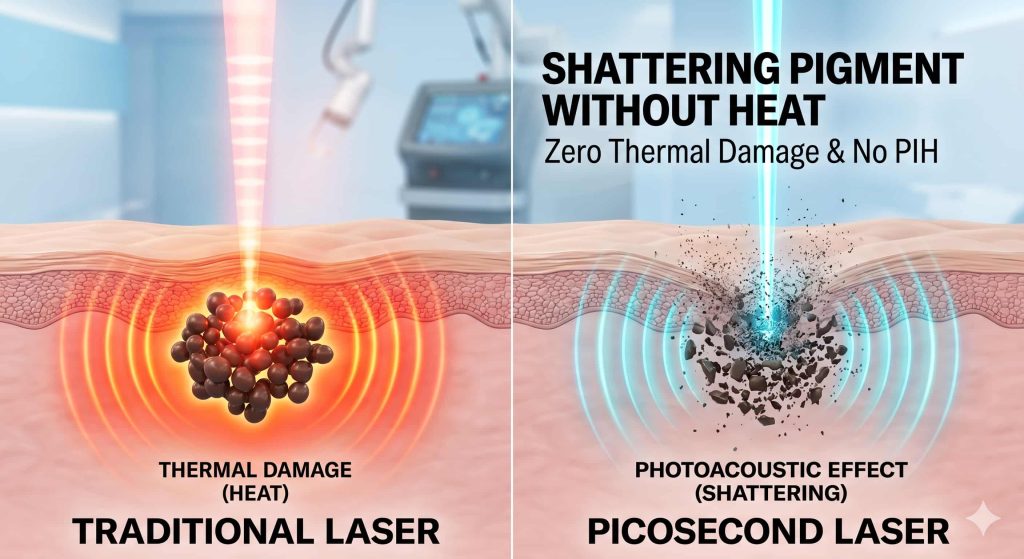
For patients, this is the most critical safety feature of the technology. By eliminating excessive heat, the photoacoustic effect drastically lowers the risk of burns, scarring, and most importantly, Post-Inflammatory Hyperpigmentation (PIH). PIH is a common complication where the skin reacts to thermal trauma by producing even more dark spots. By prioritizing mechanical fragmentation over thermal destruction, patients are actively preventing PIH and ensuring treatments align with the highest global laser safety standards.
The “Non-Ablative” Magic: Why You Don’t Need to Hide After Treatment
Historically, achieving dramatic skin resurfacing required “ablative” lasers, such as traditional $CO_2$ systems. Ablative lasers work by literally vaporizing the top layers of the skin, forcing the body to grow a new epidermal layer. While effective, this process involves open wounds, weeping skin, high infection risks, and a mandatory isolation period of weeks. Modern patients demand high-yield results without the severe biological toll.
Protecting the Epidermis: Healing from the Inside Out
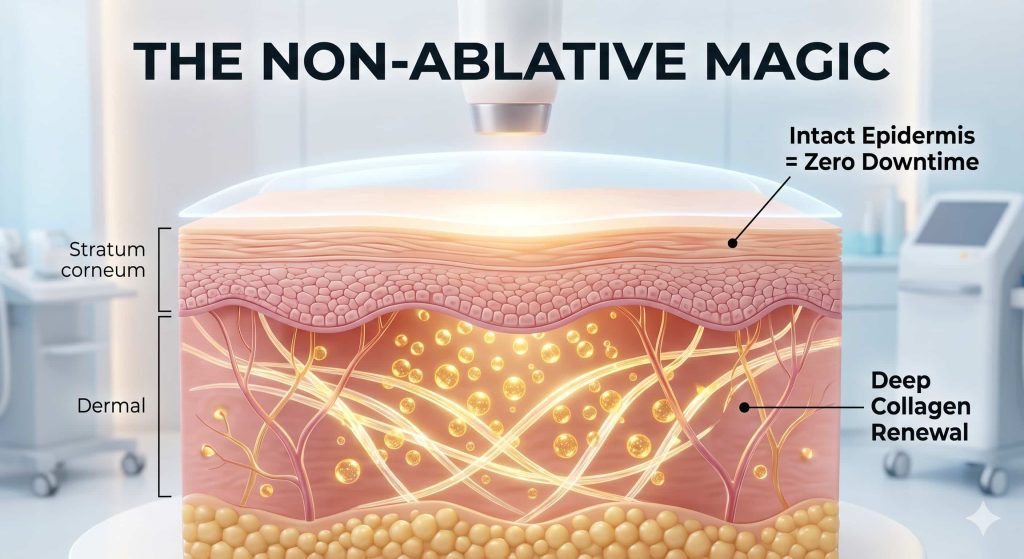
The term non-ablative means that the laser energy mathematically bypasses the surface of the skin (the epidermis) entirely without breaking it. Instead of damaging the outer barrier, a non-ablative picosecond laser focuses its optical energy exclusively on the deeper dermal layers where collagen and stubborn pigment reside.
By maintaining the integrity of the stratum corneum (the outermost skin layer), the skin’s natural barrier against bacteria and moisture loss remains perfectly intact. The healing cascade is triggered from the inside out. Your body registers a controlled micro-injury in the dermis and rushes to repair it by producing fresh structural proteins, all while the surface of your skin remains unbroken and protected.
Zero to Minimal Downtime: Fitting Treatments into a Busy Schedule
Because the epidermis is completely preserved, the dreaded clinical “downtime” is effectively eliminated. For the C-level executive, the busy parent, or the active professional, this means you can schedule a session during a lunch break and return to your daily obligations immediately.
Post-treatment clinical realities involve transient erythema (mild redness) and a feeling of warmth, similar to a very mild sunburn. These symptoms typically resolve within 2 to 6 hours. There is no crusting, no weeping, and no mandatory hiding indoors. You are cleared to wash your face gently that same evening and apply mineral makeup the following morning.
What Can a Non-Ablative Picosecond Laser Fix? Targeted Solutions
A premium picosecond platform is a highly versatile clinical tool. By adjusting wavelengths, fluence, and specialized fractional optics, certified practitioners can target highly specific dermatological concerns with absolute precision.
Erasing Stubborn Pigmentation and Melasma Safely
Melasma is notoriously difficult to treat, particularly in patients with darker skin tones (Fitzpatrick Scale III-VI). Traditional heat-based lasers often exacerbate melasma, triggering melanocytes to overproduce pigment in defense against the thermal trauma.
The non-ablative picosecond laser is currently recognized as the safest and most effective modality for melasma management. Because it utilizes the cold, photoacoustic shockwave to pulverize the melanin, it does not trigger the defensive hyperpigmentation cascade. Over a series of treatments, the shattered melanin dust is quietly metabolized and flushed out by the immune system, revealing an even, luminous complexion without the risk of a rebound effect.
Acne Scars and Skin Rejuvenation: The LIOB Effect
To treat textural irregularities like atrophic acne scars, enlarged pores, and fine lines, a non-ablative picosecond laser utilizes specialized fractional lens arrays. These micro-lenses concentrate the picosecond energy into tiny, high-intensity focal points beneath the skin.
This process triggers a fascinating biophysical phenomenon known as Laser-Induced Optical Breakdown (LIOB). The intense optical energy creates microscopic, plasma-filled vacuoles (cavities) strictly within the dermis. The surrounding tissue remains completely undamaged. The body interprets these LIOB cavities as trauma and aggressively initiates a localized wound-healing response.
Fibroblasts are stimulated to flood the area with vast amounts of new Type I and Type III collagen, as well as elastin. Over the ensuing weeks, this newly synthesized matrix literally pushes up from beneath, physically elevating depressed acne scars and smoothing out wrinkles. For patients seeking rigorous acne scar reduction, utilizing a collagen stimulation laser capable of true LIOB is the most scientifically validated non-surgical approach available today.
The Gold Standard for Tattoo Removal
Tattoo ink particles are heavy metals and dense synthetic compounds permanently lodged in the dermis. Traditional nanosecond lasers often fail to clear stubborn colors like bright blue or green, and eventually reach a plateau where the ink particles are too small for a sledgehammer effect, but too large for the immune system to remove.
The trillionth-of-a-second pulse of a picosecond laser shatters these residual, stubborn ink particles into sub-micron dimensions. This allows for faster clearance, fewer total sessions, and the ability to completely eradicate a wider spectrum of ink colors, restoring the skin back to its natural canvas without leaving a ghostly silhouette of the old tattoo.
The Manufacturer’s Secret: Why Equipment Quality Dictates Your Results
From a patient’s perspective, it is easy to assume that any clinic advertising “picosecond” treatments will deliver the same results. As an aesthetic laser manufacturer, we must clarify a harsh clinical reality: the engineering quality of the hardware dictates 90% of the safety and efficacy of your treatment.
Stability, Peak Power, and Uniform Beam Profiles
Manufacturing a device capable of generating true, stable picosecond pulses requires highly sophisticated optical engineering. Low-cost, generic machines often suffer from severe pulse duration degradation—meaning they advertise a picosecond but actually deliver a slower nanosecond pulse. Furthermore, they lack the robust power supplies needed to sustain high peak power.
Crucially, the quality of the laser’s beam profile is paramount. A low-quality laser emits a “Gaussian” beam, which is hot in the center and weak at the edges. This leads to inconsistent results and a high risk of center-point burns. A premium non-ablative picosecond laser utilizes an optically refined top-hat beam profile. This ensures that the energy is distributed with absolute mathematical uniformity across the entire treatment spot. Every millimeter of the targeted skin receives the exact same therapeutic dose, guaranteeing predictable, flawless results without overlapping burns or missed zones.
Why Your Clinic’s Choice of a Cocoon Laser Matters
When you step into a medical spa, the hardware they use is a direct reflection of their commitment to your safety. Clinics operating Cocoon Laser technology are backed by rigorous industrial manufacturing standards.
Our professional medical laser equipment is engineered to deliver immutable pulse stability, uncompromising peak power, and perfectly uniform energy distribution. Furthermore, our devices undergo exhaustive clinical auditing to achieve elite regulatory clearances, including Medical CE and FDA 510(k). When evaluating certified aesthetic clinics for your next procedure, verifying the manufacturer of the equipment is the most proactive step you can take to ensure your skin is in safe, capable hands.
Preparing for Your First Session: A Patient’s Checklist
To maximize the photoacoustic benefits of your non-ablative picosecond treatment and ensure the fastest possible cellular turnover, patient compliance before and after the procedure is essential.
Pre-Treatment Do’s and Don’ts
- Discontinue Active Topicals: Cease the use of all Retinoids (Retinol, Tretinoin), AHAs (Glycolic Acid), and BHAs (Salicylic Acid) at least 5 to 7 days prior to your session to prevent epidermal hypersensitivity.
- Strict UV Avoidance: Avoid active sunbathing, tanning beds, and self-tanning lotions for at least 4 weeks prior. The laser targets pigment; a fresh tan introduces competing melanin that can absorb the laser energy and cause superficial burns.
- Medical History Disclosure: Inform your practitioner of any recent antibiotic use, as some medications induce severe photosensitivity.
Post-Care Essentials to Maximize the Glow
- Aggressive Hydration: The LIOB process and subsequent collagen synthesis require high cellular hydration. Utilize a medical-grade hyaluronic acid serum and a rich, ceramide-based barrier repair cream to support the epidermal barrier.
- Mandatory Sun Protection: Your freshly treated skin is highly vulnerable to UV radiation. A broad-spectrum physical sunscreen (containing Zinc Oxide or Titanium Dioxide) with an SPF of 50 or higher must be applied daily and reapplied every two hours if exposed to daylight.
- Avoid Thermal Triggers: For the first 48 hours post-treatment, avoid heavy cardiovascular exercise, saunas, hot yoga, and extremely hot showers. Keeping the skin temperature cool minimizes transient erythema and prevents unnecessary inflammation.
Ready for Flawless Skin? Take the Next Step
The era of choosing between highly effective treatments with weeks of painful downtime, or comfortable treatments with negligible results, is officially over. The non-ablative picosecond laser bridges the gap between patient comfort and clinical excellence. By harnessing the photoacoustic effect and LIOB technology, patients can achieve profound textural refinement, erase stubborn melasma, and stimulate intense collagen production—all without breaking the surface of the skin.
However, technology is only as good as the engineering behind it. Do not compromise your skin’s health with substandard, unverified devices. Demand transparency from your provider, insist on FDA 510(k) and Medical CE-cleared equipment, and prioritize clinical safety above all else.
If you are ready to erase pigmentation, smooth acne scars, and achieve an unparalleled complexion without the downtime, it is time to experience the pinnacle of optical engineering. Seek out authorized providers utilizing genuine Cocoon Laser systems, and take the definitive step toward flawless, rejuvenated skin. Explore our technology and learn more about our rigorous clinical standards at https://www.cocoonlaser.com/.
If you need more information, please click “Contact Us”.
If you want to obtain more information, please follow our official website and Facebook.