Thulium Laser vs CO2 Laser: Which Is Better for Skin Resurfacing?
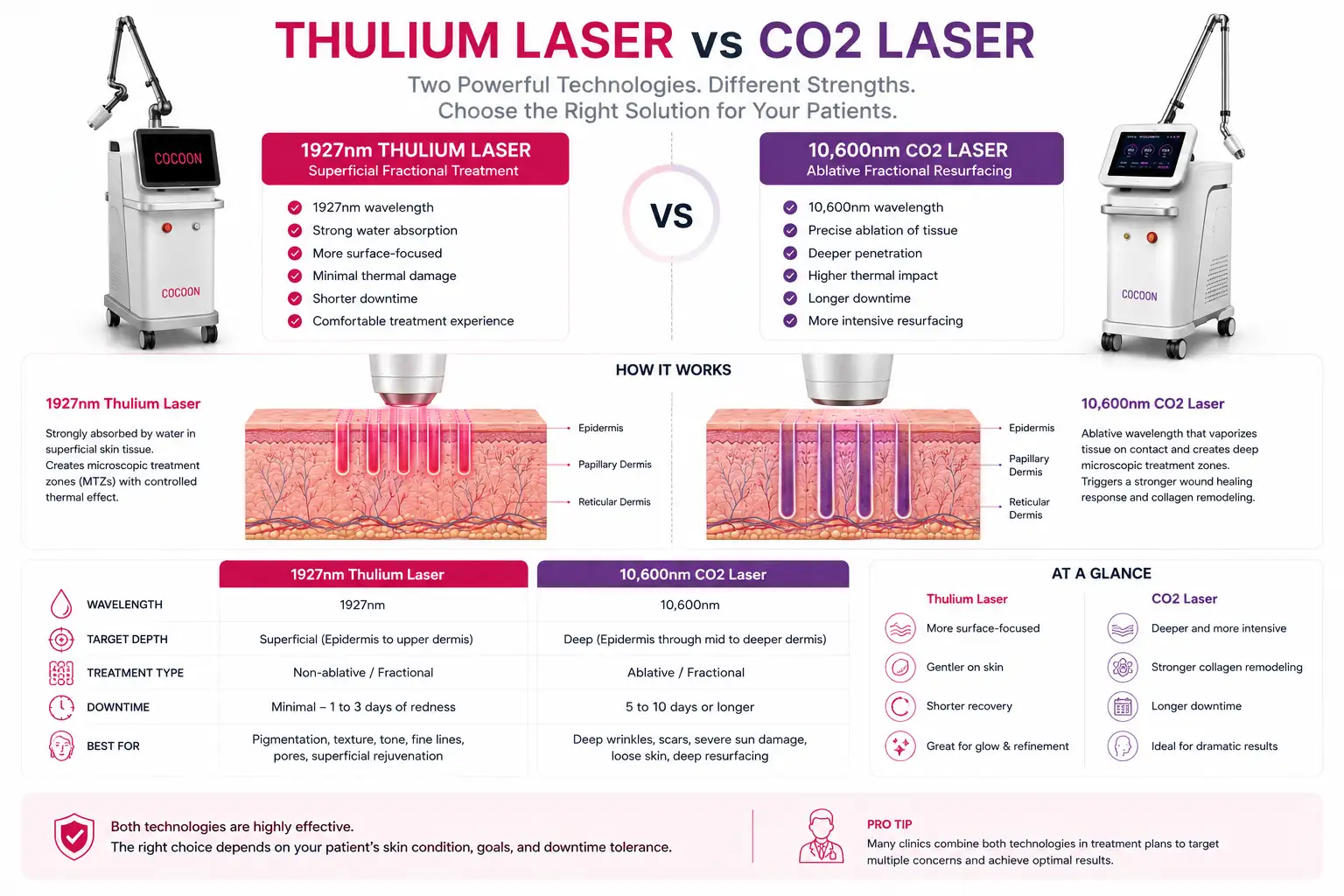
Thulium laser and fractional CO2 laser technologies can both be used within professional skin resurfacing and rejuvenation strategies, but they interact with tissue very differently.
In aesthetic applications, approximately 1927nm thulium laser technology is generally associated with relatively superficial fractional treatment. It is often considered for selected pigmentation, photodamage, uneven-looking skin tone, and superficial skin-quality concerns.
A 10,600nm CO2 laser, by comparison, is strongly absorbed by water and can create ablative tissue effects. Fractional CO2 systems are commonly used when treatment objectives involve more intensive skin resurfacing, wrinkles, texture, and selected scar applications.
This does not mean CO2 is simply a “stronger version” of thulium laser, nor does it mean thulium is automatically the better option when shorter recovery is desired. The two technologies occupy different treatment positions.
This guide compares thulium laser vs CO2 laser across wavelength, tissue interaction, treatment depth, resurfacing, pigmentation, acne scars, wrinkles, results, downtime, safety, and professional equipment selection.
Quick Answer
What is the main difference between thulium laser and CO2 laser? A 1927nm fractional thulium laser is generally associated with relatively superficial fractional treatment, making it particularly relevant to selected pigmentation, photodamage, uneven-looking tone, and superficial skin-quality concerns.
A 10,600nm fractional CO2 laser can create ablative microscopic treatment zones and is commonly used for more intensive resurfacing, including selected wrinkles, textural irregularities, and scar concerns.
In simple terms, thulium laser is generally more surface-focused, while fractional CO2 laser provides stronger ablative resurfacing capability. Neither is universally better. The appropriate technology depends on the treatment objective, desired intensity, patient characteristics, recovery tolerance, device, and professional assessment.
Thulium Laser vs CO2 Laser at a Glance
| Feature | 1927nm Thulium Laser | Fractional CO2 Laser |
|---|---|---|
| Typical Wavelength | Approximately 1927nm | Approximately 10,600nm |
| Primary Chromophore | Water | Water |
| General Treatment Profile | Relatively superficial fractional treatment | Ablative fractional resurfacing capability |
| Common Treatment Focus | Pigmentation, photodamage, uneven-looking tone, superficial skin quality | Texture, wrinkles, selected scars, more intensive resurfacing |
| Ablative Capability | Depends on device and treatment architecture; commonly used for less ablative or non-ablative fractional strategies | Yes, fractional CO2 systems can create ablative microscopic columns |
| Typical Recovery Intensity | Often lower, depending on parameters | Can be more substantial, depending on treatment intensity |
| Pigmentation Focus | Often more directly relevant to superficial pigment concerns | Can improve selected pigmentary irregularities as part of resurfacing |
| Scar Resurfacing | More limited for deeper scar-remodeling objectives | Common professional application |
| Best Choice | Depends on treatment objective, patient selection, device design, treatment intensity, and acceptable recovery | |
This table describes general differences between the technologies. Actual treatment behavior varies significantly among devices and protocols, so wavelength alone should not be used to predict exact treatment depth, downtime, or results.

What Is a 1927nm Thulium Laser?
In aesthetic medicine, approximately 1927nm is one of the most widely discussed wavelengths associated with fractional thulium laser technology.
The wavelength interacts strongly with water in skin tissue. This contributes to a relatively superficial energy-deposition profile compared with technologies commonly used for deeper remodeling.
Professional 1927nm fractional treatment may be considered for selected concerns such as:
- Superficial pigmentation
- Visible photodamage
- Uneven-looking skin tone
- Selected dyschromia concerns
- Superficial skin-quality improvement
- Fractional facial rejuvenation
Most aesthetic discussions of 1927nm treatment also involve fractional delivery, meaning that energy is distributed into microscopic treatment zones rather than uniformly treating the entire skin surface.
For a detailed explanation, see our 1927nm Thulium Laser and Fractional Thulium Laser guides.
What Is a Fractional CO2 Laser?
A CO2 laser typically operates at approximately 10,600nm. This wavelength is strongly absorbed by water and can rapidly heat water-containing tissue.
In fractional CO2 resurfacing, the laser is delivered in a patterned manner to create microscopic columns or zones of controlled ablative and thermal effect while leaving intervening tissue between treatment areas.
Depending on the system and treatment parameters, fractional CO2 technology may be used for professional applications involving:
- Skin resurfacing
- Selected acne scars
- Selected surgical or traumatic scars
- Wrinkle reduction
- Textural irregularities
- Photodamage
- Selected pigmentation concerns
- Broader rejuvenation strategies
Because CO2 treatment can be ablative, treatment intensity and recovery requirements can differ substantially from more superficial fractional procedures.
1927nm vs 10,600nm: Why Wavelength Matters
Both thulium and CO2 laser technologies interact significantly with water, but the magnitude and practical consequences of that interaction are different.
Approximately 1927nm is strongly absorbed by water and is generally used in aesthetic systems to create relatively superficial fractional treatment effects.
At approximately 10,600nm, CO2 laser energy is absorbed extremely strongly by water. At sufficient energy density, this can produce rapid heating and vaporization of water-containing tissue, giving CO2 systems their ablative resurfacing capability.
Therefore, simply saying that both wavelengths target water does not mean they produce the same tissue response.
A useful simplified comparison is:
- 1927nm thulium: relatively superficial fractional thermal treatment profile
- 10,600nm CO2: strong water absorption with ablative fractional resurfacing capability
Thulium Laser vs CO2 Laser Treatment Depth
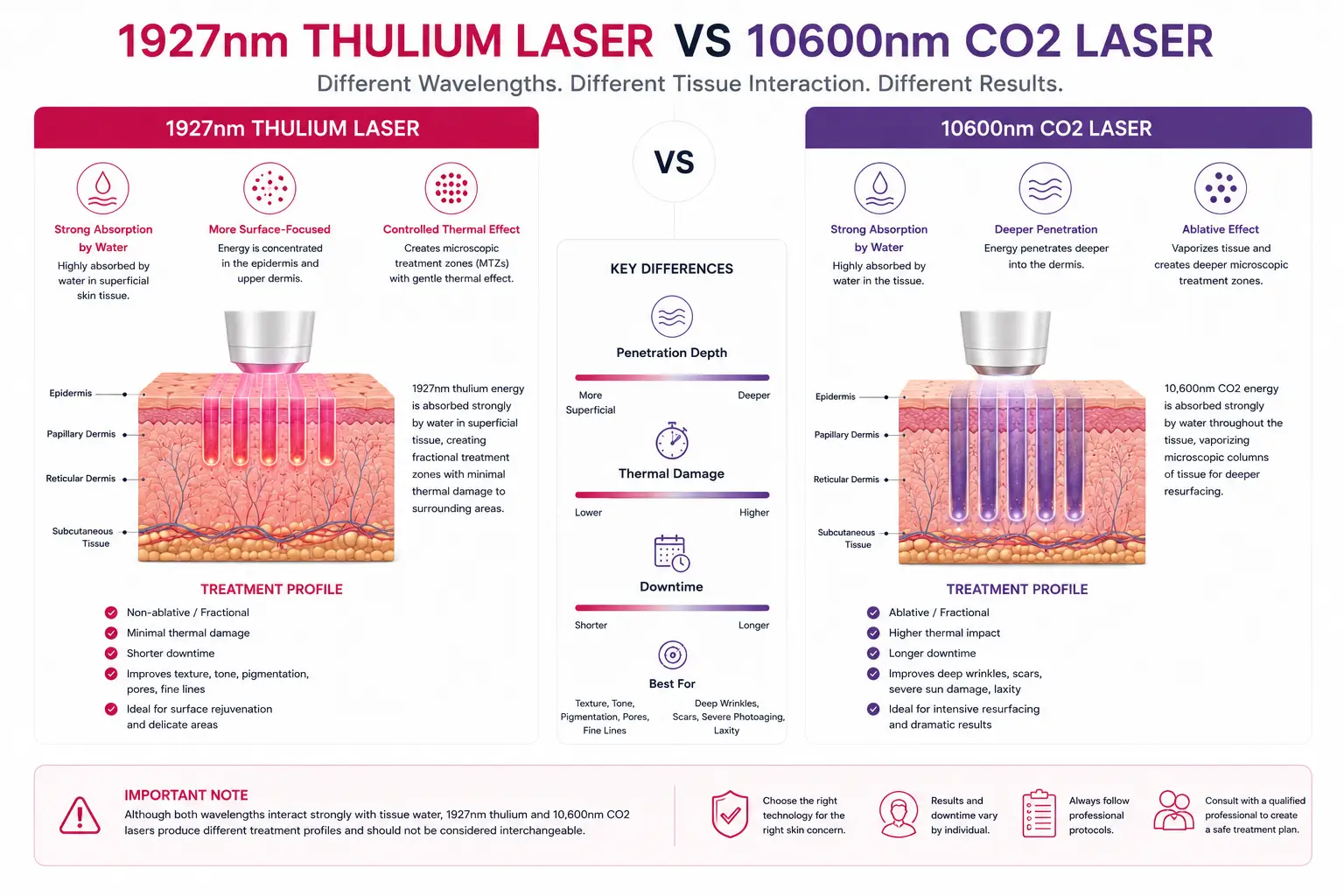
Describing treatment depth requires caution because neither wavelength has one universal clinical depth across every machine and parameter combination.
In general, 1927nm fractional thulium technology is associated with a relatively superficial treatment profile. This makes it particularly relevant when treatment objectives are concentrated closer to the skin surface.
Fractional CO2 systems can create ablative microscopic columns and surrounding thermal effects. Depending on the system and parameters, this allows a substantially different resurfacing strategy.
Actual treatment characteristics can be influenced by:
- Pulse energy
- Energy density
- Pulse duration
- Fractional density
- Spot characteristics
- Scanning pattern
- Number of passes
- Beam profile
- Device architecture
- Treatment area
For this reason, fixed depth claims should be supported by device-specific evidence rather than applied universally to every laser operating at a particular wavelength.
Thulium Laser vs CO2 Laser for Skin Resurfacing
The phrase skin resurfacing can refer to treatments of very different intensity, so the best technology depends on what level of resurfacing is actually required.
When Thulium Laser May Be More Relevant
Fractional 1927nm thulium technology may be more relevant when the treatment objective emphasizes relatively superficial concerns such as:
- Uneven-looking pigmentation
- Photodamage
- Uneven-looking tone
- Superficial skin-quality concerns
- A more conservative fractional treatment strategy
When Fractional CO2 May Be More Relevant
Fractional CO2 technology may be more relevant when the treatment objective requires stronger resurfacing and remodeling, including selected:
- Textural irregularities
- Acne scars
- Other selected scars
- Wrinkles
- More substantial resurfacing objectives
Therefore, the choice should not be framed as “mild laser versus strong laser.” Instead, the practitioner should determine which tissue response best matches the clinical objective.
Thulium Laser vs CO2 Laser for Pigmentation
Pigmentation is one of the areas where 1927nm thulium technology is particularly relevant in aesthetic practice.
Its relatively superficial fractional profile can make it suitable for selected treatment strategies involving superficial pigmentation and visible photodamage.
Fractional CO2 resurfacing can also affect pigmentary irregularities as part of broader skin resurfacing. However, if the main objective is specifically superficial pigment rather than deeper texture or resurfacing, an ablative CO2 procedure may represent a different level of treatment intensity than is required.
The appropriate approach depends on:
- Type of pigmentation
- Estimated pigment depth
- Skin phototype
- History of post-inflammatory hyperpigmentation
- Desired treatment intensity
- Acceptable recovery
- Other simultaneous skin concerns
Pigmentation should be professionally evaluated before treatment because visually similar discoloration can have different causes and may not respond to the same laser strategy.
Thulium Laser vs CO2 Laser for Melasma
Melasma requires greater caution than many other pigment-related treatment concerns.
Fractional 1927nm thulium laser may be considered in selected melasma management strategies because of its relatively superficial treatment profile. However, visible improvement does not mean that the underlying condition has been permanently removed.
Melasma may recur, and treatment-related inflammation can contribute to unwanted pigmentary responses in susceptible patients.
Fractional CO2 treatment introduces a more intensive ablative resurfacing mechanism and should not be considered automatically preferable simply because it can produce stronger tissue effects.
In melasma management:
- More aggressive treatment is not necessarily better
- Recurrence remains possible
- Post-inflammatory hyperpigmentation is an important consideration
- Photoprotection remains important
- Long-term management may be required
- Patient selection and conservative treatment planning can be particularly important
For a dedicated discussion, see our Thulium Laser for Melasma guide.
Thulium Laser vs CO2 Laser for Acne Scars
When the primary concern is true textural acne scarring rather than post-acne discoloration, fractional CO2 technology is generally more directly associated with scar-resurfacing strategies.
Fractional CO2 can create ablative microscopic treatment columns and surrounding thermal effects that may be useful in selected scar-remodeling protocols.
A 1927nm thulium treatment has a different role. Its relatively superficial treatment profile may be more relevant to post-acne pigmentation, uneven-looking tone, or surface skin-quality concerns than to deeper scar structures.
This distinction matters because patients frequently use “acne scars” to describe more than one condition.
| Post-Acne Concern | Technology More Commonly Associated with the Objective |
|---|---|
| Post-inflammatory discoloration | 1927nm may be relevant depending on pigment characteristics |
| Uneven-looking tone after acne | 1927nm may be relevant |
| Atrophic textural scars | Fractional CO2 may be more directly relevant |
| Mixed pigmentation and texture | May require individualized or multimodal treatment planning |
Scar type, depth, skin characteristics, and previous treatment history should be professionally assessed before choosing a resurfacing technology.
Thulium Laser vs CO2 Laser for Wrinkles
Both technologies may appear in skin-rejuvenation strategies, but their roles differ.
Fractional thulium treatment may improve aspects of overall skin appearance where photodamage, uneven-looking tone, and superficial quality are important components of the treatment objective.
Fractional CO2 is more directly associated with resurfacing strategies targeting selected wrinkles and textural aging concerns because of its ablative and thermal remodeling capabilities.
However, wrinkle severity, location, skin laxity, facial anatomy, and other aging characteristics can influence treatment selection. Laser resurfacing is not a universal solution for every type of visible facial aging.
Which Produces More Dramatic Results: Thulium or CO2?
A more intensive fractional CO2 resurfacing treatment can produce more substantial visible changes for selected texture, wrinkle, and scar objectives than a relatively superficial thulium treatment.
But more dramatic does not automatically mean more appropriate.
Treatment success should be measured against the original objective.
For example:
- A patient primarily concerned with superficial pigmentation may not need aggressive ablative resurfacing.
- A patient with significant textural acne scarring may require more remodeling than a superficial fractional treatment is designed to provide.
- A patient with multiple concerns may need staged or multimodal treatment rather than a single wavelength selected for every problem.
This is why before-and-after photographs should always be interpreted together with the indication, device, settings, number of sessions, recovery period, and follow-up interval.
For a deeper discussion of thulium treatment results, read our Thulium Laser Before and After guide.
Thulium Laser vs CO2 Laser: Which Is Better?
Neither technology is universally better. The answer depends on what the clinic is trying to treat.
| If the Main Treatment Goal Is… | Technology More Commonly Associated with That Goal |
|---|---|
| Superficial pigmentation | 1927nm Thulium |
| Photodamage | 1927nm Thulium |
| Uneven-looking superficial tone | 1927nm Thulium |
| More intensive skin resurfacing | Fractional CO2 |
| Selected acne scars | Fractional CO2 |
| Selected wrinkles and deeper texture | Fractional CO2 |
| Mixed pigmentation and texture | Individualized or multimodal treatment may be considered |
Rather than asking which machine is stronger, clinics should ask which treatment mechanism best matches their patient population and intended service portfolio.
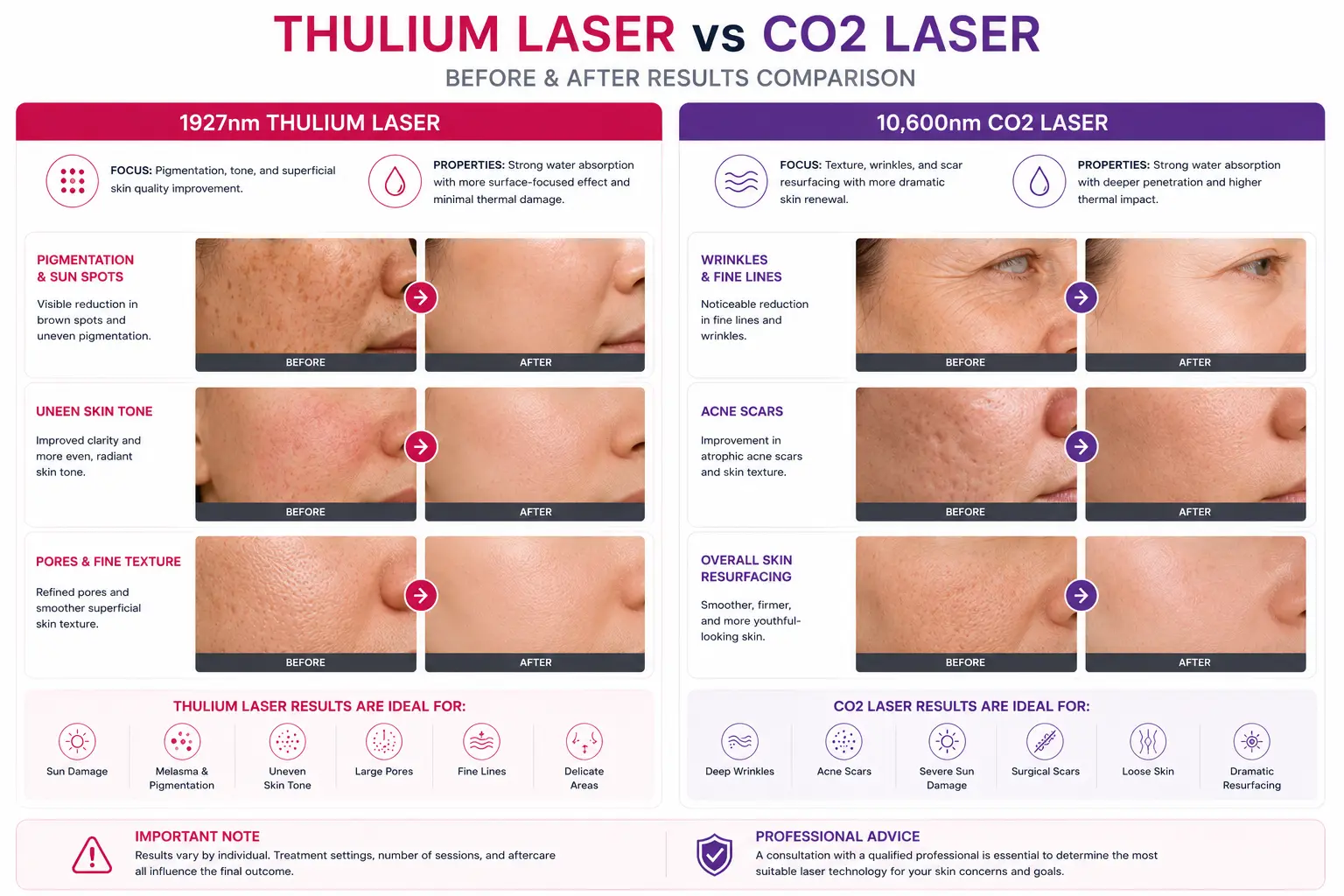
Thulium Laser vs CO2 Laser Before and After
Before-and-after results should be judged according to the treatment objective rather than by how dramatic the photographs appear.
After a 1927nm thulium treatment, visible improvement may be assessed through changes in:
- Superficial pigmentation
- Photodamage
- Uneven-looking tone
- Surface skin quality
- Overall complexion
After fractional CO2 treatment, evaluation may place greater emphasis on:
- Skin texture
- Selected acne scars
- Wrinkles
- Selected traumatic or surgical scars
- More intensive resurfacing outcomes
This means that comparing a thulium result with a CO2 result without considering the original indication can be misleading.
A stronger resurfacing response is not necessarily better if the treatment objective is primarily superficial pigmentation or photodamage.
Thulium Laser vs CO2 Laser Downtime
Downtime is one of the most important practical differences patients and clinics consider when comparing thulium and CO2 laser technology.
In general, fractional 1927nm thulium treatments may be associated with a less intensive recovery profile than more aggressive fractional CO2 resurfacing.
However, treatment intensity matters greatly.
Downtime can be influenced by:
- Energy
- Fractional density
- Pulse duration
- Number of passes
- Treatment coverage
- Device design
- Treatment area
- Skin characteristics
- Individual healing response
Typical Thulium Recovery Experience
Depending on the treatment, temporary effects may include:
- Redness
- Warmth
- Mild swelling
- Dryness
- Rough or sandpaper-like texture
- Temporary darkening of pigmentation
Typical Fractional CO2 Recovery Experience
Fractional CO2 resurfacing can involve a more intensive visible recovery phase, particularly when stronger ablative treatment parameters are used.
Depending on treatment intensity, temporary effects may include:
- Redness
- Swelling
- Warmth or discomfort
- Oozing or crusting in more intensive procedures
- Dryness
- Peeling or surface recovery
- Prolonged erythema in some cases
Exact downtime should never be predicted from wavelength alone.
Thulium Laser vs CO2 Laser Recovery Timeline
| Recovery Stage | 1927nm Thulium | Fractional CO2 |
|---|---|---|
| Immediately After Treatment | Redness, warmth, sensitivity, possible mild swelling | Redness, swelling, heat sensation, possible more visible tissue response |
| Early Recovery | Dryness, roughness, temporary pigment darkening | Surface healing, dryness, peeling or crusting depending on intensity |
| Following Days | Temporary surface effects usually begin settling | Visible recovery may continue, especially after stronger treatments |
| Following Weeks | Pigmentation and tone changes become easier to assess | Texture and resurfacing results become easier to assess |
| Longer Term | Additional sessions may be considered depending on objective | Remodeling and final resurfacing response may continue evolving |
These are general patterns only. Device-specific protocols can produce substantially different recovery experiences.
Which Is More Painful: Thulium Laser or CO2 Laser?
Comfort varies by treatment area, device, treatment intensity, pain tolerance, and anesthesia or cooling strategy.
A relatively conservative thulium procedure may be experienced differently from a more intensive fractional CO2 resurfacing procedure.
In general, ablative fractional CO2 treatments may require more attention to comfort management because of their potential treatment intensity.
Depending on the platform and local requirements, clinics may use strategies such as:
- Topical anesthesia
- Air cooling
- Integrated cooling systems
- Appropriate treatment pacing
- Post-treatment cooling
Comfort protocols should follow device instructions and professional clinical practice.
Thulium Laser vs CO2 Laser Side Effects and Risks
Both technologies can produce expected temporary treatment responses as well as potential adverse effects.
Possible risks may include:
- Prolonged redness
- Swelling
- Skin irritation
- Delayed healing
- Post-inflammatory hyperpigmentation
- Hypopigmentation in some circumstances
- Infection
- Persistent sensitivity
- Unwanted textural or pigmentary changes
- Other device- or patient-specific adverse reactions
Risk is influenced by treatment intensity, patient selection, operator technique, aftercare, skin characteristics, and the specific platform.
More aggressive treatment can increase tissue response, but it may also increase the importance of careful recovery management.
Post-Inflammatory Hyperpigmentation: Thulium vs CO2
Post-inflammatory hyperpigmentation, or PIH, is an important consideration for both thulium and CO2 laser treatment.
PIH can occur when inflammation stimulates increased pigmentation following a procedure.
Factors that may increase concern include:
- Previous history of PIH
- Greater baseline pigmentation
- Recent sun exposure
- Active skin inflammation
- Aggressive treatment settings
- Inadequate photoprotection
- Previous adverse responses to energy-based procedures
A less aggressive technology should not automatically be described as risk-free, and a more intensive technology should not automatically be considered unsuitable.
Patient selection and parameter control remain critical.
Thulium Laser vs CO2 Laser for Different Skin Types
Skin phototype can influence treatment planning, but professional assessment should go beyond skin type alone.
Clinics may need to consider:
- Baseline pigmentation
- History of PIH
- Recent tanning or sun exposure
- Treatment objective
- Previous laser history
- Skin sensitivity
- Expected treatment intensity
- Ability to follow aftercare instructions
Because fractional CO2 treatment can create stronger ablative tissue effects, treatment planning may require particular attention in patients with a higher risk of unwanted pigmentary change.
This does not mean thulium treatment is automatically appropriate for every skin type. Device-specific guidance and professional assessment remain necessary.
How Many Treatments Are Needed: Thulium vs CO2?
There is no universal rule that thulium always requires more sessions or CO2 always requires fewer sessions.
Treatment frequency depends on:
- Treatment objective
- Severity of the concern
- Technology used
- Treatment intensity
- Patient tolerance
- Healing response
- Clinical protocol
A clinic may choose a series of more conservative fractional treatments or fewer higher-intensity procedures depending on the indication and treatment strategy.
More sessions do not automatically mean a technology is less effective. Treatment intensity, downtime, and desired outcome must be evaluated together.
How Long Do Thulium and CO2 Laser Results Last?
Result duration depends on what was treated and what biological or environmental factors continue after treatment.
Long-term appearance can be influenced by:
- Sun exposure
- Natural aging
- Underlying pigmentation tendency
- Hormonal influences
- Skin-care habits
- Smoking and other lifestyle factors
- Maintenance treatment
For pigmentation-related concerns, visible improvement may not prevent future pigment development or recurrence.
For resurfacing objectives, treatment-related remodeling may produce longer-lasting visible changes, but natural aging continues.
Therefore, neither treatment should be marketed as producing universally permanent results.
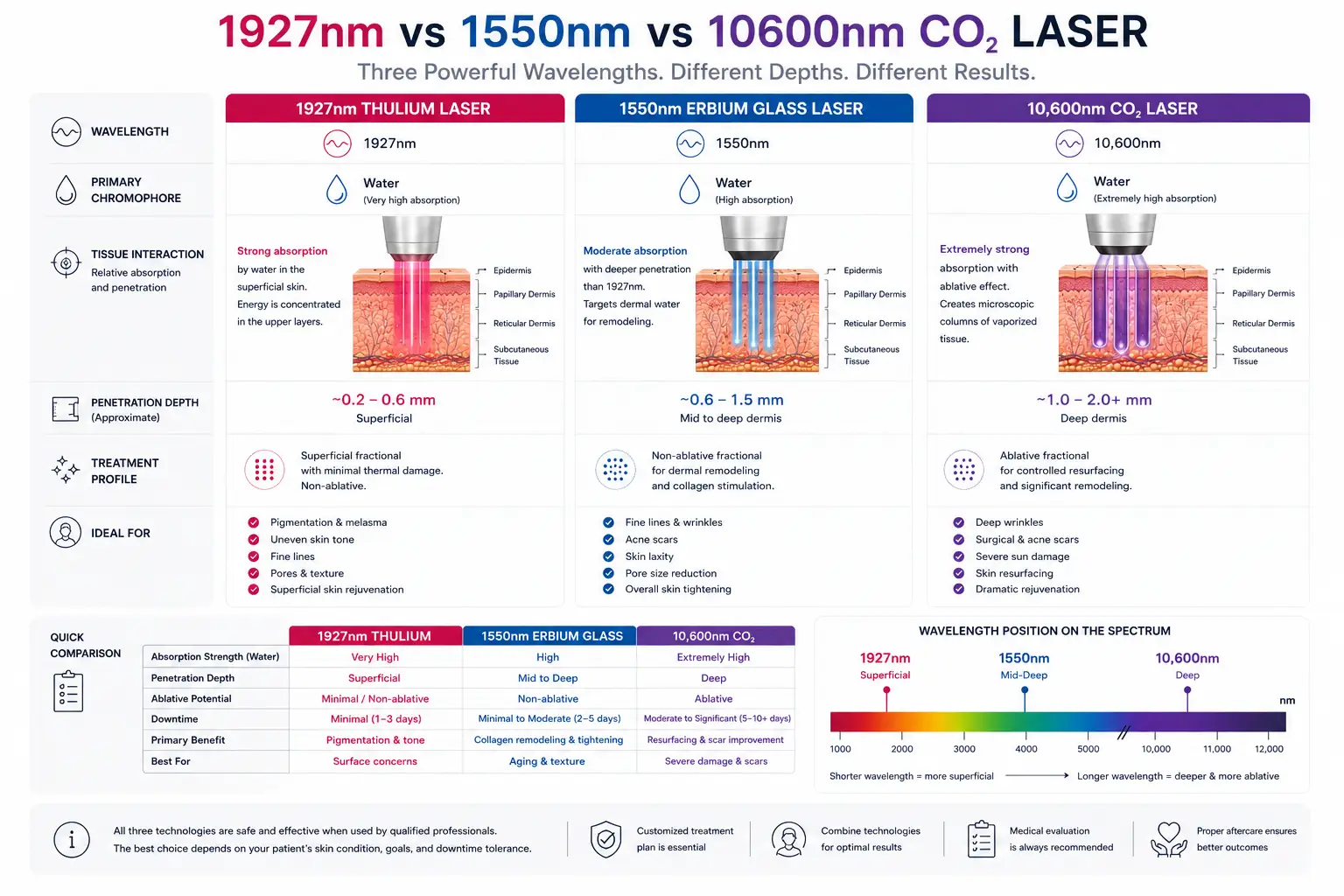
1927nm vs 1550nm vs 10,600nm CO2 Laser
Clinics comparing resurfacing technologies may find it useful to place 1927nm, 1550nm, and 10,600nm CO2 into the same framework.
| Technology | General Treatment Profile | Common Clinical Focus |
|---|---|---|
| 1927nm Thulium | Relatively superficial fractional treatment | Pigmentation, photodamage, uneven tone, superficial skin quality |
| 1550nm Fractional Laser | Deeper non-ablative fractional treatment | Texture, selected scars, fine lines, dermal remodeling |
| 10,600nm Fractional CO2 | Ablative fractional resurfacing | More intensive resurfacing, wrinkles, selected scars, texture |
These technologies should not be viewed as a simple ladder from weak to strong. They offer different tissue interactions and treatment profiles.
For a direct comparison between the first two technologies, see our 1927nm vs 1550nm Laser guide.
Does a Clinic Need Both Thulium and CO2 Laser?
For some clinics, the answer may be yes because the two technologies address different treatment priorities.
A professional clinic may see patients seeking treatment for:
- Superficial pigmentation
- Photodamage
- Uneven skin tone
- Fine lines
- Acne scars
- Other scars
- Texture
- More intensive resurfacing
One technology may not be ideal for every one of these objectives.
A clinic using both a 1927nm thulium system and a fractional CO2 platform may gain greater flexibility to select treatment intensity and depth according to the individual concern.
However, maintaining two platforms also involves:
- Higher equipment investment
- Additional training
- Maintenance requirements
- Different treatment protocols
- Patient-selection responsibilities
- Potentially different regulatory and documentation requirements
Clinics should therefore evaluate expected procedure volume and treatment portfolio before purchasing multiple systems.
Which Laser Should a Clinic Buy First?
For a clinic buying its first fractional resurfacing system, the correct decision should begin with the procedures it intends to perform most frequently.
A Thulium Laser May Be the Better Starting Point If…
- Pigmentation and photodamage are major treatment categories
- The clinic focuses heavily on facial skin quality
- Relatively superficial fractional treatment fits the service model
- Patients frequently prefer lower-intensity treatment strategies
A Fractional CO2 Laser May Be the Better Starting Point If…
- Acne scars are a major treatment category
- The clinic performs intensive skin resurfacing
- Wrinkles and deeper texture are major treatment objectives
- The clinic already has workflows for ablative treatment and recovery management
A Clinic May Eventually Need Both If…
- The patient population includes both pigmentation and scar concerns
- The clinic wants multiple treatment-intensity options
- The practice intends to build a broader laser-resurfacing portfolio
- Procedure volume justifies investment in complementary technologies
What Should Clinics Compare When Buying a Thulium or CO2 Laser?
Wavelength is only one part of a professional equipment purchase.
Clinics and distributors should also compare:
- Laser source technology
- Energy range and stability
- Fractional density control
- Pulse-width options
- Scanning system
- Spot or treatment-area options
- Handpieces and applicators
- Treatment modes
- User interface
- Cooling or comfort support where applicable
- Treatment speed
- Consumables
- Maintenance requirements
- Training
- Clinical protocol support
- Technical service
- Warranty
- Device documentation
- Applicable regulatory status
- OEM or distributor support where required
For CO2 systems in particular, clinics may also need to evaluate available treatment modes, scanning flexibility, RF-excited versus other laser-source designs, and the range of professional applicators.
Fractional CO2 Laser Equipment for Professional Clinics
Clinics whose treatment portfolio requires ablative fractional resurfacing may consider a professional CO2 laser platform designed for applications such as skin resurfacing, selected scars, wrinkles, and textural treatment.
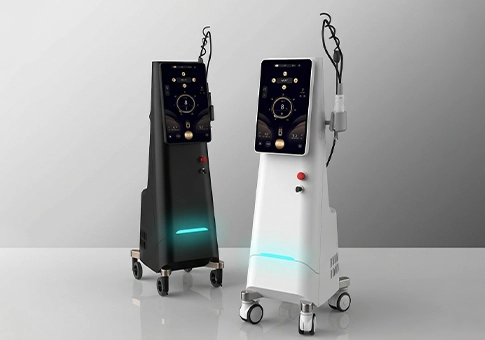
The CO2 Star Fractional CO2 Laser Machine is designed as a professional 10,600nm fractional CO2 platform with multiple treatment modes and applicators for clinical aesthetic use.
Equipment purchasers should review device specifications, intended applications, training, service requirements, and local regulatory requirements before making a purchasing decision.
Frequently Asked Questions About Thulium Laser vs CO2 Laser
Is thulium laser better than CO2 laser?
Not universally. Thulium laser is generally more relevant to relatively superficial pigmentation, photodamage, and skin-quality objectives, while fractional CO2 is more commonly used for intensive resurfacing, selected scars, wrinkles, and deeper textural concerns.
Which is better for pigmentation, thulium or CO2 laser?
For selected superficial pigmentation and photodamage, 1927nm thulium technology is often more directly aligned with the treatment objective. CO2 may affect pigmentation as part of broader resurfacing but represents a different level of tissue treatment.
Which is better for acne scars?
For selected true textural acne scars, fractional CO2 laser is generally more directly associated with scar-resurfacing strategies. If the post-acne concern is primarily pigmentation rather than texture, 1927nm thulium may be more relevant in selected cases.
Which laser has more downtime?
More intensive fractional CO2 procedures can involve greater visible downtime than relatively conservative thulium treatments. However, downtime depends heavily on device parameters and individual response.
Is thulium laser ablative?
“Thulium laser” describes a broader family of devices, and treatment architecture varies. Many aesthetic 1927nm systems are used for fractional strategies with a relatively superficial treatment profile. The exact tissue effect should be described according to the specific device and parameters rather than wavelength alone.
Is fractional CO2 laser ablative?
Yes. Fractional CO2 laser technology can create microscopic ablative treatment zones surrounded by thermal effects while leaving intervening tissue between treatment areas.
Can thulium and CO2 lasers be used in the same clinic?
Yes. Because the technologies serve different treatment objectives, some clinics may use both to broaden their resurfacing and pigmentation treatment options. Each device still requires appropriate training, patient selection, and protocol management.
Is CO2 laser stronger than thulium laser?
“Stronger” is not the most useful comparison. Fractional CO2 can create more intensive ablative resurfacing effects, while 1927nm thulium is generally more surface-focused. The better technology depends on the treatment objective.
What is the wavelength of a CO2 laser?
Professional aesthetic CO2 lasers commonly operate at approximately 10,600nm.
What is the wavelength of an aesthetic thulium laser?
Approximately 1927nm is one of the most commonly discussed wavelengths in aesthetic fractional thulium laser treatment, although the broader thulium laser family is not limited to one wavelength.
Final Verdict: Thulium Laser or CO2 Laser?
Thulium laser and fractional CO2 laser should not be viewed as competing versions of the same treatment. They provide different tissue interactions and occupy different positions within professional skin treatment.
Approximately 1927nm thulium laser is generally associated with relatively superficial fractional treatment and may be particularly relevant to selected superficial pigmentation, photodamage, uneven-looking tone, and skin-quality concerns.
Approximately 10,600nm fractional CO2 laser provides ablative resurfacing capability and is more commonly associated with treatment strategies involving selected acne scars, wrinkles, texture, and more intensive skin resurfacing.
For patients and clinics, the right choice depends on the primary concern, desired treatment intensity, acceptable recovery, skin characteristics, and the capabilities of the specific device.
For equipment purchasers, wavelength alone is not enough. Fractional delivery, pulse control, energy stability, scanning architecture, applicators, workflow, training, technical support, documentation, and regulatory status all contribute to the practical value of a professional laser platform.
Clinics treating a broad mix of pigmentation, photodamage, scars, texture, and wrinkles may ultimately benefit from access to both thulium and fractional CO2 technologies, provided that procedure volume, training, and clinical requirements support the investment.
Editorial & Technical Review: This article was prepared for the Cocoon Laser professional aesthetic technology knowledge center for educational and equipment-research purposes. It does not replace individual medical assessment. Treatment suitability, contraindications, parameters, expected outcomes, recovery, and adverse-event risks vary by patient and device. Qualified professionals should follow the intended use, instructions, training requirements, and applicable regulations for the specific laser system.