The Secret to Safe Treatments: Non-invasive Skin Treatment Laser Machine Technologies
Executive Summary
The foundation of safe, non-invasive aesthetic treatments relies on a rigorous intersection of human physiology and advanced photonics. True safety is not an accident; it is engineered through technologies governed by Selective Photothermolysis, precise Thermal Relaxation Time (TRT) management, and accurate clinical assessment using the Fitzpatrick Scale. For patients, navigating the landscape of non-invasive laser machines requires understanding critical hardware components, such as TEC Cooling systems, and regulatory benchmarks like FDA 510(k) or Medical CE certifications. Whether treating pigmentation or undergoing collagen remodeling procedures, recognizing the underlying mechanics—from the photoacoustic effect in advanced picosecond modalities to the continuous energy calibration of shots count—empowers consumers to make informed, medically sound decisions and demand clinical excellence from their practitioners.
Demystifying Non-Invasive Lasers: Why “No Downtime” Doesn’t Mean “No Technology”
The aesthetic industry frequently promotes the concept of “zero downtime,” leading to a misconception that non-invasive procedures lack clinical depth. In reality, bypassing the destruction of the skin’s surface requires significantly more sophisticated engineering than simply burning tissue away.
The Core Mechanism: Selective Photothermolysis Explained
At the heart of all safe laser dermatology is the principle of Selective Photothermolysis. Formulated in the 1980s, this principle dictates that a specific wavelength of light can precisely target a specific biological chromophore (such as melanin in pigmentation, or hemoglobin in vascular lesions) without causing thermal damage to the surrounding healthy tissue.
For this to work safely, three parameters must perfectly align:
- Wavelength: Must be highly absorbed by the target and minimally absorbed by surrounding tissue.
- Energy (Fluence): Must be sufficient to alter the target structure.
- Pulse Duration: Must be shorter than the target’s Thermal Relaxation Time (the time it takes for the target to cool down by 50%).
When these parameters are optimized by clinical-grade non-invasive laser machines, the laser energy passes harmlessly through the transmissive layers of the skin, only converting to heat when it strikes the intended microscopic target.
Ablative vs. Non-Ablative: Protecting Your Epidermal Barrier
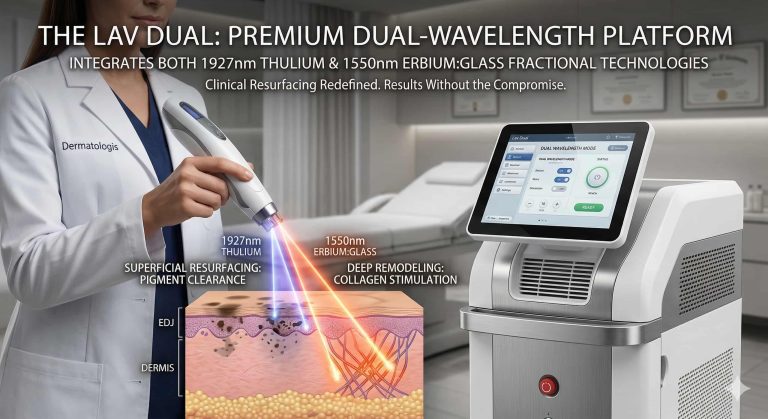
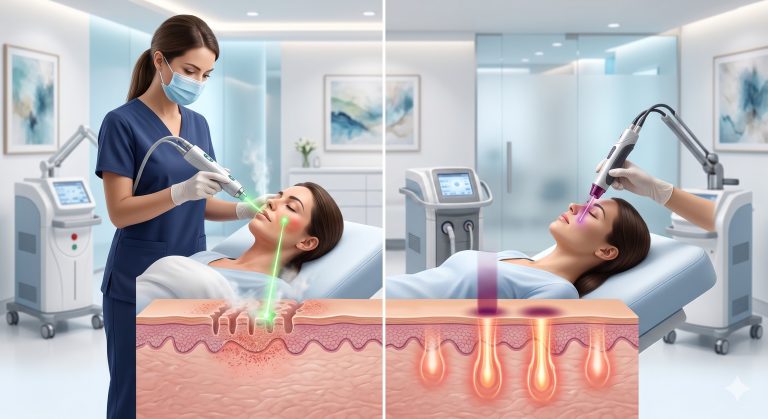
To fully grasp the safety profile of non-invasive lasers, it is critical to compare them objectively against traditional ablative technologies. Non-ablative lasers (such as specific fractional Erbium:Glass or Thulium applications) are engineered specifically to preserve the stratum corneum—the outermost layer of the epidermis.
| Parameter | Ablative Lasers (e.g., Traditional CO2) | Non-Ablative Lasers (e.g., 1565nm, 1927nm) |
| Epidermal Barrier | Vaporized / Destroyed | Completely Intact |
| Mechanism of Action | Widespread bulk tissue vaporization | Sub-surface micro-coagulation zones |
| Clinical Downtime | 1 to 3 weeks (wound healing required) | Minimal to none (transient erythema only) |
| Infection Risk | High (requires strict sterile aftercare) | Extremely Low (barrier remains sealed) |
| Primary Clinical Goal | Severe rhytids, deep scar revision | Gradual collagen stimulation, tone correction |
By keeping the epidermal barrier intact, non-ablative lasers eliminate the primary vectors for bacterial infection and dramatically reduce the risk of Post-Inflammatory Hyperpigmentation (PIH), making them a remarkably safe option for modern aesthetic interventions.
The Hidden Safety Features in Premium Aesthetic Laser Machines
A laser’s wavelength is only one part of the clinical equation. As a reputable aesthetic laser supplier will attest, the hardware encasing the laser diode or flashlamp is what separates a potentially dangerous device from a medically safe one.
Advanced Epidermal Cooling Systems
The primary limiting factor in delivering effective laser energy is epidermal heating. If the surface of the skin gets too hot, thermal injury (burns) will occur regardless of the wavelength used. Premium devices utilize advanced epidermal cooling systems to actively extract heat from the skin before, during, and after the laser pulse.
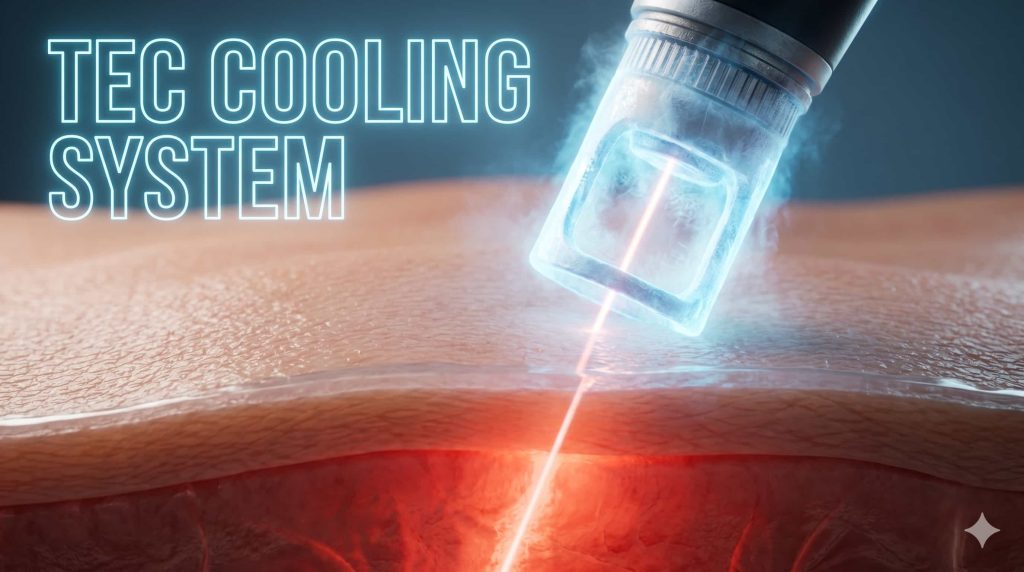
- TEC Cooling (Thermoelectric Cooling): Advanced contact cooling utilizes Sapphire or Barium crystal tips integrated with Peltier TEC modules. These systems maintain a constant, low temperature (often around 0°C to 4°C) at the skin surface, absorbing excess thermal energy and numbing the area simultaneously.
- Cryogen Spray Cooling (CSC): This technology delivers a precisely timed micro-burst of cryogen to the skin milliseconds before the laser fires, instantly dropping the epidermal temperature while leaving the deeper dermal targets unaffected.
A clinic’s ability to offer a safe, pain-managed experience relies entirely on the continuous, stable operation of these cooling mechanisms.
Precision Pulse Durations: Nanosecond vs. Picosecond
The duration of the laser pulse is a critical safety metric. Historically, Q-switched lasers operated in the nanosecond range (one billionth of a second). While effective, they relied heavily on a photothermal (heat) effect to break up pigment, which carried a risk of heat dissipating into surrounding tissue.
The advent of the picosecond laser (operating in trillionths of a second) shifted the paradigm. By delivering energy so rapidly, the mechanism transitions from photothermal to a predominantly photoacoustic effect. The target chromophore absorbs the energy so fast that it shatters into microscopic particles through mechanical acoustic waves, rather than boiling via thermal expansion. This drastically reduces bulk heating in the dermis, yielding a significantly higher safety margin, especially for complex pigmentary conditions.
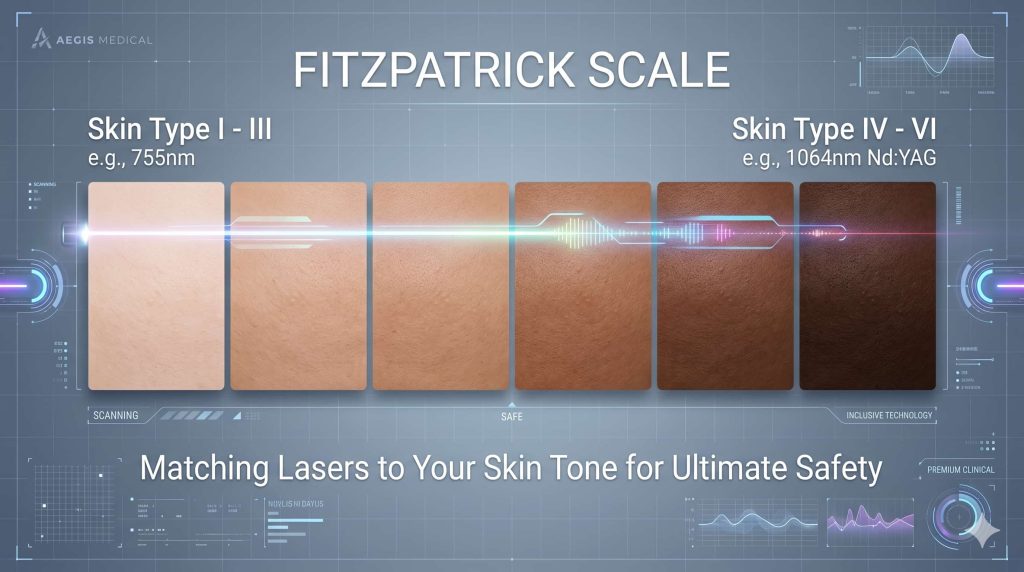
The Fitzpatrick Scale: Matching Laser Wavelengths to Your Clinical Skin Type
The most critical factor in mitigating risk during any light-based therapy is the accurate assessment of the patient’s skin type. A one-size-fits-all approach in medical aesthetics is a fundamental clinical error.
Why Your Skin Tone Dictates Your Laser Options
The Fitzpatrick Scale is a standardized numerical classification schema for human skin color, ranging from Type I (pale white, always burns, never tans) to Type VI (deeply pigmented dark brown to darkest brown, never burns).
The primary chromophore targeted in many laser procedures—and the primary obstacle in others—is melanin. Because Type IV through VI skin contains a high density of epidermal melanin, utilizing highly melanin-absorbed wavelengths (like 755nm Alexandrite) on dark skin is inherently dangerous. The surface melanin will absorb the laser energy before it can reach the deeper target, resulting in severe epidermal burns, blistering, and paradoxical hyperpigmentation.
Safe Technologies for Darker Skin Tones (Type IV-VI)
To safely treat darker skin types, whether for vascular lesions, rejuvenation, or standard procedures like diode laser hair removal, the clinician must utilize a wavelength that bypasses the dense epidermal melanin.
The Nd:YAG laser (1064nm wavelength) stands as the gold standard for treating Fitzpatrick Types IV-VI. The physics behind this are straightforward: the 1064nm wavelength has a significantly lower absorption coefficient for melanin compared to shorter wavelengths, yet it boasts exceptional optical penetration depth. This allows the laser energy to bypass the epidermal pigment safely and target deeper dermal structures, such as hair follicles or deep vascular networks, ensuring efficacy without compromising the epidermal barrier.
Real Results vs. Marketing Myths: Setting Healthy Expectations
To fully benefit from clinical-grade aesthetic technology, patients must calibrate their expectations based on biological reality rather than marketing hyperbole.
The Timeline of Collagen Remodeling
Many non-invasive laser treatments aim to stimulate fibroblasts to produce new collagen and elastin (neocollagenesis). While patients often desire an immediate “lifting” effect, true structural remodeling is governed by cellular biology.
- Immediate Phase (Days 1-3): Tissue experiences controlled micro-injury. Immediate, transient tissue contraction may occur due to collagen fiber denaturation, but this is not the final result.
- Proliferative Phase (Days 3-28): Fibroblasts migrate to the treated zones and begin synthesizing new extracellular matrix components.
- Remodeling Phase (Months 1-3+): The new collagen fibers organize and cross-link, providing long-term structural integrity and improved skin texture.
A medically accurate expectation is that the true, finalized results of non-invasive skin treatment laser machine technologies will manifest fully between 28 to 90 days post-treatment.
Recognizing Normal Post-Treatment Responses
Understanding the difference between a normal biological response to laser therapy and an adverse event is vital for patient safety and peace of mind.
- Normal Responses: Transient erythema (redness lasting a few hours to a day), mild edema (swelling, particularly around follicles or targeted vessels), and a sensation akin to a mild sunburn. These indicate the desired clinical endpoint has been reached.
- Adverse Responses: Sustained blistering, intense unmanageable pain, immediate severe crusting, or paradoxical darkening outside of targeted pigmented lesions. These are indicators of incorrect parameter settings or poor machine calibration, necessitating immediate medical follow-up.
Checklist: What to Ask Your Practitioner Before a Laser Session
The ultimate responsibility for safe treatment lies with the clinical provider, but an educated patient acts as the final safeguard. Before consenting to any laser procedure, utilize this objective checklist to evaluate the clinic’s standards.
Inquiring About FDA Compliance and Machine Certifications
Do not assume all machines in a clinic are created equal. The global market is flooded with unregulated, underpowered, or unstable replica devices.
- Ask for Certification: Request confirmation that the device holds an FDA 510(k) clearance (for the US market) or a Medical CE mark (for the European market) for the specific indication being treated.
- Inquire About Maintenance: Laser cavities and flashlamps degrade over time. A professional clinic tracks the shots count of their handpieces and follows strict preventative maintenance schedules to ensure the machine outputs exactly the energy displayed on the screen. An uncalibrated machine can silently deliver drastic power spikes, leading to unforeseen thermal injury.
Verifying the Clinic’s Skin Typing Protocols
A safe consultation must be analytical, not purely transactional.
- Demand a Fitzpatrick Assessment: If the practitioner does not formally assess and document your clinical skin type using the Fitzpatrick Scale before discussing treatment options, decline the treatment.
- Confirm the Wavelength: Ask the practitioner to explain why they chose a specific wavelength for your skin type. If you possess Fitzpatrick Type V skin and they suggest a 755nm wavelength without a robust clinical justification and test spotting, this represents a significant safety red flag.
By demanding transparency regarding the hardware, understanding the physiological timelines, and ensuring adherence to clinical protocols, you transform from a passive consumer into an empowered patient, ensuring that your pursuit of aesthetic enhancement remains grounded in uncompromising safety.
If you need more information, please click “Contact Us”.
If you want to obtain more information, please follow our official website and Facebook.