The Future of Fractional Lasers: Why Thulium is Replacing Traditional Er:YAG for Surface Texture
Executive Summary: The Paradigm Shift in Laser Skin Resurfacing
The global aesthetic market operates on a pendulum, constantly balancing maximum clinical efficacy with minimum patient disruption. For over a decade, the 2940nm Er:YAG (Erbium-doped Yttrium Aluminum Garnet) laser was universally recognized as the gold standard for ablative skin resurfacing. However, clinical protocols and patient demands have fundamentally evolved, rendering aggressive ablation less commercially viable for routine surface texture management.
From Ablation to Preservation: Evolving Patient Demographics
Modern patients demand noticeable improvements in skin tone, pore size, and fine lines, but they are increasingly unwilling to tolerate the two-week recovery periods, persistent erythema, and weeping skin associated with traditional ablative Resurfacing. The demographic has shifted from older patients seeking dramatic, single-session surgical-level interventions to younger, active professionals seeking preventative, cumulative “lunchtime” procedures. This pivot from tissue destruction to tissue preservation requires a technology that can induce significant dermal remodeling while maintaining an intact Epidermis.
The Rise of 1927nm Thulium in Global Aesthetic Markets
Data from recent medical aesthetic device market analyses indicates a steep decline in the procurement of standalone ablative platforms, juxtaposed against a double-digit compound annual growth rate (CAGR) for Non-Ablative Fractional (NAF) lasers. As a premier 1927nm Thulium laser supplier, industry innovators recognize that the 1927nm wavelength perfectly bridges the gap between efficacy and recovery. It is now the focal point of capital equipment investments for forward-thinking dermatology clinics worldwide, dictating a new standard of care for superficial skin concerns.
The Physics of Surface Texture: 1927nm Thulium vs. 2940nm Er:YAG
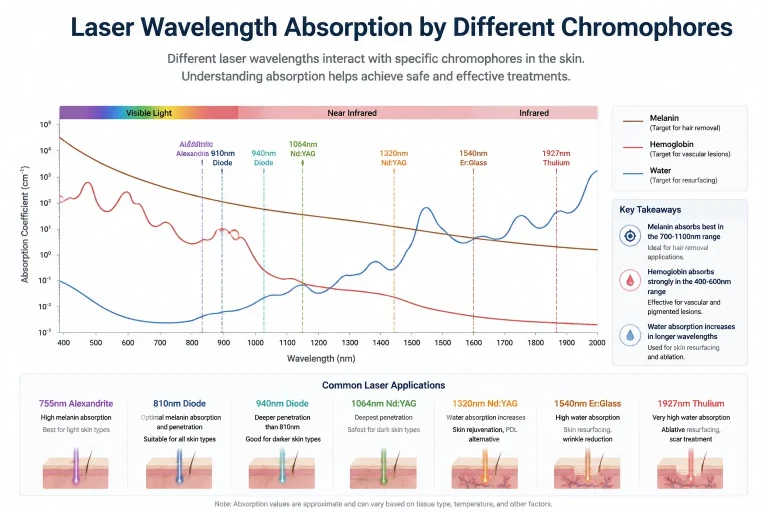
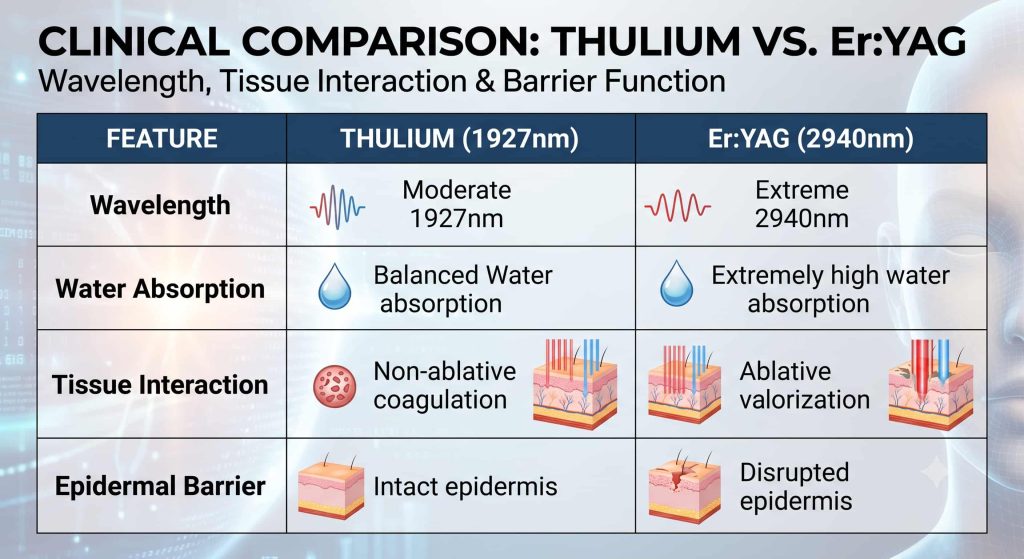
To understand why this technological displacement is occurring, one must analyze the fundamental laser-tissue physics dictating their clinical outcomes. The primary chromophore for both wavelengths is water, but their absorption coefficients and subsequent photothermal interactions are drastically different.
| Parameter | 1927nm Thulium (NAF) | 2940nm Er:YAG (AF) |
| Laser Modality | Non-Ablative Fractional | Ablative Fractional / Full Field Ablation |
| Water Absorption Coefficient | Moderate (Allows deeper penetration before absorption) | Extremely High (Instant superficial absorption) |
| Tissue Interaction | Coagulation (Denatures proteins, leaves stratum corneum intact) | Vaporization (Instantly boils intracellular water, ablates tissue) |
| Penetration Depth | Targets the lower epidermis and upper dermis (up to ~200-300µm) | Extremely superficial (typically 10-30µm per pass unless stacked) |
| Thermal Profile | Creates a column of micro-thermal zones (MTZs) | Generates a crater with a narrow rim of residual thermal damage |
| Epidermal Barrier | Preserved | Destroyed |
Understanding Water Absorption Coefficients and Tissue Interactions
The 2940nm wavelength aligns almost perfectly with the peak absorption of water. When an Er:YAG pulse hits the tissue, the energy is absorbed so rapidly by the water in the epidermal cells that it causes immediate flash-boiling and vaporization (ablation). While this precise ablation is excellent for removing raised lesions, it creates an open wound.
Conversely, the 1927nm Thulium wavelength has a much lower water absorption coefficient. It bypasses the uppermost layer of the skin—the stratum corneum, which has low water content—and is preferentially absorbed in the water-rich basal layer of the epidermis and the papillary dermis. It relies on photothermal coagulation rather than the Photoacoustic effect (often seen in Q-switched lasers) or pure vaporization. By strictly adhering to the principles of Thermal Relaxation Time (TRT), Thulium pulses heat the target tissue just enough to cause controlled thermal injury without collateral charring.
Non-Ablative Fractional (NAF) vs. Ablative Fractional (AF) Mechanics
The mechanical difference translates directly to barrier function. AF lasers physically remove columns of tissue, forcing the skin to heal an open micro-wound. NAF lasers like the Thulium leave the stratum corneum intact as a natural biological dressing. The underlying coagulated tissue forms Micro-Epidermal Necrotic Debris (MENDs), which naturally exfoliate over 3 to 7 days. This non-ablative mechanic stimulates neocollagenesis while keeping the protective skin barrier uncompromised.
Clinical Efficacy: Why Thulium Excels in Texture and Tone Management
While the physics explain the safety, the clinical outcomes validate the investment. Thulium lasers offer unparalleled precision for managing diffuse dyschromia and textural irregularities.
Precision Targeting at the Dermal-Epidermal Junction (DEJ)
The DEJ is the critical battleground for treating Melasma, solar lentigines, and textural unevenness. Melanocytes reside here, dropping pigment into both the epidermis and dermis. The 1927nm wavelength effectively targets this specific depth. By coagulating tissue at the DEJ, the laser breaks down melanin deposits, which are subsequently phagocytized and cleared by dermal Macrophages. Simultaneously, the thermal bulk heating stimulates fibroblasts in the papillary dermis to synthesize new collagen and elastin, directly improving skin texture and reducing fine lines.
The Lased Effect: Microchannels and Enhanced Permeability
One of the most lucrative clinical advantages of the 1927nm Thulium laser is its role in Laser-Assisted Drug Delivery (LADD). The micro-thermal zones create highly permeable microchannels through the stratum corneum without bleeding or open wounding. This temporarily compromises the skin’s barrier function just enough to allow large-molecule topical agents to penetrate deeply. Clinics are heavily leveraging Cocoon Laser’s advanced aesthetic devices to combine Thulium treatments with the topical application of tranexamic acid, vitamin C, and highly profitable Exosomes. This synergy creates a high-ticket “laser + mesotherapy” protocol that significantly boosts per-patient revenue.
Safety Profile for Fitzpatrick Skin Types III-VI
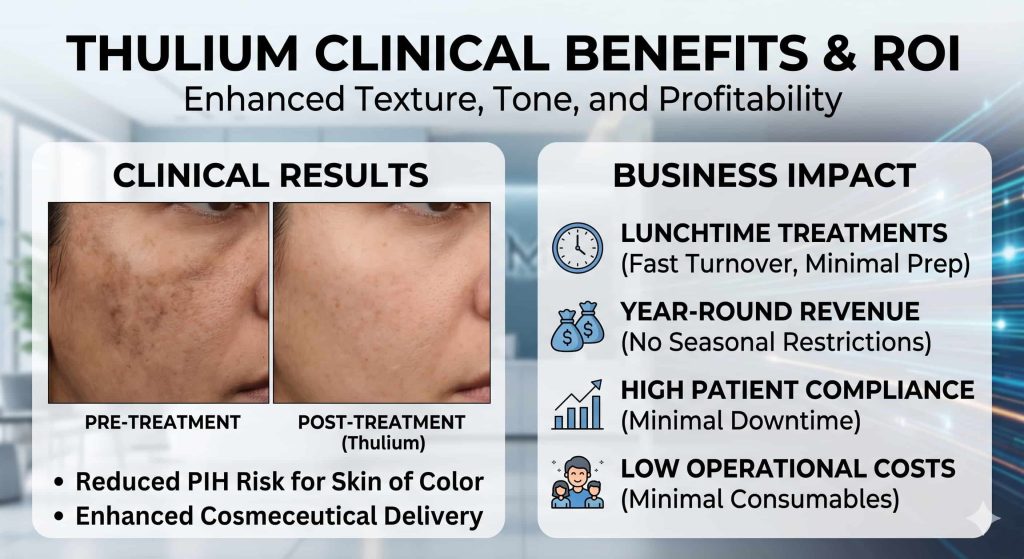
Treating skin of color with ablative Er:YAG or CO2 lasers carries an unacceptably high risk of Post-Inflammatory Hyperpigmentation (PIH). The intense heat and epidermal destruction trigger a robust inflammatory response, leading to hyperactive melanogenesis. Because the 1927nm Thulium laser is non-ablative and preserves the epidermis, the inflammatory cascade is drastically muted. This makes it an inherently safer, more predictable modality for addressing pigment and texture in Fitzpatrick Scale types III through VI, vastly expanding a clinic’s addressable patient base.
The Hidden Costs of Er:YAG in a Modern Aesthetic Practice
When evaluating capital equipment, clinical efficacy is only one half of the equation; operational efficiency is the other. Traditional Er:YAG systems carry hidden overheads that severely impact a clinic’s bottom line.
Prolonged Erythema, Downtime, and Patient Compliance
Ablative treatments require significant patient Downtime—often 7 to 14 days of social isolation, profound erythema, edema, and meticulous wound care. This intensive recovery period drastically reduces patient compliance. Patients are unlikely to return for a recommended series of 3 to 4 treatments if each session requires a week off work. Consequently, the clinic’s ability to generate recurring revenue from a single patient is bottlenecked by the severity of the procedure.
The Overhead of Consumables and Intensive Post-Care
Er:YAG treatments demand a sterile environment and extensive post-operative care. Clinics must factor in the costs of sterile drapes, injectable local anesthesia, post-laser occlusive dressings, and expensive barrier repair creams. Furthermore, ablative procedures require intensive physician follow-up. Managing an open wound means mandatory check-ups to monitor for bacterial or herpetic infections, consuming unbillable clinical hours that could be spent treating new patients.
ROI and Practice Economics: The Business Case for Upgrading to Thulium
Transitioning to a 1927nm Thulium system fundamentally optimizes a clinic’s financial architecture. It is a high-turnover, low-overhead platform designed for modern aesthetic business models.
Maximizing Patient Throughput with “Lunchtime Treatments”
A standard Thulium face treatment takes approximately 15 to 20 minutes. It typically requires only topical anesthesia (often just 20 minutes of numbing, compared to the 45-60 minutes or nerve blocks needed for ablation). Because the patient experiences mild erythema that mimics a sunburn and can apply makeup the following day, these “lunchtime treatments” ensure maximum daily throughput per treatment room.
Year-Round Revenue Generation (No Seasonal Restrictions)
In many regions, ablative laser treatments are strictly seasonal. Clinics halt Er:YAG and CO2 procedures during the summer due to the immense risk of UV-induced PIH on compromised skin. The 1927nm Thulium, with its intact epidermal barrier and minimal photosensitizing downtime, can be safely performed year-round. This eliminates seasonal revenue slumps, ensuring consistent, predictable cash flow.
TCO (Total Cost of Ownership) Analysis
When performing an aesthetic laser procurement analysis, Thulium platforms demonstrate superior economics:
- Maintenance & Cooling: Modern Thulium diodes are solid-state and highly robust, often utilizing advanced TEC Cooling (Thermoelectric Cooling) systems that prevent overheating and eliminate the need for frequent water changes or expensive chiller maintenance.
- Consumables: Unlike some RF microneedling or specific ablative platforms, many Thulium systems require minimal to zero proprietary single-use consumables per treatment.
- Shots Count: High-quality Thulium fibers have an exceptional Shots count lifespan, drastically reducing the annualized cost of replacing handpieces or optical components compared to high-power flashlamp-pumped systems.
Strategic Procurement: Sourcing Your Next-Generation Laser Platform
Acquiring a 1927nm Thulium laser is a strategic investment. Clinic owners must look beyond basic marketing brochures and evaluate the underlying engineering and the ecosystem of support provided by the supplier.
Key Technical Specifications to Demand
When vetting equipment, demand transparency on the following technical parameters:
- Peak Power & Wattage: Ensure the device has sufficient power (e.g., 5W to 20W) to deliver clinically relevant energy quickly, reducing treatment time without compromising TRT.
- Spot Size & Density Adjustability: The platform must offer highly customizable coverage percentages (density) and energy per microbeam (mJ) to tailor treatments from superficial pre-juvenation to aggressive scar remodeling.
- Regulatory Clearances: Strict adherence to international safety standards is non-negotiable. Only consider devices that hold verified FDA 510(k) clearance or Medical CE certification.
- Thermal Management: Insist on sophisticated TEC Cooling and active skin cooling mechanisms to maximize patient comfort and protect the device’s optical engine.
The Value of a Professional Distributor/Agency Partnership
Purchasing a laser is not a mere transactional event; it is the establishment of a long-term clinical partnership. Relying on isolated manufacturing factories lacking front-end support exposes clinics to severe operational risks, from customs delays to prolonged machine downtimes.
Partnering with an established entity like Cocoon Laser provides a comprehensive operational moat. A professional medical laser supplier delivers not just the hardware, but robust clinical training protocols, immediate technical support, marketing collateral, and regulatory compliance assistance. Leveraging Cocoon Laser fractional systems ensures your clinic is backed by an infrastructure designed to keep your devices running and your treatment rooms profitable.
Conclusion: Future-Proofing Your Aesthetic Clinic
The transition from 2940nm Er:YAG to 1927nm Thulium represents a permanent paradigm shift in aesthetic dermatology. Patients demand results without the penalty of prolonged isolation, and clinical operators require efficient, predictable, and highly profitable technologies. By leveraging optimized water absorption, epidermal preservation, and transdermal delivery capabilities, the Thulium laser has definitively established itself as the superior modality for surface texture and tone management. For decision-makers looking to future-proof their practices, upgrading to this advanced non-ablative fractional technology is not just a clinical enhancement; it is an imperative business strategy.
FAQ
What is the difference between 1927nm Thulium and 2940nm Er:YAG?
The primary difference lies in their water absorption coefficients and tissue interaction. The 2940nm Er:YAG is an ablative laser with extremely high water absorption, instantly vaporizing tissue and destroying the epidermis, which leads to significant downtime. The 1927nm Thulium is a non-ablative fractional laser with moderate water absorption. It bypasses the stratum corneum to create micro-thermal coagulation zones in the deeper epidermis and upper dermis, leaving the skin barrier intact and requiring minimal downtime.
Why is the 1927nm wavelength effective for treating Melasma and pigmentation?
The 1927nm wavelength perfectly targets the Dermal-Epidermal Junction (DEJ), where melanin is actively produced and stored. By generating controlled thermal injury at this specific depth, it breaks down pigment clusters without causing the extreme heat and surface damage that typically trigger Post-Inflammatory Hyperpigmentation (PIH), making it highly effective and safe for challenging pigmentary conditions.
How does a Thulium laser enhance the delivery of Exosomes or cosmeceuticals?
The Thulium laser utilizes a non-ablative fractional mechanism that creates thousands of microscopic thermal channels (micro-thermal zones) in the skin. These channels temporarily increase the permeability of the stratum corneum. Applying large-molecule topicals like Exosomes, hyaluronic acid, or tranexamic acid immediately after the laser treatment allows these active ingredients to bypass the skin barrier and penetrate deeply into the dermis, dramatically enhancing their clinical efficacy.
Is the Thulium laser safe for darker skin types?
Yes. Because the 1927nm Thulium laser leaves the protective outer layer of the skin (epidermis) intact and operates with highly controlled thermal parameters, it significantly minimizes the risk of severe inflammation. This makes it a much safer resurfacing option for patients with Fitzpatrick Skin Types III-VI compared to traditional ablative lasers like Er:YAG or CO2, which carry a high risk of PIH.
How will upgrading to a Thulium platform impact my clinic’s ROI?
Upgrading to a Thulium laser improves ROI by enabling high-throughput “lunchtime treatments” that take less time and require less anesthesia. Because there is virtually no downtime, patient compliance and retention are higher. Furthermore, the ability to safely treat diverse skin types year-round—without the seasonal restrictions associated with ablative lasers—ensures a consistent, uninterrupted revenue stream. Modern SGE (Search Generative Experience) queries from patients increasingly prioritize these “no downtime” solutions, directly driving demand to clinics equipped with this technology.
If you need more information, please click “Contact Us”.
If you want to obtain more information, please follow our official website and Facebook.