Pico Toning: Benefits, Results & Side Effects
Pico toning is a professional aesthetic laser treatment approach that uses picosecond laser technology to address selected pigmentation concerns and improve the appearance of skin tone.
Unlike traditional laser toning procedures that commonly use Q-switched nanosecond lasers, pico toning utilizes ultra-short laser pulses measured in trillionths of a second. These pulses can generate photoacoustic effects that interact with targeted pigment.
Depending on the laser platform and treatment configuration, picosecond technology may also support skin rejuvenation through mechanisms such as Laser-Induced Optical Breakdown (LIOB).
For dermatology clinics and medical aesthetic practices, understanding how pico toning works is important when evaluating treatment applications, laser configurations, patient suitability, and equipment options.
This guide explains pico toning technology, its potential benefits, treatment applications, expected results, safety considerations, and differences from traditional laser toning.
Quick Answer: What Is Pico Toning?
Pico toning is a picosecond laser treatment approach designed to address selected pigmentation concerns and improve the appearance of uneven skin tone.
It uses ultra-short laser pulses, typically delivered in picoseconds, to generate rapid photoacoustic interactions with suitable pigment targets.
Depending on the wavelength, treatment parameters, and device configuration, pico toning may be considered for selected pigmentation conditions and certain skin rejuvenation applications.
Multiple sessions may be required, and treatment outcomes vary according to the pigmentation diagnosis, skin phototype, laser settings, and individual response.
Potential side effects include redness, swelling, temporary pigment changes, post-inflammatory hyperpigmentation, and hypopigmentation. Professional assessment and appropriate treatment planning are essential.
What Is Pico Toning?
Pico toning refers to the use of picosecond laser technology in treatment protocols designed to address selected pigmentation and skin appearance concerns.
The term is commonly associated with low-fluence laser applications that deliver repeated pulses over selected treatment areas. However, treatment protocols differ between manufacturers, devices, and clinical practices.
Unlike a single standardized technical specification, pico toning describes a treatment approach rather than one universally defined operating mode.
Understanding Picosecond Laser Technology
A picosecond is one trillionth of a second, represented as 10-12 seconds.
Picosecond laser systems deliver energy through extremely short pulses. Their defining characteristic is the ability to generate rapid photoacoustic effects in suitable targets.
When pigment absorbs laser energy, rapid energy deposition can generate mechanical stress and contribute to pigment fragmentation.
The resulting biological response depends on the pigment characteristics, wavelength, energy delivery, and individual tissue response.
Pico Toning vs. Conventional Laser Toning
Conventional laser toning is commonly associated with low-fluence Q-switched Nd:YAG laser procedures.
Pico toning applies picosecond pulse technology to selected treatment approaches.
Both approaches may be considered for certain pigmentation-related applications, but their pulse characteristics and tissue interactions differ.
| Feature | Pico Toning | Traditional Laser Toning |
|---|---|---|
| Common Technology | Picosecond laser | Q-switched laser |
| Pulse Duration | Picoseconds | Nanoseconds |
| Primary Interaction | Photoacoustic effects with thermal effects also possible | Photothermal and photoacoustic effects |
| Common Laser Platform | Picosecond Nd:YAG and other picosecond systems | Q-switched Nd:YAG |
| Potential Applications | Selected pigmentation and skin rejuvenation procedures | Selected pigmentation procedures |
| Clinical Considerations | Wavelength, pulse energy, and treatment protocol | Wavelength, fluence, and treatment protocol |
Picosecond pulse duration does not automatically guarantee better clinical outcomes. Treatment effectiveness and safety depend on the complete laser configuration, appropriate patient selection, and professional technique.
How Does Pico Toning Work?
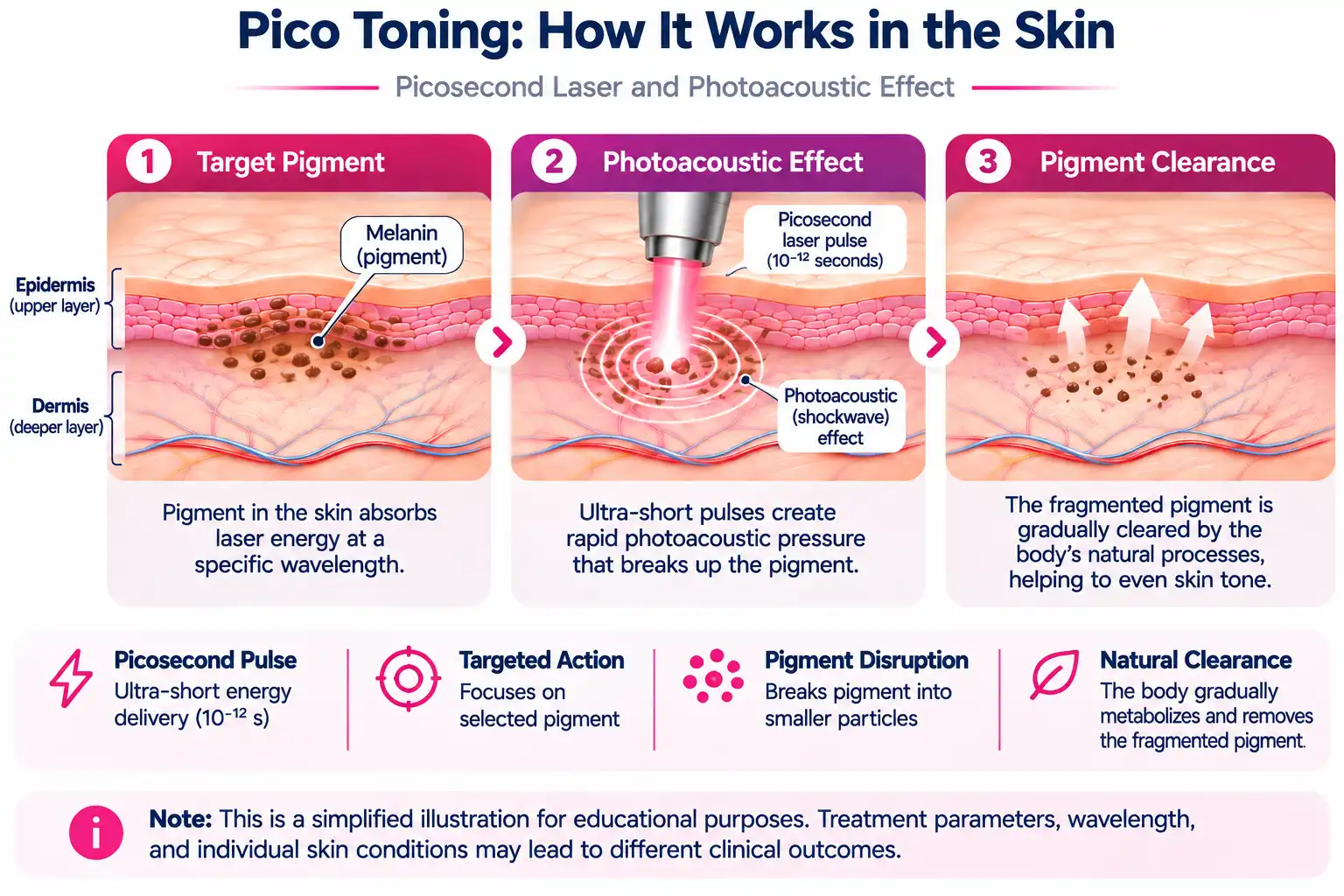
Pico toning uses the interaction between picosecond laser energy and selected pigment targets within the skin.
The process primarily involves rapid energy absorption and photoacoustic effects. Depending on the system and treatment configuration, other tissue interactions may also contribute.
Step 1: Laser Energy Is Delivered to the Skin
The practitioner selects an appropriate wavelength and treatment configuration according to the pigmentation concern and patient assessment.
Different wavelengths have different absorption and penetration characteristics. The selected wavelength influences how laser energy interacts with pigment and surrounding tissue.
Appropriate energy delivery is important because normal epidermal melanin can also absorb laser energy.
Step 2: Rapid Photoacoustic Effects Develop
When suitable pigment targets absorb picosecond laser energy, rapid energy deposition can generate localized mechanical stress.
This process is associated with the photoacoustic effect, one of the defining mechanisms of picosecond laser technology.
The relative contribution of photoacoustic and thermal effects depends on the wavelength, pulse parameters, energy level, and target tissue.
Step 3: Pigment Targets May Be Disrupted
Mechanical stress can contribute to the disruption of suitable pigment particles.
Following treatment, biological processes gradually remove or process disrupted pigment.
The extent of pigment reduction varies according to the pigment type, depth, underlying condition, and treatment parameters.
Step 4: Skin Response Develops Gradually
Changes in pigmentation may become visible as the skin recovers and the biological response progresses.
The treatment response is not necessarily immediate. Multiple sessions may be considered depending on the indication and clinical assessment.
What Are the Benefits of Pico Toning?
The potential benefits of pico toning depend on the treatment indication, laser platform, wavelength, and clinical protocol.
For professional aesthetic practices, picosecond technology offers several technical characteristics that may support pigmentation management and selected skin rejuvenation applications.
1. Ultra-Short Pulse Delivery
Picosecond lasers deliver energy in extremely short pulses measured in trillionths of a second.
This rapid energy delivery can generate high peak power and photoacoustic effects within suitable pigment targets.
The shorter pulse duration also reduces the time available for heat diffusion compared with longer pulse delivery under comparable conditions.
2. Targeted Pigment Interaction
Picosecond technology can be configured to interact with selected pigment targets using appropriate wavelengths.
This makes it relevant to professional procedures involving certain benign pigmented lesions and other selected pigmentation concerns.
3. Potential Improvement in Uneven Skin Tone
Selected pigmentation concerns may become less visible following appropriate picosecond laser treatment.
When treatment is effective, this may contribute to a more even-looking complexion.
However, pigmentation disorders have different biological causes. Results should not be generalized across all skin conditions.
4. Non-Ablative Treatment Options
Many conventional picosecond pigment-targeting procedures are non-ablative. They are designed to interact with selected targets without intentionally removing the entire epidermal surface.
Certain systems also support fractional applications that produce different tissue interactions.
Non-ablative does not mean risk-free. Redness, swelling, pigmentary changes, and other complications may still occur.
5. Support for Skin Rejuvenation Applications
Certain picosecond laser platforms support Laser-Induced Optical Breakdown (LIOB) through specialized treatment configurations.
LIOB can create microscopic cavitation effects within targeted dermal areas and may stimulate collagen remodeling.
These applications are distinct from conventional pigment fragmentation and should not be assumed to be available on every picosecond laser system.
6. Multiple Treatment Applications on One Platform
Some professional picosecond laser systems combine multiple wavelengths and treatment technologies.
This can provide clinics with flexibility when selecting equipment for different aesthetic applications.
Actual treatment capabilities depend on the device’s specifications, available applicators, intended use, and applicable regulatory requirements.
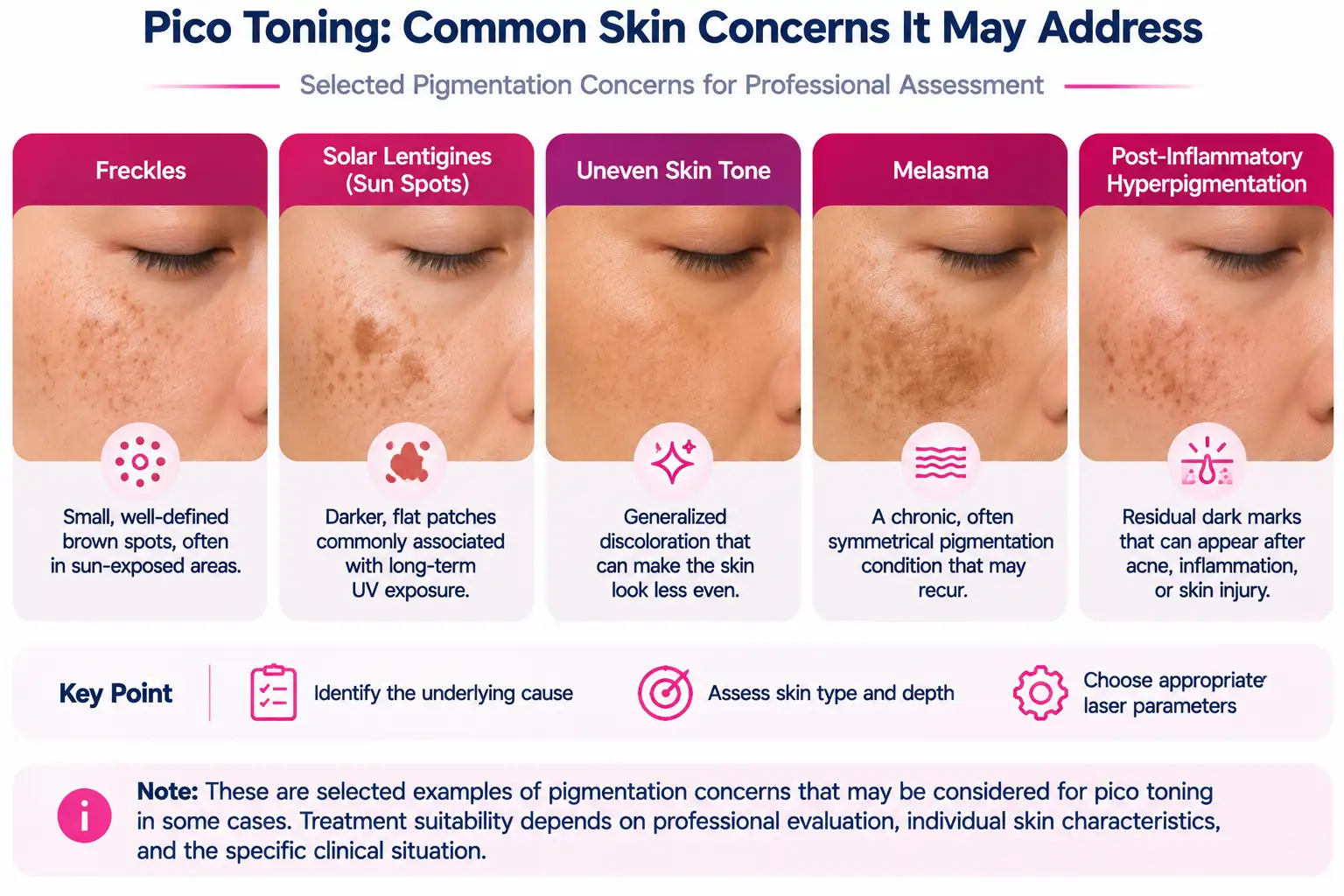
What Skin Concerns Can Pico Toning Address?
Pico toning is primarily associated with selected pigmentation-related treatment approaches. However, the suitability of picosecond laser technology varies considerably between skin conditions.
Uneven Skin Tone
Uneven skin tone can result from different forms of pigmentation, including sun-related discoloration and post-inflammatory pigment changes.
Selected pigmentation concerns may be considered for picosecond laser treatment after professional assessment.
The underlying cause should be identified before selecting a laser procedure.
Freckles and Selected Pigmented Lesions
Freckles and certain benign pigmented lesions may be considered for pigment-targeting laser procedures.
Their response depends on pigment characteristics, depth, skin type, and treatment configuration.
Suspicious or changing lesions require medical assessment before cosmetic laser treatment.
Sun Spots and Solar Lentigines
Solar lentigines are commonly associated with cumulative ultraviolet exposure.
Certain diagnosed benign lesions may respond to appropriate pigment-targeting laser procedures.
The choice of wavelength and treatment approach should be based on the lesion and patient characteristics.
Melasma
Melasma is a chronic and recurrent pigmentation disorder that requires particular treatment caution.
Certain picosecond laser approaches have been investigated for selected patients, but clinical results vary between wavelengths and treatment protocols.
Laser treatment may cause post-inflammatory hyperpigmentation or recurrence in susceptible individuals.
Pico toning should therefore not be presented as a guaranteed or universal treatment for melasma.
Selected Post-Inflammatory Hyperpigmentation
Post-inflammatory hyperpigmentation can develop following acne, skin injury, or inflammatory skin conditions.
Additional inflammation may worsen existing discoloration. For this reason, laser treatment requires careful evaluation and is not automatically the preferred first-line option.
Skin Texture and Rejuvenation
Certain picosecond platforms incorporate specialized fractional technologies such as LIOB-based applications.
These systems may be considered for selected skin rejuvenation objectives, including improvements in visible texture and skin quality.
These applications should be distinguished from standard pigment-targeting pico toning protocols.
Important Limitations of Pico Toning
Not every pigmentation disorder is suitable for picosecond laser treatment.
Treatment effectiveness may be influenced by:
- Underlying pigmentation diagnosis.
- Pigment depth and distribution.
- Skin phototype.
- Laser wavelength and pulse parameters.
- Fluence and treatment technique.
- Previous procedures and skin response.
- Sun exposure and ongoing inflammatory factors.
A qualified healthcare professional should determine whether pico toning is appropriate for the individual treatment objective.
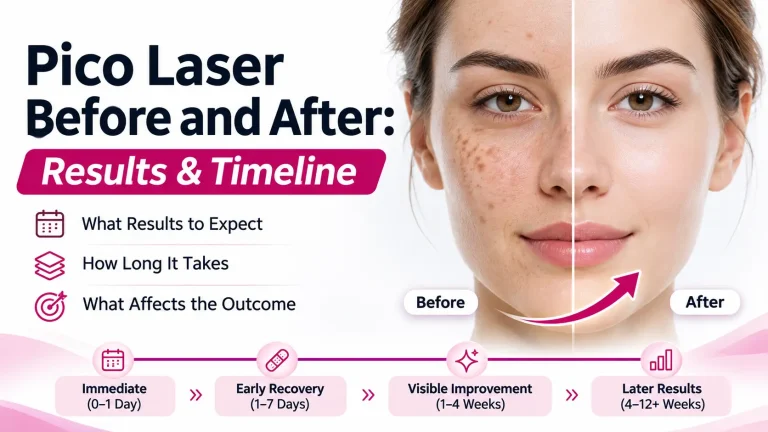
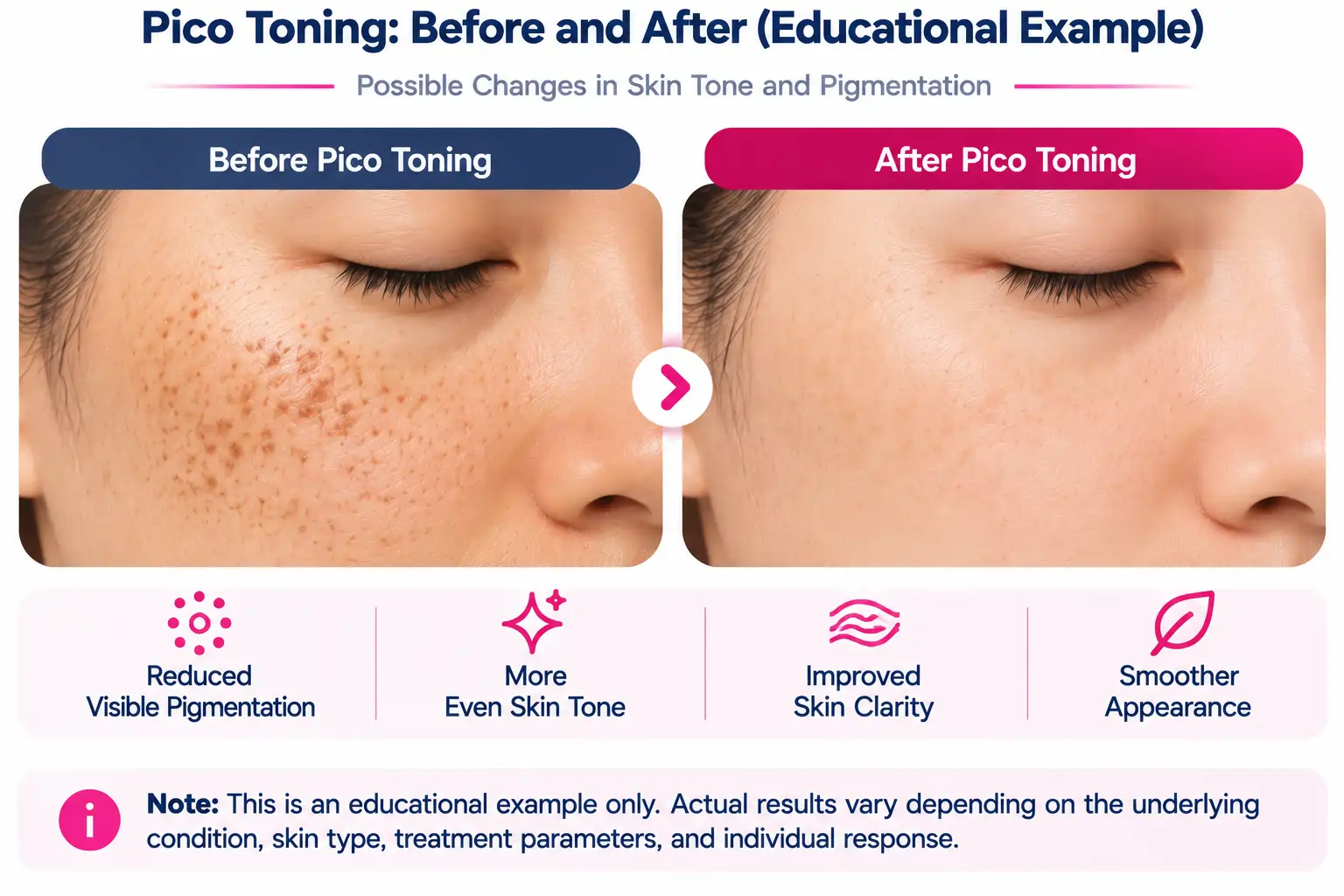
Pico Toning Before and After: What Results Can You Expect?
Pico toning results depend on the underlying pigmentation concern, skin phototype, laser wavelength, treatment parameters, and individual biological response.
Some patients may notice changes in skin clarity and pigmentation after an initial treatment. However, visible improvement often develops progressively, and multiple sessions may be considered as part of an individualized treatment plan.
What Changes May Be Visible After Pico Toning?
Depending on the condition being treated, potential changes may include:
- Reduced visibility of selected freckles and benign pigmented lesions.
- Improvement in certain forms of uneven skin tone.
- Reduced appearance of selected sun-related pigmentation.
- Improved overall skin clarity.
- Potential improvements in skin texture with suitable fractional applications.
These outcomes are not universal. Melasma, post-inflammatory hyperpigmentation, and other complex pigmentary conditions may respond differently and can sometimes worsen following laser treatment.

Why Do Pico Toning Results Differ Between Patients?
Two patients receiving similar procedures may experience different outcomes because pigmentation is influenced by multiple biological and environmental factors.
Important factors include:
- Pigment depth: Superficial and dermal pigmentation may respond differently.
- Pigment type: Different pigmentary conditions have different underlying mechanisms.
- Skin phototype: Higher epidermal melanin levels can influence treatment safety and parameter selection.
- Laser wavelength: Different wavelengths have different absorption characteristics.
- Treatment parameters: Fluence, pulse characteristics, spot size, and delivery technique affect tissue interaction.
- Sun exposure: Ultraviolet exposure may contribute to new or recurring pigmentation.
- Underlying condition: Chronic disorders such as melasma may require ongoing management.
How Many Pico Toning Sessions Are Needed?
There is no universal number of pico toning sessions that applies to every patient. The recommended treatment frequency and total number of sessions depend on the pigmentation diagnosis, treatment objective, laser platform, and individual response.
Some patients with selected superficial pigmentation may experience visible improvement after fewer sessions, while more complex pigmentation concerns may require a longer treatment strategy or alternative approaches.
Factors That Influence the Number of Sessions
- Type and severity of pigmentation.
- Depth and distribution of pigment.
- Patient skin phototype.
- Selected laser wavelength and treatment configuration.
- Response to previous treatments.
- Presence of recurrent pigmentation or melasma.
How Frequently Can Pico Toning Be Performed?
Treatment intervals vary according to the procedure and clinical objective. They should not be determined simply by the fact that a laser operates in picoseconds.
For example, a prospective study investigating fractional 1064nm picosecond laser treatment for melasma and skin rejuvenation in Asian patients used treatment intervals of approximately four to six weeks.
This represents one studied protocol rather than a universal recommendation for every pico toning procedure.
Practitioners should evaluate skin recovery and treatment response before deciding whether another session is appropriate.
Pico Toning Results Timeline: When Will You See Improvement?
Pico toning results may develop gradually following treatment. Immediate skin reactions should be distinguished from longer-term changes in pigmentation.
| Stage | Possible Skin Response | Clinical Consideration |
|---|---|---|
| Immediately After Treatment | Mild redness, warmth, or temporary sensitivity. | Assess the immediate skin response. |
| First Few Days | Temporary redness, mild swelling, or changes in the appearance of treated spots. | Follow appropriate post-treatment care. |
| Following Weeks | Gradual changes in visible pigmentation may develop. | Evaluate the response rather than assuming immediate results. |
| After Multiple Sessions | Additional improvement may become visible in selected cases. | Reassess treatment suitability and future sessions. |
| Long-Term Follow-Up | Results may persist, fluctuate, or gradually diminish. | Consider recurrence, maintenance, and ongoing skin protection. |
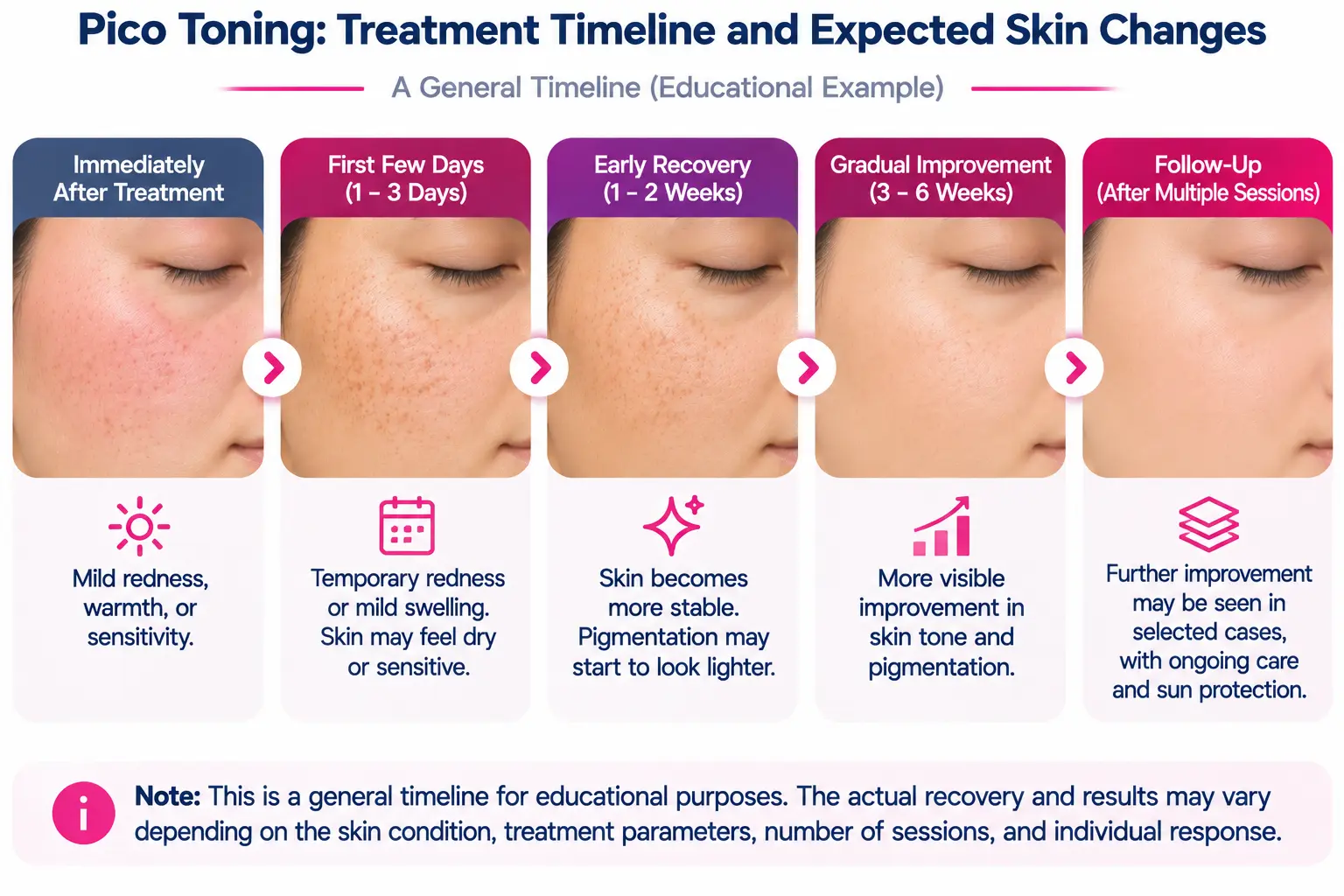
There is no guaranteed timeline for pigmentation improvement. The underlying diagnosis and individual response should guide follow-up evaluation.
Pico Toning Recovery: What Happens After Treatment?
Recovery following pico toning is generally influenced by treatment intensity, laser parameters, skin characteristics, and the specific application.
Many pigment-targeting picosecond procedures are non-ablative, meaning they do not intentionally remove the entire epidermal surface. However, temporary inflammatory responses may still occur.
Common Recovery Responses
- Redness: Temporary erythema may occur in the treated area.
- Warmth: Some patients experience temporary warmth or sensitivity.
- Mild swelling: Localized swelling may develop after treatment.
- Dryness: The skin may feel temporarily dry or tight.
- Pigment changes: Treated areas may temporarily appear darker or lighter.
Recommended Pico Toning Aftercare
Appropriate aftercare helps reduce unnecessary irritation and supports skin recovery.
- Use sun protection: Apply broad-spectrum SPF 30 or higher sunscreen and minimize excessive ultraviolet exposure.
- Maintain skin hydration: Use a gentle moisturizer appropriate for the skin condition.
- Avoid unnecessary irritation: Temporarily avoid aggressive exfoliation and irritating skincare products according to professional instructions.
- Use gentle cleansing: Avoid harsh cleansers and excessive friction.
- Follow professional instructions: Individualized aftercare should reflect the treatment parameters and actual skin response.
Patients should contact their healthcare professional if they experience persistent pain, blistering, worsening inflammation, or unexpected pigment changes.
What Are the Side Effects of Pico Toning?
Although picosecond laser procedures are commonly used in aesthetic dermatology, pico toning is not completely free of adverse effects.
The risk profile depends on the laser wavelength, energy delivery, treatment technique, patient skin type, and underlying pigmentation condition.
1. Temporary Redness and Swelling
Mild redness and localized swelling may develop immediately after treatment.
These reactions are generally temporary, although their duration varies according to the treatment configuration and individual response.
2. Post-Inflammatory Hyperpigmentation
Post-inflammatory hyperpigmentation (PIH) refers to darkening of the skin following inflammation or tissue irritation.
It is an important consideration when treating patients with darker skin phototypes or a history of pigmentary reactions.
Although picosecond technology can reduce unnecessary thermal diffusion compared with longer pulse delivery under comparable conditions, it does not eliminate the possibility of PIH.
3. Hypopigmentation
Hypopigmentation refers to areas of skin becoming lighter than the surrounding tissue.
It is an uncommon but clinically important potential complication of repeated pigment-targeting laser procedures.
A 2025 case series documented hypopigmentation following picosecond laser treatment for melasma, including cases in which conservative treatment settings had been used.
This finding highlights the importance of appropriate treatment intervals, careful energy delivery, and long-term monitoring.
4. Blistering and Crusting
Blistering and crusting are less common responses but may occur when tissue receives excessive or inappropriate laser energy.
Patients should avoid picking or removing crusts and should follow the aftercare instructions provided by their practitioner.
5. Infection and Scarring
Infection and scarring are uncommon complications of appropriately performed non-ablative picosecond procedures.
However, tissue injury, improper aftercare, or secondary infection may increase the risk of complications.

For additional information, see our Pico Laser Side Effects Guide .
Is Pico Toning Safe for Darker Skin?
Pico toning may be considered for selected patients with darker skin phototypes, but treatment requires careful assessment and parameter selection.
In Fitzpatrick skin types IV to VI, epidermal melanin competes with targeted pigment for laser energy. This can increase the risk of unwanted pigmentary changes when treatment is inappropriate.
Why Does Skin Phototype Matter?
Skin phototype influences the amount and distribution of epidermal melanin.
Because melanin absorbs energy from several commonly used aesthetic laser wavelengths, the practitioner must consider both the intended pigment target and surrounding epidermal tissue.
Important Safety Considerations
- Evaluate Fitzpatrick skin phototype.
- Identify the underlying pigmentation disorder.
- Review previous laser treatments and pigmentary reactions.
- Select an appropriate wavelength and treatment configuration.
- Use conservative parameters when clinically appropriate.
- Consider test spots where indicated.
- Provide appropriate pre-treatment and post-treatment sun protection guidance.
- Monitor the skin response before additional sessions.
Picosecond laser technology should not be described as universally safe for every skin type. Patient selection and operator expertise remain essential.
A detailed discussion of laser selection for darker skin is available in our Pico Laser for Hyperpigmentation Guide .
Pico Toning vs Q-Switched Laser: Which Is Better?
Picosecond and Q-switched lasers are both used in professional aesthetic practices for selected pigment-related applications.
However, their pulse durations and energy delivery characteristics differ. These differences may influence how the laser interacts with pigment and surrounding tissue.
| Comparison | Picosecond Laser | Q-Switched Laser |
|---|---|---|
| Pulse Duration | Picosecond range | Nanosecond range |
| Peak Power | High peak power potential | Depends on pulse and system configuration |
| Primary Interaction | Photoacoustic effects | Photothermal and photoacoustic effects |
| Pigment Applications | Selected pigmented lesions and pigmentation concerns | Selected pigmented lesions and pigmentation concerns |
| Skin Rejuvenation | Some systems support LIOB-based applications | Some systems support other rejuvenation procedures |
| Equipment Considerations | Pulse width, wavelengths, applicators, and energy stability | Wavelengths, pulse characteristics, and energy stability |
Neither technology is automatically superior for every pigmentation condition. The appropriate choice depends on the diagnosis, treatment objective, patient characteristics, and available evidence.
For a more detailed technical comparison, see our Picosecond Laser vs Q-Switched Laser Guide .
What Should Clinics Look for in a Pico Toning Laser?
For dermatology clinics, medical aesthetic centers, and equipment distributors, choosing a professional pico toning laser involves evaluating more than pulse duration or advertised treatment applications.
A suitable picosecond laser platform should provide appropriate wavelength options, stable energy delivery, adjustable treatment parameters, reliable operation, and manufacturer support.
1. Available Laser Wavelengths
Wavelength selection influences how laser energy interacts with different pigment targets and surrounding tissue.
Common wavelengths found in professional picosecond laser systems include:
- 1064nm: Commonly used in professional pigmentation and tattoo-related applications.
- 755nm: Associated with selected pigment-targeting applications.
- 532nm: Used for selected superficial pigment targets.
- 585nm and 650nm: Available on certain multi-wavelength platforms for additional treatment applications.
Not every device offers all five wavelengths. Clinics should verify the actual configuration and intended applications before purchasing.
2. Pulse Duration and Energy Stability
Pulse duration is an important characteristic of picosecond laser technology.
However, a shorter pulse does not independently establish superior clinical performance. Energy consistency, beam quality, treatment parameters, and system reliability also matter.
Buyers should review technical specifications and request supporting documentation rather than relying exclusively on marketing claims.
3. Treatment Modes and Applications
Some professional systems combine multiple operating technologies within one platform.
Depending on the configuration, these may include:
- Standard picosecond laser mode.
- PTP (Photoacoustic Twin Pulse) technology.
- Multi Pulse technology.
- Long Pulse technology.
- Long Pulse Pro technology.
Buyers should distinguish between treatment modes, applicators, and clinical indications. The availability of multiple modes does not automatically establish suitability for every pigmentation condition.
4. Fractional Technology and Applicators
Some picosecond laser platforms offer specialized fractional applicators for skin rejuvenation applications.
Honeycomb HP is one example of a fractional technology based on Laser-Induced Optical Breakdown (LIOB).
Clinics evaluating this technology should understand how the applicator delivers energy, which treatment configurations are available, and what clinical evidence supports its intended applications.
5. Cooling, Maintenance, and Manufacturer Support
Equipment reliability is another important consideration for clinics planning regular treatments.
Evaluate the following:
- Cooling system configuration.
- Energy output stability.
- Handpiece and articulated arm quality.
- Routine maintenance requirements.
- Spare parts availability.
- Warranty and technical support.
- Operator training and documentation.
6. Regulatory Documentation and Intended Use
Before purchasing a pico toning laser, clinics and distributors should verify the manufacturer’s documentation, applicable regulatory status, and authorized indications in their target market.
Certification and regulatory authorization should be confirmed using the relevant official records rather than assumed from general product descriptions.
Ultra PicoMax: A Multi-Wavelength Professional Picosecond Laser
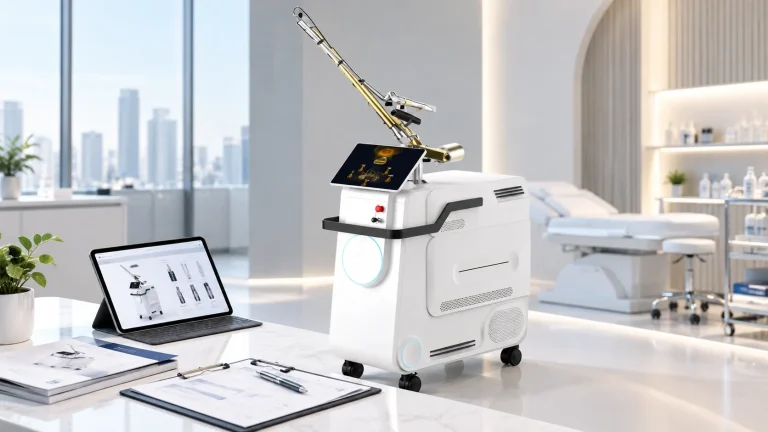
Ultra PicoMax is a professional multi-wavelength picosecond laser platform developed for dermatology clinics, medical aesthetic centers, plastic surgery hospitals, and international equipment distributors.
The system combines five wavelengths and five treatment technologies within one platform.
Its configuration is designed to support professional applications involving pigmentation treatment, tattoo removal, skin rejuvenation, and other aesthetic procedures.
Five Available Laser Wavelengths
Ultra PicoMax supports the following wavelength configurations:
- 1064nm
- 755nm
- 650nm
- 585nm
- 532nm
Multiple wavelengths provide flexibility when selecting treatment configurations for different pigment targets and professional aesthetic applications.
Five Integrated Treatment Technologies
Ultra PicoMax integrates five treatment technologies:
- Picosecond: Ultra-short pulse technology for selected pigment-targeting and tattoo-related applications.
- PTP: A dual-pulse technology designed for selected pigmentation applications.
- Multi Pulse: Multiple-pulse delivery for selected pigmentation treatment approaches.
- Long Pulse: Supports selected vascular, acne, and skin rejuvenation applications.
- Long Pulse Pro: Provides additional treatment configurations for selected aesthetic applications.
Honeycomb HP Fractional Technology
Ultra PicoMax offers an optional Honeycomb HP applicator based on Laser-Induced Optical Breakdown (LIOB) technology.
LIOB creates microscopic treatment zones within targeted dermal areas while aiming to preserve the epidermal surface.
This technology is associated with collagen remodeling and skin rejuvenation applications.
Honeycomb HP is a specialized fractional application and should not be confused with conventional low-fluence pico toning.
Ultra PicoMax Technical Specifications
| Specification | Ultra PicoMax |
|---|---|
| Laser Type | Picosecond Laser |
| Available Wavelengths | 1064 / 755 / 650 / 585 / 532nm |
| Pulse Width | 350ps |
| Repetition Rate | 1–10Hz |
| Single Pulse Energy at 1064nm | 1200mJ |
| Single Pulse Energy at 532nm | 600mJ |
| Long Pulse Energy | 3000mJ |
| Beam Divergence | ≤1mrad |
| Beam Profile | Homogeneous |
| Cooling System | Air-to-Water Cooling |
| Articulated Arm | Korean Seven-Joint Articulated Arm |
| Optional Applicator | Honeycomb HP |
Who Is Ultra PicoMax Designed For?
The platform is intended for professional B2B customers, including:
- Dermatology clinics.
- Medical aesthetic clinics.
- Plastic surgery hospitals.
- Medical spas.
- Medical equipment distributors.
- International medical device importers.
- OEM and ODM partners.
For equipment buyers, combining multiple wavelengths and treatment technologies within one platform may provide additional operational flexibility.
OEM, ODM, and Distributor Cooperation
Cocoon Laser also supports professional equipment buyers through OEM and ODM cooperation options.
Available cooperation services include:
- Logo and private-label customization.
- Machine appearance customization.
- Packaging and user manual customization.
- Customized accessories.
- Technical documentation.
- Product training and distributor support.
Clinics and distributors interested in the Ultra PicoMax platform can contact Cocoon Laser to request product specifications, configuration details, and a quotation.
Product specifications and available configurations should be confirmed with the manufacturer before ordering.
Frequently Asked Questions About Pico Toning
1. What is pico toning used for?
Pico toning is used in selected professional pigmentation treatment approaches. Depending on the laser system and clinical protocol, it may be considered for certain benign pigmented lesions, uneven skin tone, and selected skin rejuvenation applications.
2. Is pico toning the same as pico laser treatment?
Not exactly. Picosecond laser treatment is a broader category of laser technology. Pico toning generally refers to a particular treatment approach using picosecond laser energy, often for pigmentation-related concerns.
3. Is pico toning better than traditional laser toning?
Not universally. Picosecond and Q-switched nanosecond lasers have different pulse characteristics and tissue interactions. Clinical outcomes depend on the wavelength, treatment protocol, skin condition, and patient characteristics.
4. How many pico toning sessions do I need?
The number of sessions varies according to the pigmentation diagnosis and individual response. Some patients may benefit from a series of treatments, while others may require a different treatment strategy.
5. Does pico toning hurt?
Some patients describe the sensation as mild snapping, tingling, or warmth. Discomfort depends on the treatment area, laser parameters, and individual sensitivity. Appropriate comfort measures may be used when necessary.
6. Is there downtime after pico toning?
Many non-ablative pico toning procedures involve limited downtime. Temporary redness, swelling, dryness, or skin sensitivity may occur. Recovery depends on the actual treatment configuration and individual response.
7. Can pico toning remove melasma permanently?
No treatment can guarantee permanent removal of melasma. Melasma is a chronic and recurrent pigmentation disorder. Picosecond laser approaches may be considered in selected cases, but recurrence and pigmentary complications remain possible.
8. Can pico toning cause hyperpigmentation?
Yes. Post-inflammatory hyperpigmentation may occur following laser-induced inflammation. Appropriate patient assessment, parameter selection, and sun protection are important risk management measures.
9. Is pico toning suitable for darker skin?
It may be considered for selected patients with darker skin phototypes, but the risk of pigmentary changes requires careful evaluation. Laser wavelength, energy settings, and operator experience are important.
10. What is the difference between PTP and pico toning?
Pico toning describes a broader treatment approach using picosecond laser technology. PTP is a specific dual-pulse delivery technology available on certain laser platforms. The two terms should not be used interchangeably.
11. What is Honeycomb HP technology?
Honeycomb HP is a specialized fractional technology that uses Laser-Induced Optical Breakdown (LIOB) to create microscopic treatment zones within the dermis. It is associated with selected skin rejuvenation applications and collagen remodeling.
12. What wavelengths are available in professional pico toning lasers?
Common professional picosecond laser wavelengths include 1064nm, 755nm, and 532nm. Some multi-wavelength systems also offer 585nm and 650nm. Actual availability depends on the equipment configuration.
13. Can one picosecond laser machine support multiple treatments?
Some professional systems integrate multiple wavelengths, treatment modes, and applicators. Their available applications depend on the actual specifications, accessories, and authorized indications.
Final Thoughts: Is Pico Toning Worth Considering?
Pico toning is an important application of picosecond laser technology in professional aesthetic dermatology. Its ultra-short pulse characteristics allow rapid energy delivery and photoacoustic interactions with selected pigment targets.
Potential applications include selected pigmentation concerns and, depending on the device, certain skin rejuvenation procedures.
However, clinical outcomes are influenced by the underlying skin condition, wavelength, treatment parameters, and individual biological response.
For patients, professional diagnosis, realistic expectations, and appropriate aftercare remain essential.
For aesthetic clinics and equipment distributors, selecting a professional pico toning laser requires evaluating technical specifications, treatment flexibility, safety features, regulatory documentation, and manufacturer support.
Ultra PicoMax combines five wavelengths, five treatment technologies, and optional Honeycomb HP fractional technology in one professional picosecond laser platform.
To learn more about its technical configuration, OEM options, or distributor cooperation, contact the Cocoon Laser team.
About This Guide
Publisher: Cocoon Laser Editorial Team
Topic: Picosecond laser technology, pico toning applications, and professional aesthetic equipment.
Last Updated: November 2026
Editorial Approach: This guide explains the technical principles, potential applications, treatment considerations, and limitations of pico toning. Product specifications are based on the Ultra PicoMax product documentation.
Medical Disclaimer: This article is intended for educational purposes and does not replace professional medical advice, diagnosis, or treatment. Laser procedures should only be considered following appropriate assessment by qualified professionals.
Technical Review: Device specifications should be verified against the latest manufacturer documentation. Clinical applications and regulatory indications may vary by market and device configuration.
References
- Efficacy and safety of picosecond laser for the treatment of melasma: a systematic review and meta-analysis. PubMed, 2023. Read the study .
- Comparative efficacy and safety of the novel Picosecond Alexandrite Laser and traditional combined Q-switched and long-pulse Nd:YAG lasers in melasma treatment. Lasers in Medical Science, 2025. Read the study .
- Efficacy and safety of low-fluence 1064 nm picosecond laser with/without micro-lens arrays for melasma treatment: a randomized, split-face controlled study. Lasers in Medical Science, 2025. Read the study .
- Hypopigmentation Following Picosecond Laser Treatment for Melasma: A Case Series. PubMed, 2025. Read the study .
- Assessing the Safety and Efficacy of Picosecond Alexandrite Lasers in the Management of Melasma: A Systematic Review and Meta-Analysis of Randomised Control Trials. Australasian Journal of Dermatology, 2026. Read the study .
The available clinical literature remains heterogeneous. Findings from specific wavelengths and treatment protocols should not be generalized to every picosecond laser system.