
Permanent Hair Removal for Blonde, Gray & White Hair: What Works?
Permanent Hair Removal for Blonde, Gray & White Hair: What Actually Works?
Permanent hair removal becomes more complicated when the hair is blonde, gray or white. Most laser and IPL hair-reduction technologies rely on pigment in the hair to absorb light and convert it into heat. As hair loses pigment, that optical target becomes weaker.
This is why a laser system that performs well on dark, coarse hair may produce very different results on light blonde, gray or white hair. Changing to a more powerful device or a different wavelength does not automatically solve the problem.
In this guide, we explain why hair color matters, whether IPL, diode, Alexandrite and Nd:YAG lasers can work on light-colored hair, and which alternative hair-removal methods deserve consideration when there is too little melanin for conventional light-based hair reduction.
Quick Answer: Can Blonde, Gray or White Hair Be Permanently Removed?
Blonde, gray and white hair can be more difficult to treat with conventional laser and IPL because these technologies depend substantially on melanin in the hair as an optical target.
Darker blonde hair may contain enough pigment for some light-based systems to produce a response, but very light blonde hair is generally more challenging. Gray hair becomes progressively more difficult as pigment is lost, while white hair usually contains too little melanin for conventional IPL or laser hair reduction to target effectively.
When there is insufficient hair pigment, simply switching from IPL to diode, Alexandrite or Nd:YAG does not guarantee effective treatment. For hair that cannot be adequately targeted by light, electrolysis is an important alternative because its mechanism does not depend on hair color in the same way.
Why Is Blonde, Gray and White Hair Harder to Remove Permanently?
To understand the problem, it helps to separate two factors that are often confused: skin pigmentation and hair pigmentation.
In light-based hair reduction, the treatment system needs an appropriate optical target. For conventional laser and IPL hair reduction, melanin associated with the hair plays an important role in absorbing optical energy.
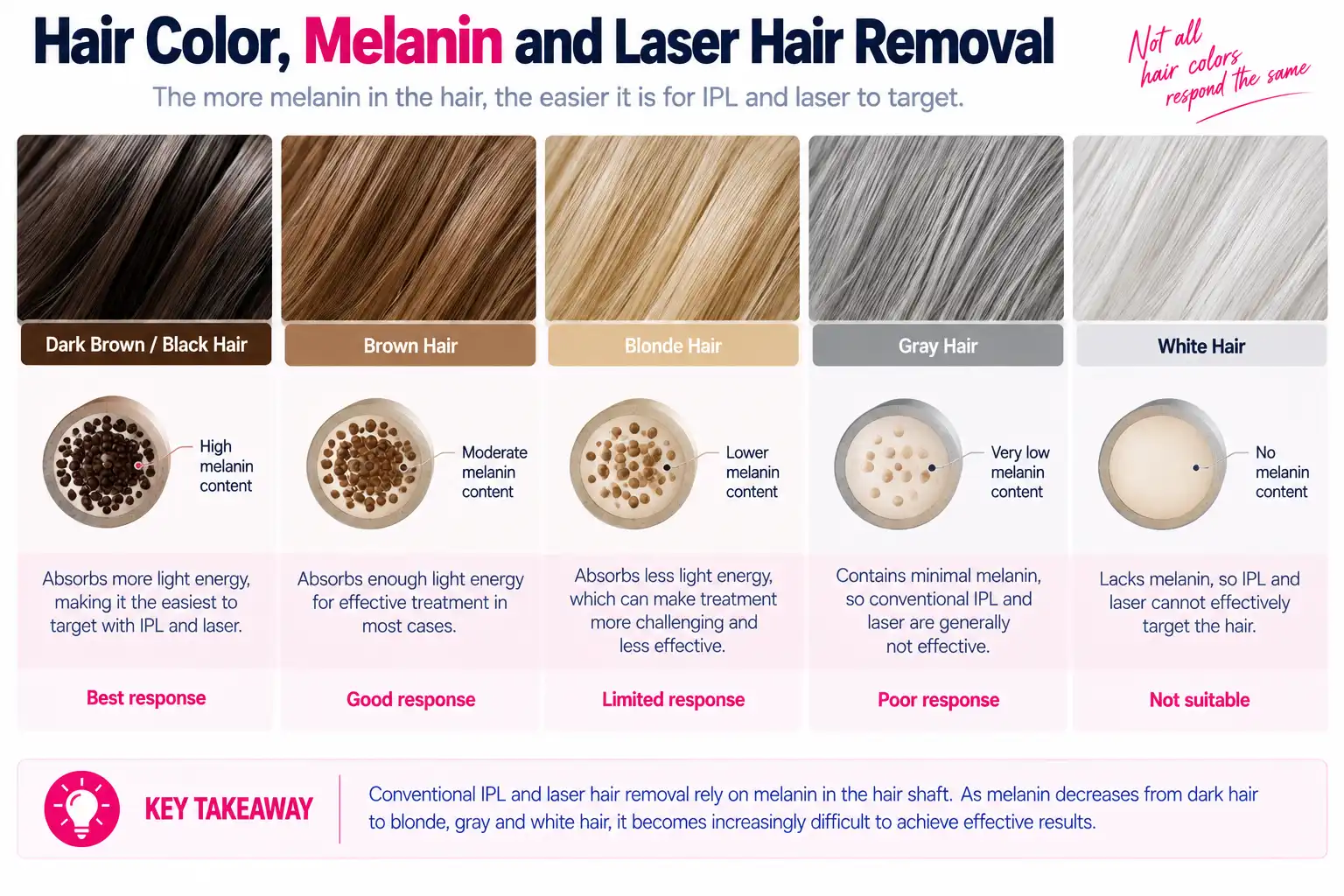
Dark hair usually contains more melanin than blonde, gray or white hair. This creates greater optical contrast in many suitable skin-and-hair combinations.
As hair becomes lighter, the amount and type of pigment available to absorb treatment light changes. Eventually, there may not be enough useful target pigment for conventional laser or IPL treatment to produce the desired follicular heating.
| Hair Color | Typical Pigment Availability | Conventional IPL/Laser Challenge |
|---|---|---|
| Black / Dark Brown | Relatively high | Often provides a strong optical target when skin compatibility is appropriate |
| Dark Blonde | Lower and variable | Response may vary substantially |
| Light Blonde | Low | Often difficult to target effectively |
| Gray | Reduced and variable | Increasingly difficult as pigment is lost |
| White | Very little or no useful melanin | Generally a poor target for conventional IPL and laser hair reduction |
Why Melanin Matters for Laser and IPL Hair Removal
Laser and IPL hair reduction are based on selective optical heating. Light emitted by the treatment system interacts with chromophores in tissue, and the treatment is designed so that sufficient energy reaches the intended target while limiting unnecessary injury to surrounding structures.
In hair reduction, melanin is an important chromophore. When suitable wavelengths of light are absorbed by pigment associated with the hair, part of that optical energy is converted into heat.
That thermal effect can influence follicular structures involved in future hair growth. This principle helps explain why hair color is not merely a cosmetic characteristic when evaluating laser or IPL hair removal.
You can learn more about this mechanism in our What Is Selective Photothermolysis? guide.
What Happens When Hair Contains Too Little Melanin?
If the hair contains very little melanin, substantially less optical energy may be absorbed by the intended hair target. Increasing the device setting does not simply create the missing chromophore.
This distinction is critical.
A treatment system can deliver more energy, but if the intended structure does not contain enough of the relevant absorber, increasing energy may also increase exposure of surrounding tissue rather than selectively solving the hair-targeting problem.
Therefore:
- More power does not create more melanin in blonde hair.
- A different wavelength does not make white hair become pigmented.
- Multiple wavelengths do not automatically solve the absence of a useful optical target.
These principles are particularly important when evaluating marketing claims for “permanent hair removal” systems intended for very light hair.
Does Laser Hair Removal Work on Blonde Hair?
Laser hair removal may work on some blonde hair, but results depend heavily on how much useful pigment the hair actually contains.
“Blonde” covers a wide range of hair colors. Dark blonde hair with visible pigment is biologically and optically different from extremely pale blonde hair containing very little melanin.
This means it is inaccurate to make either of these absolute claims:
- “Laser always works on blonde hair.”
- “Laser never works on blonde hair.”
A more useful question is whether the individual hair contains sufficient target pigment for the selected technology and treatment parameters.
Dark Blonde vs Light Blonde Hair
Dark blonde hair may retain enough pigment to provide some optical target, particularly when there is favorable contrast between hair and surrounding skin. Results can still be less predictable than with darker terminal hair.
Light blonde hair presents a greater challenge because less melanin is available to absorb treatment light. As hair becomes increasingly pale, conventional laser hair reduction generally becomes less reliable.
| Blonde Hair Type | Expected Laser Challenge | Why |
|---|---|---|
| Dark Blonde | Variable | May retain useful pigmentation |
| Medium Blonde | More challenging | Reduced melanin lowers optical targeting efficiency |
| Very Light Blonde | Often difficult | Very limited target pigment may be available |
Can Alexandrite Laser Remove Blonde Hair?
Alexandrite hair-removal systems commonly operate around 755 nm. Melanin absorption characteristics at shorter near-infrared wavelengths can make Alexandrite technology relevant to discussions about lighter or finer pigmented hair.
However, this does not mean a 755 nm Alexandrite laser can reliably remove hair that lacks sufficient melanin.
There is an important difference between:
“lighter pigmented hair that still contains a usable optical target” and “hair with too little pigment to target effectively.”
Alexandrite technology may deserve consideration for some appropriately pigmented blonde hair, but very pale blonde, gray and white hair remain fundamentally more challenging.
Does Diode Laser Work on Blonde Hair?
Diode hair-removal systems commonly operate in wavelength regions around 800–810 nm, although modern professional platforms may combine multiple wavelength bands.
Diode laser systems can be highly relevant for pigmented hair, but their effectiveness still depends on an appropriate optical target. A diode laser does not bypass the basic requirement for sufficient hair pigmentation simply because it uses a different wavelength.
Therefore, darker blonde hair may respond differently from very light blonde hair, and individual assessment is more meaningful than assuming that all blonde hair will respond equally.
For more information about this technology, see our 808nm Diode Laser Hair Removal guide.
Does Nd:YAG Laser Work on Blonde Hair?
Nd:YAG hair-removal systems commonly use a wavelength of approximately 1064 nm. This wavelength is often discussed in professional hair removal because of its penetration and interaction characteristics, particularly when treating darker skin types with an appropriate system and parameters.
But this creates a common misunderstanding:
A laser being useful for darker skin does not mean it is automatically better for light-colored hair.
Skin-tone compatibility and hair-color compatibility are different problems.
The 1064 nm wavelength does not create melanin inside blonde, gray or white hair. If the hair lacks sufficient pigment, changing to Nd:YAG does not automatically make it an effective target.
Does Laser Hair Removal Work on Gray Hair?
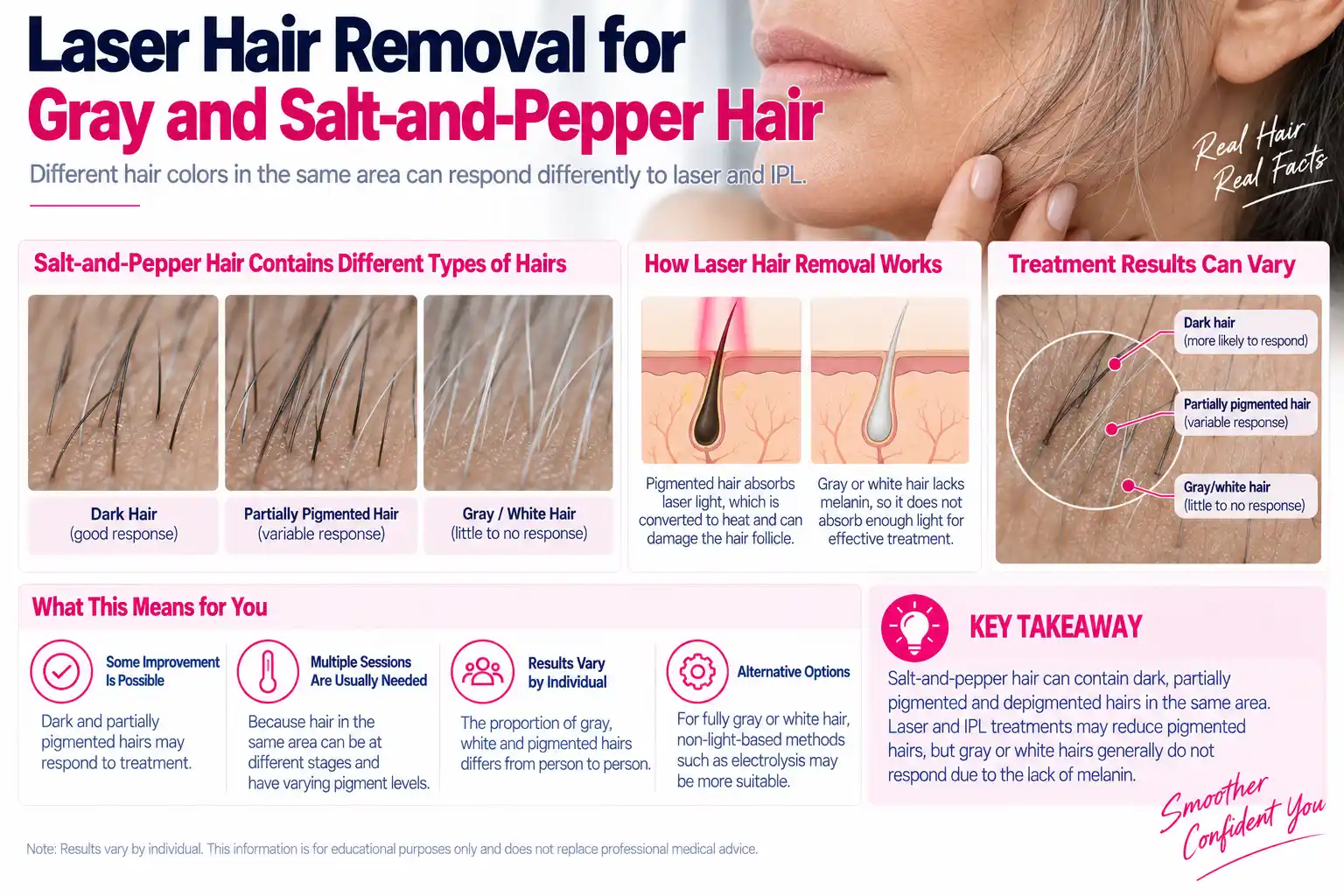
Gray hair is generally more difficult to treat with conventional laser hair removal because graying is associated with loss of hair pigmentation.
Gray hair is not always completely pigment-free. Some gray hairs may retain residual pigment, while others may be almost entirely depigmented.
This creates significant variability.
Someone with salt-and-pepper hair, for example, may have a mixture of:
- Dark pigmented hairs
- Partially pigmented gray hairs
- Nearly white hairs
A light-based treatment may therefore affect the darker hairs more readily than the gray or white hairs in the same treatment area.
This can leave the lighter hairs increasingly noticeable after darker hairs have been reduced.
Does Laser Hair Removal Work on White Hair?
White hair is generally a poor target for conventional laser hair removal because it contains little or no melanin available for selective optical targeting.
This is not primarily a problem of insufficient machine power.
It is a problem of target availability.
If the intended chromophore is absent, increasing fluence or switching between common hair-removal wavelengths does not automatically restore selective targeting.
This is why claims that a conventional 755 nm, 808 nm or 1064 nm hair-removal laser can reliably remove completely white hair should be evaluated carefully.
Does IPL Work on Blonde Hair?
IPL uses broadband pulsed light rather than the comparatively narrow wavelength output of a laser, but the fundamental pigment challenge remains.
For hair reduction, IPL still relies substantially on melanin-associated optical absorption. Darker blonde hair may therefore respond differently from very pale blonde hair.
Consumer IPL devices can be particularly restrictive because manufacturers commonly specify compatible hair colors and skin tones. Users should follow those compatibility requirements rather than assuming that a high-intensity setting can compensate for very light hair.
Does IPL Work on Gray or White Hair?
Conventional IPL is generally poorly suited to gray and white hair when insufficient melanin is present.
Broadband light does not eliminate the need for an appropriate chromophore. A wider range of wavelengths should not be interpreted as meaning that IPL can automatically target pigment-free hair.
This is another reason why users should distinguish between:
- the number of wavelengths emitted by a system,
- the amount of energy delivered, and
- whether the intended biological target actually absorbs that energy effectively.
Blonde vs Gray vs White Hair: Which Is Hardest to Treat?
From the perspective of conventional light-based hair reduction, difficulty generally increases as useful hair pigmentation decreases.
| Hair Type | Laser / IPL Potential | Main Limitation | Alternative to Consider |
|---|---|---|---|
| Dark Blonde | Variable; may respond in suitable cases | Less pigment than dark brown or black hair | Professional assessment; electrolysis if optical targeting is inadequate |
| Light Blonde | Limited | Low melanin | Electrolysis |
| Gray | Usually limited and variable | Progressive pigment loss | Electrolysis |
| White | Generally poor for conventional laser/IPL | Little or no useful melanin target | Electrolysis |
The important conclusion is that hair color should be evaluated before choosing a laser or IPL device. The most advanced light-based platform cannot simply ignore the optical properties of the target hair.
So What Actually Works for Blonde, Gray and White Hair?
When conventional laser or IPL cannot adequately target a hair because too little melanin is present, a hair-removal method that does not depend on optical absorption becomes more relevant.
This is where electrolysis becomes particularly important.
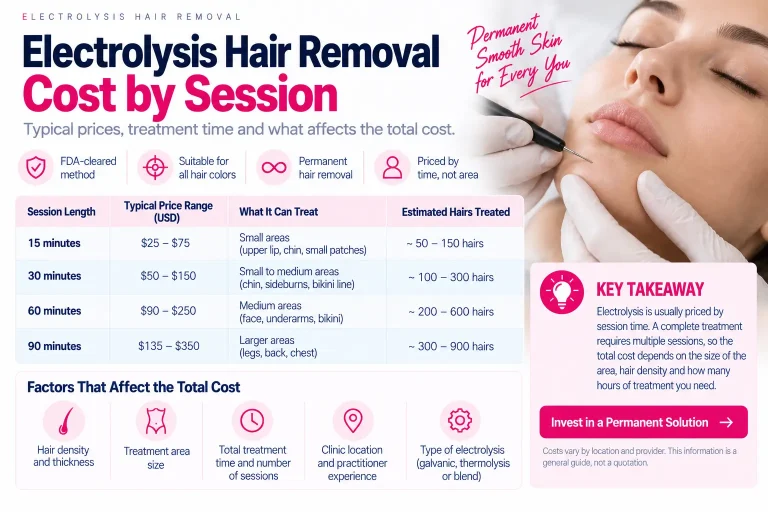
Unlike laser and IPL, electrolysis treats individual follicles using an inserted probe and electrical energy. Its basic mechanism does not require the hair shaft to contain the same melanin target needed by conventional optical hair-reduction technologies.
That difference is why electrolysis frequently enters the discussion when someone asks:
- What is the best permanent hair removal for blonde hair?
- How can gray hair be permanently removed?
- Can white hair be removed if laser does not work?
- What should I use when IPL cannot detect my hair color?
However, electrolysis also has practical differences from laser and IPL, including treatment speed, follicle-by-follicle application and the number of sessions that may be required.
In the next section, we will compare electrolysis, laser, IPL, epilation, waxing and shaving for light-colored hair and explain which option makes the most sense for different treatment goals.
Which Hair Removal Methods Actually Work for Light Hair?
Once hair contains too little melanin for reliable optical targeting, the decision is no longer simply about finding a stronger laser. The more useful question is whether the selected hair-removal method depends on hair pigment at all.
Electrolysis, laser, IPL, epilation, waxing and shaving can all remove or reduce visible hair, but they work through fundamentally different mechanisms and should not be described as equivalent forms of permanent hair removal.
| Method | Depends on Hair Melanin? | Suitable for Blonde / Gray / White Hair? | Primary Goal |
|---|---|---|---|
| Electrolysis | No, not in the same optical sense as laser/IPL | Yes, hair color is not the same fundamental limitation | Follicle-by-follicle hair removal |
| Laser | Yes | Variable for blonde; generally limited for gray and white hair | Long-term hair reduction |
| IPL | Yes | Variable for darker blonde; generally limited for gray and white hair | Long-term hair reduction |
| Mechanical Epilator | No | Yes | Temporary removal from the root |
| Waxing | No | Yes | Temporary removal from the root |
| Shaving | No | Yes | Temporary surface removal |
Electrolysis for Blonde, Gray and White Hair
Electrolysis is fundamentally different from laser and IPL. Instead of sending light through the skin and relying on melanin to absorb optical energy, electrolysis treats individual hair follicles with a fine probe and electrical energy.
Because the process does not depend on blonde, gray or white hair providing a strong melanin target, hair color is not the same limiting factor that it is for conventional laser and IPL hair reduction.
This makes electrolysis particularly relevant for:
- Very light blonde hair
- Gray or grey hair
- White hair
- Individual hairs remaining after laser treatment
- Small areas containing a mixture of pigmented and non-pigmented hair
The trade-off is treatment speed. Laser and IPL can expose multiple follicles across a treatment area with each pulse or flash, whereas electrolysis works follicle by follicle. Large treatment areas can therefore require substantial time and repeated appointments.
Laser vs Electrolysis for Blonde Hair
The choice between laser and electrolysis for blonde hair depends heavily on how much pigment remains in the hair.
Dark blonde hair may still contain enough pigment for a professional to consider whether an appropriate light-based system could produce useful reduction. Very light blonde hair presents a different situation because the optical target may be too weak.
| Factor | Laser | Electrolysis |
|---|---|---|
| Depends on hair pigment | Yes | No, not in the same way |
| Dark blonde hair | May be considered depending on pigmentation | Can be considered |
| Very light blonde hair | Often challenging | More relevant when optical targeting is inadequate |
| Treatment coverage | Can treat multiple hairs across an area | Individual follicles |
| Hair-color limitation | Important | Much less important |
Therefore, someone with dark blonde hair should not automatically assume laser is impossible, while someone with extremely pale blonde hair should not assume that buying a higher-powered laser will overcome the absence of sufficient melanin.
Laser vs Electrolysis for Gray and White Hair
The distinction becomes clearer with gray and especially white hair.
As pigment disappears, conventional laser targeting becomes increasingly difficult. Electrolysis does not require the same pigment-dependent optical pathway, making it a particularly important option when the hair is fully depigmented.
Salt-and-pepper hair creates an interesting treatment situation because the same area can contain both pigmented and non-pigmented follicles.
In such cases, the technologies may sometimes play different roles: suitable dark hairs may be candidates for light-based reduction, while remaining gray or white hairs may require a method that does not depend on melanin.
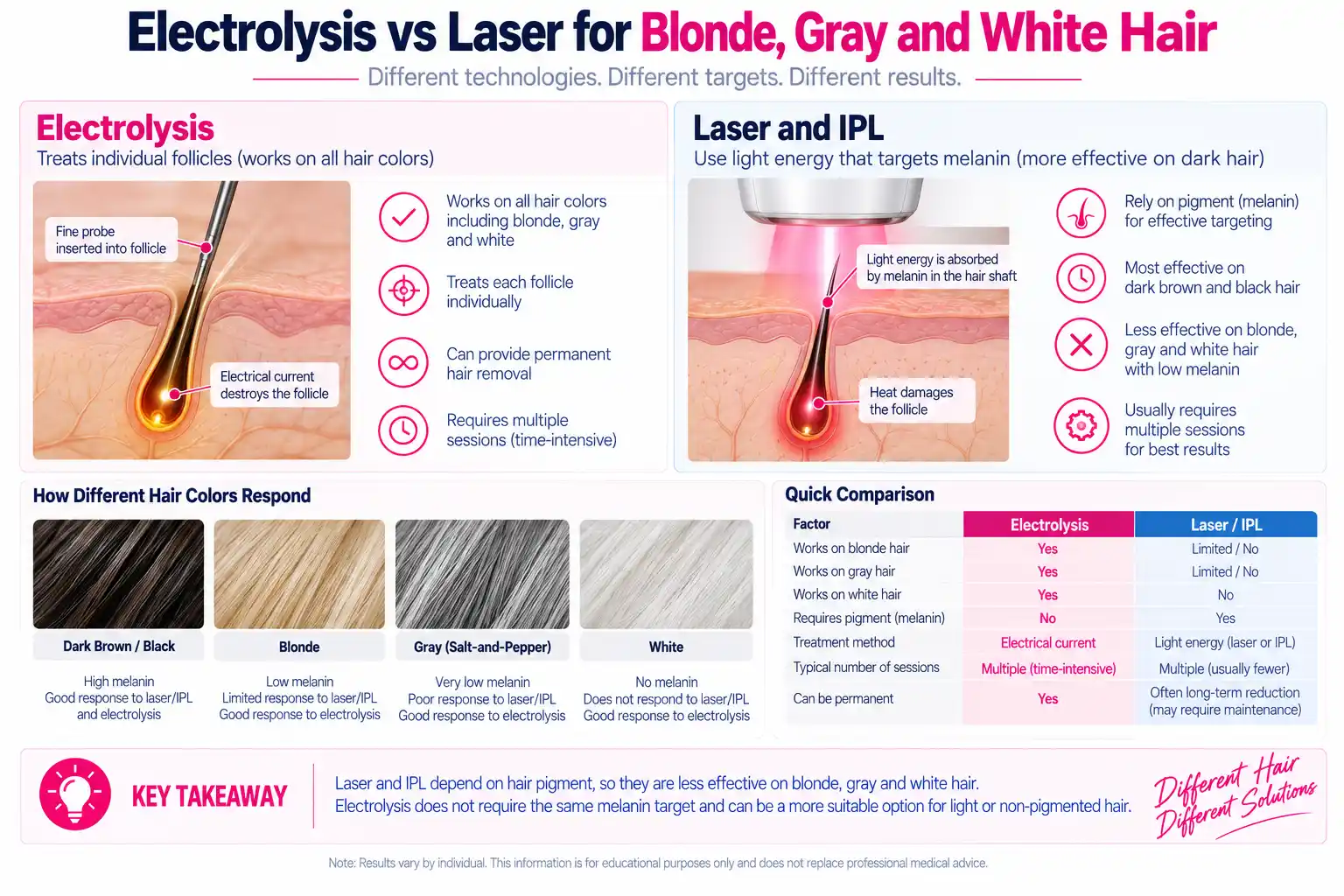
Can New Laser Technology Remove Blonde or White Hair?
New laser platforms continue to improve wavelength combinations, pulse delivery, cooling, treatment speed and operator control. However, technological improvements should not be confused with eliminating the basic physics of optical targeting.
A multi-wavelength laser can provide different penetration and absorption characteristics, but multiple wavelengths do not create pigment inside a hair that contains little or no melanin.
Claims that a new laser can reliably treat all white, gray and blonde hair should therefore be evaluated by asking:
- What chromophore is being targeted?
- How much of that chromophore exists in the hair?
- What wavelength or wavelengths are being used?
- Is the evidence specific to truly white or very light hair?
- Does the claim describe permanent removal or long-term reduction?
These questions are more useful than relying on labels such as “latest generation,” “four wavelength” or “maximum power.”
What About 755nm, 808nm and 1064nm Lasers?
Professional hair-removal platforms commonly use wavelengths around 755 nm, 808/810 nm and 1064 nm. Modern systems may also combine multiple wavelengths.
Each wavelength has different optical characteristics, but none should be interpreted as a universal solution for hair that completely lacks the intended melanin target.
755nm Alexandrite Laser
The approximately 755 nm Alexandrite wavelength has relatively strong interaction with melanin compared with longer hair-removal wavelengths. This can make it relevant when considering appropriately pigmented finer or lighter hair.
However, stronger melanin interaction does not mean completely white hair suddenly becomes treatable. There still needs to be sufficient pigment to absorb the optical energy.
808/810nm Diode Laser
Diode laser technology around 808–810 nm is widely used for professional hair reduction. It can provide an effective balance of melanin interaction and penetration for appropriate hair-and-skin combinations.
But the same limitation remains: an 808 nm diode laser cannot selectively heat melanin that is not present in sufficient quantity.
1064nm Nd:YAG Laser
The 1064 nm Nd:YAG wavelength is often considered when treating darker skin types because of its optical characteristics and comparatively lower melanin absorption than shorter wavelengths.
This is a skin compatibility advantage in appropriate clinical contexts, not evidence that 1064 nm is better at detecting white or gray hair.
| Wavelength | Common Technology | Does It Eliminate the Need for Hair Pigment? |
|---|---|---|
| 755 nm | Alexandrite | No |
| 808/810 nm | Diode | No |
| 1064 nm | Nd:YAG | No |
Does Multi-Wavelength Diode Laser Work on White Hair?
Combining multiple diode laser wavelengths can expand the optical characteristics available within a professional hair-removal platform. Depending on the system, different wavelength components may contribute different penetration and absorption characteristics.
However, multi-wavelength does not mean pigment-independent.
A system combining 755 nm, 808 nm, 940 nm and 1064 nm wavelengths may offer advantages for treating a broader range of appropriate pigmented hair and skin combinations, but it does not change completely white hair into a melanin-rich target.
This distinction is particularly important for clinics evaluating professional multi-wavelength diode platforms. The benefit of multiple wavelengths should be assessed in terms of appropriate treatment versatility rather than marketed as a solution to every possible hair color.
Can You Permanently Remove Blonde, Gray or White Facial Hair?
Facial hair is one of the areas where the limitations of light-based treatment can become especially noticeable.
A person may have dark terminal hairs on the chin alongside blonde, gray or white hairs. Laser or IPL may respond differently to each hair even though all of them are located in the same small treatment area.
For isolated light-colored facial hairs, follicle-by-follicle treatment can become more practical than it would be for a very large body area.
This makes electrolysis particularly relevant to discussions about permanent facial hair removal when the target hairs are white, gray or very light blonde.
For a broader comparison of facial hair-removal technologies, see our Best Facial Hair Removal Device: IPL, Laser or Epilator? guide.
Can You Permanently Remove Blonde or Gray Hair at Home?
Consumers should be particularly cautious with claims that an at-home IPL or laser device can permanently remove very light blonde, gray or white hair.
Most consumer light-based hair-removal systems still depend on suitable hair pigmentation. Their hair-color compatibility charts commonly reflect this limitation.
Mechanical home methods such as shaving, waxing and epilation can remove light-colored hair regardless of melanin content, but these methods provide temporary removal rather than permanent follicular destruction.
Therefore, the phrase “at-home permanent hair removal for blonde hair” should not automatically be interpreted as meaning that a consumer laser or IPL device can permanently eliminate very lightly pigmented hair.
What Is the Best Permanent Hair Removal Method for Blonde Hair?
For blonde hair, the answer depends on how much pigment remains.
Dark blonde hair: professional assessment may determine whether enough pigment is present for an appropriate laser technology to provide useful reduction.
Very light blonde hair: as pigmentation decreases, conventional laser and IPL become less reliable. Electrolysis becomes increasingly relevant because it does not depend on hair melanin in the same way.
The mistake is treating every shade described as “blonde” as optically identical.
What Is the Best Permanent Hair Removal Method for Gray Hair?
Gray hair varies in remaining pigmentation. A partially pigmented gray hair is different from a completely depigmented white hair.
However, as gray hair loses melanin, conventional laser and IPL targeting becomes progressively less reliable. Electrolysis is therefore an important option when there is insufficient pigment for effective optical targeting.
What Is the Best Permanent Hair Removal Method for White Hair?
For completely white hair, conventional laser and IPL generally face a fundamental limitation: the intended melanin target is largely absent.
Among established hair-removal approaches, electrolysis is particularly relevant because treatment does not require the hair to provide the same optical pigment target.
Shaving, waxing and mechanical epilation can also remove white hair, but their effects are temporary.
Common Mistakes When Removing Blonde, Gray or White Hair
Assuming a More Powerful Laser Will Solve the Problem
Lack of pigment is not simply a lack-of-power problem. Increasing energy does not create melanin inside the target hair.
Assuming 1064nm Is Best for White Hair
Nd:YAG’s relevance to darker skin does not mean it is uniquely capable of targeting pigment-free hair. Skin-tone compatibility and hair-color compatibility are separate considerations.
Assuming Multi-Wavelength Means All Hair Colors
Multiple wavelengths can increase treatment versatility, but they do not remove the fundamental need for an appropriate optical target in conventional laser hair reduction.
Treating All Blonde Hair as the Same
Dark blonde and extremely pale blonde hair can contain very different amounts of pigment. Hair should be assessed by its actual characteristics rather than the color label alone.
Confusing Permanent Hair Removal With Permanent Hair Reduction
These phrases should not be used interchangeably. Laser and IPL are generally discussed in terms of long-term or permanent hair reduction, while claims about permanent hair removal require more precise interpretation.
Plucking Before a Laser Consultation
If laser suitability is being evaluated, removing the target hair from the follicle before assessment can make evaluation more difficult. Follow the preparation instructions given by the treating professional.
常见问题
Can blonde hair be permanently removed?
Very light blonde hair is difficult to target with conventional laser and IPL because it contains relatively little melanin. Darker blonde hair may respond in some cases. Electrolysis is an important alternative when insufficient pigment is available for optical targeting.
Does laser hair removal work on blonde hair?
It can work on some sufficiently pigmented blonde hair, but results become less predictable as the hair becomes lighter. Very pale blonde hair may not provide an adequate melanin target.
What is the best permanent hair removal for blonde hair?
There is no universal answer for every shade of blonde. Professional laser assessment may be reasonable for darker blonde hair with sufficient pigment, while electrolysis becomes more relevant for very lightly pigmented hair.
Can gray hair be permanently removed?
Gray hair becomes increasingly difficult for conventional IPL and laser as pigmentation is lost. Electrolysis can be considered because its mechanism does not depend on melanin in the same way.
Does laser hair removal work on grey hair?
Results are generally limited when grey hair contains little pigment. Some partially pigmented hairs may behave differently from completely white hairs, but conventional laser treatment cannot be assumed to work reliably on all grey hair.
Can laser remove white hair?
Conventional hair-removal lasers generally have difficulty targeting completely white hair because little or no melanin is available to absorb the treatment light.
Does IPL work on blonde hair?
IPL may produce a response in some darker blonde hair, but effectiveness generally decreases as pigmentation becomes lighter. Very light blonde hair is often a poor target.
Does IPL work on gray or white hair?
Conventional IPL is generally poorly suited to gray and white hair when insufficient melanin is present. Broadband light still requires an appropriate optical target for hair reduction.
Is electrolysis better than laser for white hair?
For completely white hair, electrolysis has an important advantage because it does not require the same melanin target used by conventional laser hair reduction.
Can 1064nm Nd:YAG remove white hair?
The 1064 nm wavelength does not eliminate the need for an appropriate optical target. Its usefulness in professional treatment of darker skin should not be interpreted as proof that it can reliably target completely white hair.
Can a multi-wavelength diode laser remove white hair?
Combining multiple wavelengths can broaden the capabilities of a professional diode laser system, but it does not create melanin in white hair. Completely depigmented hair therefore remains a significant challenge for conventional optical hair-reduction technology.
Final Verdict: What Actually Works for Blonde, Gray and White Hair?
The best hair-removal method depends less on the marketing power of the machine and more on whether the target hair contains enough pigment for the technology to work.
Dark blonde hair may still contain sufficient melanin for an appropriate professional laser system to produce useful reduction in some individuals. As blonde hair becomes lighter, however, optical targeting becomes increasingly difficult.
Gray hair presents variable pigmentation, so individual hairs may respond differently. Completely white hair contains little or no useful melanin and is therefore generally a poor target for conventional IPL and laser hair reduction.
Switching from IPL to Alexandrite, diode or Nd:YAG does not automatically solve this problem. Likewise, combining several wavelengths does not remove the fundamental need for an appropriate chromophore.
When hair lacks sufficient pigment, electrolysis becomes particularly relevant because its mechanism does not depend on hair color in the same way as IPL and laser. Temporary options such as shaving, waxing and mechanical epilation remain available when permanent or long-term reduction is not required.
The practical rule is simple: evaluate the actual pigmentation of the hair before choosing a light-based hair-removal technology. Hair color, skin characteristics, treatment area and the intended endpoint should guide technology selection—not claims that one machine can permanently remove every hair color.