What Is Selective Photothermolysis?
Selective photothermolysis is one of the most important scientific principles in modern medical aesthetic laser treatments. It explains how laser energy can selectively target specific tissue structures while minimizing thermal injury to surrounding skin.
Whether performing professional hair reduction, tattoo removal, pigmentation correction, vascular treatments, or fractional skin resurfacing, nearly every modern aesthetic laser system relies on this principle to deliver controlled and predictable clinical outcomes. Understanding selective photothermolysis helps clinics, distributors, and equipment buyers evaluate laser technologies beyond marketing claims by focusing on the underlying interaction between light and biological tissue.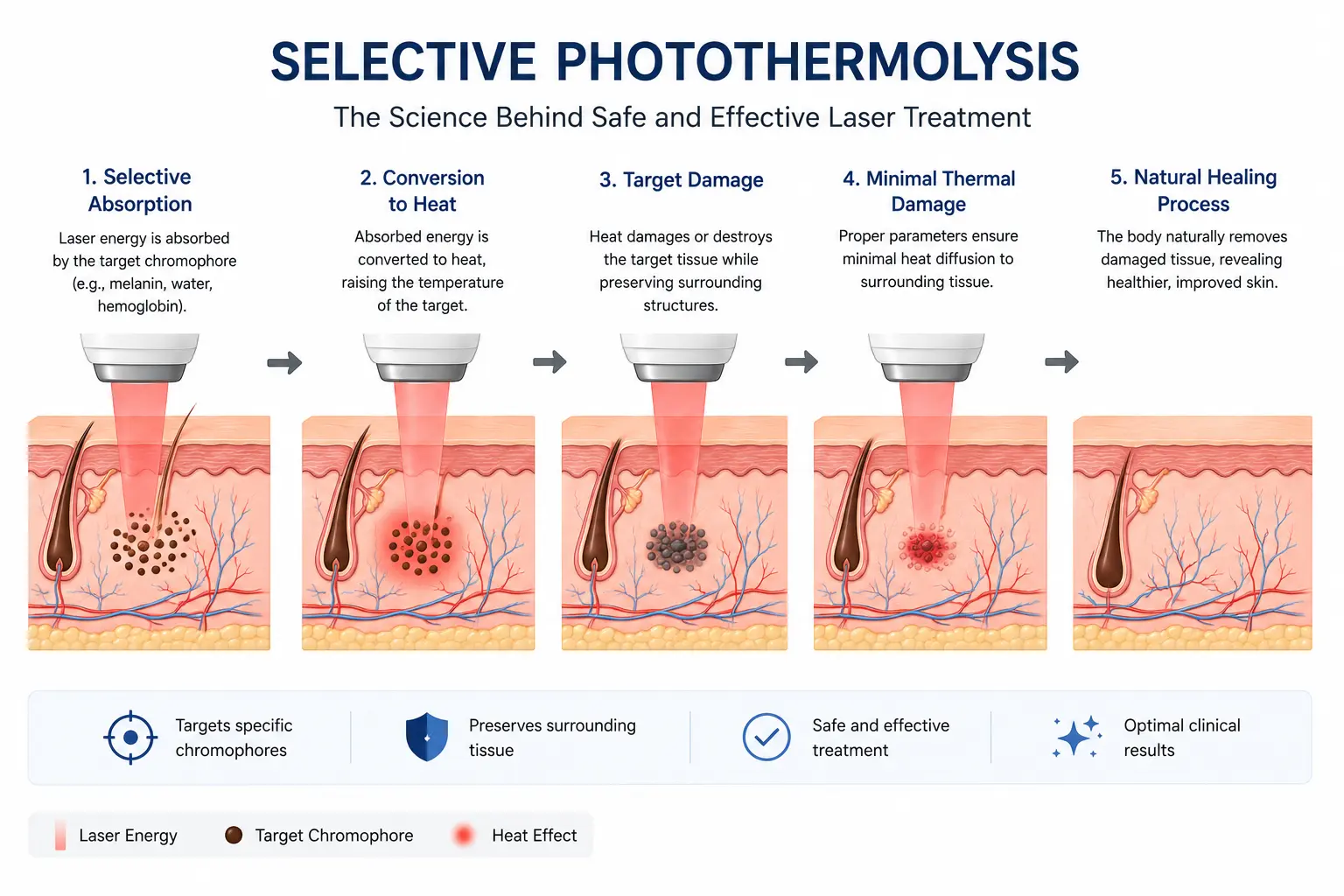
What Is Selective Photothermolysis?
Selective photothermolysis is a laser-tissue interaction principle describing how carefully selected wavelengths of light can deliver thermal energy to a specific biological target, known as a chromophore, while minimizing unwanted heating of surrounding structures. The word itself can be understood in three parts:- Selective — targeting a specific tissue component.
- Photo — using light as the energy source.
- Thermolysis — converting absorbed light into heat that produces controlled tissue effects.
Who Developed the Theory of Selective Photothermolysis?
The principle of selective photothermolysis was formally introduced in 1983 by researchers Dr. Rox Anderson and Dr. John Parrish. Their work established the scientific foundation for many of today’s laser dermatology procedures by demonstrating that appropriate combinations of wavelength, pulse duration, and energy could selectively affect target tissues while reducing collateral thermal injury. This theory transformed medical laser technology and remains one of the cornerstones of modern dermatology, aesthetic medicine, and laser surgery.Why Is Selective Photothermolysis So Important?
Without selective photothermolysis, laser systems would simply heat all tissues equally, greatly increasing the risk of burns, scarring, and unwanted tissue damage. Instead, clinicians can select treatment parameters that maximize energy absorption within the intended target while limiting unnecessary exposure elsewhere. This principle forms the scientific basis for many aesthetic procedures, including:- Laser hair reduction
- Tattoo removal
- Pigmented lesion treatment
- Vascular lesion treatment
- Fractional skin resurfacing
- Skin rejuvenation
- Acne scar treatment
How Does Selective Photothermolysis Work?
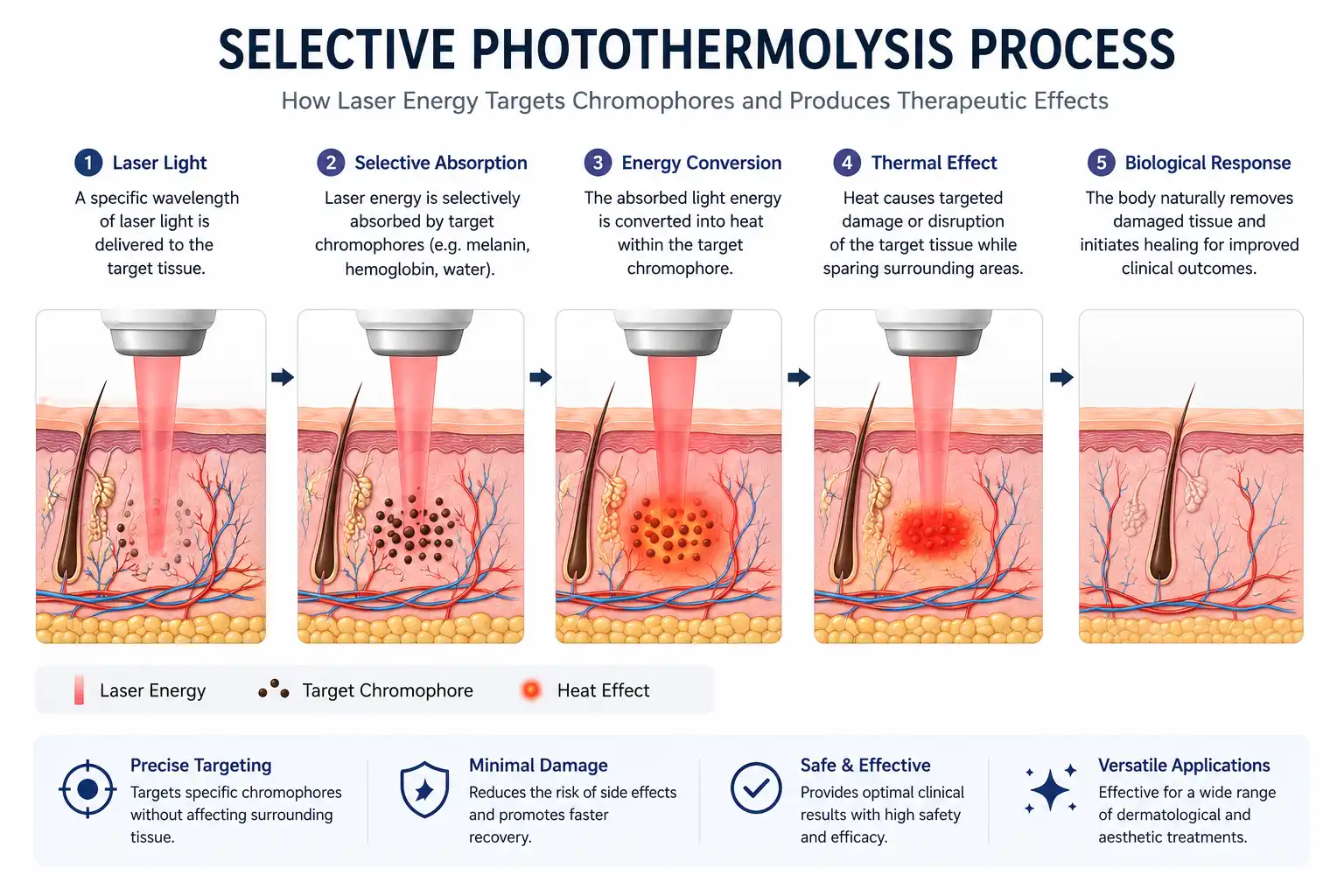
The process can be summarized as a sequence of energy transfer events:- The laser emits light at a selected wavelength.
- The light penetrates biological tissue.
- A specific chromophore preferentially absorbs the energy.
- The absorbed energy converts into heat.
- Controlled thermal effects occur within the target tissue.
- Cooling and appropriate pulse duration help reduce unnecessary heat spread to surrounding structures.
What Are Chromophores?
A chromophore is a biological substance that preferentially absorbs specific wavelengths of light. In laser medicine, chromophores determine where laser energy is deposited and therefore which tissue will be affected during treatment. Different laser procedures target different chromophores. Selecting an appropriate wavelength allows clinicians to concentrate energy within the intended target while minimizing unnecessary heating of surrounding tissue.| Chromophore | Primary Location | Typical Clinical Application |
|---|---|---|
| Melanin | Hair and epidermis | Hair reduction and pigmentation treatment |
| Hemoglobin | Blood vessels | Vascular lesion treatment |
| Water | Skin tissue | Fractional resurfacing and skin rejuvenation |
| Tattoo Pigment | Dermal ink particles | Tattoo removal |
Melanin: The Primary Target for Hair Reduction
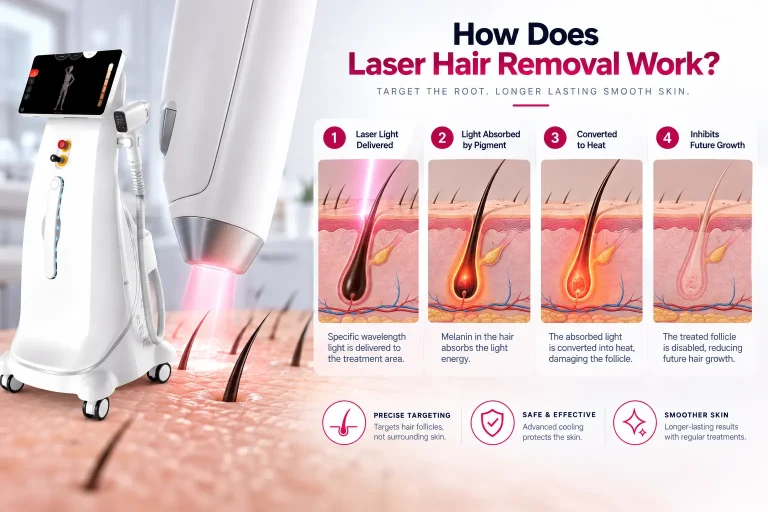
Melanin is the principal chromophore involved in professional laser hair reduction. It is responsible for much of the natural color found in hair and skin and efficiently absorbs selected laser wavelengths. During treatment, melanin inside the hair shaft absorbs optical energy and converts it into heat. This heat is conducted toward the follicle, where it produces controlled thermal effects that reduce future hair growth. Hair containing larger amounts of melanin generally absorbs more laser energy than lightly pigmented hair. Consequently, dark coarse hair often responds more predictably than blonde, gray, or white hair.Hemoglobin: The Target for Vascular Lasers
Hemoglobin is the oxygen-carrying pigment within red blood cells. Certain wavelengths are preferentially absorbed by hemoglobin, allowing vascular laser systems to selectively heat abnormal blood vessels while minimizing unnecessary thermal injury to surrounding tissue. This principle is widely used when treating vascular lesions, facial redness, spider veins, rosacea, and other vascular-related skin concerns.Water: The Foundation of Fractional CO₂ and Thulium Lasers
Water is the dominant chromophore for ablative and fractional resurfacing lasers. Unlike hair removal systems that target melanin, CO₂ and many thulium laser platforms deposit energy primarily into tissue water. Water rapidly converts absorbed laser energy into heat, producing controlled microthermal treatment zones that stimulate tissue remodeling and collagen regeneration while preserving surrounding untreated tissue. This mechanism underlies treatments for wrinkles, acne scars, surgical scars, enlarged pores, photoaging, and skin resurfacing.Tattoo Pigments as Artificial Chromophores
Tattoo inks function as artificial chromophores because pigment particles absorb specific wavelengths emitted by picosecond and Q-switched laser systems. Instead of relying primarily on thermal injury, picosecond technology produces an intense photoacoustic effect that fragments pigment particles into smaller pieces, allowing the body’s immune system to gradually remove them over time. Different tattoo colors absorb different wavelengths with varying efficiency, which is why multiple wavelengths are often incorporated into modern tattoo removal platforms.Why Does Wavelength Selection Matter?
Wavelength determines both tissue penetration depth and chromophore absorption. Selecting an appropriate wavelength is therefore one of the most important decisions during treatment planning.| Laser Type | Main Wavelength | Primary Chromophore | Typical Application |
|---|---|---|---|
| Alexandrite | 755nm | Melanin | Hair reduction |
| Diode | 808nm | Melanin | Hair reduction |
| Nd:YAG | 1064nm | Melanin / Hemoglobin | Hair reduction and vascular treatments |
| Fractional CO₂ | 10600nm | Water | Skin resurfacing |
| 1927nm Thulium | 1927nm | Water | Pigmentation and rejuvenation |
| Picosecond | 532 / 755 / 1064nm | Tattoo pigment and melanin | Tattoo and pigmentation removal |
Why Are Pulse Duration and Thermal Relaxation Time Important?
Wavelength alone cannot determine treatment success. Pulse duration must also be matched to the thermal characteristics of the target tissue. Thermal Relaxation Time (TRT) describes the time required for a heated target to lose approximately half of its thermal energy to surrounding tissue. Delivering laser energy within an appropriate time frame helps concentrate heat inside the target before excessive diffusion occurs. In practice, clinicians balance wavelength, fluence, pulse duration, repetition rate, spot size, and cooling rather than relying on a single parameter.How Is Selective Photothermolysis Applied in Modern Aesthetic Laser Treatments?
Although the scientific principle of selective photothermolysis remains the same, different medical aesthetic laser systems target different chromophores depending on the clinical objective. By selecting an appropriate wavelength, pulse duration, fluence, and cooling strategy, clinicians can concentrate laser energy within specific tissues while minimizing unnecessary thermal effects on surrounding structures. Today, this principle supports a wide range of dermatological and aesthetic procedures, including hair reduction, pigmentation management, tattoo removal, vascular treatments, skin resurfacing, and collagen remodeling.Selective Photothermolysis in Laser Hair Reduction
Hair reduction is one of the most widely recognized applications of selective photothermolysis. During treatment, laser energy is preferentially absorbed by melanin contained within the hair shaft and follicle. As melanin absorbs the selected wavelength, optical energy is converted into heat. This heat diffuses toward follicular structures responsible for hair regeneration while cooling technology helps reduce unnecessary heating of the epidermis. Modern diode laser systems commonly combine several wavelengths to improve flexibility across different skin phototypes and treatment areas. Multi-wavelength platforms allow clinicians to tailor treatments according to individual patient characteristics rather than relying on a single wavelength for every indication.Selective Photothermolysis for Pigmented Lesions
Pigmented lesions such as freckles, solar lentigines, age spots, and certain forms of hyperpigmentation also rely on selective photothermolysis. In these treatments, melanin within pigmented cells functions as the target chromophore. Appropriate wavelength selection allows laser energy to concentrate within excess pigment while reducing thermal exposure to surrounding healthy tissue. Various technologies—including picosecond lasers, Q-switched lasers, and fractional thulium systems—may be selected depending on the clinical presentation and treatment objectives.Selective Photothermolysis in Tattoo Removal
Tattoo removal applies the same targeting principle to artificial pigments embedded within the dermis. Unlike hair reduction, however, modern picosecond systems rely heavily on photoacoustic effects in addition to thermal interactions. Extremely short pulse durations generate high peak power that fragments tattoo particles into much smaller pieces. These fragments are gradually removed through the body’s natural immune response.Selective Photothermolysis in Fractional CO₂ Laser Resurfacing
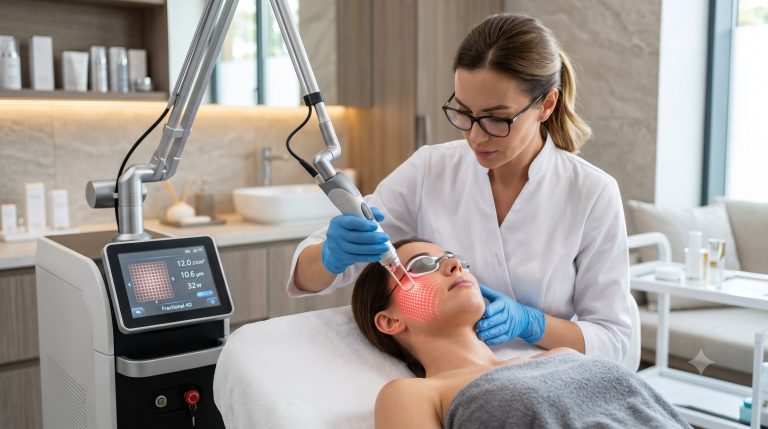
Fractional CO₂ laser systems primarily target water rather than melanin. Because water is abundant throughout skin tissue, laser energy creates microscopic treatment columns known as microthermal treatment zones (MTZs). These controlled microscopic injuries stimulate tissue remodeling and collagen production while preserving surrounding untreated skin. This fractional treatment pattern supports faster recovery compared with traditional fully ablative resurfacing. Fractional CO₂ technology is widely used for acne scars, wrinkles, enlarged pores, photoaging, and skin resurfacing procedures.Selective Photothermolysis in 1927nm Thulium Laser Treatments
The 1927nm thulium wavelength also targets tissue water but with a more superficial penetration profile than fractional CO₂ lasers. This characteristic makes it particularly suitable for treating epidermal pigmentation, photodamage, and overall skin quality while maintaining relatively short recovery periods. Controlled microthermal injury stimulates epidermal renewal while preserving much of the surrounding tissue architecture.Selective Photothermolysis in Vascular Treatments
Vascular laser systems primarily target hemoglobin within abnormal blood vessels. Following absorption, heat coagulates targeted vessels, which are subsequently reabsorbed by the body over time. Appropriate wavelength selection helps maximize hemoglobin absorption while reducing thermal exposure to surrounding tissue.How Does Selective Photothermolysis Differ Between Lasers and IPL?
Both lasers and Intense Pulsed Light (IPL) systems rely on selective absorption by chromophores, but they generate light differently.| Feature | Laser | IPL |
|---|---|---|
| Light Source | Single coherent wavelength | Broad-spectrum pulsed light |
| Target Specificity | Higher | Filter-dependent |
| Clinical Precision | Generally higher | Broader treatment versatility |
| Typical Applications | Hair removal, tattoo removal, resurfacing | Hair reduction, photorejuvenation, pigmentation, vascular lesions |
How Different Laser Technologies Apply Selective Photothermolysis
| Technology | Primary Chromophore | Main Clinical Applications |
|---|---|---|
| Diode Laser | Melanin | Hair reduction |
| Alexandrite Laser | Melanin | Hair reduction |
| Nd:YAG Laser | Melanin / Hemoglobin | Hair reduction, vascular treatments |
| Picosecond Laser | Tattoo pigment, melanin | Tattoo removal, pigmentation |
| Fractional CO₂ Laser | Water | Skin resurfacing, acne scars |
| 1927nm Thulium Laser | Water | Pigmentation, skin rejuvenation |
| IPL / OPT | Melanin / Hemoglobin | Hair reduction, photorejuvenation, vascular lesions |
Advantages and Limitations of Selective Photothermolysis
Selective photothermolysis has fundamentally changed medical laser technology by enabling clinicians to deliver energy more precisely than earlier non-selective thermal treatment methods. By matching laser parameters to specific chromophores, modern laser systems can achieve predictable clinical effects while helping preserve surrounding tissue. However, successful treatment depends on appropriate patient selection, accurate parameter adjustment, and proper operator training. Selective photothermolysis is a scientific principle—not a guarantee of identical outcomes for every patient.| Advantages | Clinical Considerations |
|---|---|
| Selective targeting of specific tissues | Requires accurate wavelength selection |
| Reduced thermal injury to surrounding skin | Cooling remains essential |
| Applicable across multiple laser technologies | Different chromophores require different parameters |
| Supports predictable clinical outcomes | Operator training significantly influences results |
| Foundation of modern aesthetic laser medicine | Patient-specific treatment planning is required |
Common Misconceptions About Selective Photothermolysis
Myth 1: Higher Energy Always Produces Better Results
Treatment success depends on balancing wavelength, fluence, pulse duration, spot size, repetition rate, and cooling. Increasing energy alone does not necessarily improve outcomes and may increase unnecessary thermal exposure.Myth 2: One Laser Can Treat Every Condition Equally Well
Different wavelengths interact with different chromophores. A wavelength that performs well for hair reduction may not be the most appropriate choice for tattoo removal, vascular lesions, or fractional resurfacing.Myth 3: Selective Photothermolysis Applies Only to Hair Removal
Although the concept is frequently introduced through laser hair reduction, it also forms the scientific basis of pigmentation treatment, vascular therapy, tattoo removal, fractional CO₂ resurfacing, and many other laser-assisted procedures.How Is Selective Photothermolysis Evolving?
Advances in laser engineering continue to improve how selective photothermolysis is applied in clinical practice. Modern platforms increasingly integrate multiple wavelengths, intelligent energy control, enhanced cooling systems, larger spot sizes, and real-time parameter optimization. Rather than replacing the principle itself, these innovations enable clinicians to apply selective photothermolysis more consistently across a wider range of indications and patient characteristics.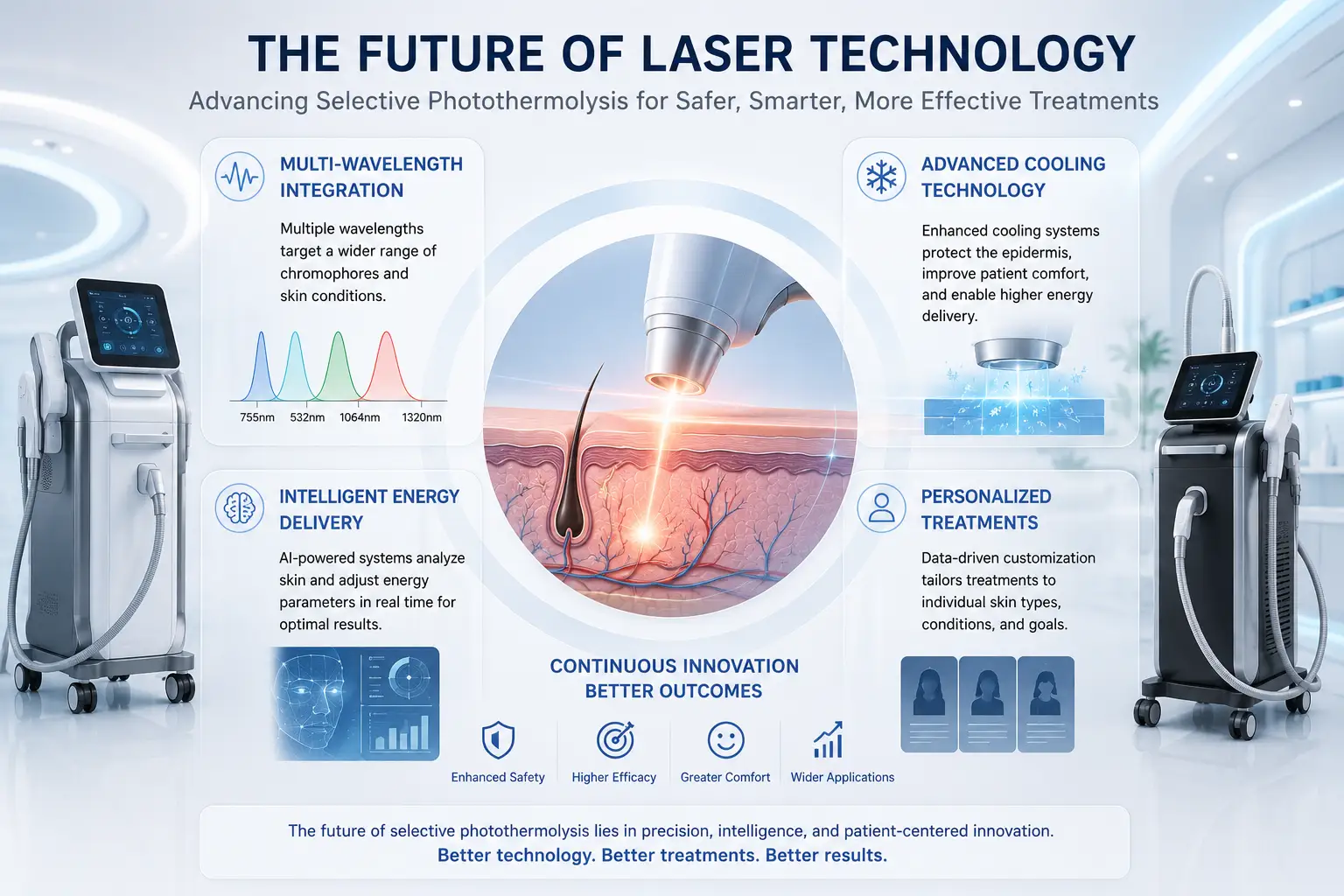
Frequently Asked Questions
What is selective photothermolysis in simple terms?
It is the principle of using a carefully selected laser wavelength to deliver heat to a specific target—such as melanin, hemoglobin, water, or tattoo pigment—while reducing unnecessary heating of surrounding tissue.Why is selective photothermolysis important?
It provides the scientific foundation for many modern laser procedures by allowing energy to be concentrated within the intended treatment target instead of heating all tissues equally.Which aesthetic treatments use selective photothermolysis?
Professional laser hair reduction, tattoo removal, pigmentation treatment, vascular lesion therapy, fractional CO₂ resurfacing, and 1927nm thulium treatments all apply this principle using different chromophores and laser parameters.Is selective photothermolysis only related to lasers?
Laser systems are the most common application, but IPL devices also rely on selective absorption of light by chromophores, although they use filtered broad-spectrum light rather than a single coherent wavelength.References
- Anderson RR, Parrish JA. Selective Photothermolysis: Precise Microsurgery by Selective Absorption of Pulsed Radiation. Science . 1983.
- ANSI Z136.3 – Safe Use of Lasers in Health Care.
- IEC 60825 – Safety of Laser Products.
- ISO 13485 – Medical Devices: Quality Management Systems.
- Current peer-reviewed dermatology and laser medicine literature.