The “Baby Face” Effect: How 1927nm Thulium Lasers Revolutionized Non-Ablative Skin Resurfacing
Executive Summary:
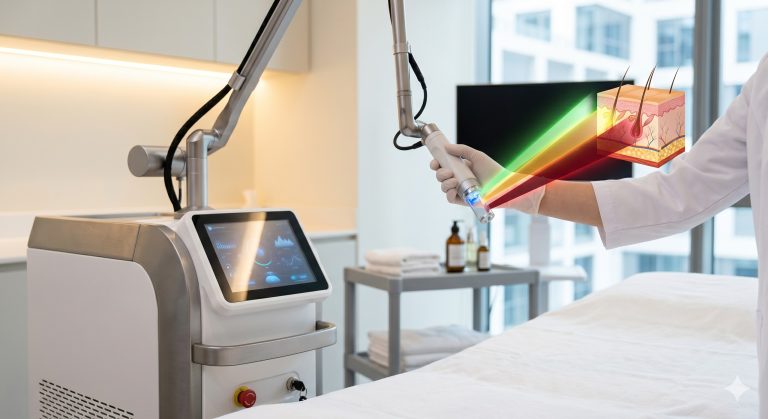
The 1927nm Thulium laser represents a pivotal advancement in non-ablative skin resurfacing, engineered to address epidermal pigmentation, textural irregularities, and advanced photoaging with near-zero clinical downtime. By leveraging a highly specific water absorption coefficient, this fractional photothermolysis modality precisely targets the epidermal-dermal junction while strictly preserving the stratum corneum. This translates to unparalleled safety across the entire Fitzpatrick Scale (I-VI), drastically minimizing Post-Inflammatory Hyperpigmentation (PIH) risks. For aesthetic clinics and dermatological practices, the Thulium laser offers an exceptional Return on Investment (ROI) driven by high patient throughput (“lunchtime procedures”), robust delegability, and seamless integration with Laser-Assisted Drug Delivery (LADD) protocols. As a premier professional medical laser device supplier, Cocoon Laser provides Medical CE and FDA 510(k) compliant systems designed to optimize Total Cost of Ownership (TCO) while delivering the highly sought-after “Baby Face” clinical endpoints.
Executive Summary: The Paradigm Shift in Aesthetic Dermatology
The aesthetic medicine landscape is undergoing a rigorous transition, driven simultaneously by advancements in photonics and shifting patient demographics. Modern patients demand high-impact results without the prohibitive recovery periods historically associated with aggressive laser interventions. This intersection of demand and technology has elevated the 1927nm Thulium laser from a niche modality to a cornerstone of comprehensive dermatological practice.
Defining the “Baby Face” Phenomenon Clinically
In consumer marketing, the term “Baby Face” is ubiquitous, but within clinical practice, it requires an objective definition. Clinically, this phenomenon refers to the comprehensive restoration of epidermal health. It is characterized by the refinement of micro-texture, a statistically significant reduction in pore volume, the normalization of melanin distribution (even tone), and the smoothing of superficial rhytides (fine lines). Crucially, achieving this endpoint with a Thulium system requires zero clinical downtime—patients experience transient erythema rather than the prolonged exudative phases of traditional resurfacing.
The Transition from Ablative to Advanced Non-Ablative Modalities
For decades, ablative technologies such as 10600nm $CO_2$ and 2940nm Erbium:YAG ($Er:YAG$) represented the gold standard for dramatic tissue remodeling. However, their aggressive vaporization of the epidermis necessitates significant downtime, intense post-operative wound care, and carries an elevated risk profile for scarring and PIH, particularly in skin types III through VI.
The commercial and clinical logic has thus shifted toward advanced non-ablative modalities. By generating controlled thermal injury without vaporizing tissue, non-ablative systems stimulate neocollagenesis and epidermal turnover while maintaining a functional skin barrier. The 1927nm wavelength, in particular, perfectly bridges the gap between the superficial action of chemical peels and the deeper remodeling of traditional lasers, offering a highly predictable, repeatable, and profitable treatment protocol for clinics.
The Physics of 1927nm: Understanding Thulium Laser Photothermolysis
To evaluate the clinical utility of the Thulium laser, procurement directors and dermatologists must understand its fundamental interaction with tissue. The efficacy of the 1927nm wavelength is dictated by the principles of selective photothermolysis, specifically its interaction with tissue water.
The Unique Water Absorption Coefficient
The primary chromophore for the 1927nm wavelength is water ($H_2O$). However, its absorption coefficient is the key differentiator.
- Compared to 1550nm (Erbium Glass): The 1927nm wavelength features a water absorption coefficient roughly an order of magnitude higher than the 1550nm wavelength. Because it is absorbed more rapidly by water, the 1927nm energy cannot penetrate as deeply. It expends its thermal energy primarily within the epidermis and the uppermost papillary dermis (typically $200\text{ \mu m}$ to $300\text{ \mu m}$ deep).
- Compared to 10600nm ($CO_2$): While $CO_2$ has an exceptionally high water absorption rate causing immediate tissue vaporization (ablation), the 1927nm absorption is balanced perfectly to cause coagulation rather than vaporization.
This specific penetration profile makes the Thulium laser the optimal tool for targeting superficial dyschromia and epidermal photoaging.
Creating Macroscopic Epidermal Necrotic Debris (MENDs)
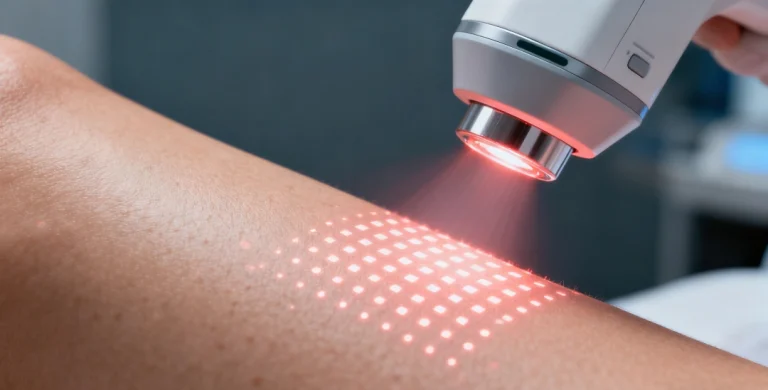
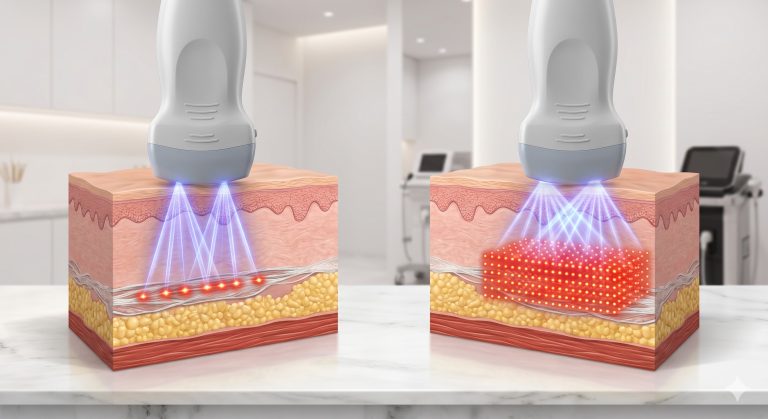
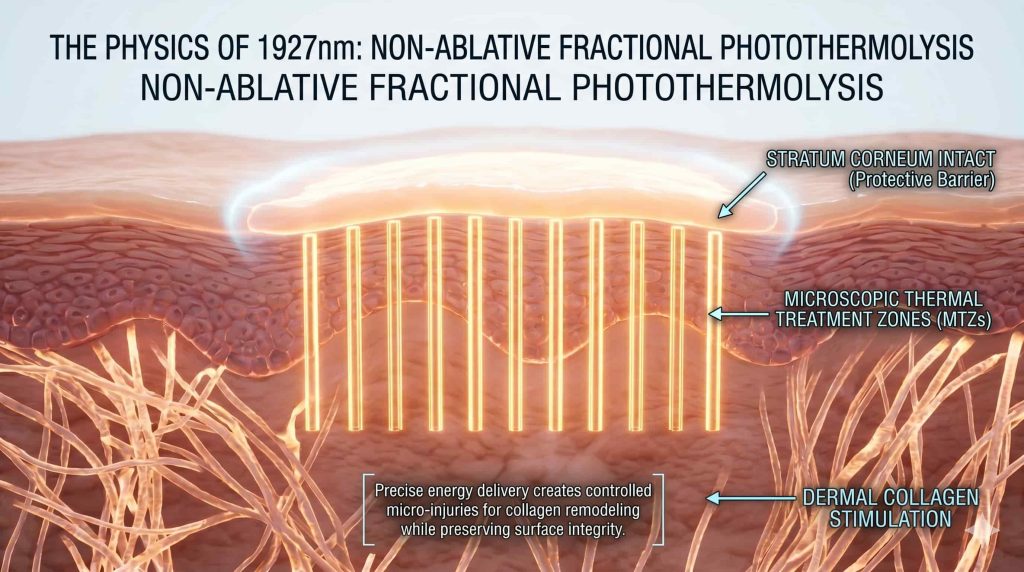
When the fractional Thulium laser fires, it creates columns of thermal coagulation known as Microscopic Treatment Zones (MTZs). Because the laser targets the basal layer where melanocytes reside, it denatures the pigment-laden keratinocytes. Over the course of 3 to 7 days post-treatment, these coagulated zones are pushed upward by the natural epidermal turnover process, forming Macroscopic Epidermal Necrotic Debris (MENDs). Clinically, this presents as a micro-crusting or a “sandpaper” texture on the skin surface. As the MENDs naturally exfoliate, they carry the excess melanin out of the skin, resulting in a dramatically brighter and more uniform complexion.
Preservation of the Stratum Corneum
The most critical safety feature of the 1927nm non-ablative process is the preservation of the stratum corneum. Because the outermost layer of the skin contains relatively lower water content (approximately 10-15%) compared to the underlying viable epidermis (up to 70%), the 1927nm energy largely passes through the stratum corneum without destroying it.
- Clinical Benefit: The intact stratum corneum acts as a natural biological dressing. It prevents opportunistic bacterial infections and critically minimizes Transepidermal Water Loss (TEWL).
- Patient Benefit: No open wounds, no requirement for occlusive dressings, and the ability to apply makeup within 24 hours.
Primary Clinical Indications and Efficacy for Dermatologists
For a clinical practice to justify the capital expenditure of a new laser system, the device must demonstrate versatility across high-demand indications.
Epidermal Pigmentation and Melasma Management
The 1927nm wavelength is highly efficacious for clearing benign pigmented lesions, including ephelides (freckles), lentigines (sun spots), and general dyschromia. Furthermore, it has become a vital component in the complex management of melasma. Because melasma is easily exacerbated by excessive heat and inflammation, the controlled, lower-density thermal profile of the Thulium laser allows for the gentle clearance of epidermal pigment without triggering the hyperactive melanocyte response often seen with aggressive photothermal lasers.
Textural Refinement and Actinic Keratosis (AK)
Beyond pigmentation, the Thulium laser excels at dermal remodeling for textural issues. The thermal heat dissipating from the MTZs stimulates fibroblasts in the papillary dermis, upregulating the production of Type I and Type III collagen. This leads to a visible reduction in pore size and the smoothing of fine rhytides. Additionally, Thulium systems are frequently utilized and FDA-cleared for the treatment of Actinic Keratosis, clearing pre-cancerous lesions through controlled epidermal necrosis.
Synergistic Therapies: Laser-Assisted Drug Delivery (LADD)
Perhaps the most commercially lucrative application of the Thulium laser currently is its role as a laser-assisted drug delivery system. The MTZs created by the laser act as transient micro-channels in the skin.
Immediately post-treatment, the permeability of the skin is exponentially increased. Clinics are leveraging this by applying high-value topical therapeutics—such as lyophilized Exosomes, Tranexamic Acid (for melasma), or stabilized Vitamin C—directly onto the treated area. The acoustic and thermal channels allow these macromolecules to bypass the epidermal barrier and reach the dermis, achieving a synergistic 1+1>2 clinical outcome. This protocol not only enhances results but allows clinics to create premium-priced, bespoke treatment packages.
The Business Case: Why Thulium Lasers are a High-ROI Investment for Clinics
From the perspective of a B2B buyer or clinic owner, clinical efficacy must be matched by financial viability. The integration of a Thulium laser fundamentally improves a clinic’s operational metrics.
Meeting Patient Demand for “Lunchtime Procedures”
The aesthetic market is heavily skewed toward treatments with high tolerability and low downtime. The 1927nm laser meets this demand perfectly. Patients can undergo a full-face treatment in under 20 minutes (often with minimal topical anesthesia) and return to work immediately with only mild erythema. This convenience drives high patient compliance, encouraging them to complete recommended treatment series (typically 3-5 sessions) and increasing lifetime patient value (LTV).
Treating Diverse Patient Demographics (Fitzpatrick I-VI Safety)
Traditional resurfacing lasers represent a severe liability when treating darker skin types due to the high risk of PIH. The non-ablative nature and precise depth control of the Thulium laser make it remarkably safe for Fitzpatrick Skin Types IV through VI. By effectively mitigating the PIH risk, clinics can confidently market their resurfacing services to a much broader demographic, expanding their addressable market and maximizing the utilization rate of the device.
Delegability and Operational Efficiency
Advanced laser systems designed by reputable aesthetic laser suppliers feature intuitive, protocol-driven interfaces. The predictable tissue interaction of the 1927nm wavelength means the treatment has a relatively flat learning curve. In jurisdictions where regulations permit, these treatments can be safely delegated to physician assistants, nurse practitioners, or highly trained dermal aestheticians. This delegability frees up the lead physician to perform complex surgical or injectable procedures, thereby optimizing the clinic’s overall revenue per square foot (坪效) and human resource efficiency (人效). Furthermore, with a low consumable overhead per treatment (aside from standard shots count degradation on the optics), the gross margin per session remains highly attractive.
Thulium 1927nm vs. Other Resurfacing Technologies: A Comparative Analysis
To assist procurement teams in evaluating their technological infrastructure, the following structural matrices differentiate the 1927nm Thulium laser from legacy and alternative modalities.
1927nm Thulium vs. 1550nm Erbium Glass
Both are non-ablative fractional lasers, but their disparate absorption profiles dictate distinct clinical applications.
| Feature / Metric | 1927nm Thulium Laser | 1550nm Erbium Glass Laser |
| Water Absorption | Very High | Moderate |
| Primary Target Depth | Epidermis & Papillary Dermis ($200-300\text{ \mu m}$) | Deep Dermis (up to $1500\text{ \mu m}$) |
| Clinical Focus | Pigmentation, texture, tone, superficial fine lines, LADD | Deep acne scars, deep wrinkles, severe dermal remodeling |
| Pain Level | Low to Moderate (Highly tolerable) | Moderate to High (Requires strong topical/local blocks) |
| Downtime / Recovery | 1-3 days (Mild erythema, micro-crusting) | 3-5 days (Significant edema, prolonged erythema) |
| Optimal Patient Profile | “Baby Face” seekers, early photoaging, melasma patients | Patients with severe atrophic scarring or advanced elastosis |
1927nm Thulium vs. Q-Switched / Picosecond Lasers
While both modalities address pigmentation, their physical mechanisms of action are fundamentally different.
| Feature / Metric | 1927nm Thulium Laser | Picosecond / Q-Switched Lasers |
| Mechanism of Action | Photothermal: Coagulates tissue containing melanin; body extrudes pigment via MENDs. | Photoacoustic: Mechanically shatters melanin/ink into micro-particles; cleared by macrophages. |
| Pulse Duration | Milliseconds ($ms$) | Nanoseconds ($ns$) to Picoseconds ($ps$) |
| Primary Indication | Global epidermal resurfacing, texture improvement, overall brightening. | Focal pigmented lesions, tattoo removal, localized dermal pigment (Ota, Hori’s). |
| Tissue State Post-Tx | Intact stratum corneum with underlying thermal coagulation. | Potential for localized petechiae (LIOB formation) or epidermal disruption at high fluences. |
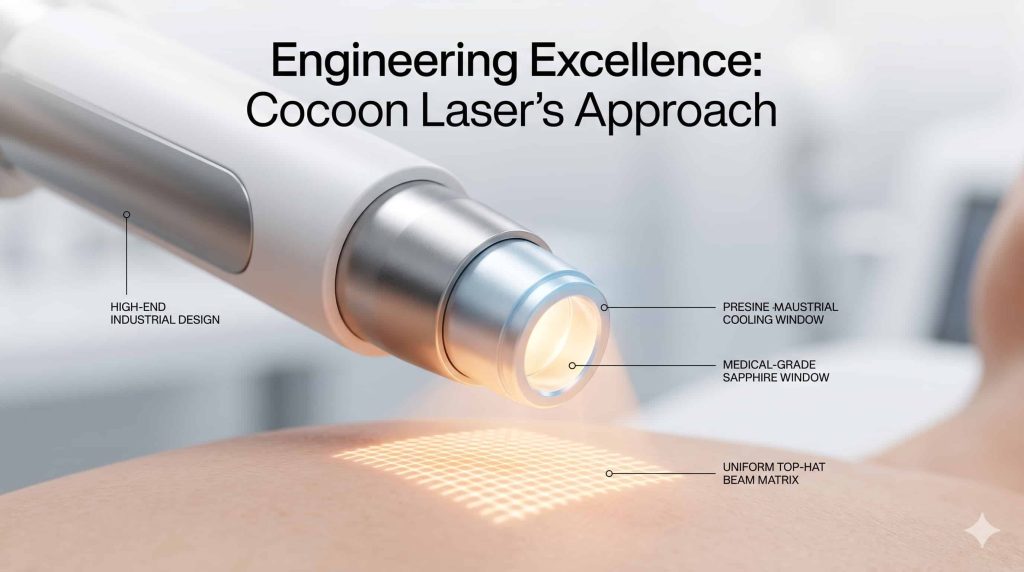
Engineering Excellence: Cocoon Laser’s Approach to Thulium Technology
As a vanguard in manufacturing medical CE certified aesthetic devices, Cocoon Laser engineers its Thulium platforms to meet the exacting standards of high-volume international clinical environments. The hardware architecture is designed not just for clinical efficacy, but for absolute stability and precision.
Precision Beam Profiling and Fractional Delivery
Substandard fractional lasers often suffer from Gaussian beam profiles where the center of the micro-beam is excessively hot, while the edges fall below the therapeutic threshold. Cocoon Laser’s 1927nm systems utilize advanced optical engineering to deliver a Top-hat beam profile. This ensures that energy is distributed uniformly across the entire diameter of every MTZ.
Coupled with a high-speed, randomized magnetic scanner, the system ensures that consecutive laser pulses are non-adjacent. This proprietary random emission pattern drastically reduces bulk heating and thermal stacking in the tissue, virtually eliminating the risk of accidental burns and ensuring uniform clinical results even during rapid, high-coverage passes. Furthermore, advanced internal thermal management (incorporating robust cooling architectures similar to TEC Cooling principles found in high-powered diodes) ensures the generator output remains perfectly stable, even during continuous multi-hour operation.
Intuitive Interface and Customizable Dosimetry
Aesthetic medicine is not one-size-fits-all. Cocoon Laser platforms are equipped with highly customizable dosimetry controls. Clinicians can independently adjust:
- Power (Watts/mJ): To dictate the depth of coagulation.
- Density (Coverage %): To control the aggressiveness of the resurfacing (e.g., 5% for a light “glow” treatment vs. 20% for severe actinic damage).
- Scanning Shapes: To perfectly adapt to facial contours, minimizing overlapping on sensitive areas like the periorbital region.
This level of granular control empowers dermatologists to tailor protocols ranging from a pre-event “lunchtime glow” to aggressive corrective resurfacing, maximizing the utility of the device.
Conclusion: The Future of Preventive and Restorative Aesthetic Medicine
Summary of the Thulium Advantage
The 1927nm Thulium laser has irrevocably altered the algorithm of aesthetic dermatology. By establishing a golden equilibrium between robust clinical efficacy and near-zero downtime, it perfectly satisfies the modern patient’s desire for the “Baby Face” effect. Its ability to uniformly clear epidermal pigmentation, refine texture, safely treat all Fitzpatrick skin types, and act as an unparalleled vehicle for laser-assisted drug delivery makes it an indispensable asset. For clinics, it represents a high-ROI, highly delegable system that ensures rapid capital amortization and exceptional patient retention.
Partner with Cocoon Laser
Upgrading your clinical infrastructure requires partnering with an equipment manufacturer that understands both the physics of photonics and the realities of commercial clinic operations. Cocoon Laser is committed to providing cutting-edge, compliant, and clinically validated aesthetic lasers to the global B2B market.
To explore the detailed technical specifications of our 1927nm Thulium platforms, review comprehensive clinical before-and-after data, or request a precise Total Cost of Ownership (TCO) analysis for your practice, connect with our engineering and commercial teams today.
Elevate Your Clinical Practice. Explore Advanced Modalities at Cocoon Laser
If you need more information, please click “Contact Us”.
If you want to obtain more information, please follow our official website and Facebook.