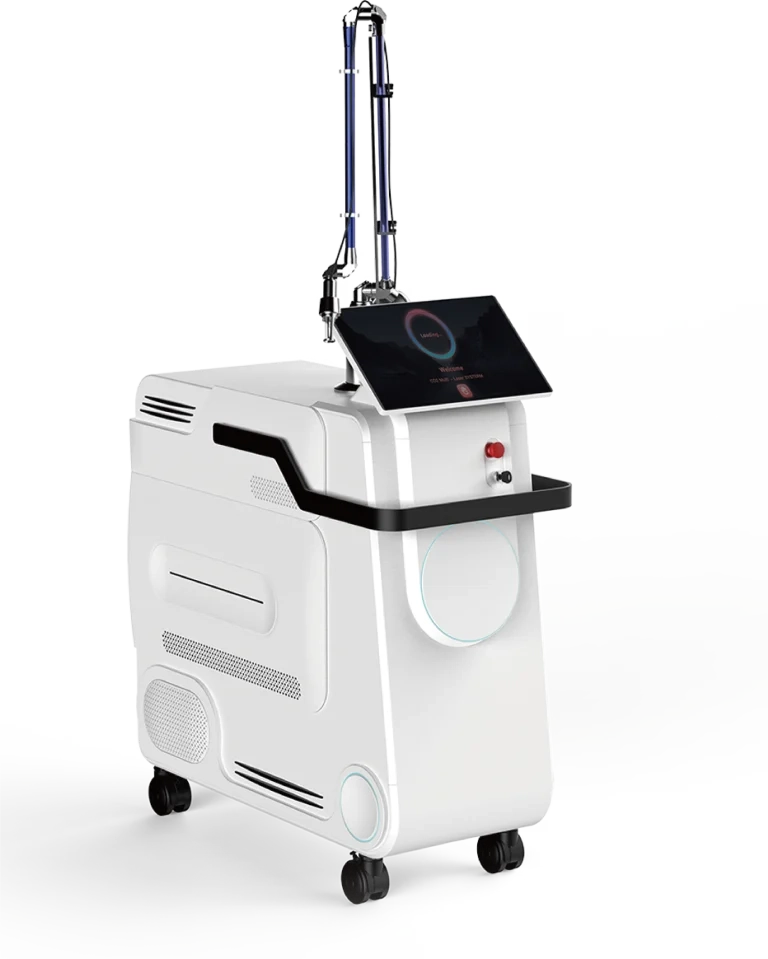
Best Fractional CO2 Laser Machines for Clinics
For dermatologists, aesthetic clinics, hospitals, medical spas, distributors and purchasing managers.
Published by Cocoon Laser · Updated October 2026
Choosing the best fractional CO2 laser machine for a clinic involves more than comparing laser power or brand recognition. A professional buyer needs to evaluate the laser source, fractional scanning technology, available handpieces, authorized treatment applications, service arrangements and total equipment cost.
Some clinics prioritize an established medical laser platform with local service support. Others need a configurable fractional CO2 laser system for a growing treatment center or an international distribution business. These purchasing scenarios call for different equipment selection criteria.
This guide compares five professional CO2 laser platforms and explains how to evaluate their suitability. It includes two Cocoon Laser systems alongside established international brands, with a clear distinction between documented product specifications and information that must be confirmed directly with each supplier.
Quick Answer: What Is the Best Fractional CO2 Laser Machine?
There is no single best fractional CO2 laser machine for every clinic. The appropriate choice depends on treatment requirements, operator qualifications, available budget, local regulatory status and technical support.
CO2 Star is worth considering for professional B2B buyers seeking a configurable 10600nm, 40W RF-excited CO2 platform. CO2 4D is another multi-mode option for clinics and distributors evaluating different applicator configurations. Lumenis UltraPulse Alpha, DEKA SmartXide Tetra and Alma Pixel CO2 are established-brand platforms to investigate when brand-specific technology, clinical documentation or regional service availability are purchasing priorities.
Before purchasing, obtain model-specific technical documentation, confirm legally permitted indications and compare complete quotations rather than marketing claims alone.
Our Top 5 Fractional CO2 Laser Machines for Clinics
CO2 Star
Professional 10600nm fractional CO2 platform with a supplier-listed 40W RF-excited source and multiple operating modes.
CO2 4D
Professional fractional CO2 platform with multiple applicator options and a built-in smoke evacuation feature listed in supplier documentation.
Lumenis UltraPulse Alpha
A premium-brand CO2 laser platform to investigate for specialist medical applications and manufacturer-supported configurations.
DEKA SmartXide Tetra
A professional CO2 laser platform associated with configurable treatment approaches and specialized aesthetic applications.
Alma Pixel CO2
A fractional CO2 platform to compare for clinics prioritizing established-brand resurfacing technology and regional support.
Fractional CO2 Laser Machine Comparison Table
The table below highlights the primary purchasing considerations. It does not imply that different devices have equivalent clinical performance. Confirm the exact generation and regional configuration of each machine.
| Machine | Technology / Configuration | Best-Fit Purchasing Scenario | Price Information |
|---|---|---|---|
| CO2 StarCocoon Laser | 10600nm; 40W RF-excited; fractional and additional modes | Professional B2B procurement and distributor evaluation | Request quotation |
| CO2 4DCocoon Laser | 10600nm; 40W RF-excited; four listed modes; multiple applicators | Multi-mode equipment configuration | Request quotation |
| UltraPulse AlphaLumenis | Professional CO2 platform; exact model specifications require confirmation | Established-brand specialist equipment | Distributor quotation |
| SmartXide TetraDEKA | Professional CO2 platform; confirm pulse and accessory package | Specialist aesthetic workflows | Distributor quotation |
| Pixel CO2Alma | Fractional CO2 platform; confirm exact product generation | Fractional resurfacing equipment evaluation | Distributor quotation |
The purchasing categories above are editorial distinctions, not objective awards or comparative performance rankings. All model-specific claims should be checked against current manufacturer documentation.
Why Trust This Guide?
Cocoon Laser operates in the professional aesthetic equipment supply market. Our perspective focuses on questions that matter to equipment buyers: configuration, supplier documentation, operating costs, training, service and purchasing terms.
The specifications for CO2 Star and CO2 4D are drawn from Cocoon Laser product documentation. The competing platforms are discussed as relevant purchasing alternatives, without inventing comparative test results or confidential commercial pricing.
This guide should be treated as a structured starting point for supplier due diligence. It does not replace clinical evidence reviews, independent equipment inspections, regulatory checks or consultation with qualified laser specialists.
How We Selected These Fractional CO2 Laser Machines
We considered five criteria when preparing this shortlist:
- Relevance: The equipment must be associated with professional CO2 laser applications rather than consumer beauty devices.
- Technology: The platform should offer fractional treatment capabilities or an appropriate CO2 laser configuration.
- Purchasing fit: The device should address a recognizable clinic, hospital or distributor procurement scenario.
- Supplier evaluation: Buyers should be able to request technical documents, accessory details and service terms.
- Comparison value: The shortlist should cover different purchasing priorities rather than repeat nearly identical marketing descriptions.
We did not perform independent optical measurements, clinical outcome comparisons or blinded practitioner evaluations. Accordingly, this article does not assign numerical performance scores.
Detailed Reviews of the Best Fractional CO2 Laser Machines
CO2 Star — Cocoon Laser
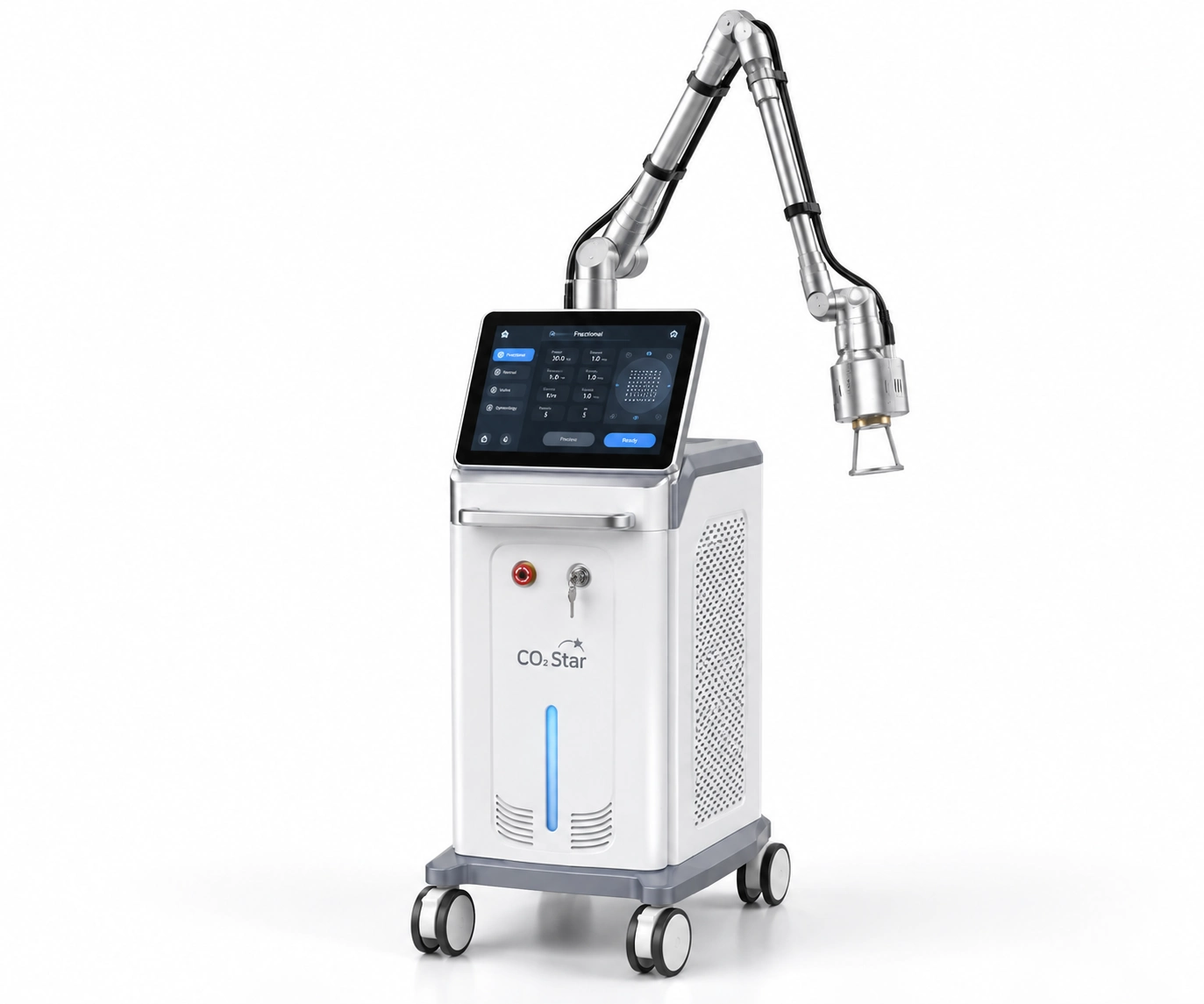
CO2 Star is a professional 10600nm fractional CO2 laser system in Cocoon Laser’s B2B equipment portfolio. According to supplier documentation, it combines a 40W RF-excited CO2 source, a seven-joint articulated arm and multiple treatment configurations.
Its documented operating options include fractional, normal, vulva and gynecology modes. The availability of these modes does not establish their legal use in every market. Buyers must verify device-specific indications, accessories and practitioner requirements.
Key Specifications
- 10600nm CO2 laser wavelength
- 40W maximum rated output
- RF-excited CO2 laser source
- Seven-joint articulated arm
- Four listed operating modes
- Nine applicator options in product documentation
- Built-in smoke evacuation feature listed by the supplier
Why Buyers May Consider CO2 Star
The platform offers a starting point for clinics and distributors seeking a configurable fractional CO2 machine from a B2B equipment supplier. Its published configuration allows buyers to ask detailed questions about source performance, scanning controls, accessories and customization.
What to Verify
Request the official model-specific data sheet, measured laser output information, a complete handpiece list, safety documentation, warranty terms and confirmation of the exact delivered configuration.
Worth shortlisting for professional B2B procurement where configuration flexibility and supplier-direct discussions are important.
CO2 4D — Cocoon Laser

CO2 4D is another professional 10600nm fractional CO2 platform offered by Cocoon Laser. Its product documentation lists a 40W RF-excited source, four treatment modes, nine applicator options and a seven-joint articulated arm.
The platform is positioned for professional aesthetic and dermatology equipment markets, including buyers interested in multiple treatment configurations within one system.
Key Specifications
- 10600nm CO2 wavelength
- 40W RF-excited laser source
- Four listed treatment modes
- Nine applicator options
- Adjustable scanning graphics and spot configurations
- Seven-joint articulated arm
- Built-in smoke evacuation system listed by the supplier
Why Buyers May Consider CO2 4D
CO2 4D may appeal to clinics and distributors that want to compare multiple operating modes and accessory configurations. It is especially relevant when a buyer wants a single supplier to explain the differences between available fractional CO2 product models.
What to Verify
Because CO2 Star and CO2 4D share several headline specifications, buyers should ask for a side-by-side model comparison. Important details include pulse control, scanner functions, standard accessories, included smoke evacuation equipment, warranty and service.
A relevant multi-mode option, but its practical advantages over CO2 Star should be established through configuration-specific documentation rather than assumed from the model name.
Lumenis UltraPulse Alpha

Lumenis is an established name in professional laser equipment, and the UltraPulse product family is associated with specialist CO2 laser applications.
For clinics evaluating a premium-brand platform, UltraPulse Alpha is a candidate for further investigation. Buyers should assess its available delivery systems, treatment accessories, clinical documentation and authorized applications in their own market.
Potential Purchasing Advantages
- Established manufacturer and product-family recognition
- Opportunity to evaluate specialist CO2 laser configurations
- Manufacturer and distributor documentation for due diligence
- Potential access to region-specific training and service channels
What to Verify
Ask the regional supplier for the exact model’s technical specifications, accessory compatibility, approved indications, installation requirements and service coverage. Do not assume every UltraPulse product generation includes identical features.
A suitable research candidate for clinics prioritizing established-brand specialist equipment and the availability of local authorized support.
DEKA SmartXide Tetra

DEKA SmartXide Tetra is a professional CO2 laser platform associated with aesthetic resurfacing and configurable laser treatment approaches.
It is worth researching for practices that want to compare specialized treatment workflows, pulse-control options and established-brand equipment support.
Potential Purchasing Advantages
- Professional CO2 laser platform positioning
- Focus on configurable treatment approaches
- Relevant to clinics comparing specialized resurfacing workflows
- Regional distributor support may be available
What to Verify
Request the official current model specifications, available pulse technologies, compatible handpieces, local regulatory status and service terms. Confirm whether any advertised treatment accessories are included or sold separately.
A relevant comparison candidate for clinics where treatment workflow and specific pulse-control capabilities are major selection factors.
Alma Pixel CO2

Alma’s Pixel CO2 product family is associated with professional fractional CO2 resurfacing technology. It is a relevant candidate for buyers who want to compare established-brand fractional platforms.
Product generations and regional availability can differ, so buyers should avoid treating the Pixel CO2 name as a single universal specification.
Potential Purchasing Advantages
- Established medical aesthetic equipment brand
- Fractional resurfacing-focused product positioning
- Opportunity to evaluate branded optical and scanning technologies
- Potential regional training and service arrangements
What to Verify
Confirm the exact product generation, laser source specifications, scanning functions, available handpieces, regulatory authorization and local after-sales support.
Worth investigating when a clinic values established-brand fractional resurfacing technology and can obtain reliable local product support.
What Makes a Good Fractional CO2 Laser Machine?
A fractional CO2 laser uses light at approximately 10600nm, which is strongly absorbed by water in tissue. Fractional delivery creates discrete microscopic treatment zones while leaving surrounding areas untreated.
Treatment effects depend on pulse characteristics, delivered energy, treatment density, scanning geometry and clinical technique. Device selection should be based on the intended procedure and documented performance rather than a single headline specification.
Laser Source Quality
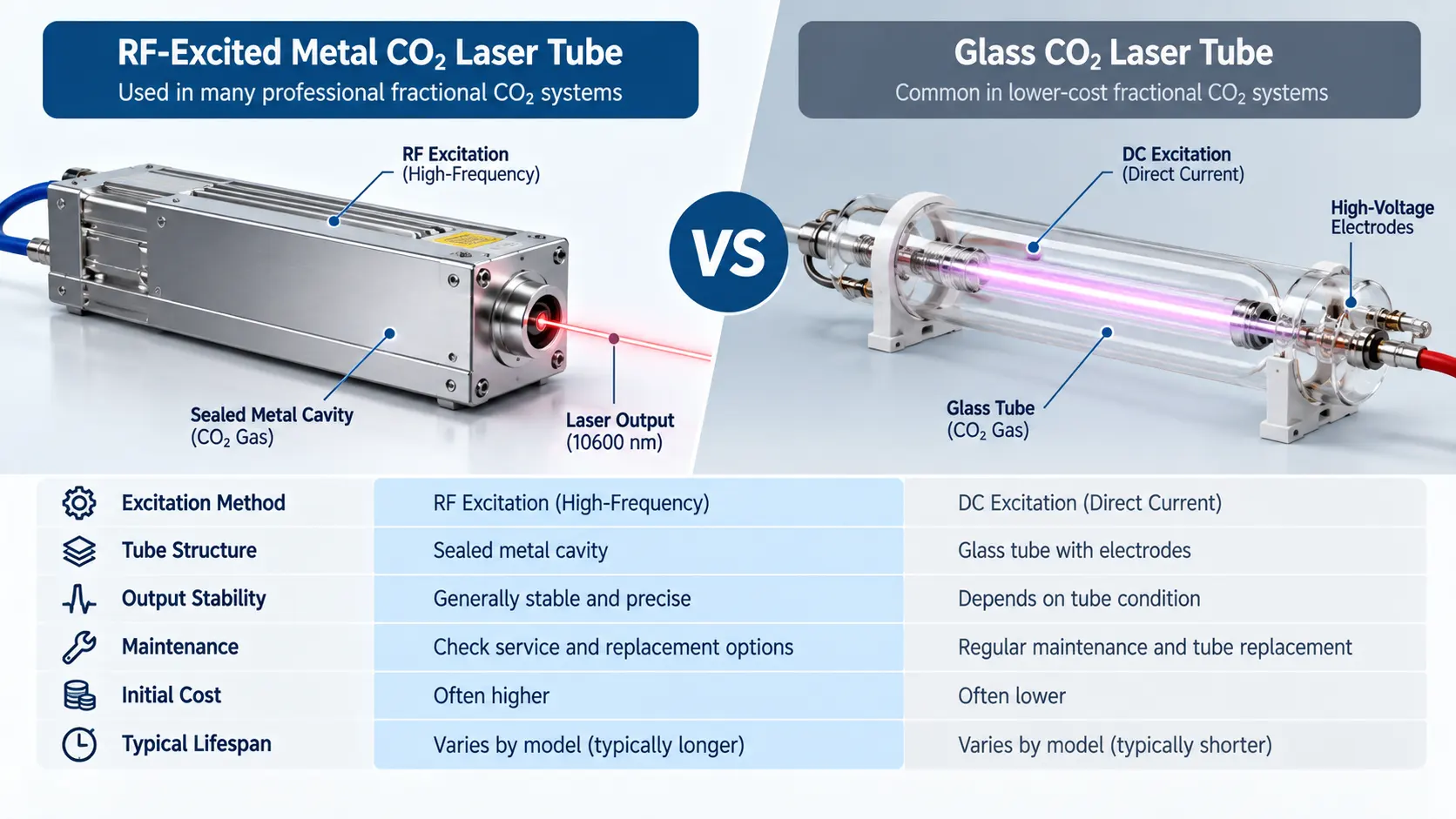
Professional buyers should compare the source architecture, output stability, servicing requirements and replacement arrangements. RF-excited metal sources and glass-tube systems have different design and maintenance considerations.
Pulse Characteristics
Laser power does not describe the complete treatment pulse. Ask about pulse duration, delivered energy, repetition characteristics and available pulse-control modes.
Fractional Scanner Precision
Review scanner patterns, spot geometry, density controls, treatment-area settings and repeatability. The number of preset patterns is less important than the quality and suitability of the actual delivered output.
Handpieces and Accessories
Confirm which accessories are included. An advertised device may support several configurations without including every accessory in the standard package.
Safety and Plume Management
Ablative CO2 procedures can generate surgical smoke and airborne contaminants. Clinics need appropriate smoke evacuation, laser-rated protective eyewear, room controls and trained personnel. A built-in smoke feature does not necessarily replace a complete plume-control assessment.
RF CO2 Laser vs. Glass Tube: Which Should Clinics Buy?
| Buying Factor | RF-Excited CO2 | Glass-Tube CO2 |
|---|---|---|
| Initial equipment cost | Often higher | Often lower |
| Excitation method | Radio-frequency excitation | Commonly direct-current excitation |
| Output characteristics | Depends on source design and controls | Depends on source design and controls |
| Service | Check sealed-source repair and replacement terms | Check tube replacement and alignment requirements |
| Purchasing decision | Compare measured performance and ownership cost | Compare initial savings against service requirements |
Neither technology should be selected based on price or tube construction alone. Buyers need evidence of output performance, safety, maintainability and service support for the specific model.
How Much Does a Fractional CO2 Laser Machine Cost?
Fractional CO2 laser equipment pricing varies substantially by manufacturer, laser source, included accessories, distribution arrangements and regional regulatory requirements.
Publicly advertised lower-cost systems may be priced in the low thousands of US dollars, while established medical platforms and more comprehensive service packages can reach tens of thousands of dollars. These figures should not be treated as equivalent quotations.
Compare the Full Cost, Not Only the Machine Price
- Base machine and included laser source
- Fractional scanner and treatment handpieces
- Freight, import taxes and customs charges
- Installation and operator training
- Warranty and replacement parts
- Maintenance and potential downtime
- Safety equipment and plume evacuation
- Local regulatory and insurance requirements
For a detailed budget breakdown, read our Fractional CO2 Laser Machine Price Guide (2026) .
Which Fractional CO2 Laser Machine Is Right for Your Clinic?
New Aesthetic Clinic
Prioritize authorized applications, straightforward operation, staff training and dependable service. Avoid paying for advanced accessories without a clear clinical need.
Established Dermatology Practice
Compare treatment capabilities, documented pulse and scanning performance, clinical evidence and service availability for your planned procedures.
Hospital or Specialist Center
Give greater weight to institutional procurement requirements, medical device documentation, maintenance contracts and qualified technical support.
Equipment Distributor or Importer
Evaluate OEM/ODM options, minimum order quantities, training materials, documentation, spare parts supply and long-term commercial arrangements.
How to Evaluate a Fractional CO2 Laser Manufacturer
Request Model-Specific Technical Documents
Ask for the exact model designation, source specifications, operating modes, scanner parameters, accessory list and documented output characteristics.
Verify Regulatory Status
Determine whether the equipment and intended procedures are legally permitted in the destination market. A quality management certificate alone does not establish device authorization.
Review Training and Service Arrangements
Ask who provides operator instruction, commissioning, repairs and replacement parts. International buyers should clarify whether service is remote, local or factory-based.
Check OEM/ODM Responsibilities
Branding changes can affect labeling and regulatory obligations. Confirm the legal manufacturer, importer responsibilities, product identification and documentation requirements.
Request an Itemized Quotation
Obtain a complete commercial offer showing accessories, shipping terms, lead time, payment conditions, warranty and exclusions.
Why We Didn’t Recommend Other Devices
This shortlist is not an exhaustive catalog of professional CO2 laser machines. We excluded devices that could not be meaningfully evaluated within this guide, including:
- Generic marketplace listings without a clearly identified manufacturer or exact model
- Products advertised only with unsupported performance or treatment claims
- Non-fractional CO2 equipment not suited to the article’s primary purchasing intent
- Devices without sufficient publicly identifiable information for an initial comparison
- Products whose availability or configuration could not be established with reasonable confidence
Exclusion does not mean a product is unsafe or clinically inferior. It means the available information is insufficient for inclusion in this particular buying comparison.
Common Mistakes When Buying a Fractional CO2 Laser
1. Choosing the Highest Advertised Wattage
Higher rated output does not automatically mean better treatment precision, safety or patient outcomes. Evaluate the complete optical system.
2. Comparing Different Packages as if They Were Identical
One quotation may include only the base machine, while another includes multiple handpieces, training and service. Request equivalent configurations.
3. Assuming All Treatment Modes Are Authorized
The presence of a treatment mode or accessory does not establish legal authorization in every country. Confirm the exact permitted indications.
4. Ignoring Plume Evacuation and Safety Requirements
CO2 laser procedures require appropriate safety controls, including laser protection and suitable management of treatment-generated plume.
5. Overlooking Long-Term Maintenance
Ask about laser source replacement, scanner service, spare parts, warranty exclusions and expected downtime.
6. Relying on Marketing Claims Instead of Documentation
Claims such as “best results,” “zero downtime” or “painless treatment” should not substitute for credible evidence, professional judgment or patient-specific assessment.
Fractional CO2 Laser Buying Checklist
Questions to Ask Before Placing an Order
- Who is the legal manufacturer?
- What is the exact model and generation?
- What type of CO2 laser source is installed?
- What are the documented pulse characteristics?
- Which scanner patterns and spot sizes are available?
- Which handpieces are included in the quotation?
- What indications are authorized in my market?
- What training is provided?
- How is laser plume managed?
- What warranty and repair services are included?
- How quickly can spare parts be supplied?
- What are the shipping and payment terms?
Frequently Asked Questions
What is the best fractional CO2 laser machine for a dermatology clinic?
The best option depends on the clinic’s treatment requirements, qualified staff, regulatory environment and service needs. Compare the documented capabilities of shortlisted devices rather than choosing solely by brand or power rating.
Is a 40W fractional CO2 laser powerful enough for professional use?
A 40W rating can be part of a professional device specification, but suitability depends on pulse control, delivered energy, scanning performance, authorized applications and clinical technique. Power alone cannot establish effectiveness.
What is the difference between CO2 Star and CO2 4D?
Both are described in Cocoon Laser documentation as 10600nm platforms with 40W RF-excited sources and multiple treatment modes. Buyers should request a detailed comparison of accessories, controls, configurations and commercial terms.
Are RF-excited fractional CO2 lasers better than glass-tube machines?
RF-excited systems often have higher initial prices and different design characteristics. The better purchasing choice depends on verified output performance, maintenance requirements, service and total ownership cost.
Can fractional CO2 lasers be used for acne scars?
Fractional ablative CO2 technology is used in selected acne scar treatment settings. Appropriate patient selection, device authorization and qualified clinical assessment are essential. Results and recovery vary.
How much does a professional fractional CO2 laser cost?
Prices vary from lower-cost factory-direct listings to premium medical platforms costing tens of thousands of dollars. Compare complete equipment quotations, including service, accessories and import-related expenses.
Can I buy a fractional CO2 laser directly from a manufacturer?
Some suppliers sell directly to professional B2B buyers. Importers and clinics should verify manufacturer identity, regulatory responsibilities, technical support and delivery arrangements.
Do fractional CO2 laser machines require special training?
Yes. Professional ablative laser use requires appropriate qualifications, device-specific training, safety controls and compliance with local requirements.
Can distributors request OEM fractional CO2 laser machines?
Some suppliers offer OEM/ODM arrangements. Branding, minimum order quantities, legal manufacturer responsibilities and destination-market documentation should be confirmed in writing.
How long does a fractional CO2 laser machine last?
Service life varies by source design, usage, maintenance, operating conditions and parts availability. Ask for manufacturer service recommendations rather than relying on generic lifespan claims.
Final Verdict: Which Fractional CO2 Laser Should You Choose?
The best fractional CO2 laser machine is not necessarily the most expensive, the highest-powered or the one with the longest list of advertised applications.
For professional B2B procurement, CO2 Star and CO2 4D are two Cocoon Laser platforms to evaluate using their documented 10600nm RF-excited technology and available configurations.
Clinics interested in established international brands should also investigate Lumenis UltraPulse Alpha, DEKA SmartXide Tetra and Alma Pixel CO2, with particular attention to the exact regional model, available clinical documentation and local service arrangements.
Before making a final decision, request technical specifications, compare equivalent quotations, verify the legal indications and calculate the expected total cost of ownership.
Compare CO2 Star and CO2 4D for Your Business
Contact Cocoon Laser to request technical specifications, available configurations, accessories, OEM/ODM information and a commercial quotation for your destination country.
Request Equipment Details →