What Is the Best Laser Hair Removal Machine for Clinics?
Choosing the best laser hair removal machine for a clinic is not simply a matter of finding the device with the highest power, the largest number of wavelengths, or the most treatment modes.
Professional hair removal systems use different optical technologies, including diode lasers, Alexandrite lasers, long-pulsed Nd:YAG lasers, multi-wavelength diode systems, and intense pulsed light platforms. Each technology has different optical characteristics, treatment workflows, patient considerations, and business advantages.
For a clinic, medical spa, distributor, or aesthetic equipment buyer, the best machine is therefore the one that matches the intended patient population, treatment volume, clinical applications, operating model, and available technical support.
This guide compares the major professional hair removal technologies and explains what clinics should evaluate before purchasing a laser hair removal machine.
Quick Answer
For many professional clinics, a high-quality diode laser is one of the most versatile choices for dedicated hair removal, while Alexandrite and long-pulsed Nd:YAG systems can offer important advantages for particular skin and hair characteristics.
Multi-wavelength diode platforms combining wavelengths such as approximately 755nm, 808/810nm, and 1064nm are also popular because they are designed to provide broader treatment flexibility within a single hair-removal platform.
IPL and SHR systems can also perform professional hair reduction, but IPL is not technically a laser. Its advantage is often platform versatility, particularly when a clinic wants one system that can support hair reduction alongside other light-based aesthetic applications.
There is no single machine that is objectively best for every clinic. Buyers should compare the actual wavelength or spectral output, pulse control, fluence, spot size, repetition rate, cooling, treatment speed, handpiece design, energy stability, training, service, operating costs, and regulatory documentation rather than choosing by marketing claims alone.
What Is a Professional Laser Hair Removal Machine?
A professional laser hair removal machine is an energy-based system designed to reduce unwanted hair by delivering optical energy to pigmented hair structures.
Most laser hair-removal technologies rely primarily on melanin within the hair as the optical target.
When an appropriate wavelength, pulse duration, fluence, and treatment technique are used, absorbed optical energy is converted into heat. The objective is to create a controlled thermal effect within hair-bearing structures while limiting unwanted heating of surrounding skin.
This mechanism is related to the principle of selective photothermolysis.
Professional hair-removal equipment can include several different technology categories:
- Diode laser systems
- Alexandrite laser systems
- Long-pulsed Nd:YAG laser systems
- Multi-wavelength diode laser systems
- IPL and SHR systems
These technologies should not be treated as interchangeable simply because they can all be used for hair reduction.
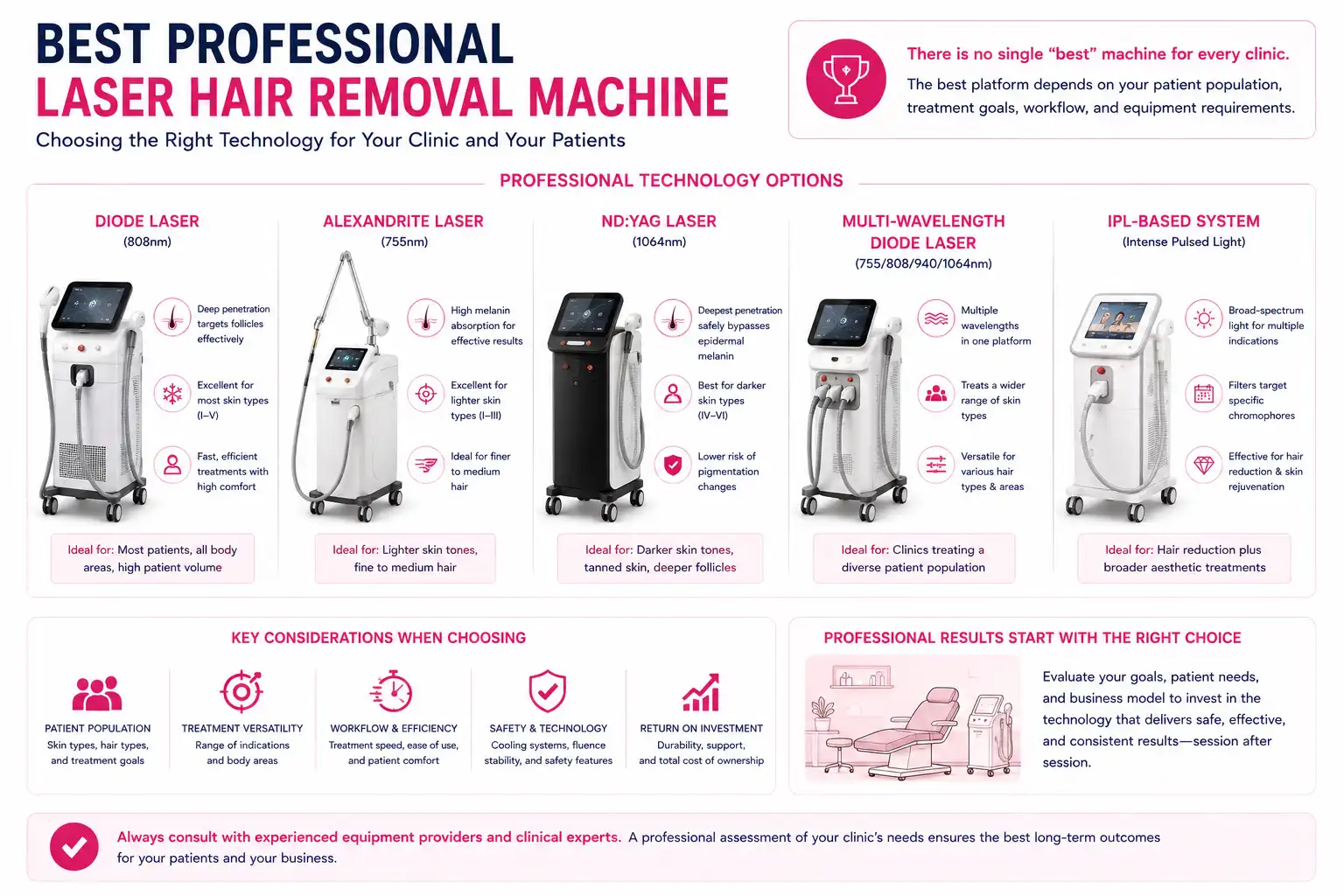
Which Type of Laser Hair Removal Machine Is Best?
The four major technology categories clinics commonly encounter are diode, Alexandrite, Nd:YAG, and IPL-based systems.
A useful starting comparison is:
| Technology | Typical Optical Output | Key Characteristic | Potential Clinic Advantage |
|---|---|---|---|
| Diode Laser | Commonly around 808/810nm; other diode configurations also exist | Dedicated laser hair-reduction platform | Strong balance of hair targeting, workflow flexibility, and treatment speed |
| Alexandrite Laser | 755nm | High melanin absorption relative to longer hair-removal wavelengths | Can be highly effective for appropriately selected lighter skin types with pigmented hair |
| Long-Pulsed Nd:YAG | 1064nm | Longer wavelength with lower relative melanin absorption | Important option when treating darker skin phototypes with appropriate protocols |
| Multi-Wavelength Diode | Often combines approximately 755nm, 808/810nm and 1064nm bands | Multiple wavelength components within one diode platform | Designed to broaden treatment flexibility across hair and skin characteristics |
| IPL / SHR | Filtered broad-spectrum pulsed light | Not a laser; configurable through filters and pulse modes | Multi-application versatility for clinics offering more than hair reduction |
These differences are important, but wavelength alone does not determine whether a machine is good.
Two devices using the same nominal wavelength can perform differently because of differences in energy delivery, pulse control, spot size, cooling, repetition rate, handpiece engineering, and system stability.
1. Diode Laser Hair Removal Machine
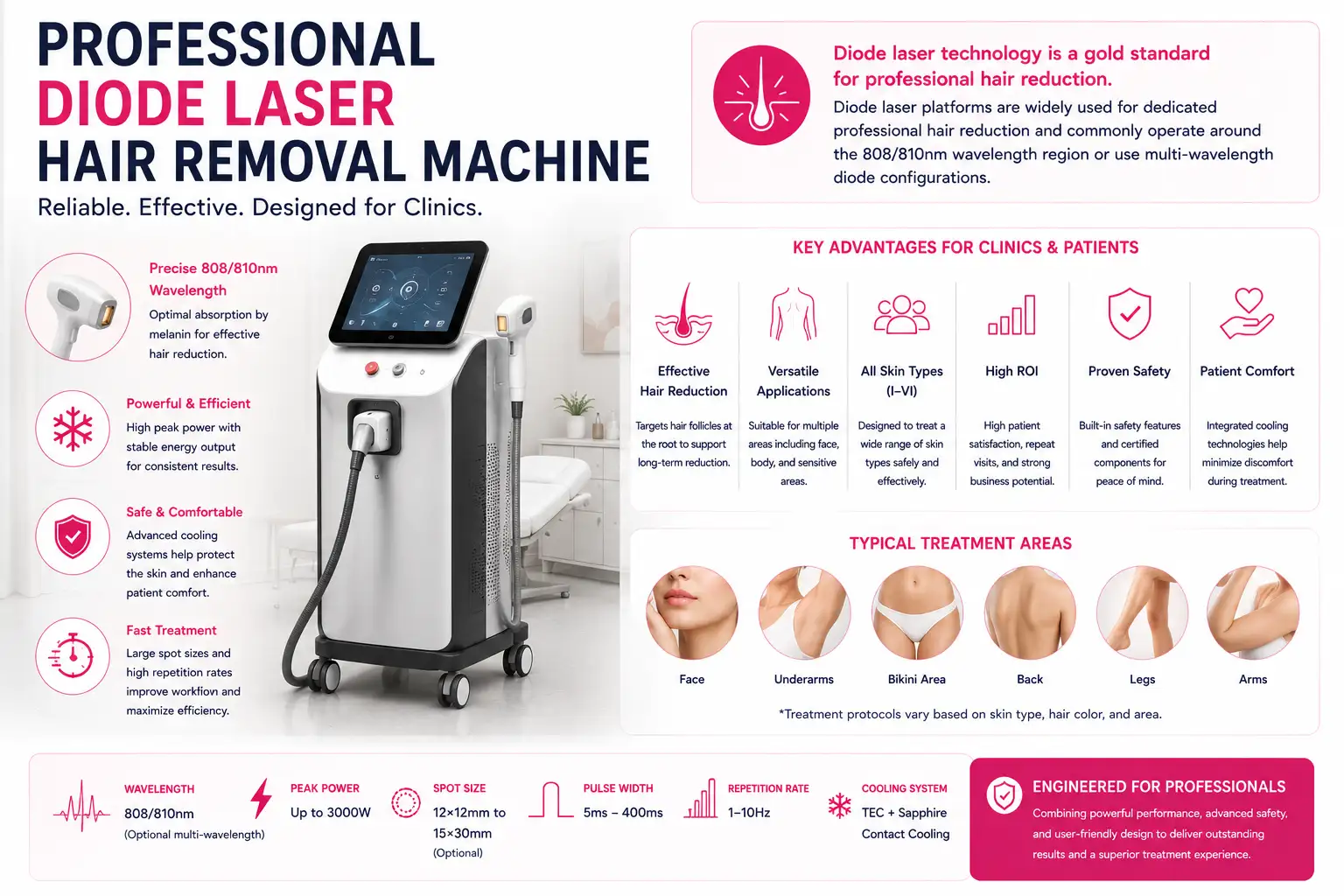
Diode laser systems are among the most widely used dedicated technologies for professional hair reduction.
A common configuration operates around 808nm or 810nm, although diode platforms can use other wavelengths or wavelength combinations.
The optical characteristics of the 808/810nm region provide a useful balance between melanin interaction and penetration into hair-bearing tissue, which is one reason this wavelength range has become common in professional hair-removal equipment.
Advantages of Diode Hair Removal Machines
- Designed specifically for high-volume hair-reduction workflows
- Available with relatively large treatment spots
- Can support high repetition rates depending on system design
- Often paired with contact cooling
- Suitable for treating both small and large body areas with appropriate protocols
- Available in single-wavelength and multi-wavelength configurations
Potential Limitations
- Performance varies substantially between manufacturers
- Cooling quality is important for comfort and epidermal management
- Higher stated power does not automatically mean better clinical performance
- Low-quality handpieces can affect energy stability and long-term operating costs
For clinics primarily focused on professional hair removal, diode technology is often one of the first categories worth evaluating.
2. Alexandrite 755nm Laser Hair Removal Machine
Alexandrite lasers operate at approximately 755nm.
Compared with longer hair-removal wavelengths such as 1064nm, 755nm has relatively strong interaction with melanin.
This can make Alexandrite technology particularly effective for appropriately selected patients with lighter skin and dark, pigmented hair.
Advantages of Alexandrite Lasers
- Strong melanin targeting
- Established use in professional hair reduction
- Can be effective for pigmented hair in appropriately selected lighter skin types
- Professional platforms may support efficient treatment of large areas
Potential Limitations
Stronger melanin interaction also means epidermal pigmentation must be carefully considered.
Skin phototype, tanning status, fluence, pulse duration, cooling, and other parameters are therefore important when evaluating treatment suitability.
Alexandrite should not simply be described as the “strongest” or “best” hair-removal wavelength because its suitability depends on the patient and treatment context.
3. Nd:YAG 1064nm Laser Hair Removal Machine
Long-pulsed Nd:YAG hair-removal systems typically operate at approximately 1064nm.
Compared with shorter wavelengths such as 755nm, 1064nm has lower relative absorption by melanin and deeper optical penetration characteristics.
These properties are one reason long-pulsed Nd:YAG systems are frequently considered when treating patients with darker skin phototypes.
Advantages of 1064nm Nd:YAG
- Lower relative epidermal melanin absorption than shorter common hair-removal wavelengths
- Useful option for darker skin phototypes when appropriately operated
- Established professional laser technology
- Deep optical penetration characteristics
Potential Limitations
Lower melanin absorption is not automatically an advantage for every hair type. Treatment efficiency depends on the target hair, pulse parameters, fluence, spot size, cooling, and system design.
It is therefore more accurate to describe Nd:YAG as an important option within a professional hair-removal portfolio rather than a universally superior laser.
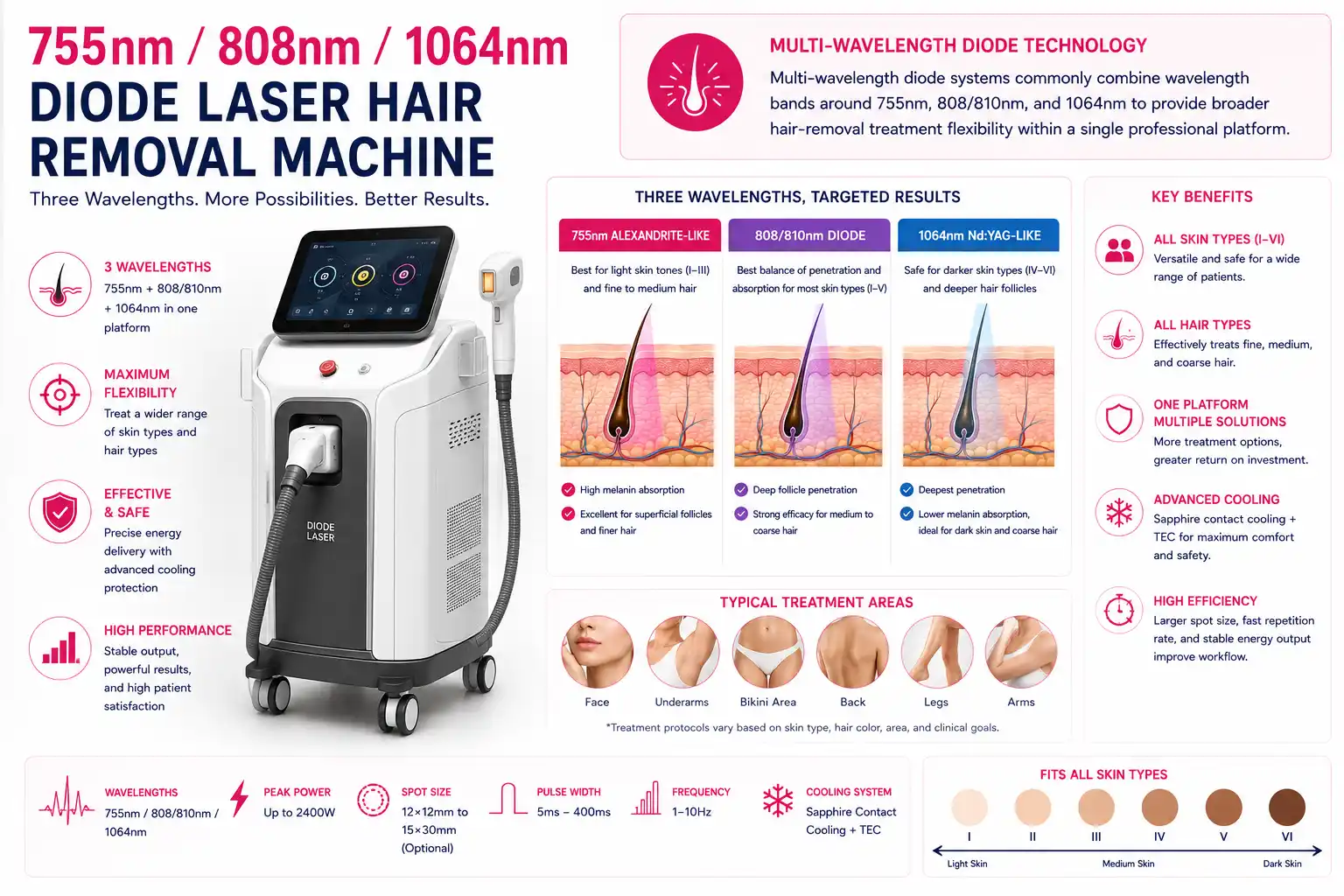
4. Multi-Wavelength Diode Laser Hair Removal Machine
Multi-wavelength diode systems have become an important category in professional hair removal.
A common configuration combines wavelength bands around:
- 755nm
- 808/810nm
- 1064nm
The concept is to combine optical characteristics associated with shorter, intermediate, and longer hair-removal wavelengths within one diode handpiece or platform.
This can provide clinics with broader treatment flexibility without requiring several completely separate hair-removal machines.
However, buyers should be careful with marketing terminology.
A machine advertised as “three wavelength” or “triple wavelength” should not automatically be assumed to reproduce the exact optical behavior of three independent Alexandrite, diode, and Nd:YAG laser systems.
Clinics should verify the actual diode configuration, wavelength distribution, output, pulse characteristics, cooling, and technical documentation of the specific device.
5. IPL and SHR Hair Removal Machines
IPL is another major professional hair-reduction technology, but there is an important distinction:
IPL is not a laser.
Intense Pulsed Light systems generate broad-spectrum pulsed light and use optical filters to select portions of that spectrum for treatment.
For hair reduction, appropriate spectral output is selected to interact primarily with melanin in unwanted hair.
SHR commonly refers to a repeated-pulse and often in-motion treatment strategy. Many professional SHR systems are based on IPL technology.
Advantages of IPL / SHR Platforms
- Can provide professional hair reduction
- Some platforms support conventional IPL and SHR modes
- Filters can support multiple treatment applications depending on the system
- Can be attractive for clinics wanting a multi-function aesthetic platform
Potential Limitations
- IPL should not be marketed as a laser
- Performance varies substantially between systems
- Filter selection and spectral output are important
- Skin pigmentation must be carefully considered
- A multi-purpose IPL platform may serve a different role from a dedicated hair-removal laser
For more detail about the technology, see What Is IPL Hair Removal? and IPL vs SHR Hair Removal: What’s the Difference?.
Diode vs Alexandrite vs Nd:YAG vs IPL: Which Is Best?
The answer depends on what “best” means for the clinic.
| Clinic Priority | Technology Worth Evaluating | Reason |
|---|---|---|
| Dedicated high-volume hair removal | Diode | Strong balance of specialization, speed, cooling options, and workflow |
| Lighter skin with pigmented hair | Alexandrite 755nm | Relatively strong melanin interaction |
| Darker skin phototypes | Long-pulsed Nd:YAG 1064nm | Lower relative epidermal melanin absorption than shorter wavelengths |
| Broad dedicated hair-removal flexibility | Multi-wavelength diode | Combines multiple diode wavelength bands in one platform |
| Hair reduction plus other light-based applications | IPL / OPT / SHR | Multi-application platform flexibility |
This table should be treated as a purchasing framework rather than a universal clinical rule.
The actual machine, patient population, operator training, and treatment protocol are more important than the technology name alone.
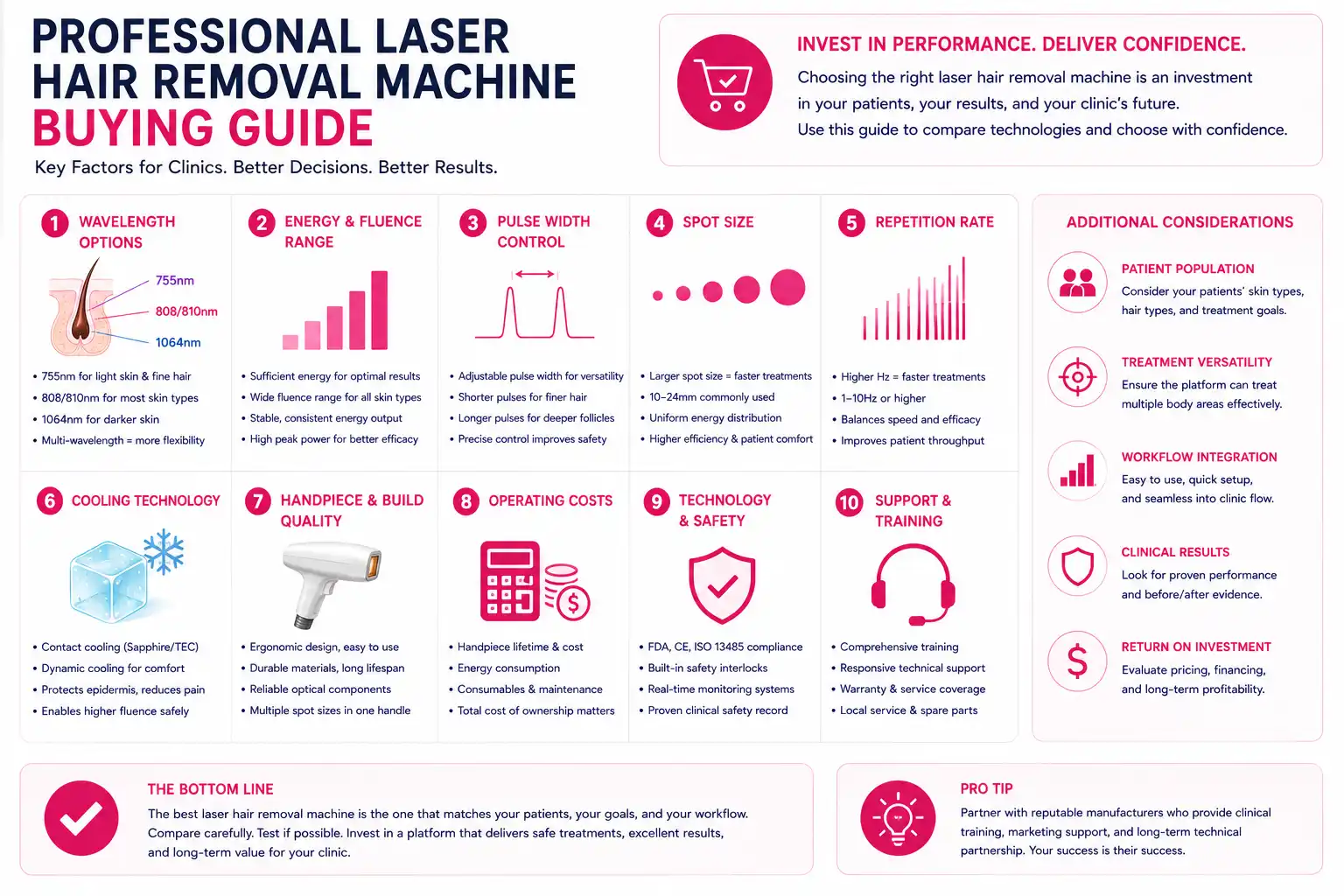
What Should Clinics Look for in a Laser Hair Removal Machine?
Once a clinic has identified the appropriate technology category, the next step is comparing the actual equipment.
This is where many purchasing decisions go wrong.
Buyers often focus on one headline specification — such as power or number of wavelengths — while overlooking the engineering factors that directly affect treatment workflow and long-term ownership.
The following factors deserve closer evaluation.
1. Wavelength or Spectral Output
For a laser, identify the actual wavelength or wavelength combination.
For IPL, evaluate the spectral output and available filters rather than treating the machine as though it had one laser wavelength.
2. Fluence and Energy Delivery
Maximum advertised energy is less useful than understanding whether the system can deliver controlled, repeatable energy across the intended operating range.
3. Pulse Duration and Pulse Structure
Professional systems should provide pulse characteristics appropriate for their intended applications and patient populations.
4. Spot Size
Larger treatment areas such as the back and legs benefit from efficient coverage, while smaller areas may require greater precision.
5. Repetition Rate
Repetition rate can significantly affect treatment speed, particularly in high-volume clinics.
However, a high stated repetition rate is useful only if the system can maintain appropriate energy delivery and thermal management during continuous operation.
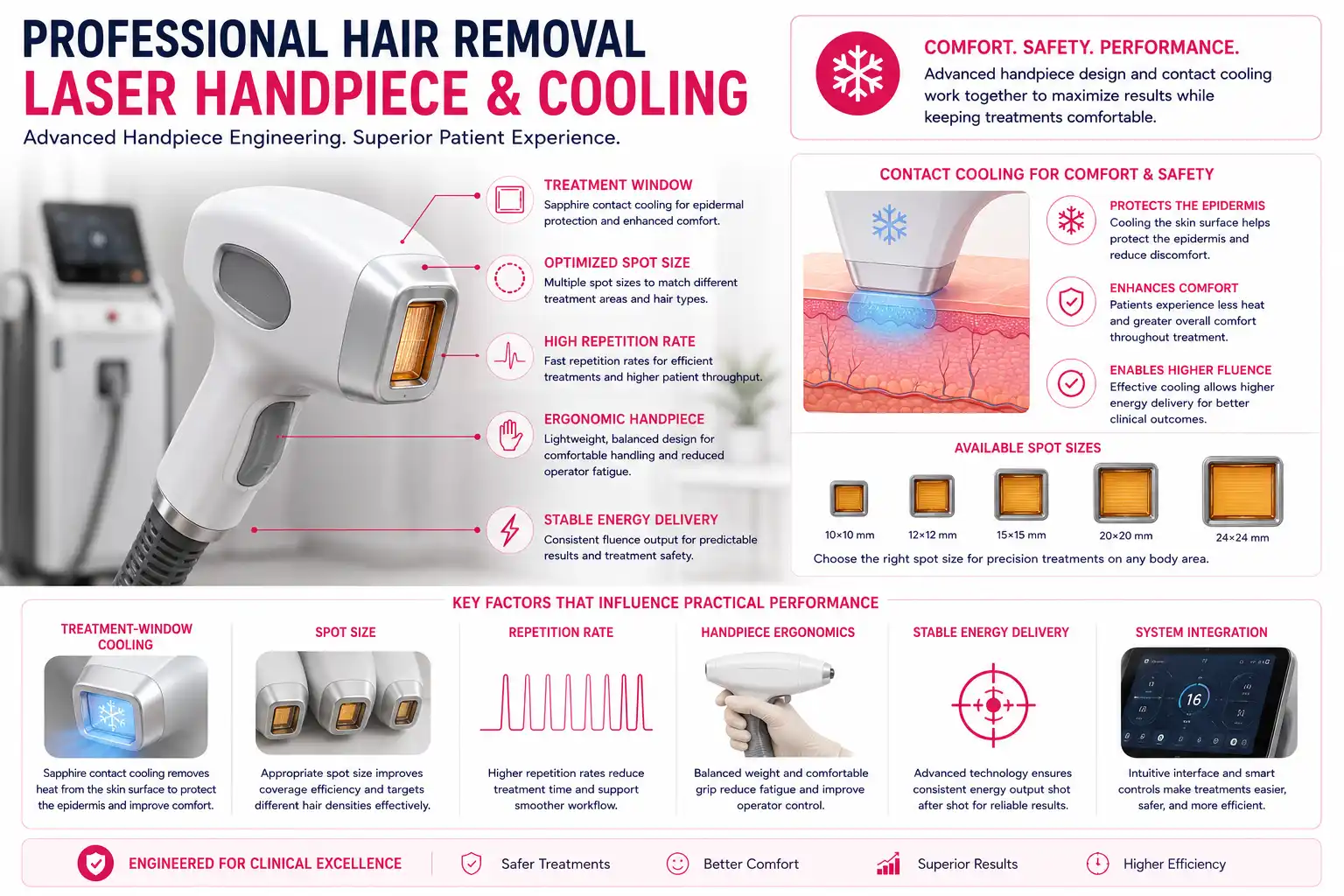
6. Cooling System
Cooling is one of the most important practical features of a professional hair-removal platform.
Depending on the system, cooling may help manage epidermal temperature, improve treatment comfort, and support efficient treatment workflows.
7. Handpiece Design
Clinics should consider handpiece weight, ergonomics, treatment-window visibility, cable flexibility, cooling performance, and long-term service requirements.
8. Energy Stability
Consistency matters more than an impressive maximum specification.
Buyers should evaluate whether the machine is designed to maintain stable output during extended professional use.
9. Consumables and Operating Costs
Purchase price is only one component of total ownership cost.
Ask about:
- Handpiece life
- Consumable requirements
- Replacement costs
- Routine maintenance
- Cooling-system maintenance
- Shipping costs for service
- Expected downtime if a component fails
10. Training and Technical Support
Even a well-designed machine can become a poor investment if the supplier cannot provide adequate installation guidance, operator training, troubleshooting, spare parts, and after-sales support.
11. Regulatory Documentation
Clinics and distributors should verify the documentation applicable to their market and intended use rather than relying only on a supplier’s marketing statement.
What Is the Best Laser Hair Removal Machine for Different Clinics?
The best professional laser hair removal machine depends partly on the clinic’s business model.
A dermatology practice treating a diverse patient population may prioritize different capabilities from a high-volume medical spa focused primarily on hair reduction. Likewise, a new clinic purchasing its first aesthetic system may value versatility and operating simplicity more than a large multi-device practice.
| Clinic Type | Technology to Consider | Key Buying Priorities |
|---|---|---|
| Dedicated Hair Removal Clinic | Diode or multi-wavelength diode | Speed, cooling, large spot size, repetition rate, durability and operating cost |
| Medical Spa | Diode or IPL/SHR depending on service mix | Versatility, ease of operation, treatment speed and patient comfort |
| Dermatology Practice | Technology selected according to patient population and clinical requirements | Skin-type flexibility, parameter control, safety features and clinical support |
| High-Volume Clinic | High-performance diode or other dedicated laser platform | Continuous operation, handpiece durability, cooling, treatment speed and service support |
| New Aesthetic Clinic | Diode or multi-function IPL/SHR platform | Investment cost, application range, training, operating simplicity and after-sales support |
| Multi-Application Aesthetic Center | IPL/OPT/SHR or a combination of dedicated platforms | Application range, filters, pulse modes, workflow and equipment utilization |
This is why asking “Which machine has the best specifications?” is usually less useful than asking “Which machine best fits the treatments and patients my clinic expects to serve?”
Single-Wavelength vs Multi-Wavelength Diode Laser: Which Is Better?
Clinics comparing diode laser machines frequently encounter both single-wavelength 808/810nm systems and multi-wavelength platforms.
A well-designed single-wavelength diode system can be an effective dedicated hair-removal platform. The fact that another machine advertises three or four wavelengths does not automatically make it clinically superior.
Multi-wavelength diode systems are attractive because they are designed to combine different optical characteristics within one platform.
Common triple-wavelength configurations include approximately:
- 755nm — shorter wavelength component with stronger relative melanin interaction
- 808/810nm — widely used intermediate diode hair-removal wavelength region
- 1064nm — longer wavelength component with lower relative melanin absorption and deeper optical penetration characteristics
However, buyers should look beyond the number printed on the handpiece.
Important questions include:
- Are the wavelength components delivered simultaneously or through another configuration?
- What is the actual optical output of each component?
- How stable is the output during extended operation?
- What pulse durations are available?
- What fluence can be maintained at clinically useful repetition rates?
- How effective is the contact-cooling system?
- What is the expected handpiece life?
A high-quality 808nm platform may be a better investment than a poorly engineered multi-wavelength system.
For a deeper wavelength comparison, see 755nm vs 808nm vs 1064nm Diode Laser: What’s the Difference?.
Does Higher Laser Power Mean a Better Hair Removal Machine?
No. A higher advertised wattage does not automatically mean a better laser hair removal machine.
Power is only one engineering specification within the complete energy-delivery system.
Clinics should also consider:
- Fluence at the treatment window
- Spot size
- Pulse duration
- Repetition rate
- Energy stability
- Thermal management
- Cooling performance
- Duty cycle
For example, a machine may advertise a high peak power but perform poorly during continuous treatment if the system cannot maintain stable optical output or manage heat effectively.
For a high-volume clinic, sustained performance can be more important than the largest number on a specification sheet.
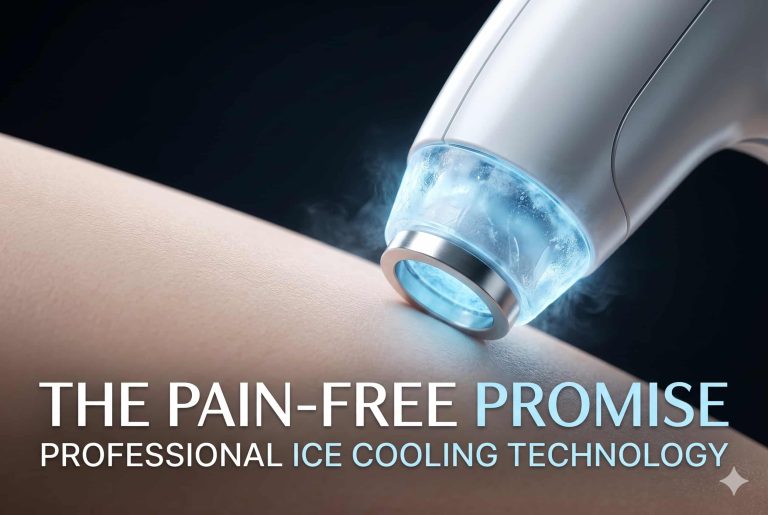
Why Cooling Matters in a Professional Hair Removal Machine
Cooling should be considered a core system feature rather than a minor comfort accessory.
During light-based hair reduction, melanin within the epidermis can also absorb optical energy. Appropriate cooling can help manage epidermal temperature while supporting treatment comfort and workflow.
Depending on the platform, cooling technologies may include:
- Contact cooling through the treatment window
- Sapphire contact cooling
- Integrated water-based thermal management
- External cold-air cooling on compatible treatment platforms
- Other manufacturer-specific cooling systems
When comparing machines, buyers should not evaluate cooling only by the lowest temperature shown on a marketing page.
More useful questions include whether cooling remains stable during prolonged operation, whether the treatment window maintains effective skin contact, and how the cooling system performs at the machine’s intended repetition rate.
How Important Is Treatment Speed?
Treatment speed can directly affect clinic capacity, especially for large areas such as the legs, back, chest, and full body.
However, repetition rate alone does not determine real treatment speed.
Practical throughput depends on the interaction between:
- Spot size
- Repetition rate
- Available fluence
- Pulse duration
- Cooling performance
- Handpiece ergonomics
- Operator technique
- Ability to maintain stable output during continuous operation
A machine capable of a high repetition rate only under very limited settings may not necessarily provide the fastest practical treatment workflow.
What Is the Best Laser Hair Removal Machine for Different Skin Types?
No wavelength should be assigned automatically to every person within a particular skin type, but wavelength and epidermal melanin interaction are important considerations.
As a general optical principle:
- Shorter common hair-removal wavelengths such as 755nm have relatively strong melanin interaction.
- 808/810nm diode wavelengths provide an intermediate balance commonly used for professional hair reduction.
- 1064nm has lower relative melanin absorption and is frequently considered when treating darker skin phototypes.
This does not mean that wavelength alone determines safety.
Skin suitability also depends on:
- Actual skin phototype
- Recent tanning
- Hair pigmentation
- Fluence
- Pulse duration
- Spot size
- Cooling
- Treatment technique
- Device-specific instructions
A machine marketed as “all skin types” should therefore still be evaluated according to its actual technical capabilities and treatment protocols.
What Is the Best Hair Removal Machine for Darker Skin?
When treating darker skin, epidermal melanin becomes an especially important consideration because it can compete with hair melanin for optical energy.
Long-pulsed 1064nm Nd:YAG is an established professional option often considered for darker skin phototypes because its wavelength has lower relative melanin absorption than shorter common hair-removal wavelengths.
Certain diode systems may also be used across a broad range of skin types when the device, parameters, cooling, and treatment protocol are appropriate.
The correct conclusion is therefore not that one machine is automatically “safe for dark skin,” but that the platform must provide an appropriate combination of optical characteristics, parameter control, cooling, and professional treatment protocols.
What Is the Best Laser Hair Removal Machine for a New Clinic?
A new clinic should usually prioritize operational practicality rather than purchasing the machine with the longest specification sheet.
Important questions include:
- Will hair removal be a primary service or one of many services?
- What patient population does the clinic expect to treat?
- How many treatments are expected each day?
- How much training will operators require?
- How quickly can the supplier provide technical support?
- What are the handpiece and maintenance costs?
- Is the device documentation suitable for the target market?
If hair removal will be a major revenue service, a dedicated diode or other professional laser platform may make sense.
If the clinic needs hair reduction alongside pigmentation, vascular, or photorejuvenation applications, a professional IPL/OPT/SHR platform may offer broader equipment utilization depending on the system and its intended applications.
Professional Laser Hair Removal Machine vs Cheap Beauty Machine
Professional buyers should be cautious about comparing equipment solely by purchase price.
Two machines that look similar externally can differ substantially in internal engineering and long-term performance.
Differences may include:
- Laser-bar or light-source quality
- Power-supply design
- Energy calibration
- Cooling architecture
- Water circulation and thermal management
- Handpiece construction
- Treatment-window quality
- Software and parameter control
- Electrical safety
- Quality-control procedures
- Replacement-part availability
- Technical support
A lower initial purchase price can become expensive if the machine experiences frequent downtime, requires repeated handpiece replacement, or lacks reliable technical support.
How Much Does a Professional Laser Hair Removal Machine Cost?
Professional laser hair removal machine prices vary widely according to technology, configuration, manufacturer, power system, handpiece design, cooling, certifications, service package, and market.
Entry-level professional systems can cost several thousand U.S. dollars, while higher-end platforms from established medical laser manufacturers can cost tens of thousands of dollars or substantially more.
Rather than comparing only the purchase price, clinics should calculate total cost of ownership.
This includes:
- Machine purchase price
- Shipping and installation
- Training
- Handpiece replacement
- Consumables
- Routine maintenance
- Spare parts
- Warranty coverage
- Potential downtime
- Expected treatment volume
A more expensive machine can sometimes have a lower effective cost per treatment if it provides better durability, throughput, and service support.
For a detailed purchasing analysis, see Diode Laser Machine Price: How Much Does a Professional Hair Removal Machine Cost?.
How to Calculate the Business Value of a Hair Removal Machine
For a clinic, the best machine is not necessarily the cheapest machine or the machine with the highest treatment price.
A practical business evaluation should consider:
- Average treatment price in the local market
- Expected treatments per day
- Average treatment duration
- Number of sessions in a typical treatment series
- Machine utilization rate
- Consumable cost per treatment
- Operator time
- Maintenance cost
- Expected equipment lifespan
- Potential downtime
Treatment speed can be particularly important here.
If one platform allows a clinic to complete large-area treatments efficiently while maintaining appropriate treatment parameters, the increased daily capacity can affect the economic value of the machine.
Reliability is equally important. A machine generates no treatment revenue while it is waiting for replacement parts or technical service.
How to Choose a Laser Hair Removal Machine Manufacturer
The manufacturer or supplier should be evaluated almost as carefully as the machine itself.
Professional buyers should ask potential suppliers about:
- Manufacturing and quality-control processes
- Product documentation
- Warranty terms
- Technical training
- Remote troubleshooting
- Spare-parts availability
- Handpiece replacement policy
- Software support
- OEM and ODM capabilities when relevant
- Distributor support
- Expected response time after a technical problem
Distributors should also consider whether the manufacturer can provide consistent documentation, product training, marketing materials, replacement components, and scalable supply.
A machine with strong specifications but weak manufacturer support can create significant long-term operational problems.
Questions to Ask Before Buying a Laser Hair Removal Machine
Before requesting a final quotation, clinics and distributors can use the following checklist.
- What is the actual laser wavelength or IPL spectral range?
- Is the system single-wavelength or multi-wavelength?
- What fluence range is available at the treatment window?
- What pulse-duration range does the system support?
- What spot sizes are available?
- What is the maximum usable repetition rate?
- Can the machine maintain stable output during continuous treatment?
- How does the cooling system work?
- What is the expected handpiece life?
- Are there consumables?
- What maintenance is required?
- What warranty is included?
- How are replacement parts supplied?
- What operator training is available?
- What technical support is available after installation?
- What regulatory documentation is available for the target market?
These questions are generally more useful than simply asking the supplier, “How many watts does your machine have?”
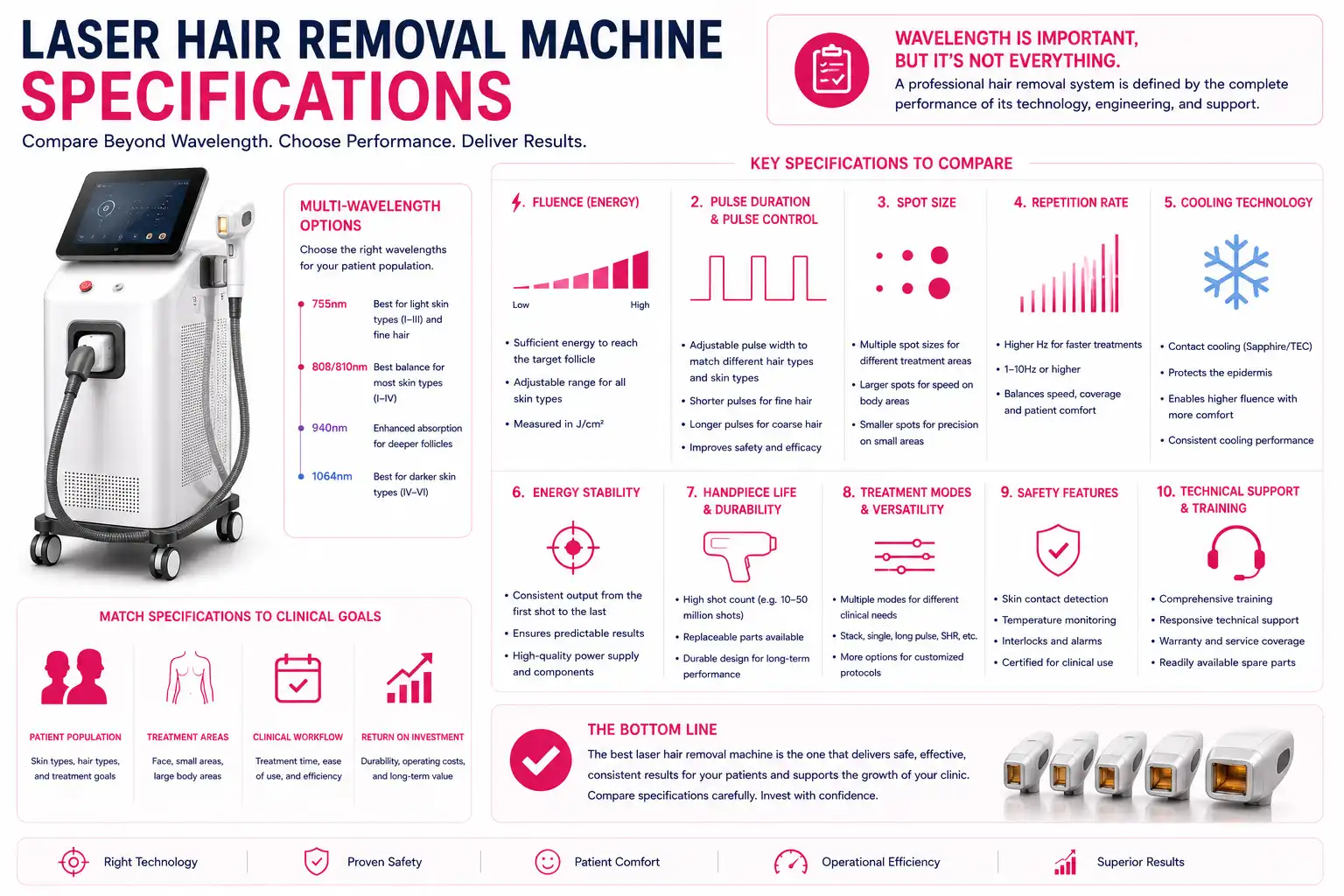
What Specifications Matter Most?
| Specification | Why It Matters | Common Buying Mistake |
|---|---|---|
| Wavelength | Influences optical interaction with melanin and tissue | Assuming more wavelengths automatically means better performance |
| Fluence | Describes energy delivered per treatment area | Looking only at maximum power |
| Pulse Duration | Influences thermal delivery | Ignoring available pulse control |
| Spot Size | Affects treatment coverage and workflow | Choosing only by maximum repetition rate |
| Repetition Rate | Influences potential treatment speed | Assuming maximum Hz can be used at every setting |
| Cooling | Important for epidermal thermal management and comfort | Comparing only the advertised minimum temperature |
| Energy Stability | Supports consistent treatment delivery | Ignoring performance during extended operation |
| Handpiece Life | Affects long-term ownership cost | Looking only at machine purchase price |
| Service Support | Reduces operational risk and downtime | Evaluating the hardware but not the supplier |
Common Mistakes When Buying a Professional Hair Removal Machine
Choosing the Machine With the Highest Wattage
Maximum power does not describe the complete optical performance of a hair-removal system.
Assuming More Wavelengths Always Means Better
Multi-wavelength technology can be useful, but the engineering quality and actual optical output matter more than the number of wavelength labels.
Ignoring Cooling Performance
Cooling affects treatment workflow, thermal management, and patient experience.
Buying Based Only on the Lowest Price
A low purchase price may be offset by short handpiece life, maintenance problems, expensive replacement parts, or machine downtime.
Ignoring the Supplier
After-sales support becomes especially important once equipment is operating every day in a clinic.
Assuming Every Patient Can Use the Same Settings
Hair characteristics, skin pigmentation, treatment area, tanning status, and individual response all influence professional treatment planning.
Buying a Multi-Function Machine Without Checking the Actual Technology
Terms such as IPL, OPT, SHR, diode, and multi-wavelength describe different aspects of light source or delivery. Buyers should verify what the machine actually contains rather than relying on the number of treatment names shown in a brochure.
Frequently Asked Questions
What is the best laser hair removal machine?
There is no single best machine for every clinic. Diode lasers are a versatile choice for many dedicated hair-removal practices, while Alexandrite and Nd:YAG systems have important advantages for particular skin and hair characteristics. Multi-wavelength diode systems can broaden flexibility, while IPL/SHR platforms may suit clinics that want hair reduction plus additional light-based applications.
What is the best professional laser hair removal machine?
The best professional system is one that combines appropriate optical technology with stable energy delivery, useful pulse control, efficient spot size, effective cooling, durable handpiece design, reasonable operating costs, and reliable manufacturer support. The right choice depends on the clinic’s patient population and business model.
Is diode the best laser for hair removal?
Diode technology is one of the most versatile and widely used options for dedicated professional hair reduction, but it is not universally best for every patient. Alexandrite and Nd:YAG systems may offer advantages in particular treatment scenarios.
Is 808nm good for laser hair removal?
The 808/810nm wavelength region is widely used in professional diode laser hair reduction because it provides a useful balance of melanin interaction and optical penetration. Actual performance still depends on the complete machine and treatment parameters.
Is a triple-wavelength laser better than 808nm?
Not automatically. Triple-wavelength diode systems are designed to broaden optical flexibility, but a high-quality single-wavelength 808/810nm machine may outperform a poorly engineered multi-wavelength system. Energy stability, cooling, pulse control, spot size, and handpiece quality also matter.
Which laser is best for darker skin?
Long-pulsed 1064nm Nd:YAG is an established option frequently considered for darker skin phototypes because it has lower relative melanin absorption than shorter common hair-removal wavelengths. Appropriate diode systems may also be used for a broad range of skin types when device capabilities, parameters, cooling, and protocols are suitable.
Which laser is best for lighter skin and dark hair?
Alexandrite 755nm can provide strong melanin targeting in appropriately selected lighter skin types with dark hair. Diode systems are also widely used. The best choice depends on the individual and the specific device.
Is IPL a laser hair removal machine?
No. IPL uses filtered broad-spectrum intense pulsed light rather than laser emission. It can be used for professional hair reduction, but it should not technically be described as a laser.
Is SHR a laser?
Not necessarily. SHR commonly describes a treatment-delivery method involving repeated pulses and often an in-motion technique. Many SHR systems use IPL as the underlying light source, although device implementations vary.
How much does a professional laser hair removal machine cost?
Prices vary substantially. Professional systems may range from several thousand U.S. dollars for some equipment configurations to tens of thousands of dollars or substantially more for higher-end platforms. Technology, manufacturer, configuration, documentation, service, and market all affect price.
What should I check before buying a laser hair removal machine?
Check the actual wavelength or spectrum, fluence, pulse-duration range, spot size, repetition rate, cooling, energy stability, handpiece life, consumables, warranty, training, spare parts, technical support, and regulatory documentation relevant to your market.
Does higher wattage mean better hair removal?
No. Wattage alone does not determine treatment quality. The machine must convert its available power into controlled optical output with appropriate fluence, pulse duration, spot size, repetition rate, cooling, and stability.
What is the best hair removal machine for a medical spa?
It depends on the service mix. A clinic focused primarily on hair reduction may prefer a dedicated diode platform, while a medical spa wanting hair reduction plus other light-based treatments may consider a professional IPL/OPT/SHR system. Patient population, treatment volume, training, and operating costs should also be considered.
Final Verdict: What Is the Best Laser Hair Removal Machine?
For many clinics focused on dedicated hair removal, a high-quality diode laser is one of the strongest all-around choices because it can combine efficient treatment workflow, professional cooling, large-area capability, and broad clinical versatility.
But there is no universally best laser hair removal machine.
Alexandrite 755nm systems can offer strong melanin targeting for appropriately selected lighter skin types. Long-pulsed Nd:YAG 1064nm systems provide optical characteristics that are particularly important when darker skin phototypes need to be considered. Multi-wavelength diode systems aim to combine broader wavelength flexibility within a single dedicated platform.
IPL and SHR systems occupy a different position. IPL is not a laser, but a professional IPL/OPT/SHR platform can be attractive when a clinic wants hair reduction together with additional light-based aesthetic applications.
For professional buyers, the most important lesson is to compare complete machines rather than wavelength labels or marketing specifications.
Evaluate the wavelength or spectral output, fluence, pulse control, spot size, repetition rate, cooling, energy stability, handpiece durability, operating cost, warranty, training, technical support, and regulatory documentation.
The best laser hair removal machine is ultimately the platform that provides the right combination of treatment capability, reliability, workflow efficiency, and long-term support for the clinic that will actually use it.
Editorial & Technical Review: This guide was prepared for the Cocoon Laser professional aesthetic technology knowledge center for educational and equipment-evaluation purposes. Laser and IPL systems vary in wavelength, spectral output, pulse characteristics, fluence, cooling, intended use, treatment protocols, and regulatory status. No technology should be considered universally suitable for every patient or application. Clinics and distributors should evaluate the specific device documentation, applicable regulatory requirements, professional training, and patient suitability before treatment or purchasing decisions.