IPL Hair Removal Before and After: What Results Can You Expect?
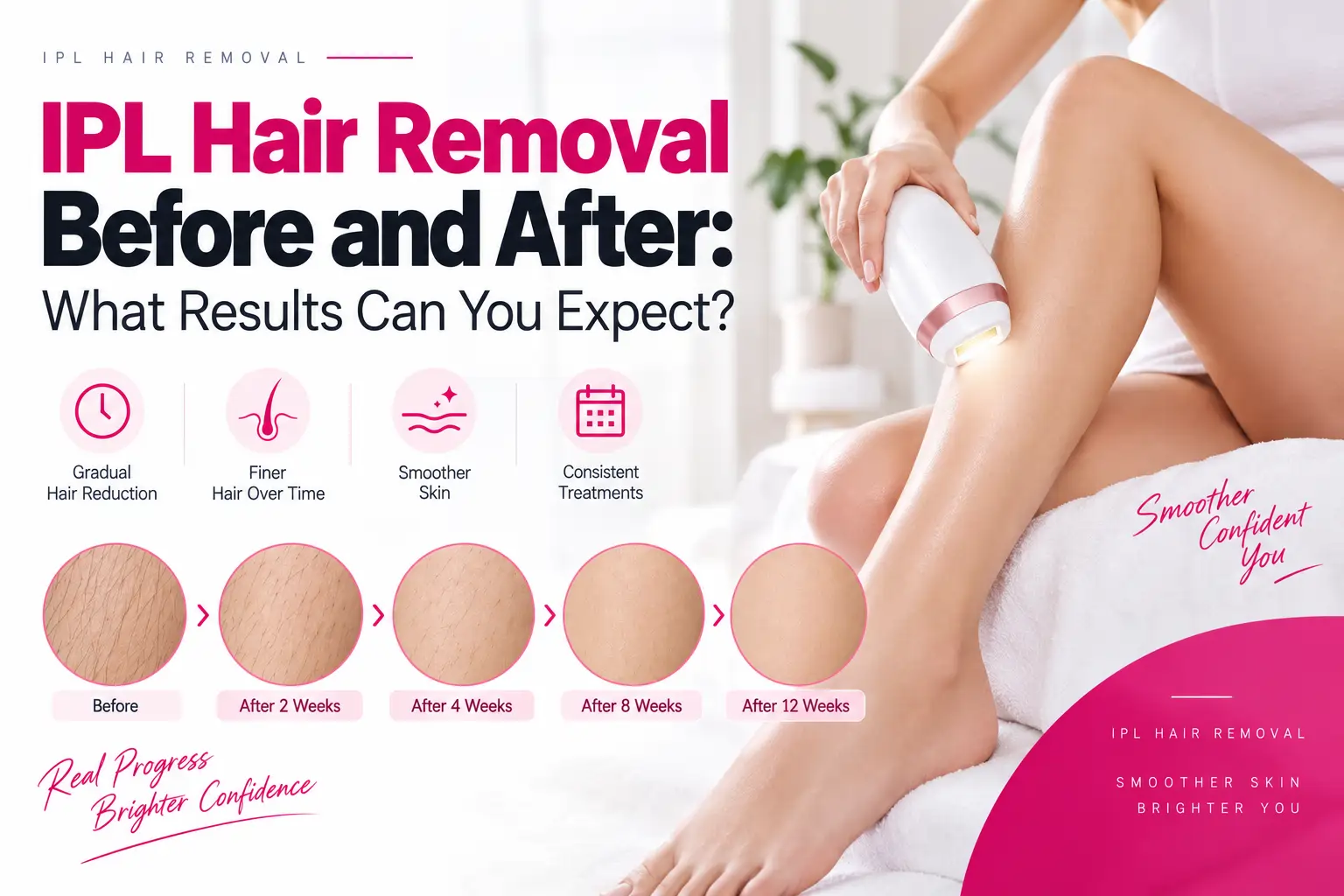
IPL hair removal results usually develop gradually rather than appearing immediately after the first treatment. Before starting IPL, you may have regular visible hair growth that requires frequent shaving or other temporary removal methods. After a series of appropriately timed treatments, successful hair reduction may appear as slower regrowth, fewer visible hairs, reduced density, and finer or less noticeable hair.
However, IPL before-and-after results vary considerably. Hair color and thickness, skin pigmentation, treatment area, hair-growth cycle, device characteristics, treatment settings, and consistency can all influence how quickly changes become noticeable and how much reduction is ultimately achieved.
This guide explains what you may notice before and after IPL hair removal, when results typically begin to become apparent, why hair does not disappear immediately, and what realistic long-term results can look like.
Quick Answer: What Results Can You Expect From IPL Hair Removal?
IPL hair removal results are progressive. Do not expect all unwanted hair to disappear immediately after one treatment.
After an effective treatment series, users may notice slower visible regrowth, fewer hairs, reduced hair density, finer regrowth, and longer periods between noticeable hair growth. Changes generally become easier to evaluate across repeated treatments rather than immediately after a single IPL session.
The timeline and degree of improvement vary according to the IPL system, treatment protocol, body area, hair pigmentation, skin characteristics, and individual hair-growth cycles. Some users may also require maintenance treatments after the initial treatment course.
IPL Hair Removal Before and After: Results Timeline
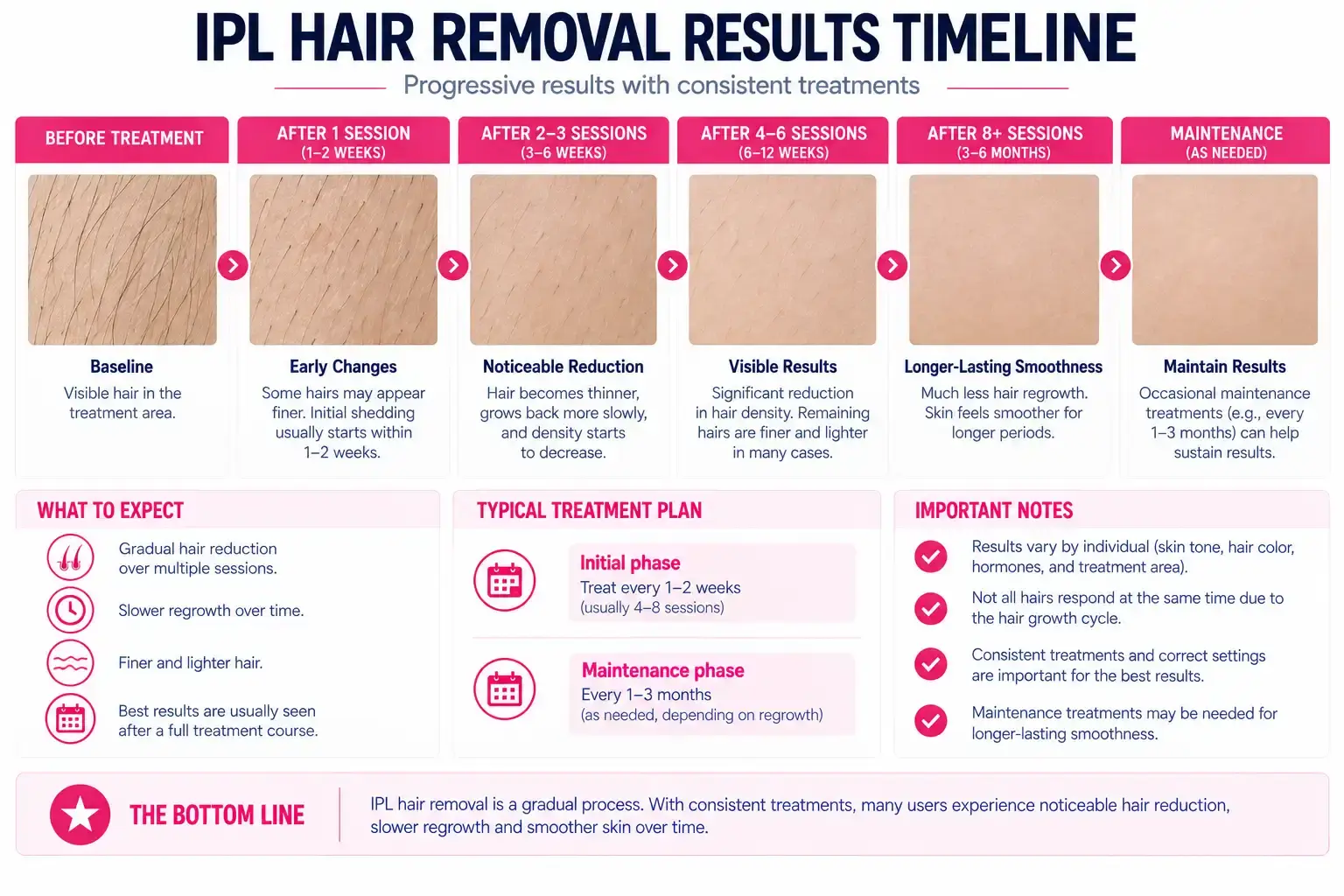
One of the easiest ways to understand IPL results is to look at them as a timeline. IPL does not remove every visible hair at the moment the flash is delivered. Instead, changes develop as treated hairs respond and additional follicles move through different stages of the hair-growth cycle.
| Stage | What You May Notice |
|---|---|
| Before IPL | Normal visible hair growth, density and regrowth pattern for the treatment area. |
| Immediately after treatment | Hair is usually still visible. Temporary redness, warmth or localized follicular response may occur. |
| Following days and weeks | Some effectively treated hairs may gradually shed or become less noticeable. |
| After several treatments | Slower regrowth, reduced density or patchier visible growth may become easier to observe. |
| After the initial treatment course | The overall degree of hair reduction can be assessed more meaningfully. |
| Long term | Some hair may return over time, and maintenance treatment may be appropriate for some users. |
This timeline is intentionally general. A specific IPL device may recommend a different treatment schedule, and individual responses should not be expected to follow an identical week-by-week pattern.
What Does Hair Look Like Before IPL Treatment?
Before beginning an IPL treatment course, it is useful to establish a realistic baseline. This makes it easier to judge changes later instead of relying only on memory.
Consider characteristics such as:
- How dense the visible hair appears
- How quickly it becomes noticeable after shaving
- Hair thickness
- Hair color
- Whether growth is uniform or naturally patchy
- The body area being treated
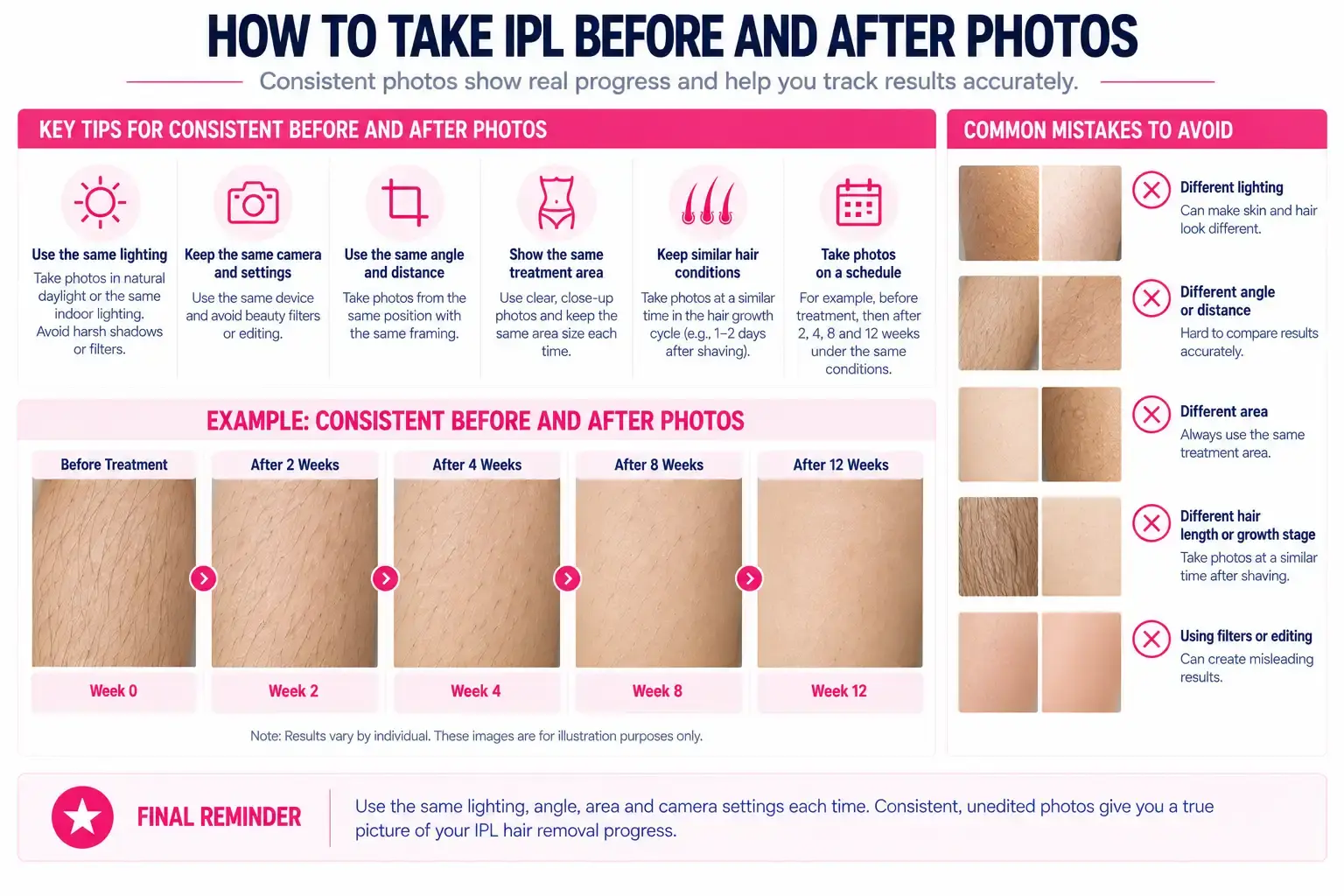
Taking consistent photographs before beginning treatment can make later comparison more meaningful. If you do this, try to use similar lighting, camera distance, angle, and approximately the same interval after shaving.
Otherwise, changes in lighting, camera exposure, skin preparation or hair length can make two photographs look dramatically different even when the actual change in hair density is relatively modest.
What Happens Immediately After IPL Hair Removal?
Immediately after IPL treatment, do not expect the treated hair to suddenly disappear.
IPL delivers optical energy that can be absorbed by melanin associated with pigmented hair. The resulting thermal effect is intended to influence follicular structures involved in future hair growth. This biological process is different from physically pulling or cutting the hair out of the skin.
Depending on the device, treatment parameters and individual response, the skin may also temporarily show:
- Mild redness
- Temporary warmth
- Mild sensitivity
- Localized swelling around some follicles
These possible skin responses should not be confused with the actual hair-reduction result. Significant pain, burns or blistering are also not signs that the treatment is simply “working better.”
For more information about treatment reactions and safety, see IPL Hair Removal Side Effects: Is IPL Safe? .
Does Hair Fall Out Immediately After IPL?
No. Hair does not normally need to fall out immediately for IPL treatment to have an effect.
Treated hairs may remain visible for a period after the session. Some may gradually shed as the skin and follicle progress through their normal processes.
This is an important expectation to establish because a user may look at the treatment area immediately after the first session, see hair still present, and incorrectly conclude that IPL did nothing.
IPL results are better evaluated over time and across an appropriate treatment series than by inspecting the area immediately after each flash.
What Happens During the First 1–2 Weeks After IPL?
During the period following treatment, some effectively treated hairs may begin to loosen, shed, or become less noticeable. However, not every hair in the treatment area will respond identically.
Some hairs may continue to appear as though they are growing before they eventually shed, while other hairs may remain because they were not in the most responsive stage of the hair-growth cycle at the time of treatment.
The exact timing varies, so the first or second week should not be treated as a universal deadline by which every treated hair must disappear.
What Results Can You Expect After the First IPL Treatment?
The first IPL treatment is generally too early to judge the final result.
You may notice some shedding or a change in the speed or pattern of visible regrowth, but a large proportion of follicles in the area may not have been in the same growth stage during the session.
After one treatment, it is therefore unrealistic to expect:
- Complete elimination of all visible hair
- A permanent result
- Identical reduction across the entire treatment area
- The same response as another person
A single-session result is only one point in a longer treatment process.
Why Can IPL Hair Growth Look Patchy After Treatment?
Patchier hair growth can become noticeable during a course of IPL treatment because individual follicles respond differently and are not synchronized in the same growth phase.
Some areas may therefore show obvious reduction earlier, while other areas still contain visible hair.
This does not automatically mean that the treatment was applied incorrectly. However, consistently untreated areas can also result from technique, incomplete coverage or device-use issues, so treatment should continue according to the appropriate protocol.
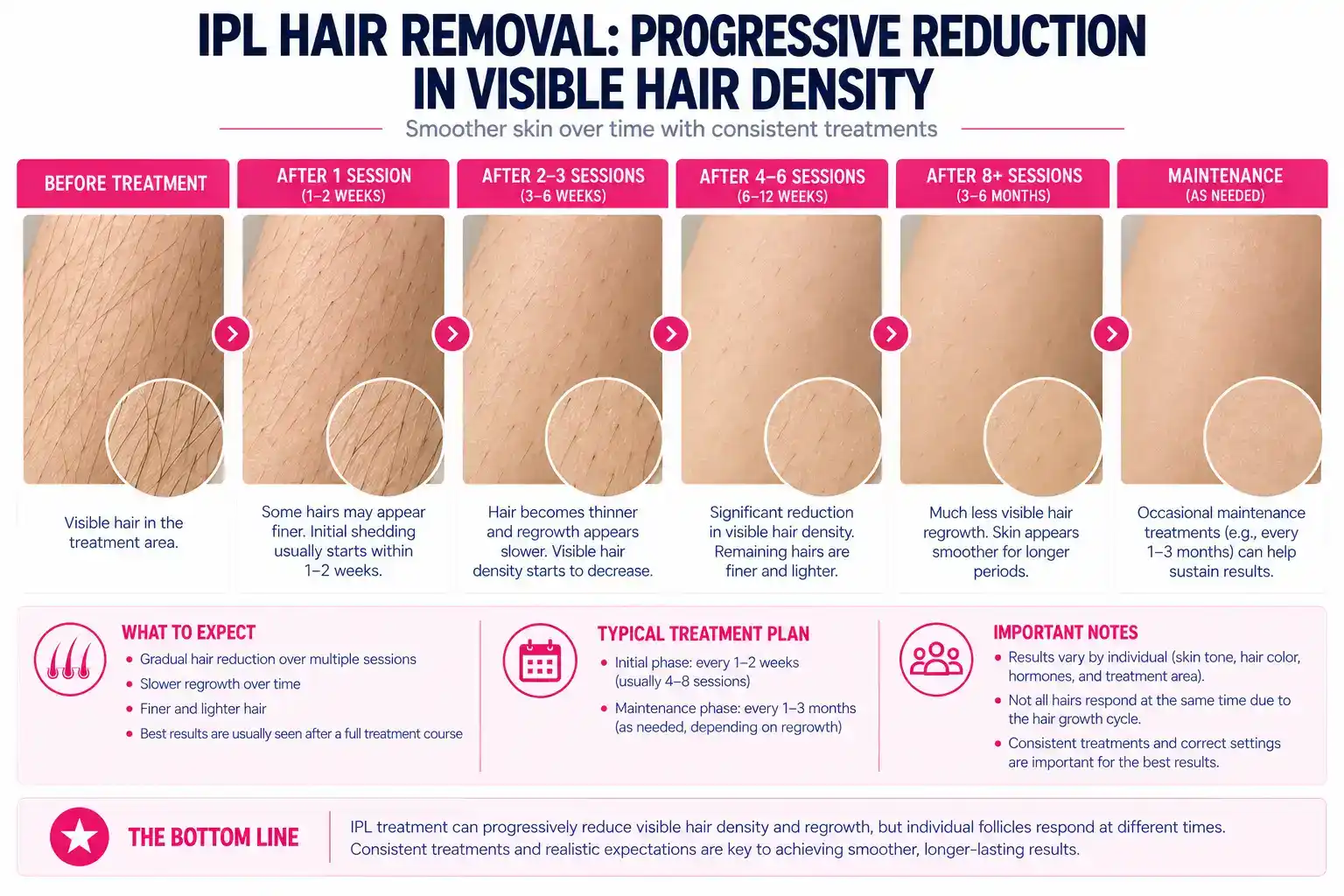
What Results Can You Expect After Several IPL Sessions?
Changes generally become easier to assess after repeated treatments because additional hairs have had opportunities to be treated as they move through their growth cycles.
Depending on individual response, users may begin to notice:
- Slower visible hair regrowth
- Fewer hairs in the treatment area
- Reduced overall hair density
- More patchy or sparse growth
- Finer or less noticeable regrowth
- Longer periods before hair becomes visually obvious
These changes are generally more meaningful indicators of progress than expecting a perfectly hair-free treatment area immediately after every session.
Why Does IPL Take Multiple Sessions to Show Results?
Hair-growth biology is one of the main reasons IPL results are progressive.
Individual follicles move through different stages commonly described as:
- Anagen — active growth
- Catagen — transition
- Telogen — resting phase
All follicles in a treatment area are not in the same stage simultaneously. Repeated treatments therefore provide additional opportunities to address hairs as their biological state changes.
This is why performing IPL much more frequently than recommended does not necessarily make results appear faster. Treatment intervals should follow the instructions for the specific device or the protocol established by the treating professional.
For a detailed explanation of treatment frequency, read How Often Should You Use IPL Hair Removal? .
IPL Results After 4 Weeks: What Should You Expect?
Four weeks is a common point at which users may start comparing their progress, but it should not be treated as a universal milestone.
Depending on the device schedule, treatment area and individual response, some users may notice slower or less dense regrowth by this stage. Others may still be early in their initial treatment course.
Rather than asking whether the area is completely hair-free after four weeks, look for broader changes such as:
- Does visible hair return more slowly?
- Is there less hair than at baseline?
- Are some areas becoming more sparse?
- Does the regrowth appear finer or less noticeable?
These comparisons are more useful than applying the same fixed percentage or timeline to every IPL user.
IPL Results After 8 Weeks: Should There Be a Difference?
After a longer period of consistent treatment, changes may become easier to recognize, particularly when compared with a properly documented baseline.
However, eight weeks still does not guarantee a particular degree of reduction. Treatment schedules differ between devices, and hair-growth patterns vary substantially between body areas and individuals.
If there appears to be little or no change despite correct and consistent use, it may be useful to review whether the hair color, skin tone, device compatibility, treatment technique and treatment schedule are appropriate rather than simply increasing energy or treatment frequency.
What Does a Successful IPL Before-and-After Result Look Like?
A successful IPL result does not necessarily mean perfectly hair-free skin.
A more realistic before-and-after comparison may show:
| Before IPL | After an Effective Treatment Course |
|---|---|
| Frequent visible regrowth | Slower visible regrowth |
| Higher hair density | Reduced hair density |
| More uniform visible growth | Growth may become sparser or patchier |
| Coarser visible hairs | Some regrowth may appear finer or less noticeable |
| Short interval before hair becomes noticeable | Longer interval before visible regrowth may occur |
The degree of change varies. Before-and-after images should therefore be interpreted as an example of one person’s response rather than a guarantee of what every IPL user will achieve.
Why Do IPL Before-and-After Results Vary Between People?
Two people using IPL for the same number of weeks can experience substantially different results because treatment response depends on multiple variables.
Important factors include:
- Hair pigmentation
- Hair thickness
- Skin pigmentation
- Body area
- Hair-growth cycle
- IPL device design
- Spectral filtering and pulse characteristics
- Treatment parameters
- Treatment consistency
- Technique and treatment coverage
- Age and individual biology
- Hormonal influences
The term IPL describes a broad technology category. It does not mean that every professional system or every home IPL device delivers identical optical output or produces identical results.
At-Home IPL vs Professional IPL: Will the Results Be the Same?
At-home and professional IPL systems use related light-based principles, but they should not be expected to produce identical before-and-after results.
Consumer IPL devices are designed around self-use, convenience, simplified controls and built-in safety features. Professional IPL platforms are intended for trained operators and may provide broader device-dependent control over parameters, filtering, pulse characteristics, treatment areas and cooling.
| Factor | At-Home IPL | Professional IPL |
|---|---|---|
| Intended user | Consumer | Trained professional |
| Treatment controls | Usually simplified | May provide broader device-dependent adjustment |
| Skin assessment | Based largely on manufacturer guidance and device features | Can include professional assessment before treatment |
| Treatment consistency | Depends heavily on correct and consistent self-use | Depends on professional protocol and operator technique |
| Results | Progressive and user-dependent | Progressive and treatment-dependent |
It would therefore be misleading to promise that every professional IPL system will produce a particular percentage of reduction or that every home device will follow the same results timeline.
If you are specifically comparing home hair-removal technologies, see our Best At-Home Laser Hair Removal Device: IPL vs Diode Explained guide.
Do IPL Results Differ by Body Area?
Yes. Hair characteristics vary considerably between different areas of the body, so IPL results should not automatically be expected to develop at the same rate everywhere.
Hair density, thickness, pigmentation, growth cycles and hormonal influences can differ between the legs, underarms, bikini area, face and other treatment areas.
IPL Results on the Legs
Leg hair can cover a relatively large treatment area. Progress may become noticeable as slower regrowth, lower density and increasingly sparse areas appear over repeated treatments.
When comparing before-and-after photographs of the legs, use approximately the same interval after shaving so differences in hair length do not exaggerate the apparent result.
IPL Results on the Underarms
Underarm hair is often visually easy to monitor because the treatment area is relatively compact. Changes in density and the time required for visible regrowth may become easier to compare during an appropriate treatment course.
IPL Results on the Bikini Area
Hair characteristics can vary within the bikini area itself, so reduction may not be perfectly uniform. Device-specific treatment-area restrictions should always be followed, particularly for consumer systems.
IPL Results on the Face
Facial hair deserves more cautious expectations. Hair growth in some facial areas can be strongly influenced by biological and hormonal factors, and not every IPL device is intended for every facial treatment area.
Follow the device manufacturer’s instructions regarding where on the face treatment is permitted. Unexpected or substantial changes in facial hair growth that raise a health concern may warrant appropriate medical evaluation.
Why Am I Not Seeing Results From IPL Hair Removal?
Seeing limited change after IPL does not automatically mean that the technology cannot work for you. However, several factors can contribute to weak or inconsistent results.
Common possibilities include:
- Expecting visible results too soon
- Using IPL inconsistently
- Hair containing too little melanin to provide an effective optical target
- Device and skin-tone incompatibility
- Using inappropriate treatment settings
- Incomplete coverage of the treatment area
- Stopping the initial treatment course too early
- Differences in hair-growth cycles
- Body-area differences
- Individual biological or hormonal influences
You May Be Judging the Result Too Early
IPL results are progressive. Looking for complete hair removal immediately after one or two sessions creates an unrealistic benchmark.
Your Hair Color May Be a Limiting Factor
Conventional IPL hair reduction relies substantially on melanin associated with pigmented hair. Very light blonde, white, gray and some red hair may therefore respond poorly because there is less melanin available as an optical target.
Your Treatment Schedule May Be Inconsistent
Frequently missing treatments during the initial course can reduce opportunities to address hairs as they move through different growth stages.
The solution is not to compensate by treating excessively often. Follow the schedule recommended for the particular device or professional protocol.
Your Treatment Coverage May Be Uneven
Inconsistent coverage can contribute to areas where visible hair remains comparatively dense. At the same time, excessive repeated overlap should not be used in an attempt to force faster results.
Should You Increase IPL Energy if You Are Not Seeing Results?
Do not assume that increasing IPL energy is automatically the correct response to slow results.
Treatment parameters must remain appropriate for the specific device, skin characteristics and treatment protocol. Increasing energy beyond suitable settings can increase unwanted thermal exposure without guaranteeing a better result.
If results appear limited, first review factors such as treatment consistency, device compatibility, hair pigmentation, coverage and whether enough time has passed to evaluate the treatment course.
For safety considerations related to excessive exposure, read IPL Hair Removal Side Effects: Is IPL Safe? .
Does Hair Grow Back After IPL?
Yes, some hair can become visible again after IPL. This does not necessarily mean that all treatment results have been lost.
Regrowth after an effective treatment course may appear:
- Less dense
- Slower
- Finer
- More scattered
- Less visually noticeable
Long-term regrowth varies between individuals, and some users may eventually benefit from maintenance treatments.
We cover this question in much greater detail in Is IPL Hair Removal Permanent? How Long Do Results Really Last? .
How Long Do IPL Hair Removal Results Last?
There is no universal duration for IPL results. How long reduced hair growth remains noticeable can depend on the treatment area, hair characteristics, treatment protocol, device, individual biology and whether maintenance treatments are performed.
This is another reason a before-and-after image taken immediately after an initial treatment course cannot tell you how that person’s result will look months or years later.
Long-term results should be evaluated separately from the short-term visual changes shown in typical before-and-after photography.
How to Take Reliable IPL Before-and-After Photos
If you want to track your own IPL results, standardized photographs are much more useful than casual images taken under different conditions.
Try to keep the following factors consistent:
- Camera and lens
- Camera distance
- Camera angle
- Lighting direction and intensity
- Background
- Body position
- Approximate time after shaving
- Image exposure and editing
Avoid changing lighting, applying heavy image processing or comparing freshly shaved skin with several days of hair growth. Those differences can create an exaggerated impression of treatment effectiveness.
How Should You Evaluate IPL Before-and-After Photos Online?
Before-and-after images can be useful, but they should not be interpreted as proof that every user will achieve the same outcome.
When evaluating IPL results online, ask:
- Were the photographs taken under similar lighting?
- Is the camera distance and angle comparable?
- Was the same interval after shaving used?
- How many treatments were performed?
- Over what period did treatment occur?
- Was a professional or at-home IPL system used?
- Was maintenance treatment performed?
- Are the images actual documented results or simply marketing illustrations?
A dramatic pair of photographs without information about timing, treatment protocol or imaging conditions provides much less useful evidence than a standardized treatment series.
Common IPL Before-and-After Misconceptions
“Hair Should Be Gone Immediately After IPL”
IPL is not a mechanical hair-removal method. Treated hairs may remain visible after the session and changes develop progressively.
“One Treatment Is Enough to Judge IPL”
One session cannot address every follicle under identical biological conditions. Results are more appropriately evaluated across a treatment course.
“Completely Hair-Free Skin Is the Only Successful Result”
Long-term hair reduction can also appear as fewer hairs, slower growth, lower density and finer regrowth.
“Everyone Should Have the Same Results After 8 Weeks”
Treatment schedules, hair-growth cycles, devices, body areas and individual responses differ. Eight weeks is not a universal clinical endpoint.
“A More Painful IPL Treatment Produces Better Results”
Greater discomfort is not proof of greater effectiveness. Significant pain or excessive thermal exposure can instead indicate a safety concern.
“Every Before-and-After Photo Is Directly Comparable”
Differences in shaving, lighting, angle, exposure and image processing can dramatically change the appearance of hair and skin.
What Are Realistic IPL Hair Removal Expectations?
The most realistic way to evaluate IPL is to look for progressive changes rather than immediate perfection.
| Unrealistic Expectation | More Realistic Expectation |
|---|---|
| All hair disappears after one session | Results develop over repeated treatments |
| Every follicle responds equally | Reduction can develop unevenly as hair cycles differ |
| Results are identical for everyone | Hair, skin, body area, device and biology influence response |
| More energy always means better results | Parameters should remain appropriate for the device and user |
| No hair will ever return | Some regrowth can occur and maintenance may be appropriate |
常见问题
How soon do you see results from IPL hair removal?
IPL results develop gradually. Some users may notice changes in shedding or regrowth during the weeks following treatment, but meaningful hair reduction is generally better evaluated across repeated sessions rather than immediately after the first treatment.
What happens after the first IPL treatment?
Hair will usually still be visible immediately afterward. Some treated hairs may later shed, while temporary skin responses such as mild redness or warmth can occur. One session is generally too early to judge the final hair-reduction result.
Does hair fall out after IPL?
Some effectively treated hairs may gradually shed after treatment. This does not necessarily happen immediately, and not every hair in the area will respond at the same time.
Why is my hair still growing after IPL?
Continued visible growth can occur because follicles are in different stages of the hair-growth cycle. Hair pigmentation, treatment consistency, device compatibility, treatment parameters and individual response can also influence results.
Does IPL make hair grow back thinner?
After an effective treatment course, some users may notice finer or less noticeable regrowth in addition to reduced density and slower visible growth. Individual responses vary.
How many IPL treatments before you see results?
There is no universal number that applies to every IPL system or every user. Treatment schedules differ, and meaningful progress should be evaluated over the appropriate course recommended for the specific device.
Why do my IPL results look patchy?
Follicles do not all respond at the same time because hair-growth cycles differ. Treatment coverage and technique can also influence whether some areas appear more reduced than others.
Are IPL before-and-after results permanent?
IPL is better described in terms of long-term hair reduction rather than guaranteed permanent elimination of every hair. Some regrowth can occur, and maintenance treatments may be appropriate for some users.
Final Verdict: What Should IPL Before and After Really Look Like?
Realistic IPL before-and-after results are progressive rather than immediate. The goal is not necessarily for every visible hair to disappear after the first treatment. Instead, successful treatment may gradually produce slower regrowth, fewer visible hairs, reduced density, sparser growth and finer or less noticeable hair.
The amount and speed of change depend on hair pigmentation, skin characteristics, body area, hair-growth cycles, treatment consistency, device design, treatment parameters and individual biology.
Before-and-after photographs are most useful when they are standardized and accompanied by information about treatment timing and protocol. Dramatic marketing images taken under different conditions should not be treated as a guarantee of individual results.
If you are planning an IPL treatment course, focus on changes in hair density, regrowth speed and visibility over time rather than expecting instant or identical results after every session.
Continue learning with our IPL Treatment Frequency Guide, IPL Permanent Hair Reduction Guide, and IPL Hair Removal Safety Guide.