HIFU and RF are two widely used energy-based technologies in modern aesthetic
medicine. Both are designed to improve skin quality and body contours,
but they work through different physical principles and target different
tissue layers.
Understanding the difference between HIFU and RF helps aesthetic clinics
select suitable treatment technologies and helps patients develop realistic
expectations about results.
Key Takeaways
HIFU and RF are both non-surgical aesthetic technologies but use different
energy mechanisms.
HIFU uses focused ultrasound energy, while RF uses electromagnetic radio
frequency energy.
HIFU generally targets deeper tissue layers, while RF mainly focuses on
controlled thermal effects in skin and connective tissues.
Both technologies may support skin tightening, but their treatment approaches
are different.
The best choice depends on treatment goals, target tissues, and clinical
requirements.
What Is HIFU?
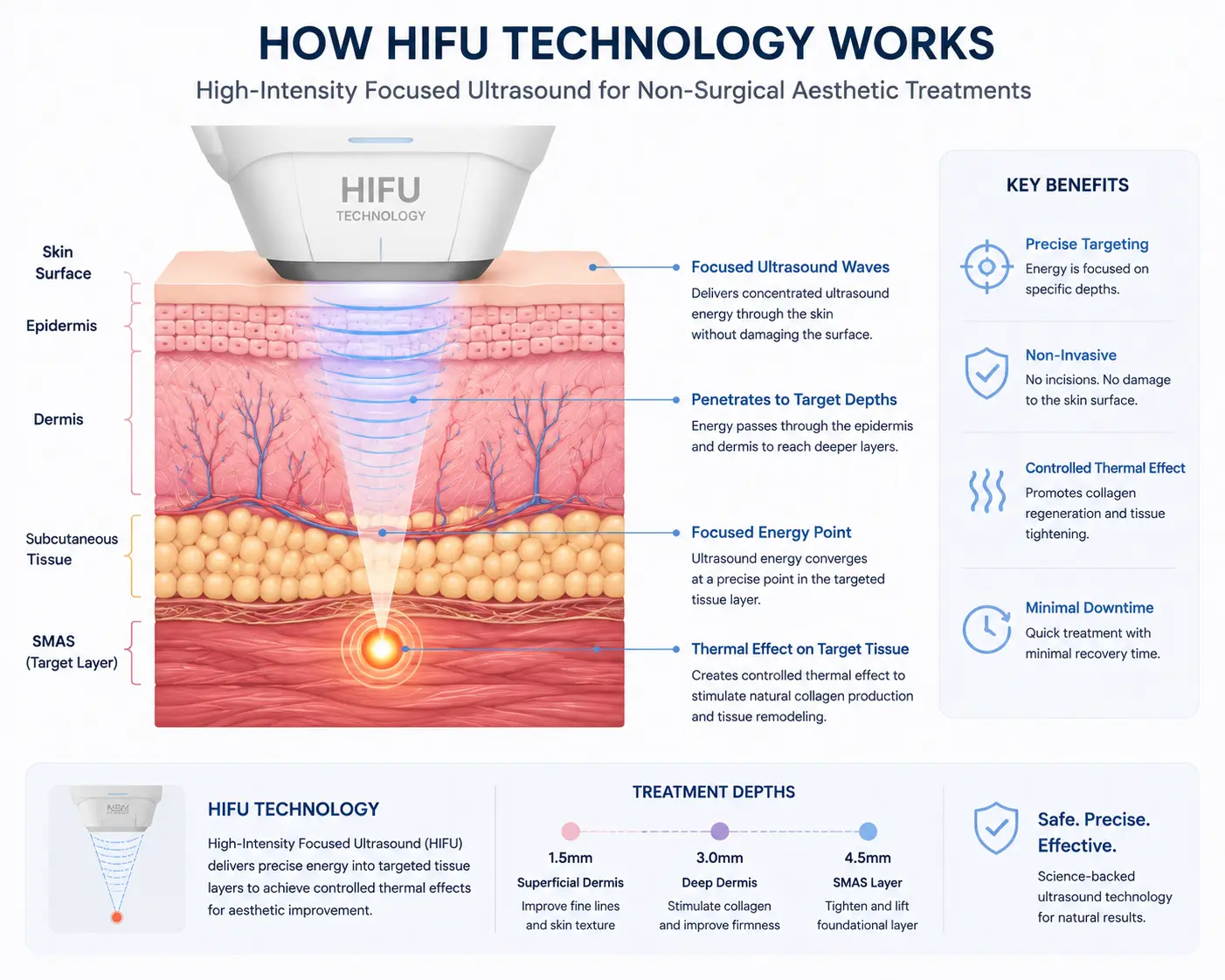
HIFU (High-Intensity Focused Ultrasound) is an energy-based aesthetic
technology that uses focused ultrasound waves to deliver controlled energy
into specific tissue layers.
Unlike traditional ultrasound imaging, aesthetic HIFU systems are designed
to create targeted thermal effects at selected depths, supporting tissue
remodeling processes.
HIFU technology delivers focused ultrasound energy into targeted tissue
layers for controlled thermal effects.
How HIFU Works
Focused ultrasound energy is delivered to selected depths.
Controlled thermal zones are created within targeted tissue.
The body responds through natural tissue remodeling processes.
Gradual improvement may occur over time depending on individual response.
Common HIFU Applications
Skin tightening
Facial lifting applications
Body contouring treatments
Non-surgical aesthetic procedures
What Is RF (Radio Frequency)?
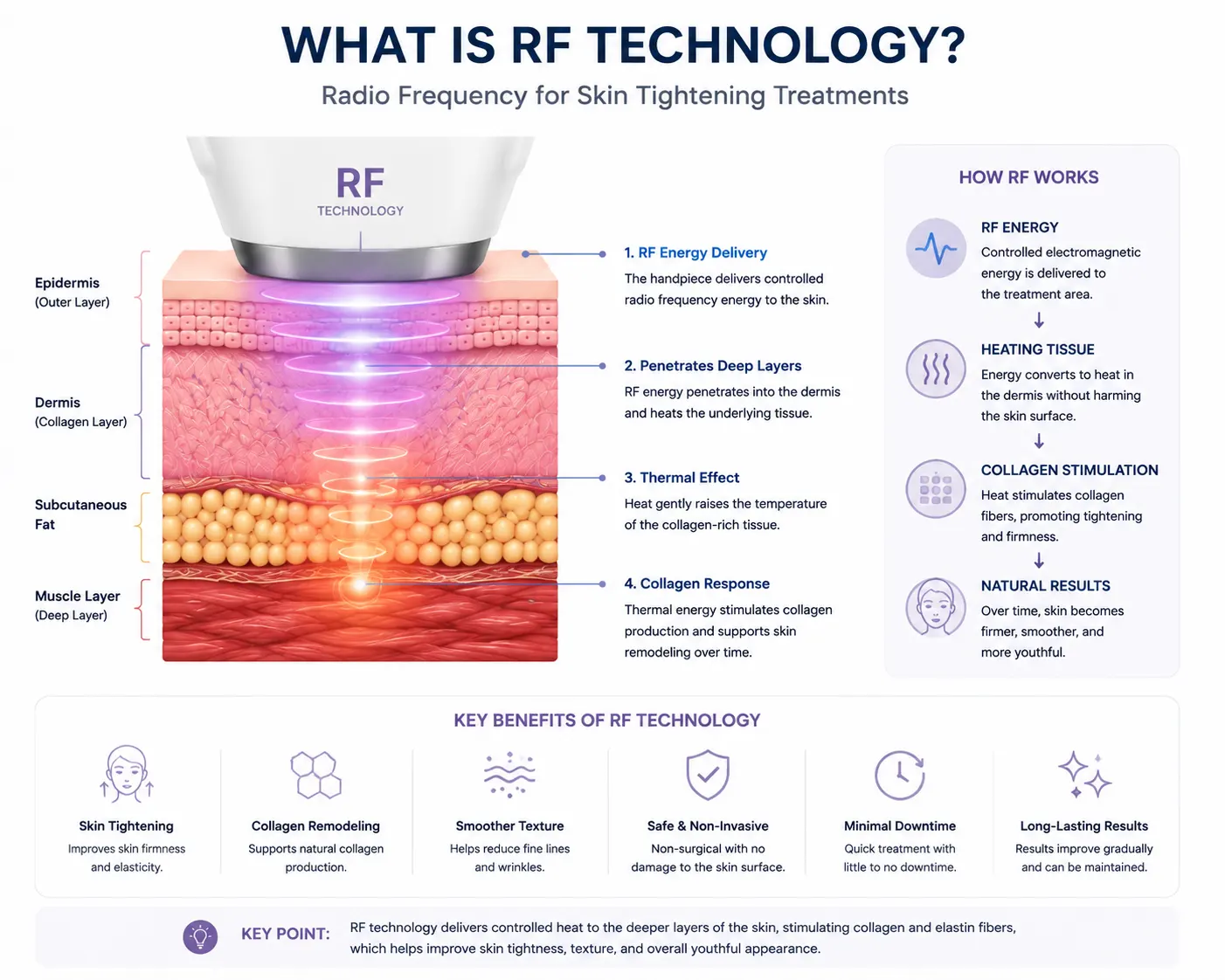
Radio Frequency (RF) is an energy-based aesthetic technology that uses
electromagnetic waves to generate controlled heat within targeted tissues.
RF treatments are commonly associated with skin tightening because thermal
stimulation may support collagen-related tissue responses.
RF technology uses controlled electromagnetic energy to create thermal
effects that support skin firmness.
How RF Works
Radio frequency energy penetrates targeted tissues.
Controlled heating stimulates tissue responses.
Collagen-related remodeling processes may improve skin firmness.
Treatment results develop progressively.
Common RF Applications
Skin tightening
Body contouring
Skin texture improvement
Aesthetic rejuvenation treatments
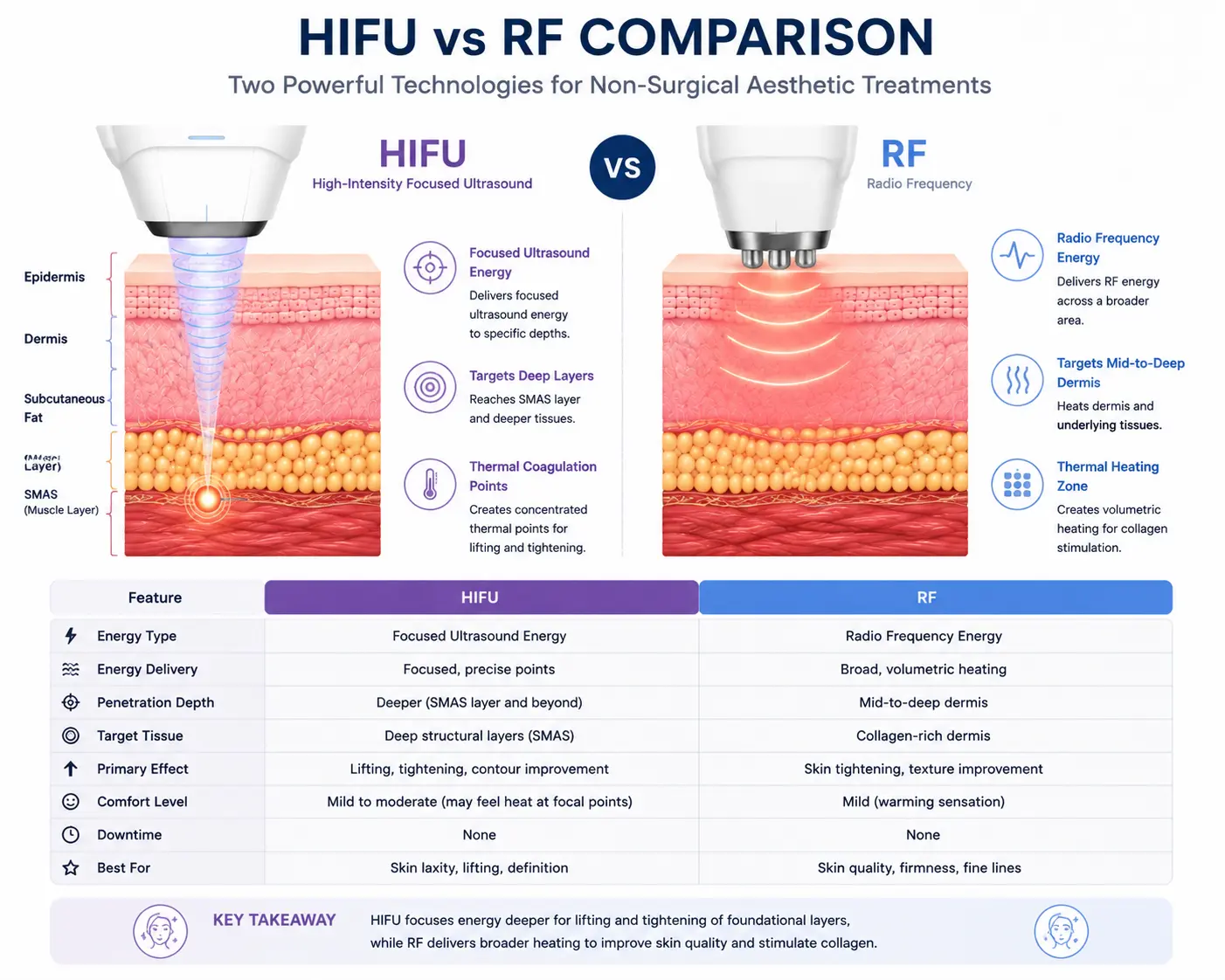
HIFU vs RF: Key Technology Comparison
Although HIFU and RF are both energy-based aesthetic technologies, they
differ significantly in energy type, treatment depth, mechanism, and primary
applications.
The right choice depends on the specific treatment goal, target tissue,
and clinical protocol rather than simply choosing one technology over another.
Feature
HIFU
RF
Full Name
High-Intensity Focused Ultrasound
Radio Frequency Technology
Energy Type
Focused ultrasound waves
Electromagnetic radio frequency waves
Primary Effect
Controlled thermal effects at targeted depths
Controlled heating within tissues
Main Target
Deep tissue layers and selected treatment depths
Skin and connective tissue
Main Purpose
Tissue remodeling and tightening
Skin firmness and collagen-related improvement
Common Applications
Skin lifting, tightening, body contouring
Skin tightening, texture improvement, body contouring
Treatment Sensation
May feel focused energy delivery depending on settings
Usually experienced as controlled warmth
Adds Volume?
No
No
HIFU and RF use different energy mechanisms and target different tissue
responses in aesthetic applications.
HIFU vs RF: Difference in Treatment Depth
One of the biggest differences between HIFU and RF is how energy is delivered
into tissue.
HIFU Treatment Depth
HIFU systems deliver focused ultrasound energy to specific depths beneath
the skin. The energy converges at targeted points to create controlled
thermal effects.
Because HIFU energy can be focused at selected depths, it is commonly
discussed for applications involving deeper tissue remodeling.
RF Treatment Depth
RF technology generates heat through electromagnetic energy. The distribution
of energy depends on the RF system design, frequency, electrode configuration,
and treatment parameters.
RF is widely used for applications related to skin firmness and collagen-supporting
treatments.
HIFU vs RF for Skin Tightening
Both HIFU and RF are commonly associated with skin tightening, but they
achieve this through different mechanisms.
Category
HIFU
RF
Main Mechanism
Focused ultrasound thermal stimulation
Radio frequency thermal stimulation
Primary Focus
Targeted tissue remodeling
Skin heating and collagen-related responses
Treatment Style
Precise energy delivery
Broad-area thermal treatment
Common Uses
Lifting and tightening applications
Firmness and skin quality improvement
Neither technology is universally better. The appropriate choice depends
on the patient's concerns, treatment area, device capabilities, and professional
assessment.
HIFU vs RF for Body Contouring
In body contouring applications, HIFU and RF may both be used as part
of non-surgical aesthetic treatment plans. However, their roles are different.
Concern
HIFU Approach
RF Approach
Loose Skin
Supports tissue remodeling and tightening
Supports skin firmness through thermal stimulation
Skin Quality
May improve overall tissue appearance
Commonly used for collagen-related skin improvement
Body Contour
Used in selected body tightening applications
Used for skin tightening and contour support
Fat Reduction
Not primarily designed for fat removal
Not primarily designed for fat removal
Important:
HIFU and RF are not fat-loss replacements. Their main roles in body contouring
are related to tissue quality, firmness, and aesthetic enhancement.
Can HIFU and RF Be Combined?
Yes. In modern aesthetic practices, HIFU and RF technologies may be used
together as part of a comprehensive treatment strategy because they work
through different energy mechanisms.
While HIFU focuses on delivering concentrated ultrasound energy to selected
tissue depths, RF uses electromagnetic energy to create controlled thermal
effects. Combining different technologies allows clinics to address multiple
aspects of tissue quality and body contour improvement.
Potential Advantages of Combining HIFU and RF
Addresses different tissue characteristics through different energy mechanisms.
Provides more flexible treatment planning.
Allows clinics to design customized aesthetic protocols.
May improve overall treatment versatility.
Clinical Note:
Combination treatments should be based on professional assessment, appropriate
device indications, and established treatment protocols.
Which Is Better: HIFU or RF?
There is no universal answer to whether HIFU or RF is better. Both technologies
have different strengths and are designed for different aesthetic objectives.
The better option depends on several factors:
The treatment area.
The patient's aesthetic goals.
The target tissue.
The device specifications.
The professional treatment plan.
Treatment Goal
Technology Often Considered
Deep tissue tightening applications
HIFU technology
Skin firmness improvement
RF technology
Comprehensive body contouring programs
Combination approaches
Multi-functional clinic services
Platforms integrating multiple technologies
For professional clinics, the question is usually not "HIFU or RF?" but
rather "Which technology combination best matches the treatment services
we want to provide?"
HIFU vs RF: Advantages and Limitations
Technology
Advantages
Limitations
HIFU
Precise energy targeting
Suitable for selected deeper tissue applications
Non-invasive approach
Does not add volume
Results depend on individual response
RF
Suitable for skin firmness applications
Comfortable thermal treatment experience
Widely used in aesthetic clinics
Does not change skeletal structure
Not a replacement for fat reduction procedures
How Clinics Choose Between HIFU and RF Equipment?
For aesthetic clinics, selecting between HIFU and RF equipment involves
evaluating more than just the technology name. Equipment should match the
clinic's service positioning, patient needs, and business objectives.
1. Treatment Portfolio
Clinics should first determine which treatments they want to provide.
A clinic focused on lifting and tightening may prioritize HIFU technology,
while clinics emphasizing skin quality improvement may consider RF systems.
2. Technology Integration
Modern aesthetic equipment increasingly combines multiple technologies
to provide broader treatment options.
3. Patient Experience
Factors such as treatment comfort, workflow efficiency, and device usability
are important considerations for long-term clinical operation.
4. Manufacturer Support
For professional buyers, technical support, training, maintenance, and
OEM cooperation are important factors when selecting aesthetic equipment.
AI 360 HIFU: Combining Multiple Body Contouring Technologies
As aesthetic clinics increasingly look for versatile treatment platforms,
multifunctional systems that integrate different technologies are becoming
an important trend.
AI 360 HIFU combines HIFU, RF, and EMS technologies into one professional
aesthetic platform, allowing clinics to provide more comprehensive body
contouring treatment options.
Technology
Function
HIFU
Focused ultrasound energy for tissue remodeling applications
RF
Controlled thermal energy for skin firmness support
EMS
Electrical muscle stimulation for body conditioning programs
For clinics and distributors, multifunctional platforms provide flexibility
by supporting different treatment goals through one integrated system.
Learn More About AI 360 HIFU
Frequently Asked Questions
What is the main difference between HIFU and RF?
The main difference is the type of energy used. HIFU uses focused ultrasound
energy to create targeted thermal effects at selected depths, while RF
uses electromagnetic energy to generate controlled heat within tissues.
Is HIFU better than RF?
Neither technology is universally better. HIFU and RF are designed for
different purposes, and the most suitable option depends on treatment goals,
target tissues, device specifications, and professional assessment.
Can HIFU and RF be used together?
Yes. HIFU and RF may be combined in some aesthetic treatment strategies
because they use different energy mechanisms and can address different
aspects of tissue improvement.
Which is better for skin tightening, HIFU or RF?
Both HIFU and RF can be used for skin tightening applications. HIFU focuses
on targeted ultrasound energy delivery, while RF focuses on controlled
thermal stimulation and collagen-related tissue responses.
Does HIFU remove fat?
HIFU is not primarily designed as a fat removal technology. Its main applications
are related to tissue remodeling and tightening depending on the device
and treatment protocol.
Does RF tighten loose skin?
RF technology is commonly used in aesthetic treatments focused on skin
firmness because controlled thermal energy may support collagen-related
remodeling processes.
Which technology is better for body contouring, HIFU or RF?
The best technology depends on the specific body contouring goal. HIFU
and RF may both be used in body contouring programs, but they address different
tissue responses.
Should clinics choose HIFU or RF equipment?
Clinics should evaluate treatment goals, patient needs, device capabilities,
technology integration, training support, and manufacturer reliability
before selecting equipment.
References
U.S. Food & Drug Administration (FDA). Information about aesthetic devices
and energy-based technologies.
American Academy of Dermatology (AAD). Cosmetic dermatology and skin rejuvenation
resources.
American Society for Dermatologic Surgery (ASDS). Non-invasive aesthetic
treatment information.
Scientific publications discussing ultrasound technology, radio frequency
energy, and aesthetic tissue remodeling.