Modern hair reduction treatments use different laser technologies, including
diode laser, Alexandrite laser, and Nd:YAG laser systems. Although all
technologies work based on selective photothermolysis, they differ in wavelength,
penetration depth, skin type suitability, and clinical applications.
Understanding the differences between hair reduction laser technologies
helps aesthetic clinics choose suitable equipment and helps practitioners
design effective treatment strategies.
Key Takeaways
Different laser wavelengths create different treatment characteristics.
Diode lasers are widely used because of their balance between penetration
depth and versatility.
Alexandrite lasers are commonly associated with shorter wavelengths and
specific skin type applications.
Nd:YAG lasers use longer wavelengths that can provide deeper penetration.
The best technology depends on skin type, hair characteristics, and clinical
goals.
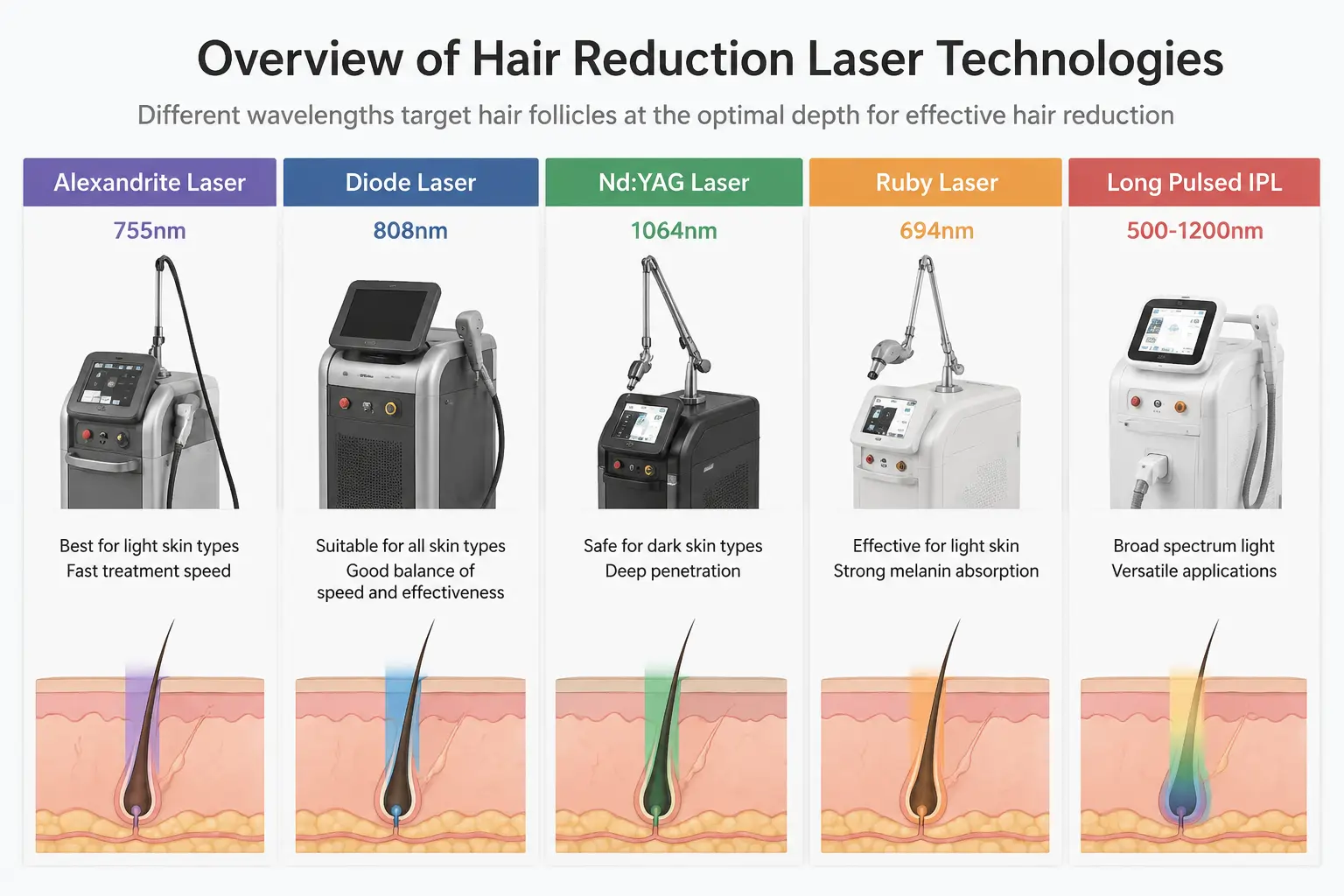
Overview of Hair Reduction Laser Technologies
Laser hair reduction technologies work by delivering controlled light
energy into hair follicles. The target is melanin within the hair structure,
which absorbs laser energy and converts it into heat.
Different laser systems use different wavelengths. The wavelength determines
how deeply energy penetrates into the skin and how it interacts with surrounding
tissues.
Different laser technologies use different wavelengths to target hair
follicles for professional hair reduction treatments.
How Do Hair Reduction Laser Technologies Work?
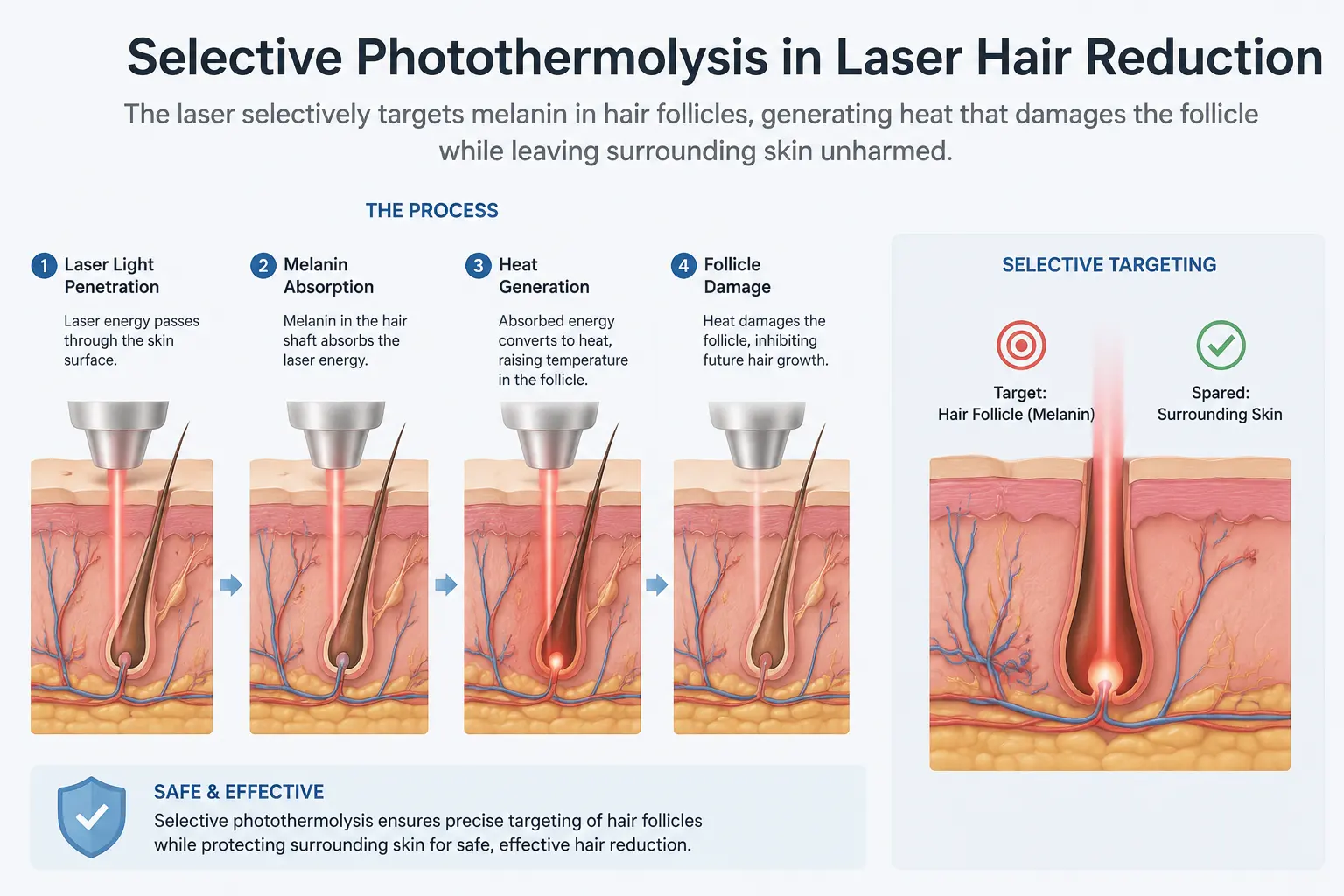
Most professional laser hair reduction systems are based on the principle
of selective photothermolysis.
Selective photothermolysis means that specific wavelengths of light are
selected to target a specific chromophore, while minimizing damage to surrounding
tissue.
Component
Role
Laser Wavelength
Determines energy penetration and absorption characteristics
Melanin in Hair Follicle
Absorbs laser energy
Thermal Effect
Creates controlled follicle-targeting heat
Laser hair reduction uses selective photothermolysis to target hair follicles
through controlled light absorption.
Diode Laser Technology for Hair Reduction
Diode laser technology is one of the most widely used laser systems in
professional hair reduction treatments. It uses semiconductor laser technology
to generate specific wavelengths of light designed for targeting hair follicles.
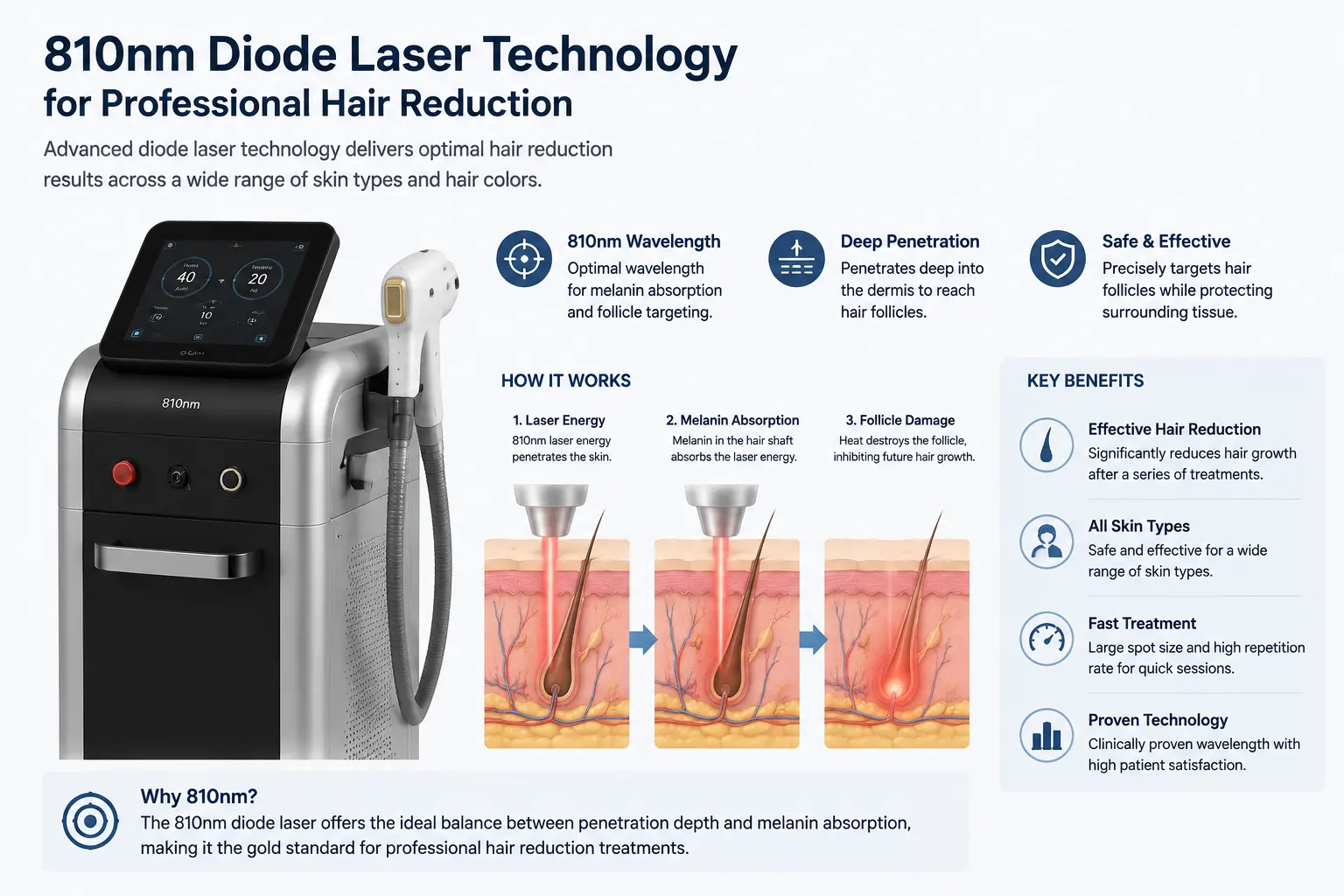
Among professional hair reduction systems, the 810nm diode laser wavelength
is commonly used because it provides a balance between melanin absorption
and deeper skin penetration.
Diode Laser Technology for Hair Reduction
Diode laser technology is one of the most widely used laser systems in
professional hair reduction treatments. It uses semiconductor laser technology
to generate specific wavelengths of light designed for targeting hair follicles.
Among professional hair reduction systems, the 810nm diode laser wavelength
is commonly used because it provides a balance between melanin absorption
and deeper skin penetration.
810nm diode laser technology is widely used in professional hair reduction
systems because of its balance between penetration depth and treatment
versatility.
Why Is 810nm Diode Laser Popular for Hair Reduction?
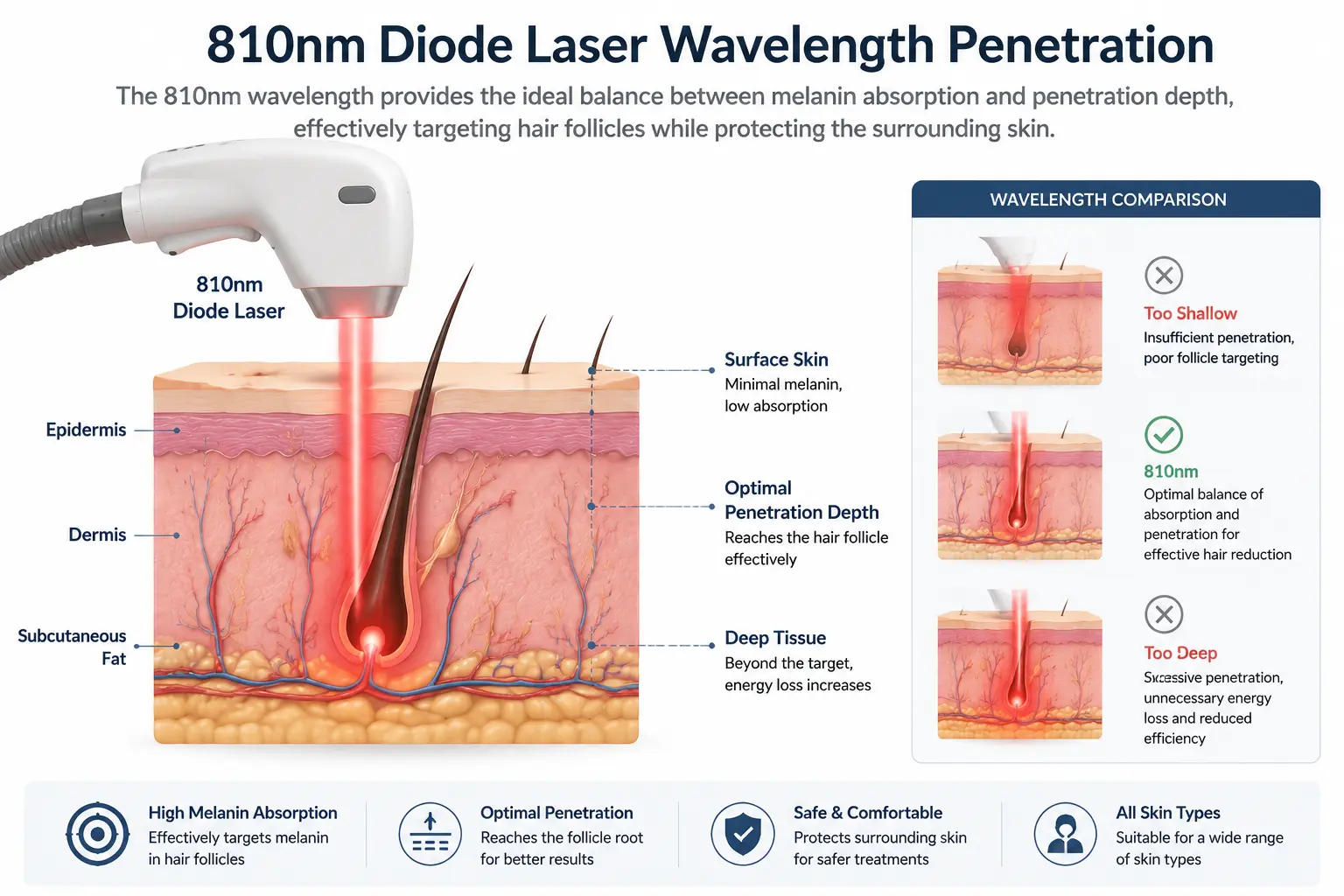
The 810nm wavelength is often considered a versatile option for professional
hair reduction because it provides a practical balance between penetration
depth and melanin absorption.
Suitable for a wide range of professional hair reduction applications.
Provides deeper penetration compared with shorter wavelengths.
Offers effective energy delivery to hair follicles.
Commonly integrated into professional clinic systems.
The 810nm diode laser wavelength provides a balance between energy absorption
and penetration depth.
Advantages of Diode Laser Hair Reduction Technology
Advantage
Explanation
Versatility
Suitable for many professional hair reduction applications.
Efficient Energy Delivery
Designed to deliver controlled laser pulses to hair follicles.
The Role of Diode Laser in Hair Reduction Technology
Compared with other laser wavelengths, diode laser technology occupies
an important position because it provides a balance between performance,
versatility, and clinical usability.
However, no single wavelength is universally suitable for every situation.
Professional selection depends on factors including skin type, hair characteristics,
treatment area, and device configuration.
How Clinics Choose a Professional Diode Laser Machine
For aesthetic clinics, selecting a diode laser system involves evaluating
more than wavelength alone.
Important Considerations
Laser output stability.
Cooling system performance.
Handpiece design and ergonomics.
Treatment parameter flexibility.
Manufacturer technical support.
A reliable diode laser platform should provide consistent energy delivery,
patient comfort, and operational efficiency for professional treatment
environments.
Alexandrite Laser Technology for Hair Reduction
Alexandrite laser technology is another widely recognized laser system
used in professional hair reduction treatments. It typically operates at
a 755nm wavelength, which has strong absorption characteristics for melanin.
Because of its wavelength characteristics, Alexandrite laser systems are
commonly considered for specific hair and skin type applications where
effective melanin targeting is desired.
How Does Alexandrite Laser Hair Reduction Work?
Alexandrite lasers emit light at approximately 755nm. This wavelength
is strongly absorbed by melanin, allowing laser energy to be delivered
efficiently to pigmented hair structures.
Similar to other hair reduction technologies, Alexandrite laser systems
rely on selective photothermolysis, where specific light energy targets
the hair follicle while attempting to minimize surrounding tissue effects.
Process
Description
755nm Laser Emission
Alexandrite crystal generates the laser wavelength.
Melanin Absorption
Hair pigment absorbs laser energy efficiently.
Thermal Conversion
Light energy converts into controlled heat.
Hair Follicle Targeting
Thermal effects affect follicle structures.
Characteristics of 755nm Alexandrite Laser
The 755nm wavelength has a shorter wavelength compared with diode and
Nd:YAG lasers. This creates different energy absorption and penetration
characteristics.
Characteristic
755nm Alexandrite Laser
Wavelength
Approximately 755nm
Melanin Absorption
High melanin absorption characteristics
Penetration Depth
Generally shallower compared with longer wavelengths
Common Application
Professional hair reduction treatments for suitable candidates
Advantages of Alexandrite Laser Technology
Strong absorption by melanin due to shorter wavelength characteristics.
Commonly used for professional hair reduction treatments.
Fast treatment capability on larger areas with suitable systems.
Well-established technology with extensive clinical history.
Considerations and Limitations of Alexandrite Laser
Although Alexandrite laser technology provides effective melanin targeting,
wavelength selection should always consider skin type, pigmentation level,
and treatment parameters.
Not every skin type is suitable for the same wavelength settings.
Professional assessment is important before treatment selection.
Alexandrite Laser vs Diode Laser
Both Alexandrite and diode lasers are widely used for hair reduction,
but their wavelength characteristics create different treatment profiles.
Feature
Alexandrite Laser
Diode Laser
Wavelength
755nm
Commonly 810nm
Melanin Absorption
Higher
Balanced
Penetration Depth
Relatively shallower
Deeper penetration
Common Strength
Efficient pigment targeting
Versatility across applications
The appropriate choice depends on skin type, hair characteristics, treatment
area, and professional device selection.
Nd:YAG Laser Technology for Hair Reduction
Nd:YAG laser technology is another important laser system used in professional
hair reduction treatments. It typically operates at a wavelength of 1064nm,
which provides deeper penetration characteristics compared with shorter
wavelengths.
Because of its longer wavelength, Nd:YAG laser systems are often considered
for applications where deeper energy delivery and reduced superficial melanin
absorption are important factors.
How Does Nd:YAG Laser Hair Reduction Work?
Nd:YAG lasers emit light at approximately 1064nm. Compared with shorter
wavelengths, this longer wavelength penetrates deeper into tissue while
having lower absorption by epidermal melanin.
Like other laser hair reduction technologies, Nd:YAG systems use selective
photothermolysis to deliver controlled energy toward hair follicles.
Process
Description
1064nm Laser Emission
Nd:YAG crystal generates long wavelength laser energy.
Energy Penetration
Laser energy reaches deeper tissue layers.
Target Absorption
Hair pigment absorbs part of the delivered energy.
Thermal Effect
Controlled heat affects hair follicle structures.
Characteristics of 1064nm Nd:YAG Laser
Characteristic
Nd:YAG Laser
Wavelength
1064nm
Penetration Depth
Deeper penetration compared with shorter wavelengths
Melanin Absorption
Lower epidermal melanin absorption compared with shorter wavelengths
Common Application
Professional hair reduction treatments requiring longer wavelength characteristics
Advantages of Nd:YAG Laser Technology
Longer wavelength provides deeper penetration.
Lower superficial melanin absorption characteristics compared with shorter
wavelengths.
Commonly considered for professional applications requiring deeper energy
delivery.
Established laser technology with extensive clinical experience.
Considerations When Using Nd:YAG Laser
Although Nd:YAG technology provides unique wavelength characteristics,
treatment results depend on many factors including hair type, treatment
parameters, device quality, and professional operation.
Lower melanin absorption may require different energy strategies.
Treatment parameters must be optimized according to individual conditions.
Professional assessment remains important for technology selection.
Nd:YAG Laser vs Diode Laser
Feature
Nd:YAG Laser
Diode Laser
Wavelength
1064nm
Commonly 810nm
Penetration
Deeper penetration
Moderate to deep penetration
Energy Absorption
Lower melanin absorption
Balanced melanin absorption
Typical Strength
Long wavelength applications
Versatile professional hair reduction
Diode vs Alexandrite vs Nd:YAG Laser: Complete Comparison
Each hair reduction laser technology has different wavelength characteristics.
The best choice depends on skin type, hair characteristics, treatment goals,
and clinical requirements.
Feature
Alexandrite Laser
Diode Laser
Nd:YAG Laser
Wavelength
755nm
810nm
1064nm
Laser Type
Alexandrite crystal laser
Semiconductor diode laser
Nd:YAG crystal laser
Melanin Absorption
Higher
Balanced
Lower
Penetration Depth
Shallower
Moderate to deep
Deep
Main Advantage
Efficient pigment targeting
Versatility and broad applications
Long wavelength characteristics
Common Consideration
Skin type suitability
Parameter optimization
Energy adjustment
Diode vs Alexandrite vs Nd:YAG Laser: Complete Comparison
Each hair reduction laser technology has different wavelength characteristics.
The best choice depends on skin type, hair characteristics, treatment goals,
and clinical requirements.
Feature
Alexandrite Laser
Diode Laser
Nd:YAG Laser
Wavelength
755nm
810nm
1064nm
Laser Type
Alexandrite crystal laser
Semiconductor diode laser
Nd:YAG crystal laser
Melanin Absorption
Higher
Balanced
Lower
Penetration Depth
Shallower
Moderate to deep
Deep
Main Advantage
Efficient pigment targeting
Versatility and broad applications
Long wavelength characteristics
Common Consideration
Skin type suitability
Parameter optimization
Energy adjustment
Laser Hair Reduction Selection Based on Skin Type
Skin type is an important factor when selecting hair reduction laser technology
because different wavelengths interact differently with melanin in the
skin and hair.
Professional practitioners typically consider the Fitzpatrick skin type
classification when evaluating suitable laser approaches.
Skin Consideration
Technology Consideration
Lower pigmentation levels
Shorter wavelength systems may be considered depending on hair characteristics.
Medium skin tones
Diode laser is often considered because of its balanced characteristics.
Higher pigmentation levels
Longer wavelength systems may be considered due to deeper penetration
characteristics.
Important:
Final technology selection should always be based on professional assessment,
device specifications, and appropriate treatment protocols.
How Clinics Choose a Professional Hair Reduction Machine
For aesthetic clinics and distributors, selecting a professional hair
reduction machine requires evaluating technology, reliability, patient
experience, and business requirements.
1. Wavelength Configuration
The wavelength determines important characteristics such as energy penetration
and interaction with melanin. Clinics should select systems that match
their target customer base.
2. Cooling Technology
Efficient cooling systems are essential for improving patient comfort
and supporting safe treatment workflows.
3. Energy Stability
Consistent laser output is important for professional treatment environments
that require reliable performance.
4. Handpiece Design
Ergonomic handpieces and suitable spot sizes can improve treatment efficiency,
especially for larger treatment areas.
5. Manufacturer Support
For international buyers, technical support, training, spare parts availability,
and OEM capability are important considerations.
Multi-Wavelength Laser Systems for Hair Reduction
As aesthetic clinics serve increasingly diverse patient populations, multi-wavelength
laser systems have become an important trend in professional hair reduction
equipment.
By combining different wavelengths in one platform, clinics can achieve
greater flexibility when designing treatment protocols.
Advantages of Multi-Wavelength Platforms
Support different skin and hair characteristics.
Provide broader treatment options.
Improve clinic service flexibility.
Reduce the need for multiple separate devices.
Cocoon Hair Reduction Laser Solutions
Cocoon Laser provides professional aesthetic laser solutions designed
for clinics, distributors, and OEM partners worldwide.
Our hair reduction systems focus on reliable energy delivery, advanced
cooling technology, and professional treatment flexibility.
Professional Hair Reduction Platform Features
Advanced diode laser technology.
Stable laser output.
Professional cooling systems.
Ergonomic treatment handpieces.
OEM and distributor support.
For clinics looking to expand their laser hair reduction services, selecting
the right technology platform is essential for long-term success.
Explore Hair Reduction Solutions
Conclusion: Choosing the Right Hair Reduction Laser Technology
Hair reduction laser technology has evolved into multiple specialized
systems, including diode laser, Alexandrite laser, and Nd:YAG laser technologies.
Each wavelength provides different energy characteristics, penetration
depth, and clinical applications.
Diode lasers are widely used because of their balanced performance and
versatility. Alexandrite lasers provide strong melanin absorption characteristics,
while Nd:YAG lasers offer longer wavelength properties and deeper penetration.
There is no single laser technology that is suitable for every patient
or every clinic. The optimal choice depends on skin type, hair characteristics,
treatment goals, device configuration, and professional assessment.
For aesthetic clinics and distributors, selecting a reliable hair reduction
laser platform requires evaluating technology capability, treatment flexibility,
cooling performance, manufacturer support, and long-term business needs.
Frequently Asked Questions
What are the main types of hair reduction laser technologies?
The main professional hair reduction laser technologies include diode
laser, Alexandrite laser, and Nd:YAG laser. Each uses different wavelengths
with unique energy characteristics.
Which laser technology is best for hair reduction?
There is no universally best laser technology. The most suitable option
depends on skin type, hair characteristics, treatment area, and clinical
objectives.
What is the difference between diode laser and Alexandrite laser?
Diode lasers commonly use an 810nm wavelength and provide balanced penetration
characteristics, while Alexandrite lasers typically use a 755nm wavelength
with stronger melanin absorption.
What is the difference between diode laser and Nd:YAG laser?
Diode lasers commonly operate around 810nm, while Nd:YAG lasers use a
longer 1064nm wavelength with deeper penetration characteristics.
Why is 810nm diode laser popular for hair reduction?
The 810nm diode laser wavelength is widely used because it provides a
balance between melanin absorption and penetration depth, making it suitable
for many professional applications.
Is Alexandrite laser better than diode laser?
Alexandrite and diode lasers have different advantages. Alexandrite provides
strong melanin absorption, while diode laser offers versatility across
many treatment applications.
Is Nd:YAG laser suitable for hair reduction?
Nd:YAG laser technology is used in professional hair reduction treatments
and provides longer wavelength characteristics with deeper penetration.
How do clinics choose a professional hair reduction machine?
Clinics should evaluate wavelength configuration, cooling system, energy
stability, handpiece design, manufacturer support, and treatment requirements.
What is a multi-wavelength hair reduction laser?
A multi-wavelength laser combines different laser technologies into one
platform, allowing clinics to provide more flexible treatment options for
different patient needs.